I. INTRODUCTION
The needs of aspherical optical lenses have been increased because of their extensive usage in photonic applications. One of the most attractive applications of infrared aspheric lenses is for the infrared thermographic camera. Aspheric lenses lead to superior optical performance such as reduction of optical aberrations. Furthermore, due to its widespread applications and merits, the companies like Umicore and Lightpath are successfully commercializing molded chalcogenide glasses for last ten years. The conventional techniques for manufacturing aspheric lenses for infrared optics are the single point diamond turning and polishing methods, which can be applied to crystalline materials such as Ge and ZnSe etc. However, the main drawback of these methods is time-consuming process and difficulty in mass production with high accuracy. Therefore, the use of precision glass molding (PGM) method has recently became more attractive to fabricate aspheric glass lens in infrared optics since it is simple and cost effective which can lead to the mass production.Reference Cha, Kim, Hwang, Jeong and Kim1,Reference Cha, Kim, Park, Hwang, Kim, Hong and Lee2 In case of amorphous materials for infrared optical lenses, the ternary Ge–Sb–Se glass systems have attracted researchers' attention since these materials have a unique optical transmittance in the wave length region from ∼2 to 16 µm.Reference Choi, Cha, Kang, Kim and Kim3–Reference Abdel-Rahim, Moharram, Dongol and Hafiz5 Therefore, there have been intensive studies for the Ge–Sb–Se glass systems for photonics applications.Reference Zhang, He, Zhu, Zhao and Tritt6–Reference Ivanova and Cernoskova9 It has been proved that special chalcogenide glasses had the feasibility of infrared optical lenses with aspherical optical geometries using PGM process.Reference Cha, Kim, Hwang, Jeong and Kim1,Reference Cha, Kim, Park, Hwang, Kim, Hong and Lee2 However, all commercial chalcogenide glasses cannot always satisfy the requirement for PGM process in making aspherical optical lenses. Thus, one of the challenging issues is to find out the right chalcogenide compositions with high thermal stability compatible with PGM process.
Previous studies have not suggested the criteria for the optimized glass composition for infrared optical lenses fabricated by PGM method. Our earlier research reported criteria for selecting candidate glass for PGM process as belowReference Choi, Cha, Kang, Kim and Kim3; (i) mean coordination number (MCN) > 2.5, (ii) glass transition temperature (T g) < 300 °C, (iii) Vickers hardness > 170 kgf/mm2, and (iv) high thermal stability i.e., low crystallization kinetics. In this work, (35–20)Ge–(5–20)Sb–60Se glass was prepared to find out right composition for infrared optical lenses fabricated by PGM process. The effects of the compositional dependence on (35–20)Ge–(5–20)Sb–60Se glass were discussed with respect to thermal properties. Differential scanning calorimetry (DSC) and thermo mechanical analysis (TMA) were used to find out T g, crystallization temperature (T x) and softening temperature (T s). Preceding experiments using a pressing tester were conducted prior to PGM process to evaluate the moldability for each glass compositions. The chalcogenide glass disk with 5 mm thickness was pressed under similar PGM environments. IR transmittance spectra of Ge–Sb–Se glass disk with 2 mm thickness were collected. The surface condition of both chalcogenide glass disks and WC molds was characterized by using an optical microscope and an interferometer. Finally, the molded glass lens was successfully fabricated by a PGM machine with the processing conditions obtained from the preceding experiments.
II. EXPERIMENTAL
Ge pieces (99.999% purity), Se pellets (99.999% purity), and Sb pieces (99.999% purity) from 5 N plus were used as starting materials to fabricate infrared optic glass. According to molar ratio, each elements were weighed and encapsulated into Φ = 10 mm of a quartz ampule under N2 atmosphere. The quartz ampule was sealed at 10−5 Torr under vacuum by torching and loaded into a rocking furnace for melting of the contents. The ampule was rocking at 1000 °C for 24 h to make a good homogeneity. Then, the ampule was quenched into cold water to form a bulk glass rod. The resulting glass was subsequently annealed at T g − 20 °C to remove the internal stress.
After the annealing process, glass powder was prepared for thermal analysis using DSC 200F3 (NETZSCH-Gerätebau GmbH, Selb, Germany). The heating rate was 10 °C/min and heated up to 550 °C with N2 gas flux. The DSC equipment was calibrated prior to measurement using high purity standards Sn with well-known melting points. The fitting accuracy of glass transition temperature (T g) and onset crystallization temperatures (T x) is ±1 K. The thermal expansion coefficient (TEC) for rectangular glass rods with 5 mm × 5 mm × 10 mm was measured using a dilatometer (DIL 402C (NETZSCH-Gerätebau GmbH, Selb, Germany)) to measure T g and dilatometric softening temperatures (T s) as well as coefficient of temperature expansion. The fitting accuracy of thermal expansion is 0.1 K over the entire temperature range of 25–350 °C. The temperature stability of this equipment is ±0.1 K with average standard error of about 1 K in the measured values of T g and T s. The x-ray diffraction for the ternary Ge–Sb–Se glass systems has been performed to confirm the amorphous state of the selected glasses. Transmittance spectra of Ge–Sb–Se glass system were measured by FT-IR spectrometer (Spectrum 100 (Perkin Elmer, Shelton, CT)). All measurements were performed on 2 mm disks which were polished on both sides and were recorded in wave number range of 4000–400 cm−1. The spectra were collected at resolution of 4 cm−1 and each spectrum was the average of fifteen scans. PANalytical x-ray diffractometer was operated in the Bragg configuration using Cu Kα radiation (λ = 1.54 Å) from 10° to 60° at a scanning rate of 0.2°/min. A glass disk was prepared and polished on both sides using Telegram-25 (Struers Ltd., Catcliffe Rotherham, United Kingdom). The thickness of the disk with 5 mm was used for pre-pressing test. A pressing tester was designed for preceding experiments to find out both the right processing temperatures in PGM process and save processing time and materials. The surface of WC mold and lens were characterized by UA3P (Panasonic) with attached atomic force probe to evaluate form accuracy.
III. RESULTS AND DISCUSSION
A. Transmittance
(35–20)Ge–(5–20)Sb–60Se glasses with MCN between 2.6 and 2.72 were fabricated using the standard melting and quenching method. Four compositions were selected a as function of MCN. Figure 1 shows the IR transmittance of 2 mm thick disk of the (35–20)Ge–(5–20)Sb–60Se glass system as a function of MCN. For the ternary Ge–Sb–Se glass systems, the average transmittance in the wave length region of 8–12 µm was increased from 61% to 65% with increasing Ge amount. The most of the absorption peaks from Ge–O are observed at 12.7 µm i.e., wave number of 787 cm−1. In addition, no oxide peaks were observed except for Germanium oxide.
The infrared transmittance spectra of (35–20)Ge–(5–20)Sb–60Se glass systems as a function of MCN.

B. Thermal and thermomechanical properties
First, the TMA was carried out using a dilatometer as shown in the inset of Fig. 2(a). T g defines the inflexion points on the temperature and T s were obtained from variation of mechanical changes as a function of temperature. The TECs of (35–20)Ge–(5–20)Sb–60Se glass systems decreased from 14.65 × 10⁻⁶/K to 13.18 × 10⁻⁶/K with MCN i.e., the increasing of Ge amount. It is generally accepted that the lower values of TEC are more reliable for the performance of optical lens since wave front distortions can be expected due to changes in optical path length. It means that these wave front distortions are generated due to the inhomogeneous thermal expansion of the glass can be compensated by the refractive index change with temperature.10 Also, image distortion is associated with the temperature coefficients of refractive index and dn/dT. The aberrations from dn/dT cause the focal-point shift of the optics, because the refractive index of lens is highly dependent on temperature and wave length.Reference Lloyd11
(a) The thermo-mechanical properties of (35–20)Ge–(5–20)Sb–60Se glass systems. (b) Variation of glass transition temperature (T g) and glass softening temperature (T s) in (35–20)Ge–(5–20)Sb–60Se glass systems as a function of MCN.
Therefore, the optimized temperatures for PGM process should be selected according to different glass compositions with characteristic thermal behavior. For the thermal properties of (35–20)Ge–(5–20)Sb–60Se glass systems, T g is increased from 261 °C to 292 °C and T s increased from 300 °C to 334 °C with MCN i.e., the increasing of Ge amount as shown in inset of Fig. 2(b). T g and T s are very important since they were used to determine the annealing temperature and pressing temperature PGM process, respectively. It was thought that the increase in T g is mainly due to the increasing of Ge amount with higher melting temperature (938 °C) than Sb (630 °C). It was reported that the addition of Ge instead of Sb led to increasing T g were attributed to the cross linking. These features are in good agreement with previous studies by Wei et al. and Ivanova et al.Reference Wei, Fang, Shen and Wang8,Reference Ivanova and Cernoskova9 To characterize the thermal stability of (35–20)Ge–(5–20)Sb–60Se glass systems, T g and onset crystallization temperature (T x) were measured using DSC as shown in Fig. 3(a). It is clear that two distinctive endothermic and exothermic peaks are observed at T g (279 °C) and T x (509 °C) for the ternary Ge–Sb–Se glass with 2.675 of MCN, respectively. Figure 3(b) shows the behavior T g and T x with the increasing of Ge amount. Basically, T g increased monotonically from 255 °C to 288 °C. It is found that there is a difference between T g by 4–6 °C from TMA and DSC. It was generally accepted that TMA is not as accurate as DSC since TMA is performed based on the changes of mechanical property and sample dimensions in TMA are much larger. In addition, heat transfer is not efficient in TMA. As we anticipated, the same features in T g were obtained from DSC. T x were 500 °C to 508 °C at 2.625 and 2.675 of MCN, respectively. However, T x at 2.7 of MCN distinctively dropped to 409 °C.
(a) A typical DSC curve at a heating rate of 10 K/min for 27.5Ge–12.5Sb–60Se glass with 2.675 of MCN. (b) Variation of glass transition temperature (T g) and onset crystallization temperature (T x) in (35–20)Ge–(5–20)Sb–60Se glass systems as a function of MCN.
The glass stability (T x − T g) of 30Ge–10Sb–60Se glass with 2.7 of MCN showed the steep decrease, implying that the relative ability remaining in the amophorous state and glass forming ability is decreased. In being compared with the commercial IRG 25 from Schott AG with 232 °C of T x − T g, 27.5Ge–12.5Sb–60Se glass with 2.675 of MCN showed similar 229 °C of T x − T g. It was reported that the glass stability for ternary Ge–Sb–Se glass systems decreases with the increasing Ge amount.Reference Wei, Fang, Shen and Wang8,Reference Micoulaut and Naumis12 The main reason for reducing the thermal stability and glass forming ability are stemming from destroying the connectivity of the glass network since homopolar bonds such as Ge–Ge (186 kJ/mol) and Sb–Sb (136 kJ/mol) with lower bonding energy can be formed instead of Ge–Sb (184 kJ/mol) and Ge–Se (230 kJ/mol).Reference Wei, Fang, Shen and Wang8,Reference Myuller and Borisova14
To evaluate the applicability of molding process to glass compositions, the pressing test was conducted using a pressing tester. To make molded glass lens, the preform lens was prepared. The cost of preform lens is composed of 50% of raw materials cost and 50% of the grinding and polishing cost. In addition, the processing parameters such as the optimized temperature of preform lens, the pressure, and pressing speed should be optimized which can reduce the cost and time before PGM process.
The WC mold and glass disk used for the pressing test are shown in Fig. 4(a). WC molds were ground using an ultraprecision processing machine (ASP01 (Nachi-Fujikoshi Co., Toyama, Japan)). The top surfaces of WC mold were coated with diamond like carbon (DLC) to prevent the adhesion of chalcogenide glass on the WC mold surface. The roughness average was measured by an interferometer (NewView 5000 (Zygo Co., Middlefield, CT)). The roughness average of WC mold after DLC coating and chalcogenide glass disk were about 7 nm and 6 nm, respectively. Schematic diagram of a press tester during the pressing and releasing process are illustrated in Fig. 4(b). The disks of the Ge–Sb–Se glass are loaded into the pressing tester. The temperature increased with 100 °C/min and then reached to T s − 10 °C, T s, T s + 10 °C. In pressing test, the pressing depth was 3 mm with a pressing velocity of 0.1 mm/s and then the pressed glass disks were cooled down with a speed of 100 °C/min. The moldability of chalcogenide glass was characterized through adhesion of the glass to the surface of the mold, lens breakage, and transcription properties of the mold surface. The roughness average analysis and XRD were performed to evaluate the surface condition and to verify the structural stability of the current glass samples after the corresponding pressing, respectively.
(a) WC mold and polished disk for pressing test. The surface images of mold and glass disk obtained from an interferometer, (b) schematic diagram of a press tester during pressing and releasing process.
Figure 5(a) shows the disks of the Ge–Sb–Se glass with 2.65 of MCN after being pressed at T s − 10 °C, T s, and T s + 10 °C. As seen in images (top) taken by an optical microscopy, the greater the contact area of glass disk is in being pressed at higher temperature since the elastics of glass samples increased. The images taken by an interferometer in the area of 2.5 mm × 3 mm were obtained with increase in pressing temperatures. There are three assumptions on the state of glass disk after being pressed i.e., (i) the cracked disk because of low pressing temperature, (ii) the glass disks with smooth surface because of the optimized pressing temperature, (iii) the glass flowing down out of the molds and adhered on the surface of the molds because of too high pressing temperature. Figure 5(b) shows that the roughness average of the Ge–Sb–Se glass is in the range of 2.625–2.675 of MCN increased at T s and then decreased down at T s + 10 °C. The interesting facts were that the surface of the Ge–Sb–Se glass had more cracks around the edge of glass disk in being pressed at T s − 10 °C. In case of being pressed at T s + 10 °C, the roughness averages decreased but minor damages such as tiny holes are partially observed on the surface of the glass disks. In the Ge–Sb–Se glass with 2.7 of MCN in being pressed at T s + 10 °C, it was found that the part of glass disk was pulled out and adhered to the surface of WC mold as shown in the inset of Fig. 5(b). It means that the Ge–Sb–Se glass with 2.7 of MCN did not have the good applicability of molding process since it has high molding temperature because of the high content of Ge. In connection with the analysis of thermal stability, it was found that the same features in roughness average are observed indicating that the optimal pressing temperatures are T s when the Ge–Sb–Se glass are in the range of 2.625–2.675 of MCN. The relations between the glass stability and the pressing process will be evaluated based on the structural stability of the Ge–Sb–Se glass by XRD analysis in the next paragraph.
(a) Disk images of 27.5Ge–12.5Sb–60Se glass with 2.65 of MCN after being pressed and the surface image taken by an interferometer. (b) The roughness average from the interferometer images after being pressed at different temperatures (T s − 10 °C, T s, T s + 10 °C) as a function of pressing temperatures.
XRD technique was used to confirm the structure stability after being pressed at different temperatures. The investigation of amorphous state by XRD confirmed the optimal glass compositions compatible to PGM process in the view of structure stability. As shown in Fig. 6, XRD patterns of (35–20)Ge–(5–20)Sb–60Se glass systems were presented as a function of MCN after being pressed at T s and T s + 10 °C. There were two broad humps observed in the range of 20–60° (Fig. 6), indicative of the amorphous nature of the glass disk when being pressed at T s. However, it was found that the tiny peaks around 40° for 22.5Ge–17.5Sb–60Se glass systems with 2.7 of MCN after being pressed at T s + 10 °C as an evidence getting crystallized (Fig. 5). It means that 22.5Ge–17.5Sb–60Se glass with 2.7 of MCN has weak compatibility with PGM process among (35–20)Ge–(5–20)Sb–60Se glass systems. These results are consistent with the glass stability for (35–20)Ge–(5–20)Sb–60Se glass steeply decreased at 2.7 of MCN.
X-ray diffraction spectra of (35–20)Ge–(5–20)Sb–60Se glass systems as function of MCN (a) after being pressed at T s (b) after being pressed at T s + 10 °C.
To evaluate the feasibility of infrared molded lens using (35–20)Ge–(5–20)Sb–60Se glass, the infrared molded lens was fabricated using a PGM system as shown in Fig. 7. The molding process consists of five stations: two heating stations, a press station, a slow-cooling station, and a rapid-cooling station. The temperatures at the 2nd heating and the pressing were determined based on a previous pressing test. The 27.5Ge–12.5Sb–60Se glass with 2.675 of MCN was used to fabricate a biaspheric lens with 21 mm diameter. To prevent the breakage of lens, the temperature of the first heating step was assigned to be lower than the transition temperature. Both the second heating step and the pressing stage were set to 325 °C of the softening point which was obtained at pressing test as shown in Fig. 5. The loads of the pressing and slow cooling stages were maintained at constant magnitudes of 500 N and 200 N, respectively. Figure 7(b) shows a chalcogenide glass preform, WC molds for molding, and the chalcogenide glass lens. Final lens were successfully molded using given parameters and a PGM process. It was found that there were no breakages or the glass adhesion to the mold surface.
(a) Schematic of the molding process using PGM machine (b) preform lens, upper mold, lower mold, and molded lens.
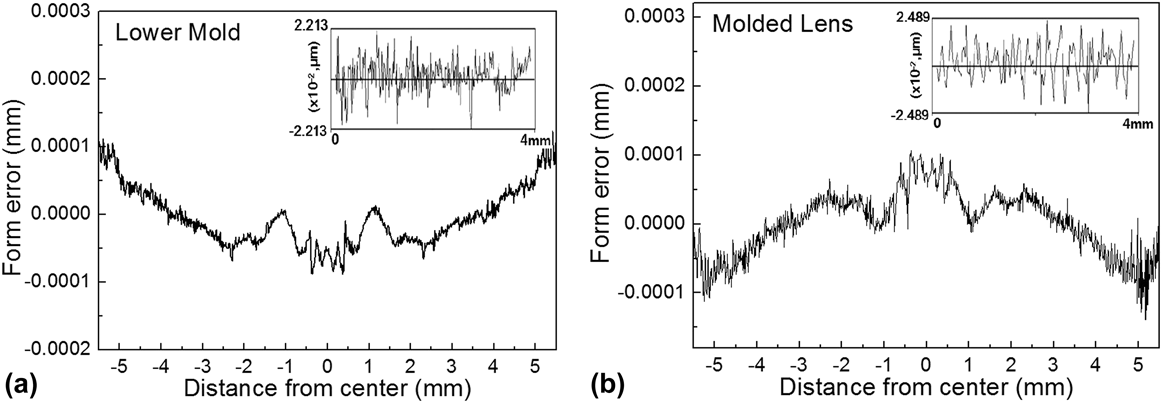
Figure 8(a) shows form accuracy on the surface of lower mold. It was characterized by UA3P (Panasonic Co., Ltd., Osaka, Japan) with attached atomic force probe. The mold of WC without binder was grinded and polished based on an optical design and used for making molded lenses. Form accuracy of WC mold was found to be 0.2201 µm of peak to valley. Arithmetic surface roughness (R a) was about 5.2 nm [inset of Fig. 8(a)]. As per earlier investigations, these values are acceptable for standard PGM processes. Figure 8(b) shows form accuracy of molded lens which was found to be 0.2468 µm of peak to valley and R a was about 7.4 nm [inset of Fig. 8(b)]. From these elucidations, it was found that, the molded lens obtained from PGM process did not have any pits, and therefore, can be used in infrared cameras after antireflection coating.
Form accuracy and arithmetic surface roughness (insets) for (a) lower mold and (b) molded lens, respectively.
IV. CONCLUSIONS
We fabricated (35–20)Ge–(5–20)Sb–60Se glass systems for the application of moldable infrared lenses. The effects of the compositional ratio on thermal and thermo-mechanical properties were investigated. The TEC of the (35–20)Ge–(5–20)Sb–60Se glass systems decreased with the increasing of Ge amount. T g and T s increased due to the increasing of Ge with higher melting temperature, which led to the improved cross-linking. Preceding experiments using a pressing tester evaluated the moldability for each glass compositions. It was found that the optimal pressing temperatures are T s when the Ge–Sb–Se glasses have 2.625–2.675 of MCN. The 35Ge–5Sb–60Se glass with the lowest thermal stability showed the more cracks and adhesions on WC mold after being pressed at T s and T s + 10 °C. The crystallization was confirmed by XRD after being pressed at T s + 10 °C. We selected 27.5Ge–12.5Sb–60Se with 2.675 of MCN to fabricate the moldable lenses using PGM process. Finally, molded lens was successfully fabricated without any defects indicating the selected 27.5Ge–12.5Sb–60Se glass system suitable for PGM process.
ACKNOWLEDGMENT
This work was supported by the Technology Innovation Program funded by the Ministry of Trade, Industry and Energy of Korea (Grant No. 10043803).