While the US Supreme Court formally decides a relatively small number of cases, its influence extends well beyond those few. The opinions published by the Supreme Court constitute federal legal precedent, and lower courts are meant to rule in accordance with the precedent in all future cases, else risk reversal by a higher court. This principle of stare decisis ostensibly ensures uniform application of the law throughout the courts. Therefore, when deciding a particular case, the Supreme Court is also presumably deciding on a general class of cases resembling the case at hand. However, the extent to which the precedent will be applied is not mechanistic and can vary according to a number of factors. Lower courts have a wealth of precedents from which they can draw in crafting a legal argument, and reference to a particular opinion is rarely guaranteed. While scholars are aware of such judicial latitude, the factors that increase the likelihood of an opinion being cited by future and lower courts have not been fully uncovered. This paper, focusing primarily on the role of ideology, provides clearer delineation of what drives precedent citation at each level of the hierarchy. In so doing, I will elucidate the factors that could cause non-uniformity in how the law is applied.
Judges are conventionally depicted as ideologically indifferent arbitrators without political preferences over outcomes. A large body of literature disputes this perception, however, and the consensus in political science is that judges behave according to partisan ideology (Pinello Reference Pinello1999). Given that the ideology of judges impacts how they decide a case, can it also impact how widely a precedent is applied? If so, does it have similar effects on each level of the judiciary? Ideologically motivated judges may vary their adherence to precedent according to the ideological content of the precedent as well as their position in the hierarchy.
There is a longstanding puzzle around how the hierarchical structure of the courts impacts compliance. In his canonical work, Frank (Reference Frank1973) argues that the upper court myth, that the upper courts drive most legal decision-making, falsely assumes lower courts do not play a significant role in shaping the law. Trial court judges, too, practice discretion and influence how the law is applied (Murphy Reference Murphy1959; Re Reference Re2015). The extent to which such behavior occurs, and when it is potentially advantageous, is the subject of active research (e.g., Hübert Reference Hübert2019). I consider precedents issued by the Supreme Court and examine the ideological factors that influence how often they are applied throughout the federal courts. Both the courts of appeals and district courts are bound to these precedents, but the differences in their institutional contexts result in differences in their incentives to comply. In particular, the courts of appeals and district courts face different reviewing bodies, which in turn affects how they decide cases. If the reviewing court’s ideological preferences do not align with the precedent, they may be less likely to enforce it; therefore, the citing court has less incentive to apply the precedent.
Given such differences, I explore how Supreme Court precedent is applied by lower federal courts by assembling a dataset of cases orally argued in the Supreme Court under Chief Justices Warren Burger and William Rehnquist, from 1969 to 2005, and citations to each case per year from each level of the federal judicial hierarchy. This builds on data previously compiled on citations to Supreme Court precedent by the Supreme Court and courts of appeals by Black and Spriggs II (Reference Black and Spriggs2013), by including citations from district courts. Given the disparate incentives, responsibilities, and caseloads faced at each level of the hierarchy, inclusion of citations from district courts presents a fuller account of the impact of a precedent and opens the possibility that district courts treat precedent differently from the higher courts. I specify a model of yearly citation counts to each precedent by district courts, courts of appeals, and the Supreme Court given various opinion precedent-setting Court and citing court characteristics. By estimating this model separately at each level of the hierarchy, I provide novel insights on the differential effects of ideology.
One such insight is both appellate and district courts are more likely to cite a case after the Supreme Court disagrees with a prior lower court decision and rules in the opposite ideological direction of the previous lower court ruling. This implies a level of responsiveness by the lower courts to an ideological “correction” issued by the Supreme Court. I also find that as the Supreme Court becomes more ideologically removed from itself at the time of setting precedent, the courts of appeals cite a precedent less, while district courts cite it more. Taken together, these results show that while both strata of the lower courts are responsive to precedent, there are complicated dynamics underlying their compliance with the Supreme Court. Additionally, the characteristics of the majority in support of a Supreme Court decision are also relevant. Specifically, the ideological extremity of the opinion writer relative to the court median decreases citations by the Supreme Court, and opinions passed by larger majorities receive more citations by the Supreme Court. This implies that popularity of an opinion on the precedent-setting Court is only associated with more citation by the Supreme Court itself. These results provide evidence that ideology plays a role in determining citation, and underscores the disparate relationship each level of the hierarchy has with precedent.
To elucidate these results more fully, I include additional analyses on whether liberal and conservative precedents have differential effects on citation and how lower court ideology impacts citation. I find that although both liberal and conservative precedents are cited similarly at each level of the hierarchy, when the Supreme Court updates doctrine by correcting a lower court ruling, district courts are less responsive to liberal updates than conservative ones. This is consistent with the understanding of the lower court presented by Frank (Reference Frank1973) as an institution that can influence the law by choosing how closely it will follow precedent. However, I also find that the district courts appear to cite conservative precedents more when the courts of appeals is more conservative. This suggests that while the lower courts do appear to be selectively compliant with Supreme Court precedent, it might be the case that this occurs because they are instead choosing to act in alignment with the appellate courts’ preferences.
These findings have implications on our understanding of the rule of law. The flexibility granted to judges on which precedents to invoke, coupled with increasing ideological behavior by the courts, can lead to disparities in how the law is applied by different courts. Ideological polarization of the federal bench thus can result in two distinct types of law, each relying of a different set of precedents. These discrepancies could induce a lack of uniformity and an increase in the incentives of litigants to participate in the appeals process.
In the remainder of this paper, I detail the various ways in which ideological considerations may impact citations to Supreme Court precedent differently at each level of the court. The following section contains a discussion of the literature on the federal judiciary and compliance and builds a theory on the role of ideology in stare decisis. I then describe the data and empirical strategy employed, present the results, and conclude by discussing implications and remaining questions.
Federal courts and citation
The US judicial system is rigidly stratified, both between state and federal systems, and within the federal courts. Positioned atop this hierarchy, the Supreme Court is responsible for setting the precedent that is meant to be applied by all lower and future courts. Cases that originate in the federal system are usually first heard by a district court. If a district court opinion is appealed, it will move to a court of appeals in that circuit. In the event that one party seeks further review beyond the appellate courts, it can petition the Supreme Court for a writ of certiorari. In the rare instances (less than 100 per year, typically) that the Supreme Court grants cert, the opinion passed down establishes a precedent to be applied by all other courts in similar cases. Given the volume of the cases that petition for cert, and the Supreme Court’s limited docket, the Court cannot practice close oversight over each of these lower court judges. Stare decisis, the norm by which courts are bound to precedent, is meant to ensure that all lower court decisions are guided by Supreme Court precedent. Thus, if a precedent is broadly applicable and the lower courts are compliant, it should be invoked frequently in subsequent legal decisions.
Judicial citations offer one way to observe how the courts apply precedent, and a wealth of literature has grown around this rich data. Citations to cases have long been considered a way to approximate case importance or judicial influence (Landes, Lessig, and Solimine Reference Landes, Lessig and Solimine1998). Fowler et al. (Reference Fowler, Johnson, Spriggs, Jeon and Wahlbeck2007), Fowler and Jeon (Reference Fowler and Jeon2008), and Carmichael et al. (Reference Carmichael, Wudel, Kim and Jushchuk2017) use network analysis to show how citations can be used to map the relationships between cases and determine case centrality. Clark and Lauderdale (Reference Clark and Lauderdale2012) show how doctrine is developed through citation and built upon interrelated opinions in the Supreme Court. Recent work uses citation as a way to capture the judicial agenda (Duck-Mayr, Hansford, and Spriggs Reference Duck-Mayr, Hansford and Spriggs2021). Others have considered the factors that influence citation as a means to better understand why a case might be invoked more frequently. Overrulings, subsequent summary decisions, vacancies on the Supreme Court, and age have all been shown to alter the citation patterns to precedent (Black and Spriggs II Reference Black and Spriggs2013; Benjamin and Vanberg Reference Benjamin and Vanberg2016; Broughman and Widiss Reference Broughman and Widiss2017; Masood, Kassow, and Songer Reference Masood, Kassow and Songer2017). Judicial citations provide a promising means of studying how precedent application varies with ideological factors, and how the law is shaped accordingly (Clark and Lauderdale Reference Clark and Lauderdale2010).
This paper explores how ideological considerations have differential effects on citation across the hierarchy. Including district courts allows for a more complete depiction of the federal judicial system and improves our ability to understand how ideology and compliance interact in the hierarchical court system. How frequently an opinion is invoked in the lower courts, where the vast majority of litigation occurs, is a key measure of precedential impact (Hitt Reference Hitt2016). Due to the volume of cases heard at lower levels of the hierarchy, there is the greatest potential for variation in the rate of citation by district courts (Boyd, Kim, and Schlanger Reference Boyd, Kim and Schlanger2020). Thus, citations to Supreme Court precedent by district courts contain a wealth of information on the applicability of precedent. In analyzing the three levels of the federal judiciary, I illustrate that these different relationships with precedent are congruent with understandings of the distinct functions of the courts.
There is a strong consensus within political science that the judicial system is not naive to ideological considerations (Segal and Spaeth Reference Segal and Spaeth1993; Pinello Reference Pinello1999). In this view, the judicial branch can act strategically to influence policy rather than simply enforce the laws enacted by the other branches of government. Ruger et al. (Reference Ruger, Kim, Martin and Quinn2004), among others, provide empirical support for this claim by showing a relationship between ideology and judicial voting behavior. A number of factors at the time of setting precedent have been shown to influence subsequent treatment of a decision, including the characteristics of an opinion (Nelson and Hinkle Reference Nelson and Hinkle2018; Masood, Kassow, and Songer Reference Masood, Kassow and Songer2019) and the identity of the judges (Budziak Reference Budziak2017; Masood and Kassow Reference Masood and Kassow2020). It has also been argued that the content of a Supreme Court opinion might correlate with characteristics of the majority coalition (Edelman, Klein, and Lindquist Reference Edelman, Klein and Lindquist2008, Reference Edelman, Klein and Lindquist2012).Footnote 1 However, the extent to which the ideological context of the Supreme Court at the time of drafting the opinion and setting the precedent impacts its subsequent citation remains unresolved.
While many works show that the court often decides cases ideologically, less has been said about how courts apply ideological precedents. Hansford and Spriggs (Reference Hansford and Spriggs2006) use citations to examine the treatment of precedent and show that Supreme Court justices strategically cite opinions to advance their policy goals. Other works have since furthered our understanding of how the ideological context at the time of citation can impact a court’s citation to precedent (e.g., Hinkle Reference Hinkle2015). Westerland et al. (Reference Westerland, Segal, Epstein, Cameron and Comparato2010) show that when the contemporaneous Supreme Court is ideologically removed from the precedent, the courts of appeals treat the case more harshly. On the district courts, Boyd and Spriggs (Reference Boyd and Spriggs2009) find that judges are more likely to cite a precedent when it aligns with their own ideological preferences. I aim to contribute to this discussion by considering how this behavior might vary by court level.
A number of scholars have argued that the features of the different levels of the hierarchy result in differences in judging (see Kastellec Reference Kastellec2017 for a review). One such feature that distinguishes the courts is that the types of cases heard by each level also differ. The cases heard most by district courts are ones in which precedent is more clearly established, while those heard higher up the hierarchy contain more uncertainty. In their role as trial courts, district courts are meant to primarily engage in fact finding (Hornby Reference Hornby2007). After gathering information, the district court judge issues a ruling based on how they believe the law applies. If this case is appealed, the appellate court does not engage in more fact-finding but instead reviews how the case was decided. Litigants choose to appeal a case if they believe there is a sufficiently high probability that the revised ruling will benefit them. That is, if they believe the reviewing court will be more favorable, they will appeal (Yates, Cann, and Boyea Reference Yates, Cann and Boyea2013). This means the cases heard at the courts of appeals involve an element of ambiguity in how the law applies. Thus, the cases that reach the appellate court could be more ambiguous on average than those heard by district courts. Cases heard by the Supreme Court pass through another iteration of selection and are the most uncertain or the most legally important of the ones heard by the courts of appeals. The more ambiguous cases faced by the higher courts also allow for more ideological discretion. Baum (Reference Baum1978), Corley (Reference Corley2009), and Corley and Wedeking (Reference Corley and Wedeking2014) show that legal clarity and certainty increase compliance. Judges can capitalize on the legal uncertainty surrounding the cases on their dockets and advance their own ideology. In particular, if it is unclear which precedents apply to a given case, they may select those that allow them to achieve their preferred outcome (Johnson Reference Johnson1987).
Another key facet of the hierarchical dynamics of the judiciary that curtails a courts ability to act ideologically is the differences in prospects of review. The district courts face possible review by the appellate courts, appellate courts face the possibility of review en banc, or by the Supreme Court (Kastellec Reference Kastellec2011).Footnote 2 After a trial on a district court, a litigant can avail themselves of the appeals process if they believe the case was erroneously decided. The case is then heard by an appellate court, which reviews how the district court arrived at the decision. A party in this case can petition for further review by the Supreme Court, which is granted very rarely. That is, while the courts of appeals are required to hear cases appealed from the district court, the Supreme Court’s docket is discretionary. The prospect of review by a higher court is therefore greater for the district courts than it is for the court of appeals (Haire, Lindquist, and Songer Reference Haire, Lindquist and Songer2003; Smith Reference Smith2006; Choi, Gulati, and Posner Reference Choi, Gulati and Posner2012).
Given the differences between the Supreme Court, courts of appeals and district courts, we can expect them to engage with precedent differently. With more autonomy, a court has more ability to set precedent. If judges are ideologically motivated, they may use this discretion to be less compliant with existing precedents with which they disagree. The courts of appeals are less likely to face review and hear more ambiguous cases. However, to the extent that district courts are constrained, it is based on the preferences of the courts of appeals rather than the Supreme Court. This potentially induces a tension in the district courts between following Supreme Court precedent or circuit preferences. Thus, the behavior of a court largely depends on its position in the hierarchy. Mounting evidence confirms that trial courts adapt their behavior to the appellate courts (Choi, Gulati, and Posner Reference Choi, Gulati and Posner2012; Boyd Reference Boyd2015; Feess and Sarel Reference Feess and Sarel2018), and that appeals courts adapt to the preferences of the Supreme Court (Westerland et al. Reference Westerland, Segal, Epstein, Cameron and Comparato2010; Benjamin and Vanberg Reference Benjamin and Vanberg2016). How do these overlapping dynamics affect citation to Supreme Court precedent? What implications does this have on the uniform application of the law?
Theoretical expectations
Citations to Supreme Court precedent measure how widely the opinion is applied. This captures two distinct features of precedent scope: applicability and compliance. When drafting an opinion, the Court can influence how widely applicable it will be. However, the extent to which the precedent is applied in practice depends on future compliance. In this section, I consider how ideological factors shape applicability, compliance, and consequently, stare decisis.
Considering how ideological factors affect precedent scope requires taking into account the complicated dynamics that underlie opinion applicability. These are primarily related to the circumstances surrounding the case and the decision-making process on the Court. Some cases simply present issues that are broader than others or are litigated at different rates. To account for this, I control for issue area. However, an element of breadth is endogenous to opinion writing. If judges know that future application of a case is variable, they can anticipate this in advance and optimize accordingly to advance their ideological interests (Fox and Vanberg Reference Fox and Vanberg2013). Of particular interest are the characteristics of the majority that support an opinion, such as majority size and the ideological position of the opinion author (Hansford and Spriggs Reference Hansford and Spriggs2006; Lupu and Fowler Reference Lupu and Fowler2013). Precedents that pass with larger majorities or are written by more moderate Justices are more popular within the Court. This popularity might afford the Court more latitude to establish a broadly applicable opinion. Conversely, the opinion could have high favorability because it is narrow in scope and thus less contentious. The former mechanism implies within-Court popularity of a precedent should be associated with more citations, while the latter implies the opposite. I explore whether either of these is borne out in the data at each level of the hierarchy.
A key feature of an opinion is whether the issue invoked is ideological or not. To some extent, this is constrained by case facts; however, the Supreme Court has discretion over which issues it will rule. The majority of cases are decided on an ideological issue. Of these decisions, there are some in which the Supreme Court issues a ruling that contradicts the previous lower court decision being reviewed. While all precedents issued by the Supreme Court clarify the Court’s stance, ones in which they rule in the opposite ideological direction from the lower court contain added information.Footnote 3 These can be considered a “correction” of the doctrine that was being applied previously by lower courts. Such rulings update rather than reinforce the doctrine being applied and constitute a more drastic departure from the status quo. An opinion issued by the Supreme Court, even if it reinforces doctrine, should be cited highly because lower courts may cite this opinion instead of other lower court decisions or previous Supreme Court decisions. However, we would expect this relationship to be most pronounced for decisions that contain an update to doctrine. For such decisions, lower courts may cite them more because there are likely fewer other relevant precedents to rely on. That is, lower courts have less discretion in whether to invoke an opinion with an update to doctrine than ones that reinforce doctrine. Compliance in the lower courts should imply that when the Supreme Court updates doctrine the lower court follows the new precedent. Whereas if they instead reinforce existing doctrine, or modify it more subtly, there is less need for lower courts to adapt. Therefore, if the lower courts are compliant to precedent, an opinion that contains an ideological disagreement should be cited more frequently by lower courts.
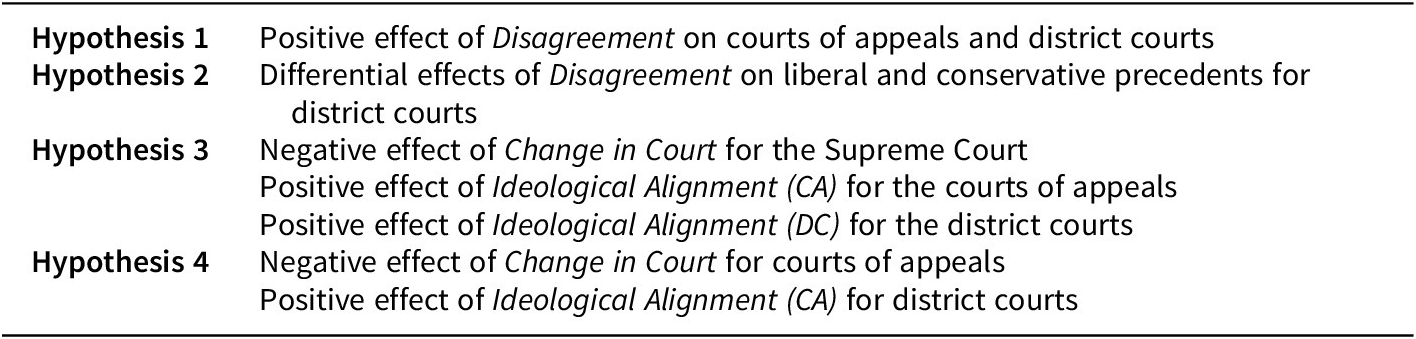
Hypothesis 1 Precedents that constitute an ideological disagreement from the prior lower court opinion are cited more.
Much of the extent of compliance depends directly on ideological factors. Perfect compliance to precedent on the lower courts would imply symmetric responses to liberal and conservative decisions. However, as discussed previously, incentives to comply with a precedent depend on the ideological content of an opinion, as well as their position in the hierarchy. Absent the threat of review, courts are less likely to be compliant with precedents with which they disagree. Despite the fact that the appeals court generally hears more ambiguous cases than district courts, and therefore has discretion in more of its docket, it also faces a different reviewing body. Further, given that many of these ambiguous cases originate in the district courts, they also have the opportunity to practice ideological discretion and also face the added complication of satisfying the circuit. Therefore, we would expect the courts which are directly accountable to the Supreme Court, the appellate courts, to be more likely to be compliant with precedent. Whereas the district courts, which are somewhat shielded by the courts of appeals, may be less tightly bound to Supreme Court precedent, and thus can potentially practice some discretion in which precedents it applies. However, district courts also are being monitored within their circuit. So while they may face a negligible threat of review by the Supreme Court, they face a significant threat of review by the appellate courts.Footnote 4 Put differently, for district courts to be bound by precedent requires a two-stage rather than a one-stage implementation process. This implies that to the extent there is asymmetric responsiveness to liberal and conservative updates to doctrine, it should be most pronounced on the district courts.
Hypothesis 2 District courts are more likely to be ideologically non-compliant with precedent than the courts of appeals.
Finally, we would expect that the contemporaneous ideological context is also relevant in determining compliance. This operates through two mechanisms: differences in the ideology of the citing court from the precedent, and differences in the ideology of the reviewing court from the precedent. When the citing court is ideologically removed from the precedent, there is less incentive for them to comply; when the reviewing court is distant from the precedent, non-compliance becomes less costly and therefore more likely. Conversely, when the citing court or reviewing court is ideologically aligned with the precedent, the case should be cited more.Footnote 5 This leads to the final two hypotheses:
Hypothesis 3 When the citing court is more aligned with the precedent, the case will be cited more.
Hypothesis 4 When the reviewing court is more aligned with the precedent, the case will be cited more.
Westerland et al. (Reference Westerland, Segal, Epstein, Cameron and Comparato2010) shows that the courts of appeals is less deferential to an opinion when the Supreme Court has changed ideologically from the time of issuing the opinion. As the Court no longer aligns with the precedent-setting Court, it is less likely to uphold the precedent and possibly seeking to undermine it. Thus, since the courts of appeals seeks to avoid review, they will be less likely to cite the precedent. In this analysis, I explore whether district court citations similarly adapt to a change in Supreme Court ideology. Since it is not the direct reviewing body to these courts, the mechanism for this effect is not as clear. However, I also examine whether alignment between the aggregate ideology of the courts of appeals and the ideological disposition of an opinion impacts citation on the district courts. This posits the same mechanism regarding review but has the potential to raise an added tension – between being compliant with the Supreme Court’s precedent or the appellate courts’ ideology.
Data and methods
Citation data
The dependent variables in this analysis are constructed from citations to Supreme Court precedent per year at each level of the federal judicial hierarchy.Footnote 6 As mentioned, the data for citations expands upon the Black and Spriggs II (2013) dataset, which records citations from the Supreme Court and courts of appeals, by including citations from district courts.Footnote 7 The precedents included are all cases formally argued in the US Supreme Court under Chief Justices Warren Burger and William Rehnquist, beginning in 1969 and continuing into 2005. Citations are recorded for every precedent in each year beginning when the case is decided and ending in 2005. So for a case decided in 1986, we have twenty observations, whereas a case decided in 2001 only has five corresponding observations. In total, this yields 82,319 case-year observations, for a total of 3,968 precedents.Footnote 8
I collected the district court data from Shepard’s Reports available via LexisNexis.Footnote 9 For this analysis, I examine a sum of all citation to a precedent in a year except negative citation, although I show robustness to considering total citations.Footnote 10 Specifically, I include the positive, neutral, and “cited” classifications of citations. Exclusion of the negative classification allows for a focused analysis on how widely a precedent is applied rather than how widely it is invoked.Footnote 11 This yields a measure well-suited to capture compliance throughout the court.
Table 1 provides summary statistics for citations to a precedent in each citing year.Footnote 12 Citation clearly varies in degree by level of hierarchy, but the specific precedents being cited also vary by court. Table 2 lists the most cited cases in each level of the federal courts in the ten years after they are published. There is only one case that is one of the most cited by both the Supreme Court and the courts of appeals, Chevron v. NRDC. The majority opinion, authored by Justice John Paul Stevens, establishes a legal doctrine for when it is appropriate to defer to a bureaucratic agency’s interpretation of a statute. Between the courts of appeals and district courts, however, there is more overlap. There are four cases which are highly cited by both of the lower courts, most of which pertain to matters of judicial procedure.
Summary of Citations Per Case-Year by Level of Hierarchy

Most Cited Precedents in the First Ten Years

Note: Above are the Supreme Court decisions issued between 1969 and 1995 that receive the most citations by the Supreme Court, appellate courts, and district courts in the first ten years after they are published.
However, most striking is how different these lists are for each court. There is a notable level of variation in which cases are cited the most by these courts. In particular, the cases most cited by the Supreme Court are almost entirely distinct from the ones most cited by the lower courts. Further, between the appellate courts and district courts there is still substantial variation. The set of cases invoked frequently by the appellate courts are largely procedural. That is, these precedents generally relate to explicit legal standards set by the Supreme Court on how the lower courts are to go about adjudicating. In contrast, more cases cited by the Supreme Court or district courts are more substantive in nature. These cases generally relate more to the legality of specific policies. These broad observations align with the roles of the courts of appeals in reviewing cases and district courts as trial courts. The trial courts engage in fact finding and will cite cases that are directly substantively related to the case being decided. The appellate courts, however, are reviewing the decisions of the district courts and, therefore, are more likely to rely on precedents establishing procedural standards. In the following analysis, I seek to explore how the ideological characteristics of these precedents possibly results in their differential treatment throughout the hierarchy.
Explanatory variables
I consider the effect of several ideological factors on a precedent’s subsequent citation. These include Ideological Decision, Disagreement, Change in Court Ideology, Majority Size, and Opinion Writer Extremeness. Ideological Decision is a binary variable equaling 1 if the precedent was determined to have an ideological disposition according to the Supreme Court database (Spaeth et al. Reference Spaeth, Epstein, Martin, Segal, Ruger and Benesh2018). This measurement defines a decision as liberal or conservative depending on the issue the Court chooses to address in a given case and which party was favored in the ruling. For the baseline analysis, I consider the effect of a decision being ideological, remaining agnostic to whether the decision is liberal or conservative. The Supreme Court is somewhat constrained by case facts but is allowed discretion over the issue over which it is ruling. The choice to appeal to an ideological issue, as opposed to a non-ideological one, may impact citation to the precedent. The majority of decisions made on the Supreme Court are ideological, so I consider the effects of other ideological considerations on citation, and conduct an additional analysis to allow for the possibility of differential effects of Liberal and Conservative decisions.
In cases in which the Supreme Court does decide ideologically, if the case was previously heard in a lower court, the lower court’s decision is also assigned an ideological disposition. If the Supreme Court and lower court rule in opposite ideological directions, I code Disagreement as 1. That is, if the Supreme Court’s decision was conservative, and the lower court’s was liberal, or vice versa, this counts as disagreement.Footnote 13 An instance of disagreement involves the Supreme Court updating doctrine that was being applied by the lower courts. Compliance by lower courts should imply that when such an update occurs, citation increases. Given Hypothesis 1 , we therefore expect a positive effect of disagreement on citations by the courts of appeals and district courts; Hypothesis 2 would imply that for the district courts this effect may not be the same for liberal and conservative decisions, given that during this time period the district courts skew conservative.
Change in Court Ideology is measured using Martin and Quinn (Reference Martin and Quinn2002) estimates. It is taken as the distance in estimates of the Supreme Court median in the year the precedent was issued to the estimate of the median Justice’s ideal point on the Court in the citing year. This approximates how ideologically distant the contemporaneous Court is at the time of citation to the Court at the time of setting the precedent. This is distinct from the other ideological variables in that it is not endogenous to the precedent-setting Court. It is therefore not relevant to how the Court may attempt to influence citation to its precedent. It does, however, provide interesting insight as to how the future courts respond to a change in leadership. That is, it gauges whether a precedent’s strength diminishes when it might be out of favor with the contemporaneous Court. As the Change in Court Ideology increases, alignment between the Supreme Court and precedent decreases, so Hypothesis 3 suggests citation should decrease on the Supreme Court. For the courts of appeals, Hypothesis 4 states that as Change in Court Ideology increases, citation should decrease.
Key to understanding the collegial environment of the Court at the time of the precedent is the size of the majority, I include a variable for this ranging from 4 to 9.Footnote 14 Smaller majorities may represent one of several mechanisms that are difficult to disentangle. On the one hand, small majorities may reflect the difficulty of putting together a winning coalition. In such circumstances, smaller majorities may constrain an opinion writer, preventing her from positioning close to her ideal point. Conversely, a small majority may be the result of an opinion writer not deviating from her preferred ideological outcome, even if it is at the expense of support from additional Justices. Either of these mechanisms could impact the content of an opinion and thus affect its citation.
Opinion Writer Extremeness is measured using ideal point estimates from Martin and Quinn (Reference Martin and Quinn2002); it measures the absolute value of the distance between the opinion writer’s ideal point and the Supreme Court median’s in the year the precedent was written. This captures how extreme the opinion writer was relative to the precedent-setting court.Footnote 15 Opinions written by ideological extremists likely contain more extreme ideological content, which may impact citation. Given that majority opinion authorship is assigned at the discretion of the Chief Justice (or the most senior member of the majority), if there is an effect of extremity on citation, it means the choice of who authors the opinion affects not only the opinion’s ideological content but also its applicability.
I also account for the effect of lower court ideology on citation. Because my data is aggregated at the court level, I am unable to identify the ideology of the particular citing judge. However, I employ proportions of appellate and district court judges who were appointed by Republican or Democratic presidents as a measure of aggregate ideology. In particular, I measure Ideological Alignment with a decision as the proportion of Republican appointees on the court for conservative precedents and proportion of Democratic appointees for liberal precedents. I do this separately for the appellate and district court in each citing year for each precedent. Although this does not capture the extremism of ideological beliefs on the lower courts, it does provide a sense of the distribution of ideological alignment with a precedent on the court as a whole. Hypothesis 3 on the courts of appeals and district courts implies that as as alignment increases so should citation; for the district courts, Hypothesis 4 implies that as the courts of appeals is more aligned with a precedent, the district courts will be more likely to cite it. During this time period, the aggregate ideologies of the courts of appeals and district courts are highly correlated, making it difficult to distinguish between Hypothesis 3 and 4 for the district courts. Table 3 summarizes these theoretical expectations.
Summary of Expectations

Citation rates may also fluctuate for reasons unrelated to ideology. I use many of the measures which have previously been shown to correlate with citation behavior as controls.Footnote 16 I further control for whether cases are first heard by the Supreme Court. In such cases, in which the lower court does not review a case prior to it reaching the Supreme Court, I code Original Jurisdiction as 1. The set of cases that go directly to the Supreme Court is small but are likely cited differently from cases which originate in lower courts. I also include indicator variables for each issue area.Footnote 17
Empirical strategy
The dependent variable in each regression is a logged value of citation by each level of the court in each year of citation.Footnote 18 In the analysis presented here, I employ population-averaged generalized estimating equations (GEE) at each level of the federal judicial hierarchy. This allows for the specification of serial correlation across observations, which I model using an AR(1) structure.Footnote 19 I also cluster standard errors at the precedent level. This approach allows for within-precedent correlation in errors while still permitting autocorrelation over time.Footnote 20
I estimate the following:
 $$ E\left({Y}_{it}\right)\hskip0.35em =\hskip0.35em \alpha +\beta {Ideology}_{it}+\gamma {X}_{it}+{\delta}_t. $$
Where
 $ {Y}_{it}\hskip0.35em =\hskip0.35em \mathit{\log}\left({cite}_{it}+1\right) $
, and Ideology is a matrix of the main variables of interest, Ideological Decision, Disagreement, Change in Court Ideology, Majority Size, and Opinion Writer Extremeness. I include a matrix of controls X, and estimate fixed effects for the age of a precedent. Unlike previous studies, I do not assume any functional form to the rate of decay of precedent, instead allowing citation to vary non-parametrically with age.Footnote
21
This yields a comparison of how precedent ages differently at the different levels of the judiciary.Footnote
22
I conduct two additional analyses to examine the implications of the main results. I first decompose the Ideological Decisions variable to test whether there are differential effects of liberal or conservative decisions. This allows me to discern how the particular ideological disposition of a precedent influences its subsequent citation. If citation does vary between liberal and conservative decisions, there is possibly selective compliance by some courts to precedents with which they disagree. Next, I consider how lower court ideological alignment with a precedent potentially impacts citation. This involves examining the role of the citing court’s ideology as well as the reviewing court’s, to uncover what is driving apparent discrepancies in compliance to precedent.
Results
Table 4 presents the results from the baseline estimation.Footnote 23 The results underscore that ideology matters at all level of the federal judiciary in how they defer to precedents. But they also indicate that there are substantial differences in how the levels respond to precedent and ideology. These results are consistent with the view that each stratum engages with precedent differently given their distinct caseloads and prospects of review. There are several factors endogenous to the opinion-writing process that impact its later citation, suggesting that when the Supreme Court is determining the content of a precedent, Justices are simultaneously affecting its applicability.
Determinants of Precedent Citation by Court Level

Note: Estimates are from a population averaged generalized estimating equations (GEE) model with an AR(1) correlation structure. Standard errors are reported in parenthesis and are clustered by precedent. The dependent variables in columns (1), (2) and (3) are log transformed citations per year to each precedent, for the Supreme Court, courts of appeals and district courts, respectively. Each model contains all controls listed in the text as well as age fixed effects.
*p < .05, ** p < .01, *** p < .001
The estimated effects of Ideological Decisions differ across the hierarchy. The coefficients in the Supreme Court and district courts models are positive and statistically significant, indicating a positive relationship between a precedent being ideological and its subsequent citation. The Supreme Court cites ideological decisions approximately 10% more, and district courts cite such decisions 45.4% more. No such effect is found for the appellate courts. However, the absence of significance on the courts of appeals is sensitive to specification, and I present the most conservative model in the paper.Footnote 24
One common feature of the district and appeals courts is that they cite a Supreme Court precedent more when it reviews an ideological decision made by a lower court and disagrees with that ruling. The courts of appeals and district courts respectively cite such decisions approximately 8% and 10.4% more times than all other ideological decisions. This result suggests that the lower courts are responsive to an update in doctrine, in support of Hypothesis 1. When the Supreme Court “corrects” how a lower court had previously decided a case, it clarifies its stance on that issue, and thereby changes the legal doctrine that was being applied. The positive effect this has on citations presents evidence of lower court compliance.
Opinions written by more ideologically extreme judges are cited less frequently by the Supreme Court. These opinions potentially contain more extreme content and are therefore invoked less by future Supreme Courts. Opinions written by moderate Justices are, conversely, cited more by the Supreme Court. There is also a positive association between Majority Votes and citation on the Supreme Court. Opinions supported by more Supreme Court justices may be considered “stronger” precedents (Benjamin and Desmarais Reference Benjamin and Desmarais2012) and receive more citations, consequently. This evidences the fact that when setting a precedent Justices on the Court are making choices that not only affect what decision is reached but how widely that decision is followed by voting with the majority or not. This could constitute another reason why some Justices do not vote with the majority even when they are not pivotal. However, these effects are only significant on the Supreme Court. That is, internal popularity of an opinion does not appear to have an effect on lower court citation. This could be the result of strategic dynamics within the precedent-setting court. That is, the size of the majority and selection of the opinion writer can be endogenous to the applicability of an opinion.
Importantly, the courts of appeals and district courts respond differently to a change in Court ideology. The courts of appeals cite a precedent approximately 5.8% fewer times when the median Justice in the citing year is far from the median Justice in the precedent year. This supports the expectation that the appellate courts avoid invoking an opinion with which the Supreme Court no longer agrees in order to reduce the likelihood of being reviewed. This is in line with the findings of Westerland et al. (Reference Westerland, Segal, Epstein, Cameron and Comparato2010) and Benjamin and Vanberg (Reference Benjamin and Vanberg2016) who show that when there has been a change in the Court’s ideology since the time of the precedent, appellate courts treat the precedent more harshly. Therefore, we confirm Hypothesis 4 for the courts of appeals. The novel data on citation from the district courts shows, however, that this effect does not hold for all lower courts. Specifically, district courts cite a case 14.3% more times when the Court in the citing year is far from the precedent-setting Court.
The contrasting responses of the appellate and district courts to change in Court ideology points to differences in their relationships to the Supreme Court. Given that the distance between the precedent-setting Court and citing-year Court generally increases as the precedent ages (albeit not necessarily steadily), this result could suggest that the value of a precedent is more enduring on district courts. While the appellate courts are more sensitive to the preferences of the Supreme Court, the district courts may instead maintain their deference to precedent. These results juxtaposed present two distinct types of possible compliance: compliance with precedent and compliance with the Supreme Court. The appellate court, in its own capacity to set precedent, is less bound to prior decisions and therefore might cite them less if citation will increase their likelihood of review. The district courts, however, do not enjoy this level of discretion and thus could be more tightly bound to precedent. In order to fully discern between these two types of compliance, one would need to account for changes in the particular citing courts over time and changes in external political considerations. This is a particularly compelling area for future research.
Overall, these results provide evidence to conclude that ideological factors influence application of precedent by future and lower courts. The extent to which these affect each level of the hierarchy differ in interesting ways. Both the appellate and district courts respond to updates in doctrine after the Supreme Court issues an opinion that differs ideologically from a prior lower court decision. On the courts of appeals, I show that as the ideology of the Supreme Court gets further from the precedent-setting Court, citation to the precedent decreases; the opposite holds for district courts. This shows that while both lower courts are compliant to precedent, there might be some subtle differences in the mechanism underlying this compliance. The ideological extremeness of the opinion writer and the size of the majority affects citation by the Supreme Court but not the lower courts. Taken together, these results suggest that ideology plays a role in how much a precedent gets cited, but also that the degree to which this affects compliance varies by court level.
Effects of differential ideology
As shown in the previous section, there is an effect of precedents being Ideological Decisions on citation from Supreme Court and district courts. In Table 5, I dissect this term into Liberal Decisions and Conservative Decisions by the Supreme Court. In so doing, I can observe whether the courts respond differently to liberal or conservative precedents to test Hypothesis 2. I then interact Liberal Decision with Disagreement to test whether when the Supreme Court decides liberally, overturning a conservative lower court decision, the precedent is treated differently than in cases when the Court rules conservatively, overturning a liberal lower court decision.
Liberal v. Conservative Precedents

Note: Estimates are from a population averaged generalized estimating equations (GEE) model with an AR(1) correlation structure. Standard errors are reported in parenthesis and are clustered by precedent. The dependent variables in columns (1) and (4), (2) and (5), and (3) and (6) are log transformed citations per year to each precedent, for the Supreme Court, courts of appeals and district courts, respectively. Each model contains all controls listed in the text as well as age fixed effects.
*p < .05, ** p < .01, *** p < .001
I find very similar effects for either ideological disposition at each level of the federal hierarchy. It therefore appears to be the case that the effect of these decisions on compliance is better explained as a product of the precedent being ideological, rather than the specific ideology espoused. However, upon including the interaction term, a more complicated story emerges.
In columns (4), (5) and (6), I interact Liberal Decision with Disagreement. Because disagreement only can occur when the Supreme Court issues a liberal or conservative precedent, this interaction estimates whether there are differential effects of disagreement on citation to liberal or conservative precedents. The results show that when the Supreme Court issues a liberal precedent, in disagreement with a prior conservative lower court ruling, the precedent receives about 15% fewer cites. So while both liberal and conservative decisions appear to be cited as frequently, whether or not they are changing doctrine already being applied by lower courts affects them differently. In particular, liberal decisions are less likely to be invoked by district courts, implying an asymmetry in compliance across liberal and conservative dispositions, confirming our expectation in Hypothesis 2.
To explore the mechanism underlying this result, I consider whether liberal decisions differ systematically from conservative ones in observable ways. Figure 1 illustrates the proportion of cases in the data that are decided in each term that are conservative. It also shows the median justice’s ideal point in each term, with higher numbers corresponding to a more conservative court (Martin and Quinn Reference Martin and Quinn2002). There is a relatively weak correlation between court conservatism and the proportion of cases that are decided conservatively in each term. That is, it does not appear to be the case that more conservative courts issue significantly more conservative decisions or conversely, that conservative courts issue very few liberal decisions. The Court does, however, tend to be conservative during this time frame. It could be the case that conservative decisions reached by a conservative Court differ in some way from liberal decisions reached by conservative Courts, thus yielding a difference in citation. The data is limited in being able to fully assess whether this is the case, but I do consider whether conservative decisions passed by more conservative courts are cited differently. To examine such a possibility, I specify a model including the Court median’s ideal point in the precedent-setting year and interact it with Conservative decisions and find no evidence of such differences (see Table A.7 in the Supplementary Appendix). In Figure 2, I show that conservative decisions are passed with narrower majorities than liberal ones. It is thus not the case that conservative decisions are associated with larger majorities and are thus stronger precedents.
Conservative Decisions and Median Justice’s Ideal Point Over Time.
Note: Dots indicate the proportion of Supreme Court precedents issued in a particular term that are conservative. The x’s indicate the median Justice’s ideal point in the given term, with higher values indicating more conservative Court medians. There is a fairly weak correlation between the amount of conservative precedents issued and Court conservatism.

Majority Size of Liberal & Conservative Decisions.
Note: Above are histograms of majority sizes for liberal decisions (left) and conservative decisions (right). A higher proportion of liberal decisions pass with unanimous support, whereas more conservative decisions pass with narrow majorities.

We can therefore rule out the possibility that conservative precedents are more likely to be cited after disagreement because they were passed with larger majorities or are more representative of the court’s overall preferences. This suggests that the apparent higher levels of citation to conservative precedent after disagreement is a function of non-compliance on the district court. This provides empirical support for recent theoretical work by Hübert (Reference Hübert2019), in which he shows that district court judges can pull de facto law away from the de jure law established by higher courts.
Lower court ideology
A natural consideration is whether lower court ideology impacts citation. As shown by Westerland et al. (Reference Westerland, Segal, Epstein, Cameron and Comparato2010), Benesh and Reddick (Reference Benesh and Reddick2002), and Randazzo (Reference Randazzo2008) lower courts at times practice discretion in their compliance with higher courts and may choose to act in accordance with their own ideological interests. The data presented in this paper are aggregated at the court level, precluding the possibility of identifying the particular citing court’s ideology. However, I can account for the aggregate ideology of the courts of appeals and district courts in the citing year. To this end, I employ a measure of ideological alignment on the courts of appeals and district courts based on the proportion of sitting judges in each citing year that were appointed by a Republican President as a measure of ideological alignment with conservative decisions, and proportion of Democratic appointees for liberal decisions. A complication in this approach is that the ideologies of the courts of appeals and district courts are highly correlated, making it difficult to identify which is affecting citation. I therefore present two separate analyses: first, accounting for the ideological alignment of the citing court with the precedent, next accounting for the ideological alignment of the reviewing court. I find suggestive evidence that the apparent non-compliance by district courts may be a product of hierarchical concerns.
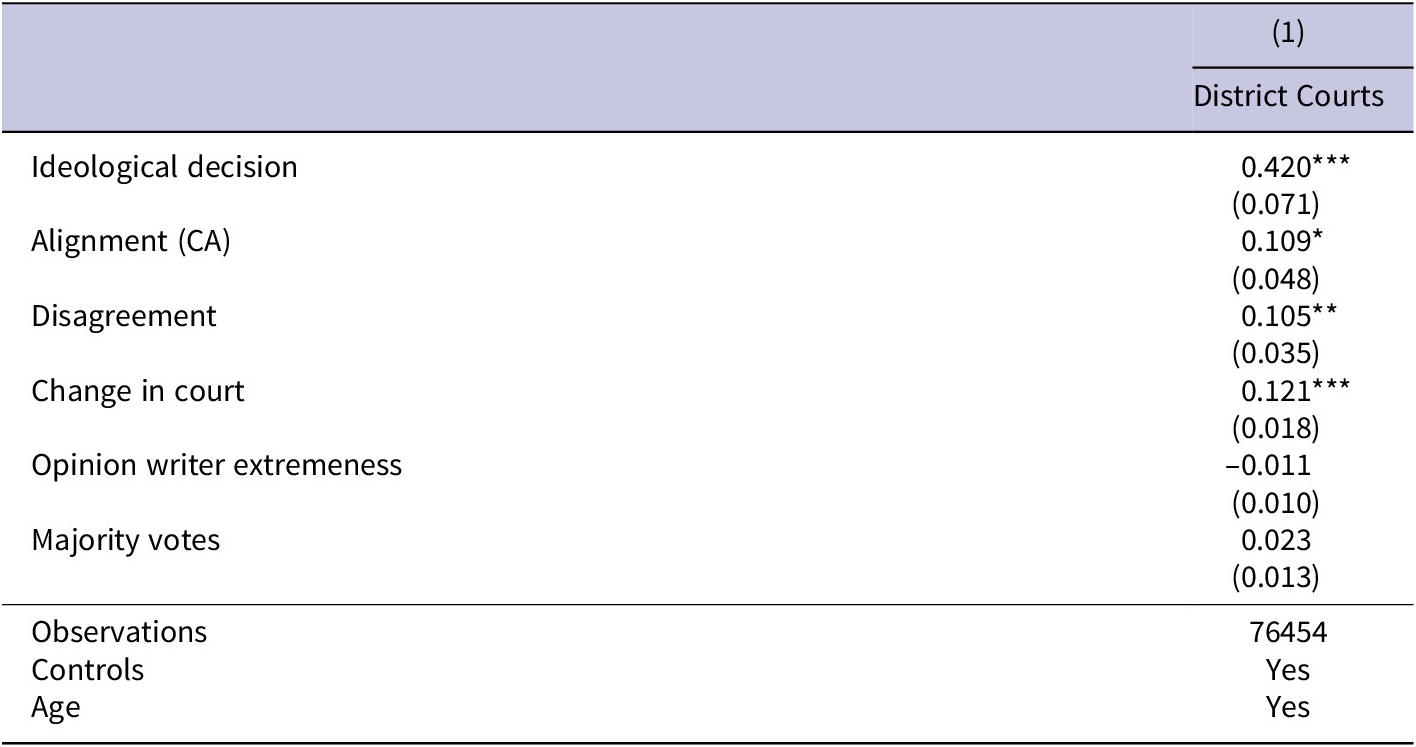
To consider how the courts of appeals and district courts ideologies potentially impact citation, I include a measure of ideological alignment of each court in the citing year with the precedent. If the lower courts are acting in their own ideological interests, we would expect that when they are more aligned with the precedent, they are more likely to cite. By this logic, the coefficient on Alignment (CA) in (3) and Alignment (DC) in (4) should be positive. As shown in Table 6, the courts of appeals are about 10.4% more likely to cite an opinion when they are overall aligned with the precedent. That is, when there are more conservatives on the court and the precedent is conservative, or if there are more liberals on the court and the precedent is liberal, there are more citations to the precedent. In contrast, this does not appear to occur on the district court. Thus, I only find evidence for Hypothesis 3 on the appellate courts.
Citing Court Ideology

Note: Estimates are from a population averaged generalized estimating equations (GEE) model with an AR(1) correlation structure. Standard errors are reported in parenthesis and are clustered by precedent. The dependent variables in columns (1) and (2), are log transformed citations per year to each precedent, for the courts of appeals and district courts, respectively. Each model contains all controls listed in the text as well as age fixed effects.
*p < .05, ** p < .01, *** p < .001
An alternate way lower court ideology may manifest in citation behavior is via the appeals process. That is, district courts potentially face review by the courts of appeals and might take this into account in their decision-making. As we saw earlier, it is the case that the courts of appeals adapts its behavior to the preferences of the contemporaneous Supreme Court. We will now consider whether there is evidence that the district courts behave in a similar manner with respect to the appellate courts. I estimate a model of district court citations including a measure of appellate court alignment with the precedent. If the district courts are in fact anticipating the preferences of the appellate courts, they would be more likely to cite a precedent when the appellate court is more aligned with it. As shown in Table 7, this pattern does emerge in the data. District courts cite precedents approximately 11.5% more when the courts of appeals are more aligned with the precedent, suggesting responsiveness to the reviewing court’s ideology, in support of Hypothesis 4 for the district courts.
Reviewing Court Ideology

Note: Estimates are from a population averaged generalized estimating equations (GEE) model with an AR(1) correlation structure. Standard errors are reported in parenthesis and are clustered by precedent. The dependent variable is log transformed citations per year to each precedent from district courts. The model contains all controls listed in the text as well as age fixed effects.
*p < .05, ** p < .01, *** p < .001
The results presented in this section provide evidence that the court of appeals’ ideology is influential in the decision to cite by the courts of appeals themselves as well as the district courts. However, more work is needed to fully uncover the role of lower court ideology in citation. Specifically, with more granular data on which district court judges are making the decision to cite, and which circuit those judges belong to, one could more accurately assess how citation behavior relates to individual justice’s ideology. This would elucidate the role of both citing and reviewing courts’ ideologies in following precedent, and is a promising avenue for future research.
Conclusion
Ideological considerations interact with the federal judicial hierarchy in several interesting ways, broadly confirming the theoretical expectations that compliance to precedent varies by court level. Both the courts of appeals and district courts are responsive to an “update” in doctrine issued in a Supreme Court precedent; however, district courts are less responsive to liberal corrections of this form. The courts of appeals are less likely to cite a precedent when the contemporaneous Supreme Court is ideologically removed from the precedent-setting court. This suggests the appellate courts are more sensitive to the ideology of the Supreme Court. District courts, by contrast, are potentially responsive more to the preferences of the appellate courts.
These results draw into question the extent of the upper court myth. While I find evidence that the district courts partake in what appears to be ideological non-compliance with liberal decisions, I also find evidence that part of the district courts apparent preference conservative decisions is associated with conservatism on the courts of appeals. As such, the asymmetry in compliance may be a product of the district courts seeking to appease the appellate courts instead of following their own interests. This would imply that while appellate courts may be adhering closely to stare decisis in their own decisions, the ideological preferences of appellate court judges can influence district court judges otherwise. While the data in this paper are only available until 2005, there is reason to believe that as the federal bench becomes more politicized, the effects of these ideological considerations will grow in importance.
These data can be used in a number of ways in future research, to further investigate how the distinct incentives and responsibilities of district and appellate courts lead to different citing behavior. However, these data offer a first step in understanding the role of precedent in district courts. To further elucidate the mechanisms by which compliance by district courts differs from appellate courts, one must be able to discern between the set of cases heard at each level of the court. Next steps to this end would include integration of data on differences in the dockets and caseloads of the various courts.
Among the bevy of questions remaining regarding how compliance varies across the hierarchy is why movement of the Court away from its ideology at the time of setting precedent results in more citations from district courts. A satisfactory answer to this question would need to account for outside factors that might influence the lower court’s behaviors. In particular, lower court judges might choose to signal alignment with the President, in lieu of alignment with the Court, in order to seek career advancement. Future work on adherence to stare decisis should couple these citation data with information on ideological positions of external political actors to further explore why the lower courts vary in compliance.
Acknowledgements
I would like to thank Tasos Kalandrakis, Lawrence Rothenberg, Dan Alexander, Tom Clark, Rachael Hinkle, Olga Gasparyan, Varun Karekurve-Ramachandra, Maria Silfa, Jessica Sun, and participants at the 2020 SPSA conference for helpful feedback. I gratefully acknowledge Ryan C. Black and James F. Spriggs for sharing their data, and Nathan Leopold and Mariam Malashkhia for research assistance. All remaining errors are my own.
Competing Interest
The author declare no competing interests exist.
Data Availability Statement
The data and code required to replicate all analyses in this article are available on the Journal of Law and Courts Dataverse within the Harvard Dataverse Network.
Supplementary Materials
To view supplementary material for this article, please visit http://doi.org/10.1017/jlc.2022.5.