Introduction
The greenhouse whitefly Trialeurodes vaporariorum (Westwood) (Hemiptera: Aleyrodidae) is a phloem-feeding pest that causes major problems in vegetable and ornamental crops by weakening plants through direct feeding, secreting large amounts of honeydew, which is followed by the development of sooty mould, and by transmitting viruses. It transmits the following plant viruses (Crinivirus and Closterovirus) (Jones, Reference Jones2003): Tomato infectious chlorosis virus (TICV), Tomato chlorosis virus (ToCV) (Duffus et al., Reference Duffus, Liu and Wisler1996; Wisler et al., Reference Wisler, Duffus, Liu and Li1998a , Reference Wisler, Li, Liu, Lowry and Duffus b ), Beet pseudo yellow virus (BPYV) (Closterovirus) (Duffus, Reference Duffus1965; Tzanetakis et al., Reference Tzanetakis, Wintermantel and Martin2003) and Potato yellow vein virus (PYDV) (Alba, Reference Alba1950). Trialeurodes vaporariorum is also known to disperse Polyphagotarsonemus latus mites (Palevsky et al., Reference Palevsky, Soroker, Weintraub, Mansour, Abu-Moach and Gerson2001; Petanovic et al., Reference Petanovic, Marcic and Vidovic2010; Marcic et al., Reference Marcic, Prijovic, Drobnjakovic, Peric, Sevic and Stamenkovic2011) and to vector several bacterial species, such as Xanthomonas pelargonii Brown (O'Reilly, Reference O'Reilly1974; Peric, Reference Peric1999). Large infestations of this pest can result in stunted plants and leaf necrosis, lower yields and poor fruit quality (Wisler et al., Reference Wisler, Duffus, Liu and Li1998a , Reference Wisler, Li, Liu, Lowry and Duffus b ; Albajes et al., Reference Albajes, Lodovica Gullino, van Lenteren and Elad1999; Martin et al., Reference Martin, Mifsud and Rapidsarda2000; Lopes, Reference Lopes2002; Ramos et al., Reference Ramos, Neto, Arsénio, Mangerico, Fortunato, Stigter, Fernandes, Lavadinho and Louro2002; Jones, Reference Jones2003; Valverde et al., Reference Valverde, Sim and Lotrakul2004; Fortes et al., Reference Fortes, Moriones and Navas-Castillo2012; Karatolos et al., Reference Karatolos, Williamson, Denholm, Gorman, French-Constant and Nauen2012). Trialeurodes vaporariorum is polyphagous, and its hosts are plant species that belong to 82 families (Mound & Halsey, Reference Mound and Halsey1978).
Trialeurodes vaporariorum sometimes shares a habitat with the devastating sweet potato whitefly Bemisia tabaci (Gennadius) (Skaljac et al., Reference Skaljac, Zanic, Goreta Ban, Kontsedalov and Ghanim2010). The two whiteflies have different population dynamics. Although populations of B. tabaci reach their peak during the summer, populations of T. vaporariorum peak during cooler climatic conditions (Luo et al., Reference Luo, Wang, Cui and Zhang2004). Eggs of T. vaporariorum are more resistant to cold than those of B. tabaci, which enables T. vaporariorum to reproduce and bear its population throughout the year (Caciagli, Reference Caciagli and Czosnek2007). The large reproductive potential of these two whitefly species, their barely visible eggs and their young immature stages on the underside of leaves make them easily transportable through the international plant trade.
The native range of T. vaporariorum is not known, but it is assumed to be North or South America (CABI, 2013). The first description of this species dates back to 1856 in England, when it had already become an established and widespread in glasshouses (CABI, 2013). More recently, the presence of established populations of T. vaporariorum has been documented in many countries of the world's temperate regions (Manzano & van Lenteren, Reference Manzano and van Lenteren2009). Since the 1970s, T. vaporariorum has been a serious pest in greenhouse crops in Serbia (Zahradnik, Reference Zahradnik1963) and Croatia (Zanic et al., Reference Zanic, Goreta, Perica and Sutic2008). Trialeurodes vaporariorum has been reported as a predominant whitefly species over B. tabaci in Croatia, Montenegro and Bosnia and Herzegovina (Skaljac et al., Reference Skaljac, Zanic, Goreta Ban, Kontsedalov and Ghanim2010, Reference Skaljac, Zanic, Hrncic, Radonjic, Perovic and Ghanim2013). Bemisia tabaci has not been reported in Serbia (J. Bocanski, personnel communication).
Various molecular methods have been applied to differentiate between different whitefly species and to study their intraspecific genetic variations (reviewed in De Barro et al., Reference De Barro, Liu, Boykin and Dinsdale2011). The most widely applied method has been mitochondrial cytochrome c oxidase I (COI) ‘barcoding’, which is a mitochondrial, protein-coding gene that has been recommended as a global bio-identification system for animals (Hebert, Reference Hebert2003). This gene, along with the 16S rDNA, 18S rDNA and elongation factor-1a genes, has been encouraged as a standard target for insect phylogenetics (Caterino et al., Reference Caterino, Cho and Sperling2000; Armstrong & Ball, Reference Armstrong and Ball2005). Data from established COI barcode datasets are becoming increasingly considered for identifying arthropod pests and biosecurity (Armstrong & Ball, Reference Armstrong and Ball2005; Floyd et al., Reference Floyd, Wilson and Hebert2009, Reference Floyd, Lima, deWaard, Humble and Hanner2010; Boykin et al., Reference Boykin, Armstrong, Kubatko and De Barro2012a ). Based on rather prominent variations that are found in the COI gene in B. tabaci, this important pest has currently been confirmed as a complex of at least 31 morphologically indistinguishable species (De Barro et al., Reference De Barro, Liu, Boykin and Dinsdale2011; Hu et al., Reference Hu, De Barro, Zhao, Wang, Nardi and Lui2011; Boykin et al., Reference Boykin, Armstrong, Kubatko and De Barro2012a , Reference Boykin, De Barro, Hall, Hunter, McKenzie, Powell and Shatters b ; Wang et al., Reference Wang, Yang, Boykin, Zhao, Li, Wang and Liu2013). The world's two most widespread and damaging members of the B. tabaci species complex, which cause a considerable biosecurity concern, are the Middle East-Asia Minor 1 (MEAM1, commonly known as the B biotype) and Mediterranean (MED, commonly known as the Q biotype) (De Barro et al., Reference De Barro, Liu, Boykin and Dinsdale2011).
Only a few relatively small populations of T. vaporariorum that originated from India have been analysed for COI sequence variability (Roopa et al., Reference Roopa, Krishna Kumar, Asokan, Rebijith, Mahmood and Verghese2012). A comparative study of their mitochondrial gene and the nuclear internal transcribes spacer (ITS) sequences of ribosomal DNA showed no noticeable variations among the investigated populations. That study also indicated no cryptic species or biotypes in T. vaporariorum as opposed to B. tabaci (Roopa et al., Reference Roopa, Krishna Kumar, Asokan, Rebijith, Mahmood and Verghese2012). In contrast, by analysing the biochemical and allozyme profiles of 11 populations of T. vaporariorum in Korea, Shin et al. (Reference Shin, Mo, Lee, Park and Cho2013) reported rather large differences and two major groups that were divided by the Baekdudaegan Mountains as a geographic barrier. Furthermore, they found low migration and linkage disequilibrium, thus concluding that populations tended to be influenced by gene drift rather than uniform selection pressures caused by insecticides or host-plant resistance.
A particular problem associated with the invasion of T. vaporariorum is that excessive use of insecticides has led to the development of high resistance to different insecticide classes (Omer et al., Reference Omer, Leigh and Granett1992, Reference Omer, Johnson, Tabashnik and Ullman1993; Gorman et al., Reference Gorman, Devine, Bennison, Coussons, Punchard and Denholm2007, Reference Gorman, Slater, Blande, Clarke, Wren, McCaffery and Denholm2010; Karatolos et al., Reference Karatolos, Denholm, Williamson, Nauen and Gorman2010; Shin et al., Reference Shin, Mo, Lee, Park and Cho2013). In Serbia, however, populations from different regions have been observed to vary in their levels of susceptibility to certain active ingredients (Prijovic et al., Reference Prijovic, Drobnjakovic, Marcic, Peric, Petronijevic and Stamenkovic2012). The aims of this study were: (1) to determine the pattern of genetic variation within and among populations of T. vaporariorum from Serbia and neighbouring Croatia, Montenegro and Macedonia, based on COI sequence analysis; and (2) to explore the genetic relatedness of the analysed populations with other T. vaporariorum populations and determine the possible geographic origin of populations that colonised the investigated area. Our results may be useful for better understanding the population genetics and spread of these important agricultural pests.
Materials and methods
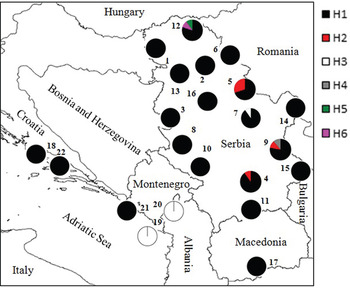
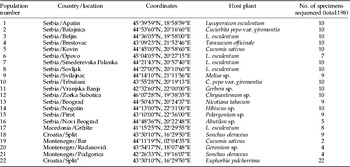
Trialeurodes vaporariorum populations were sampled during 2009–2012 from open fields or greenhouses in Serbia, Montenegro, Macedonia and coastal Croatia (fig. 1). Sampling locations and host plants are shown in table 1. Adult individuals were collected using a Pasteur pipette that was attached to a hand-held aspirator and were immediately preserved in absolute ethanol and stored at −20 °C until processing. After sampling, the pupal stages of T. vaporariorum were verified using a dissecting microscope to confirm the species. Genomic DNA of each individual T. vaporariorum female (n=10–20 per population) was extracted in lysis buffer, as previously described, and used for sweet potato whitefly B. tabaci (Gennadius) (Chiel et al., Reference Chiel, Gottlieb, Zchori-Fein, Mozes-Daube, Katzir, Inbar and Ghanim2007; Skaljac et al., Reference Skaljac, Zanic, Goreta Ban, Kontsedalov and Ghanim2010). Polymerase chain reaction (PCR) of mitochondrial cytochrome c oxidase I (mtCOI) was performed using a primer set created in this study: 5′ AGGCGGGGAAAATTGAAGTC 3′ (TCOF) and 5′ TAAACCCAAAAAGTGCTGAGG 3′ (TCOR), which produced a ∼500-bp product. PCR was carried out in a 20-μl volume containing 4 μl DNA lysate, 20 pm of each primer, 10 mM dNTP mix, 10X Dream Taq buffer (+MgCl2) and 5 units μl−1 of Dream Taq polymerase (Fermentas, Vilnius, Lithuania). The PCR products were visualised on a 1.5% agarose gel containing ethidium bromide. To verify the PCR products, the bands were eluted, and the DNA was sent for sequencing (3730xl DNA analyser, Macrogen Europe, Amsterdam, Netherlands). The sequences were compared with those in databases using the BLAST algorithm of NCBI.
Locations of the collected whitefly populations in Serbia, Montenegro, Macedonia and coastal Croatia according to the population numbers in table 1. Circles illustrate the appearance of haplotypes H1–H6.

Populations of Trialeurodes vaporariorum that were collected in this study and their host plants.

1 Population imported by trade from Slovenia (Čatež ob Savi).
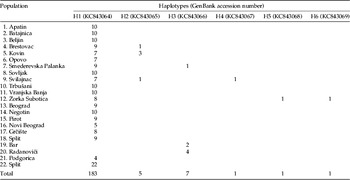
COI sequences were aligned using ClustalW (Higgins et al., Reference Higgins, Thompson and Gibson1996), implemented in MEGA5 (Tamura et al., Reference Tamura, Peterson, Peterson, Stecher, Nei and Kumar2011) and refined manually. We deposited one sequence per haplotype (KC843064–KC843069) into GenBank (table 2) as well as the sequences of all specimens that were analysed (KF921091–KF921288). DNA sequences obtained in the present study were compared with the corresponding sequences available at GenBank (table 4). Variable sites as well as different haplotypes were generated using DnaSP Ver. 5.10 (Librado & Rozas, Reference Librado and Rozas2009), and Bayesian analysis was performed using MrBayes 3.1 (Ronquist & Huelsenbeck, Reference Ronquist and Huelsenbeck2003) with four chains of 1,000,000 generations, trees sampled every 100 generations and a burnin value set to 25% of the sampled trees. The best-fit substitution model was used, as determined by the Akaike Information Criterion (Akaike, Reference Akaike1974), and implemented in jModelTest 0.1.1 (Posada, Reference Posada2008) with six substitution types (nst=6) and a proportion of the invariable sites (p-inv=0.4700). The phylogenetic tree was displayed using FigTree v1.3.1, and the haplotype network was constructed using the median joining (MJ) algorithm that was implemented into the Network v4.6.1.0 software (Bandlet et al., Reference Bandlet, Foster and Rohl1999) with the default settings.
Sites (populations) sampled and the number of Trialeurodes vaporariorum individuals that were analysed. The six COI haplotypes (H1–H6) and their corresponding GenBank accession numbers.

Results
DNA sequence variation and demographic analysis
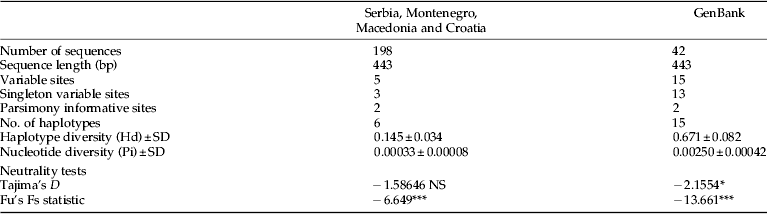
Genetic variability of the T. vaporariorum mitochondrial COI sequence was analysed for 16 populations from Serbia, and the results were compared with those for populations from neighbouring Montenegro (three populations), Macedonia (one population) and Croatia (two populations) (fig. 1). One hundred and ninety-eight individuals were examined (tables 2 and 3), and all sequences were 443-bp long. A low overall level of sequence divergence was found: only five variable nucleotides, two of which were parsimony informative and three were singletons (table 3). Six haplotypes were recorded (H1–H6), the haplotype (gene) diversity (Hd) in these specimens was very low (0.145±0.034), and the corresponding nucleotide diversity (Pi) was also very low (0.00033±0.00008). The most frequent haplotype, H1, was identified in 183 specimens in all Serbian populations and in 20 of the 22 analysed populations (fig. 1). The second-most frequent haplotype, H3, was identified in seven specimens, whereas haplotype H2 was identified in five specimens, and haplotypes H4–H6 were unique. The Tajima's D value (−1.58646, not significant) and Fu's Fs statistics (−6.649, P<0.01) for the entire sample were both negative and indicated an excess of low frequency polymorphisms in the populations, which could imply recent population expansion.
Variations in the COI sequences of specimens of Trialeurodes vaporariorum from Serbia, Montenegro, Macedonia and Croatia (this study) and sequences retrieved from GenBank (shown in table 4).

Statistical significance: *, P<0.05; **, P<0.02; *** P<0.01; NS – not significant.
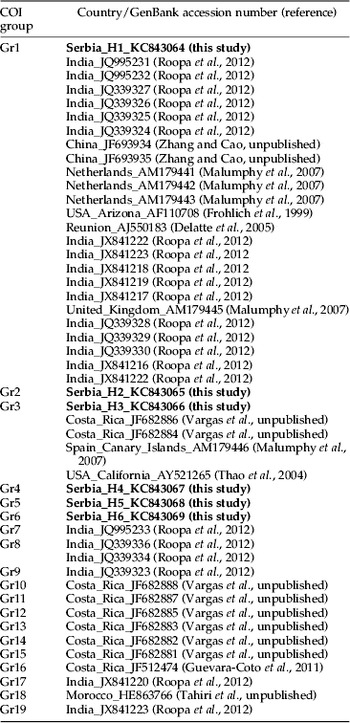
Classification of the global populations of Trialeurodes vaporariorum into 19 COI groups. The countries, GenBank accession numbers and references for T. vaporariorum sequences that were acquired from NCBI-GenBank for phylogenetic analysis are given.

We compared the sequences obtained in this study with those previously deposited into the GenBank. We retrieved 42 sequences from specimens that originated largely from India (Roopa et al., Reference Roopa, Krishna Kumar, Asokan, Rebijith, Mahmood and Verghese2012), Costa Rica, the Netherlands, China, the United Kingdom, Morocco, Spain and the USA (table 4). A 443-bp alignment revealed 15 variable sites (13 singletons and only two parsimony informative) and 15 haplotypes (table 3). In those specimens, the haplotype diversity and the corresponding nucleotide diversity were higher than in our study. Additionally, the Tajima's D value (−2.1554, P<0.05) and Fu's Fs statistics (−13.661, P<0.01) rejected the null hypothesis of constant population size (table 3).
Relationship between COI haplotypes and host plant species
There was no correlation between the T. vaporariorum COI haplotypes and the host plants that the specimens were collected from. Three different haplotypes of T. vaporariorum were collected from the host plants Cucumis sativus, Melisa sp. and Chrysantemum sp., whereas two haplotypes were found to infest Lycopersicon esculentum and Taraxacum officinale. Other host plants were infested with one haplotype, mostly H1, except for Geranium sp., which was infested with the H3 haplotype, as shown in Supplementary table 1. In conclusion, six haplotypes of T. vaporariorum were found to infest different plant species that belonged to horticultural and wild plants.
The phylogenetic relationship among all haplotypes of T. vaporariorum
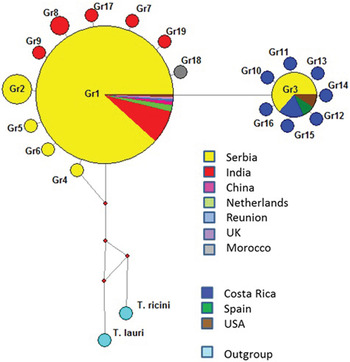
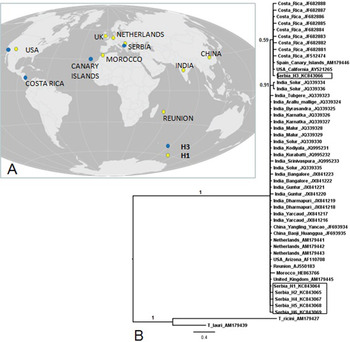
To establish the evolutionary relationships among the analysed populations and to possibly identify the geographic origin of the T. vaporariorum populations that colonised Serbia, Montenegro, Croatia and Macedonia, we performed a phylogenetic analysis of the COI haplotypes that originated from this study and the other T. vaporariorum populations that were retrieved from GenBank. The final COI dataset contained 240 sequences that were grouped into 19 haplogroups, Gr1–Gr19, of which 15 were unique (table 4). The MJ COI network resulted in two major haplogroups that corresponded to haplogroup 1 (containing haplotypes that were previously identified in India, China, the Netherlands, Reunion, the United States and the United Kingdom) and haplogroup 3 (haplotypes from Costa Rica, the USA and Spain) (figs 2 and 3A). Most of the Serbian haplotypes grouped within the world's most-frequent haplogroup, 1, and the single Serbian COI haplotype, H3, clustered within haplogroup 3 (fig. 2). A more detailed analysis showed that the difference between haplotypes H1 and H3 was limited to a single T-C substitution at position 154. An additional phylogenetic analysis was performed using the Bayesian inference (BI) method and included 50 COI sequences: H1–H6 haplotypes from this study, 42 COI sequences retrieved from the GenBank and COI sequences of Trialeurodes ricini and Trialeurodes lauri that were used as outgroups. The COI phylogenetic tree revealed a single, strongly supported clade (posterior probability (pp) of 1.0), where the five Serbian haplotypes, including the most frequent H1 haplotype (KC843064), clustered with haplotypes from India, China, USA, Morocco and several European countries. The single Serbian COI haplotype, H3 (KC843066), clustered into a separate though very weakly supported subclade (pp of 0.58) with haplotypes from America and Spain (fig. 3B).
Median-joining network for the COI haplotypes. Each circle represents a haplotype, and the circle size is proportional to the haplotype frequency. Colours indicate the geographic origin of the haplotypes. Branch lengths are approximately equal to the inferred mutational steps. The haplogroup codes are according to those in table 4.

(A) Global distribution of haplotypes H1 and H3. (B) Phylogenetic tree of T. vaporariorum based on COI and constructed using Bayesian inference. The haplotypes identified in Serbia are framed. Numbers on nodes are posterior probabilities. Scale indicates an expected number of substitutions per site.

Discussion
Low COI sequence variability of T. vaporariorum populations
This is the first study to analyse the genetic variation of greenhouse whitefly T. vaporariorum populations in Europe. Taking into consideration the number of tested individuals, it is also the largest phylogeographic study of this whitefly species. Our comparison of the sequence variability of a 443-bp long fragment of the COI gene based on 198 specimens that were sampled from Serbia and the neighbouring Macedonia, Montenegro and Croatia showed an overall low level of sequence divergence in this gene, with only five variable nucleotides and six haplotypes being identified. The most frequent haplotype, H1, has been identified in 92% of the studied specimens (183/198).
The notably low level of mtDNA variation that was found in the analysis of the COI mtDNA marker, as documented in this study for the southeast European T. vaporariorum populations and for the Indian populations (Roopa et al., Reference Roopa, Krishna Kumar, Asokan, Rebijith, Mahmood and Verghese2012), contrasts with the rather high biochemical and allozyme variations that were reported among Korean populations (Shin et al., Reference Shin, Mo, Lee, Park and Cho2013). The observed high variation in nuclear loci and low variation in mtDNA may be due to the small size of the founding populations, where genetic drift has had insufficient time to reduce the variation at the nuclear loci and the populations were successively expanded with a few founder females that were established in new geographic areas. A similar pattern of genetic variation has been observed in the Asian tiger mosquito, Aedes albopictus (reviewed in Žitko et al., Reference Žitko, Kovačić, Desdevises and Puizina2011) and some other invasive insects.
A lack of spatial genetic structure among the studied T. vaporariorum populations as well as both demographic tests that we performed (Tajima's D value and Fu's Fs statistics) confirmed an invasive status of T. vaporariorum and indicated recent colonisation events and population growth. The small number of founders and/or repeated population bottlenecks in conjunction with intensive trade of plant material could be responsible for the observed genetic uniformity of the analysed populations of T. vaporariorum. Reduced levels of genetic variation could also be a consequence of extensive insect control measures that include the removal of infestation sources and insecticide application that lead to a reduction and/or eradication of some T. vaporariorum populations.
An additional and/or alternative explanation for the absence of significant COI sequence variation in our data could be the potential influence of bacterial symbionts on T. vaporariorum population differentiation and indirect selection on mtDNA. The evidence of frequent linkage disequilibrium between mtDNA and bacterial symbionts is growing, particularly in arthropods (reviewed in Galtier et al., Reference Galtier, Nabholz, Gle´min and Hurst2009; Gueguen et al., Reference Gueguen, Vavre, Gnankine, Peterschmitt, Charif, Chiel, Gottlieb, Ghanim, Zchori-Fein and Fleury2010). According to Skaljac et al., (Reference Skaljac, Zanic, Goreta Ban, Kontsedalov and Ghanim2010, Reference Skaljac, Zanic, Hrncic, Radonjic, Perovic and Ghanim2013), T. vaporariorum populations from Croatia and Bosnia and Herzegovina harboured Arsenophonus and Hamiltonella bacterial symbionts, while a more diverse composition of bacterial symbionts was recorded in T. vaporariorum populations from Montenegro, where the populations harboured Rickettsia, Hamiltonella, Arsenophonus, Wolbachia and Cardinium. Currently, no data about the symbiont composition in the T. vaporariorum populations from Serbia have been published.
Although limited, the integrated COI sequence data indicate two likely, main haplogroups of T. vaporariorum
An analysis of the network relationships of invasive species provides a good opportunity to explore the geographic relationships of haplotypes and, from this, infer the geographic origin of the analysed specimens/populations. This can be important when reconstructing the patterns of spread from their respective native ranges if there is variation in the selected gene (Floyd et al., Reference Floyd, Lima, deWaard, Humble and Hanner2010; De Barro & Ahmed, Reference De Barro and Ahmed2011). COI barcoding is capable of fulfilling this need to the extent that different populations or subspecies carry distinct COI signatures, which are fully represented in the reference database (Floyd et al., Reference Floyd, Lima, deWaard, Humble and Hanner2010). A number of successful applications of COI in phylogeographic studies has been reported, e.g., in Gypsy moth Lymantria dispar, which is a major forestry pest (Bogdanowicz et al., Reference Bogdanowicz, Wallner, Bell, ODell and Harrison1993, Reference Bogdanowicz, Schaefer and Harrison2000; Armstrong & Ball, Reference Armstrong and Ball2005; Ball & Armstrong, Reference Ball and Armstrong2006), Mediterranean fruit fly Ceratitis capitata (Barr, Reference Barr2009), cactus moth Cactoblastis cactorum (Simonsen et al., Reference Simonsen, Brown and Sperling2008), cotton pest Oxycarenus hyalinipennis (Nagoshi et al., Reference Nagoshi, Paraiso, Brambila and Kairo2012) and Asian citrus psyllid Diaphorina citri (Boykin et al., Reference Boykin, De Barro, Hall, Hunter, McKenzie, Powell and Shatters2012b ). For the sweet potato whitefly B. tabaci, COI analysis proved to be useful for its phylogeography (e.g., Frohlich et al., Reference Frohlich, Torres-Jerez, Bedford, Markham and Brown1999; Boykin et al., Reference Boykin, Shatters, Rosell, McKenzie, Bagnall, De Barro and Frohlich2007; Dinsdale et al., Reference Dinsdale, Cook, Riginos, Buckley and De Barro2010; De Barro & Ahmed, Reference De Barro and Ahmed2011; Hu et al., Reference Hu, De Barro, Zhao, Wang, Nardi and Lui2011; Boykin et al., Reference Boykin, Armstrong, Kubatko and De Barro2012a , Reference Boykin, De Barro, Hall, Hunter, McKenzie, Powell and Shatters b ).
The two most frequent haplogroups of T. vaporariorum that were identified in this study were Gr1 (including the predominant Serbian haplotype H1) and Gr3 (including the Serbian haplotype H3) (fig. 3A), which differed by only a single unique nucleotide (a single C-T substitution at the position 154). This difference, although very small, is indicative of two major, putative haplogroups and two possibly different centres of origin and distribution of T. vaporariorum populations. Haplotype H3 is shared among populations from Costa Rica, the USA and Spanish Canary Islands (fig. 3A). Except for a single specimen in the USA, the H1 haplogroup has not been found in the Americas, although our study showed that it is widespread in Europe and Asia.
Six specimens of T. vaporariorum belonging to haplotype H3 were found in Montenegro, and a single specimen was found in Serbia. Provided that haplogroups 1 and 3 originate in different native ranges, such data may suggest that several source populations and repeated introductions occurred.
Although the data presented in this study indicate a very low variability of COI sequences in the investigated area, they can be useful in future studies on population genetics and the spread of T. vaporariorum. It would be useful if those studies would correlate the compositions of symbiotic community with COI mtDNA diversity. Furthermore, because the variations in the mtDNA sequences were rather small, analyses using more variable, neutral nuclear markers and a more extensive sampling of populations, particularly in the native range, are needed to deepen our understanding of the biology, ecology and spread of this damaging and invasive insect pest.
The supplementary material for this article can be found at http://www.journals.cambridge.org/BER
Acknowledgements
The authors would like to thank Snježana Hrnčić from the Biotechnical Faculty in Podgorica, Montenegro and Stanislava Lazarevska from the Faculty of Agriculture in Skopje, Macedonia, for their valuable help. This study was partially funded by the Ministry of Education, Science and Technological Development of the Republic of Serbia grant no. TR 31043 and by the Ministry of Science, Education and Sports of the Republic of Croatia grant nos. 091-0910468-0281 and 177-11911196-0829. The authors also thank the two anonymous reviewers for their helpful comments and suggestions, which improved the final version of the manuscript.