Highlights
-
APOE-ϵ4 carriers with dementia had more amyloidosis, tauopathy and synucleinopathy.
-
In DLB, functionality, motor impairment and shorter sleep were associated with tauopathy, longer sleep was associated with synucleinopathy, and impairments in daily motor and non-motor experiences were associated with amyloidosis.
-
In AD, motor impairment was associated with cerebrospinal fluid ubiquitin.
Introduction
Motor and non-motor experiences of daily living are impaired in different dementia syndromes, including those that are specifically associated with parkinsonism, such as dementia with Lewy bodies (DLB) and Parkinson’s disease dementia, Reference Oliveira, Machado and Sampaio1 and those for which such manifestations may increase dementia risk, such as Alzheimer’s disease (AD). Reference Aggarwal, Wilson, Beck, Bienias and Bennett2 Mild parkinsonism can be found in normal aging, idiopathic Parkinson’s disease and AD. Reference Hogan, Fiest and Roberts3 Associations of specific biomarkers with motor and non-motor experiences of daily living might help in differential diagnosis, Reference Russo, Carrarini and Di Iorio4 in optimizing the selection of participants and reducing the duration of clinical trials for the development of disease-modifying therapies, and in the personalization of therapeutic interventions and prognostic estimates. Reference Ferreira, Przybelski and Lesnick5
Aggregates of α-synuclein are the main components of Lewy bodies. Reference Kapaki, Paraskevas, Emmanouilidou and Vekrellis6 The toxic effects of α-synuclein oligomers in synucleinopathies include neuroinflammatory mechanisms that lead to synaptic dysfunction Reference De Oliveira, Miraldo and De Castro-Neto7 and to impaired integrity of the cell membrane and of intracellular processes of protein catabolism, resulting in greater release of α-synuclein into the cerebrospinal fluid. Reference Kapaki, Paraskevas, Emmanouilidou and Vekrellis6 Misfolded forms of tau and α-synuclein can be ubiquitinated in the neuronal cytoplasm before accumulating in different neurodegenerative diseases, while growing evidence shows that misfolded α-synuclein can be propagated from cell to cell in a prion-like manner. Reference Roussel, Kruppa, Miranda, Crowther, Lomas and Marciniak8
Although amyloid-β (Aβ) pathology is one of the main pathological features of AD, it can also be found in about half of patients with DLB, Reference De Oliveira, Miraldo and Castro-Neto9 thus leading to frequent misdiagnoses between the two most common primary forms of neurodegenerative dementia. Reference Hogan, Fiest and Roberts3 Concerning cerebrospinal fluid biomarkers, the Aβ 42/Aβ 40 ratio is a marker of plaque pathology, tau and phospho-tau Thr181 are markers of changes in axonal tau metabolism, phosphorylation and secretion (leading to the formation of ubiquitinated neurofibrillary tangles), and neurofilament light (NfL) is a marker of neurodegeneration. Reference De Oliveira, Miraldo and De Castro-Neto7 In AD, α-synuclein can act synergistically with both tau and Aβ to promote their aggregation, potentially affected by carriership of the ϵ 4 allele of APOE (apolipoprotein E gene) Reference De Oliveira, Miraldo and De Castro-Neto7 and reflecting the connection among proteins involved in different pathological cellular mechanisms.
When it comes to late-onset AD, the most relevant gene (though not essential for the development of the disease) is APOE: it increases disease susceptibility and is associated with earlier dementia onset, modulates the frequency of most behavioral symptoms, leads to dysfunction of the blood–brain barrier and inefficient neural repair, cerebral deposition of amyloid, dissemination of neurofibrillary tangles, α-synuclein spreading, faster brain atrophy and pleiotropic effects and interactions with other genes. Reference Oliveira10 Harmful prospective effects of second-generation antipsychotics and antiepileptic drugs on cognitive and functional changes in AD have also been described only for APOE-ϵ4 non-carriers. Reference De Oliveira, Almeida, Chen, Smith and Bertolucci11 Nevertheless, cerebrospinal fluid apolipoprotein E is not considered a viable biomarker for cognitive, functional or motor decline in AD. Reference Schmidt, Gerlach and Peter12 On the other hand, given its importance also for Lewy body dementia syndromes and the potential co-pathology with AD, it is recommended that APOE-ϵ4 carriership be taken into account in most studies with cerebrospinal fluid biomarkers for proper pathophysiological links. Reference De Oliveira, Miraldo and Castro-Neto13
The aim of this study was to investigate differential associations of cerebrospinal fluid biomarkers of brain pathology with motor and non-motor experiences of daily living in DLB and AD, compared with cognitively healthy controls, and taking APOE-ϵ4 carriership and demographic features into account in the analyses.
Methods
Participants and clinical assessment
The study design was cross-sectional, conducted at the Behavioral Neurology Section of Hospital São Paulo, in São Paulo, Brazil, after approval by the Ethics Committee. Consecutive outpatients with probable DLB according to the fourth consensus report of the DLB Consortium Reference McKeith, Boeve and Dickson14 were recruited, followed by outpatients with late-onset dementia due to AD based on the 2011 National Institute on Aging – Alzheimer’s Association criteria, Reference McKhann, Knopman and Chertkow15 matched by sex and exact scores on the Clinical Dementia Rating and the Mini-Mental State Examination. For all patients with DLB, the dementia syndrome had to start at least 1 year before the onset of parkinsonism (otherwise, they could have Parkinson’s disease dementia), while late-onset AD corresponded to dementia onset after 65 years old. Reference Oliveira, Machado and Sampaio1 All patients with dementia were willing to participate in the research (along with their caregivers), and all of them had a magnetic resonance imaging exam to exclude vascular lesions or mass lesions and to evaluate either medial parietal or medial, basal or lateral temporal atrophy. The Modified Ischemic Score Reference Loeb and Gandolfo16 was employed to exclude vascular dementia or mixed dementia, in which patients with DLB or AD could not score more than 2. Finally, patients with DLB were matched with cognitively healthy controls (who had to score zero on the Clinical Dementia Rating) by sex and age (± 2 years). All participants were recruited from September 2015 to October 2017.
Controls could not have a history of brain disease and had to be willing to participate and undertake the same neurological tests as patients with dementia. They were mostly recruited from the Orthopedics inpatient clinic and typically had hand or hip fractures, so collection of cerebrospinal fluid had to take place during anesthetic induction right before surgery.
Patients and controls were assessed for sex, education, age at dementia onset (for patients only) and at inclusion in the study, use of cognitive enhancers or Levodopa, subjective sleep duration, Reference De Oliveira, Bertolucci, Chen and Smith17 and scores on the Clinical Dementia Rating, Reference Chaves, Camozzato and Godinho18 the Mini-Mental State Examination, Reference Bertolucci, Brucki, Campacci and Juliano19 the Schwab & England scale and the Movement Disorder Society – Unified Parkinson’s Disease Rating Scale (MDS-UPDRS) Reference Goetz, Tilley and Shaftman20 parts I (non-motor aspects of experiences of daily living), II (motor aspects of experiences of daily living), III (motor examination), IV (motor complications) and V (Hoehn & Yahr stages). Except for the Mini-Mental State Examination and the motor exam, all information collected from patients with dementia was confirmed or scored by frequent caregivers. All assessments were conducted on weekdays in the morning time by the first author.
None of the participants could have an active infection, or be using antibiotics or antiviral drugs, so as not to interfere with biomarker results in the analyses of cerebrospinal fluid (particularly Aβ isoforms). Additionally, participants would be excluded if collection of cerebrospinal fluid by way of a spinal tap was impossible.
Cerebrospinal fluid analyses
Collection and biobanking of cerebrospinal fluid were based on a traditional consensus, Reference Teunissen, Petzold and Bennett21 and previously described in detail. Reference De Oliveira, Miraldo and De Castro-Neto7 All cerebrospinal fluid analyses were performed randomized and in duplicates on the same week for each analyte by two of the authors who were blinded to the clinical information.
Cerebrospinal fluid biomarkers were assessed by enzyme-linked immunosorbent assays: Aβ 42 (Elabscience, Wuhan, China); Aβ 40 (Phoenix Pharmaceuticals, Burlingame, USA); Aβ 38 (EUROIMMUN, Lübeck, Germany); tau and phospho-tau Thr181 (INNOTEST ELISA, Fujirebio, Ghent, Belgium); α-synuclein (BioLegend, San Diego, USA); and ubiquitin and NfL (Cloud-Clone, Houston, USA). The lower limits of detection of all analytes were Aβ 42 (9.4 pg/ml), Aβ 40 (6.3 pg/ml), Aβ 38 (0.1 pg/ml), total tau (43.3 pg/ml), phospho-tau Thr181 (15.6 pg/ml), α-synuclein (6.1 pg/ml), ubiquitin (0.1 ng/ml) and NfL (6.5 pg/ml). Intra-assay variation (within-assay precision for samples that were replicated on the same plate) for each of the analytes was 14% for Aβ 42, 6% for Aβ 40, 6% for Aβ 38, 10% for total tau, 10% for phospho-tau Thr181, 9% for α-synuclein, 11% for ubiquitin and 12% for NfL.
Genotyping
Genomic DNA was extracted from whole blood using a standard salting-out procedure for the determination of APOE haplotypes. Genotyping of rs7412 and rs429358 followed the standard protocols of real-time polymerase chain reactions using TaqMan® SNP Genotyping Assays on the Applied Biosystems 7,500 Fast Real-Time PCR System (Applied Biosystems®, Foster City, USA). Genotyping procedures were carried out only after clinical data were collected from all patients.
Outcome measures
The main outcome measure was the distinctive score in each motor or non-motor test according to variations in cerebrospinal fluid biomarkers or their ratios for each dementia syndrome. Second, variations in cerebrospinal fluid biomarkers and their ratios according to APOE-ϵ4 carriership were assessed for each group (DLB, AD and controls).
Statistical analyses
Absolute values of biomarkers were treated as continuous measures; additionally, some ratios were analyzed with the aim to correct for inter-individual differences in the dynamics of the cerebrospinal fluid and to reduce the impact of pre-analytical factors on isolated biomarkers: Aβ 42/Aβ 40, Aβ 42/Aβ 38, tau/phospho-tau Thr181, phospho-tau Thr181/Aβ 42, α-synuclein/Aβ 42 and tau/ubiquitin. The chi-square test was used for comparisons of discrete variables, while the Mann–Whitney test (for two groups) and the Kruskal–Wallis test (for three groups) were used for comparisons of clinical features, cerebrospinal fluid biomarkers and ratios. Subjective sleep duration, functional and motor scores were then logarithmically transformed to meet the normality assumptions for a general linear model that was employed for associations of these same scores with every independent biomarker or ratio for each group (DLB, AD and controls) and adjusted for the following covariates: sex, age and the number of APOE-ϵ4 alleles. Significant results from the general linear model were corrected for false discovery rates to minimize the occurrence of type I errors but, due to the preliminary nature of this study, final results were presented with and without the correction. Significance was set at p < 0.05. All analyses were performed using IBM® SPSS® Statistics version 24.0 (IBM® Corporation, Armonk, USA).
Results
In the end, 27 consecutive outpatients with DLB were included and were paired with 27 outpatients with AD and 27 controls; two-thirds were women.
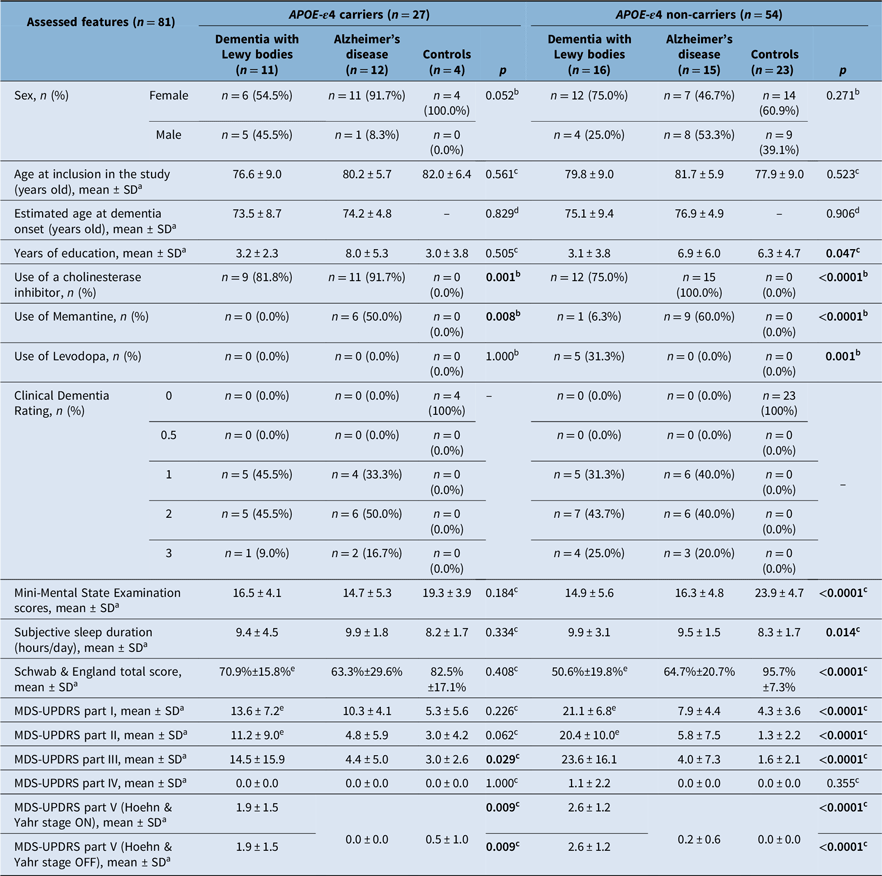
Table 1 shows demographic and clinical results for all participants, stratified according to APOE-ϵ4 carriership. Among APOE-ϵ4 non-carriers, those with DLB had lower levels of education, lower Mini-Mental State Examination scores and lower Schwab & England total scores and were the only group that used Levodopa; they also had longer subjective sleep duration than APOE-ϵ4 non-carriers with AD and controls. Only among APOE-ϵ4 non-carriers, scores on MDS-UPDRS parts I and II were higher for patients with DLB, while all patients with DLB had higher scores on MDS-UPDRS parts III and V, regardless of APOE-ϵ4 carriership. No significant differences among groups were found regarding the MDS-UPDRS part IV. When comparing APOE-ϵ4 carriers and APOE-ϵ4 non-carriers from each group, the following differences were found: APOE-ϵ4 non-carriers with DLB had lower Schwab & England total scores and higher scores on MDS-UPDRS parts I and II than APOE-ϵ4 carriers with DLB; no differences were found between APOE-ϵ4 carriers and APOE-ϵ4 non-carriers with AD or controls.
Demographic and clinical results according to APOE-ϵ4 carriership

a SD = standard deviation.
b Chi-square test.
c Kruskal–Wallis test.
d Mann–Whitney test.
e The Mann–Whitney test was also employed for comparisons of quantitative variables between APOE-ϵ4 carriers and APOE-ϵ4 non-carriers from each group. The following differences between APOE-ϵ4 carriers and APOE-ϵ4 non-carriers were found for dementia with Lewy bodies: Schwab & England total scores (p = 0.009); MDS-UPDRS part I (p = 0.023) and MDS-UPDRS part II (p = 0.025); all other differences were non-significant for dementia with Lewy bodies (p > 0.064). No differences between APOE-ϵ4 carriers and APOE-ϵ4 non-carriers were significant for Alzheimer’s disease (p > 0.107) or for controls (p > 0.071).
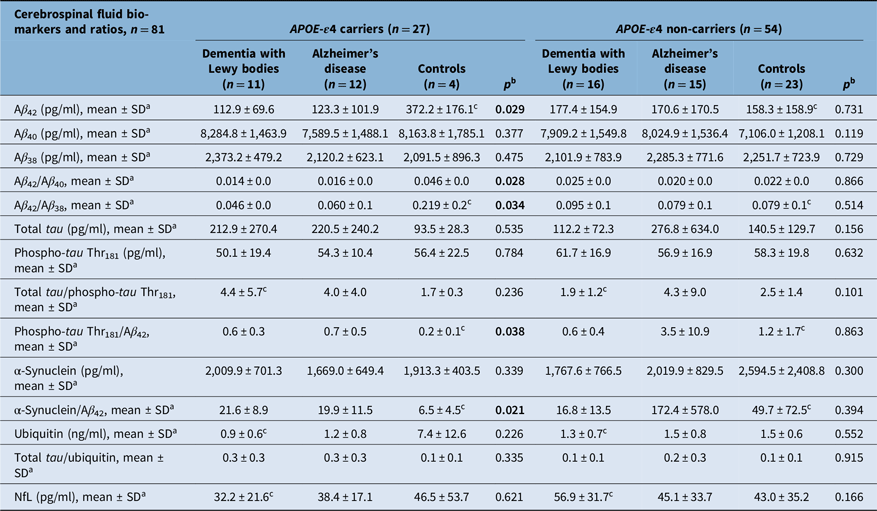
Table 2 shows the distribution of cerebrospinal fluid biomarkers and ratios according to APOE-ϵ4 carriership. Significant differences were found only among APOE-ϵ4 carriers: those with dementia had lower Aβ 42, Aβ 42/Aβ 40 and Aβ 42/Aβ 38 ratios, which were even lower for those who had DLB; those with dementia also had higher phospho-tau Thr181/Aβ 42 and α-synuclein/Aβ 42 ratios. When comparing APOE-ϵ4 carriers and APOE-ϵ4 non-carriers from each group, the following differences were found: APOE-ϵ4 non-carriers with DLB had lower cerebrospinal fluid tau/phospho-tau Thr181 and higher cerebrospinal fluid ubiquitin and NfL than APOE-ϵ4 carriers with DLB; no differences were found between APOE-ϵ4 carriers and APOE-ϵ4 non-carriers with AD; concerning controls, APOE-ϵ4 non-carriers had lower cerebrospinal fluid Aβ 42, lower Aβ 42/Aβ 38 ratio and higher phospho-tau Thr181/Aβ 42 and α-synuclein/Aβ 42 ratios than APOE-ϵ4 carriers.
Cerebrospinal fluid biomarkers and ratios according to APOE-ϵ4 carriership

a SD = standard deviation.
b Kruskal–Wallis test.
c The Mann–Whitney test was employed for comparisons of quantitative variables between APOE-ϵ4 carriers and APOE-ϵ4 non-carriers from each group. The following differences between APOE-ϵ4 carriers and APOE-ϵ4 non-carriers were found for dementia with Lewy bodies: total tau/phospho-tau Thr181 (p = 0.029); ubiquitin (p = 0.038); NfL (p = 0.034); all other differences were non-significant for dementia with Lewy bodies (p > 0.064). No differences between APOE-ϵ4 carriers and APOE-ϵ4 non-carriers were significant for Alzheimer’s disease (p > 0.107). The following differences between APOE-ϵ4 carriers and APOE-ϵ4 non-carriers were found for controls: Aβ 42 (p = 0.034); Aβ 42/Aβ 38 (p = 0.017); phospho-tau Thr181/Aβ 42 (p = 0.041); α-synuclein/Aβ 42 (p = 0.029); all other differences were non-significant for controls (p > 0.071).
Figure 1 shows the main effects concerning APOE-ϵ4 carriers in comparison to participants who were APOE-ϵ4 non-carriers.
Main effects of APOE-ϵ4 carriership on the findings of the study (in comparison to participants who were APOE-ϵ4 non-carriers).

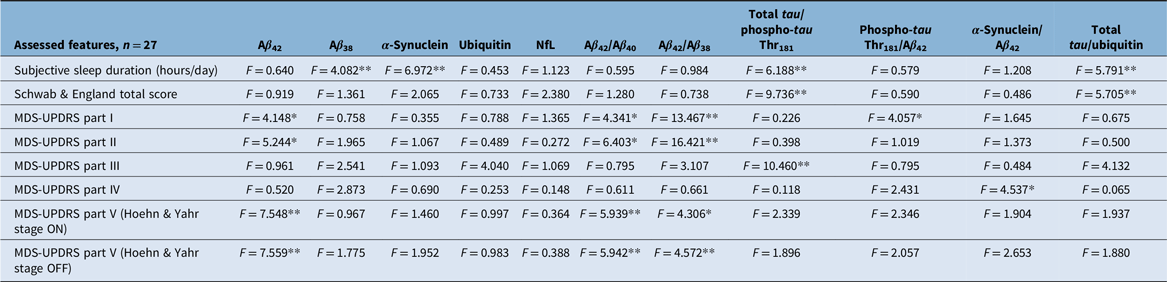
Table 3 shows associations between motor and non-motor test scores and cerebrospinal fluid biomarkers and their respective ratios for patients with DLB. The following significant trends were found: subjective sleep duration was associated with Aβ 38 and α-synuclein and inversely associated with tau/phospho-tau Thr181 and tau/ubiquitin; Schwab & England total scores were associated with tau/ubiquitin and inversely associated with tau/phospho-tau Thr181; MDS-UPDRS parts I and II were associated with Aβ 42, Aβ 42/Aβ 40 and Aβ 42/Aβ 38, while the MDS-UPDRS part I was also inversely associated with phospho-tau Thr181/Aβ 42; the MDS-UPDRS part III was associated with tau/phospho-tau Thr181; the MDS-UPDRS part IV was associated with α-synuclein/Aβ 42; MDS-UPDRS part V both ON and OFF was associated with Aβ 42, Aβ 42/Aβ 40 and Aβ 42/Aβ 38.
Associations between logarithmically transformed scores of motor and non-motor tests and independent cerebrospinal fluid biomarkers and their respective ratios for patients with dementia with Lewy bodies

Note: General linear model adjusted for sex, age and number of APOE-ϵ4 alleles: *, significant p < 0.05 (uncorrected); **, significant p < 0.05 (corrected for false discovery rates).
We conducted a sensitivity analysis to verify if use of Levodopa affected the assessed scores for APOE-ϵ4 non-carriers with DLB (n = 16). Since five of these patients used Levodopa, and none from the other groups did, only APOE-ϵ4 non-carriers with DLB entered the sensitivity analysis. We did not find significant differences regarding MDS-UPDRS parts I (p = 0.651), II (p = 0.213), III (p = 0.571), V ON (p = 0.533) or V OFF (p = 0.821), the Schwab & England scale (p = 0.611), or subjective sleep duration (p = 0.428). We did find higher scores of the MDS-UPDRS part IV for those who used Levodopa (p = 0.013), while all those who did not scored zero, which is expected given the fact that these scores reflect motor complications of therapy. Since the MDS-UPDRS part IV was associated only with α-synuclein/Aβ 42 in patients with DLB, and this association did not survive corrections for false discovery rates, we conclude that the effects of Levodopa therapy over the associations found were negligible.
Table 4 shows associations between motor and non-motor test scores and cerebrospinal fluid biomarkers and their respective ratios for patients with AD. The following significant trends were found: MDS-UPDRS parts I and II were associated with NfL; the MDS-UPDRS part III was associated with ubiquitin; and the MDS-UPDRS part V was inversely associated with Aβ 38.
Associations between logarithmically transformed scores of motor and non-motor tests and independent cerebrospinal fluid biomarkers and their respective ratios for patients with late-onset Alzheimer’s disease

Note: General linear model adjusted for sex, age and number of APOE-ϵ4 alleles: *, significant p < 0.05 (uncorrected); **, significant p < 0.05 (corrected for false discovery rates).
For patients with AD, associations of the MDS-UPDRS part IV with biomarkers could not be established because none of them scored different from zero. In addition, the MDS-UPDRS part V was calculated as a single score (not ON and OFF) both for patients with AD and for controls because none of them used dopaminergic drugs.
After corrections for false discovery rates, the following findings remained significant: in DLB, subjective sleep duration was associated with Aβ 38 and α-synuclein and inversely associated with tau/phospho-tau Thr181 and tau/ubiquitin, Schwab & England total scores were associated with tau/ubiquitin and inversely associated with tau/phospho-tau Thr181, MDS-UPDRS parts I and II were associated with Aβ 42/Aβ 38, the MDS-UPDRS part III was associated with tau/phospho-tau Thr181, and MDS-UPDRS part V both ON and OFF was associated with Aβ 42 and Aβ 42/Aβ 40, and the MDS-UPDRS part V OFF was also associated with Aβ 42/Aβ 38; in AD, the MDS-UPDRS part III was associated with ubiquitin.
Figure 2 shows the most representative associations for patients with DLB and for patients with AD.
Associations between sleep duration, functionality and MDS-UPDRS scores with cerebrospinal fluid biomarkers and their respective ratios for patients with dementia (with raw data). Dementia with Lewy bodies: (A) sleep duration was associated with Aβ 38; (B) sleep duration was associated with α-synuclein; (C) sleep duration was inversely associated with tau/phospho-tau Thr181; (D) sleep duration was inversely associated with tau/ubiquitin; (E) the Schwab & England scale was inversely associated with tau/phospho-tau Thr181; (F) the Schwab & England scale was associated with tau/ubiquitin; (G) MDS-UPDRS part I (non-motor experiences of daily living) was associated with Aβ 42/Aβ 38; (H) MDS-UPDRS part II (motor experiences of daily living) was associated with Aβ 42/Aβ 38; (I) MDS-UPDRS part III (motor examination) was associated with tau/phospho-tau Thr181; (J) MDS-UPDRS part V (Hoehn & Yahr stages) ON was associated with Aβ 42; (K) MDS-UPDRS part V (Hoehn & Yahr stages) ON was associated with Aβ 42/Aβ 40; (L) MDS-UPDRS part V (Hoehn & Yahr stages) OFF was associated with Aβ 42; (M) MDS-UPDRS part V (Hoehn & Yahr stages) OFF was associated with Aβ 42/Aβ 40; (N) MDS-UPDRS part V (Hoehn & Yahr stages) OFF was associated with Aβ 42/Aβ 38. Alzheimer’s disease: (O) MDS-UPDRS part III (motor examination) was associated with ubiquitin.

Discussion
Demographic and clinical findings
Lower levels of education among APOE-ϵ4 non-carriers with DLB might have been reflected in lower Mini-Mental State Examination scores, while worse functionality followed longer subjective sleep duration and worse performance on motor and non-motor experiences of daily living. This is expected because worse motor performance is more prevalent when parkinsonism is more evident, also affecting sleep and physical self-maintenance. Reference Oliveira, Machado and Sampaio1
The MDS-UPDRS was originally validated for Parkinson’s disease but is a widely used scale for the assessment of motor and non-motor features of older people with different dementia syndromes; therefore, it was chosen to enable comparability to other studies. All patients with DLB had higher scores on MDS-UPDRS parts III and V, regardless of APOE-ϵ4 carriership, which is in line with the fact that parkinsonian signs are expectedly more prevalent in DLB. No significant differences among groups were found regarding the MDS-UPDRS part IV, which is also expected because few patients with DLB used Levodopa, and none in the other groups.
The finding that APOE-ϵ4 non-carriers with DLB had lower Schwab & England total scores and higher scores on MDS-UPDRS parts I and II than APOE-ϵ4 carriers with DLB was probably due to chance, with APOE-ϵ4 non-carriers with DLB being more impaired in motor and non-motor experiences of daily living.
Cerebrospinal fluid biomarkers
Significant differences concerning cerebrospinal fluid biomarkers were found only among APOE-ϵ4 carriers: amyloid pathology was more intense for patients with dementia, and even more intense for those with DLB, reflecting the high level of AD co-pathology in APOE-ϵ4 carriers with DLB. Reference De Oliveira, Miraldo and Castro-Neto13 Amyloid biomarkers in patients with DLB were more similar to those of patients with AD when they were APOE-ϵ4 non-carriers. As previously described, amyloid co-pathology in DLB is more frequent in APOE-ϵ4 carriers and may potentially predict lower cognitive performance when considered in combination with tau pathology. Reference Ferreira, Przybelski and Lesnick5 On the other hand, NfL may be involved in the formation of Lewy bodies but may also increase with aging, Reference De Oliveira, Miraldo and Castro-Neto9 potentially explaining the non-significant differences among groups in the present study.
APOE-ϵ4 carriers with DLB had higher cerebrospinal fluid tau/phospho-tau Thr181 than APOE-ϵ4 non-carriers with DLB; this is not a universal finding Reference Ferreira, Przybelski and Lesnick5 but demonstrates that APOE-ϵ4 carriership affects tauopathy in DLB. APOE-ϵ4 non-carriers with DLB were more impaired in motor and non-motor experiences of daily living, potentially explaining the higher levels of ubiquitin and NfL than in APOE-ϵ4 carriers with DLB. APOE-ϵ4 carriership influenced α-synuclein/Aβ 42 but not α-synuclein in isolation, which is not unexpected because there seems to be no consensus on whether cerebrospinal fluid α-synuclein levels actually rise or fall in most neurodegenerative diseases. Reference Kapaki, Paraskevas, Emmanouilidou and Vekrellis6
Concerning controls, APOE-ϵ4 non-carriers had cerebrospinal fluid evidence of amyloid pathology, tauopathy and synucleinopathy more often than APOE-ϵ4 carriers. Though unexpected at first sight, this finding could be explained by a survival effect. In addition, the older ages of our participants might have contributed to less significant differences in biomarkers of amyloid pathology and tauopathy between patients with dementia and controls. Reference De Oliveira, Miraldo and Castro-Neto13
Associations between sleep duration and cerebrospinal fluid biomarkers
Only in DLB, longer sleep was associated with Aβ 38 and α-synuclein, while shorter sleep was associated with measures of tauopathy. One study had previously shown that lower cerebrospinal fluid α-synuclein was associated not only with disrupted sleep but also with both excessive and insufficient sleep duration in cognitively healthy older people Reference Wang, Liu and Bi22 The association between sleep disturbances and dementia is considered bidirectional, where poorer sleep affects dementia risk, Reference Ownby, Saeed and Wohlgemuth23 and the brain’s ability to produce healthy sleep is impaired by neurodegeneration, amyloid pathology and synucleinopathy. Reference Oliveira and Tarawneh24 Overall, prolonged sleep duration has been associated with smaller brain volumes, more executive dysfunction and higher risk of dementia. Reference Westwood, Beiser and Jain25 Moreover, it had previously been reported that sleep duration does not depend on APOE-ϵ4 carriership in AD. Reference De Oliveira, Bertolucci, Chen and Smith17 Larger studies with a broader range of biomarkers are required to elucidate the relationship of sleep duration with neuropathology in different dementia syndromes.
Associations between functionality and cerebrospinal fluid biomarkers
Schwab & England total scores were associated with measures of tauopathy only in DLB. The association of tauopathy with worse instrumental functionality had previously been described for patients with DLB, but not for AD. Reference De Oliveira, Miraldo and Castro-Neto9 Considering patients in the same dementia stages, motor impairment is more intense in DLB than in AD, leading to worse functional independence. Reference De Oliveira26
Associations between the MDS-UPDRS and cerebrospinal fluid biomarkers in DLB
It had previously been described that scores of MDS-UPDRS parts I and II are associated with each other in early Parkinson’s disease, while worsening non-motor symptoms were associated with lower cerebrospinal fluid Aβ 42. Reference Simuni, Caspell-Garcia and Coffey27 Our findings expand on such associations by demonstrating that scores of MDS-UPDRS parts I and II were associated with measures of amyloid pathology in DLB.
The postural instability and gait disorder phenotype in patients with DLB has been associated with cerebrospinal fluid biomarkers of amyloid pathology and tauopathy, compatible with more AD co-pathology, Reference Walker, Cousins and Siderowf28 though this is not a universal finding. Reference Ferreira, Przybelski and Lesnick5 We found a stronger association of MDS-UPDRS part III scores with measures of tauopathy, in line with a longitudinal study that showed associations of cerebrospinal fluid measures of tauopathy with motor deterioration and cognitive decline in patients with Parkinson’s disease, though potentially through interactions with α-synuclein. Reference Xu, Huang and Feng29 Given the fact that isoforms of tau and α-synuclein aggregate within Lewy bodies, Reference De Oliveira, Miraldo and De Castro-Neto7 we also found that the MDS-UPDRS part IV was associated with α-synuclein/Aβ 42, but this association did not survive corrections for false discovery rates.
MDS-UPDRS part V both ON and OFF was associated with higher cerebrospinal fluid Aβ 42 and its ratios reflecting less cerebral amyloid. While this is an unexpected finding, it could reflect more amyloid pathology in patients with less motor impairment, while those with more motor impairment could be more affected by other forms of neuropathology. In addition, cerebrospinal fluid Aβ 42/Aβ 40 is a bimodal marker (normal or abnormal) without a clear relationship between the degree of change and the neuropathological extent. Reference De Oliveira, Miraldo and Castro-Neto13 Although it is still unclear whether the contributions of amyloid pathology and tauopathy to the clinical phenotypes in DLB are isolated or synergistic, our findings point to the first hypothesis.
Associations between the MDS-UPDRS and cerebrospinal fluid biomarkers in AD
Motor disturbances in AD, reflected by high MDS-UPDRS part III scores, have been associated with low Aβ 42, but not with tau or phospho-tau Thr181. Reference Schirinzi, Di Lorenzo and Sancesario30 We found an inverse association of the MDS-UPDRS part V with Aβ 38 that did not survive corrections for false discovery rates. Concerning the MDS-UPDRS part III in AD, the only significant association was with ubiquitin, probably reflecting the formation of neurofibrillary tangles affecting motor performance. The MDS-UPDRS part III has also been associated with cerebrospinal fluid soluble triggering receptor expressed on myeloid cells 2 (sTREM2) in patients with Parkinson’s disease, Reference Al-Abdulrasul, Ajalin and Tuisku31 a traditional biomarker of neuroinflammation in AD that should be studied in association with biomarkers of neurodegeneration in longitudinal cohorts. Reference Bettcher, Oliveira and Willette32
Even though the associations of MDS-UPDRS parts I and II with NfL did not survive corrections for false discovery rates, it has been described that cerebrospinal fluid NfL predicts worse non-motor symptoms and depressed mood in Parkinson’s disease, indicating its potential usefulness as a longitudinal biomarker also in AD because widespread neurodegeneration might underlie a greater non-motor burden. Reference Urso, Batzu, Logroscino, Chaudhuri and Pereira33
One cerebrospinal fluid study has shown that, when adjusted for sex, education, age, dementia duration, number of APOE-ϵ4 alleles and use of psychotropic drugs, agitation and night-time behavior disturbances are associated with measures of tauopathy, while delusions are associated with tauopathy and indirect measures of amyloidogenesis in AD. Reference De Oliveira, Miraldo and De Castro-Neto7 Other studies suggest that analyses of cerebrospinal fluid biomarkers of amyloid pathology and tauopathy may help differentiate psychosis associated with neurodegenerative conditions from that associated with primarily psychiatric disorders. Reference Agüera-Ortiz, Babulal and Bruneau34 Behavioral symptoms are important components of non-motor experiences of daily living, Reference Jellinger35 though, since no associations of amyloid or tau biomarkers with the MDS-UPDRS part I were found, it is likely that this is not the best instrument to assess such associations.
Associations of the MDS-UPDRS part IV with biomarkers could not be established because none of the patients with AD scored different from zero. In addition, the MDS-UPDRS part V was calculated as a single score (not ON and OFF) both for patients with AD and for controls because none of them used dopaminergic drugs.
Final considerations
One major strength of this study is that APOE-ϵ4 carriership and essential demographic features were taken into account in the analyses. However, the cross-sectional design limits our ability to infer the potential directionality and causation, while neuropathological correlations were not available, and environmental features were not assessed.
The use of cognitive enhancers was more frequent among patients with dementia, as expected. A few APOE-ϵ4 non-carriers with DLB were using Levodopa, potentially interfering with the associations between motor features and biomarkers, but it is well known that parkinsonism is often less responsive to dopaminergic treatments in DLB than in Parkinson’s disease. Reference McKeith, Boeve and Dickson14 In addition, self-reported sleep usually reflects objective assessments of sleep accurately Reference De Oliveira26 , but reporting may be influenced by recall bias in patients with dementia.
A drawback of biofluid biomarkers is the inability to determine brain region-specific changes, which may limit staging of disease severity and their use as prognostic biomarkers. Furthermore, relatively small subgroup sample sizes might have affected the estimated differences in biomarkers among our groups, though modest sample sizes are inherent to most single-center studies, and our analyses with patients matched by dementia stages were able to identify significant differences for many associations.
Conclusion
Biomarker ratios were superior to amyloid and tau biomarkers in associations with motor and non-motor experiences of daily living in DLB; these associations that were not so prominent for most patients with AD probably because they did not have as much motor impairment as patients with DLB. Our findings could be useful not only to predict motor and non-motor impairments at different time points in the continuum of these dementia syndromes but also for differential diagnosis and potentially to personalize therapeutic interventions and prognostic predictions. Future longitudinal studies should address whether the uneven associations of motor and non-motor experiences of daily living with cerebrospinal fluid biomarkers may be modified by pharmacological therapy.
Acknowledgments
This work was supported by FAPESP – The State of São Paulo Research Foundation (grant #2015/10109-5 and grant #2015/18125-0). The sponsor had no role in study design, in data collection, in analysis and interpretation of the data, in the writing of the report, or in the decision to submit the paper for publication.
Author Contributions
F.F.O.: Conceptualization, Methodology, Formal analysis, Investigation, Data curation, Writing – original draft, Writing – review and editing, Visualization and Project administration. M.C.M.: Methodology, Formal analysis, Investigation, Data curation and Writing – review and editing. E.F.C.N.: Methodology, Formal analysis, Resources and Writing – review and editing. S.S.A.: Conceptualization, Methodology, Validation, Formal analysis, Resources, Data curation and Writing – review and editing. S.L.A.M.: Methodology, Investigation, Resources and Writing – review and editing. P.H.F.B.: Conceptualization, Methodology, Formal analysis, Resources, Writing – review and editing, Project administration and Funding acquisition. M.G.N.M.: Conceptualization, Methodology, Formal analysis, Resources, Writing – review and editing, Supervision, Project administration and Funding acquisition.
Funding Statement
This work was sponsored by FAPESP – The State of São Paulo Research Foundation (grant #2015/10109-5 and grant #2015/18125-0). All authors have read the paper and agreed to be listed as authors, having approved it and validated the accuracy of the data.
Competing Interests
The authors have no conflicts of interest to report.
Ethical Standards
This study is part of the research project 0370/2015 (CAAE 43868615.5.0000.5505) approved by the Ethics Committee of Hospital São Paulo, Federal University of São Paulo (UNIFESP), in June 2015, following the tenets of the Declaration of Helsinki. All invited participants and their legal representatives agreed to participate on the research and signed the Informed Consent Form before the assessment.