


Introduction
The past decade has witnessed the growth of attentional control techniques for the treatment of anxiety and mood problems. For example, Segal, Williams and Teasdale (Reference Segal, Williams and Teasdale2002) have recently developed Mindfulness-Based Cognitive Therapy (MBCT), an 8-week group intervention employing mindfulness meditation and cognitive therapy to prevent depressive relapse in formerly depressed individuals. In MBCT, meditative techniques are used to facilitate a detached awareness of thoughts so that depressogenic thoughts are not overly attended to and elaborated. The concept of mindfulness has its roots in the Buddhist tradition, and has been defined as “paying attention in a particular way: on purpose, in the present moment, and nonjudgmentally” (Kabat-Zinn, Reference Kabat-Zinn1994, p. 4).
Wells (Reference Wells1997) has suggested that an attentional style that is inflexibly and perseveratively self-focused plays an important role in the etiology and maintenance of anxiety and mood disorders. Self-focused attention has been defined by Ingram (Reference Ingram1990) as “an awareness of self-referent, internally generated information that stands in contrast to an awareness of externally generated information derived through sensory receptors” (p. 156). Excessive self-focused attention is found to be a common feature across anxiety disorders and depression (Woodruff-Borden, Brothers and Lister, Reference Woodruff-Borden, Brothers and Lister2001). Wells has proposed that techniques that help individuals to disengage from self-focused appraisal and instead develop “detached mindfulness” will be beneficial in overcoming mood and anxiety problems (Wells and Matthews, Reference Wells and Matthews1994).
Wells (Reference Wells1990) developed the technique of Attention Training (ATT) to diminish perseverative self-focused attention. According to Wells (Reference Wells2000), ATT results in flexible control over attention, which in turn facilitates the development of new information processing routines, such that negative and erroneous beliefs about unwanted thoughts and thought processes are corrected. He further argues that ATT promotes a stable attentional shift from the internal to the external environment, which provides individuals with the distance needed to view unwanted thoughts in a non-self-relevant and non-threatening way.
ATT involves a series of external auditory attention-focusing exercises, conceptually classified as “selective attention”, rapid “attention switching”, and “divided attention”. Each exercise is practiced for approximately 3–5 minutes during a single ATT session, which overall lasts for 10–15 minutes. In the selective attention phase, participants are instructed to direct their attentional focus on single sounds identified in the external environment. In the next phase, attention switching, participants are directed to rapidly shift their attentional focus between the identified sounds. In the final divided attention phase, participants are instructed to simultaneously attend to as many of the identified sounds as possible.
The effectiveness of ATT in the treatment of anxiety disorders and major depressive disorder has been evaluated using single-case methodology. Papageorgiou and Wells (Reference Papageorgiou and Wells2000) examined the effectiveness of ATT in treatment of recurrent depression in four individuals, using an A-B design. They found that ATT resulted in clinically significant reductions in depression and anxiety, and reduced the frequency of negative automatic thoughts and self-focused attention. Other single case studies have found ATT to be effective in the treatment of patients with social phobia, hypochondriasis, and panic disorder (Papageorgiou and Wells, Reference Papageorgiou and Wells1998; Wells, Reference Wells1990; Wells, White and Carter, Reference Wells, White and Carter1997). However, to date there have been no controlled studies of ATT in the treatment of anxiety disorders and/or depression.
Obsessive-compulsive disorder (OCD) is an anxiety disorder characterized by recurrent intrusive thoughts, images or impulses, and/or compulsive behaviours or mental acts designed to reduce anxiety or distress (American Psychiatric Association, 1994). Intrusive thoughts have been defined as “repetitive, upsetting, unwanted thoughts, images or impulses of internal origin that suddenly appear in consciousness and are considered irrational, unrealistic, foreign to one's character, and difficult to control” (Purdon and Clark, Reference Purdon and Clark1993, p. 715). Between 80–99% of people are thought to experience intrusive thoughts whose content and nature is experienced as unpleasant (e.g., Rachman and de Silva, Reference Rachman and de Silva1978; Salkovskis and Harrison, Reference Salkovskis and Harrison1984). These intrusive thoughts are similar in content to the obsessions that characterize OCD (e.g. Rachman and de Silva, Reference Rachman and de Silva1978). Cognitive models of OCD assert that intrusive thoughts become problematic and turn into clinically significant obsessions when they are erroneously appraised as distressing, meaningful, and potentially harmful to self or others, and when they evoke a sense of responsibility for preventing the perceived harm (Rachman, Reference Rachman1997, Reference Rachman1998; Salkovskis, Reference Salkovskis, Scott, Williams and Beck1989).
A primary complaint of individuals with OCD is a perceived deficit in their ability to dismiss intrusive thoughts (Rachman and Hodgson, Reference Rachman and Hodgson1980). Edwards and Dickerson (Reference Edwards and Dickerson1987) indeed found that participants' ability to dismiss an intrusive thought was associated with an inability to disengage attention to the thought, as opposed to an inability to access a more pleasant thought as a distractor. Since negative and erroneous appraisal of the meaning and significance of intrusive thoughts is considered a key factor in the development and persistence of obsessional problems, effective interventions should promote either a reappraisal or dismissal of intrusive thoughts. Given that ATT is designed to help people disengage from ruminative appraisal, it may be a promising intervention for individuals troubled by intrusive thoughts.
The aim of the present study was to investigate the effectiveness of one session of ATT on the frequency and emotional appraisal of intrusive thoughts in individuals reporting high levels of obsessive-compulsive symptoms. In order to control for demand characteristics and placebo effects, participants were randomly assigned to receive instructions in ATT, Thought Replacement (TR; replace obsessional thought with a neutral thought), Distraction (DI; distract oneself from the obsessional thought by thinking something positive) or no intervention (CONT).
TR and DI were identified as relevant control conditions because both have been associated with superior thought control compared to other strategies (e.g. Conway, Howell and Giannopolous, Reference Conway, Howell and Giannopoulos1991; Wegner, Schneider, Carter and White, Reference Wegner, Schneider, Carter and White1987; Wenzlaff, Wegner and Roper, Reference Wenzlaff, Wegner and Roper1988). TR is said to be effective in that it limits the number of stimuli used in the service of replacing a thought (Wegner et al., Reference Wegner, Schneider, Carter and White1987). Distraction with thoughts opposite in emotional valence to the target thought assists thought control because thoughts relevant to the target thought are less likely to be cued (Conway et al., Reference Conway, Howell and Giannopoulos1991; Wenzlaff et al., Reference Wenzlaff, Wegner and Roper1988). However, neither TR nor DI should lead to a change in thought appraisal or aversiveness since there is no opportunity for new learning about the thought's meaning. Furthermore, these strategies would not be expected to lead to the stable shift in attention that is said to be a beneficial result of ATT. It was thus hypothesized that ATT would be associated with fewer intrusive thought occurrences and less aversion to those thoughts than TR, DI, or CONT.
Method
Participants
The sample consisted of 108 undergraduate students (68 women, 40 men) with a mean age of 18.99 years (SD = 1.36). They were selected from a large pool of participants enrolled in an introductory psychology class at the University of Waterloo who completed a number of psychological measures as part of the course and received course credit in exchange for participation in this study. Participants were selected on the basis that their “frequency” and “distress” scores on the Obsessive Compulsive Inventory (OCI; Foa, Kozak, Salkovskis, Coles and Amir, Reference Foa, Kozak, Salkovskis, Coles and Amir1998) were no less than one-half the standard deviation below the means of a clinical sample of individuals diagnosed with OCD (as reported in Foa et al., Reference Foa, Kozak, Salkovskis, Coles and Amir1998).
Measures
OCI
The OCI is a 42-item self-report measure of obsessive-compulsive symptoms (e.g. washing, checking, doubting, ordering, obsessing, hoarding, and mental neutralizing). Each item is rated on a 5-point scale for (a) the frequency of the symptom (0 = never; 4 = almost always), and (b) the amount of distress caused by the symptom (0 = not at all; 4 = extremely). The OCI has been demonstrated to have good reliability and construct validity in both clinical and nonclinical samples and is able to distinguish individuals with OCD from other anxiety disorders and controls (Foa et al., Reference Foa, Kozak, Salkovskis, Coles and Amir1998).
Interpretation of Intrusions Inventory (III; Obsessive-Compulsive Cognitions Working Group [OCCWG], 2001)
The III is a 31-item self-report measure that assesses three categories of interpretations of intrusive thoughts, including the “importance” of thoughts, the perceived “responsibility” for having these thoughts, and “control” of thoughts. Respondents identify two intrusive thoughts they frequently experience, and interpretations of these intrusive thoughts are made by rating each of the 31 items on a 100-point scale of beliefs (0 = I did not believe this idea at all; 100 = I was completely convinced this idea was true). The III has been shown to have good reliability and convergent validity and is able to distinguish individuals with OCD from individuals with other anxiety disorders and controls (OCCWG, 2001). For the data analysis for the present study, the 100-point scale was transformed to a 10-point scale.
Depression, Anxiety, Stress Scales -21 (DASS-21; Antony, Bieling, Cox, Enns and Swinson, Reference Antony, Bieling, Cox, Enns and Swinson1998; Lovibond and Lovibond, Reference Lovibond and Lovibond1995)
The DASS-21 is a 21-item self-report measure of symptoms of depression, anxiety symptoms, and indicators of stress, including tension, irritability, and a tendency to overreact to stressful situations. Each item is rated on a 4-point scale (0 = did not apply to me at all; 3 = applied to me very much, or most of the time), with respondents endorsing how much the item applied to them over the past week. The internal consistency and concurrent validity of the DASS-21 has been found to be in the acceptable range and the scale is able to distinguish between features of depression, physical arousal, and agitation (Antony et al., Reference Antony, Bieling, Cox, Enns and Swinson1998).
Procedure
Participants were randomly assigned to receive one of three interventions, ATT (n = 25), TR (n = 26), DI (n = 29), or no intervention (CONT; n = 28). They each completed the III, and the first intrusive thought recorded was selected as the thought to be used during the task. The procedure used in the present study was a modification of that used in prior studies of the appraisal of intrusive thoughts in our laboratory (Purdon, Reference Purdon2001; Purdon, Rowa and Antony, Reference Purdon, Rowa and Antony2005). Participants in the present study were first instructed to imagine a scene involving their intrusive thought and to concentrate on the thought in detail for a period of 30 seconds, after which they rated the vividness of the intrusive thought in their mind, using a computer-administered 100-point Visual Analogue Scale (VAS; 0 = not at all vivid; 100 = extremely vivid).
Participants were then instructed to monitor their stream of consciousness for a period of 7 minutes (Interval 1), recording each occurrence of their intrusive thought by clicking the mouse button. In order to keep alert during the monitoring interval, participants were told that a small letter or number would appear periodically on the screen and that they were to press the space bar following each appearance.
Following the thought monitoring interval, participants were asked to complete three VAS ratings: 1) appraisal of the unpleasantness of the thought (0 = not at all unpleasant; 100 = extremely unpleasant); 2) perceived effort in attempting to dismiss the thought (0 = did not try at all; 100 = tried my hardest); and 3) perceived success in reducing the frequency of the thought (0 = not at all successful; 100 = extremely successful). Participants were then taken to a different room where they received ATT, TR, DI, or CONT, each of which is described below.
Attention Training (ATT)
Participants received one session of ATT led by either the first author or a research assistant trained in the delivery of ATT. Training was conducted in direct accordance with Wells' ATT manual. Participants were first presented with the rationale that ATT may be helpful in reducing the frequency of intrusive thoughts through shifting attention away from their intrusive thoughts and towards the external environment. Following the rationale, participants completed the selective attention, attention switching, and divided attention phases of ATT. Each phase lasted between 3–5 minutes, with the entire procedure lasting approximately 10 minutes.
Thought Replacement (TR)
Participants were presented with the rationale that TR may be helpful in reducing the frequency of intrusive thoughts by allowing them to switch the content of their thinking away from their intrusive thought. They were then instructed to shift their attention to a neutral thought whenever their intrusive thought entered consciousness.
Distraction (DI)
Participants were presented with the rationale that concentrating on a pleasant memory may be helpful in reducing the frequency of intrusive thoughts. Following the rationale, participants were instructed to bring a pleasant memory into their mind and think about it in detail. They were also instructed that should their intrusive thought enter into consciousness, they should bring that pleasant memory back to mind.
No Intervention (CONT)
CONT participants sat in the room quietly for a period of 2 minutes following Interval 1, receiving no instructions.
Following the intervention, participants in each of the three intervention groups (ATT, TR, and DI) were asked to rate, using a 7-point Likert scale, how effective they believed their assigned intervention would be in reducing the frequency of intrusive thoughts (1 = not at all effective; 7 = extremely effective).
All participants were then taken back to the computer where the intrusive thought was again primed for 30 seconds. The VAS vividness rating was re-administered, and they then underwent a second 7-minute thought monitoring interval (Interval 2). Following Interval 2, VAS ratings of unpleasantness, perceived effort, and perceived success were re-administered. ATT, TR, and DI participants then rated the extent to which they used their intervention during Interval 2 using 7-point Likert scales, (1 = not at all; 7 = all the time), and the perceived effectiveness of their intervention in reducing the frequency and intensity of the thought (1 = not at all effective; 7 = extremely effective). All participants then completed the DASS-21, were thanked for their participation, and debriefed.
Results
Preliminary analyses
Equivalency of experimental groups
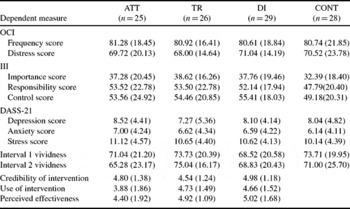
There was an equal distribution of men and women in each experimental group, χ2 (3) = 2.80; p = .42, and there were no age differences across groups, F (3, 104) = 0.02; p = .99. Table 1 shows the group means and standard deviations for self-report measures, VAS ratings of the vividness of the intrusive thought prior to the two thought-monitoring intervals, and Likert-scale ratings.
Means and standard deviations of OCI scores, III scores, DASS-21 scores, ratings of the vividness of primed intrusive thought, credibility of intervention, use of intervention during interval 2, and perceived effectiveness of the intervention in reducing the frequency of the intrusive thought

Note: Standard deviations are in parentheses. OCI = Obsessive Compulsive Inventory; III = Interpretation of Intrusions Inventory; DASS-21 = Depression, Anxiety, Stress Scales – 21.
OCI Frequency and Distress scores were equivalent to those observed in the OCD sample in the OCI validation study (Foa et al., Reference Foa, Kozak, Salkovskis, Coles and Amir1998), evidence that they are reporting significant concern with obsessive-compulsive symptoms. There were no significant differences between groups on any of these measures (all Fs < 2.18, ps > .12). Thus, the three interventions were perceived to be equally credible and effective, and participants reported using the strategy taught in the intervention to the same degree during the second thought monitoring interval.
Tests of the main hypotheses
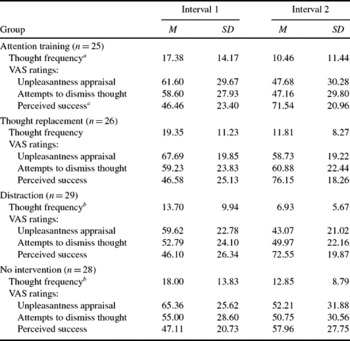
A series of 2 (time; Interval 1, Interval 2) × 4 (group; ATT, TR, DI, CONT) repeated measures Multivariate Analysis of Variance (MANOVA) was conducted to examine change in the frequency of the intrusive thought, appraisal of the unpleasantness of the intrusive thought, effort in attempting to dismiss the intrusive thought, and perceived success in reducing the frequency of the intrusive thought, from Interval 1 to Interval 2 (see Table 2). Four cases (ATT: n = 1; DI: n = 2; CONT: n = 1) were observed to have recorded an extremely high frequency of intrusive thoughts at both Interval 1 and Interval 2 (i.e. z scores that were greater than 3 and discontinuous from the rest of the distribution). As such, they were eliminated from the analysis of intrusive thought count frequency. One case from the ATT group was observed to have recorded an extremely low rating of perceived success at both Interval 1 and Interval 2 (i.e. z scores that were less than -3 and discontinuous from the rest of the distribution), and was eliminated from the analysis of perceived success in reducing the frequency of the intrusive thought.
Means and standard deviations of frequency of the intrusive thought, appraisal of unpleasantness, attempts to dismiss the intrusive thought, and perceived success in reducing the frequency of the intrusive thought

Note: a. n = 24; b. n = 27.
There was a main effect of time on the frequency of experiencing the intrusive thought, F (1, 100) = 51.70; p < .001, such that frequency decreased from Interval 1 to Interval 2 for all groups. There was no main effect of group, F (3, 100) = 1.74; p = .17, nor an interaction of time with group, F (3, 100) = .32; p = .81. Thus, all groups reported a similar decrease in intrusive thought frequency across intervals.
There was a main effect of time, F (1, 104) = 36.39; p < .001, on the appraisal of the unpleasantness of the intrusive thought, such that unpleasantness ratings decreased from Interval 1 to Interval 2 for all groups, but again no main effect of group, F (3, 104) = 1.40; p = .25, and no interaction of time with group, F (3, 104) = .53; p = .67. As with intrusive thought frequency, all groups reported a similar decrease in their appraisal of the unpleasantness of the intrusive thought from Interval 1 to Interval 2.
There was a marginally significant main effect of time on participants' efforts in attempting to dismiss the intrusive thought, F (1, 104) = 3.40; p = .07, such that effort declined slightly across intervals for all groups. There was no main effect of group, F (3, 104) = .74; p = .53, or interaction of time with group, F (3, 104) = 1.34; p = .27. Thus, all groups reported slightly less effort in attempting to dismiss their intrusive thought during Interval 2.
Finally, there was a main effect of time, F (1, 103) = 81.93; p < .001, on perceived success in reducing the frequency of their intrusive thought, such that participants reported a significant increase in perceived success following Interval 2. This main effect was qualified by a time by group two-way interaction, F (3, 103) = 2.77, p = .05. Although simple effects tests were not significant, participants receiving no intervention (CONT) reported the smallest increase in perceived success in reducing the frequency of intrusive thoughts across intervals (M increase = 10.85 versus M increases = 25.08 – 29.57 in the active interventions [ATT, TR, and DI]).
To determine whether participants were accurate in their ratings of how successful they were in reducing the frequency of their intrusive thoughts, the reduction in intrusive thoughts across intervals was correlated with participants' ratings of success in reducing the frequency of the thought. A positive correlation was found only for the no intervention control group (CONT; r = .42, p < .05). In contrast, no relationship was observed between the actual reduction in intrusive thoughts and perceived success for the three intervention groups (ATT: r = −.14, p = .49; TR: r = .07, p = .75; and DI: r = .18, p = .34).
Discussion
The aim of the present study was to examine the effectiveness of ATT relative to TR, DI, and CONT in the reduction and reappraisal of the unpleasantness of a pre-selected intrusive thought in an analogue sample of individuals with OCD symptoms. Participants rated the credibility and effectiveness of each intervention similarly, and reported using each to the same degree during the second thought monitoring interval. However, contrary to hypotheses, all groups, including the CONT group, demonstrated similar reductions in the frequency of intrusive thoughts experienced across intervals. In addition, all groups reported a similar decrease in their appraisal of the unpleasantness of the thought across intervals. Thus, none of the active interventions (ATT, TR, and DI) was superior to no intervention (CONT) in decreasing the frequency and unpleasantness of intrusive thoughts. One explanation for these findings is that the periods of imaginal exposure plus the monitoring periods allowed for some extinction of the aversive response to the intrusive thought. If this is the case, it would appear that active interventions such as ATT, TR, and DI add no benefit to the treatment of intrusive thoughts beyond that afforded by exposure.
The findings of this study suggest no benefit to ATT over other types of active intervention (TR and DI) or even no intervention in modifying the appraisal of intrusive thoughts or reducing their frequency. In the published case studies that demonstrated ATT to be a successful intervention (Papageorgiou and Wells, Reference Papageorgiou and Wells1998, Reference Papageorgiou and Wells2000; Wells, Reference Wells1990; Wells et al., Reference Wells, White and Carter1997), patients were administered weekly sessions of ATT and were also instructed to practice ATT on their own in between sessions (although the published case studies did not provide data on the extent to which people actually practiced ATT). The current study afforded no opportunity for such practice, and it is possible that these practice sessions are the key factor in the success of ATT as an intervention for anxiety and mood disorders; perhaps metacognitive appraisal of the thought's meaning changes over repeated episodes of experiencing the thought without actively engaging with it. It is also unclear if the absence of a differential treatment effect results from ATT's actual efficacy for this population or from the degree to which the training manual alone, in the absence of training and supervision from an experienced ATT administrator, conveys the level of detail required to effectively administer ATT.
It is interesting to note that, in the present study, participants in the three active intervention groups (ATT, TR, and DI) perceived themselves to be more successful in reducing the frequency of their intrusive thought after the intervention than did the CONT group, yet experienced the same number of thought occurrences. The treatment instructions may have introduced expectancy effects, and/or demand characteristics that influenced responding. It is also possible that the treatment conditions increased locus of control, such that participants perceived their thought frequency to be less than if they had not used the strategy they had been taught. However, this more positive perception of thought frequency was not associated with a decrease in perceived aversiveness of the thought.
Following from the cognitive model of OCD, interventions that emphasize the appraisal of intrusive thoughts should be more effective in reducing levels of distress and preventing the development of OCD than will interventions that focus on reducing the frequency of intrusive thoughts experienced. Wells and Matthews (Reference Wells and Matthews1994) have suggested that ATT facilitates a detached mindfulness so that thoughts can be experienced in a non-evaluative manner. However, in the present study, those individuals who received ATT did not report appraising their intrusive thoughts as any less unpleasant than individuals receiving TR, DI, or no intervention. More research is needed to effectively evaluate the potential role of ATT in ameliorating obsessional problems. Future work should include daily practice sessions and weekly follow-up. It would also be interesting to identify the specific causal mechanisms by which ATT might work, and the relationship between episodes of experiencing the thought with detached awareness and change in thought appraisal.



Comments
No Comments have been published for this article.