In the last 20 years, SLA researchers have produced an abundance of empirical studies on the cognitive and pedagogical effects of input enhancement (for reviews, see Han, Park, & Combs, Reference Han, Park and Combs2008; Lee & Huang, Reference Lee and Huang2008). As defined by Doughty and Williams (Reference Doughty, Williams, Doughty and Williams1998), input enhancement is an implicit (and unobtrusive) way to draw language learners’ attention to specific forms—be they lexical or related to the grammar—in the input. The theory, first proposed by Sharwood Smith Reference Sharwood Smith(1991, Reference Sharwood Smith1993), is that through enhancement, the teacher or researcher manipulates the form such that it becomes perceptually more salient to the second language (L2) learner than it otherwise would be (Barcroft, Reference Barcroft2003; Wong, Reference Wong2003). Enhancement, thereby, increases the likelihood that the learner will notice the form—a first step toward learning it. This is an important claim because paying attention to forms in the input is assumed to be a necessary precondition for learning them (Leow, Reference Leow, Gutiérrez-Rexach and Martínez-Gil1999; Robinson, Reference Robinson1995, Reference Robinson, Doughty and Long2003; Schmidt, Reference Schmidt1990, Reference Schmidt and Robinson2001; Sharwood Smith, Reference Sharwood Smith1991; Tomlin & Villa, Reference Tomlin and Villa1994). Researchers, thus, study the effects of enhancement to investigate (at least in part) the claim that SLA only occurs with attention (Hama & Leow, Reference Hama and Leow2010; Leow, Reference Leow2000; but see Leung & Williams, Reference Leung and Williams2011; Williams, Reference Williams2005, who debate this and report that adults can learn L2 forms implicitly). Second language learners often do not learn forms that are abundant in the input (such as tense markers: Cadierno, Reference Cadierno1995; Overstreet, Reference Overstreet1998; or morphology that carries little meaning: VanPatten, Reference VanPatten1989) because the forms are, for various reasons (e.g., redundancy or unpronounced phonology), not salient to the learners (Sharwood Smith, Reference Sharwood Smith1993). According to the theory, enhancement helps foster that necessary attention to nonsalient forms.
A difficult question to answer is whether the enhancement of forms actually leads toward the learning and understanding of the forms postnoticing or if enhancement only jump-starts a possible learning path (that ends, it is hoped, in full understanding) by rendering the forms more salient and likely to be noticed. Thus, the goal of the present investigation is to shed more light on this central issue by using an eye-tracker to measure learners’ noticing of enhanced versus unenhanced grammatical forms. By measuring visual focal attention directly in the present study, I empirically investigate whether enhancement renders the forms perceptually more salient to the learners. I also measure form learning and investigate whether increased attention to form results in decreased attention to meaning to replicate Lee (Reference Lee2007), which found trade-off effects with enhancement being associated with lower comprehension. Although noticing has been measured in different ways in prior input enhancement studies, as is reviewed in the next section, in this study, I operationalize noticing as a significant increase in visual foci over a baseline (control) condition; that is, in this study, I look at whether learners pay more visual attention to enhanced forms than to the same forms unenhanced (see Godfroid, Housen, & Boers, Reference Godfroid, Housen, Boers, Pütz and Sicola2010, for more information on how prolonged eye fixations on forms over a baseline condition can be equated to noticing). Thus, using eye-movement data, this study empirically tests the original assumption by Sharwood Smith (1991, Reference Sharwood Smith1993) that enhancement promotes noticing.
LITERATURE REVIEW
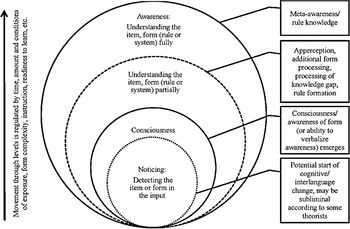
Research on input enhancement is based on the hypothesis that noticing and awareness—which are both constructs within attention or consciousness—are necessary and distinct parts of the L2 learning process. Building on Schmidt’s (Reference Schmidt1990, Reference Schmidt1993, Reference Schmidt and Schmidt1995, Reference Schmidt and Robinson2001) noticing hypothesis, researchers have argued that to learn a L2 (i.e., to come to understand the language at least receptively), learners must first notice parts (i.e., forms) of the L2; thus, noticing novel forms in the input is the first stage in becoming fully aware of—understanding—those forms (Leow, Reference Leow1997a; Leow, Johnson, & Zárate-Sández, Reference Leow, Johnson, Zárate-Sández, Sanz and Leow2011; Rosa & Leow, Reference Rosa and Leow2004; Rosa & O’Neill, Reference Rosa and O’Neill1999). This first level of noticing may be part of a subliminal process, as reported by Truscott and Sharwood Smith (2011, p. 520), or, as argued by Schmidt (Reference Schmidt and Schmidt1995), it may only include a low level of awareness, one that is possibly short-lived.Footnote 1 Noticing—subliminal or not—occurs when a novel form in the input is apperceived (Gass, Reference Gass1997) or detected (Robinson, Reference Robinson1995). The conscientious learner may recognize that he or she does not yet understand that form; that is, the learner may recognize that he or she cannot parse the form (Carroll, Reference Carroll2001). This process represents the start of possible cognitive change (Sachs & Suh, Reference Sachs, Suh and Mackey2007) in or restructuring Footnote 2 (Carroll, Reference Carroll2001; Gass, Reference Gass1984; Selinker, Kim, & Bandi-Rao, Reference Selinker, Kim and Bandi-Rao2004) of the learner’s interlanguage system and allows for subsequent learning. But awareness at the level of understanding—described by Sachs and Suh as developing meta-awareness or formulating rules related to the form—does not necessarily happen all at once; it may come in stages, or it may not happen at all. For example, the learner may consciously notice the novel form and then abandon it at any later stage. A learner who does not abandon the form may submit it to further processing; compare it to his or her knowledge base; come to partially understand the newly noticed form; and later, through additional exposure, hypothesis testing, and interlanguage restructuring, come to fully understand the form. These conscious-learning gradations that model how novel forms in the input are first noticed and subsequently learned are outlined in Figure 1, which is only one possible model of these gradations. For a more extensive review of these issues, see Truscott and Sharwood Smith Reference Truscott and Sharwood Smith(2011); see Robinson (Reference Robinson, Doughty and Long2003) for an in-depth discussion on the relationship between noticing and detection.
Noticing and awareness as distinct levels of attention (i.e., consciousness) in L2 learning processes, based on work by Carroll (Reference Carroll2001), Gass (Reference Gass1997), Leow (Reference Leow1997a), Robinson (Reference Robinson1995), Sachs and Suh (Reference Sachs, Suh and Mackey2007), Schmidt (Reference Schmidt and Schmidt1995, Reference Schmidt and Robinson2001), and Truscott and Sharwood Smith Reference Truscott and Sharwood Smith(2011).

Enhancement Draws Readers’ Attention and Aids Form Learning
Studies have investigated the benefits of enhancing input in the written mode (i.e., bolding, underlining, or italicizing targeted language forms in a text) as well as the aural mode (i.e., exact repetition of the input or manipulation of the speech rate; see Jensen & Vinther, Reference Jensen and Vinther2003, for an overview). Results are mixed: Some studies have concluded that enhancement has no effect on learning (Alanen, Reference Alanen and Schmidt1995; Bowles, Reference Bowles, Kempchinsky and Piñeros2003; Izumi, Reference Izumi2003; Leow, Reference Leow1997b, Reference Leow2001b; Leow, Egi, Nuevo, & Tsai, Reference Leow, Egi, Nuevo and Tsai2003; Overstreet, Reference Overstreet1998; Wong, Reference Wong2003), whereas others have shown that enhancement positively affects learning (Jourdenais, Ota, Stauffer, Boyson, & Doughty, Reference Jourdenais, Ota, Stauffer, Boyson, Doughty and Schmidt1995; Lee, Reference Lee2007; Shook, Reference Shook1994; Williams, Reference Williams1999).Footnote 3 Outcomes have been mixed because what is enhanced, how it is enhanced, and for whom and for how long (or how much) impacts the enhancement’s efficacy. Mediating factors held responsible for the mixed outcomes and subsequently studied include (a) the enhancement technique (De Santis, Reference De Santis2008; Leow, Reference Leow2001b; Simard, Reference Simard2009); (b) form type, saliency, or complexity (Leow, Reference Leow2001b; Leow et al., Reference Leow, Egi, Nuevo and Tsai2003); (c) the relevance of the form for understanding the passage (Peters, Hulstijn, Sercu, & Lutjeharms, Reference Peters, Hulstijn, Sercu and Lutjeharms2009); (d) the task directions provided by the instructors, which may be related to task motivation (Peters, Reference Peters2007; Peters et al., Reference Peters, Hulstijn, Sercu and Lutjeharms2009); (e) the level of a passage’s comprehensibility relative to the learner’s proficiency (Wong, Reference Wong2003); (f) the length of the text in which the enhancement occurs (Leow, Reference Leow1997b); (g) topic familiarity (Combs, Reference Combs2008; Lee, Reference Lee2007; Overstreet, Reference Overstreet1998); (h) learner readiness (Park, Reference Park2004); (i) the frequency of the form in the input (Rott, Reference Rott2007); and (j) the amount of explicit instruction of the form provided alongside enhancement (Alanen, Reference Alanen and Schmidt1995; Kim, Reference Kim2006; Martínez-Flor & Soler, Reference Martínez-Flor and Soler2007). Regardless of the arguments and outcomes of these studies, one thing has become clear: Studying the effects of enhancement is a complex undertaking mostly because, as explained by Leow et al. (Reference Leow, Johnson, Zárate-Sández, Sanz and Leow2011), the effects of enhancement can only be measured indirectly through online or offline measures of noticing or measures of interlanguage change, and both of these constructs are complex (see Truscott & Sharwood Smith, Reference Truscott and Sharwood Smith2011) and difficult to quantify. In this article, I demonstrate that the effects of enhancement can be measured more directly through tracking learners’ eye movements while they read.
Complexities in Measuring the Effects of Input Enhancement
Han et al. (Reference Han, Park and Combs2008) deliberated on the complexity of measuring the effects of input enhancement. They noted that many researchers who investigated input enhancement assumed that, if enhancement had any effect, the effect would show up instantly in learners’ production. In some studies, researchers (i.e., Lee, Reference Lee2007; Leow, Reference Leow1997b; Overstreet, Reference Overstreet1998; Shook, Reference Shook1994; Wong, Reference Wong2003) assumed that enhancement would draw learners’ attention to the forms and investigated whether enhancement led to form learning, as measured by form pre- and posttesting; thus, the effects of enhancement were equated with posttest gains. This is problematic because a measure of form learning cannot directly measure the effects of enhancement (see Leow, Reference Leow2001a). Even when learning occurs, input enhancement may only be part of the learning process that began by learners noticing the form. Other mechanisms (e.g., flooding of the input, learner-internal cognitive factors, and natural L2-learning processes) may be responsible for noticing or any subsequent learning (Han et al., Reference Han, Park and Combs2008; Sharwood Smith, Reference Sharwood Smith1991), regardless of enhancement. Even if enhancement triggers noticing as claimed (Izumi, Reference Izumi2002; Leow, Reference Leow2001b; Park, Reference Park2004; Simard, Reference Simard2009; Wong, Reference Wong2003), enhancement may not be sufficient for immediately measureable acquisition to occur (Sharwood Smith, Reference Sharwood Smith1993). Han et al. noted that the amount of time needed for acquisition to occur after noticing has yet to be empirically ascertained and that this may vary depending on the large number of variables (e.g., the form’s complexity, the readiness of the learner, the first language [L1] of the learner, the learner’s motivation, and task goals) that cannot be accounted for in all conditions.
A further look at the claim that enhancement triggers noticing regardless of evidence of subsequent learning is warranted because it is at the heart of the argument for enhancement: Enhancement aids noticing, which is a central precondition for adult L2 acquisition (see Izumi, Reference Izumi2002; Leow, Reference Leow2001a; Robinson, Reference Robinson1995; Schmidt, Reference Schmidt1990, Reference Schmidt1993, Reference Schmidt and Schmidt1995, Reference Schmidt and Robinson2001). Thus far, many different retrospective (offline) and concurrent (online) methods have been used to measure noticing. For example, noticing during input enhancement has been measured through posttask questionnaires (Robinson, Reference Robinson1997), via note-taking while reading (Izumi, Reference Izumi2002), and through concurrent (Alanen, Reference Alanen and Schmidt1995; Bowles, Reference Bowles, Kempchinsky and Piñeros2003; Leow, Reference Leow2001b) or subsequent think-aloud verbal protocols (Jourdenais et al., Reference Jourdenais, Ota, Stauffer, Boyson, Doughty and Schmidt1995). Collecting introspective data after exposure to the enhanced forms may be problematic because researchers can only use the retrospective data to “make inferences as to whether learners either paid attention to or became aware of targeted forms or structures in the input” (Leow, Reference Leow and DeKeyser2007, p. 23). Thus, it may be better to measure noticing as it happens or as close to the occurrence as possible, which a few key studies have done.
In a study conducted by Izumi (Reference Izumi2002), participants were instructed to take notes of words they thought were important, necessary, or useful for understanding the text while reading. Some learners read text with grammatical forms (i.e., English relative clauses) enhanced, whereas others read the same text without enhancement. Izumi’s study concerned a rather long (and therefore arguably rather salient and noticeable) grammatical form (i.e., relative clauses), and enhancement appeared to impact noticing. Izumi provided learners with points for noticing when the learners wrote down words that pertained to the targeted forms; more points equated more noticing. Over time, readers given the enhanced text took more notes related to the relative clauses than those reading without enhancement. As Izumi concluded, “to the extent that notetaking served as an adequate measure of noticing, these results indicate a positive role played by the visual input enhancement” (p. 560).
A second method (see Bowles, Reference Bowles2010) for measuring whether learners notice enhanced forms more than nonenhanced forms is to quantify how much the learners talk about the form (when prompted to do so) while reading, a data-collection technique called concurrent think-aloud. Alanen (Reference Alanen and Schmidt1995), Jourdenais et al. (Reference Jourdenais, Ota, Stauffer, Boyson, Doughty and Schmidt1995), Leow (Reference Leow2001b), Leow et al. (Reference Leow, Egi, Nuevo and Tsai2003), and Bowles (Reference Bowles, Kempchinsky and Piñeros2003) employed concurrent think-alouds along with other measures to assess learners’ noticing of enhanced forms. Specifically, Alanen used think-alouds to measure learners’ noticing of semiartificial Finnish locative suffixes and consonant gradation and to examine whether enhancement (i.e., italicization), explicit instruction, or both led to increased noticing and learning as compared to a control group. Although she did not explain exactly how she coded her think-aloud data, Alanen reported that participants who read enhanced texts noticed the target forms just as much as those who received explicit instruction on the form. Explicit instruction, with or without enhancement, resulted in better form learning than enhancement only.
Leow (Reference Leow2001b), Leow et al. (Reference Leow, Egi, Nuevo and Tsai2003), and Bowles (Reference Bowles, Kempchinsky and Piñeros2003) were the first to provide adequate details regarding their think-aloud data-coding procedures and used only concurrent think-aloud data to measure noticing.Footnote 4 In their studies, Spanish language learners were prompted to state out loud what they were thinking when reading a text with or without targeted forms enhanced. Each reader’s speech was recorded and transcribed. The transcripts were coded for instances of noticing such that whenever the reader made a verbal reference to the targeted form, he or she was awarded a point for noticing. Bowles and Leow et al., following Leow’s procedures, also gave noticing points to readers if they (a) correctly or incorrectly translated the Spanish targeted forms or (b) made any written marks on the text itself that were related to the targeted forms. Noticing across text conditions (enhanced and unenhanced) in these concurrent think-aloud studies appeared to be statistically consistent; that is, by using the noticing point system, Leow, Leow et al., and Bowles found that their participants equally noticed the forms regardless of enhancement.Footnote 5
The methodological quandary is whether failure to measure noticing through first-person accounts necessarily means that learners did not notice. Some researchers hold that there are various levels and types of noticing, attention, and awareness (Leow et al., Reference Leow, Johnson, Zárate-Sández, Sanz and Leow2011; Tomlin & Villa, Reference Tomlin and Villa1994) and that some measures of noticing, like think-alouds, may only tap into higher levels of awareness. At a lower level of processing, individuals may register the form but not be able to self-report noticing. Some suggest that if a learner cannot report the noticing, noticing did not occur (Leow, Reference Leow1997a; Rosa & Leow, Reference Rosa and Leow2004; Rosa & O’Neill, Reference Rosa and O’Neill1999). However, this may be an instance in which researchers are using a test’s sensitivity in measuring a construct to define the construct itself. It is illogical to state that an entity is one thing if you can measure it, another if you cannot, and something different still if individuals can self-report having it. Awareness may have different levels, but it is not the case that noticing itself switches into being at a certain level of discovery. In sum, the problem is an issue of veridicality: a potential lack of efficacy with self-reports of noticing. Thus, a more objective method of measuring enhancement’s effect on noticing is needed.
Motivation for the Current Study on Input Enhancement’s Effects
This study, a partial replication of Lee (Reference Lee2007), revisits the question of whether enhancement renders forms more perceptually salient. In his study, Lee had 259 Korean English-language learners read one of two texts: one with a familiar topic and the other with an unfamiliar topic. Both texts were flooded with passive sentences; that is, the frequency of the form in the input was artificially increased. Within each group, half received the passive forms enhanced, and half viewed them as regular text. Using ANOVAs and t tests, Lee demonstrated that learners were significantly better able to correct written sentences that contained incorrect English passive forms after exposure to the texts with enhanced passive forms than with nonenhanced passive forms. But learners who read the texts with the enhanced passive forms performed significantly worse on a measure of text comprehension—a free-recall test with points awarded for idea units correctly conveyed—than learners who read unenhanced texts. Although Lee did not explicitly state his theoretical assumptions about the nature of attentional resources, he concluded that enhancement rendered the passive forms more salient and that, consequently, the learners who read enhanced passives directed more attention to them but deployed less attention to text comprehension. On the one hand, his results countered many prior studies that found enhancement had no effect on form learning (Izumi, Reference Izumi2002; Leow, Reference Leow1997b; Leow et al., Reference Leow, Egi, Nuevo and Tsai2003; Overstreet, Reference Overstreet1998; Wong, Reference Wong2003), but, on the other hand, they corroborated some work in input processing that demonstrated that directing attention to form affected attention to meaning (VanPatten, Reference VanPatten1989). Lee also found that learners who read the text with enhanced passives wrote down significantly fewer correct idea units (a measure of text comprehension) than learners who read texts without enhancement, a result similar to Overstreet’s (Reference Overstreet1998) results but opposite the findings of several studies that concluded that enhancement had no effect on comprehension (Leow, Reference Leow1997b, Reference Leow2001b; Leow et al., Reference Leow, Egi, Nuevo and Tsai2003; Rott, Reference Rott2007; Wong, Reference Wong2003). Lee’s study is ripe for replication because its basic findings run counter to many other studies’ results, and replication, even one that contains slight modifications to the study’s design (also known as a conceptual replication; see Polio & Gass, Reference Polio and Gass1997), can be used to assure that a study’s results can be generalized further.
The present study replicates Lee (Reference Lee2007) but with two modifications. First, I screened for learner proficiency through a secondary, outside proficiency measure (i.e., the Dialang reading test) because input enhancement studies, including Lee’s (Reference Lee2007), typically lack independent measures of proficiency (Lee & Huang, Reference Lee and Huang2008). Second, I measured via eye-movement recordings whether enhancement draws the learners’ attention to the targeted forms without assuming that it does. Eye-movement data may indicate whether or not enhancement increases focal attention and, if so, when. Readers sequentially fix their eyes on individual words (Pollatsek, Reichle, & Rayner, Reference Pollatsek, Reichle and Rayner2006; Rayner, Reference Rayner1998, Reference Rayner2009), and this saccadic movement from one word to another happens as readers recognize and process words (Reichle, Rayner, & Pollatsek, Reference Reichle, Rayner and Pollatsek2003). Thus, what is most interesting to SLA researchers is what readers do when they do not recognize words, do not understand a grammatical form (like the passive form), or struggle with ambiguities or inconsistencies in the text. The learners may undergo what Reichle, Warren, and McConnell (Reference Reichle, Warren and McConnell2009) called postlexical processing (which SLA researchers might call post-form-noticing processing), during which they may integrate the just-accessed form into higher level linguistic representations such as a clause- or sentence-level syntactic structure, a context-appropriate semantic representation, or a discourse model, or they may entirely fail to integrate the form and, instead, abandon it—reminiscent of the L2 learning processes related to interlanguage restructuring. Reichle et al. (Reference Reichle, Warren and McConnell2009) explained that this post-form-noticing processing may result in prolonged fixation times or regressions to earlier parts in the text. Thus, I used eye-movement data to search for prolonged fixation times or regressions to earlier parts in the text as a way to objectively measure noticing.
The study was guided by two research questions:
-
1. Does input enhancement significantly draw learners’ visual attention to the targeted linguistic forms, as measured by eye-movement data?
-
2. What are the effects of textual enhancement on learners’ form learning or development, as measured by a form correction test, and comprehension of meaning, as measured by a free-recall test?
On the basis of results from Lee (Reference Lee2007) and prior research, I hypothesized that learners would be more optimally directed to enhanced passive verb forms. I also hypothesized that those who read the text with enhanced forms would perform better on the posttest correction task. Given Lee’s results, I further tested the hypothesis that the learners would experience a trade-off effect such that attending more to forms, as prompted by enhancement, would detract from their attention to meaning and result in lower scores on the recall test. However, this last hypothesis—that there would be a trade-off effect—runs counter to many current learning theories that suggest that increased cognitive effort is effective for both comprehension and restructuring (DeKeyser & Juffs, Reference DeKeyser, Juffs and Hinkel2005; Ellis, Reference Ellis2006; Segalowitz, Reference Segalowitz2010). Additionally, as explained by Robinson (2003, p. 646), trade-off effects may be due to specific task demands (and control functions) rather than to a single pool of attention and capacity limits; thus, I questioned whether or not the last hypothesis would hold.
METHOD
Participants
Participants were volunteers from intermediate-level, English as a second language classes at a large, Midwestern university. Of the 80 who volunteered and participated in all parts of the study, five scored other than a B1 or B2 on the Dialang test of reading proficiency (they scored an A2, C1, or C2),Footnote 6 11 had eye movements that could not be tracked as it was impossible to calibrate the camera lens to accurately record their eye movements, and nine scored above the criterion (explained in the next section) on the pretest of passive form construction. Therefore, 55 participants’ data are used in the study. Their average age was 23 (SD = 6.66, min = 18, max = 45). A majority (i.e., 36) were native speakers of Mandarin Chinese, although a number of other L1 backgrounds were represented: 4 were native speakers of Arabic, 4 were native speakers of Korean, and 4 identified themselves as bilinguals (1 of Mandarin Chinese and Japanese, 1 of Kyrgyz and Russian, 1 of Javanese and Indonesian, and 1 of Haitian Creole and French). Also included was 1 native speaker of each of these languages: Cantonese, Japanese, Kazakh, Portuguese, Sinhala, Sudanese, and Spanish.
Materials
Pre- and Posttests of Passive Form Construction
I based the pre- and posttests of the passive form on those administered by Lee (Reference Lee2007). As in Lee, each test had 10 sentences that assessed passive-related form errors; 7 additional sentences were distractors. Like in Lee, there were three types of form error included in the tests: (a) an incorrect use of a present participle instead of a past participle, (b) a bare verb form instead of a past participle, and (c) a missing auxiliary (be) verb. The tests appear as supplemental material in the online version of this article.
Authentic Reading Text
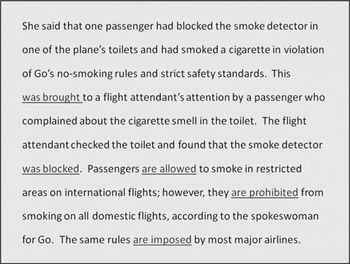
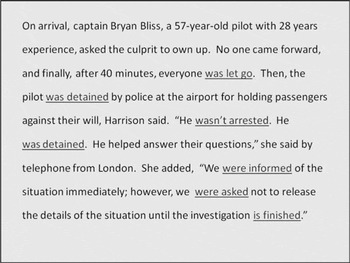
For the experimental reading, I chose to modify an authentic text rather than employ the inauthentic one used by Lee (Reference Lee2007). The text for this study was a Reuters news report (“Pilot Detained after Siege,” 1998) found on the Internet. The original text, however, did not contain a flood of passives. Thus, I altered the text to include 17 passive forms. To prepare the text for reading on the eye-tracker (an EyeLink 1000 from SR Research) and to better guarantee that the eye-tracker would accurately track the readers’ eye movements in relation to the passive forms, I divided the text into four segments and placed each segment on a PowerPoint slide using 18-point, double-spaced Arial font. Two versions of the text were prepared for the eye-tracking experiment: one with the passive forms in normal font (unenhanced) and one with the forms underlined and in red (enhanced). I could not use boldface type for the enhancement because I needed the areas of visual interest (i.e., the space on and around the passive forms) to be the same size regardless of the text condition.Footnote 7 I used the EyeLink experiment builder program to draw by hand four interest area slides, one for each part of the text. These slides can be thought of as transparencies that later fit over the text slides to designate the areas of interest the computer program must use to filter the eye-movement data. I transformed the text slides to .TIFF format (to maintain a high resolution of the text images) and uploaded them and the four interest area slides—which would later be used by the eye-tracker to quantify eye movements over the areas of interest (i.e., the passive forms)—to the eye-tracking system. The appendix displays the four enhanced text slides as they appeared to the participants, with the exception that the first interest area in the appendix is indicated by a box around the first passive form, whereas participants did not see any interest area box outlines. The box on slide 1 in the appendix is only there to illustrate an example of the size and location of the area in which eye-movement data were recorded for this study. Note that in the experiment, each slide filled the computer screen, and each was shown one at a time; the ecological validity of this way of presenting a reading text is discussed later. Although in the appendix the background of each slide appears grey, in the experiment it was light blue. The shading was used to soften any computer glare, which I hoped would make onscreen reading easier on the readers’ eyes.
Free-Recall Task
To replicate Lee (Reference Lee2007), I employed a free-recall task to assess reading comprehension. Learners typed the free recall on a computer in the lab where the eye-tracking experiment took place but not on the same computer as the one used for the eye-tracking experiment. The directions that appeared at the top of the computer screen read as follows:
Write the news report you just read on the computer. Use English or your native language to rewrite the story. Spelling, grammar and punctuation will not be graded or scored, so do not worry about your spelling, punctuation or grammar. Type EVERY idea that you can remember from the news report you read; from general ideas to smaller details.
Procedures
All data were collected in an eye-tracking lab at the university. Learners participated one at a time. After signing the consent form and filling out a background questionnaire, a learner sat in front of a computer that was connected to the EyeLink 1000 eye-tracking system. In this study, I used the EyeLink’s desktop mount, which requires participants to use a chin and forehead rest to stabilize the head. Doing so renders the eye-movement recordings more accurate than if the learner were able to move his or her head freely during the experiment. I used monocular eye-tracking, which tracked the right eye. This was done because (a) most individuals are right-eye dominant and (b) monocular recording is more accurate than binocular (although, in hindsight, as is explained in the limitations section, it would have been better to test for eye dominance and track the more dominant eye for each individual; see Holmqvist et al., Reference Holmqvist, Nyström, Andersson, Dewhurst, Jarodzka and van de Weijer2011). I explained to each learner that I would be recording his or her eye movements as he or she read. Specifically, each learner was told the following before the experiment began:
During this experiment, you are going to read a text presented on the computer screen. The text is divided up into four PowerPoint slides. You will see each slide one time. You can read at your own pace. When you are done reading a slide, please click on any button on the game controller to change the slide to the next one. Because once we start you cannot move your head away from the chin and forehead rest, please keep the game controller in your hand.
The learner then participated in a 9-point calibration and verification procedure. After successful calibration, the participant was told the following:
Now we will start with the reading text. Remember the text is presented on four slides, and you can read at your own pace. Click on any button on the game controller when you are ready to move on to the next slide. At the very beginning, a dot will appear at the upper-left side of the computer screen. Fixate on that dot, and then we will start.
After manual acceptance of the learner’s fixation on the dot in the upper-left side of the screen, which was a final drift correction, the experiment began. The learner clicked the controller to advance to the next slide. He or she could not go back to reread a past slide. Immediately after reading all slides, the learner moved to another computer in the lab, where he or she performed the recall task and took the posttest. Each participant was paid $20 for his or her time.
Scoring and Analysis
The pre- and posttests were scored dichotomously. Lee (Reference Lee2007) noted that, in his study, the Korean language learners, on average, only scored 2.2 out of 10 possible points (SD = 1.88) on the passive pretest, which, he suggested, demonstrated that they had “failed to internalize the target form” (p. 96). Thus, I used this as a benchmark for inclusion in this study; only data from those who scored less than 3 on the pretest were used for analyses. This criterion, as previously mentioned, excluded 9 learners. Of the 55 participants whose data were viable, their average pretest score was 1.40 (SD = 0.50).
All participants typed their recalls in English, except for two who typed in Chinese. A native speaker of Chinese, who was highly proficient in English, translated these two recalls into English. Then, a research assistant and I scored the free-recall tests. Because this is a partial replication of Lee (Reference Lee2007), we sought to score in the manner he did; however, we found his explanation of how to score idea units lacking. Although the term idea units has been defined in several ways (e.g., as simple sentences, semantic propositions, or phrases in Carrell, Reference Carrell1983, p. 89; or as almost any type of semantic phrase or element in Kroll, Reference Kroll, Keenan and Bennett1977, pp. 85–90), there appears to be no general consensus on the methods to be undertaken in operationalizing idea units for scoring. This is potentially problematic as researchers are continually left to devise and reinvent protocols for scoring. For this study, we broke the text down into 63 idea units through an iterative process—that is, through many steps. We first created a scoring rubric with each sentence in the text as its own idea unit; we then decided which phrases within each sentence were most likely autonomous, thus counting (potentially) as their own idea units. After using the rubric to score an initial set of three essays, we changed the scoring rubric by condensing some idea units and separating out others. The final rubric appears as supplemental material to the online version of this article. Essays were first scored by giving a point if an idea unit was adequately conveyed; however, we soon decided to give a half point if an idea unit was partially conveyed. Thus, we used partial-credit, unit scoring.Footnote 8 A Pearson Product Moment correlation coefficient as a measure of interrater reliability, r = .97, demonstrated a high level of agreement on the two raters’ scoring of the recall essays. Any score discrepancies were discussed before settling on the final scoring of each idea unit. Cronbach’s alpha was then calculated to estimate the comprehension test’s reliability, and it was .94, indicating the test had high internal consistency overall.
The EyeLink 1000 calculates many eye-movement measurements. For this study, I focused on four—the total fixation time, the number of visits, first pass reading time, and the rereading time—to obtain a rather comprehensive picture of the amount of attention paid to the interest areas (i.e., the passive forms). These measurements were operationalized using the following definitions: (a) total fixation time is the total time (in milliseconds) spent fixating on the interest area; (b) number of visits to the target area indicates how many times readers’ line of sight entered the area of interest—that is, the total number of fixations of which the total fixation time consists; (c) first pass reading time is the summed duration of the fixations that readers made during the first visit to the area of interest, provided that no text downstream had yet been viewed; it reflects the reader’s initial processing of the targeted text; and (d) rereading time is not provided directly by the EyeLink output; rather, it was computed, as is standard, by subtracting first pass reading time of the area of interest from the total time spent fixating on the area.
I conducted two main analyses. First, I ran one-way ANOVAs to test whether enhancement affects noticing of the passive forms (with noticing quantified as the total fixation time, the number of visits, the first pass reading time or gaze duration, and the rereading time). I also ran independent-samples t tests to investigate whether enhancement influences the dependent learning variables (i.e., form learning and development and text comprehension).
RESULTS
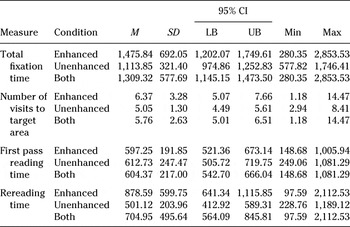
To answer Research Question 1, which asked whether or not input enhancement significantly draws learners’ visual attention to the targeted linguistic forms, I first computed an average for each individual of his or her eye-movement measurements over the 17 passive forms. I submitted these data, summarized in Table 1, to the ANOVAs.
Descriptive statistics of the eye-tracking measurements averaged across the 17 passive forms

Note.
n = 27 for the enhanced group, 23 for the unenhanced. All times are in milliseconds. CI = confidence interval for the mean, LB = lower bound, and UB = upper bound.
Because the assumption of equality of variances was violated in all four ANOVAs (Levene’s test for equality of variances: p = .05 or smaller), which indicated that the variances of the groups cannot be assumed to be equal, I report Welch’s F, which accounts for unequal variance, for each ANOVA. There was a significant effect of enhancement on total fixation time, F(1, 49) = 5.90, p < .05, r 2 = .31, and on rereading time, F(1, 49) = 9.42, p < .001, r 2 = .38. However, there was no significant effect of enhancement on the number of visits, F(1, 49) = 3.68, p = .06, r 2 = .25, or the first pass reading time, F(1, 49) = 0.06, p = .81, r 2 = .04. On visual inspection, the effect sizes of enhancement for total fixation time and rereading time are sizable (above the .30 threshold for a medium effect). There is also a notable trend in the data that suggests that enhancement may impact the number of visits learners make to the passive form areas within the text, at least mildly (r 2 = .25). This effect size may be practically meaningful even though the comparison of the means between the two groups (enhanced and unenhanced) on this number-of-visits variable failed to reach statistical significance.
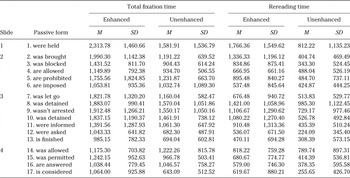
To investigate this first research question more finely, I visually inspected the 17 passive form interest areas in terms of total fixation time and rereading time—the two factors impacted most by enhancement—to see which specific interest areas (i.e., which passive forms) may have contributed the most to the significant differences between the reading behaviors on these two measures across groups. These raw data are presented in Table 2.
Average times learners fixated on and reread the 17 individual passive forms

Note.
n = 27 for the enhanced group, 23 for the unenhanced. All times are in milliseconds.
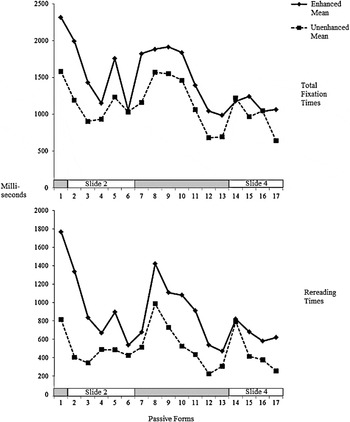
As can be seen in Figure 2, which contains graphs of the data from Table 2, the enhancement appears to simply and consistently amplify the effects of input flooding. The incompletely learned passive forms are fixated on and reread in patterns that are consistent across groups regardless of whether the forms were enhanced. The learners who read the enhanced forms, however, spent more time fixating on them and rereading them overall. In particular, the significant enhancement effects (i.e., increased fixation and increased rereading) are most acutely seen on forms presented early on within each slide and with enhanced forms that appeared in the upper-left side of the slides: enhancement 1 of 17 on slide one (i.e., were held), enhancement 2 on slide 2 (i.e., was brought), enhancement 8 on slide 2 (i.e., was detained), and enhancement 14 on slide 4 (i.e., was allowed). In general, there appears to be a consistent decline over time of the effects of flooding and enhancement; as the learners read, they paid less attention to the passive forms, but their attention toward the enhanced or flooded forms spiked with the presentation of each new text slide.
Total fixation time and rereading time averages in milliseconds on the 17 passive forms. Color gradations (gray, white, gray, white) along the X axis correspond to the four slides on which the passive forms appeared.

To answer Research Question 2 about the effects of textual enhancement on learners’ form learning and development and comprehension of meaning, two independent-samples t tests were performed. The first was used to compare how the unenhanced versus enhanced text impacted gain scores (as measured by subtracting learners’ pretest passive form correction scores from their posttest scores). I used the second t test to investigate how the two groups compared in terms of their performances on the idea-unit-recall reading comprehension test.
On average, the learners performed no differently in terms of their passive form development: The enhanced group’s gain score averages (M = 1.13, SD = 1.41) were slightly better than those of their peers who read the text with the passive forms unenhanced (M = 0.92, SD = 1.68), but these group differences were not statistically different, t(53) = .51, p = .61. Similarly, the two groups performed no differently on the reading comprehension test. This time the unenhanced group performed slightly better: They recalled on average slightly more idea units (M = 10.14, SD = 5.49) than their peers who read the enhanced text (M = 9.35, SD = 5.49), but, again, differences were not statistically different, t(53) = −.51, p = .62. To further investigate if there was a relationship between learners’ gain scores and their performances on the recall tests, I derived Pearson Product Moment correlations among three sets of scores: the enhanced group’s scores on the two measures, the unenhanced group’s scores on the two measures, and all learners’ scores on the two measures. In all three cases, there was no significant relationship between gain scores and reading comprehension scores as measured via idea-unit-recall testing (for enhanced-condition learners, r = .07, p = .70; for the unenhanced, r = −.09, p = .66; and for all learners together, r = −.02, p = .09).
DISCUSSION
Researchers investigate input enhancement because it allows them to pinpoint what is noticed or learned through a very simple, implicit learning condition. Additionally, researchers study the pedagogical value of enhancement because many L2 and foreign language teachers use it. Alongside input flooding (i.e., artificially increasing the frequency of the form in the input), input enhancement is ubiquitous in L2 and foreign language classrooms. It appears in textbooks (Sutton, Reference Sutton2009), in computer-assisted language learning programs (Gascoigne, Reference Gascoigne2006), and, more recently, in language learning applications for handheld devices (Reinders & Cho, Reference Reinders and Cho2010). Because of the large number of variables that affect the impact of enhancement, it is impossible to identify exactly what enhancement impacts in all cases. So, instead, researchers tend to study whether enhancement does what it is supposed to accomplish—namely, in the written mode, whether it draws readers’ attention to the form and subsequently aids form learning.
In this study, I analyzed English language learners’ eye-movement data, collected as they read, to investigate whether enhancement draws attention, promotes noticing, and subsequently aids form learning. I further investigated whether the enhancement and form learning detracts from reading comprehension. The results indicated that enhancement—in particular, enhancement of passive forms presented to intermediate-level English language learners who have not yet internalized the forms—draws readers’ attention to the forms in some ways but not others. That is, when presented with enhanced forms, learners spent more time rereading the forms, and, as a result, fixated on the forms longer overall. They also tended to visit the targeted forms more often than their counterparts who read the same text without enhancement. But the learners did not spend more time initially trying to process the forms (i.e., first pass reading) when they were enhanced: In this sense, enhancement did not increase initial processing any more than flooding did; a suspicion articulated by prior input enhancement researchers (Han et al., Reference Han, Park and Combs2008; Sharwood Smith, Reference Sharwood Smith1991). Moreover, in the context of this study, enhancement triggered noticing as researchers claimed it would (Izumi, Reference Izumi2002; Leow, Reference Leow2001b; Park, Reference Park2004; Simard, Reference Simard2009; Wong, Reference Wong2003), but the increase in the amount of noticing was not enough for immediately measureable acquisition to occur, which has been discussed as a possible outcome of enhancement (Sharwood Smith, Reference Sharwood Smith1993). The question remains as to why.
Researchers such as Williams (Reference Williams1999) have noted that “not everything that is registered by the senses is . . . encoded in long-term memory” (p. 2). Likewise, “forms may be noticed perceptually, but not linguistically” (Leeman, Areagoitia, Fridman, & Doughty, Reference Leeman, Areagoitia, Fridman, Doughty and Schmidt1995, p. 219). Thus, it follows that enhanced forms may attract attention but fail to be processed more highly, as this study’s results suggest. It could be that the increase in noticing due to form enhancement was not enough for immediately measurable, passive form acquisition to occur because (a) the learners were not developmentally ready to learn the form (corroborating Park, Reference Park2004) or (b) the learners were not motivated to learn the form (corroborating Peters, Reference Peters2007; Peters et al., Reference Peters, Hulstijn, Sercu and Lutjeharms2009). In this study, with regard to form readiness, the English language learners might have been developmentally less ready than those from Lee (Reference Lee2007). In Lee’s study, the average pretest score was 2.2, but in the present study no learner with a score higher than 3 was allowed to participate. There are other possible explanations, including insufficient exposure, that point to the fact that learning is not instantaneous. It could also be that form learning may not have occurred in this study because the learners were not told to pay attention to the forms (e.g., as a teacher in a classroom may do); that is, they were not provided with any explicit instruction on the form, which, as Alanen Reference Alanen and Schmidt(1995), Kim (Reference Kim2006), and Martínez-Flor and Soler (Reference Martínez-Flor and Soler2007) found, affects the impact enhancement has on learning. In many input enhancement research studies, including Lee (Reference Lee2007), the researchers did not publish the directions provided to the learners. I suspect that the experimental condition (i.e., in a language lab, not in a classroom) and the lack of task direction—I also did not provide the learners any goal for reading—affected the learners’ reading behaviors. That is, these factors may have influenced what they focused on when they read and their orientations toward the text, including whether they deemed it important to try to come to understand the meaning of the flooded or enhanced forms. Perhaps readers failed to internalize the forms’ meaning because they had no true motivation to do so. This is unlike the classroom in which a teacher may instruct students to pay attention to underlined forms because the underlining relates to the grammar point to be discussed that day. It is conceivable that such directions would have affected the learners’ visual attention to the targeted areas. Future input enhancement researchers may want to further investigate the covarying effects of task goals and enhancement on noticing and form learning.
Remaining to be discussed is why, in this study, enhancement did not detract from reading comprehension as Lee (Reference Lee2007) and Overstreet (Reference Overstreet1998) found. In this study, learners’ reading comprehension test scores and their gain scores had no relation to the condition of the passive form presentation (enhanced versus unenhanced). Likewise, there were no trade-off effects. Reading comprehension was not related in any way to form correction gain scores, nor did enhancement affect comprehension, as has been found by other researchers (Leow, Reference Leow1997b, Reference Leow2001b; Leow et al., Reference Leow, Egi, Nuevo and Tsai2003; Rott, Reference Rott2007; Wong, Reference Wong2003). Thus, this study lends support to previous input enhancement research that has shown that enhancement is a good, implicit pedagogical tool for drawing learners’ attention to the form without compromising the task of reading for meaning. An additional conclusion is that the data do not support the notion that form and meaning compete for a single pool of attentional resources. Trade-off effects, like those found in Lee (Reference Lee2007), may be, as argued by Robinson (Reference Robinson, Doughty and Long2003), “better explained by differing control functions during central processing (allocation policy, time constraints on scheduling attention allocation), and interference occurring during resource allocation to those specific task demands which central processing responds to” (p. 646).
However, I would like stress my concerns here about this type of isolated use of enhancement. This condition for enhancement may be artificial in informing L2 pedagogy because teachers rarely enhance forms without, at some point in the lesson, going back and directing learners’ attention to the enhanced forms. In other words, the outcomes from studies that investigate enhancement without any explicit, guided direction to the targeted forms may not be generalizable to the classroom because of the artificial nature of these studies’ lab-based, as opposed to educationally based, procedures. Long (Reference Long and Byram2000) noted that most SLA theories do not concern language teaching directly, and they should not have to because they supportively inform teachers “about who and what it is they are trying to teach” (p. 6). But I believe the theories and hypotheses concerning enhancement are not like most SLA theories in this regard. I did not provide explicit direction to the targeted forms in this study because I was replicating procedures from Lee (Reference Lee2007), but during data collection, participants often asked, before they started reading, about the purpose of reading and if there would be a test or if they should take notes for any reason. In light of this, I now believe that future input enhancement research must be conducted in conditions more representative of how teachers use input enhancement: with reading directions, reading-task goals, and preemptive or reactive (postreading) explicit, directed instruction on the enhanced forms. I would argue that it is rare that a teacher floods forms or enhances them but never discusses the forms explicitly in his or her lesson. An authentic, nonmodified text with an individual form naturally flooded throughout is exceedingly rare if not nonexistent. Flooding and enhancement are teachers’ tools and, thus, must be studied in the context of how teachers use them. Enhancement alone may facilitate learning if the form is already partially learned or if the learner is on the cusp of grasping the information necessary to learn the form (Park, Reference Park2004)—and if the learner is motivated to understand the form better—but most empirical studies, like this one and like Lee’s, use pretests to ensure that the learners are not on the cusp of grasping the targeted form. For learners for whom the form is relatively novel, as this study showed with this particular type of form and this type of enhancement, enhancement may only lead to initial detection (see Robinson, Reference Robinson, Doughty and Long2003); the teacher or textbook may need to provide the extra information through explicit instruction for the form to become understandable and learnable.
This study demonstrates that researchers investigating whether enhancement aids noticing need the more sensitive and objective measures of noticing that eye-movement data provide. As described by Robinson, Mackey, Gass, and Schmidt (Reference Robinson, Mackey, Gass, Schmidt, Gass and Mackey2012), “verbal reports are unlikely to faithfully reflect everything that learners are attending to and aware of” (p. 261). Eye-tracking is an indispensable technique to examine the effects of input enhancement because it reveals whether enhancement actually induces learners to look longer at the forms, as was revealed in present data set. The eye-movement recordings indicated that the enhancement increased certain types of focal attention. Enhancement stimulated more postlexical processing (Reichle et al., Reference Reichle, Warren and McConnell2009) or, as I like to call it in a SLA context, post-form-noticing processing. Readers fixated on the incompletely learned forms longer and reread them more often when they were enhanced. Nonetheless, there was no evidence that those who read the enhanced forms learned them any better than those who read the unenhanced forms. In fact, neither group learned passives to any measureable extent. As Reichle et al. (Reference Reichle, Warren and McConnell2009) described, failure to integrate (i.e., learn or understand) a form during post-form-noticing processing may result in further comprehension difficulties, which are also signaled by prolonged fixations and regressive saccades. Thus, these eye-tracking data alone cannot differentiate successful from unsuccessful post-form-noticing processing (i.e., whether any type of form understanding, interlanguage restructuring, or learning occurred). In this study, I used form correction test gain scores to measure learning, but the data from the pre- and posttests suggest that for most, the increased post-form-noticing processing that resulted from enhancing the forms had no larger learning effect than simply flooding the form; any restructuring that occurred was below that of what could be measured or indicated by gain scores. This underscores the need for multiple measures of noticing. Nonetheless, the eye-tracking data captured one level of what SLA researchers term noticing—that is, paying increased focal attention to the input (Schmidt, Reference Schmidt1990)—and the data in this study appear to suggest that enhancement does lead to increased focal attention to the enhanced forms in the input.
LIMITATIONS AND FUTURE DIRECTIONS
Although using an eye-tracker to measure the effects of enhancement on noticing proved informative, having learners read a text while their eyes were tracked placed limitations on the ecological validity of the study (see Findlay & Gilchrist, Reference Findlay, Gilchrist, Jenkens and Harris1999, for more on ecological validity and eye-tracking research). To increase eye-movement-recording accuracy, I increased the text’s font size and the spacing between the lines of the text, which necessitated that the text be presented across four slides; this had consequences. First, learners were only able to reread text presented on the current slide they were viewing, which may have distorted measures of subsequent (i.e., noninitial) fixations and rereading. The probability of this type of data distortion is supported by research on computer text presentation formats: Differing formats affect eye movements, including fixation durations, total fixations, and the amount of regressions (Sharmin, Špakov, & Räihä, Reference Sharmin, Špakov and Räihä2012; Shrestha & Owens, Reference Shrestha and Owens2009). Indeed, the effect of this study’s text format on the learners’ visual intake patterns can be seen in Figure 2 and in connection with the appendix. In particular, fixations on the passive forms, regardless of whether or not they were enhanced, tended to be longer when the passives appeared at the top of the screen. This corroborates Web site usability research in which readers created F-shaped patterns of fixations (shown in heat maps) across computer screens of text (e.g., Shrestha & Owens, Reference Shrestha and Owens2009). In such research, the frequency of fixations, regardless of the page type and reading goal, has been shown to be higher toward the top of the text and to decrease along descending text when that text is on screen. Thus, it would be interesting and perhaps more ecologically valid to conduct further experiments like this one with the entire on-screen text on one page, something that may be difficult with an EyeLink 1000 eye-tracking system (i.e., having small font would result in less accurate eye-movement data, and, as far as I know, a participant cannot scroll around on the screen with the EyeLink), but that might be possible with a different eye-tracking system.Footnote 9
In addition to the problem of the ecological validity of the four screens, the position of the passives on the individual pages may have affected the passive form fixations. Even though readers tend to fixate their eyes on word centers, the location of the fixation prior to the saccadic movement to a word (called the launch site by McConkie, Kerr, Reddix, & Zola, Reference McConkie, Kerr, Reddix and Zola1998) influences the landing site (i.e., word) fixation (see Reichle, Rayner, & Pollatsek, Reference Reichle, Rayner and Pollatsek1999; Vitu, Kapoula, Lancelin, & Lavigne, Reference Vitu, Kapoula, Lancelin and Lavigne2004). Thus, it is probably not a coincidence that the passive forms for which the enhancement effect is the most pronounced occurred at the top of a page or at the beginning of a line of text. In those positions, enhancement effects may be increased because of the positions alone.Footnote 10 Thus, the interpretation of eye-movement data that compares enhanced versus nonenhanced forms is rather complex. The complexities underscore the significance of a control group, especially when the reading format necessitates that interest areas be at locations other than at the center of the screen where eye-movement recording is most accurate. It is of utmost importance that the control group reads under the same conditions (i.e., with the interest areas in the same location and of the same size), with the one difference being the study’s manipulated independent variable—in this case, enhancement.
Additionally, the difficulties of collecting eye-movement data directly impacted the number of participants in the study. Out of 80 potential participants, 11 were eliminated because their initial eye-movement calibrations were too far off. These 11 individuals may have been left-eye dominant; future researchers employing monocular recordings may lose fewer participants if they use a test to determine ocular dominance and then record the dominant eye (see Ehrenstein, Arnold-Schulz-Gahmen, & Jaschinski, Reference Ehrenstein, Arnold-Schulz-Gahmen and Jaschinski2005; Holmqvist et al., Reference Holmqvist, Nyström, Andersson, Dewhurst, Jarodzka and van de Weijer2011). Five more participants’ eye-movement data were incompletely recorded after successful calibration due to technology failure. Thus, eye-movement data is expensive and rather time consuming to collect, especially given this study’s loss of about 25% of the data, which, in this case, was mostly due to the technical difficulties inherent in tracking humans’ eye movements while they read.
Furthermore, there may be motivation to remove from the dataset the native speakers whose L1s were nonalphabetic languages. Doing so would control for any low-level, script-unfamiliarity influences or differences in general reading processes that stem from L1 background (see Feng, Miller, Shu, & Zhang, Reference Feng, Miller, Shu and Zhang2009; Kajii, Nazir, & Osaka, Reference Kajii, Nazir and Osaka2001; Kazandjian, Cavezian, Zivotofsky, & Chokron, Reference Kazandjian, Cavezian, Zivotofsky and Chokron2010; Rayner, Shen, Bai, & Yan, Reference Rayner, Shen, Bai and Yan2009; Yan, Kliegl, Richter, Nuthmann, & Shu, Reference Yan, Kliegl, Richter, Nuthmann and Shu2010). However, because these individuals were relatively balanced across groups and retaining participants was important for the statistical analyses to be performed, I did not remove them.
Despite these limitations, I believe researchers must more fully explore how eye-movement data can be employed to investigate the impacts of form enhancement on noticing and learning. The next logical step is to combine eye-tracking techniques and measures of learning with qualitative, concurrent measures of noticing such as think-alouds, as formerly employed for input enhancement research by Leow (Reference Leow2001b), Leow et al. (Reference Leow, Egi, Nuevo and Tsai2003), and Bowles (Reference Bowles, Kempchinsky and Piñeros2003). Doing so may allow researchers to better understand how prolonged fixation times or increases in regressions to earlier text, which signal processing difficulties or increases in processing, are part of interlanguage restructuring.
APPENDIX EXACT SCREEN LAYOUT FOR EXPERIMENTAL TEXT SLIDES, ENHANCED CONDITION