



The conception of space and its mental representation, as well as scientific, mathematical, and technical knowledge, are some of the elements that build these quantitative descriptions. On some occasions, the adoption of a new system of measurement is sudden and the product of a status decision. This was the case for the metric system, whose acceptance by most countries from the eighteenth century on corresponded to the search for an international standardized system and which was imposed by laws and decrees. (Instruction Sur Les Nouvelles Mesures de Longueur 1799; Talleyrand-Périgord Reference Talleyrand-Périgord1790). In addition, the use of measures could be part of a set of tools to create meaning, as found in the size and composition of the Codex Mendoza (Gómez-Tejada Reference Gómez-Tejada2012), or to translate a cosmovision into urban design (Sugiyama Reference Sugiyama1993). The particularities of a system of measurement are such particular cultural features that, on occasion, they become a parameter for distinguishing one culture from another.
Until now, two systems of measurement have been detected in Mesoamerica. Through the analysis of the codices and the texts produced shortly after the Conquest, the system of measurement used by Nahua peoples has been carefully studied (Castillo Reference Castillo1972; Clark Reference Clark2008, Reference Clark, Morley and Renfrew2010; Dehouve Reference Dehouve2011; Matías Alonso Reference Matías Alonso1984; Williams and Harvey Reference Williams and Harvey1988; Williams and Jorge y Jorge Reference Williams2008). It is based on multiple anthropometric references, and one of its main measurement units is called the yollotli (heart). According to several authors, this distance unit would also have been used 1,500 years earlier, also in the central highlands, to establish an orthogonal layout in the city of Teotihuacan (Drewitt Reference Drewitt1967; Sugiyama Reference Sugiyama1983, Reference Sugiyama1993, Reference Sugiyama, Morley and Renfrew2010). The second system—called the zapal—has been found in constructions in the Puuc Maya area built between a.d. 750 and 1000. It is constituted from two subunits of a main unit, which are multiplied to obtain intermediate measures (O'Brien and Christiansen Reference O'Brien and Christiansen1986). Thus, these two systems rest on completely different conceptual bases, the former anthropometric and the latter based on a scaled unit.
In fact, the studies remain limited in scope, and the systems of measurement adopted by other ethnic groups within the broad spatial and temporal compass of the Mesoamerican world need more research. More studies on this subject, incorporating data from the constructive and spatial elements of archaeological sites, are required. Unfortunately, the scope of the analyses is limited by the current state of conservation, the transformations to which structures were submitted during the habitation of each site, excavation techniques, and the criteria of intervention during consolidation and restoration activities. On many occasions, this inhibits the collection of reliable data and, therefore, prevents the realization of these studies in a reliable and accurate manner. If the parallel coexistence in Mesoamerica of two different systems of measurement can be confirmed, however, and if these are typical of different cultural groups, then archaeologists would have additional data to search for to evaluate affiliations and exchanges among different cultural groups in Mesoamerica.
For these reasons, the architecture of Cacaxtla deserves particular attention, especially where the use of the main unit of measurement reported in the Maya area (Lucet Reference Lucet2015), the use of a third part of the main unit, and multiplication of the base unit by three have been demonstrated. The coincidence of the system of measurement is in addition to many other Maya characteristics found at the site, mainly murals that show similarities with the representations found in Palenque and the Usumacinta area (Brittenham Reference Brittenham2013, Reference Brittenham2015; Foncerrada Reference Foncerrada de Molina1976, Reference Foncerrada de Molina and Robertson1980; Kubler Reference Kubler1980; López de Molina Reference López de Molina1977; Magaloni et al. Reference Magaloni, Brittenham, Baglioni, Giorgi and Bernini2013; Martin Reference Martin2013; Robertson Reference Robertson and Benson1985; Walling Reference Walling1982). Common patterns have also been found in architecture (Bate and Gándara Reference Bate and Gándara1991; Lucet Reference Lucet and Castañeda2013).
Within the context of the Epiclassic period (A.D. 650–950), these similarities take on particular relevance. Teotihuacan, the city that controlled an important part of Mesoamerica during the previous centuries, was then in the process of recession as a result of social problems. On the other hand, during this time, the Maya cities of the Puuc and Usumacinta areas continued to flourish, and their decay occurred some 200 years later. So, from a.d. 600, there is evidence in the highlands of diverse population movements and geopolitical and economic restructuring manifested in the emergence or growth of cities such as Xochicalco, Tula Chico, Teotenango, and Cacaxtla. The presence of elements with features associated with Mayan expressions in the paintings and architecture of these sites adds to the analysis of the conformation of the political scene during the Epiclassic period. An expansion of the Maya sphere of influence in Mesoamerica or the presence of a Maya group in the highlands during this time could explain these paintings and site architecture, either of which would have great consequences on the circumstances of the development of the region.
Based on the study of mural paintings and despite their similarities, however, several arguments prevent categorically affirming that the site was built by a Maya group. In particular, there is an absence of elements typical of Maya culture, such as text and calendar sign hieroglyphs. Several proposals have been presented to explain the heterogeneous character detected in the style, technique, and iconography of these mural paintings. Some refer to the very origin of the Olmec-Xicalancas, the possible settlers of the site, who, in their migration from the coast, would have integrated various cultural references and preserved contact with Maya areas (Foncerrada Reference Foncerrada de Molina and Robertson1980; Lombardo Reference Lombardo de Ruiz1986; McVicker Reference McVicker1985). Other authors (Graulich Reference Graulich1988; Robertson Reference Robertson and Benson1985; Walling Reference Walling1982) affirm that local rulers would have hired Maya painters; others have concluded that both the patrons and artists came from the highlands (Brittenham Reference Brittenham2013, Reference Brittenham2015). In these latter cases, the fame of Maya painters alone would not explain the decision to make paintings in the Maya “style.” This would have corresponded with the political intention of ingratiating themselves with Maya rulers, who were still all-powerful, and would have constituted a form of recognition of their power by proclaiming affiliation or subordination (Brittenham Reference Brittenham2015; Nagao Reference Nagao, Diehl and Berlo1989).
While it is true that painting often contains a high propaganda value and therefore is carried out for political purposes, this logic hardly applies to the use of a system of measurements used on a large scale. The practice of measurement is a component of the resources for performing a trade and adopting a procedure different from what the artisan learned by traditional transmission that is very difficult, so it is more likely that this knowledge was part of the culture of the builders of Cacaxtla. On the other hand, it seems implausible that local rulers had brought, several times and during several centuries, builders from afar to follow a pattern of Maya construction. The use of a specific system of measurement in constructions cannot be easily perceived and, therefore, using it publicly as propaganda or to display political adhesion is nonsense. Consequently, finding in Cacaxtla units of measurements reported in the Maya area would reinforce the hypothesis of a site built by a social group related to those Maya cultures.
The data are insufficient, however, to reach this conclusion. The study based on the architecture of Cacaxtla (Lucet Reference Lucet and Castañeda2013) was limited to finding the use of principal units and did not seek to elucidate the use of subunits because the construction itself has a scale that limits this study. The walls, pillars, doors, and stairs are the smallest elements in the construction itself, therefore there is a limit to the investigation of sizing units in these elements. The use of subunits is likely, but the characteristics of the construction system and the material used—adobe—added to the level of deterioration, producing such a difference of proportion between the builders’ original, planned, “ideal” measurements and the current measurements that the margin of error becomes too large with respect to the smaller units and subdivisions. Thus, a coincidence between the main units and those reported from the Puuc area was found, but this finding did not go as far as to demonstrate the use of subdivisions and, therefore, the full use of the system of measurement.
Therefore, it is possible that the system of measurement reported in the Puuc area is neither exclusive to that culture nor to that period. Even if it were concluded that the zapal is found only in Cacaxtla and in the Puuc area, it would be necessary to carefully review the dates of the different settlements before making conclusions about the origin of cultural influences. In the following, reference to one of the two systems of measurement will be made using the name of its main measure, whether zapal or yollotli, leaving aside any interpretation of cultural or temporal origin.
This paper seeks to expand knowledge about the system of measurement used in Cacaxtla and to reviewwhether the system, as a whole, corresponds to the zapal in terms of its logic of arithmetic construction. Although the state of preservation of the adobe structures did not allow for this level of detail in the previous study, the artistic productions, which are on a smaller scale and offer greater detail, make it feasible. Thus, the presence in Cacaxtla of mural paintings in a good state of conservation offers the opportunity to carry out this analysis. These paintings were carefully buried when the inhabitants decided to transform the architecture: after removing the ceilings, the builders put layers of sand and fine soil between the architectural fill and walls and then built embankments to prevent the concentration of loads and structural deformations (López de Molina Reference López de Molina1979; López and Molina Reference López and Molina1976). Thanks to this procedure, the paintings did not suffer much damage and their almost complete contents can be appreciated. Additionally, several factors support the possible use of a system of units in planning their representations, including the fact that the murals cover large surfaces, some have frames, have orderly and rhythmic compositions, contain linear and circular graphic elements, and are located in pairs around openings and staircases and show a symmetric design, although the representations are different. Studying the use of measurements in a painting requires understanding the composition of the work, and the existence of preliminary strokes and other resources used by the artists to order the different figures in a harmonic way had to be reexamined.
Moreover, since the use of the yollotli had been found in one place in the construction, its presence in the painting cannot be ruled out. It appeared with a value that could also be explained by the zapal, but the symbolic burden of the site raised the question about a possible combination of the two systems of measurement, which led to the search for more data in the paintings. The use of the two systems reinforces the idea of the creation of esoteric meanings using measurement as a resource. In Mesoamerican codices and artistic representations, the media (including material and dimensions), the position, size, strokes, and composition of hieroglyphic texts and icons were discursive elements used by creators to formalize concepts (Johansson Reference Johansson K.2001). Similarly in Cacaxtla, the painters used specific red pigments only in the representations of the mutilated bodies of the Battle Mural (Magaloni et al. Reference Magaloni, Brittenham, Baglioni, Giorgi and Bernini2013).
Finally, since measurement is a social practice characteristic of cultural groups, the results of this study will highlight features that could explain the origins of the builders and painters of the site and reveal if they shared the same knowledge and culture.
MESOAMERICAN MEASUREMENT SYSTEMS
In Cacaxtla, 65 pillars and the 71 spaces that separate them show an adequate state of conservation to ensure accuracy of measurement. Among them, 83.8 percent measure 1.20, 1.47, or 1.95 m and two more pillars measure 84 cm (Table 1). The second and third measurements of the unit system have a common factor of 49 cm, a value that can be taken as a measurement module. Its use is confirmed by the dimensions of the rooms, stairs, and doors of the site (Lucet Reference Lucet2015).
Dimensions of the pillars (P) and their intermediate spaces (I). #, number of porticos; #P, number of pillars; #I, number of spaces between pillars; Med., median of measurements found in P and I; σ, standard deviation.

Moreover, several distances between spaces measure exactly 1.47 m or multiples of this distance, with a marked preference for multiples of three. Thus, 1.47 is multiplied by three and 18 to get the width and length, respectively, of Structure B; by three and six for the room of Structure E; and by three for the width of the rooms of Structures A and C and Portico F. The only important room that does not measure a multiple of three times 1.47 m is the Room of Venus, with a length of five times the reference unit. This is because this room was adapted from the transformation of a long gallery and, therefore, the builders had to adjust it to the existing space (Lucet Reference Lucet1999).
Therefore, in Cacaxtla, the builders used three base measures—49 cm, 1.47 m, and 4.41 m—and multiplied them to dimension the architecture. Each consecutive measurement was obtained by multiplying the previous three. The main measurement would have been the intermediate, 1.47 m, and would correspond to the length of a string held with the arms extended and pinched with thumbs and index fingers. From this, a division in thirds can be obtained by folding the rope. In turn, the measurements of 1.20 m and 84 cm are obtained using a subdivision of the zapal by 16 and multiplying it by 13 and nine, respectively; this subunit is obtained by dividing the main unit in half four times. It is likely that, for very small measures, they could have used a more adapted instrument, such as a rod or another object with this same ratio. In the same way, a long pole would have been used for multiples of 4.41 m (Brinton Reference Brinton1885).
The unit of 1.47 m has been reported, to date, only in the Puuc zone, particularly at Chichen Itza, Uxmal, and Kabah (O'Brien and Christiansen Reference O'Brien and Christiansen1986). In these archaeological sites, the builders used a double system of division of the main measurement that O'Brien and Christiansen named the zapal. This system consisted of dividing the base measurement by nine to obtain the oc, which measures 16.3 cm, or by 16 to obtain the unit they named the kab, which measures 9.3 cm. The authors mention that the two systems “appear to be distinctly different subdivisions of the zapal unit, suggesting parallel measurement systems based on 16 and 9 subunits” (O'Brien and Christiansen Reference O'Brien and Christiansen1986:149). The minimum common measurement, the xóot, corresponds to the division by 144 of the initial zapal and measured about one centimeter: in terms of modern mathematics, it could be called the highest common factor. According to the Chilam Balam of Chumayel, the Popol Vuh, and the Account of the Things of Yucatan by archbishop Landa, the numbers three, four, nine, and 12 were the numbers most used by Maya builders (O'Brien and Christiansen Reference O'Brien and Christiansen1986).
The urban planning of Teotihuacan, the city of reference in the highlands, followed a rigorous order that enabled the coexistence and organization of a large population. The north-south and east-west orientations that governed the layout of the main buildings and the streets that separated the housing complexes were clearly defined. Sugiyama (Reference Sugiyama, Morley and Renfrew2010:133) made a compilation of the proposed dimensions of a unit that would have served as a base measurement: “80 cm (Almaráz Reference Almaráz1865:212–213), 80.5 cm (Drewitt Reference Drewitt, de Tapia and Rattray1987; Drucker Reference Drucker1974), 60 m (Séjourné Reference Séjourné1966), 57 m and 322 m (80.5 cm × 400 m) (Drewitt Reference Drewitt1967; Reference Drewitt, de Tapia and Rattray1987).” He proposes 83 cm for the most significant monuments of the a.d.150–250 period. This unit was multiplied by quantities related to the calendrical cycles—260, 365, and 484—to locate the buildings and main plazas (Sugiyama Reference Sugiyama1983, Reference Sugiyama1993, Reference Sugiyama, Morley and Renfrew2010). Although this base unit appears in two pillars at Cacaxtla, it is not observed in other parts of the site, so it is not possible to deduce a relationship in terms of systems of measurement between the two sites. Besides, this dimension could have been chosen in proportion to the main zapal unit in a ratio of 9:16.
In the Mexica system of measurement, the large set of measurement units includes the Teotihuacan measure known as yollotli but the one found both in the Puuc area and in Cacaxtla does not appear. Most of the Mexica units carry anthropometric names and their expression in codices and early texts of the colony leaves no doubt about their translation. Researchers acknowledge a certain degree of uncertainty in their work due to the complexity of the topic, the regional variations of the measurements (both in Mesoamerica and in Spain), a lack of documentary sources, and the use of maps that lack the reference units (Clark Reference Clark2008). In addition, the anthropometric units always raise questions about standardization given the variations in the proportions of the human body. In this regard, the yollotli corresponds roughly to half the distance between the body and the fingertips and its conversion to centimeters varies slightly depending on who you follow. Castillo (Reference Castillo1972) puts its equivalent, the cenyollotli, at 90 cm, and a close measurement, the cemacolli (shoulder to finger), at 80 cm; Clark (Reference Clark2008) compares it with the Spanish vara, which varied between 83.3 and 84.3 centimeters, and applied a correlation derived from the study of the Sun Stone to set it at 83.34 cm. In other units, the differences are more evident (Table 2). The wide range of measurements could indicate differentiated use according to the type of object or material measured, since the length of some measurements made them more suitable for measuring land, rooms, or construction elements, or even specific settlements (Dehouve Reference Dehouve2011).
Nahua units.

a For nequetzalli, the author expresses doubts about its conversion to metric system.
In land censuses, such as in the Codex Vergara and the Codex of Santa María Asunción—painted towards a.d. 1543–1544—the most-used Nahua unit was the tlalquahuitl (T), a wooden measuring stick equivalent to three Spanish varas or approximately 2.5 meters. Other units were also used, such as the Arrow (1.25 m or half of T), the Heart (1 m or 2/5 of T), and the Hand (1.5 m or 3/5 of T). It is necessary to notice the lack of correspondence between the name and the dimension of each measurement. This way of relating large and small measurements does not imply that the concept of fractions had been integrated into pre-Hispanic mathematical knowledge; rather, these smaller divisions became units in and of themselves (William and Jorge y Jorge Reference Williams2008).
On the scale of a sculpture or a mural painting, the creators also used measurements. Moreover, they resorted to the use of reticles to order the different components of the composition. Sahagún mentions that one of the qualities of a good painter was to think of the rhythm and proportions of his composition (López Austin Reference López Austin2000). Composition based on the use of a grid are found in the Mixtec codices, including the Codex Bodley and Codex Cospi, Codex Mendoza, Codex Fejervary-Mayer, and Codex Nuttall, with grids made from 20 × 20, 20 × 13, 10 × 13 or 3 × 4 frames, respectively (Gómez-Tejada Reference Gómez-Tejada2012). Grids of various sizes were also used in Mexica sculpted stones, such as the Ahuitzotl and Tlaltecuhtli boxes, which reveal grids of 20 × 13 frames (Gómez-Tejada Reference Gómez-Tejada2012) and a double grid of 13 × 15 and 4 × 5 frames (López Luján Reference López Luján2010), respectively. Certain numbers, mainly four, 13, and 20, appear several times in these examples and others, such as five, 10, and 15 appear only once. They were probably significant numbers used in particular circumstances. Paintings in Bonampak and Maya stelae also used this composition tool (Miller and Brittenham Reference Miller and Brittenham2013), which appears to have been part of a long Mesoamerican tradition.
THE MURALS OF CACAXTLA
The murals of Cacaxtla occur in pairs, on either side of a staircase or an opening. Thus grouped, they follow rules of correspondence and sometimes rules of strict mirror symmetry in the design of the components and in the conceptual meaning of the icons, complementing each other in terms of the message they transmit. Some of the murals cover the entire available surface while others occupy only part of the wall; in the latter case, most of them are delimited by a painted, rectangular frame.
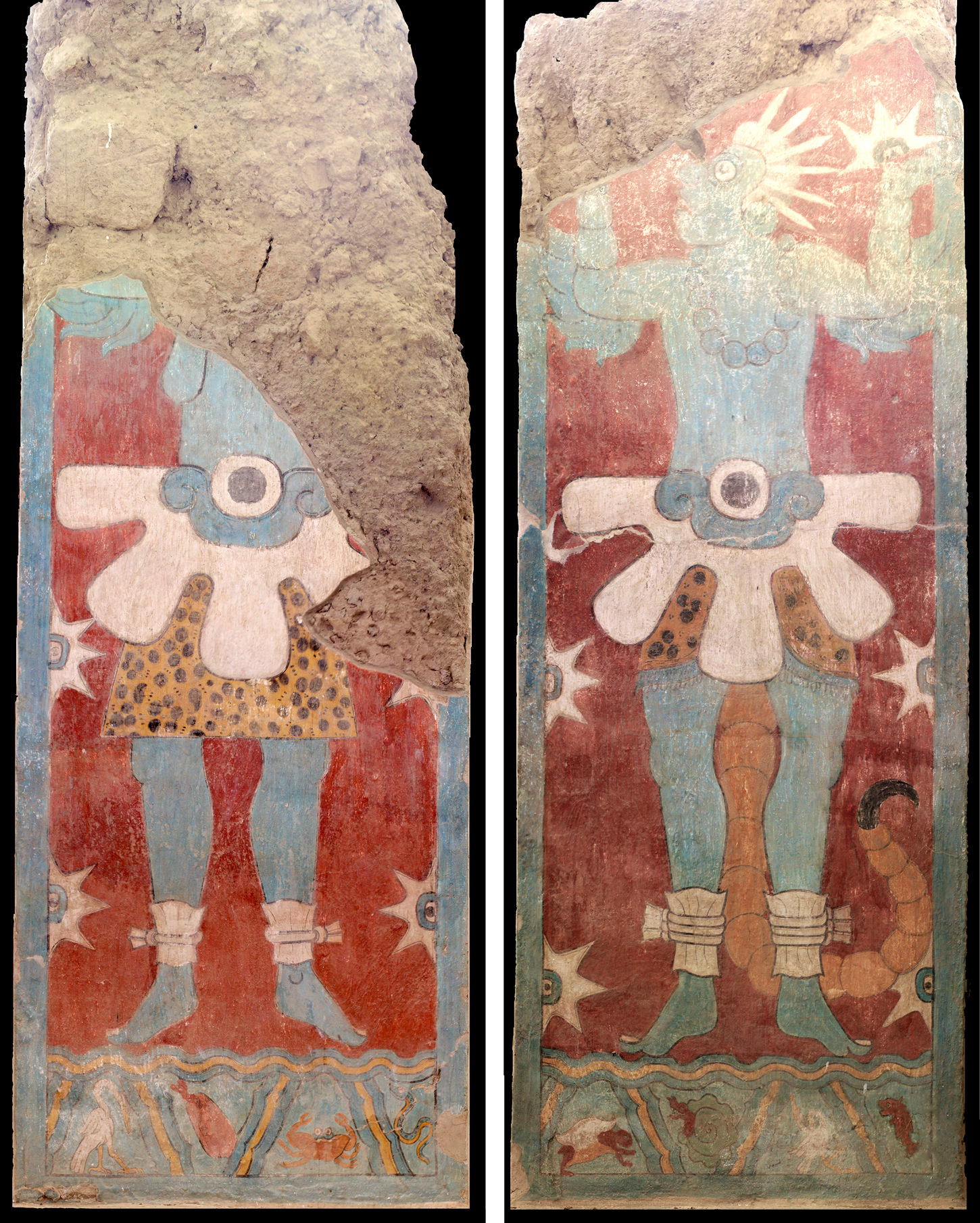
The murals of the Red Temple are found on the entire surface of the two walls that enclose the staircase. This was built as a result of an important site transformation that consisted of burying several structures and raising the floor level of a large proportion of the Great Basement (Lucet Reference Lucet1999, Reference Lucet and Castañeda2013). It was then necessary to connect the different levels and, thus, a staircase replaced the previously existing corridor. Its eastern wall, longer than the western one, was extended to the square; both walls were covered with mural painting. Sometime later, this part of the site was buried under a pyramid. During this latter transformation, the upper parts of the murals were damaged and the representations of the heads of the serpents that frame each of the murals were lost. Thus, neither the length nor the height correspond to the original size of these murals. From the previous phase of construction, representations of a Feathered Serpent border the lower part of the two parallel walls of the corridor, they end in the fill of the upper construction. On its south side, the corridor reached a portico that bordered a large square. A step delimits them and was covered by paint on its tread and riser. On the east side, the extreme parts of these paintings were mutilated in pre-Hispanic times when the staircase was built (Figure 1).
West and east murals of the Red Temple. Orthophotograph by Iraís Hernández and the author.

Murals fill the entire front surfaces of the pillars of the Temple of Venus. In a previous construction stage, the two pillars were part of a long gallery that delimited a great square to the west, still buried. When restructuring of this whole area, the builders decided to modify the portico and build an enclosure in the central axis of the plaza (Lucet Reference Lucet1999, Reference Lucet and Castañeda2013). They kept two pillars inside, cut them to reduce their size, and painted two deities on their front surfaces, one male and one female, linked to the cult of Venus. Thus, the measurements of the paintings derive from an architectural decision for representations of deities. The width of the pillars correspond to their original size but the upper parts were mutilated when the roof was removed to fill the room with earth and debris and build on a new structure (Figure 2).
South and north murals of the Temple of Venus. Orthophotograph by Iraís Hernández and the author.
The Battle Mural is found on both sides of a staircase and covers a slope that delimited the north side of the main square. It was covered by the construction of Structure B when the builders extended the platform and damaged the top of the murals. This reconfiguration of the site led to the modification of Structure A, the painting of its portico, and to the construction of the Temple of Venus (Lucet Reference Lucet and Castañeda2013). So, the actual height of the mural is only close to the original. Only the eastern length is measurable: it does not fill the entire wall and is limited on one side by the staircase and on the other by a painted frame, although, since it was painted after the representations, the graphic elements exceed the limit of the frame. The west mural was not finished; it ends abruptly, interrupted by the superstructure of Structure E (Figure 3).
The East Battle Mural fragment. Drawing by Citlali Coronel.

In the portico of Structure A, a door separates two murals that were probably joined above the lintel, which is no longer extant. A straight line frames the murals and limits their width and bottom (Figure 4). Their original height is not measurable, since the upper part of the wall has been destroyed, but is inferred from the constructive elements that conserve final heights. Two murals covered both inside jambs; their heights are almost terminal but the upper edges were damaged by removal of the lintel. One more mural was painted on the front wall of the inner room (east wall of the structure). Only the lower section of the wall survived the transformation of the site; unfortunately, its state of preservation is very poor. This is also the case for the murals of the Cuarto de la Escalera. Archaeologists found these two small paintings on both sides of a door badly damaged.
North and south murals of Structure A. Orthophotograph by Iraís Hernández and the author.

Opinions diverge regarding the temporal sequence. The oldest murals could be the inner mural of Structure A and those of Cuarto de la Escalera and Corridor of the Red Temple. They would be followed by the Battle Mural and, shortly after, by Structure A, portico and jambs, the Red Temple, and the Venus Temple (Lucet Reference Lucet1999, Reference Lucet and Castañeda2013). Brittenham (Reference Brittenham2015), however, proposes that the Venus Temple mural corresponds to the earlier period and Cuarto de la Escalera to the final one.
METHOD
Taking measurements is one of the tools commonly used in construction to ensure the stability of buildings, define their aesthetics, or quantify the material. On the other hand, this is not indispensable for pictorial or sculptural art in which the composition can be a free expression, made spontaneously by an artist following a creative impulse, without any geometric reference or predefined dimensions.
When artists seek rigorous mechanisms to structure their works and calculate the location of the main and secondary elements, they sometimes resort to tracing strokes. These are lines between the main geometric points of the surface such as the corners, the center, or the third part. The arc of a circle is usually also used to connect equidistant points, either visually or virtually. Using the intersections of lines, areas are thus demarcated and the figures are then located with an orderly, conceptual logic. In this manner, the different components of the work are structured and interrelated to form a congruent whole. This method also serves to rank the elements of graphic discourse and give more visual weight to specific points. Derived from the previous method, and with a more systematic basis, the artist can make use of a grid or an invisible geometric pattern that rhythmically organizes the composition.
A painter resorts to measurements, in particular, for the general dimensions of his work. Several factors are involved in the selection of the size of the work: its importance and function, the target audience, the environment in which it is placed, and the visibility of the work to those who are the recipients of its content. This evaluation can lead to adapting the size of the architectural surfaces of the constructions to the needs of the representation, to use them partly or entirely. The painter might also use measurements to establish the location of some points of reference, definite the size of figures and of some particular geometric forms, such as the circle, and to fix the divisions of the surface to paint, such as scaling a grid. In addition, the ratio between the width and length of a form can be derived from a standardized arithmetic ratio.
In most cases, the painter combines these conceptual resources—free drawing, lines, geometry, grid, and measurements—and uses them in variable proportions. Even with the same artist, these characteristics of the composition can change according to the work he produces. At the same time, these categories are some of the criteria that, in an effort to systematize information, help to define different artistic styles.
Several of the Cacaxtla murals have final dimensions that can be accurately measured to look for their relationship with known systems of measurement but none preserves its general dimensions in both directions. In some cases, the missing dimension can be deduced from the architectural context; to suppose the use of proportions is a useful approach, but it does not generate real data that can be taken into consideration in order to understand the measurement system. The quality of human representations and their realistic proportions indicate the attention given to their tracing and the possible use of dimensions. In the same way, circular elements, such as the shields of the Battle Mural, show a regularity that may be linked to the use of an instrument or a mold.
The southern mural of Structure A was chosen for a detailed analysis of its composition, shape, size, design, and location of the pictorial elements, in order to determine the use of a dimensioning system for small sizes. This mural is almost complete, and it is here that there are more indicators of a possible use of the system of measurement, including the presence of a surrounding frame and figures made up of straight lines or with geometric shapes. The painters of the murals of the portico took advantage of the effect of symmetry in relation to the central axis that passes through the center of the door to emphasize the concept of serpent-feline duality and to represent the attributes of each entity in a correspondence scheme with an amazing accuracy. This confirms that the painters resorted to measurements and geometric principles (Figure 5).
Superposition of south and north murals of Structure A. Drawing from Citlali Coronel, edited by Iraís Hernández.

The correspondence of figures between the two murals also aids in understanding where the painters had probably used measurements or a reference system. The elements that were reproduced on both murals with particular care to their position and size, so as to achieve the desired correspondence effect, are: the frames that surround the central scene; some contours of the volutes of the frame of the doorway; the jaws of the serpents and the centers of their tails; the human figures (the knots and the two sections of the belt); the ceremonial bars, which follow the same inclination and width but are slightly out of phase; the base of the glyphs near the top of the vegetal frame; the upper and lower limit of the numerical glyph; and the bird located in the lower, left zone of the scene.
Only undisturbed graphic items were taken into consideration and the details and secondary and organic elements were discarded, so the references are mostly straight or circular. Measurements that are dependent on or derived from others were also eliminated. All dimensions thus refer to lines and fundamental reference points of the design that undoubtedly structure the figures.
To place the graphic elements, the artists of Cacaxtla would have had to consider the spatial context, in particular the vertical and horizontal distance to the inside or outside line of the aquatic and vegetal frames, that limit the whole painting. In this study, the Feathered Serpent was not considered as a reference but a figure within the frame. The elements could have been located and dimensioned from their boundaries or bounding box, or in relation to their axis or any other element, such as a corner.
The measurements were compared with the two families of pre-Hispanic systems of measurement. A certain difference between the ideal measurement and what is actually measured is acceptable since several factors intervene: margin of natural error of all manual work, error of the painter when he executed the work, the thickness of the lines that delimit the figures, difference of criteria between the painter and our observation on the point from which to measure, margin of imprecision at the time of recording the measurement, and variations in the units of reference. To consider a measurement valid, a difference of up to one percent was accepted. This was limited to the absolute value of 4 cm for elements of dimensions greater than 4 m and 4 mm, which corresponds to the thicknesses of two contour lines for measurements less than 40 centimeters.
Obtaining the Data
The analysis of the measurements incorporated in a painting requires reliable and accurate initial data. In order to have a complete representation to measure the figures and corroborate the data at all times, the murals were registered with digital photogrammetry. A defined, three-dimensional, digital representation with a dense point cloud was thus obtained and was scaled with coordinates taken with a total station; the accuracy of the representation was corroborated by comparing the coordinates of the original with the coordinates of the digital model. The final resolution of this representation is 0.3 mm per pixel. To take advantage of the highest level of precision that the model allows, the measurements were taken directly from the point cloud. In this way, distance is measured in space and is not affected if the surface is not vertical, thereby reproducing the physical relationship that the painter had with the surface.
The plane projection used to obtain the flat image, or orthophotograph, is parallel to the surface of the mural and served as a background for the line drawing that was used to observe the outlines of the figures (Uriarte Castañeda Reference Uriarte Castañeda2013).
A review of the surface by displaying the model in shades of gray, calculated with algorithms that highlight the reliefs, shows the details of its irregularities (Figure 6). The wavy aspect of the finishing layer corresponds to the way it was applied and to its support material. In addition, this view highlights the manufacture of the stucco, its grains and its texture, and draws attention to some deteriorations in the pictorial layer such as cracks and missing parts. There are also some lines engraved on the stucco relief. These correspond to the black lines that emphasize the figures and are indicate areas where the painter used harder instruments to conserve a constant line width. The straight lines of the frames stand out because of the straightness of the strokes and the probable use of rules to guide the painter's hand. No further indicative marks of a trace system or marking of reference points, however, can be detected.
Visualization of the relieve with hillshade algorithm. Processing by the author.

Due to problems of accessibility, the Battle Mural and the murals of the riser and the tread of the step of the Red Temple were not recorded with photogrammetry. In the first case, the measurements were taken with a total station.
STUDY
General Measurements
The heights of the murals of the portico of Structure A are calculable from their built environment. Considering that the highest walls of the building show a terminal height that varies between 2.672 and 2.733 meters and that the mural begins at a distance from the floor that varies between 46.4 and 47.9 centimeters, these heights therefore range between 2.193 and 2.269 meters. As the mural is 2.21 m wide, it had proportions close to those of a square. The same can be done for the other murals but the only interesting result is found in the Temple of Venus, where the ratio of the internal frame is 1:3.
The measurements of all the mural paintings have correspond to the zapal within the established range by the following multipliers: 8, 9/16, 13/16, and 3/2 (Table 3). This confirms a system of measurement based on the double division system of the zapal, one by two (and eight times two) and the other by three.
Mural painting dimensions.

a Measurement from damaged and incomplete mural painting.
b The study only consideres complete mural paintings measurements.
c Outside the validation criteria set out in the text.
The width of the mural of the Temple of Venus and that of the East Battle Mural are the only ones that can be related to the measurement system based on the use of yollotli: one and fourteen yollotli, respectively. For the former, there are two measures: one that corresponds to the width defined by the internal part of the line that frames the mural on the east side and another that corresponds to the limit of the representations. The difference is only 7.4 cm but this is enough so that the overall width of the painting is closer to a multiple of the zapal, while the interior of the frame is related to the yollotli. Since two yollotli is equivalent to the Nahua measure maitl (fathom), the dimensions of the East Battle Mural measure eight zapal, seven maitl, or 14 yollotli.
There is no way to distinguish which of the two systems, the yollotli or the zapal, served as the basis for the dimensions of the Battle Mural and the murals of the Temple of Venus. While the first system solves only the measurement of these two murals, the second explains all the general measurements of the mural paintings of Cacaxtla. Based on the architectural logic, the temporality of their elaboration indicates that these two murals were not contemporary, and this prevents finding an explanation based on synchronic events indicating a cultural intervention at a precise moment.
Dimension of Human Representations and Shields
The measurements of the humans depicted in the paintings (Table 4) led to the distinction of several groups of measurements: the representations in the North and South Jambs of Portico A (0.972–1.103 m), the merchant of the East Red Temple (1.148 m), the men of the portico of Structure A (1.301–1.311 m), the figures of the Battle Mural (1.333–1.47 m), and, finally, the tallest figure corresponds to the Temple of Venus (1.664 m).
Size of humans in murals at Cacaxtla.

a Outside the validation criteria set out in the text.
Though the first group was represented in a space of reduced height and those of the Battle Mural were limited by the dimension of the slope, this was not the case for the merchant or of the men of Structure A, who might have had the same dimensions as the figure of Venus. Thus, these differences were voluntary.
Most of the dimensions have measurements based on the division of the zapal by nine and 16, when the hypothetical projection of the high level of the skull or, for the merchant, the visible part of its height is taken as the reference. Only one man of the Battle Mural measures one zapal, while the others measure a little less, although their hunched attitude, hairstyles, and headdresses generate uncertainty about the point to measure. One measurement, however, pertains to the yollotli: the male figure of the Temple of Venus, measuring a maitl or two yollotli.
Regarding the 11 shields measured in the Battle Mural, five have inner diameters of 1/6 zapal and one measures 3/16 zapal. These six shields also have external diameters related to the yollotli system (two) or both systems (four). Another three shields show measurements of one or other of the two systems for the diameter of the circle that includes the surrounding feathers: the zapal system (two) or the yollotli (one) was used. The remaining three shields have no measurements pertaining to either of the two systems.
Spatial Organization of the South Mural of Structure A
When superimposing a grid 20 frames wide on the mural, a strong coincidence of the lines with the main elements of the composition is observed (Figure 7).
Superposition of south mural and a grid of 20 x 20 units.

From the doorway and making a horizontal path to the right, the lines separate vertical zones that correspond to clearly distinguishable thematic areas. Four squares delimit the width of the vegetal frame. In the next three, a vertical band where the head of the Feathered Serpent, part of the centipede at the end of the ceremonial bar, and an icon on the top are found. Then, eight spaces frame the area assigned to the man that covers the width of the feathers that line his shoulders and gives him a wide spread. In the next two squares are the tail of the Feathered Serpent and the body of the bird; a square defines the width of the body of the Feathered Serpent and two more the aquatic framework.
Vertically and from bottom to top, the first two vertical fringes delimit the aquatic frame and are followed by one used for the width of the Feathered Serpent, one for the foot area, one for the head of the serpent and the ankles, two for the head of the stick and the icon feather to the right of the human figure, and two each correspond to the loincloth, belt, arms, and head.
The reticle acquires more importance in the horizontal rhythm since the vertical lines mark clearly defined zones while, in the other direction, the horizontal bands are interrupted by the central element, the man standing on the Feathered Serpent.
In some cases, this grid serves as a virtual reference used to directly draw the contour lines of the figures, as in the case of the long horizontal and vertical lines that limit the aquatic and floral frames. In contrast, on other occasions, as for the Feathered Serpent, they frame a figure. The grid was also used to connect several elements in a virtual manner: a central line of the vertical strip where the man is located marks the position of the cloth bracelets, the loincloth, and a leg, thus reaffirming this central axis in the composition, apart from separating the space from the head, which is set forward in relation to the body. Moreover, some of the lines of the reticle pass through characteristic points such as, for example, the eye of the centipede head of the ceremonial bar.
The superposition on the painting of a grid that follows the system of division of the zapal by 16 does not yield more information than the use of a subunit of the zapal for the two color strips that are next to the door, which means that these widths were measured.
Measuring Components of the South Mural of Structure A
After retaining only the references that match the established measures (Figure 8 and Table 5), the following are noted. (1) The width of the frame, on the three sides of the mural still preserved, is coupled to the grid. In contrast, the internal fringes of the aquatic frame, the vertical fringes of the vegetal frame, and the width of the volute that comes out of it follow measurements are derived from the zapal. Nevertheless, the height of the volute measures multiples of the square that forms the minimum unit of the grid. (2) While the width of the body of the Feathered Serpent is explained by the reticle, the location of its eye and the center of its tail correspond to divisions of the zapal. (3) As for the man, the width of his body and its total span, the inner edge of his loincloth, and the fringe of his claws are all delimited by the reticle. Its organic form, however, does not favor the search for credible measurements; it is only possible to measure the loincloth, of rectangular shape, with certainty, and the distance from the central axis of the man to the frame. They correspond to the zapal subdivisions except the center of the belt, which corresponds to one yollotli. (4) The ceremonial bar is drawn with an inclination of two units in the base by three in height. The extension of the lower line of its bounding box begins after the third square of the grid and that point was used to define the full length measuring 1 1/3 zapal; parallel lines define its width and the width of the ceremonial bar. The beginning of the figure and the position of the centipede's eye were measured vertically. (5) The inner line of the aquatic frame served as reference to place the numerical glyph at a measured distance, and to define the total height of each numerical bar as well as the width of the number; the circles of its base could well have been drawn from a physical object, so we measured the inner part of the line. (6) The organic shape of the bird complicates the detection of measurements, only its overall height corresponds to a measurement that is repeated in the other elements of the mural. (7) The measurements of the icon in the upper part of the span are particularly interesting. It represents an enclosure around which one walks, with a central door and the star of Venus embedded inside the walls. This icon demonstrates, by itself, the use of measurements derived from the zapal in the elaboration of the Cacaxtla paintings (Figure 9). Its location in height corresponds to the main unit and is placed from the central dot of the Venus star in the sidewalls. In the same way, its central axis was used for its lateral location. The sizing of the components is deduced based on the use of two subunits of the zapal in a particularly interesting combination. By assigning “A” to the width of each wall and “B” to the length of the side walls of the front door, the total length corresponds to 2A + 2B. The inside length of the room measures 2B, while the opening measures 2A. It is a very clean and logical mathematical correspondence. A and B measure 1/24 and 1/18 of the zapal, respectively, and their derivatives, units of 1/12 and 1/9 of the zapal, are also used. In the horizontal direction, the variation between the measured and the theoretical measurement is minimal since it varies from −1 to 4 millimeters. In the vertical direction, the width of the walls measures A. The inner height of the room and the total, however, do not correspond to this reference system, so the margin of error exceeds the criteria for validating the results.
Measurement references, south mural of Structure A.

Glyph “Venus Room”. (a) Measurements; (b) moduls; (c) ideal measurements; and (d) differences between ideal and real measurements.

Measurement of graphic elements in south mural of Structure A.

a Fractions correspond to measures from the zapal system.
b Difference between the zapal system and the measured dimension
RESULTS
Just as in the construction, the zapal system dominates the measurement of the paintings. It is found in the general measurements of the murals, the human representations, and the elements of the painting of the south wall of the portico of Structure A, where it was used both for their positioning and for their measurements. In the case of this building, it was possible to know the proportions of the murals, which turned out to be a square of 1.5 zapal, a compact and perfect ratio. In the Battle Mural, the zapal is multiplied by eight. Only one human representation in this mural measures one zapal. A line parallel to the base would seem to have served to delimit the available space for all the standing human figures. The natural movements of the characters in combat action, and their superior decorations, however, forced the painters to reduce their heights a little.
In the composition of the south mural of the portico of Structure A, numerous measurements correspond to subdivisions of the zapal by two (twice), three (three times), four (once), six (three times), eight (twice), nine (five times), 12 (twice), 16 (three times), and 27 (once). The greater part was used to define the height and width of the mural and place its central axis and to locate the figure within the context.
The double system of division of the zapal by nine and 16 found by O'Brien and Christiansen (Reference O'Brien and Christiansen1986) would explain most of the subunits found at Cacaxtla, except those corresponding to 1/6 and 1/12, where the division module is a combination of two and three (6 = 2 × 3; 12 = 2 × 2 × 3). Therefore, in addition to intermingling the two systems, some measurements resulted from the division by the two divisors together; in other words, division by six. This shows that the painters had at their disposal a wide combination of possible measurements and, which they used according to their needs in order to obtain desired lengths.
All these subdivisions are obtained by folding a string in two or three equal parts, which derives from a simple manipulation. For this reason, the system of measuring small distances was a mixture of these two dividends and arithmetically presents what actually corresponds to a manual logic of the work of the builder or the painter with his tools. In fact, subdivisions lower than those reported are detected, which reach 1/24, 1/27, and 1/32 of the zapal. In these cases of small measurements, it is likely that the painter's visual education—his trained eye—and his dexterity had given him the freedom to obtain measurements directly, without resorting to the use of a tool. Nor can the use of small instruments, such as rods, be ruled out when it comes to sizes corresponding to these distances.
With this system of divisors, those that follow the main value are 73.5 cm and 49 cm, meaning that there is a rapid decrease in value. The use of a complementary system to obtain intermediate measures is likely. This would have been for adding several subunits, for example a half unit plus one-third of another, in the same way that the length of the mural measures “1 + 1/3.” Since the Mesoamerican cultures did not use fractions (Jorge et al. Reference Jorge, Williams, Garza-Hume and Olvera2011), each subunit, with its corresponding value in relation to the general one, was transformed into a unit of its own. Unfortunately, because of the number of possible combinations, this becomes somewhat difficult to verify from the archaeological data.
Some measures find their interpretation both in the zapal system and in the yollotli system. This is the case of the length of the Battle Mural which can be interpreted with yollotli and zapal multipliers, with an amazing level of precision. The center of the men of the murals of the portico of Structure A, the width of the painting of Venus, and the height of the figure in this mural correspond to the yollotli system. This width is also explained with the zapal but in a less “elegant” way since in the yollotli they are entire measurements, one and two, and in the other case they are multiples of its divisors 16—one, nine, and 18, respectively. Because of the importance of these elements, the painters chose their dimensions with utmost care. Finding them in the two systems does not seem to be a coincidence; everything indicates that it was decided to create a point of convergence between the two systems and thus to emphasize, symbolically, the importance of the places.
The grid used in Cacaxtla was set out upon a surface with general measurements defined on the basis of the zapal, but its rhythm and therefore the locations that come from it do not correspond to measurements derived from the zapal. Instead, they have their origin in the way of counting among Mesoamerican cultures that was based on 20. This number is a structural component of the solar and ritual calendars, as is attested in texts from the Late Preclassic period (300 b.c.–a.d. 250) such as Kaminaljuyu Stela 10 (ca. 300 b.c.; Justeson Reference Justeson, Morley and Renfrew2010). In the first case, the solar year is divided into 18 twenty-day “months,” while in the second case the 260-day cycle is divided into 20 thirteen-day periods. In this mural painting, the number 20 was used to organize a surface, that is, in a different conceptual framework. Here, it is used to spatially partition and group the elements that make up the painting, giving unity to a set of visual elements and following a rhythmic spatial organization characterized by its uniformity. In this sense, the number retains congruence with its use for counting and grouping calendar days.
The way in which the measure is applied varies. For the location of the numerical glyph and the center of the man, the references were made relative to the internal line of the aquatic frame; for the bird and the ceremonial bar, the painter chose the outside frame. The eye of the Feathered Serpent and the fourth icon of Venus were placed in the vertical direction with the outer line of the frame and in the horizontal direction with the interior of this frame or of the vegetal frame. The reference used in the figure also varies. In most cases—the glyph of the Venus Room, tail of the Feathered Serpent, and numerical glyph in the horizontal—the reference used is the axis of symmetry, taking advantage of its formal characteristics.
As seen, at all times, the painter had many different ways to choose the size, shape, and position of the elements. His first decision was to choose surface size using a unit system and a multiplier. Then he divided it into a grid by choosing the number of modules and selected width of the aquatic frame. Then he began to locate the different elements, choosing as reference the interior or exterior of this frame, according to a variety of criteria.
CONCLUSION
The analysis of the mural paintings at Cacaxtla confirms the use of measurements based on a 1.47-m unit and its subdivision by nine and 16 to obtain smaller dimensions, i.e., divisions by two and three in a repeated manner. The subunits differ, however, by also incorporating divisions of combinations of two and three, that is, six. The study that describes the zapal system units (O'Brien and Christiansen Reference O'Brien and Christiansen1986) was carried out based on construction data, which probably did not allow for the detection of these additional forms of division. Thus, what is reported in Cacaxtla does not necessarily indicate a novel adaptation of the division system reported in the Maya area. The information obtained from the mural painting does, however, provide very high-precision and credible small measurements that can be related to the zapal, and therefore is better suited to detecting this level of detail.
More than corresponding to arithmetic operations, the principle of subdivision of the main unit results from the practice of measuring by manipulating a rope or string during the execution of the work in situ. Building construction is a complex and laborious manual activity that requires the participation of numerous people who must speak a common practical and technical language. Throughout the centuries, cultures sought improvements in materials and construction techniques. To optimize construction, collection of raw material, and organization of the work groups, the systems of measurement and quantification were refined and incorporated into the work from the design phase of the constructions. Although the elaboration of a mural does not require, in a strict sense, a prior measurement, this was an established cultural practice. Architecture and mural painting of Cacaxtla share the same conceptual framework and knowledge regarding the use of measurements, including the logic of units of measurements and their subdivisions, geometry, and arithmetic. This would confirm that architects and artists shared this cultural knowledge.
At the same time, the presence of a dimension that can be interpreted as a subdivision of the zapal as well as a yollotli, in elements as relevant as the length of the largest mural and the height of human representations of deities, is significant. It eliminates a doubt that arose during the study of the system of measurement in architecture, where the yollotli had been found in only one place, and confirms its intentional use. Moreover, the use of an anthropometric reference system for human representation, with a measure that the Mexicas called maitl and that corresponded to the height of a man, shows the understanding of its essence. Its incorporation in the figure of a deity is the expression of a code that adds to the content of the image itself. Measurement thus reinforces the naturalistic style of representation by adding an anthropometric measure and takes on a role of meaning that goes beyond the merely practical. Thus, the selection of measurements from two systems with antagonistic conceptual frameworks—one mathematical and the other anthropocentric—its multipliers and dividers, the use (or not) of a grid, and a standardized number of modules, are part of the resources employed by painters to include concepts within the paintings that add to the very meanings of the representations. The location of Cacaxtla and the temporality of the paintings are factors that can explain the inclusion of multicultural meanings in the measurement, as materialization of the convergence of two distinct way to represent and conceptualize space.
As mentioned, the current state of knowledge of Mesoamerican systems of measurement is limited to the zapal in Cacaxtla and the Maya Puuc area on one hand and, on the other, to the yollotli in Teotihuacan and Mexica cultures. The dominant measuring system in Cacaxtla is the zapal and, punctually, the yollotli is also manifested. If these systems of measurement were really characteristics of specific cultural connotations, and assuming that the origin of zapal was in the Maya area, which remains to be demonstrated, then this distinction would acquire a particular importance in discussions to determine the origin of the builders and muralists of the site. Both would come from the Maya area and the hypothesis that seeks to explain the Maya features found in the painting murals through the hiring of painters from that zone made subject to local rulers should be ruled out. The specific integration of the yollotli would then correspond to a manifestation of the altiplano in a mainly Maya context, within the framework of multicultural influences peculiar to the Epiclassic.
It is not possible at this time to conclude that the two systems are cultural distinct to an extent that would allow the establishment of an absolute altiplano-Maya dichotomy. It is necessary to extend the study of Mesoamerican systems of measurement to other areas and temporalities to know if the zapal originated in, and was exclusive to, the Maya area. Thus, with the current information on this subject, it is only possible to conclude that the painters and the builders of Cacaxtla shared their knowledge of measurement systems with those of the Maya Puuc area.
Finally, this study shows that mural paintings, generally studied in order to extract information about materials, techniques, style, iconography, epigraphy, dress, rituals, deities, and so on, is also a primary source of information for research into other unresolved issues, such as the systems of measurement used in Mesoamerica and concepts of spatial organization.
RESUMEN
El sistema de medición de la arquitectura mesoamericana no es aún un tema resuelto. Por los documentos cercanos a la conquista conocemos las unidades empleadas por las culturas nahua, nominadas con relación al cuerpo humano. Por otro lado, en base al estudio de los sitios arqueológicos, sabemos que los constructores de Teotihuacan utilizaron un módulo para la planeación urbana, multiplicándolo con cantidades que concuerdan con números calendáricos, y que los del área Puuc dimensionaron las construcciones con una unidad y subunidades que correspondían a la novena y dieciseisava parte de la principal, el zapal.
En Cacaxtla, el estudio de los componentes arquitectónicos demostró el uso de la misma unidad que en esta área maya. Sin embargo, el estado de las construcciones limitó la deducción del sistema de subdivisión para saber si también las subunidades coinciden. Dado que la pintura mural del sitio muestra un excelente estado de conservación y que existen varios factores, tales como la simetría de los murales, la presencia de marcos pintados que limitan su extensión, así como una composición ordenada y el uso de líneas rectas paralelas y de círculos, supusimos el uso de mediciones pequeñas por parte de los pintores para lograr esta exactitud formal.
En este estudio demostramos que las medidas generales de los murales corresponden con la unidad principal encontrada en la arquitectura, lo que indica que los pintores de Cacaxtla y sus constructores compartían un mismo marco de referencia. En vez de trabajar con unidades pequeñas y multiplicarlas según las necesidades, los pintores dividieron esta unidad entre dos, tres y seis de manera repetitiva. Así, lograron obtener estas dimensiones pequeñas al doblar una cuerda, es decir, a partir de la práctica de medición in situ. Además, el módulo empleado en Teotihuacan, el yollotli, fue utilizado en algunos elementos específicos y el mural de La Batalla puede ser interpretado de manera precisa tanto como múltiple del yollotli como del zapal. Así que los pintores buscaron en este caso específico un dimensionamiento común a los dos sistemas.
Los artistas utilizaron una retícula basada en la división entre veinte de la superficie para ubicar los principales componentes de manera ordenada; más que base de un sistema de numeración, este número aparece como un concepto de unificación de entidades independientes, de la misma forma que, en el calendario, sirve para agrupar un conjunto de días-dioses en un todo congruente. Este recurso para la composición de las obras se encuentra también en la pintura mural y las estelas mayas, en bajorrelieves aztecas y en códices mixtecos y de la Escuela de Tlatelolco.
Así que la selección del sistema de medidas, de sus multiplicadores y divisores, de una retícula con una cantidad de módulos estandarizados, son parte de los recursos empleados por los pintores para incluir significados dentro de las pinturas y estos se suman a los significados mismos de las representaciones. La ubicación de Cacaxtla, cerca de Teotihuacan, y la temporalidad de las pinturas son factores que pueden explicar la inclusión de significados multiculturales en la medición, como materialización de la convergencia de dos formas de representación y conceptualización del espacio.
Cacaxtla es un sitio del periodo epiclásico ubicado en el altiplano central, por lo que una coincidencia de su sistema de medidas con los conocidos en la cercanía era presumible. Sin embargo, este corresponde principalmente con un sistema de medidas reportado hasta la fecha solamente en el área Puuc. Además, la pintura mural del sitio también presenta rasgos característicos de la cultura maya. En esa época marcada por una restructuración geopolítica de Mesoamérica a consecuencia de los problemas sociales acontecidos en Teotihuacan y la consecuente pérdida de hegemonía de la ciudad, nuevos centros de población surgieron en el altiplano. Algunos, como Cacaxtla y Xochicalco, muestran componentes multiculturales que requieren de más estudios para encontrar su explicación. Si el sistema de medición zapal fuera propio del área maya y anterior al epiclásico, entonces el sistema de medición encontrado en Cacaxtla permitiría hablar de la presencia de un grupo maya en el altiplano.
ACKNOWLEDGMENTS
The Prehispanic Mural Painting in Mexico project developed a digital record of the painting of the site of Cacaxtla that was published in 2013 by the Institute of Aesthetic Research of the National Autonomous University of Mexico in the volume titled Estudios de Cacaxtla from the Mural Paintings in Pre-Hispanic Mexico series. I wish to thank Dr. María Teresa Uriarte for authorization to use this material and, in particular, I acknowledge the meticulous work done by Citlali Coronel to reproduce the contours of the figures with inline quality. This material was modified by Iraís Hernández, whom I also thank for the quality of her work, using the orthophotograph resulting from the photogrammetric calculation of the image that served as the basis for this study.



