Social interaction among individuals is fundamental to the development of discourse skills, such as initiating or joining a conversation, maintaining an interaction, and taking conversational turns. Although much work has been devoted to the development of communicative competence (e.g., Gertner, Rice, & Hadley, Reference Gertner, Rice and Hadley1994), the specific strategies used by hearing children to obtain one another's attention are not typically studied because the very act of talking generally serves both to get attention and also to begin an interaction. That is, a hearing child can initiate an interaction with another child simply by beginning a conversational turn. There may be an initial attention-getting signal, such as the greeting “hey” or calling the child's name (Guralnick, Reference Guralnick and Strain1981), but this is not necessary in most cases. Furthermore, a hearing child initiating a spoken interaction does not need to account for the visual attention of the interlocutor. Rather, if a child can see his intended addressee, and if the addressee is within the range of auditory perception and not otherwise engaged, the child has enough information to make the basic assumption that the addressee will perceive his initiation.
In contrast, deaf children interacting through the visual mode must take into account their interlocutor's perceptual state in order to carry out a successful interaction. A deaf child must understand that it is not enough to be able to see his intended addressee but that the addressee also must be visually attending to the child as well. Thus, before any conversational turns can take place, a child must first evaluate the locus of attention of his addressee and then obtain the addressee's attention if it is directed elsewhere. Only when visual attention is established can a successful interaction take place. This ability to take into account another person's locus of attention arguably requires a level of visual perspective-taking skill that typically does not develop before the age of 24 months (Moll & Tomasello, Reference Moll and Tomasello2006).
If the child determines that an attention-getting signal is needed, the next step in establishing an interaction is to understand what specific behaviors are appropriate for obtaining attention. In adult signed discourse, attention is obtained using a set of conventional behaviors, including tapping the addressee, waving a hand in the addressee's line of vision, pounding a surface, or even stomping one's foot (Baker, Reference Baker and Friedman1977; Wilbur & Petitto, Reference Wilbur and Petitto1981). In the course of an exchange, turn-taking is managed through the use of subtle gaze and body shifts. By monitoring one another's visual attention and using their own eye gaze to “hold the floor,” adults are able to manage complex turn-taking during discourse among groups of individuals, without extensive overlap or breakdown in the flow of communication (Coates & Sutton-Spence, Reference Coates and Sutton-Spence2001).
Given the importance and complexity of visual attention for communication in sign language, it is essential to understand when and how these skills develop in young deaf children and how they can best be fostered in their early years. For the small percentage of deaf children who have deaf parents, appropriate attention-getting strategies have been found to be modeled from birth through parent–child interactions (McKee, Johnson, & Marbury, Reference McKee, Johnson and Marbury1991). Deaf parents use a range of strategies to establish and maintain visual attention with their infants and toddlers. Furthermore, deaf parents shape their interactions purposefully in order to scaffold the development of attention-getting and attention-switching behavior. For example, deaf parents will shift from more explicit to less explicit attention-getting strategies over time as children learn to be more active partners in controlling their own attention (Harris, Clibbens, Chasin, & Tibbits, Reference Harris, Clibbens, Chasin and Tibbitts1989; Lieberman, Hatrak, & Mayberry, Reference Lieberman, Hatrak and Mayberry2014; Swisher Reference Swisher, Spencer, Erting and Marschark2000).
Although parent-child interactions are an important source of exposure to attention-getting strategies, the skills children develop in this context do not necessarily generalize to those required for peer interaction in the classroom. First, peers differ from adults as interaction partners in that there is not one skilled partner actively scaffolding and monitoring the interaction. Second, young children have a much more rudimentary knowledge of discourse skills, and their play behavior is still in the early stages of transition from parallel to more cooperative or associative interactions. Further complicating the situation, the vast majority of deaf children are born to hearing parents who are not familiar with the requirements of communication in the visual mode and who do not have prior experience with which to scaffold their children's interactions (Spencer & Lederberg, Reference Spencer, Lederberg, Adamson and Romski1997). Thus, the classroom environment may serve as a primary source of learning about visual turn-taking in American Sign Language (ASL) discourse, particularly for deaf children who have hearing parents and lack consistent input at home (Padden & Humphries, Reference Padden and Humphries1988).
Previous studies of social interaction among preschool-aged deaf children have yielded mixed findings with regard to the frequency, duration, and quality of peer interaction (for a review, see Antia & Kreimeyer, Reference Antia, Kreimeyer, Marschark and Spencer2003). Variability across these studies in the measures used to assess play skills, the linguistic background of the children involved, the mode of communication used in the settings observed, and the type of classroom environment in place is likely to account for the observed range in outcomes. Deaf children have been reported to interact less frequently with peers than hearing children, including deaf children using oral communication (Levy-Shiff & Hoffman, Reference Levy-Shiff and Hoffman1985) and deaf children using both oral communication and simultaneous speech and sign (Antia, Reference Antia1982; McKirdy & Blank, Reference McKirdy and Blank1982). Antia (Reference Antia1982) further found that peer interactions among deaf children were infrequent regardless of whether the children were in an integrated classroom or a segregated classroom for deaf children. In contrast, other studies have shown no differences in the frequency of interactions between deaf and hearing peers, in children using total communication (Vandell & George, Reference Vandell and George1981), or in a combined group of children in which some used oral language and some used total communication (Antia & Ditillo, Reference Antia and Dittillo1998). However, in the children studied by Vandell and George, despite the similar frequency, deaf children were less likely to have successful initiations than were hearing children, a pattern also observed in a case study of a deaf child (Messenheimer-Young & Kretschmer, Reference Messenheimer-Young and Kretschmer1994).
Studies that have systematically taken language ability into account have shown it to be an important factor in children's interaction skills. In a study of deaf preschool children's play, Lederberg (Reference Lederberg1991) found that children with high language ability (including speech and sign) were more likely to engage in triadic interaction, elicit more language from their peers, and respond to language from their peers than were children with low language ability. Similarly, Spencer, Koester, and Meadow-Orlans (Reference Spencer, Koester and Meadow-Orlans1994) found that deaf children rated “high” for language engaged in communication with peers more frequently and used initiations more often than children rated “low” or “mid” for language, in which language ability included both spoken and signed language.
The relationship between language ability and social interaction in deaf children is one that requires further investigation. The research reviewed above includes deaf children whose language experience and classroom environment vary greatly. In contrast, the subset of deaf children who are exposed to ASL from birth by deaf parents provide an opportunity to study the development of peer interaction skills among deaf children who have relatively similar and age-appropriate language ability. To date, few studies have analyzed peer interactions among deaf children communicating through a natural sign language (Spencer et al., Reference Spencer, Koester and Meadow-Orlans1994). The current study was designed to examine attention-getting behaviors among deaf, native-signing preschoolers in a single setting where ASL was the primary mode of communication. The current study specifically examined how deaf children obtain and maintain the attention of their peers, their level of success and persistence in obtaining attention, and developmental changes in their attention-getting ability. A microlevel analysis was conducted of initiations and responses within interactions, in order to understand the basic building blocks of successful communication. Peer interactions were compared to those between children and teachers to determine whether peer interactions mirror those observed in child–adult interaction.
The general prediction of the current study was that when the classroom environment is structured around the needs of visual communication, and the participating children share a common, accessible visual language, then there should be little to no barrier in obtaining and maintaining one another's attention. The specific hypotheses were as follows: (a) as a group, deaf children who have been exposed to sign language since birth will develop effective attention-getting and turn-taking skills that they can bring to peer interaction; (b) children will largely model their attention-getting behaviors after those used by the adults in their environment; (c) among deaf children, individual differences will be observed in the number, specific type, and success rate of initiations; and (d) there will be a positive relationship between children's ASL experience and their ability to initiate and maintain interactions.
METHODS
Participants
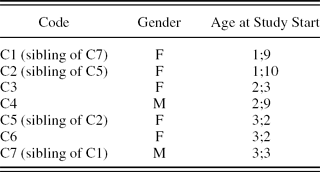
Participants were seven deaf children with moderate to profound hearing loss. They ranged in age from 21 to 39 months (mean age = 31 months). Each had at least one deaf parent and had been exposed to ASL from birth. The children attended an infant–toddler class at a residential school for the deaf (although all children lived at home), in which the primary mode of communication in the classroom was ASL. Some of the children received speech and audiology services through the school; however, all used ASL as their primary form of communication. Among the children were two sibling pairs, thus the seven children were from five different families. Demographic details of the participants are listed in Table 1. There were two additional children in the class with hearing parents who were not part of the current sample.
Study participants (children)

Note: Ages are in years;months.
There were five adult participants: one teacher, two assistants, an educational audiologist and a student teacher. The two assistants were deaf; all other adults were hearing. Despite these varying roles, all of the adults were involved in the children's play during the free-choice portion of the day. The three hearing adults were all highly proficient in ASL and used ASL to communicate with parents, other teachers, and children throughout the day.
Data collection
Classroom interactions
Children and adults were videotaped in their classroom for approximately 1 hr per day on 30 separate days, over a 3-month period. Videotaping occurred during the first hour of the children's day, when they were engaged in free play activities. Classroom activities included art, sensory play, blocks, a climbing structure, and a reading area. The cameras were placed in a fixed location for each session.
Vocabulary measure
In order to obtain a measure of linguistic ability, children's parents were given the ASL version of the MacArthur–Bates Communicative Developmental Inventory (ASL-CDI; Anderson & Reilly, Reference Anderson and Reilly2002). This instrument, which is an adaptation of the spoken language CDI, is a parent report measure of vocabulary that has been shown to be a reliable resource for estimating the size and composition of early vocabularies in a number of different languages (Fenson et al., Reference Fenson, Dale, Reznick, Bates, Thal and Pethick1994). The ASL-CDI has been standardized for use with deaf children between 8 and 36 months of age. It includes 537 signs in 20 semantic categories. One parent (C3) did not return the ASL-CDI checklist; thus, data are available for six of the seven child participants.
Coding and analysis
The videotaped data were coded and analyzed off-line. First, the continuous stream of classroom activity was divided into episodes, which were defined as a period of continuous activity. Each episode was further divided into communicative bouts, which were defined as a single, continuous interaction that took place between a child and one or more other children or adults with no change in participants. A bout ended either when a new interaction (with new participants) began or when the current exchange came to a halt and there were no exchanges for at least 30 s. Every bout in which it was possible to see the signs, actions, and eye gaze of the interlocutors was then coded.
Each bout was further broken down into a series of turns, defined as a communicative act directed from one individual to another. To be counted as a turn, the act had to be considered purposeful, that is, directed toward the addressee with the intent to initiate or continue an interaction (Ross, Lollis, & Elliott, Reference Ross, Lollis, Elliott, Rubin and Ross1982). Because of the young age of the children, turns were often nonlinguistic; that is, they did not contain any ASL signs. Furthermore, when a child used an initiation, paused, and then repeated or changed the signal, this was counted as two turns. If the child used one extended or rapidly repeating signal this was counted as one turn. Using this approach, more than 1,600 turns were identified for further analysis.
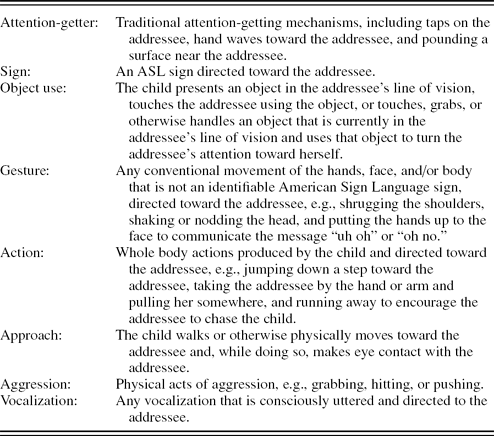
The behaviors or acts that composed the beginning of each turn were called initiations. Eight different categories of initiation that served to initiate, reinstate, and maintain attention were identified. The initiation categories came in part from those developed in previous studies of parent–child interactions involving deaf children (Harris et al., Reference Harris, Clibbens, Chasin and Tibbitts1989) and preschool interactions among deaf children (adapted from Vandell & George, Reference Vandell and George1981). Additional codes were added to accommodate certain types of interactions that were unique to children in this setting, such as grabbing objects out of another child's possession or offering a toy to another child. Initiation types included attention-getters, object-use, signs, actions, gestures, vocalizations, physical approach, and aggression (see Table 2). When two initiations were used simultaneously, both were coded.
Initiation types used during interactions

The addressee's focus of attention immediately prior to each turn was coded to note whether or not the addressee was already directing eye gaze toward the individual carrying out the turn and thus whether the initiation served to obtain or maintain attention. When the addressee was not attending to the initiator, so that the initiator was attempting to attract the addressee's attention, the success of the turn was noted. A successful turn was one in which the addressee responded appropriately to the initiation. An unsuccessful turn was one in which the addressee showed no response to the bid for attention. In the case of unsuccessful initiations, the initiator's behavior was further coded to note how individuals followed up failed attempts at initiation. Repeated and new initiations gave the addressee another chance to respond to the bid for attention. Proceeding with the turn and giving up on the interaction did not provide the addressee another chance to respond to the bid.
Reliability
A portion of the data (roughly 10%) were coded by a deaf, ASL native-signing research assistant who was trained on the coding scheme. The assistant coded a subset of data that had already been divided into episodes and bouts by the primary researcher, who is a highly proficient signer. Disagreements were discussed until agreement was reached. Reliability scores were obtained using a combination of frequency and point-by-point agreement calculations (Kazdin, Reference Kazdin1982). Reliability scores for specific coding categories were as follows: type of initiation, 93%; number of initiations by child, mean 90% (range = 77%–100%); success of initiations, 98%; follow up to unsuccessful initiations, 82%, complexity of bouts, 89%.
RESULTS
Types of attention-getting strategies
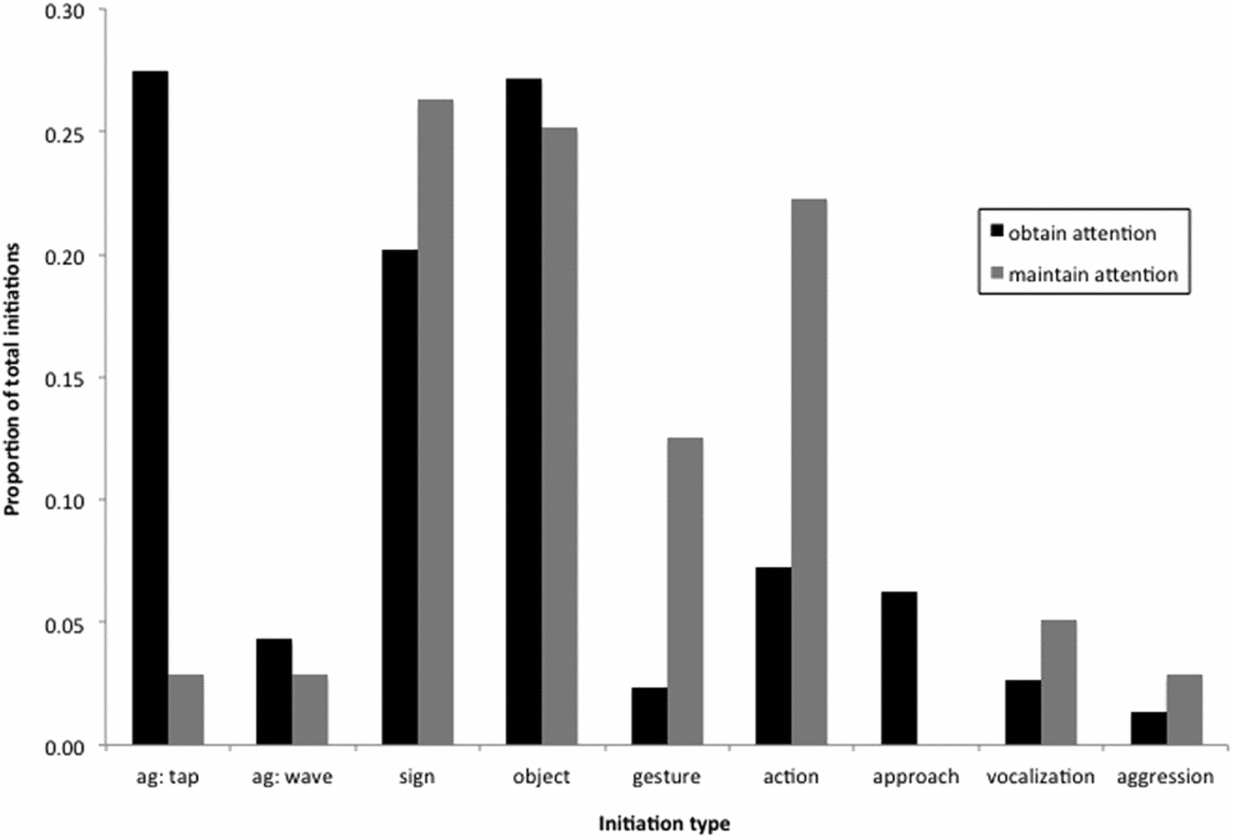
The first set of analyses was designed to determine the type of initiation strategies used by children during peer interaction. Unless otherwise noted, the results presented here are collapsed across children. Across all the recorded interactions, there were 78 analyzable bouts that contained at least 1 communicative turn between two children. In these bouts, there were 430 turns that included 477 initiations. The greater number of initiations compared to turns reflects that some turns began with 2 initiations produced simultaneously. In order to compare attention-getting devices to more general behaviors used to initiate a communicative turn, initiations were categorized into those that served to obtain the attention of the addressee (i.e., the addressee was not directing eye gaze toward the child) and those that served to maintain attention (i.e., the addressee's eye gaze was already directed toward the child). Out of 477 initiations, 302 were used to obtain the attention of another child, and 175 were used to maintain attention. The initiations that were used to obtain a peer's attention were then analyzed by type. The most common behaviors the children used to obtain peer attention were taps (84 times, 28%), object use (82 times, 27%), signs (61 times, 20%), actions (22 times, 7%), and physical approach (19 times, 6%). Gestures, waves, vocalizations, and aggression were rarely used; each type accounted for no more than 4% of all initiations. As hand waves are a commonly used attention-getting device among adults, it is notable that children rarely used them during peer interaction.
The remaining initiations served to maintain attention when the addressee was already directing eye gaze toward the initiating child. Of the 175 initiations used to maintain attention, the most common types were signs (46 times, 26%), objects (44 times, 25%) and actions (39 times, 22%), followed by gestures (22 times, 13%), and attention-getters, that is, taps and waves (10 times, 6%). The greatest differences between initiations used to obtain versus maintain attention were that conventional attention-getters (i.e., tapping and waving) were primarily used to obtain but not maintain attention, while gestures and actions were primarily used to maintain but not obtain attention (see Figure 1).
The proportion of initiations of each type used in peer interaction to obtain attention (n = 302 initiations) and maintain attention (n = 175 initiations).

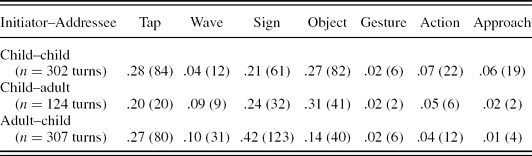
In order to determine whether children used similar behaviors with peers and adults and whether adults’ initiation patterns were parallel to children's, initiations were compared across dyads (Table 3). These comparisons yielded several key insights. First, children were highly consistent in their initiation choices, regardless of whether they were attempting to interact with a peer or an adult. Second, children relied more heavily on objects to initiate communication than did adults; adults were more likely to initiate interactions with signs. Third, to maintain attention, adults used signs the vast majority of the time, while children selected from the range of initiation types they were observed to use with peers. These results show that children and adults have the same repertoire of initiation strategies, but they differ in their relative use of these strategies.
Initiation types by initiator–addressee to obtain attention as a proportion of total initiations for each dyad

Note: The numbers in parentheses refer to the number of instances of each turn type.
Success of initiations
Every turn intended to obtain the addressee's attention was coded as either successful or unsuccessful. A successful response by the addressee occurred when the addressee directed eye gaze toward the initiating child, turned his or her head toward the child, or acted on the object that the child was using as an initiation. An unsuccessful response occurred when the addressee showed no response or change in behavior following the initiating child's attempt. During peer interactions, there were 267 single-initiation turns in the data set that were used to obtain peer attention. Of these, 172, or 64%, were successful. Success rates by initiation type ranged from 0% to 100%. The most successful initiation types were physical approach (100%), object use (70%), actions (71%), and signs (62%). Initiations that were successful roughly half the time were taps (56%), gestures (50%) and aggression (50%). The least successful initiation types were hand waves (43%) and vocalizations (0%), which were never successful when used alone.
In all instances in which children's initiation attempts were unsuccessful in gaining their peer's attention, their immediately following behavior was coded to determine how they reacted to the unsuccessful response. There were 95 unsuccessful bids for attention. When this occurred, children were equally likely to repeat the initiation (24 times, 25%) or use a new initiation strategy (23 times, 24%). Children rarely proceeded with their turn (10 times, 11% of all unsuccessful attempts) without obtaining the visual attention of the addressee. However, a substantial percentage of the time (38 instances, 40% of all failed attempts), children gave up and either walked away or made no further attempt to get the addressee's attention.
For teacher–child interactions, success was analyzed first as the proportion of children's bids for attention to which adults responded successfully. As the adults in this study were highly motivated to interact with children, it was expected that they would be largely successful in responding to children's initiations. Children's initiations toward adults were successful 65% of the time (81 out of 124 bids). Thus, the success rate of child–child and child–teacher interactions was almost identical.
As with peer interactions, in all instances in which children's initiation attempts toward adults were unsuccessful in gaining the addressee's attention, their behavior immediately following was coded. The child either repeated the same initiation or tried a new initiation 19 out of 34 times, or 56% of all follow-up turns. Only a small percentage of the time (3 out of 34, or 9%) did children simply proceed with their intended turn. For the remaining 12 out of 34 attempts, or 35% of the time, children gave up and terminated the turn and often the entire interaction.
As an additional measure of children's awareness of attention-getting signals, the success of adult initiations was analyzed as the proportion of adults’ initiations to which children responded successfully. There were 307 initiations by adults toward children used to obtain attention within the data set. Overall, adults successfully obtained children's attention on 206 of these initiations, for a success rate of 67%. Of the 74 unsuccessful adult initiations, 36 (49%) were followed up with either a repeated or new initiation. Adults gave up on the initiation 19 times (26%) and, notably, proceeded with their turn 19 times (26%). Thus, adults appear to have a different approach from children following unsuccessful initiation attempts. Adults are more willing to proceed with a turn even when they do not initially obtain the child's attention.
Individual differences
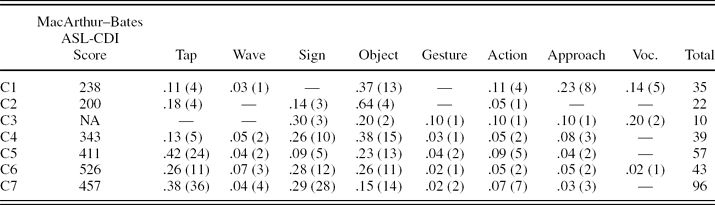
Individual differences were examined by analyzing each child's behavior with regard to the number of times the child attempted to obtain a peer's attention, the types of initiations used, the success of initiations, and the follow up to failed initiation attempts. As an additional measure of children's communicative competence, the number of bouts in which each child participated, as well as the average number of turns per bout, were calculated. Individual differences were analyzed as a function of both age and vocabulary skill (as measured by the ASL-CDI). Because all the children had been exposed to ASL from birth, CDI scores patterned closely with age (see Table 4).
Initiations by type used to obtain attention by individual child: Proportion of total (number) for each child

Note: ASL-CDI, American Sign Language version of the Communicative Development Inventory (Anderson & Reilly, Reference Anderson and Reilly2002).
Analysis revealed that older children with higher vocabularies initiated more communicative turns than younger children with lower vocabularies. The number of initiations produced by each child to obtain another child's attention was significantly correlated with age (r = .73, one-tailed p < .05) but not vocabulary (r = .66, ns).Footnote 1 The number of total turns produced (i.e., those used to obtain and maintain attention) correlated with both age and vocabulary (see Table 5). There were also age-based patterns in the distribution of initiation behaviors. Three of the four youngest children, C1, C2, and C4, used objects more than any other initiation type to get their peers’ attention. In contrast, C3 and C6 used signs more than any other initiation type, while C5 and C7 used taps most often. Contrary to expectations, there were no significant age-based differences in the success rate of peer initiations or the follow up to unsuccessful peer initiations.
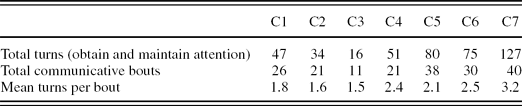
Peer interactions: Turns, bouts, and mean turns per bout by child

To obtain additional measures of complexity, for each child the total number of turns initiated (including those used both to obtain and maintain attention) was divided by the total number of bouts in which the child participated. The average number of bouts in which children participated was 27 (range = 21–40). The average number of turns per bout was 2.2 (range = 1.5–3.2). Results showed a significant positive correlation between age and number of bouts in which the child participated, and positive correlations between both age and vocabulary and average number of turns per bout (r = .79, p < .025; r = .78, p < .05). These results indicate a developmental trend. Children engage in more bouts overall, and their bouts contain a greater number of communicative turns as they mature and their vocabulary develops.
Individual differences in preferred interaction partners were analyzed by child. Only two of the youngest children initiated more turns with adults than with peers. All the other children initiated more turns with peers than adults. In fact, the three oldest children initiated at least twice as many turns with peers as with adults. When they initiated turns with adults, the children exhibited a wide range of success (55%–90%). As was the case for peer initiations, there was no consistent age-based pattern in success rate.
Adult scaffolding in the classroom
In the adult–child interactions, teachers were periodically observed making overt comments and directives regarding children's attention-getting skills. Occasionally, when teachers saw that children were struggling with their initiations toward other children or adults, they would intervene in a way that explicitly modeled a more successful way of obtaining peer or adult attention. These interventions were informal and spontaneous, and they provided important learning opportunities for the children. They involved modeling the particular attention-getter for the child, prompting the addressee to look at the initiating child or prompting the child to use an explicit attention-getter.
Two examples of this adult intervention are instructive. In the first example, one child, C1, was attempting to solicit help from an adult in putting on a pair of dress-up shoes. C1 sat in place and called out repeatedly. A hearing teacher heard the child but did not respond to this bid for attention. Instead, she used this opportunity to provide a lesson in appropriate attention-getting. Using a deaf teacher as her addressee, she first showed how vocalizing would not elicit a response and then tapped the deaf teacher to show how this successfully elicited her attention. In the second example, a teacher observed one child unsuccessfully trying to obtain the attention of another child who was in another part of the room. She gently guided the first child over to where the second child was standing and then took the first child's hand and used it to tap the second child on the arm. In these instances, the adults used the window of opportunity they perceived during unsuccessful initiations to model more appropriate methods for children to obtain attention.
DISCUSSION
The current study sought to examine how native-signing deaf children interacted with peers and teachers in a classroom environment in which ASL was the primary mode of communication. A microlevel analysis was used to examine the behaviors used to obtain and maintain attention with peers and teachers, the success of these initiations, the subsequent response to unsuccessful initiations, and developmental changes in attention-getting skills. Despite the small sample size, a large body of data was collected containing over 1,600 conversational turns. To obtain their peers’ attention, children used a discrete set of initiations, primarily attention-getters, objects, and signs. Children's initiations were successful roughly two-thirds of the time, which paralleled initiations between children and adults. Children followed up unsuccessful initiations with new or repeated strategies and did not proceed without obtaining peer attention. Older children with larger vocabularies used more initiations overall, their initiations were more sophisticated, and they engaged in longer and more complex bouts than younger children with smaller vocabularies. Each of these findings is discussed in greater detail below.
The major finding from analysis of children's attention-getting strategies is that by the age of 19 months, deaf children who have been exposed to sign language from birth are aware of the need to establish eye contact with their interlocutors in order to communicate in the visual mode, and they possess a range of available strategies with which to do so. The unique structure of interaction in the visual mode poses no barriers to communication among young children studied here. They adapted their own initiations to the demands of the communicative environment and responded to peers’ and adults’ attempts to communicate with a high level of success.
While previous findings have established that deaf parents scaffold children's attention-getting behavior (Meadow-Orlans, Koester, & Spencer, Reference Meadow-Orlans, Spencer and Koester2004), the current study extends these findings by showing that children generalize this knowledge to peer interaction from a young age. In this classroom setting, children did not generally attempt interactions with peers or teachers until they had purposefully obtained their visual attention. Thus, deaf children choose more or less explicit initiation strategies depending on the attention-related demands of the specific situation: nonlinguistic attention getters, such as taps and waves, were used almost exclusively to obtain the addressee's attention, whereas signs and gestures were used more frequently when the addressee was already attending. Children also demonstrated an understanding of and sensitivity to their specific interaction partners. The use of objects and attention getters dominated during peer interaction. By contrast, exchanges between adults and children were primarily initiated by the use of signs. Children were evidently aware that adults were ready to interact with them linguistically and required less overt attention-getting signals.
The success of an initiation is shared by both partners in a dyadic interaction. That is, a successful initiation requires both partners to understand the intention of the behavior as well as what constitutes a successful response (Vandell & George, Reference Vandell and George1981). In this sample, children's initiations with peers were successful roughly two-thirds of the time. This success rate is higher than that found in previous studies of deaf children's interactions in oral education programs, in which fewer than 20 percent of deaf children's initiations were reported as successful (Deluzio & Girolametto, Reference Deluzio and Girolametto2011; Messenheimer-Young & Kretschmer, Reference Messenheimer-Young and Kretschmer1994). The present finding further builds on previous findings that deaf children were more successful in their initiations with other deaf children than with hearing children (Weisel, Most, & Efron, Reference Weisel, Most and Efron2005). The candidate factor that set the children in the current study apart from those in earlier studies was the presence of a natural, accessible and shared language among the children, all of whom had been exposed to ASL from birth. The foundation in language and communicative competence acquired at home enabled fluid communication in this classroom environment. Children were also sensitive to the success of specific strategies, as evidenced by the fact that the most successful form of initiation, object use, was also the most frequent.
It is important to note that the overall success rate of initiations did not differ substantially between children and adults. While it was initially expected that adults would be more successful than children, both as initiators and responders, the consistent success rate likely reflects the fact that it is not always appropriate to respond to every bid for attention. For example, adults ignored children's initiation attempts when they were in the middle of an interaction with another child, and children showed the same behavior with their peers. Thus, the success rate observed here is likely approaching a typical success rate for signed interactions regardless of the age of the interlocutors.
Children's follow-up responses to unsuccessful initiation attempts shows further evidence of their understanding of the pragmatic dynamics of visual communication. Children almost never proceeded with their intended turn if they could not obtain their partner's eye gaze, suggesting that they were aware of the fruitlessness of interacting with someone who was not attending to them. Children's sensitivity to the perceptual state of their addressee demonstrates an understanding of visual perspective taking in sign language. Very young deaf children appear to know that they must take into account their partner's eye gaze, not just their own, when carrying out a communicative exchange. It seems likely that deaf children with such rich visual language exposure may show an advantage in specific cognitive tasks requiring them to account for the visual perspective of their interlocutor. Deaf children with sign language experience have previously been shown to have superior performance to hearing children on a false belief task (Courtin, Reference Courtin2000), suggesting that the visual nature of sign language may impact development in the cognitive domain. Further research with deaf children on specific perspective-taking tasks would be necessary to address this possibility.
The children in this study ranged in age from 21 to 39 months, allowing insight into how social interactions change over time as a result of both maturation and amount of linguistic and social experience. Older children had higher expressive vocabularies, initiated more turns with peers, participated in more bouts, and engaged in longer bouts than younger children. The relationship between vocabulary and number of initiations, which is confounded by age in the current study, is an important area for further investigation. If, as the current findings suggest, vocabulary skill is correlated with initiations, it would indicate that the more children are able to initiate interactions with others, the more language input they effectively receive. This is likely a bidirectional relationship, in that as children receive more language input, they may gain further exposure to and experience with visual attention-getting strategies. This further implies that children who do not learn the skills required for attention getting in a visual language at an early age could also face decreased language exposure, as well as fewer opportunities to participate in the complex social exchanges that typically take place in the classroom (Singleton & Crume, Reference Singleton and Crume2010).
Another developmental change observed here and in previous studies was a decrease in the number of initiations toward teachers and a corresponding increase in the number of initiations toward peers (Howes & Clements, Reference Howes, Clements, Goelman and Jacobs1994). That children preferred peers as interaction partners by the age of 3 likely reflects the positive, sustained, and rewarding nature of such interactions for deaf children when language is fully accessible to them.
One goal of this study was to determine whether children modeled their own initiation strategies on the ones used by familiar adults in their environment. The adults in this classroom, both hearing and deaf, made themselves ready and available interaction partners for the children in the classroom. Two features of adult initiations that differed from children's behaviors were noteworthy. First, adults frequently used signs to obtain children's attention. Signs are the least explicit attention-getters, and starting a turn with a sign could also be considered a lack of attention-getter. Second, adults were also more likely than children to proceed with their turn by signing following a failed initiation. This frequent use of signs both to initiate and to further interactions was likely an intentional strategy designed to foster sensitivity to signing in deaf children. That is, adults may have signed toward children without overt attention-getters with the expectation that the children would quickly notice the sign and look up, a strategy used by deaf adults in conversation with other adults (Coates & Sutton-Spence, Reference Coates and Sutton-Spence2001) and by deaf parents interacting with their children (Koester, Karkowski, & Traci, Reference Koester, Karkowski and Traci1998; Spencer & Deyo, Reference Spencer, Deyo, Marschark and Clark1993). Similarly, teachers may have proceeded with unsuccessful initiations by signing, using this as a teaching tool to convey to children the importance of turn-taking and monitoring of attention. Although there were no significant differences in strategies used by deaf versus hearing adults, it is also possible that some of the adults’ strategies arose partly from their own experiences growing up and interacting primarily with hearing individuals.
The children studied here were exposed from birth to adult models who were themselves adept at turn-taking and attention-getting in ASL. Through their natural use of the language, parents fostered the development of these discourse skills in their children. The classroom observed was designed and structured around the requirements of communicating in a visual language. Children thus had the opportunity to observe and imitate one other and learn from their own successes and failures as well as those of other children. In contrast, in classrooms in which the majority of children are hearing, there are unshared sociolinguistic practices that likely contribute to communicative failure between deaf and hearing peers (Keating & Mirus, Reference Keating and Mirus2003; Weisel et al., Reference Weisel, Most and Efron2005). The adults in this classroom evidently understood that they were serving as role models and teachers of interaction skills, and they frequently modeled and described appropriate attention-getting strategies. This type of adult modeling and prompting can be applied to integrated classrooms containing hearing and deaf children in order to facilitate broader interactions and friendships and help hearing children become more sensitive to the visual needs of deaf children (DeLuzio & Girolametto, Reference Deluzio and Girolametto2006; Griffin, Solit, & Bodner-Johnson, Reference Griffin, Solit and Bodner-Johnson1991; Spencer et al., Reference Spencer, Koester and Meadow-Orlans1994).
Deaf children with deaf parents represent a small minority (<5%) of the population of deaf children (Mitchell & Karchmer, Reference Mitchell and Karchmer2004). The current results suggest that, in addition to the obvious language and cognitive benefits of introducing sign language, hearing parents may benefit from explicit instruction regarding the development of social skills in their children. Creating a successful interaction with deaf children requires a high level of sensitivity to the child's perceptual needs and constant monitoring and adjustment to the child's developing abilities to attend visually and alternately to objects and people. A pattern of interaction that is too sophisticated or too immature relative to the child's abilities compromises dyadic interaction and is likely to be detrimental to the child's language and cognitive development. Such skills are crucial for deaf children to develop regardless of the mode of communication being used with them. Deaf or hard-of-hearing children learning through auditory–oral methods also require a high degree of visual sensitivity for optimal language attainment (e.g., Bergeson, Pisoni, & Davis, Reference Bergeson, Pisoni and Davis2003). Thus, interventions specifically focused on communicative strategies should be a focus for hearing parents. Some interventions that have been attempted, with promising results, include employing deaf mothers to train hearing mothers about the attentional demands of communication in the visual mode (Mohay, Milton, Hindmarsh, & Ganley, Reference Mohay, Milton, Hindmarsh, Ganley and Weisel1998), prompting hearing mothers to use certain communication strategies during play (Mohay, Reference Mohay, Spencer, Erting and Marschark2000), or focusing on teaching parents how to engage in joint picture book reading with their deaf children (Schleper, Reference Schleper1995; Van der Lem & Timmerman, Reference Van der Lem, Timmerman, Nelson and Reger1995). Further research is needed to determine the specific type of intervention that is most effective in improving deaf children's interaction skills.
CONCLUSIONS
The ability to engage in social interaction at an early age provides the building blocks for later learning and development across domains (Bruner, Reference Bruner1983). Deaf children, when they are provided with natural and accessible settings for social interaction from birth, develop communicative competence on a typical time course. The children observed in this study demonstrate that interactions with skilled communication partners at home provides children with the underpinnings of attention-getting skills, which are both implemented and expanded during exchanges with peers and teachers in the classroom. Social interaction in the visual mode is a complex and sophisticated task. With the appropriate tools and recognition of deaf children's visual needs by their interaction partners, social interactions can be meaningful and self-motivating experiences for them. Features of the environment, such as access to compatible peers, adult language models, and communication in an accessible and natural language, provide the necessary backdrop against which successful communication skills are acquired.
ACKNOWLEDGMENTS
This project composed a portion of the doctoral dissertation of the author, supervised by Dan I. Slobin, Philip Prinz, and Susan Holloway, with later guidance from Rachel Mayberry. I am grateful to each these individuals for their comments and support and to Julie Mitchiner for help with coding. Portions of this work were presented at the Boston University Conference on Language Development (BUCLD 33) in 2008. This project was partially funded by grants from the University of California Linguistic Minority Research Institute, the UC Berkeley School of Education Graduate Student Fellowship, and an NIDCD award (DC 011615). I express sincere gratitude to the classroom teacher and to all of the families who participated in this research.