Introduction
The American Psychiatric Association (APA) considers pathological gambling (PG) as an impulse-control disorder, with ‘the essential feature of Pathological Gambling’ being ‘persistent and recurrent maladaptive gambling behavior … that disrupts personal, family, or vocational pursuits’ (APA, 2000). Fundamental to understanding PG is the consistent clinical observation that PG usually coexists with other mental disorders (Specker et al. Reference Specker, Carlson, Edmonson, Johnson and Marcotte1996; National Research Council, 1999; Cunningham-Williams et al. Reference Cunningham-Williams, Cottler, Compton, Spitznagel and Ben-Abdallah2000). However, it is not known whether the same is true in the general population, as co-morbidity might be related to help-seeking. Community epidemiological data are consequently needed to clarify the co-morbidity of PG with other mental disorders.
Although several general population surveys have examined co-morbidity between problem gambling and substance use disorders (e.g. Bland et al. Reference Bland, Newman, Orn and Stebelsky1993; Cunningham-Williams et al. Reference Cunningham-Williams, Cottler, Compton and Spitznagel1998), only one community-based, nationally representative study has examined co-morbidity between PG and a wider range of mental disorders (Petry et al. Reference Petry, Stinson and Grant2005). That study found frequent lifetime co-morbidity of PG with other disorders. However, no attempt was made in that study to sort out the temporal sequencing between age of onset (AOO) of PG and its symptoms and co-morbid disorders. The current report focuses on this sequencing using data collected in another nationally representative household survey, the National Comorbidity Survey Replication (NCS-R; Kessler & Merikangas, Reference Kessler and Merikangas2004), that assessed the lifetime prevalence of PG along with a wide range of other mental and substance disorders and obtained retrospective AOO information for each of these disorders.
Method
Sample
The NCS-R is a face-to-face household survey of 9282 English-speaking respondents ages 18 years and older carried out between February 2001 and April 2003 in a nationally representative multi-stage clustered area probability sample of the US household population (Kessler & Merikangas, Reference Kessler and Merikangas2004). The response rate was 70.9%. Recruitment began with a letter and study fact brochure followed by an in-person interviewer visit to explain study aims and procedures and obtain verbal informed consent. Respondents received US$50 for participation. Consent was verbal to be consistent with the procedures in the baseline NCS (Kessler et al. Reference Kessler, McGonagle, Zhao, Nelson, Hughes, Eshleman, Wittchen and Kendler1994) for purposes of trending. The NCS-R recruitment and consent procedures were approved by human subjects committees of Harvard Medical School and the University of Michigan.
All NCS-R respondents were administered a Part I diagnostic interview, and a subsample of Part I respondents was also administered a Part II interview that assessed additional disorders and correlates. Part II respondents included all who met lifetime criteria for any Part I disorder plus a probability subsample of others who were weighted by the inverse of their probability of selection into Part II to retain the representativeness of the Part II sample. Random subsets of Part II respondents were administered assessments of disorders included for exploratory purposes. PG was among those disorders. PG was assessed in a probability subsample of 3435 Part II respondents that was weighted to adjust for differential probabilities of selection and to match the 2000 census population on the cross-classification of a number of geographic and sociodemographic variables, resulting in the subsample being representative of the US population. All analyses reported in this paper are based on these weighted data. More complete information about the NCS-R sampling design and weighting is reported elsewhere (Kessler et al. Reference Kessler, Berglund, Chiu, Demler, Heeringa, Hiripi, Jin, Pennell, Walters, Zaslavsky and Zheng2004b).
Diagnostic assessment
NCS-R diagnoses are based on Version 3.0 of the World Health Organization (WHO) Composite International Diagnostic Interview (CIDI; Kessler & Ustun, Reference Kessler and Ustun2004), a fully structured lay-administered interview that generates diagnoses according to the definitions and criteria of both the ICD-10 (WHO, 1991) and DSM-IV (APA, 1994) diagnostic systems. DSM-IV criteria are used here. The diagnoses include the three broad classes of disorder assessed in previous CIDI surveys (anxiety disorders, mood disorders, substance disorders) plus a group of five disorders found to form a factor in exploratory factor analysis that share a common feature of difficulties with impulse-control. These include PG, intermittent explosive disorder, and three retrospectively reported childhood-adolescent disorders: oppositional-defiant disorder (ODD), conduct disorder (CD) and attention deficit hyperactivity disorder (ADHD). We provisionally refer to these as impulse-control disorders in this paper, although future research might show other or more complex underlying influences that lead to their high co-morbidity. Diagnostic hierarchy rules and organic exclusion rules were used in making diagnoses. As detailed elsewhere (Kessler et al. Reference Kessler, Abelson, Demler, Escobar, Gibbon, Guyer, Howes, Jin, Vega, Walters, Wang, Zaslavsky and Zheng2004a), blind clinical reinterviews using the Structured Clinical Interview for DSM-IV (SCID; First et al. Reference First, Spitzer, Gibbon and Williams2002) with a probability subsample of NCS-R respondents found generally good concordance between DSM-IV diagnoses based on the CIDI and the SCID for anxiety, mood, and substance use disorders. CIDI diagnoses of impulse-control disorders were not validated because the SCID contains no assessment of these disorders.
The CIDI assessment of PG began by asking respondents how many times they ever gambled in their life, the types of gambling they engaged in, the age when they first gambled, and the largest amount of money they ever lost gambling in any single year of their life. A DSM-IV diagnosis of PG requires ‘persistent and maladaptive gambling behavior’ as indicated by at least five of 10 symptoms that are similar in content to the symptoms of substance abuse (e.g. jeopardized or lost a significant relationship or career opportunity because of gambling) and dependence (e.g. gambled with increasing amounts of money to retain desired excitement). The CIDI included a total of 16 questions to assess these symptoms, with multiple questions used for the conceptually more complex symptoms. The internal consistency reliability of these reports, as assessed by Cronbach's α, was 0.90. Although no clinical reappraisal interviews were carried out to validate the self-report diagnoses, clinical significance is indicated by respondents classified as having PG reporting a mean of US$4800 in gambling losses in the year of their greatest losses.
Nearly four times as many respondents reported ever having any of the 10 PG symptoms as reported meeting full criteria of PG (i.e. five or more symptoms). To study the transition from non-problem to problem gambling and from problem gambling to PG, we defined problem as a history of at least one symptom of PG. DSM-IV requires symptoms not be due to a manic episode for a diagnosis of PG. This requirement was operationalized by excluding respondents with a lifetime CIDI/DSM-IV diagnosis of bipolar I disorder (BP-I) from a diagnosis of PG. As DSM-IV explicitly excludes only symptoms due to mania and not hypomania, PG was not excluded among respondents with bipolar II disorder (BP-II).
The CIDI assesses AOO of disorders retrospectively. Based on evidence that retrospective AOO reports are often erroneous (Simon & Von Korff, Reference Simon and Von Korff1995), a special question sequence was designed for the CIDI to improve the accuracy of AOO reporting. This began with questions designed to emphasize the importance of accurate response: ‘Can you remember your exact age the very first time [emphasis in original] when you (had the symptom/the syndrome)?’ Respondents who answered ‘no’ were probed for a bound of uncertainty by moving up the age range incrementally (e.g. ‘Was it before you went to school?’ ‘Was it before age 13?’, etc.). AOO was set at the upper end of the bound of uncertainty (e.g. age 12 years for respondents who reported that onset was before the beginning of their teens). In the case of problem gambling, respondents were asked to recall their age when the first such problem occurred. Experimental research has shown that this question sequence yields more plausible responses than standard AOO questions (Knauper et al. Reference Knauper, Cannell, Schwarz, Bruce and Kessler1999).
Other measures
Sociodemographic variables used to predict PG included three that could not be caused by PG (age, sex, race-ethnicity) and two others that we could date in relation to AOO of PG so as to exclude the possibility that they were influenced by PG (education, marital status). No other sociodemographic controls (e.g. occupational status, income) were included in the models because we had no means of adjusting for the possibility that these were influenced by PG.
Respondents defined as having lifetime PG were asked if they ever obtained professional treatment for their gambling. All Part II respondents were also asked whether they had ever received treatment for ‘problems with your emotions or nerves or your use of alcohol or drugs’ and, if so, treatment by each of a number of different professionals. Responses were used to distinguish treatment in five sectors: psychiatrist, non-psychiatrist mental health specialist (e.g. psychologist), general medical (e.g. primary-care doctor), human services (e.g. religious-spiritual advisor), and complementary-alternative medicine (CAM; e.g. self-help group).
Analysis methods
Prevalence estimates were calculated using cross-tabulations. Cumulative AOO curves were constructed using the actuarial method, a method that improves on the more familiar Kaplan–Meier method in handling ties (Halli et al. Reference Halli, Rao and Halli1992). The associations of PG with gambling types, sociodemographics and co-morbid CIDI/DSM-IV disorders were examined using discrete-time survival analysis with person-year the unit of analysis (Willett & Singer, Reference Willett, Singer, Gotlib and Wheaton1997). As noted above, education and marital status were treated as time-varying controls so that we could examine the associations of these variables prior to AOO of PG with the subsequent onset of PG. Survival coefficients were converted to odds ratios (ORs) for ease of interpretation. Significant coefficients were broken down into components that distinguished effects of the predictors on initiation of gambling, on the transition from non-problem to problem gambling, and on the transition from problem gambling to PG. Temporal priorities of PG in comparison to co-morbid conditions were investigated by comparing individual-level retrospective AOO reports across disorders. Significance tests were made using the Taylor series linearization method (Wolter, Reference Wolter1985) implemented in the SUDAAN software package (Research Triangle Institute, 2002) to adjust for the weighting and clustering of the NCS-R data. Multivariate significance was evaluated using Wald χ2 tests based on Taylor series design-based coefficient variance–covariance matrices. Statistical significance was evaluated at the 0.05 level with two-sided tests.
Results
Prevalence
Nearly four out of every five respondents (78.4%) reported gambling at least once in their life, while 54.5% gambled more than 10 times, 27.1% more than 100 times, and 10.1% more than 1000 times. A dose–response relationship exists between the number of times gambled and the probability of problem gambling (i.e. at least one Criterion A symptom of PG) and PG, with the highest conditional probability of problem gambling (12.2%) and PG (4.3%) both occurring among respondents who gambled more than 1000 times. (More detailed results available on request.) In the total sample, the lifetime prevalence (with standard error in parentheses) estimate of problem gambling is 2.3% (0.3), and the lifetime prevalence estimate of PG is 0.6% (0.1). The estimated 12-month prevalence of PG is 0.3% (0.1). As noted earlier in the section on measures, a diagnosis of PG was not made among people with lifetime BP-I, among whom 17.2% (1.8) reported lifetime problem gambling and 11.1% (2.4) reported five or more lifetime symptoms. Lifetime prevalence of PG would increase from 0.6% (0.1) to 0.7% (0.1) if we allowed people with BP-I to be diagnosed with PG. Although respondents with CIDI/DSM-IV BP-II were not excluded from a diagnosis of PG, the estimated lifetime prevalence of PG is much higher among those with BP-II [2.9% (1.1)] than the remainder of the sample [0.5% (0.1)].
AOO and course
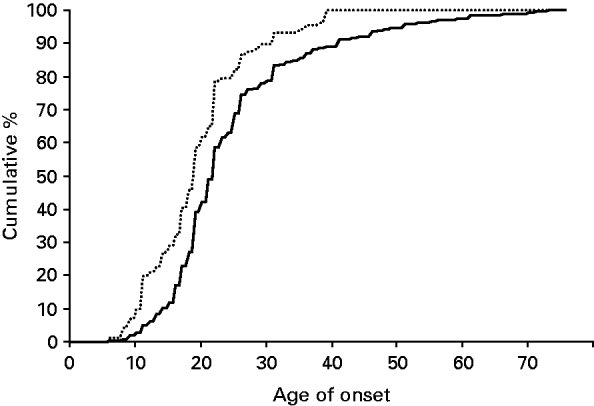
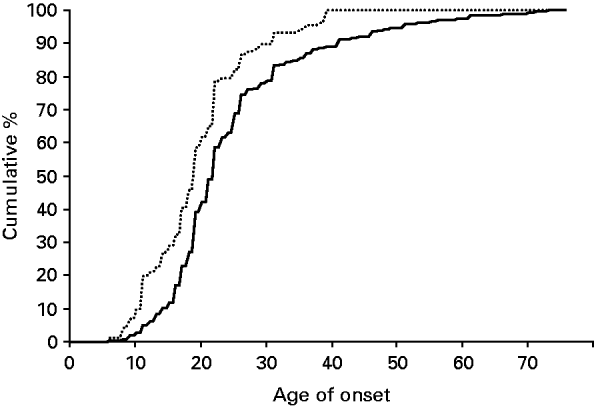
The AOO curves for first gambling are significantly later for those without any symptoms of PG (median AOO of 21) than for gamblers who went on to develop problem gambling (median AOO of 18; χ21=68.7, p=0.000) (Fig. 1). The AOO curves also show a somewhat earlier onset of gambling problems among gamblers who went on to develop PG (median AOO of 23) than other problem gamblers (median AOO of 29; χ22=1.7, p=0.42). With one exception, the speed of transition to problem gambling from first gambling does not differ significantly by number of PG symptoms, with a slightly more rapid progression among respondents who subsequently developed 3–4 or 5+ symptoms (median speed of transition of 6–7 years) than 1–2 symptoms (median speed of transition of 10 years; χ22=4.2, p=0.12). Post hoc comparison of speed-of-transition curves found a significant difference for respondents with 1–2 symptoms versus 3+ symptoms (χ21=3.9, p=0.049).
Age of onset of gambling among non-problem gamblers (—, n=2624) and problem gamblers (·······, n=117).
Respondents with lifetime PG reported an average of 9.4 (1.0) years with gambling problems. This average is considerably less than the average within-person difference between AOO and the age of most recent gambling problems [16.2 (1.3)], indicating that people with PG have years free of gambling problems interspersed with years in which the problems return. Recognizing that this finding implies that relapse is possible, we defined recovery at the time of interview provisionally as having been free of gambling problems for at least 2 years. Survival analysis was then carried out to study duration of time between AOO and age of most recently having recovered. The results showed that speed of recovery is much more rapid for people with lifetime 1–2 symptoms (median of 2 years) than either 3–4 symptoms (3 years) or 5+ (5 years) symptoms, although the sample sizes are so small that this substantial difference is not statistically significant (χ21=0.4, p=0.55). (More detailed results available on request.)
Gambling types and gambling problems
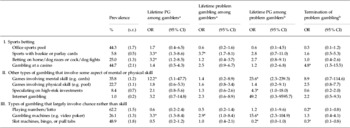
As expected, respondents with PG reported that they engaged in a larger number of different types of gambling than either non-problem gamblers or problem gamblers with 1–4 symptoms of PG. (More detailed results available on request.) However, the rank-ordering of gambling types in terms of popularity is very similar for problem gamblers and non-problem gamblers, with rank-order correlations in the range 0.78–0.98. The most popular types of gambling are numbers/lotto (62.2% among all gamblers and 86.5% among those with PG), slot machines or bingo (48.9% among all gamblers and 77.3% among those with PG), gambling at a casino (44.7% among all gamblers and 78.5% among those with PG), and office sports pools (44.3% among all gamblers and 85.1% among those with PG) (Table 1). The least popular are betting on sports with a bookie or parlay card (5.8% of all gamblers and 45.3% of those with PG), internet gambling (1.0% among all gamblers and 7.5% among those with PG), and speculating on high-risk investments (8.4% among all gamblers and 26.9% among those with PG).
Lifetime prevalence associations of gambling types with lifetime onset and persistence of CIDI/DSM-IV pathological gambling (PG)

s.e., Standard error; OR, odds ratio; CI, confidence interval.
a Multivariate model controlling for sex, race-ethnicity, age of onset (AOO) of first gambling, years since first gambling, and 11 gambling types.
b Multivariate model controlling for sex, race-ethnicity, AOO of first gambling, AOO of first problem, years since first problem, and 11 gambling types.
* Significant at the 0.05 level, two-sided test.
Significant associations exist between gambling types and gambling problems among lifetime gamblers (Table 1). Gambling on games where some component of mental skill is involved (e.g. cards) is associated with the highest risk of PG, with an OR of 12.2, followed by sports betting with a bookie or parlay card (3.3), gambling machines (3.3), and betting on horse races or cock/dog fights (3.2). Decomposition shows that these significant associations are due to a mix of effects on gambling problems among gamblers and progression to PG among problems gamblers.
Two other types of gambling are associated with recovery from problem gambling: gambling at a casino (associated with high odds of recovery) and gambling with slot machines, bingo or pull tabs (associated with low odds of recovery). The temporal priority linking these kinds of gambling with onset and persistence of PG is unclear, however, as the survey did not date AOO of each type of gambling.
Sociodemographic predictors
The odds of PG in the total sample are significantly higher among respondents in more recent cohorts (ages 18–44 at interview) than older cohorts (OR 4.9–14.3), men than women (OR 4.5), Non-Hispanic Blacks than Non-Hispanic Whites (OR 8.4), and non-students with less than a college education than students (OR 6.9–16.6). Decomposition shows that the elevated ORs of PG in recent cohorts are due to consistently elevated odds of ever gambling, gambling problems among gamblers, and progression to PG among problem gamblers. The situation is different for the elevated OR of PG among men, however, where decomposition shows that although men are significantly more likely than women ever to gamble, male gamblers are not significantly more likely than female gamblers to develop a gambling problem or to progress from problem gambling to PG.
The elevated odds of PG among Non-Hispanic Blacks exist despite Blacks being significantly less likely than Whites ever to gamble, as Blacks have an extremely high odds of developing a gambling problem once gambling begins. Non-students with less than a college education have elevated odds of ever gambling and of developing a gambling problem once they begin to gamble, but not of progressing to full PG after their first gambling problem. We also examined sociodemographic correlates of recovery from problem gambling. The odds of recovery were significantly higher among respondents in the age range 18–44 (versus 45+) and lower among students than non-students, but did not differ significantly as a function of respondent sex, race-ethnicity, education, or marital status. (More detailed results available on request.)
Co-morbidity with other CIDI/DSM-IV disorders
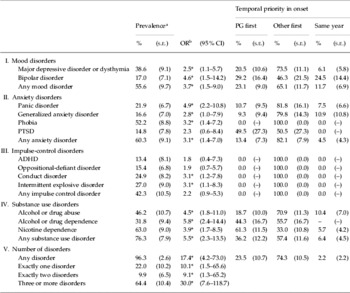
Lifetime PG is significantly associated in the total sample with other CIDI/DSM-IV disorders in gross models that adjust for ‘pseudo-co-morbidity’ by controlling for age (Kraemer et al. Reference Kraemer, Wilson and Hayward2006) (Table 2). These significant associations include a wide range of disorders. The strongest ORs involve substance use disorders (3.9–5.8) rather than other impulse-control disorders (1.8–3.1). Even stronger ORs are found with what has been called ‘multimorbidity’ (Angst et al. Reference Angst, Sellaro and Merikangas2000), or co-morbidity with any three or more other disorders (30.0). Based on these associations, 96.3% of respondents with lifetime PG also meet lifetime criteria for one or more other CIDI/DSM-IV disorders.
Lifetime co-morbidity of CIDI/DSM-IV pathological gambling (PG) with other lifetime CIDI/DSM-IV disorders and temporal priorities in age of onset (AOO)

s.e., Standard error; OR, odds ratio; CI, confidence interval; PTSD, post-traumatic stress disorder; ADHD, attention deficit hyperactivity disorder.
a The percentage of respondents with PG who also meet criteria for the other disorder.
b The ORs are calculated in the total sample, including respondents who never gambled. The ORs were calculated controlling for age at interview so as to avoid confounding due to time at risk.
* Significant at the 0.05 level, two-sided test.
Comparison of retrospective AOO reports shows that the clear majority of co-morbid anxiety disorders other than post-traumatic stress disorder (PTSD), major depressive disorders and alcohol/drug abuse began at an earlier age than PG. All co-morbid impulse-control disorders began at an earlier age than PG. In 74.3% of cases where the respondent with PG meets criteria for another lifetime disorder, at least one other such disorder began at an earlier age than the PG. These patterns raise the possibility that some mental disorders might be risk factors for PG whereas others might be consequences of PG.
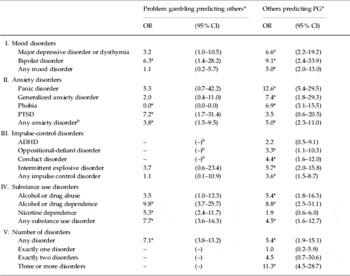
Two parallel survival analyses were carried out to investigate these possibilities provisionally using the retrospective AOO data collected in the NCS-R. One used information about other temporally primary disorders to predict subsequent onset of PG and the other used information about temporally primary PG to predict subsequent onset of other disorders. In the latter case, because of the comparative rarity of PG, we considered the effects of all problem gambling with or without PG. Respondent age, sex and race-ethnicity were controlled in all models. Education and marital status were not controlled because they could mediate the effects of the primary disorders, leading to bias in estimating total effects if they were controlled. Significant time-lagged predictive associations were found both for problem gambling predicting subsequent onset of other disorders and for other disorders predicting subsequent onset of PG (Table 3). However, there are many more associations of the latter than the former type.
Reciprocal time-lagged associations of temporally primary problem gambling predicting the subsequent first onset of other disorders and of temporally primary other disorders predicting the subsequent first onset of CIDI/DSM-IV pathological gambling (PG)Footnote a

OR, Odds ratio; CI, confidence interval; PTSD, post-traumatic stress disorder; ADHD, attention deficit hyperactivity disorder.
a Models are bivariate for each disorder and controlling for age, sex, and race-ethnicity.
b There are no onsets of ADHD, oppositional-defiant disorder (ODD) and conduct disorder (CD) that came after the PG onsets.
* Significant at the 0.05 level, two-sided test.
Several asymmetries in these cross-lagged associations are noteworthy, as PG is predicted by panic disorder, generalized anxiety disorder and intermittent explosive disorder whereas problem gambling does not significantly predict any of these disorders. Problem gambling, in comparison, predicts PTSD and nicotine dependence but these two disorders do not predict PG. In the case of associations that are reciprocally significant, the ORs of the other disorders predicting PG are generally larger than the ORs of problem gambling predicting the other disorders. Additional analyses to disaggregate the significant associations of other disorders with first onset of PG generally found the associations with onset of gambling to be non-significant, while those with the transition from non-problem gambling to problem gambling and from problem gambling to PG were generally found to be significant. We also examined the associations of other CIDI/DSM-IV mental disorders with the persistence of gambling problems, but found few of these associations to be statistically significant. (More detailed results available on request.)
Treatment
Although 49.0% of respondents with lifetime PG received treatment for emotional problems or substance use problems in their life, none reported treatment for gambling problems. The majority of respondents with lifetime PG who received treatment for emotional problems (27.9% of all those with lifetime PG) were treated in the general medical sector, although substantial percentages were also seen by a psychiatrist (21.7%) and by some other mental health professional (23.7%).
Discussion
There are four noteworthy limitations of the data analyzed here. First, diagnosis of PG was based on fully structured lay interviews for which no information is available either on test–retest reliability or validity. Second, estimates of onset and course were based on retrospective reports. Third, as the number of respondents diagnosed with PG was small, many of the associations examined were unstable and we were unable to investigate subgroup associations (e.g. differences in patterns and correlates among men and women). Fourth, many separate significance tests were computed, introducing the possibility of some false positive associations. Caution is consequently needed in interpreting results prior to independent replication.
Within the context of these limitations, the results are consistent with those of previous large-scale studies in finding a relatively low prevalence of PG (Kallick et al. Reference Kallick, Suits, Dielman and Hybels1979; Shaffer et al. Reference Shaffer, Hall and Vander Bilt1999; Welte et al. Reference Welte, Barnes, Wieczorek, Tidwell and Parker2001; Petry et al. Reference Petry, Stinson and Grant2005). The high proportions of people with PG found also to meet criteria for other DSM-IV disorders are similarly consistent with previous research (Cunningham-Williams et al. Reference Cunningham-Williams, Grucza, Cottler, Womack, Books, Przybeck, Spitznagel and Cloninger2005; Petry et al. Reference Petry, Stinson and Grant2005; Scherrer et al. Reference Scherrer, Slutske, Xian, Waterman, Shah, Volberg and Eisen2007). Another point of congruence with the literature is that people who developed gambling problems typically began gambling several years earlier than non-problem gamblers (Ladouceur, Reference Ladouceur1991; Volberg, Reference Volberg1994).
The sociodemographic correlates found here are consistent with those found by Petry et al. (Reference Petry, Stinson and Grant2005) in their independent national survey: lower prevalence among respondents in the oldest than younger cohorts and higher prevalence among men, Non-Hispanic Blacks and people with less than a college education. Our results regarding co-morbidity are also largely consistent with those of Petry et al., in that both studies found the highest ORs of PG with bipolar disorder, substance use disorder, and panic disorder. The NCS-R additionally documented strong co-morbidity of PG with ‘multimorbidity’, which was not investigated by Petry et al. However, Petry et al. documented strong co-morbidity of PG with personality disorders, which were not considered in our analysis.
We are unaware of previous attempts to examine sequencing patterns of PG with co-morbid disorders. Our retrospective AOO analyses suggest that other disorders typically predate the onset of PG and predict the subsequent onset and persistence of PG. These associations are especially strong for mood and anxiety disorders, whereas the associations with substance use disorders are due more to PG predicting subsequent substance use disorders. These findings are consistent with evidence that mental disorders tend to precede substance use disorders more generally (Nelson et al. Reference Nelson, Heath and Kessler1998; Shaffer & Eber, Reference Shaffer and Eber2002). However, caution is needed in interpreting these NCS-R results, as they rely on retrospective AOO reports. Prospective research is needed to confirm these associations.
Even though none of the NCS-R respondents with lifetime PG ever received treatment for gambling problems, nearly half received treatment for some mental or substance problem. Given that three-quarters of PG cases occur only subsequent to the onset of other DSM-IV disorders, it seems likely that onset of PG could be prevented if clinicians increased their monitoring for emerging gambling problems. However, as PG is such a rare disorder, it is difficult to argue that prevention should become a focus of clinical attention, other than perhaps among patients with BP-I disorder, where risk of PG is relatively high. The more reasonable strategy might be to assess pre-existing PG, especially among patients with disorders found in the current study and the Petry et al. study to be highly co-morbid with PG and with the sociodemographic profile of people with PG.
Acknowledgments
The National Comorbidity Survey Replication (NCS-R) is supported by the National Institute of Mental Health (NIMH; Grant U01-MH60220) with supplemental support from the National Institute on Drug Abuse (NIDA), the Substance Abuse and Mental Health Services Administration (SAMHSA), the Robert Wood Johnson Foundation (RWJF; Grant 044708), and the John W. Alden Trust. Preparation of the current report was also supported by the National Center for Responsible Gaming. Collaborating NCS-R investigators include Ronald C. Kessler (Principal Investigator, Harvard Medical School), Kathleen Merikangas (Co-Principal Investigator, NIMH), James Anthony (Michigan State University), William Eaton (The Johns Hopkins University), Meyer Glantz (NIDA), Doreen Koretz (Harvard University), Jane McLeod (Indiana University), Mark Olfson (New York State Psychiatric Institute, College of Physicians and Surgeons of Columbia University), Harold Pincus (University of Pittsburgh), Greg Simon (Group Health Cooperative), Michael Von Korff (Group Health Cooperative), Philip Wang (Harvard Medical School), Kenneth Wells (UCLA), Elaine Wethington (Cornell University), and Hans-Ulrich Wittchen (Max Planck Institute of Psychiatry; Technical University of Dresden). The views and opinions expressed in this report are those of the authors and should not be construed to represent the views of any of the sponsoring organizations, agencies, or the US Government. A complete list of NCS publications and the full text of all NCS-R instruments can be found at www.hcp.med.harvard.edu/ncs. Send correspondence to ncs@hcp.med.harvard.edu. The NCS-R is carried out in conjunction with the World Health Organization World Mental Health (WMH) Survey Initiative. We thank the staff of the WMH Data Collection and Data Analysis Coordination Centres for assistance with instrumentation, fieldwork, and consultation on data analysis. These activities were supported by the NIMH (R01 MH070884), the John D. and Catherine T. MacArthur Foundation, the Pfizer Foundation, the US Public Health Service (R13-MH066849, R01-MH069864, and R01 DA016558), the Fogarty International Center (FIRCA R01-TW006481), the Pan American Health Organization, Bristol–Myers Squibb, Eli Lilly and Company, Ortho-McNeil Pharmaceutical, Inc., GlaxoSmithKline, Pfizer, and the Pfizer Foundation. A complete list of WMH publications can be found at www.hcp.med.harvard.edu/wmh/.
Declaration of Interest
The Division on Addictions (LaBrie, Shaffer) receives funding from the National Center for Responsible Gaming, from bwin Interactive Entertainment AG, the National Institute of Mental Health (NIMH), National Institute of Alcohol Abuse and Alcoholism (NIAAA), National Institute on Drug Abuse (NIDA), the Massachusetts Council on Compulsive Gambling, the State of Nevada Department of Public Health, the Massachusetts Family Institute, and others. Professor Kessler has been a consultant for Astra Zeneca, Bristol–Myers Squibb, Eli Lilly and Co, GlaxoSmithKline, Pfizer, Sanofi-Aventis, and Wyeth and has had research support for his epidemiological studies from Bristol–MyersSquibb, Eli Lilly and Company, Ortho-McNeil, Pfizer, and the Pfizer Foundation.