INTRODUCTION
Research suggests that there is a growing reliance on voluntary codes within and across industries to oversee and monitor environmental, technical, and social aspects of firms’ operations (Brunsson, Rasche, & Seidl, Reference Carberry and King2012). Voluntary codes (also referred to as ‘standards’) are described here as rule instruments designed to alter or influence the conduct of firms or the stakeholders of those firms (Kolk, van Tulder, & Welters, 1999). Traditionally, organizational research on these codes has focused on the diffusion of several established standards (e.g., ISO 9001 and ISO 14001), compliance with their content (Sandholtz, Reference Ruef and Scott2013), and emphasized the role of isomorphic conformity as an explanatory factor for code adoption, with code adoption serving as a signal of legitimacy to other players within a marketplace (Lee, Reference Kolk, van Tulder and Welters2009). To date substantial research exists on the diffusion of, and compliance with, established codes.
In spite of this focus there is a growing awareness that a marketplace of competing codes characterized by numerous organizations producing (Reinecke, Manning, & von Hagen, Reference Psomas, Pantouvakis and Kafetzopoulos2013) as well as engaging in code development (Botzem & Dobusch, Reference Brunsson, Rasche and Seidl2013) has emerged. As a consequence firms have a choice of diverse codes for particular issues to select from (Harrison, 2004; Howlett & Ramesh, Reference Hiatt and Park2006). For example, pulp and paper firms have available to them a variety of different codes pertaining to sustainable forestry practices that include the Forest Stewardship Council and Canadian Standards Associations Sustainable Forest Management System (Rhone, Clarke, & Webb, Reference Rhone, Clarke and Webb2004), whereas organizations and their actors have a choice of competing environmental management codes (ISO 14000, EMAS, Green Dragon Environmental Management Standard) (Wenk, Reference White2009), and apparel companies can turn to several different codes (e.g., Fair Labor Association, SA 8000, Worldwide Responsible Accredited Production) pertaining to worker protections (O'Rourke, 2006). Please note that the focus of analysis in this paper is on industry sector level or multi sector voluntary codes, not those codes developed by an individual firm to apply solely to its own operations.
Researchers increasingly emphasize that the origins of voluntary codes should have an impact on their subsequent uptake (Carmin, Darnall, & Mil-Homens, Reference Carmin, Darnall and Mil-Homens2003). For example, Helms, Oliver, and Webb (Reference Hardy and Maguire2012) as well as Dokko, Nigam, and Rosenkopf (2012) have referred to standards as negotiated orders and the outcomes of ongoing bargaining processes among potential adopters. Meanwhile, scholars such as Mena and Palazzo (Reference Meyer and Rowan2012) have emphasized the importance of multistakeholder engagement and democratic forums in producing acceptable institutions, such as standards. Until recently the origins of codes have not been a focus of attention in the organizational literature as to why certain codes are considered legitimate and adopted by firms while other codes fail to be.
To address this gap we ask the question: what factors increase the likelihood that a voluntary code developed by an organization will be perceived as legitimating by firms and hence will be adopted? Key to our argument is the role of what Suchman (Reference Suddaby and Greenwood1995) calls perceptions of legitimacy. Suchman (Reference Suddaby and Greenwood1995: 574) synthesized the diverse literature on legitimacy to define the phenomenon as ‘a general perception or assumption that the actions of an entity are desirable, proper, or appropriate within some socially constructed system of norms, values, beliefs, and definitions’. Therefore some voluntary codes, but not all, are perceived as legitimizing by potential firm adopters in the sense that adoption is assumed to establish or enhance credibility and increase a firm's chances of survival within their markets. Perceptually legitimate codes benefit their adopters as those firms’ actions are more likely to be perceived as appropriate by transactional partners and, thus, less susceptible to attack from other institutional actors (Cashore, Reference Cashore2002). In this paper we call these legitimizing perceptions that are associated with a given code, ‘perceived voluntary code legitimacy’. For the purposes of clarity, we use the term ‘voluntary code developer’ to describe those organizations developing voluntary codes and ‘firm adopter’ (shortened to firm) to describe those organizational actors that are perceiving the code.
This paper emphasizes the idea that the code development process is likely to have an impact on the perceptions, and use, of codes – particularly the characteristics of the organization developing the code, the characteristics of the process involved in its creation, and the maintenance procedures that occur around the content of that code. A theoretical model outlining how the origins of codes influence their perceived legitimacy is important to the organizational literature for three reasons. First, a model of the determinants of code legitimacy is likely to assist future research on voluntary code adoption in predicting which codes are likely to be institutionalized and receive broad support from firms. Second, such a framework can guide the increasing number of industry, governmental, and non-governmental organizations looking to develop codes that will be adopted by firms. As industry bodies and governments increasingly rely upon voluntary codes to influence the behaviour of firms, research of the type discussed here will assist code developers to put in structuring conditions favourable to the development of codes that will be adopted by firms. Third, by identifying that the origins and maintenance of codes as sources of diversity and change this research presents voluntary codes and their adoption as more dynamic in nature than previous operationalized.
LITERATURE REVIEW
Institutional and economic perspectives on voluntary codes and their adoption
In recognition of the considerable diversity among codes, commentators have proposed various typologies. For example, in studies of voluntary codes pertaining to corporate social responsibility, van Tulder and Kolk (Reference Van Tulder and Kolk2001: 268) and Preuss (Reference Preuss2009: 3) respectively refer to a ‘cascade’ or ‘lattice work’ of codes, developed and championed by a variety of organizations including inter-governmental organizations, international NGOs, industry associations, and regional bodies. These codes range from largely symbolic and vague public commitments to more technical and detailed codes that are intended to be integrated into a firms’ internal policies and practices. For the purposes of this paper, voluntary code adoption will be defined broadly to include the following types of implementation strategies by firms: symbolic (the public adoption of codes with various degrees of loose coupling between practices and codes), tight coupling not involving third party review (adoption that reflects the integration of a code into a firm's practices but does involve verification by third parties), and certification (a particular form of tight coupling that includes the use of third party review intended to ensure and/or communicate full implementation). This definition is meant to be inclusive and allow for the full range of voluntary code adoption practices available and employed in the marketplace.
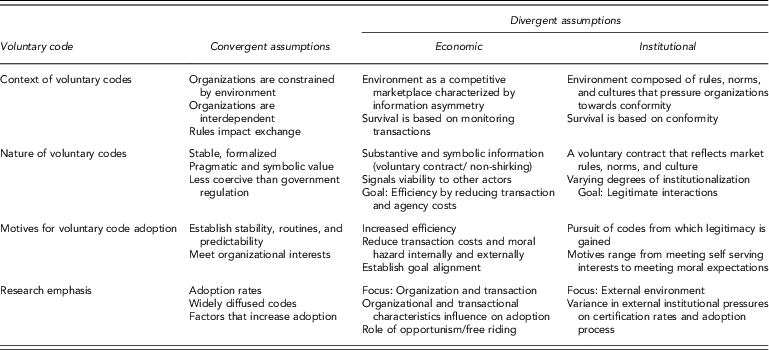
Many theoretical lenses have been used to explore the implications and value of voluntary codes, their diffusion, and their impact including resource-based views (Darnall, Reference Clegg, Kornberger and Rhodes2003), public policy/political perspectives (Cashore & Vertinsky, Reference Cashore and Vertinsky2000; Webb & Morrison, Reference Wenk2004), and learning perspectives (Terlaak & Gong, Reference Terlaak and Gong2008). Because we are interested in the factors that lead to the transactions and decision making around codes rather than the capabilities that they might bring to firms or the organizational learning processes that occur around their adoption we choose to focus on the two literatures that best explain their diffusion across industries. Institutional perspectives that emphasize collectives conforming to codes that represent shared systems of meaning and relating, and economic perspectives, that focus on transaction costs associated with selecting codes that provide symbolic and operational benefits (Hunter & Bansal, Reference Hoffman and Ocasio2007). Taken together, we adopt Oliver's (Reference Palazzo and Scherer1996) arguments that economic activity and decision making around codes, and codes, themselves are embedded in institutional environments. Table I summarizes the two extensive literatures supporting these two theoretical perspectives as well as the convergent and divergent assumptions of the institutional and economic perspectives on voluntary codes. These divergent and convergent assumptions provide the background for identifying the factors that lead to voluntary code adoption by firms. We start with the divergent assumptions that underlie these two perspectives.
Economic and institutional perspectives of voluntary code adoption

Economic perspectives of voluntary codes and their adoption
From an economic perspective the organizational environment is synonymous with the marketplace where firms conduct transactions (Akerlof, Reference Akerlof1970). Economic organizational research focuses on transactions and contract decisions made to overcome informational uncertainty in the information asymmetric environment, and the subsequent opportunism that may occur (Williamson, 1975). From this perspective, voluntary codes provide information about the transactional processes within a firm adoptee that alleviate uncertainty and increase efficiencies; thus, codes signal increased transactional security to potential partners and provide a framework by which institutional actors can monitor transactions (Christmann, Reference Christmann2000; King, Reference King2007). The economic perspective on voluntary codes describes them largely as rules that ‘require’ (in a non-legal sense) compliance and includes enforcement mechanisms (Grief, 1997). This characterization puts emphasis on voluntary codes as deterrents or constraints on firm behaviour and on the impact of these codes on the performance of those firms that adopt them.
Economic perspectives also emphasize that a firm's acceptance of the constraints accompanying voluntary codes involves strategic reasoning; that is, the adoption of the voluntary code will provide firms with some marketplace advantage. Voluntary codes are accepted when they provide increases in operational and transactional efficiencies while reducing transactional and information uncertainty (King, Reference King2007). From a transaction cost perspective, firms are motivated to adopt standards when they perceive that potential clients or partners fear opportunism and lack information regarding their organization. The decision to become certified for a specific voluntary code becomes a calculated, exchange-based decision regarding whether a voluntary code will assist the firm in meeting the contractual or transactional interests of their transaction partners (Delmas, Reference David and Strang2002).
Institutional perspectives of voluntary codes and their adoption
The institutional perspective puts forward the idea that the history and the structure of an organization's environment establishes a field of socially constructed rules, norms, and beliefs to which organizations react and conform. These rules, norms, and beliefs are reflected through institutions that are the sources of coercive, normative, and mimetic isomorphic pressures. Marketplace pressures are manifested less as rational strategic thinking about increased transactional efficiencies and more as preconscious norms impacting organizational choices (DiMaggio & Powell, Reference DeMaria1983; Oliver, Reference Oliver1991).
Institutional studies of voluntary codes have predominantly focused upon the adoption of codes within a firm or its diffusion across a collective of firms, or an industry sector. As ‘institutional theory focuses on the reproduction or imitation of organizational structures, activities, and routines in response to state pressures, the expectations of professions, or collective norms’ (Oliver, Reference Palazzo and Scherer1996: 149), research on voluntary codes portray them as existing in a continuing state of institutionalization with collective norms pressuring firms on an on-going basis to adopt codes and refine firm functioning. The impact of institutional environments on voluntary code adoption has been studied, specifically the impact of coercive, mimetic, and normative pressures on firm certification rates within marketplace environments.
Guler, Guillen, and Macpherson (Reference Granovetter2002) found that diversity in national and cultural contexts influences adoption of ISO standards. This suggested that greater numbers of ‘coercive’ influences, governmental organizations in the marketplace, normative pressures (reflected by the number of national quality experts), and increases in mimetic pressures and social capital, led to an environment with greater numbers of ISO 9001 certificates among firms per country of residence. Private firms were motivated to conform to voluntary codes due to coercive, mimetic, and normative pressures in order to increase their legitimacy in the marketplace.
Delmas's (Reference David and Strang2002) research regarding the diffusion of ISO 14001 EMS standards provides another relevant example of institutional pressures. She identified ISO 14001 adoption rates as varying significantly depending upon the institutional context. Specifically that ‘[t]he U.S. institutional environment seems [to act] as a deterrent to ISO 14001 adoption… The opposite is true in Europe’ (Delmas, Reference David and Strang2002: 91). Unlike the study of Guler, Guillen, and Macpherson (Reference Granovetter2002), Delmas concluded that the regulatory, normative, and cognitive differences of national environments impact the perceived efficiencies of ISO14001 as well as increased adoption rates.
Convergent themes underlying both theories of voluntary codes and their adoption
In spite of these divergent assumptions regarding the nature of codes and why they are adopted there are several convergent themes underlying the two theories. Specifically in regards to the nature of the marketplaces that firms are embedded in, the benefit of voluntary codes themselves, and the motives of firms to adopt them.
The institutional and economic environmental context
The organizational literature that has explored voluntary code adoption from an institutional and economic perspective emphasizes that actions by firms are constrained by an environment that is made up of other organizations as constituents of a regulated interdependent collective ‘market’ (Pfeffer & Salancik, Reference Pires, Cociorva, Saraiva, Novas and Rosa1978; White, Reference Whiteman and Cooper1981; Granovetter, 1985; Porac & Thomas, Reference Prajogo1995). Voluntary codes are a component of these regulated interdependencies as they serve as voluntary ‘contracts’ constraining firm action, taking the form of conscious or preconscious rules and sometimes representing ‘regulators’ (in a broader sense that may or may not include formal government regulation) or de-centralized institutions (Black, Reference Bitektine2008). Despite reflecting different pressures both theories reflect a relatively tight coupling between firms and their environments that is characterized by the need for continual awareness of the perceptions and actions of other constituents.
The nature of voluntary codes
Both economic and institutional perspectives view voluntary codes as stable and formalized environmental ‘rules’ with both pragmatic and symbolic value (Christmann & Taylor, Reference Christmann and Taylor2006). For example, recent research on use by firms of ISO 9001 quality management and ISO 14001 environmental management standards (voluntary codes) emphasizes the actual and ‘symbolic’ contractual power of the standards where voluntary codes are treated as decentralized or, in some cases, formalized institutions (King & Lenox, Reference King and Lenox2000; King, Lenox, & Terlaak, Reference King, Lenox and Terlaak2005). Both the economic and institutional perspectives on the nature of voluntary codes share the idea that codes offer a perceptual exchange for legitimacy – specifically, a code is adopted in exchange for firms gaining transactional security and credibility within markets.
Motives for voluntary code adoption
Voluntary codes offer desirable potential outcomes from both institutional and economic perspectives by increasing legitimacy as well as transactional stability, efficiency, and predictability for adopters within the marketplace environment. As noted earlier, traditional economic perspectives hypothesize that firms adopt voluntary codes to reduce transactional and marketplace uncertainty (Akerlof, Reference Akerlof1970). Likewise, institutional perspectives predict that successful firms are driven to reduce uncertainty and conform to norms that grant credibility to institutions and enhance a firm's survival prospects (DiMaggio & Powell, Reference DeMaria1983). Whether addressed directly or indirectly, both the economic and institutional literatures on voluntary code adoption support the notion that firms are motivated by their perceptions of transactional and environmental legitimacy within the marketplace. As described by Jiang and Bansal (Reference Jiang and Bansal2003: 1065) in their study of ISO 14001 within the Canadian pulp and paper industry, ‘even the early adopters of ISO (were led) to value not only its substance but also – to a larger extent – its legitimizing benefits’. Both theories embrace the notion that firms are driven to reduce ambiguity and be perceived as legitimate in the environmental marketplace.
Drawing from this review and research on the institutional embeddedness of economic activity, we contend that market information is not only incomplete and imperfect, as described by the economic literature (Williamson, 1975); it is also socially constructed. Following the logic of Oliver (Reference Palazzo and Scherer1996) and others (Granovetter, 1985) in this paper we assume that transactions surrounding voluntary code adoption take place within an institutional context. Therefore marketplaces are relational structures that reflect the enactment of institutionalized norms and beliefs about what constitutes appropriate economic activity and a firm's embeddedness within institutionalized marketplaces reduces transaction costs as norms limit opportunism and uncertainty.
What we don't know about voluntary codes and their adoption
In spite of an awareness that firms perceptions of a code's legitimating effects the sources of whether a code developed by an organization is perceived as legitimizing are largely unknown. Research on the foundations of a voluntary code's perceived legitimacy among potential adopters remains limited and the legitimacy of codes has often been treated as a given. As noted in the introduction studies of voluntary code adoption have emphasized a few, broadly diffused standards with less work on those codes that are less diffused. Organizational research has predominantly focused upon widely adopted, established codes such as ISO 14000 and ISO 9001 (Marcus, Reference Masakure, Henson and Cranfield1999; King & Lenox, Reference King and Lenox2000; Boiral, Reference Botzem and Dobusch2007). It is unknown as to whether findings regarding this small sample of diffused codes can be applied to other codes created by voluntary code developers. For example, there are a broad range of new and less broadly diffused standards being promoted that cover a range of social issues. Research on such voluntary codes include Reinecke, Manning, and von Hagen's (Reference Psomas, Pantouvakis and Kafetzopoulos2013) research on standards within the coffee sector, Lee's (Reference Kolk, van Tulder and Welters2009) research on standards in the organic food industry, as well as growing work on privacy standards (Jamal, Maier, & Sunder, Reference Jamal, Maier and Sunder2003). These codes vary in the environmental contexts they are embedded in, the issues their content addresses, as well as the types of firms evaluating them.
As implied by the aforementioned typologies voluntary codes are more diverse than currently conceptualized in the literature. Two understudied sources of diversity among voluntary codes that might influence their perceived legitimacy and adoption are that they are, first, produced by a variety of organizations, and, second, that they are developed and maintained through a variety of processes. For example, case studies (see Webb, Reference Webb and Morrison2004) on competing forestry standards document that codes on this subject are created by a combination of governments, industry, and advocacy organizations and that how these developers create codes influences their uptake by firms (Wenk, Reference White2009).
There is also growing interest on the processes by which voluntary codes are developed. Dokko, Nigam & Rosenkopf's (2012) recent qualitative study describes the negotiated order of technology standards and the processes by which they became standardized while Helms, Oliver, and Webb (Reference Hardy and Maguire2012) studied the negotiation and approval of ISO 26000s content by 150 organizations. These process focused studies support Sherer and Palazzo's (2007) proposition that social responsibilities of firms (as reflected in voluntary codes adopted by firms) are the result of organizations engaging in the discursive and political processes of institutionalized processes to define social expectations. Therefore, in addition to the transactional content of the code and the environmental pressures around it, a firms’ perception of the organization developing the code and the processes creating the code should influence whether it is perceived as legitimating and subsequently adopted.
Finally, the growing number of voluntary code developers and processes are producing a competitive marketplace of codes that vie for the attention of potential adoptees. The content of these different codes can vary as certain codes may be relatively similar while others differ substantially (Reinecke, Manning, & von Hagen, Reference Psomas, Pantouvakis and Kafetzopoulos2013). For example, Borial's (2007) research has found that firms find that codes (ISO 14001) require substantial costs to adopt with little perceived value among stakeholders while other codes have few costs associated with them and value is largely perceptual in nature (Christmann & Taylor, Reference Christmann and Taylor2006). As noted earlier, firms often have choices from a variety of different voluntary codes and can select a code on the basis of, among other things, which code they perceive is the most legitimate (providing legitimation). While institutional scholarship has moved towards understanding how firms make sense (Maitlis, Reference Maitlis and Lawrence2005) of institutional arrangements and give sense (Maitlis & Lawrence, Reference Marcus2007) through the use of these arrangements the voluntary code literature has predominantly emphasized firms conforming to them as marketplace norms.
Although the predominant economic and institutional research on voluntary codes has demonstrated the important legitimating effect of voluntary codes, there is no inclusive framework for understanding the sources that lead to perceptions of legitimacy. In this paper we attempt to make sense of the multiple factors that will impact how firms perceive whether this increasingly important form of organizing are legitimating or not. We ask the question: what factors increase the likelihood that a voluntary code developed by an organization will be perceived as legitimating by firms and therefore be adopted by firms?
A perceived legitimacy framework of voluntary codes and their adoption
Drawing from our review of economic and institutional perspectives on voluntary codes as complementary explanatory reasons for firms perceiving and adopting codes as well as emerging findings on the origins of codes themselves we propose a model of perceived legitimacy as a mediating factor in voluntary code adoption. Outlined below in Figure 1, we posit that the origins of a voluntary code will have a significant influence on potential firm adopters’ perceptions of code legitimacy and, hence, whether they choose to adopt it. Three particular aspects of a code's origin will be important. First, perceptions of legitimacy will be tied to characteristics of the organization developing the code; second, are the developmental processes leading to the creation of the voluntary code; third, involves the presence of formalized norm conversations in generating normative, mimetic, and coercive institutional pressures around the code. Finally, in addition to the origins of voluntary codes we confirm that the content of the code, the characteristics of the firm adopting it, and the environmental level factors surrounding the origins of the code will influence the perceptions of legitimacy held by potential firm adopters. Seven propositions are provided in support of the model.
A perceived legitimacy framework of voluntary code adoption
Perceived legitimacy as a mediator of voluntary code adoption
Organizational scholars propose that legitimacy plays an important role in contributing to the success of voluntary codes (Cashore, Reference Cashore2002; Black, Reference Bitektine2008) and firms (Deephouse, 1996). This work has emphasized that legitimacy is essential to the survival of firms (Clegg, Rhodes, & Kornberger, 2007) and that the adoption of voluntary codes provide the opportunity for firms to attain legitimacy (Cashore, Reference Cashore2002). Drawing from the work of Suchman (Reference Suddaby and Greenwood1995) and Cashore (Reference Cashore2002) there are three predominant types of legitimacy: ‘pragmatic, based on audience self-interest; moral, based on normative approval; and cognitive, based on comprehensibility and taken-for-grantedness’ (Suchman, Reference Suddaby and Greenwood1995: 1). These three types of legitimacy play an important role in the performance and behaviour of firms as well as the adoption of voluntary codes.
Traditionally, institutional perspectives of legitimacy have emphasized its origins in firms actively conforming to the established belief systems, norms, and rules that compose their environment (Meyer & Rowan, Reference Monin, Noorderhaven, Vaara and Kroon1977). For example, Ruef and Scott's (1998) research on the health care industry found that hospitals with mission statements that corresponded with the logics of the broader institutional environment were more likely to be perceived as legitimate, survive, and succeed. Numerous organizations and organizational forms such as voluntary codes, can take on perceptions of comprehensive taken for grantedness in defining what appropriate action is for organizations. Borial's (2007) research on ISO 14001 explored how the standard had become taken for granted as rational and legitimate among those organizations he studied. Therefore voluntary codes that adhere to, or reflect, the existing beliefs, norms, and rules of an organization's marketplace will be more likely to be perceived as having cognitive legitimacy, be legitimating, and adopted by firms.
Over time, more strategic perspectives of legitimacy have emerged emphasizing that it is a resource that firms actively pursue through the deployment of symbols and environmental manipulation to gain social support (Oliver, Reference Oliver1991). For example, numerous studies demonstrate that firms take action and actively attempt to conform to, as well as influence, the moral codes (norms) of their marketplace in order to legitimate themselves (Maguire, Hardy, & Lawrence, Reference Maitlis2004). Studies such as Fligstein's (Reference Drori and Honig1985) work on the diffusion of organizational structures, Maguire and Hardy's (Reference Maguire, Hardy and Lawrence2013) research on the diffusion of risk practices, and existing work on the mimetic diffusion of standards (Delmas, Reference David and Strang2002) have emphasized the importance of both firms and standards adhering to or drawing from the established norms of marketplaces.
Additionally, institutional-economic theorists have also emphasized that marketplace transactions reflects marketplace norms (Biggart & Beamish, Reference Behnam and MacLean2003). From this perspective the key question underlying the adoption of voluntary codes is what constitutes a ‘desirable, proper, or appropriate’ code transaction or adoption (Suchman, Reference Suddaby and Greenwood1995: 1)? Therefore, voluntary codes that are perceived as adhering to, or taking on, the norms for establishing transactional trust within an environment will be more likely to be perceived as legitimating. For example, within certain industries such as the manufacturing sector certifying to ISO 9001 has taken on a moral dimension and has been perceived as necessary for signalling that firms have conformed to established quality management practices (Karapetrovic, Fa, & Saizarbitoria, Reference Karapetrovic, Fa and Saizarbitoria2010).
Finally, codes will be perceived as legitimating when they serve the pragmatic interests of their audiences composed of firms. King, Lenox, and Terlaak's (2006) study of standard adoption (ISO 14001) suggests that buyers use standards (ISO 14001) for information about potential suppliers to reduce the likelihood of opportunism. It follows that a code can be perceived as legitimating when it provides practical information and is a resource that creates trust between transaction partners. An example of this is the role of public certification, which from an economic perspective, provides information about firm adopters making them more appealing within marketplaces. In spite of certifying these authors point out that pragmatic decision to certify differed from the harder (less pragmatic or more difficult) decision to actually adopt the underlying practices (Behnam & MacLean, 2011). Therefore, voluntary codes that are perceived as meeting the interests and objectives of firms should be perceived as being legitimate and more likely to be adopted.
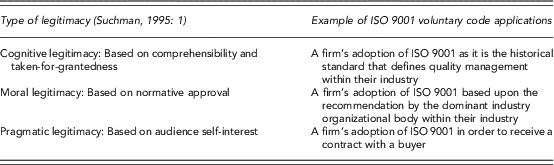
Although Suchman (Reference Suddaby and Greenwood1995) identifies three, distinct forms of legitimacy all three forms can be in effect at a given time depending on the nature of issues being faced, the environment, and the firm. As he observes, ‘the multi faceted character of legitimacy implies that it will operate differently in different contexts, and how it works may depend on the nature of the problems for which it is the purported solution’ (Suchman, Reference Suddaby and Greenwood1995: 573). The nature of the legitimacy being pursued is determined by the firm's perceptions of the expectations held by marketplace constituents. For example, Drori & Honig (Reference Desai2013) have demonstrated how creative firms have to balance both internal dynamics of appeasing professional norms while pacifying the interest based environmental demands of stakeholders. In the aforementioned study by King, Lenox, and Terlaak (2006) on ISO 9001, they found that in addition to providing pragmatic information that the adoption of the standard took on normative dimensions within marketplaces as it diffused among firms. A few brief examples of how a standard (ISO 9001) can be perceived as taking on all three dimensions of cognitive legitimacy, moral legitimacy, and pragmatic legitimacy is provided in Table 2.
Voluntary codes as sources of cognitive, normative, and pragmatic legitimacy: ISO 9000 examples
Accordingly, legitimacy is both socially construed and a resource upon which marketplace transactions can be based. This suggests that firms adopt voluntary codes that are socially constructed, or perceived, as having pragmatic, moral, and cognitive legitimacy within their marketplace. Based upon this discussion of legitimacy and the pursuit of codes that meet their strategic legitimacy needs of firms within marketplaces, our baseline proposition follows.
Proposition 1 : Whether a voluntary code will be adopted by potential firm adopters will be influenced by the degree to which that code is perceived by those firms as granting greater independent or cumulative degrees of pragmatic, moral, and cognitive legitimacy.
Firm characteristics and the perceived legitimacy of voluntary codes
Pursuant to this conceptualization of legitimacy and its pursuit are the characteristics of those firms that are their potential adopters (Jiang & Bansal, Reference Jiang and Bansal2003). Well described by Rutherford and Buller (2007), firms require a ‘threshold’ of legitimacy from which they are perceived as adhering to the beliefs, established norms, and rules of their surrounding environment. Firms vary in the level of legitimacy that they have attained within their given environments and those with lower levels of legitimacy seek out opportunities to attain it (Dimaggio & Powell, Reference DeMaria1983). It follows that a key component of determining whether a code will be perceived as legitimating and subsequently adopted is the current degree of legitimacy held by the firm(s) that is (are) evaluating it.
For example, firms with little legitimacy within environments can gain it by drawing attention to themselves from key audiences (Clegg, Rhodes, & Kornberger, 2007). Research suggests that new or even controversial organizations can take strategic actions that manage the impressions of surrounding audiences and legitimate themselves within the broader environment (Elsbach & Sutton, 1992). In marketplaces where voluntary codes are being used by firms to legitimate their activities new firms with little legitimacy might perceive that the use of a code will establish legitimacy for their organization by drawing attention to them as a ‘moral leader’. For example, as concerns regarding sustainability and social responsibility of their practices have grown within the coffee industry new players have been early adopters of standards in order to establish and distinguish themselves within the industry (Reinecke, Manning, & von Hagen, Reference Psomas, Pantouvakis and Kafetzopoulos2013). Therefore, because there is a greater requirement for it, those firms looking to establish legitimacy in their marketplaces should be more likely to perceive of voluntary codes as an opportunity to build their legitimacy.
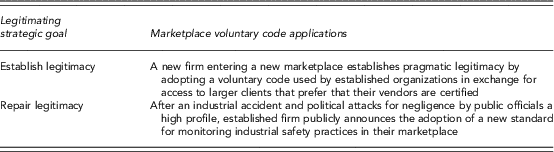
In addition to those new firms attempting to develop greater amounts of it, established firms can have their legitimacy tarnished or removed (Oliver, Reference Pfeffer and Salancik1992; DeMaria, Reference Deephouse2010; Reuber, Fischer, & Wang, Reference Reuber, Fischer and Wang2010). Firms with damaged legitimacy should be more likely to actively seek opportunities to repair perceptions of their legitimacy by adopting new institutional arrangements. Submitting to voluntary regulation through codes is becoming an increasingly important strategy for firms in attempting to rebuild public trust. For example, Wang (Reference Webb2010) found that that established financial firms in China whose employees were found to have committed fraud voluntary adopted intense monitoring and rules to repair their legitimacy. This parallels the past efforts of established manufacturers such as Apple (Fair Labor Association, Reference Dokko, Nigam and Rosenkopf2013) and the Gap (Reference Fligstein2013) that have embraced and become proponents of fair labour standards after losing legitimacy in labour controversies. In total, this suggests that as codes become an increasingly popular form of organizing those firms with damaged legitimacy will be more likely to perceive of codes as legitimating and adopt them. Examples of voluntary codes being applied to develop and repair legitimacy are provided in Table 3.
The strategic use of voluntary codes by firms to establish and repair legitimacy
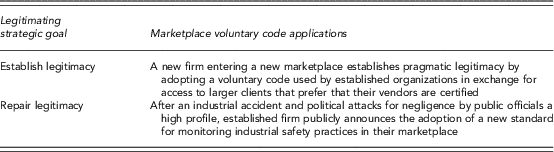
Based upon the prior arguments Proposition 2 suggests that the current level of legitimacy held by a firm evaluating the code will have a strong impact on its perceived legitimacy of the code and whether it is subsequently adopted. As noted legitimacy is the core resource required for firm survival and voluntary codes provide opportunities for firms attempting to establish or repair their own legitimacy.
Proposition 2 : Whether voluntary codes developed by an organization are perceived as legitimating and adopted will be directly influenced by the characteristics of the firms evaluating it such that those firms that are seeking to establish or repair their legitimacy will perceive higher levels of pragmatic, moral, and cognitive legitimacy.
Characteristics of the voluntary code developer
With an increasing awareness that a marketplace of voluntary codes and voluntary code developers emerging (Hallstrom, Reference Grief2008; Reinecke, Manning, & von Hagen, Reference Psomas, Pantouvakis and Kafetzopoulos2013) we assert that the characteristics of the developer of the code will play a key role in whether potential firm adopters perceive that a code is legitimating in the marketplace. We assert that three characteristics of the organization developing the voluntary code will play an important role in the perceived legitimacy of the code: the organization's positive reputation as a code developer, its issue expertise, and its mandate.
When a developer has established a reputation for code development this status should transfer a degree of taken for granted legitimacy to the codes they produce. As is the case in other marketplaces (King & Whetten, Reference King and Whetten2008) within the current marketplace of standards a status hierarchy of code developers has emerged in which certain bodies have established positive reputations around code development. The best example of an established, positive reputation within this marketplace is ISO. Since 1947 ISO has focused upon the creation of international codes around a variety of issues in order to streamline policy and business interactions that occur between firms across national boundaries. While numerous environmental management standards have been developed by a range of organizations over time, none of these standards have been able to approach the adoption rates of ISO 14001 (Angel, Hamilton, & Huber, Reference Angel, Hamilton and Huber2007). An example of the influence of ISO's reputation on the perceived legitimacy of the codes it creates emerged from the development of ISO 26000, a standard defining the contested practice of Corporate Social Responsibility. When government, industry, and firm actors interested in standardizing Corporate Social Responsibility practices considered alternatives and organization for developing such a standard, it became clear that ISO's reputation for developing global standards made it a widely accepted organization to produce a viable standard on social responsibility (Helms, Webb, & Oliver, Reference Hardy and Maguire2012).
Another characteristic that affects the role of the voluntary code developer in creating codes that are perceived as morally legitimating is the developer's expertise in regards to the issue being addressed (David & Strang, Reference Darnall2006). When organizations are perceived as experts in their fields and highly knowledgeable in the broad issues and practices surrounding their marketplace their activities and products are perceived as more legitimate (Katila, Reference Katila2002). Despite its preeminent reputation for developing international standards in the 1990s, ISO was scrutinized for (and ultimately did not pursue) considering an opportunity to develop a standard pertaining to occupational health and safety, in apparent recognition that it was ‘not an appropriate organization to lay down requirements for the relations between employers and employees’ (Podgorski, Reference Porac and Thomas2005). Different industries and professions are populated by established organizations with subject matter expertise to design code content. For example, in the prior example the International Labour Organization, with historical knowledge and expertise associated with occupational health and safety across industries, serves as a credible source for the development of workplace standards.
A practical example of how the perceived expertise of a code developer can influence the perceptions of whether a code is legitimating comes from Dow Chemical the company that drove and sponsored the Chemical Manufacturers Association Responsibility Code. This standard was rapidly adopted by the majority of chemical companies across the sector (Moffet, Bregha, & Middelkoop, Reference Oliver2004). Because of Dow's status as the leading expert in the handling of chemicals mimetic, industry-wide adoption of the voluntary code as their standard was perceived as reflecting an appropriate standard of practice. As numerous issue based organizations have established themselves as knowledge-based, industry experts, such as the Forest Stewardship Council, they have successful emerged as voluntary code developers and creating codes for industry issues. The Forest Stewardship Council provides numerous standards for managing a range of social issues within the forestry industry (Cashore, Auld, & Newsom, Reference Cashore, Auld and Newsom2003; Forest Stewardship Council.org, Reference Elsbach and Sutton2013). Organizations with established industry and social issue expertise should produce standards that are perceived as having moral legitimacy and follow the norms of an industry.
A final key dimension of whether the characteristics of the organization developing the code will lead to perceptions of legitimacy is the mandate of the developer. Within industries, governments play a powerful role in shaping marketplaces and influencing the diffusion of organizational forms such as standards. An example of the powerful role of public and public-private organizations in influencing an industry's practices is McDermott, Corredoira, and Kruse (Reference Mena and Palazzo2009) work on the role of the Argentinean government's advocacy-based role in transforming and reshaping practices, networks, and interorganizational relationships within their wine sector. Governments can play a key role in the diffusion of standards. Guler, Guillen, and Macpherson (Reference Granovetter2002) observed that the increasing role of government players in the marketplace was positively correlated with the number of ISO 9001 certificates issued. From an economic perspective, if government involvement signals support for a voluntary code, this may also stimulate further use of voluntary codes as a way to avoid more restrictive government regulation, thus increasing the code's perceived pragmatic legitimacy among the potential adopters themselves. Cumulatively this suggests that the participation of governments in marketplaces served to enhance the role of a code's perceived legitimacy.
It is important to note that although voluntary codes are ‘voluntary’ in nature, their creation and diffusion are often endorsed or sponsored by governmental or public-private institutions (Webb, 2008). The development of voluntary codes is often mandated by governments or government sponsored industry groups. For example, there are national standards bodies run by governmental organizations that are often responsible for creating and overseeing the creation and maintenance of standards for their national contexts (Helms, Oliver, & Webb, Reference Hardy and Maguire2012). When voluntary code developers are given a legal mandates to develop a code (such as those legislated to create a standard) it should increase the likelihood that firms assume that (1) the standard's creation should be followed due to the power held over them by the government body mandating it and (2) the code is perceived as a pragmatic way to avoid transaction costs associated with more restrictive rules.
In sum, we argue that the characteristics of the code developer will directly influence the perceived legitimacy of the developed code among firms. Because external constituencies and institutions influence attributions regarding the underlying motivations for the development process leading to adoption of a voluntary code, positive attributions regarding the voluntary code developer will enhance perceptions of that the code is legitimating. Proposition 3 follows.
Proposition 3 : Characteristics of the voluntary code developer including its positive reputation, issue expertise, and mandate within a marketplace will influence the likelihood that its voluntary codes will be perceived as having higher levels of cognitive, pragmatic, and moral legitimacy, and subsequently adopted by firms within that marketplace.
Characteristics of the code development process
In addition to the importance of the code developer, the characteristics of the code development process will also have a strong influence on whether a developed code will be perceived as legitimating. The processes of voluntary code development have been largely unaddressed by the management literature. Our position however is that the perceived legitimacy and adoption of a code is affected by the democratic nature as well as the visibility of the code's development process.
First, increasing attention is being paid within the organizational literature on the important role of adhering to norms of stakeholder engagement and due process for the legitimacy of institutional arrangements (Mena & Palazzo, Reference Meyer and Rowan2012). Scherer and Palazzo (2007) have argued that norms defining the practices of social responsibility, such as voluntary codes, emerge from deliberative democracies. Firms and their stakeholders increasingly expect to engage in the political activities of ethical discourse and economic bargaining to define and maintain institutions. Voluntary codes are created through a variety of processes that range in the degree to which they are democratic in nature and allow the firms that will be potentially governed by the code both representation and input into the content's development. For example, some codes are created by committees with minimal engagement with final users while other code development processes actively attempt to engage as broad of a range of stakeholders as possible (Webb, Reference Webb and Morrison2004)
As strongly implied by the procedural justice literature (Thibault & Walker, Reference Thibault and Walker1975), this due process plays an important role in the success and failure of standards. For example, Baskerville and Pont Newby (Reference Baskerville and Pont Newby2002) found that a lack of due process among a small, elite board of accounting firms led to standards that were broadly opposed and rejected by their broader constituents. In contrast, Balzrova and Castka (2012) in their research on the democratic nature of an ISO standard's development illustrated how multiple stakeholders moved towards standard content that was acceptable to a broad range of users. This process provided a forum that met democratic norms for balanced representation in which government agencies, industry leaders and non-governmental organizations all participate in the development of voluntary codes. Therefore codes developed that adhere to democratic norms will take on perceptions of greater normative legitimacy than those that do not.
A final dimension of whether a voluntary code development process will influence whether a voluntary code will be perceived as legitimating to potential firm adopters is the visibility of the code's development to potential adopters. We define visibility as the degree of awareness and transparency surrounding the development of a voluntary code through the media or public procedural communication from the developing body or parties to potential users. Visibility is important in that it will draw attention to the code itself. Substantial research on organizational attention and sensemaking suggests that organizations are in complex environments processing abundant and competing information (Thomas, Clark, & Gioia, Reference Thomas, Clark and Gioia1993; Whiteman & Cooper, Reference Williamson2011). Voluntary codes developed through public processes that capture the attention of potential firm adopters will require fewer search costs and be more pragmatic to choose than those voluntary codes that are developed through more hidden processes.
As a practical example, the ISO 26000 standard development process, which is now being diffused worldwide, had a media strategy to inform the public of key issues being addressed during its development. Other Corporate Social Responsibility based standards being developed at the same time, such as Good Corporations, have been unable to gain the attention of industries or the general public. In addition visibility through media coverage of the code's development in industry journals or media should also create greater transparency into the process and establish subsequent trust in the code's content. When there is little transparency into decision making actors are more likely to interpret procedural outcomes as unfair and create conflicts around outcomes (Monin, Noorderhaven, Vaara, & Kroon, Reference Oliver2013). Proposition 4 summarizes our prior argument on the importance or the role of the standard development process in whether a voluntary code is perceived as legitimating.
Proposition 4 : The voluntary code developer's code development process will influence the perceived cognitive and moral legitimacy of the voluntary code for potential adopters such that as the development process is democratic, and visible, in nature the potential firm adopter's perceptions of the code's moral and pragmatic legitimacy will increase.
The content of codes
Both the institutional and economic literatures imply that the practical and transactional benefits of the content of voluntary codes, as operational protocols, should influence a firm's perceptions of the legitimacy of proposed voluntary codes. Although the vast majority of research on voluntary codes has focused on the decoupling between the prescriptions of codes and the actual behaviour of firms as well as how firms use codes as legitimacy facades to achieve their interests, the content of a voluntary code, itself, has implications for how codes are evaluated and whether they are adopted by firms (Boiral, Reference Botzem and Dobusch2007; Terlaak, Reference Terlaak2007; Maclean & Behnam, Reference Maguire and Hardy2010). As sources of operational protocol, numerous studies have found that voluntary codes are evaluated by employees to determine if their content will have pragmatic value for the firm. Throughout the operations and economic literatures the adoption of code content has been found to have substantive benefits from (1) the achievement of operational efficiencies through their content and (2) benefits from increased transactions associated with public certification (Masakure, Henson, & Cranfield, Reference McDermott, Corredoira and Kruse2009; Aravind & Christmann, Reference Aravind and Christmann2011; Psomas, Pantouvakis, & Kafetzopoulos, 2013). Based upon the pragmatic and transactional value of codes three dimensions of their content should have an impact on whether they are perceived as legitimating and adopted by firms.
Evaluations of the operational efficiencies within a code's actual content, the protocols provided by them, should have an influence on perceptions of legitimacy associated with it. Prajogo's (2011) research on the implementation and evaluation of standards has found that actors are highly motivated to find new efficiencies through the content of quality management standards. The prescribed changes associated with the content of codes frequently have strong implications for the existing operations of firms and those organizational employees that scrutinize them. The negative perceived impact of these potential changes is demonstrated through Borial's (2003) research on ISO 9001 in which lower level managers responsible for implementing the ISO 9001 standard were less likely to support the standard due to the perceptions that it decreased their efficiencies and added costs to their existing activities.
Another dimension of a code's content that will influence perceptions of whether the code is legitimating and has pragmatic value is whether there is a public certification dimension to it (Aravind & Christmann, Reference Aravind and Christmann2011). From an interest-based perspective the presence of a certification component to a voluntary code's content has value for firms because it creates the opportunity to signal to potential transactional partners in the marketplace that a firm is a trustworthy transaction partner (Masakure, Henson, & Cranfield, Reference McDermott, Corredoira and Kruse2009). In the aforementioned study by Borial (2003) it was found that organizational actors had different perspectives on the content of codes – specifically, that tensions existed between different levels of management within organizations regarding the value of implementing codes. Higher level managers perceived the adoption of codes as a worthwhile cost with symbolic benefits to the company. Therefore when voluntary codes have a certification component to their content there should be a perceived practical value that allows them to increase trust with transaction partners.
Finally, a basic tenet of economic theories of organizing emphasizes that firms are motivated to decrease the financial costs associated with transactions (Williamson, 1975). Longitudinal research on quality management standards have highlighted that the perceived costs of implementation serve as a barrier to ISO 9001 implementation (Alberti, Caini, Calabrese, & Rossi, Reference Alberti, Caini, Calabrese and Rossi2000; Pires, Cociorva, Saraiva, Novas, & Rosa, Reference Podgorski2013). In the broader environment as firms have become more reliant on voluntary codes and gain experience in their implementation they recognize that the costs of adopting a specific voluntary code developer's code, including implementation costs, maintenance costs, and monitoring costs, can be perceived as too high. For example, the costs associated with certain standards can be prohibitive for small and medium size organizations (Karapetrovic, Fa, & Saizarbitoria, Reference Karapetrovic, Fa and Saizarbitoria2010). It follows that the perception of high costs associated with implementing and maintaining a given standard's content will reduce perceptions of pragmatic legitimacy. Based upon this prior reasoning, it is proposed that:
Proposition 5a : The content of voluntary codes will influence perceptions of the pragmatic legitimacy of voluntary codes among adopters such that as the code content is evaluated as improving the substantive performance of the potentially adopting firm the perceived legitimacy of the code and likelihood of subsequent adoption by firms is enhanced.
Proposition 5b : The content of voluntary codes will influence perceptions of the pragmatic legitimacy of voluntary codes among adopters such that as the code content includes a public certification dimension will increase the perceived legitimacy of the code and likelihood of subsequent adoption by firms is enhanced.
Proposition 5c : In spite of other legitimating attributes associated with the origins of a code's development when the operational costs of a voluntary code's implementation increase, the perceived pragmatic legitimacy of the code will decrease along with the likelihood of subsequent adoption.
Environmental factors
Voluntary codes are embedded within marketplaces and the ongoing activities within those marketplaces should moderate firms’ perceptions as to whether a voluntary code developer's code is legitimating. For example, research on standards have emphasized the role of external events and political pressures for their adoption by firms (Guler, Guillen, & Macpherson, Reference Granovetter2002). We assert that there are two types of environmental factors that will influence the perceived legitimacy and adoption of a voluntary code, the presence of high status adopters as well as issue related events.
The adoption of voluntary codes by high status firms will influence the perceived legitimacy of standards. Substantial research on organizations has demonstrated the important role that industry leaders play in legitimating and diffusing practices (Höllerer, Reference Helms, Oliver and Webb2013). Firms look to the activities of these high status actors in order to determine appropriate actions for navigating their marketplaces (Bitektine, Reference Biggart and Beamish2011). Within the setting of voluntary codes this mimetic imitation of institutionalized firms is exemplified by the prior example of Dow Chemical Corporation where a code initially adopted by Dow, as an industry leader, triggered support and subsequent adoption by other chemical industry firms. Therefore a key event within marketplaces that will impact whether a voluntary code will be take on cognitive legitimacy is whether or not it is adopted by a high status actor(s).
In addition the impact of high status firm adopting a given code issue-related events caused by an organization's (or its actors’) actions, that are associated with a given code's content, should have a significant impact on a developer's code. Organizational scholars have argued that the events, including environmental accidents or negative media coverage of organizational activities, play a key role in changing the behaviour of firms within an industry (Hoffman & Ocasio, 2001). For example, Hoffman's (1999), among other's (King & Soule, Reference King and Soule2007) industry level research has found that contestation and protests associated with environmental accidents or negatively perceived organizational activities disrupted the entire industry and lead to new ‘socially responsible’ practices. Work on these negative events has found that stigma associated with them is not only experienced by those firms that committed them but is also transferred to similar firms (Desai, Reference Delmas2011). These firms take steps to manage event based stigma and avoid legitimacy reducing accusations from key stakeholders (Sutton & Callahan, Reference Sutton and Callahan1987). For example, Carberry and King (2013) found that firms under attack for their role in negative public events engage in impression management strategies by adopting new, and sometimes controversial, practices to address stigmatizing attacks on the legitimacy.
Emerging theory on how organizations give sense to their stakeholders (Maitlis & Lawrence, Reference Marcus2007) suggests that firms actively attempt to shape the perceptions of key audiences. As voluntary codes grow in popularity they serve as pragmatic tools for giving sense to audiences and reestablishing trust among marketplace audiences. The potential for economic and image based harm to an industry and its firms due to issue-based events should increase the perceived potential for gaining pragmatic legitimacy, and subsequent adoption, through voluntary codes that are linked to those issues. Specifically that in the face of social controversy voluntary codes provide an ‘out of the box’, pragmatic opportunity to symbolically demonstrate (give sense) to audiences that they are responding to a negative, transaction-reducing event in the marketplace. Based on our prior arguments it is proposed that:
Proposition 6a : When a voluntary code is adopted by industry leaders it will increase the perceived cognitive and moral legitimacy of a voluntary code and increase its adoption rates.
Proposition 6b : The occurrence of issue related events will increase the perceived pragmatic legitimacy of related voluntary code among adopters and thereby increase adoption rates.
Iterative cycles of norm conversations
A final dimension in the ongoing development processes of a voluntary code that will influence perceptions of legitimacy as well as adoption rates of a code is the discourse between organizations in a common environment about the legitimacy of that code. As codes are dispersed across the broader environment and constituencies with different value systems and concepts of legitimacy, awareness increases interest among both potential adopters and affected constituents. Like other organizational forms voluntary codes are adopted and diffused, these codes are interpreted by firms and other organizational actors with more diverse perceptions of what constitutes legitimacy (Hardy & Maguire, Reference Guler, Guillen and Macpherson2010). For example, firms on the periphery of an industry may have some interest in adopting the standard but have reservations about particular protocols. Municipal, state, or federal government agencies that become aware of a voluntary code may question the role of private sector involvement within historically publicly regulated areas. Similarly, non-governmental organizations alerted to the advent of new codes or standards may believe that they lack voice in the codification process and initiate a dialogue about the nature of the code or their role in the process of the code development or implementation (Cashore, Reference Cashore2002). From the perspective of organizational strategy, legitimacy in this context reflects a contestable terrain (Seo & Creed, Reference Scherer and Palazzo2002) where different institutions want to exert a voice in the process or stake their respective claims for ideological superiority or control (Brown, 1994). As noted earlier, we refer to these discursive interactions among parties concerning the content and legitimacy of particular codes as ‘norm conversations’.
These norm conversations are discursive and rhetorical processes occupied by a broad range of actors regarding what constitutes legitimacy and whether the code, in the current environment, reflects interests and ideologies of different constituents (Suddaby & Greenwood, 2005). For example, Ashforth and Gibbs (Reference Ashforth and Gibbs1990: 576) observed that ‘strategic legitimacy theorists predict recurrent conflicts between managers and constituents over the form of legitimation activities, with managers favoring the flexibility and economy of symbolism, whereas constituents prefer more substantive responses’.
Discursive research on the diffusion of texts provides a framework for understanding these conversations as standards are written texts that are created, diffused, consumed, and reinterpreted by broader and broader audiences. Hardy & Maguire's (Reference Guler, Guillen and Macpherson2010) work on DDT and the Stockholm Convention provides an excellent example of how systems of meaning are shaped and formalized through the text work of multiple actors and into international law. In the context of voluntary codes as more governmental and non-governmental organizations, such as consumer and environmental groups, become involved in norm conversations around the text of a given standard (consume and interpret) the pressure for more substantive formalization of codes, particularly in monitoring and oversight, is likely to increase.
When a range of institutional constituents with differing perspectives take an interest in the content or implications of a voluntary code cycles of norm conversations, ranging from informal communications through the media to formal dialogues regarding altering, improving, or modernizing standards, will be stimulated. Organizations responsible for codes vary in the manner, and the degree, to which they engage with constituents regarding the appropriateness of their standard. In the context of the development of ISO 26000 pertaining to social responsibility, the International Labour Organization and the UN Global Compact pressured ISO when it announce it was creating a standard on Corporate Social Responsibility, to ensure that the standard reflected their established standards around social responsibility. ISO then formalized the opportunity for ‘norm conversations’ to take place through the signing of a MOU between the respective organizations on mutually agreed subjects, including discussions after the development of the ISO 26000 standard. Other standards such as ISO 9001 and 14001 have working groups where interests and concerns are expressed by institutional constituents and the content of the standards are maintained.
Finally, formalized norm conversations, which we define as structured, text-based processes created by voluntary code developers that engage firms and other organizations in discussions regarding the code, provide the opportunity for firms and organizations to gain voice and influence in voluntary codes and marketplace decision making (Hiatt & Park, Reference Harrison2013). As noted earlier in the section on stakeholder engagement in code development the procedural justice literature indicates that having a continuing voice in processes should increase perceptions of fairness (Thibault & Walker, Reference Thibault and Walker1975). Voluntary code developers can provide a context and discursive forums for non-governmental organizations, businesses, and regulatory bodies for input concerning issues of importance to them, and hence into code content and firm behaviour.
An example of the formalization of voicing mechanisms increasing the acceptance and adoption of a voluntary code is Gap Corporation's Vendor Code of Conduct (Rhone, Stroud, & Webb, Reference Rhone, Stroud and Webb2004). Gap originally developed its internal Sourcing Principles and Guidelines in 1993. As awareness of fair labour issues grew, the Gap was publicly and legally pushed towards better implementation of its guidelines. In the context of potential lawsuits, Gap entered formalized norm conversations with the National Labour Council and other international labour groups, the Interfaith Center of Corporate Responsibility, and their manufacturers regarding their Sourcing Principles and Guidelines. Over a period of years the Gap and the voluntary participants developed an auditing scheme for enforcing the guidelines and the Sourcing Principles and Guidelines expanded into a Code of Vendor Conduct for Gap's manufacturers that agreed to be monitored by several labour organizations. Therefore, as firms and other organizations are provided with more opportunities to exert voice into norm conversations the likelihood increases that voluntary codes and alterations to the content of voluntary codes will be perceived as legitimate. The foregoing arguments suggest that:
Proposition 7a : Initial adoption of a voluntary code will generate conflicts around the perceived legitimacy of that code that lead to norm conversations among interest groups affected by the voluntary code.
Proposition 7b : The formalization of norm conversations by voluntary code developers around adopted codes will lead to greater consensus around the content of the voluntary code and therefore increase the perceived legitimacy of the code.
Discussion and contributions
Although organizational theorists are paying greater attention to the creation of voluntary codes little is known as to how the origins of voluntary codes impact their adoption. In order to address this gap we draw from economic and institutional perspectives on voluntary code adoption and their shared emphasis on perceived legitimacy to ask the question: what factors increase the likelihood that a voluntary code developed by an organization will be perceived as legitimating by firms and adopted? To address this question we propose a model outlining how the organization developing the code, the development process, and formalized norm conversations influence the perceived legitimacy of a voluntary code. In addition we acknowledge and incorporate factors beyond the origins of the code are important to whether it is perceived as legitimating and subsequently adopted including both the content of the code, a firm's need for legitimacy, and environmental factors.
Before addressing our paper's contributions to the burgeoning literature on voluntary codes we feel that there are two limitations that we should address. First, as we discuss in our review of the literature, our model is predominantly built upon institutional and economic perspectives of codes. Our use of these predominant theoretical lenses ignores what we feel is the opportunity to explore different, new, and emerging theories of code adoption such as how the political dynamics between organizations could inform code adoption (Cashore & Vertinsky, Reference Cashore and Vertinsky2000; Webb & Morrison, Reference Wenk2004). Another promising perspective might be a knowledge based view that delineates how firms’ gradual learning of the benefits or costs associated with their experience with codes impacts adoption over time (Terlaak & Gong, Reference Terlaak and Gong2008). A second limitation to the theory we develop is that it deals with codes as symbols and less as resources. We believe that a resource based view of codes and how their content may actually serve as an advantageous capability for firms is important to understanding the decision to adopt them. While prior research has tended to treat codes as ‘window dressing’ we believe that that the substance of codes have significant substantive value for firms that can only be understood by examining how they actually impact firm activities (Darnall, Reference Clegg, Kornberger and Rhodes2003). With these two limitations addressed we believe our model and propositions extend research on voluntary codes and their adoption in three manners.
First, although prior research has identified the important role of perceived legitimacy for the adoption of voluntary codes (Cashore, Reference Cashore2002) this paper is one of the first to establish an inclusive framework of those environmental, internal, and process-based factors that influence whether a potential firm adopter will perceive that a given voluntary code as legitimizing. While prior work has captured the isomorphic conformity of firms and the efficiencies associated with code adoption, our model extends this work by emphasizing how a firm adopter's perceptions and decision making are shaped by the context around them in determining whether a developed code is legitimating in nature.
Second, in so doing we identify several new factors as to whether a code will be adopted. While prior research has focused upon the regulatory, normative, and cultural dimensions of institutional environments and the spread/effectiveness of established codes this paper identifies two dimensions of a code's origins that influence adoption. We extend Dokko, Nigam, and Rosenkopf's (2012) research on the processes used to develop codes (from informal organization-specific codes to formal, government-driven, certification processes) with theory on how the representation of particular organizations and democratic nature of a code's development process impact whether the code is perceived as legitimizing. In addition we expand research by Helms, Oliver, and Webb's (Reference Hardy and Maguire2012) on the creation of codes by arguing that the characteristics of the voluntary code developer also impact its perceived legitimacy. This suggests that the success of standards partially depends upon the reputation, expertise, and mandate of the voluntary code developer. Taken together, these differences in the characteristics of the developers creating codes and the processes used to develop codes re-conceptualize them as more diverse than currently studied.
Third, our model introduces the role of norm conversations and the ability of voluntary code developers to formalize these conversations in the perceived legitimacy of codes. Voluntary codes are maintained through processes that must be construed as fair by those involved with the code. Studying the nature and content of norm conversations may provide increased insight into the motives for adoption and a greater understanding of how Suchman's (Reference Suddaby and Greenwood1995) forms of legitimacy interact and impact the strategic responses of firms to economic and institutional pressures. This may provide greater insights into the impact of internal and external factors that predict acquiescence, resistance, as well as the de-institutionalization of voluntary codes and the norms they reflect. The role of norm conversations after the adoption of standards by firms plays in the perceived legitimacy portrays voluntary codes and their adoption as more dynamic than previously conceptualized.
Fourth, while economic perspectives of codes have emphasized their pragmatic value for transactions and institutional perspectives have focused upon the processes of isomorphic conformity in this paper we draw from an institutional embeddedness of economic activity to delineate how firms make sense of voluntary codes and whether they are legitimating (Maitlis, Reference Maitlis and Lawrence2005). As voluntary codes become an increasingly important tool for coordinating the behaviour of firms our model provides a new theoretical perspective for how firms make sense of them. Furthermore, we also strongly suggest in our model that not only do firms use voluntary codes to conform to their institutional settings but that they use them in order to give sense to those around them through their adoption (Maitlis & Lawrence, Reference Marcus2007). A key sensegiving role in voluntary code development is the ability of developers to give sense to potential firm adopters through the development procedures that they use as well as the content of the standards they produce. As industries, governments, and standards bodies are increasingly called upon to develop codes that are perceived as legitimating it is our hope that this model will provide an avenue for more diverse research that informs these efforts.
Finally, voluntary codes provide an excellent context for studying legitimacy and those particular characteristics of a given firm that predict whether it will engage in legitimacy seeking behaviour. The literature on the pursuit of legitimacy by firms has increasingly distanced itself from isomorphism and instead emphasized that firms must choose from multiple forms (including voluntary codes) and the behaviours they prescribe. Rather than assuming that firms continuously pursue legitimacy this model provides a broad range of firm and environmental level characteristics that predict how firms make sense of their environments and whether firms will choose to engage in legitimacy seeking behaviours such as standard adoption. In sum, studying the perceptions of voluntary codes and the decision to adopt them provides a natural context for understanding the firm level antecedents that precede whether firms will pursue legitimacy-seeking behaviours.
Finally, this paper adds to the growing literature on standards and their adoption by repositioning them as diverse and dynamic in nature. Rather than being similar, static forms for organizing, voluntary codes are diverse in nature, emerge and are maintained via politicized processes conducted by different organizations, and vary in the degree to which they ultimately are adopted. The diverse and dynamic nature of codes and their origins should influence whether they are able to preserve perceptions of legitimacy over time to be adopted.
Future research on voluntary codes
Researchers can begin to address the seven propositions set forth in this analysis to assist them in determining whether voluntary codes are perceived by firms as legitimate and subsequently adopted. For example, future research on the role of standard development in perceptions of codes could explore how standards with similar content varied in their diffusion based upon differences in the democratic nature of their development processes. Other scholars interested in the role that the voluntary code developer plays in code adoption could study ISO's thousands of standards to better understand how its reputation and expertise in certain issues interact to influence their perceive legitimacy.
Research could also be conducted on how voluntary code developers and firms communicate or negotiate in particular norm conversations contexts and how consensus is achieved. Norm conversations regarding the nature of legitimacy, such as meetings to develop industry standards, provide a forum for studying this phenomenon as well as an opportunity to examine the legitimating strategies used by organizations when faced with a new or changing perception about the appropriateness of a voluntary code. Essential to testing the theory developed in this paper are approaches to measuring perceptions about the legitimacy of a voluntary code. Both qualitative and quantitative methods such as surveys and field interviews may be appropriate to delineating perceptions regarding the legitimacy of voluntary codes.
An important issue in research on voluntary codes revolves around the question of when and in what settings such research should be conducted. Traditionally, research has concentrated on voluntary codes with highly formalized certification processes rather than less diffused voluntary codes. Exploration of less diffused codes may reveal useful insights concerning why these codes are perceived as less legitimate. Future researchers interested in voluntary code legitimacy might also benefit from the application of longitudinal studies of the voluntary code phenomena, specifically using the factors identified in this research and mapping their influence over the development and adoption of the code.
Traditional research on voluntary codes relies on archival data to determine the number of certificates adopted by industry members as well as public performance indicators. Although insightful and useful, certification and performance indicators do not examine the underlying perceptions that lead to an understanding of why certain codes are adopted and others, not. Interview data from regulatory, professional, and executive leaders would provide insight into the underlying pressures behind voluntary code adoption while attitudinal survey data, in combination with performance data, could assist researchers in answering essential questions regarding their perceived benefits.
Analysis of the interactions among parties involved in code development and refinement (norm conversations) provides the context for better understanding the multifaceted and ongoing nature of legitimacy and the dynamic nature of voluntary codes and norms. The legitimacy frameworks offered by Suchman (Reference Suddaby and Greenwood1995) and Cashore (Reference Cashore2002) provide a starting point for identifying whether or to what extent moral, pragmatic, or cognitive legitimacy impact firm perceptions of codes and which type of legitimacy influences the adoption of different types of norms. Future researchers may choose to combine this paper's model and Suchman's (Reference Suddaby and Greenwood1995) broader framework to address legitimacy perspectives on both internal and external phenomena in even greater depth. For example, in the context of voluntary codes addressing environmental issues, how do organizations balance or reconcile perceptions of legitimacy guided by the cost savings of energy efficiency and impact on stock price with normative concerns about being perceived as moral by external constituencies? An examination of how organizations balance motives (economic and socially driven) that are perceived as different or potentially conflicting has value for both theory development and practitioners alike. There would also be utility in examining in greater depth the dynamic, changing nature of voluntary codes and the ways in which certain codes increase in usage while others fall by the wayside. While the voluntary code development process appears to reflect normative pressures to define best practices whereas initial code adoption by growing numbers of firms appears to demonstrate mimetic pressures.
As indicated in our section on the role of individual firm characteristics in their perception of codes as well as our arguments on the role of external events in motivating actors we strongly believe that a sense giving perspective of voluntary code development and adoption can lead to research that allows for a more complete understanding of why and how codes are being used. For example, while established organizational research has predominantly argued that firms use codes to establish legitimacy facades or to gain opportunities for marketplace advantage a review of operational research on the topic strongly suggests that these codes have substantial pragmatic and substantive value. We suspect institutional and economic lenses do not fully articulate the antecedents to voluntary code adoption and why firms would engage in legitimacy seeking behaviour. As indicated by research on the deployment of standards, employees look to the content of codes itself to see if it reflects the logics of their profession as well as learn (Terlaak, Reference Terlaak2007). Text-based research on the actual content of codes and comparing it to the texts documenting similar substantive protocols within organizations might lead to better understanding as to why organizational employees pursue the prescriptions of certain standards (legitimating behaviours) over others.
Other research to better understand why firms adopt standards could come from the various discourses involved in the creation, deployment, and normative conversations surrounding codes. For example, typology work outlining the rationales of the goals firms are attempting to accomplish by participating in the development of, adoption of, or renegotiation of code content might create more diverse perspectives into their motivations. In addition discursive research that takes on both sensemaking and sense giving perspective of voluntary codes (such as Drori & Honig, Reference Desai2013) may provide a better understanding of the minutia and pluralistic motivations that driving firms towards the creation and use of voluntary codes.
Finally, Ashforth, and Gibbs's (Reference Ashforth and Gibbs1990) work on national regulatory context on certification processes suggest that governmental awareness and involvement in the development of voluntary codes points towards more coercive pressures. While this paper has focused on the perceptions of adopting firms, the perceptions and pressures of governmental organizations matter greatly to voluntary code adoption. When do these actors decide as to whether to allow codes to govern industries or to develop their own rules. For example, the non adoption of voluntary code is likely to increase pressure to make the compulsory adoption/law.