Introduction
Sulfide in fuel oil is one of the main sources of air pollution. In recent years, with increasing use of fuel oil, the environmental harm caused by the sulfur contained therein is becoming increasingly serious. Many countries have advanced more stringent restrictions on sulfur content in fuel oil. How to remove sulfur from fuel oil and produce super clean fuel has, in recent years, become of major interest and an urgent problem to be solved (Zhang et al. Reference Zhang, Huang, Li, Meng, Lu, Zhong, Liu and Yang2012a; Dehghan & Anbia Reference Dehghan and Anbia2017). The hydrodesulfurization (HDS) process is currently the only method used in refineries around the world. The hydrotreatment process is very efficient at removing mercaptan and thioether compounds, but it has difficulty removing thiophene and its derivatives (Ali et al. Reference Ali, Al-Malki, El-Ali, Martinie and Siddiqui2006). In addition, HDS is affected by thermodynamic control, and the reaction conditions are extreme: high temperature, high pressure, use of hydrogen, and costly catalysts. Developing low-cost and efficient desulfurization methods, therefore, has become an important target. Selective adsorption desulfurization has received much attention due to the mild operating conditions, high desulfurization efficiency, and no change in oil performance. The process can produce low-sulfur or ultra-low sulfur (<1 μg/g) products (Mansouri et al. Reference Mansouri, Khodadadi and Mortazavi2014; Prajapati & Verma Reference Prajapati and Verma2018; Lima et al. Reference Lima, Borges, Braga, Melo and Martinelli2018). It is expected to be an effective way to produce super clean fuel (Moreira et al. Reference Moreira, Brandão, Hackbarth, Maass, Souza and Souza2017; Guo et al. Reference Guo, Bao, Chang, Bao and Liao2019).
The core of adsorption desulfurization technology is to develop a high-performance adsorbent. In various porous materials, molecular sieves have attracted the interest of chemists and materials scientists due to their tunable pore diameter, ordered pore structure array, large surface area, ion exchange property, and potential application in a wide variety of fields (Csicsery Reference Csicsery1984; Bhandarkar & Bhatia Reference Bhandarkar and Bhatia1994; Ferreira et al. Reference Ferreira, Schulthess, Amonette and Walter2012; Li et al. Reference Li, Li and Yu2017). Microporous molecular sieves, including X type, Y type, and ZSM series, were applied first in the field of adsorption desulfurization (Salem & Hamid Reference Salem and Hamid1997; Hernández-Maldonado & Yang Reference Hernández-Maldonado and Yang2003; Velu et al. Reference Velu, Ma and Song2003; Hernández-Maldonado et al. Reference Hernández-Maldonado, Yang, Qi and Yang2005; Sarda et al. Reference Sarda, Bhandari, Pant and Jain2012). However, the adsorption effect of pure molecular sieves is not ideal. Some researchers have found that Y zeolites modified by Cu, Ag, Ni, and Zn metal ions are effective for the removal of thiophenic compounds by providing a π-complexation between thiophenic compounds and the transition metal cations (Lewis acidity, or L acidity) loaded on the zeolites. The π-complexation bond is stronger than the Van der Waals interactions (Hernández-Maldonado & Yang et al. Reference Yang, Hernández-Maldonado and Yang2003; Yang et al. Reference Yang, Hernández-Maldonado and Yang2003; Hernández-Maldonado et al. Reference Hernández-Maldonado, Yang, Qi and Yang2005). Velu et al. (Reference Velu, Ma and Song2003) revealed that CeY had better sulfur adsorption performance than CuY and NiY zeolites, which was attributed mainly to the direct interaction between sulfur atoms and metal ions (S-M interaction). With the advent of mesoporous materials, due to their large pore size and low diffusion resistance, the adsorption desulfurization properties of mesoporous molecular sieves, e.g. MCM-41, MCM-48, and SBA-15, has drawn the attention of researchers. The Al content in the Al-MCM-41 molecular sieve affects the adsorption desulfurization performance (Liu et al. Reference Liu, Xu, Chu, Liu and Au2007). The adsorption capacity of thiophene by Ce-MCM-41 is 10.0 mg(S)/g (Ke & Xin Reference Ke and Xin2010). The desulfurization performance of AgNO3/MCM-41 for high-sulfur jet fuel is better than that of AgNO3/SBA-15 and Cu(I)Y (Chen et al. Reference Chen, Wang, Yang and Yang2009). The adsorbents prepared by various methods also impact the effect of adsorption desulfurization. The desulfurization effect of Cu-MCM-48 prepared by direct synthesis is better than that prepared by the conventional incipient impregnation method; this is because the direct synthesis method provides better Cu dispersion and a larger amount of active component Cu+ in the support than the impregnation method (Shan et al. Reference Shan, Chen, Sun and Liu2011).
Molecular sieves modified by metal ions are effective at desulfurization, but their selectivity and sulfur adsorption capacity do not meet the requirements of industrial applications. The research and development of adsorbents with high adsorption capacities and selectivities is still the biggest problem in the field. At present, the modifying metal ions are mainly transition metals (such as Cu, Ag, Ni, etc.) and rare earth ions (such as Ce, La, etc.). However, the desulfurization performance of the MCM-41 molecular sieve modified by Fe, Co, and Zn is reported less often. In addition, the dispersion of metal ions can be improved by direct synthesis. The objective of the current reseach was, therefore, to synthesize MCM-41 mesoporous molecular sieves modified by incorporation of Fe, Co, and Zn in a one-step in situ hydrothermal synthesis method, then to test by static adsorption their adsorption behavior towards thiophene in simulated gasoline, which provided a basis for the development of a new type of high-efficiency and deep adsorption desulfurization agent.
Materials and Methods
Chemicals
Tetraethoxysilane (TEOS), Hexadecyl trimethyl ammonium bromide (CTAB), and Thiophene were purchased from Aladdin Reagent Co., Ltd. (Shanghai, China). Fe(NO3)3·9H2O, Co(NO3)2·6H2O, Zn(NO3)2·6H2O, NH3·H2O, and N-octane were all purchased from Sinopharm Chemical Reagent Co., Ltd (Beijing, China). All chemicals were used as received, without purification.
Adsorbent preparation
Tetraethoxysilane (TEOS) was used as the source for silicon, and hexadecyl trimethyl ammonium bromide (CTAB) was used as the template. The M-MCM-41 (M = Fe, Co, or Zn) molecular sieves were synthesized by in situ hydrothermal synthesis using a molar gel composition of Si: 0.02 M: 0.3CTAB: 4NH3•H2O:120H2O. In a typical synthesis, CTAB was dissolved in deionized water and stirred for 30 min at 35–40°C, and then TEOS and the metal salt were added slowly to the solution. The ammonia water solution was dripped slowly, and the mixture was stirred continuously for 3 h to obtain the sol. The sol was transferred into a high-pressure stainless steel reaction kettle. The reaction kettle was sealed and heated in a hot air oven at 120°C for 24 h. After crystallization, the reaction kettle was cooled to room temperature. Then the precipitate was filtered, washed several times with deionized water, and then dried at 110°C. Finally, the precipitate was calcined at 550°C for 6 h to remove the template. The materials were labeled as Fe-MCM-41, Co-MCM-41, and Zn-MCM-41, respectively. For comparison, the pure silicon MCM-41 was synthesized without adding metal salts.
Characterization of adsorbents
X-ray diffraction (XRD, small angle) measurements were performed using a Bruker D8 Advance with LynxEye array detector (Bruker, Germany). The XRD (wide angle) patterns were recorded using a XD-6 X-ray diffractometer with CuKα radiation (λ = 0.15406 nm) operating at 36 kV and 20 mA (Beijing Purkinje General Instrument Co. Ltd., China). The surface morphology of the samples was examined using a Hitachi S-3400N field emission scanning electron microscope (SEM) (Hitachi Science Systems Co. Ltd., Saitama, Japan). The distribution and amount of metal ions on the samples were determined by energy dispersive spectrometry (EDS) (Techcomp (China) Ltd.). The Fourier-transform infrared (FTIR) spectra of the powder samples (diluted in 8 wt.% KBr) were obtained using a Nicolet 5700 FTIR spectrometer (ThermoScientific, USA). The thermal properties, including thermogravimetric analysis (TGA) and differential scanning calorimetry (DSC), were measured using a simultaneous thermal analyzer SDT Q600 (TA Instruments, USA).
Desulfurization experiments
Preparation and sulfur determination of simulated gasoline
N-octane as the solvent and thiophene as the solute were mixed to obtain the simulated gasoline with a sulfur content of 220 μg/g. The concentration of thiophene in the solution at λ = 234 nm was determined using an SP-756P UV-Vis spectrophotometer (Sun et al. Reference Sun, Wang and Li2012). The desulfurization rate was calculated following Eq. 1:

where c 1 and c 2 are the concentrations (μg/g) of thiophene in the solution before and after adsorption, respectively.
Static tests
10 mL of simulated gasoline and a specific amount of the adsorbents were added to a conical bottle. The adsorption process was by means of magnetic stirring at controlled temperature and time as defined below; the solution was then filtered through a 0.22 μm organic filter membrane (Material: Nylon). The filtered liquid was taken out and analyzed for sulfur by spectrophotometry. The detailed experimental conditions to test the influence of various factors on desulfurization behavior were as follows: (1) effect of adsorbent dosage (10–200 mg), carried out at a constant temperature (30°C), adsorption time (40 min), and sulfur content of simulated gasoline (220 μg/g); (2) effect of temperature (10–50°C), carried out with an adsorbent dosage of 100 mg, adsorption time of 40 min, and sulfur content of simulated gasoline of 220 μg/g); and (3) effect of adsorption time (10–120 min), carried out at constant temperature (30°C), adsorbent dosage (100 mg), and sulfur content of simulated gasoline (220 μg/g).
Results and Discussion
Adsorbent characterization
XRD patterns
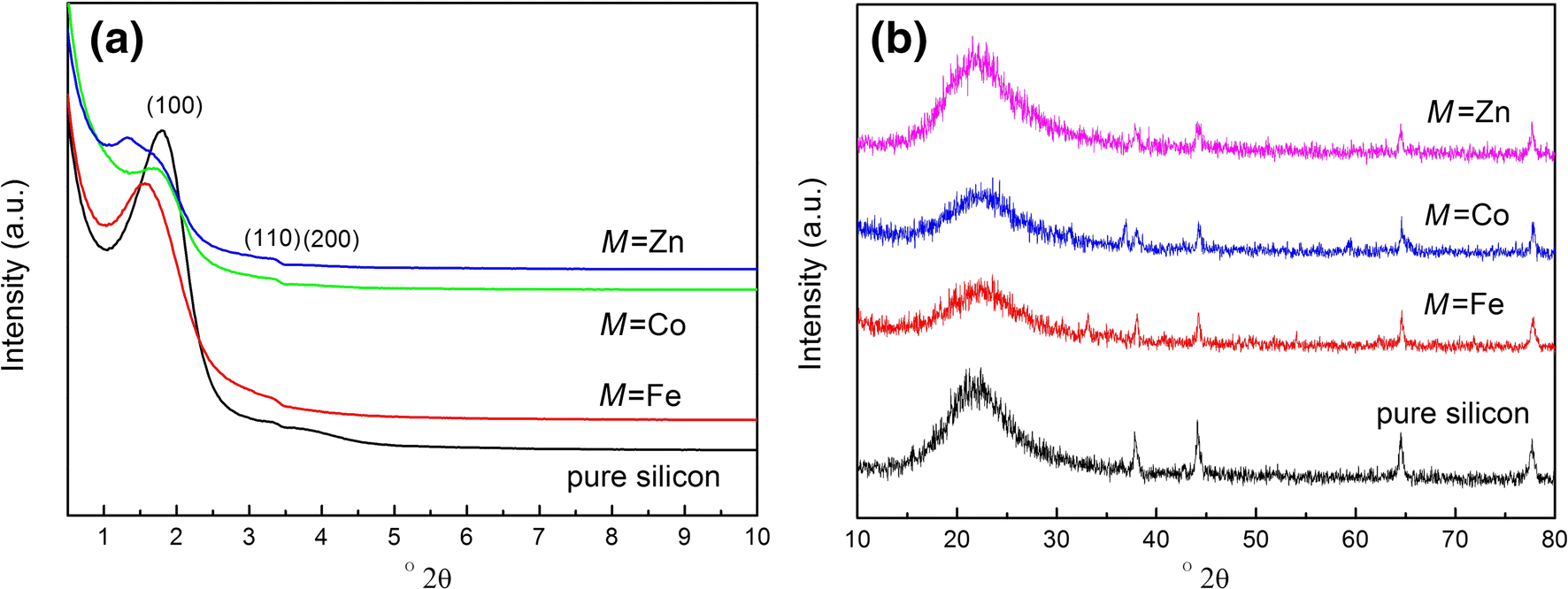
The small-angle XRD patterns of M-MCM-41 (M = Fe, Co, and Zn) (Fig. 1A) revealed that the pure silicon MCM-41 had a hexagonal structure with long-range ordered pores and three characteristic reflection peaks of d 100, d 110, and d 200. The M-MCM-41 retained the strongest characteristic diffraction peak on the (100) crystal plane as compared to the pure silicon MCM-41, which indicated that the M-MCM-41 samples could still maintain a hexagonal, regular pore structure (Jiang et al. Reference Jiang, Lin, Zhang, Liu and Xu2012). The intensities of the characteristic diffraction peaks of M-MCM-41 samples decreased significantly, and the peak position shifted towards smaller angles, which revealed that, with the introduction of metal ions, the pore structure of the molecular sieve changed from long-range order to short-range order (Zhao et al. Reference Zhao, Wang, Tang, Jiang, Li and Yin2010). Previous studies also showed that when metal ions larger than Si atoms were introduced into the MCM-41 skeleton, the crystal-cell parameters increased due to the lengthening of M-O bond, and the position of the diffraction peak of the (100) crystal plane shifted only slightly (Reddy et al. Reference Reddy, Moudrakovski and Sayari1994; Xin & Ke Reference Xin and Ke2015). The change of unit-cell parameters indicated that metal ions entered the framework of the molecular sieve. The characteristic diffraction peaks of metal oxides were not observed from the wide-angle XRD spectra (Fig. 1B), suggesting that the metal ions entered the bulk phase of the molecular sieve or dispersed uniformly in the zeolite framework rather than forming a separate, admixed phase (Liu et al. Reference Liu, Yi, Cui, Shi and Meng2018; Guo et al. Reference Guo, Bao, Chang, Bao and Liao2019).
XRD patterns of M-MCM-41 molecular sieves: (a) small-angle, (b) wide-angle

Electron microscopy images
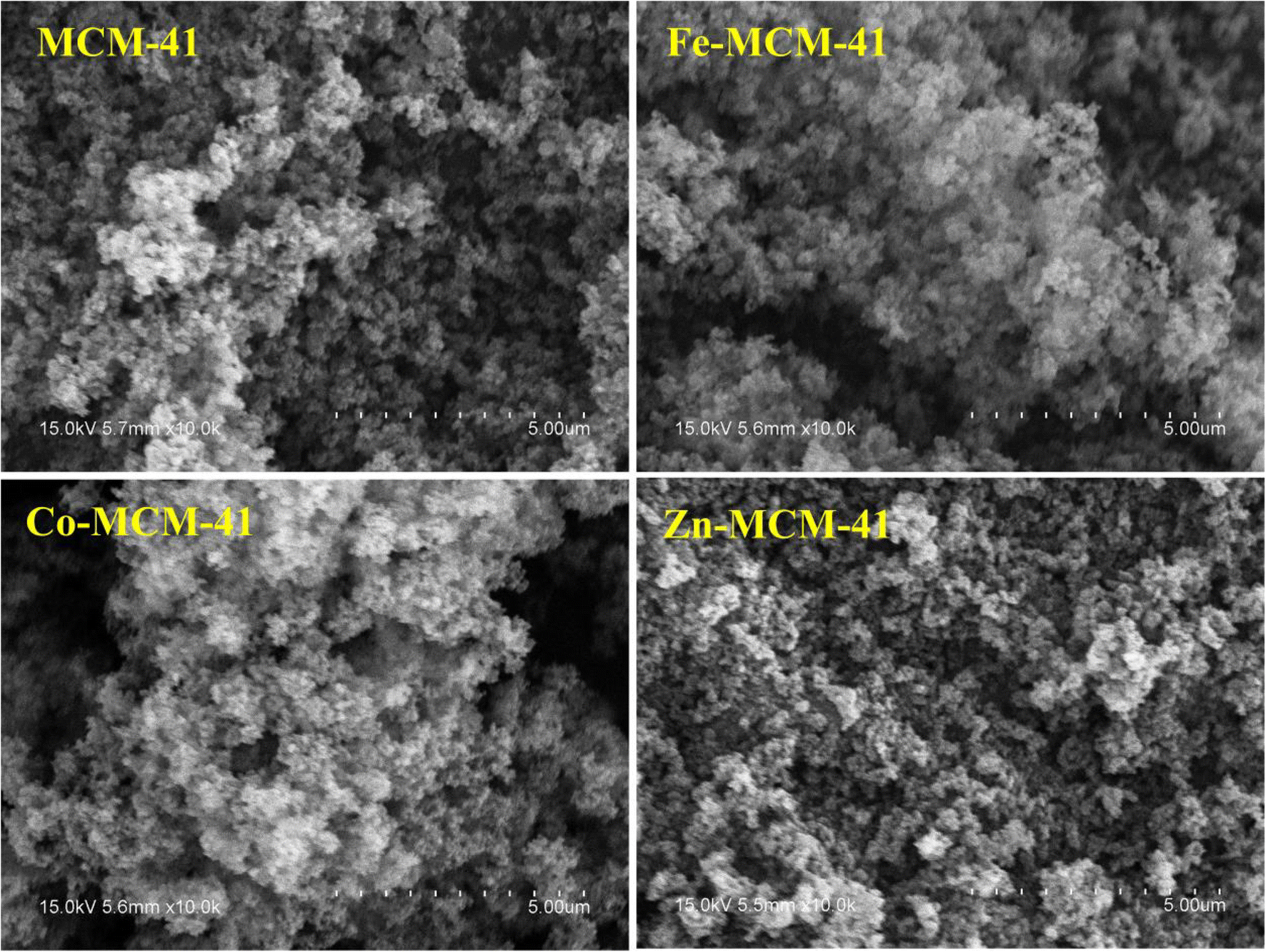
Scanning electron microscopy images of the MCM-41 and M-MCM-41 samples (Fig. 2) showed that the molecular sieves grew in clusters, the particle size was uniform, and the arrangement was compact. The surface morphology of the molecular sieves modified by metal ions did not change significantly, and these samples were grouped together by countless nanometer-scale particles. The MCM-41 and Zn-MCM-41 samples showed a particle size of ~500 nm; however, the particle sizes of the Fe-MCM-41 and Co-MCM-41 samples were much smaller. The smaller particle size of the samples might bring better catalytic and separation performance due to the accessibility of the active phase (Tosheva & Valtchev Reference Tosheva and Valtchev2005).
SEM images of the samples

EDS analysis
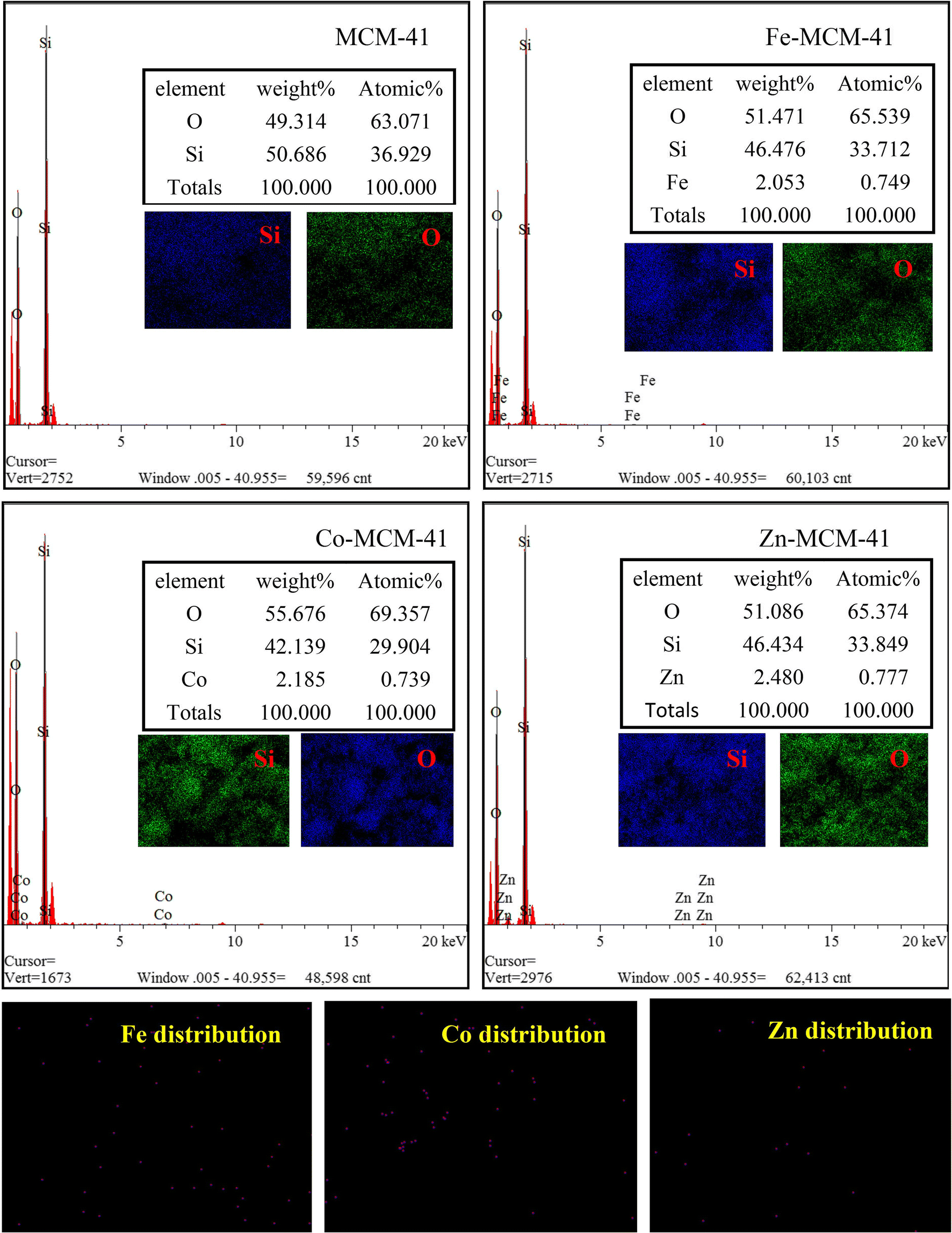
EDS analysis of the molecular sieves was carried out in order to determine their chemical composition and the distribution of metal ions (Fig. 3). The corresponding Si, O, Fe, Co, and Zn maps illustrate an homogeneous distribution of these elements in the cross-section view. The mass fraction of doped Fe, Co, and Zn in the samples was 2.053%, 2.185%, and 2.480%, respectively. The molar ratios of metal ions to Si atoms were n(M):n(Si) = 1:45 for Fe, 1:41 for Co, and 1:44 for Zn. The ratio of raw materials in the synthesis process was n(M):n(Si) = 1:50. This meant that most of the metal ions were introduced into the structure of the MCM-41 molecular sieve.
EDS profiles of the samples

FTIR analysis
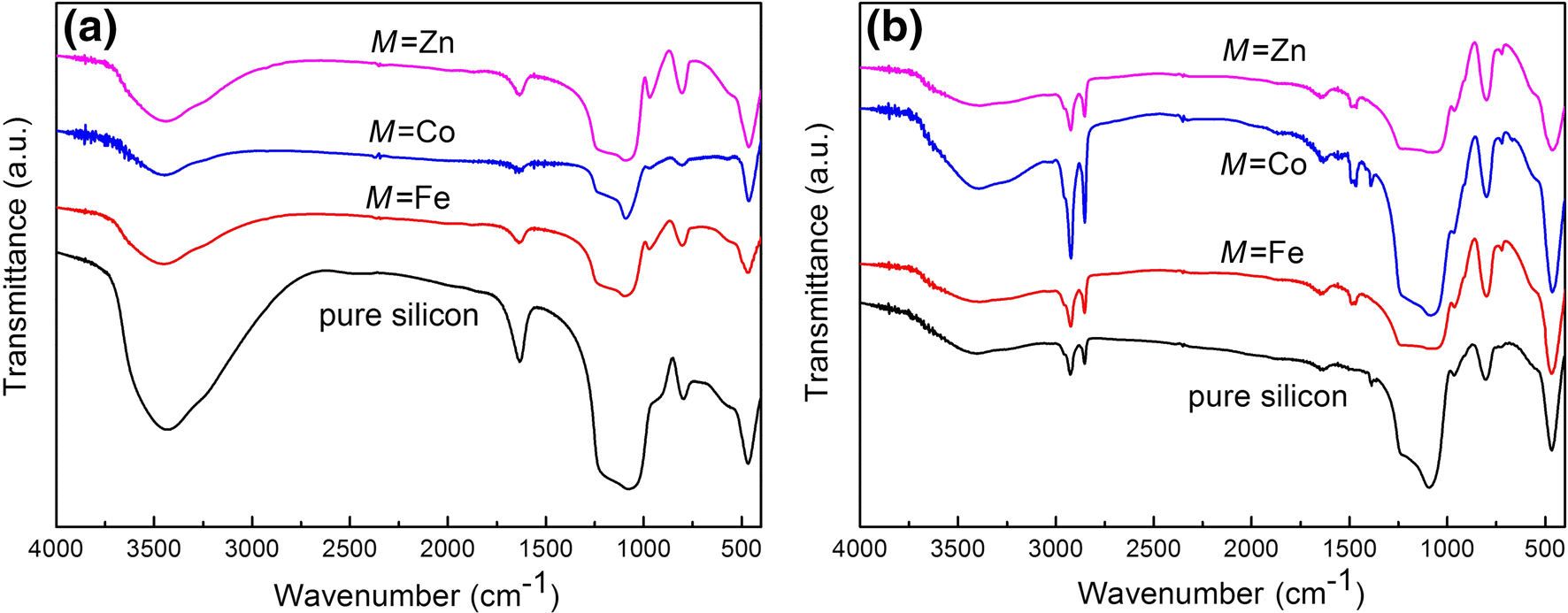
The functional groups of the sample surface were investigated by FTIR spectroscopy (Fig. 4). The infrared characteristic peaks of the modified M-MCM-41 and pure silicon MCM-41 before adsorption of thiophene were in good agreement with each other (Fig. 4A), which further indicated that the modified samples still possessed an ordered MCM-41 skeleton. The band near 3427 cm–1 is generally considered to be the O-H stretching vibration associated with Si-OH inside the pore channel of mesoporous materials, and had a blue shift in M-MCM-41. The weak band at 1630 cm–1 was assigned to the -OH bending vibration. The bands observed in the range of 400–1300 cm–1 indicated a molecular sieve skeleton structure. The Si-O-Si asymmetric stretching vibration in M-MCM-41 moved to a high wavenumber of ~20 cm–1, which was believed to be the result of movement of metal ions into the MCM-41 skeleton (Ma et al. Reference Ma, Velu, Kim and Song2005). For M-MCM-41, the shoulder at 960 cm–1 had a blue shift. Even though the attribution of this blue shift is controversial, some researchers believe that the change in the intensity of this shoulder is evidence that hetero atoms entered the framework of MCM-41 (Araujo & Jaroniec Reference Araujo and Jaroniec1999; Yu et al. Reference Yu, Li, Xu, Li, Xin and Liu2001).
FTIR spectra of the samples: (a) before adsorption of thiophene, (b) after adsorption of thiophene

After adsorption of thiophene, several new peaks appeared in the FTIR spectra (Fig. 4B). The new bands at 2924 and 2854 cm–1 were attributed to the C-H stretching band of saturated -CH2 groups. The catalytic reaction of thiophene might occur under the action of protonic acid on a zeolite surface, which would lead to the destruction of the conjugate system of thiophene rings (Richardeau et al. Reference Richardeau, Joly, Canaff, Magnoux, Guisnet, Thomas and Nicolaos2004; Jiang & Ng Reference Jiang and Ng2006) and, thus, produce the stretching-vibration peak characteristic of saturated -CH2 groups. When the S atom in thiophene interacts directly with metal ions, the electron density in the thiophene ring increases (Garcia & Lercher Reference Garcia and Lercher1992), thus causing the shift of the C=C stretching-vibration peak to a higher wavenumber. According to the study of organometallic complexes with thiophene as ligand (Mills et al. Reference Mills, Korlann, Bussell, Reynolds, Ovchinnikov, Angelici, Stinner, Weber and Prins2001), the new band at 1471 cm–1 was assigned to the C=C stretching vibration, which is evidence that the thiophene molecule was adsorbed molecularly on M-MCM-41 through a S-Metal complex. For Co-MCM-41 and MCM-41, a new weak band at 1386 cm–1 was ascribable to the red shift of the C=C stretching vibration of thiophene sulfide (Layman & Bussell Reference Layman and Bussell2004; Liu et al. Reference Liu, Yi, Cui, Shi and Meng2018). The red shift arose from a decrease in the electron density of the entire thiophene ring, indicating that the ring of the adsorbed thiophene molecule was parallel to the zeolite surface (Hernández-Maldonado et al. Reference Hernández-Maldonado, Stamatis, Yang, He and Cannella2004; Shi et al. Reference Shi, Zhang, Zhang, Tian, Jia and Chen2013). Thus, the thiophene molecules were adsorbed on Co-MCM-41 and MCM-41 through a π-complex. These results showed that, in addition to pure physical adsorption, the adsorption of thiophene in Co-MCM-41 might have two kinds of interaction: S-Metal and π complexes, while S-Metal complexes were the main adsorption form of Fe-MCM-41 and Zn-MCM-41, π complexes were the main adsorption form of pure silica MCM-41 molecular sieve.
TGA-DSC analysis
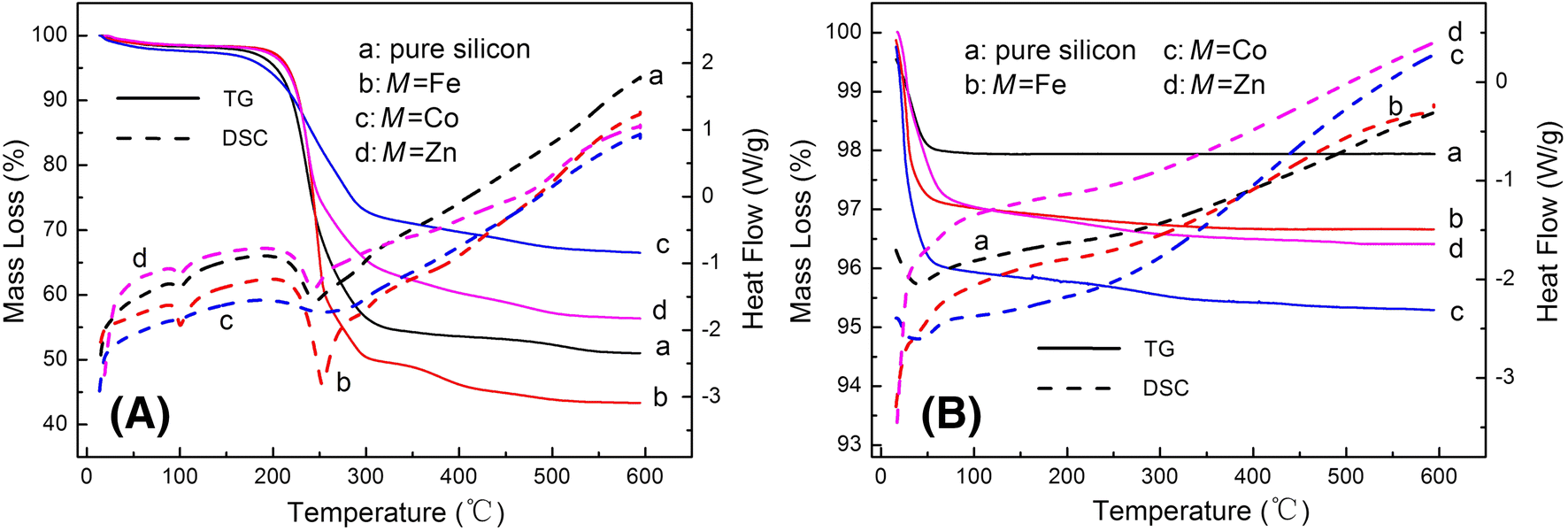
The TGA-DSC patterns (Fig. 5A) showed that each sample had two endothermic peaks before calcination. The endothermic peak near 100°C corresponded to the desorption of water molecules on the surface of the molecular sieves. The endothermic peak between 200 and 300°C was mainly the decomposition of template CTAB. For MCM-41 and Zn-MCM-41, this peak was observed at ~245°C, whereas for Co-MCM-41 and Fe-MCM-41 it was at slightly higher temperature, ~253°C. It was most intense, with the greatest weight loss, for Fe-MCM-41. The increase in weight-loss temperature during CTAB decomposition confirmed a slightly stronger interaction between the template agent and the molecular sieve framework. All samples after calcination (Fig. 5B) had a slight weight loss below 100°C due to the desorption of physically adsorbed water molecules.
TGA-DSC patterns of the samples: (A) before calcination, (B) after calcination

Adsorptive desulfurization
Effect of adsorbent dosage
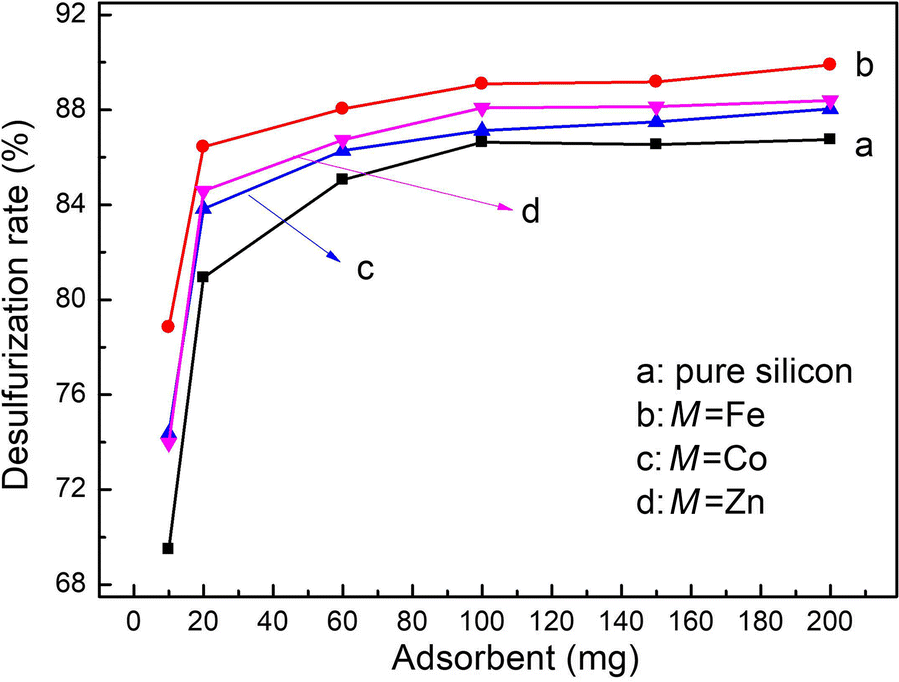
Results (Fig. 6) revealed that the initial levels of desulfurization achieved by the molecular sieves increased in the order MCM-41 < Co-MCM-41 ≅ Zn-MCM-41 < Fe-MCM-41. The level of desulfurization increased rapidly by ~8% to ~11% with increasing adsorbent dose in the range of 10–20 mg, but in the opposite order to the initial levels, i.e. MCM-41 > Co-MCM-41 ≅ Zn-MCM-41 > Fe-MCM-41. The rate of increase then slowed to similar levels for all samples as the dose increased through the range of 20–100 mg. Above 100 mg, desulfurization tended to be at equilibrium. The maximum level of desulfurization (which is the true measure of performance) achieved by the various samples followed the initial order of Fe-MCM-41 > Co-MCM-41 ≅ Zn-MCM-41 > MCM-41 and indicating that the desulfurization performance of the Fe-MCM-41 molecular sieve was the best, nearly 90%. Based on these results, an adsorbent dose of 100 mg was selected for testing other variables during subsequent experiments.
Effect of adsorbent dosage on adsorptive desulfurization

Effect of temperature
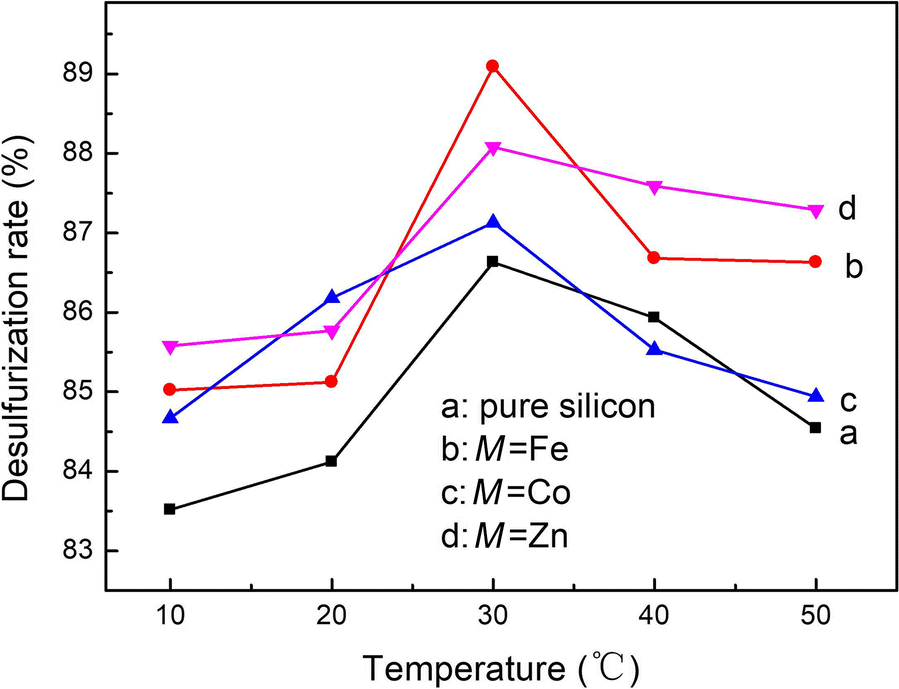
Temperature has a significant impact on the adsorption equilibrium, thus the desulfurization performance of molecular sieves in the temperature range 110–50°C was studied. The amount of thiophene adsorbed on the molecular sieves first increased and then decreased with increasing temperature (Fig. 7), and the adsorption desulfurization effect was best at 30°C. This meant that the adsorption process of thiophene on the molecular sieves had both physical and chemical aspects. At low temperature, physical adsorption played a major role, mainly through the interaction of van der Waals forces. At high temperature, chemical adsorption played a major role, mainly through complexation, such as π-complexation, S-M interaction, etc. When the adsorption temperature was >30°C, a large number of adsorbed thiophene molecules was desorbed, which led to the decrease in adsorption capacity (Zhang et al. Reference Zhang, Huang, Li, Meng, Lu, Zhong, Liu and Yang2012a).
Effect of temperature on adsorptive desulfurization

Effect of adsorption time
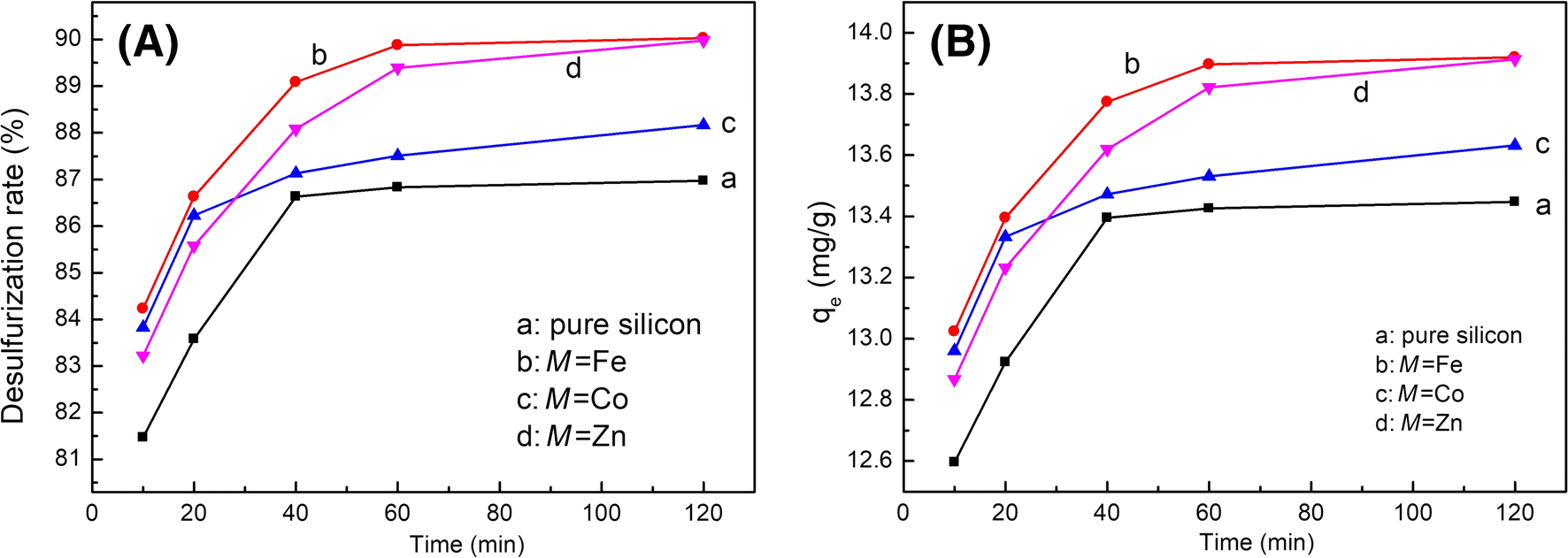
The effect of adsorption time on the desulfurization behavior of the molecular sieve showed that the extent of desulfurization of the four adsorbents increased with increasing adsorption time (Fig. 8A). MCM-41 and Fe-MCM-41 reached the adsorption equilibrium in 60 min, and the extent of desulphurization was ~87 and 90%, respectively. The desulfurization level of Co-MCM-41 and Zn-MCM-41 still increased slightly beyond 60 min, reaching maxima of ~88 and 90%, respectively, after 120 min. The Fe-MCM-41 molecular sieve again exhibited the best desulfurization performance.
Effect of adsorption time on adsorptive desulfurization of the samples: (A) extent of desulfurization, (B) adsorption capacity

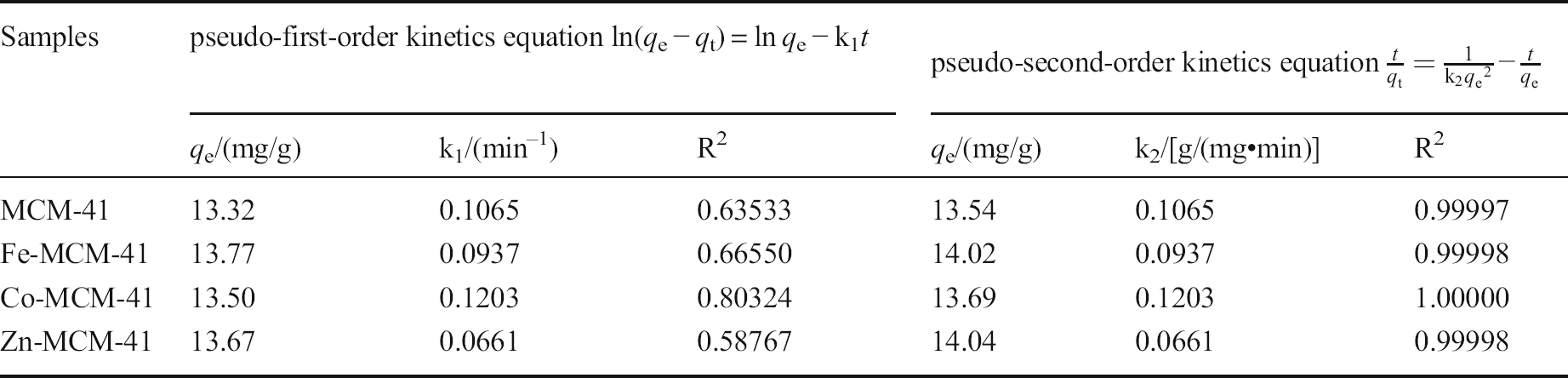
In order to explore further the adsorption mechanism of thiophene on M-MCM-41 molecular sieves, pseudo-first-order and pseudo-second-order kinetics adsorption models (Ho and Ofomaja Reference Ho and Ofomaja2005) were used to fit the experimental data (Fig. 8B). The pseudo-first-order equation is given by:

The pseudo-second-order equation is

where k1 is the pseudo-first-order rate constant (min–1), k2 is the pseudo-second-order rate constant [g/(mg·min)], t is the adsorption time (min), q e is the equilibrium adsorption capacity (mg/g), and q t is the amount adsorbed at time t (mg/g).
The parameters obtained by fitting the data in these equations (Table 1) revealed a correlation coefficient, R2, of >0.999 for the pseudo-second-order model, giving predicted values of q e that were very similar to the experimental values, i.e. 13.54 predicted vs. 13.45 experimental, 14.02 vs. 13.92, 13.69 vs. 13.63, and 14.04 vs. 13.91 mg/g for MCM-41, Fe-MCM-41, Co-MCM-41, and Zn-MCM-41, respectively, indicating that the adsorption process of thiophene on molecular sieves was described well by the pseudo-second-order kinetics equation. This model includes all the adsorption processes such as external liquid membrane diffusion, surface adsorption, and intra-particle diffusion (Thaligari et al. Reference Thaligari, Srivastava and Prasad2016). Considering the length of time to adsorption equilibrium, the Fe-MCM-41 molecular sieve had the best desulfurization performance with an equilibrium adsorption capacity of 14.02 mg/g (predicted) and 13.92 (experimental), which was greater than that of Ce-MCM-41 reported in the literature (10.0 mg(S)/g) (Ke & Xin Reference Ke and Xin2010).
Kinetics parameters of adsorptive desulfurization of thiophene by samples

Results revealed, in general, that the desulfurization of thiophene by modified molecular sieves is greater than that of pure silicon molecular sieves. The introduction of hetero atoms made the molecular sieves undergo π-complexation, S-M interaction, and so on, which changed the density and strength of Lewis acid sites and the particle size of the samples, and then affected their adsorption and desulfurization properties with respect to thiophene (Tosheva & Valtchev Reference Tosheva and Valtchev2005; Padró et al. Reference Padró, Rey, González Peña and Apesteguía2011).
Conclusions
Fe, Co, and Zn metal ions were introduced into the framework of the MCM-41 molecular sieve by a one-step in situ hydrothermal synthesis method, which kept the complete MCM-41 molecular sieve configuration. The introduction of metal ions improved the adsorption desulfurization performance of molecular sieves. The adsorption of thiophene on molecular sieves included physical adsorption and chemical adsorption. Two forms of chemical adsorption are possible: π complexation and S-Metal complexation. In addition to pure physical adsorption, both of these were observed in the adsorption of thiophene on Co-MCM-41, whereas only S-Metal complexation was the main adsorption form by Fe-MCM-41 and Zn-MCM-41 and, π-complexation was the main form of adsorption by pure silica molecular sieves. The kinetics studies showed that the pseudo-second-order kinetics adsorption model could describe more accurately the adsorption process of thiophene on molecular sieves, and this process was controlled by physical adsorption and surface chemical properties. The Fe-MCM-41 molecular sieves had the best desulfurization performance with an equilibrium adsorption capacity of 14.02 mg/g, and the extent of desulfurization was ~90%.
Acknowledgments
This research was supported by Zhejiang Provincial Natural Science Foundation of China under Grant No. LY14B060006 and LQ19E040001.