Several lines of research have converged on the finding that depression is related to difficulty in updating established negative expectations after receiving disconfirmatory positive information (for a review, see Kube, Schwarting, Rozenkrantz, Glombiewski, and Rief (Reference Kube, Schwarting, Rozenkrantz, Glombiewski and Rief2020)). For example, research into interpretation biases has demonstrated that people with depression are reluctant to revise established negative interpretations of interpersonal situations if they receive new information that suggests a more positive interpretation (Everaert, Bronstein, Cannon, & Joormann, Reference Everaert, Bronstein, Cannon and Joormann2018; Everaert, Bronstein, Castro, Cannon, & Joormann, Reference Everaert, Bronstein, Castro, Cannon and Joormann2020; Liknaitzky, Smillie, & Allen, Reference Liknaitzky, Smillie and Allen2017). In addition, research on reward insensitivity has linked depression to deficits in processing reward prediction errors (Kumar et al., Reference Kumar, Goer, Murray, Dillon, Beltzer, Cohen and Pizzagalli2018; Pizzagalli et al., Reference Pizzagalli, Holmes, Dillon, Goetz, Birk, Bogdan and Fava2009; Steele, Kumar, & Ebmeier, Reference Steele, Kumar and Ebmeier2007). Moreover, recent work has shown that people with depression maintain negative performance-related expectations despite unexpectedly positive performance feedback by negatively reappraising disconfirmatory evidence, for instance by questioning its validity or considering it an expectation rather than the rule (Kube et al., Reference Kube, Glombiewski, Gall, Toussaint, Gärtner and Rief2019a; Kube, Rief, Gollwitzer, Gärtner, & Glombiewski, Reference Kube, Rief, Gollwitzer, Gärtner and Glombiewski2019c). This negative appraisal of positive disonfirmatory evidence has been referred to as cognitive immunisation (Rief et al., Reference Rief, Glombiewski, Gollwitzer, Schubo, Schwarting and Thorwart2015). By contrast, depression does not seem to be related to abnormalities in processing unexpectedly negative information (Brolsma et al., Reference Brolsma, Vrijsen, Vassena, Kandroodi, Bergman, van Eijndhoven and Cools2020; Everaert et al., Reference Everaert, Bronstein, Cannon and Joormann2018; Kube, Kirchner, Rief, Gärtner, & Glombiewski, Reference Kube, Kirchner, Rief, Gärtner and Glombiewski2019b). Thus, the main problem of depression seems to be a reduced integration of novel positive information, rather than an increased sensitivity to unexpectedly negative information. While cognitive factors have been investigated quite extensively in this line of research, little is known about how affective factors influence difficulties in revising negative beliefs in response to novel positive information. By addressing this gap, the present work seeks to contribute to a broader understanding of mechanisms underlying aberrant information processing in depression. More specifically, by examining how current mood influences the integration of unexpectedly positive information, we aim to move forward the literature on how cognitive and affective factors may interact in depression.
In the non-clinical psychological literature, it is well-known that current negative moodFootnote †Footnote 1 can hinder positive information processing. In particular, researchers have found that the presence of negative mood impairs learning and transfer effects (Brand, Reimer, & Opwis, Reference Brand, Reimer and Opwis2007) as well as positive feedback processing (Hammer & Stone-Romero, Reference Hammer and Stone-Romero1996). Moreover, in a mood-congruent expectancy approach, Ziegler (Reference Ziegler2010, Reference Ziegler2013) provided evidence of impaired information processing if mood-incongruent information is received, i.e. positive information in the event of negative mood. Worthy of note, though, other research from the general psychology literature did not find such adverse effects of negative mood on information processing, as summarised by Forgas (Reference Forgas2013).
Consistent with the aforementioned detrimental effects of negative affect on information processing, more clinically oriented research has demonstrated bidirectional effects of negative mood and the engagement in dysfunctional rumination in depression (Kuehner, Huffziger, & Liebsch, Reference Kuehner, Huffziger and Liebsch2009; Lyubomirsky, Caldwell, & Nolen-Hoeksema, Reference Lyubomirsky, Caldwell and Nolen-Hoeksema1998; Nolen-Hoeksema, Morrow, & Fredrickson, Reference Nolen-Hoeksema, Morrow and Fredrickson1993; Nolen-Hoeksema, Parker, & Larson, Reference Nolen-Hoeksema, Parker and Larson1994; Yoon & Joormann, Reference Yoon and Joormann2012). In line with these findings, a previous study examining a non-clinical sample with varying levels of depressive symptoms found that the negative effects of depressive symptoms on the revision of negative performance-related expectations were particularly pronounced if participants underwent a negative mood induction (watching a short film clip inducing sadness) before receiving unexpectedly positive feedback for their performance (Kube & Glombiewski, Reference Kube and Glombiewski2021). This suggests that difficulties in revising established negative beliefs after novel positive information in people with elevated symptoms might be particularly pertinent when negative mood is activated.
Regarding positive mood, research suggests that positive mood broadens attention for new information (see Fredrickson (Reference Fredrickson2013) for a review) and might thereby foster the detection of positive expectation-disconfirming information. From a learning perspective, positive mood has been associated with higher learning rates, which might reflect improved adjustment to changing outcomes (Bakic, Jepma, De Raedt, & Pourtois, Reference Bakic, Jepma, De Raedt and Pourtois2014). Additionally, positive mood has been shown to promote cognitive flexibility in interpreting novel experiences at the expense of perseverating previous interpretation patterns (Dreisbach & Goschke, Reference Dreisbach and Goschke2004; Goschke & Bolte, Reference Goschke and Bolte2014), which is essential in belief updating. In addition to evidence suggesting that positive mood increases the sensitivity to positive information (Tamir & Robinson, Reference Tamir and Robinson2007), positive mood has also been shown to reduce depressive rumination (Hawksley & Davey, Reference Hawksley and Davey2010). The latter might be particularly important to belief updating, since post-event rumination can hamper the adjustment of negative expectations in line with positive experiences, as discussed above in relation to cognitive immunisation.
Overview of the present studies and hypotheses
We conducted two experimental studies to investigate how state mood influences the revision of negative expectations after receiving unexpectedly positive feedback in people with depressive symptoms. Drawing on previous research on the detrimental effects of negative mood on information processing, we hypothesised that the induction of negative mood, relative to positive mood, would hinder the revision of negative expectations in response to disconfirming positive information in depression. Conversely, in light of evidence pointing to beneficial effects of positive mood on information processing, we hypothesised that the induction of positive mood would improve the update of negative performance-related expectations in response to positive performance feedback. If these hypotheses were confirmed, it would suggest that state mood critically determines the extent to which positive information can be integrated in people with depressive symptoms. This would have important clinical implications as it would suggest that the success of any intervention relying on learning from new experiences (such as behavioural experiments) could be compromised by the occurrence of negative mood while learning.
In study 1, we examined a subclinical sample, i.e. people reporting elevated levels of depression (BDI-II sum score ⩾ 14) but not necessarily meeting the criteria of a major depressive disorder. In this sample, we compared the induction of negative mood to the induction of positive mood and a control condition undergoing distraction. Study 2 aimed to extend the findings of study 1 in two respects. First, in study 2 we used an inpatient sample of persons with major depression to examine the effects of current mood on belief updating in people with more severe levels of depression. Second, in addition to the variation of the valence of the mood induction (positive v. negative), we tested the effects of two different mood induction methods (emotion-eliciting film v. autobiographic recall + music) in study 2, resulting in a 2 × 2-design.
In each study, we tested the following two hypotheses:
1. Modulating participants' mood prior to receiving unexpectedly positive feedback will affect the use of that feedback to adjust negative expectations. Specifically, participants undergoing the induction of negative mood will update their expectations to a lesser extent than participants undergoing the positive mood induction.
2. The severity of depressive symptoms negatively predicts the extent to which initial expectations are updated.
Moreover, to get additional insights into the effects of depression and state mood on belief updating, we examined in both studies depressive symptoms and state mood (across conditions) as predictors of belief updating. In study 1, we also hypothesised that the effects of the mood induction on expectation updating would interact with depression; specifically, we predicted that the diagnostic status moderates the influence of the mood induction on the revision of previous expectations, in the sense that the negative mood induction hinders belief updating particularly in the subgroup of participants who meet the criteria of a depressive episode. In study 2, we additionally investigated in an exploratory manner whether the mood induction method (film v. music + autobiographic recall) interacts with the valence of the mood induction in terms of its effects on the adjustment of negative expectations.
General method
Procedure
The two experimental studies are based on a well-established paradigm that has been validated previously (Kube, Rief, Gollwitzer, & Glombiewski, Reference Kube, Rief, Gollwitzer and Glombiewski2018) and has been used in several previous studies to examine the adjustment of beliefs in response to new information in depression (Kube et al., Reference Kube, Rief, Gollwitzer and Glombiewski2018, Reference Kube, Glombiewski, Gall, Toussaint, Gärtner and Rief2019a, Reference Kube, Kirchner, Rief, Gärtner and Glombiewski2019b, Reference Kube, Rief, Gollwitzer, Gärtner and Glombiewski2019c; Kube & Glombiewski, Reference Kube and Glombiewski2021). Next we describe the general procedure of this paradigm, supplemented by a mood induction.
Induction of negative expectations
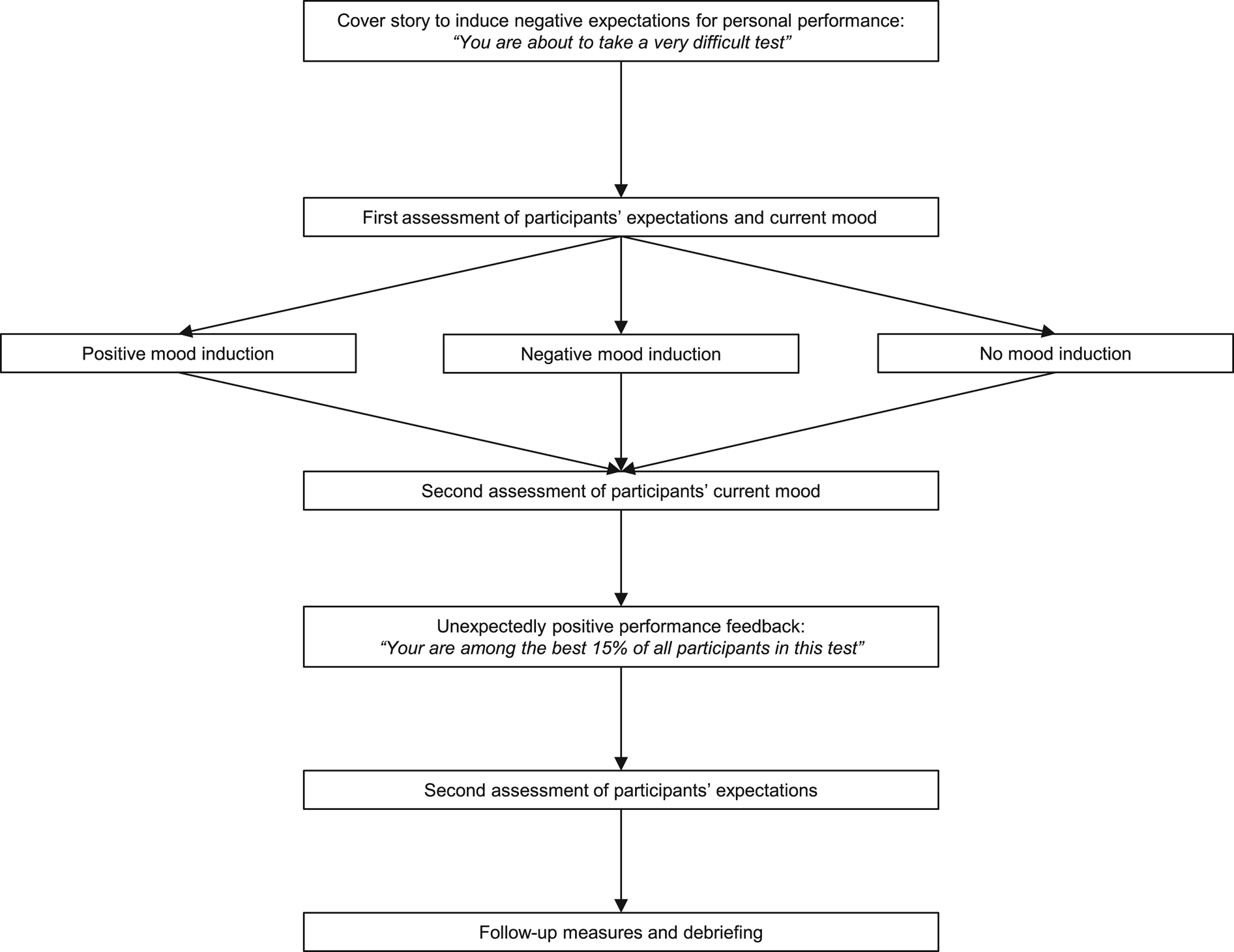
To conceal the actual purpose of the study and prevent demand effects, participants were led to believe that the study was about the relationship between current mood and performance. At the beginning of the experimental session, participants were therefore asked to rate their current mood. Next, in order to lower participants' baseline expectations for their performance in the upcoming test, participants were informed that the test was very difficult and unknown to them. Previous work demonstrated that this instruction is well appropriate to lower participants' initial expectations for their performance (Kube et al., Reference Kube, Rief, Gollwitzer and Glombiewski2018; Kube et al., Reference Kube, Kirchner, Rief, Gärtner and Glombiewski2019b).
Mood induction
In both studies, all participants underwent a positive or negative mood induction (except for the control group of study 1) before working on the performance test. The details of the mood induction procedure used in the two studies are described below.
Performance test
Participants completed the Test of EMotional INTelligence (TEMINT) (Schmidt-Atzert & Buehner, Reference Schmidt-Atzert and Buehner2002). This test was used in all previous studies of our group on expectation update in the context of disconfirmatory performance feedback. The main reason for the choice of this test was that it is difficult for participants to evaluate their own performance in this test, which is important for the subsequently received performance feedback to appear credible. Another reason for the choice of this test is that all previous studies referenced above did not find any associations between depressive symptoms and actual performance in the TEMINT. The test includes a total of 12 brief descriptions of situations with one acting person who actually experienced the given situation (e.g. ‘I had a dispute with a colleague’). Participants are provided with these situations and are asked to empathise with the acting person and to evaluate the extent to which the acting person experienced certain emotions in the scenario (such as sadness, surprise, pride etc.). The TEMINT sum score reflects the overall deviations from the actual ratings of the persons mentioned in the situations, with low sum scores indicating good performance in the test. The TEMINT has shown good psychometric properties in previous studies (Blickle, Momm, Liu, Witzki, & Steinmayr, Reference Blickle, Momm, Liu, Witzki and Steinmayr2011; Schmidt-Atzert & Buehner, Reference Schmidt-Atzert and Buehner2002). Here, Cronbach's alpha of the TEMINT was α = 0.84 in both studies.
Performance feedback
After each of three blocks of the TEMINT, participants received standardised performance feedback suggesting that their performance was very good. Specifically, participants were informed that they were among the best 15% of all participants in this test. The goal of this feedback was to disconfirm participants' initial neutral to negative expectations positively, as validated previously (Kube et al., Reference Kube, Rief, Gollwitzer and Glombiewski2018). Feedback was provided after each of three blocks as well as after the entire test.
Debriefing
After receiving feedback and rating their performance expectations again, several follow-up questionnaires were administered. Finally, participants were debriefed with respect to the true purpose of the study.
Primary outcome
In both studies, the primary outcome was the pre to post change in generalised performance expectations, while the adjustment of task-specific expectations was considered secondary. The distinction between changes in generalised and task-specific expectations is important as it reflects different levels of learning: while the latter is related to the update of beliefs for one's performance in a particular task, the former requires transferring knowledge from a specific experience to other situations, thus reflecting a generalisation of a new learning experience (Rief et al., Reference Rief, Glombiewski, Gollwitzer, Schubo, Schwarting and Thorwart2015). Previous research revealed that depression is particularly related to difficulties in revising generalised expectations, hence exhibiting the aforementioned transfer effects (Kube et al., Reference Kube, Rief, Gollwitzer, Gärtner and Glombiewski2019c).
Ethics and pre-registration
Both studies were approved by the local ethics committee (reference numbers 2019_216 and 2019–60k) and were conducted in accordance with ethical standards as laid down in the 1964 Declaration of Helsinki and its later amendments. All participants gave written informed consent and were treated in accordance with the ethical guidelines of the German Psychological Society. Both studies were pre-registered at AsPredicted: study 1: https://aspredicted.org/ce4bh.pdf; study 2: https://aspredicted.org/45v8x.pdf.
Study 1
Methods
Participants
The sample size was determined via a-priori power analysis using G × Power. We estimated the expected effect size based on our previous study, where we found in a sample with varying levels of depressive symptoms a moderate effect of a negative mood induction on the revision of negative expectations (Kube & Glombiewski, Reference Kube and Glombiewski2021). For this study, we intended to examine a subclinical sample with elevated levels of depression, where we assumed the adjustment of negative expectations to be somewhat lower. Thus, we expected a small to medium effect size of the differential mood manipulation. Accordingly, the power analysis (expected f = 0.17; power = 0.80; three groups; correlation between the two points of measurement r = 0.50) indicated a required sample size of at least 90 participants. Inclusion criteria were: BDI-II sum score ⩾ 14 (indicating at least mild depressive symptoms according to Beck, Steer, Ball, and Ranieri (Reference Beck, Steer, Ball and Ranieri1996)); at least 18 years old; and sufficient German language skills. The inclusion criterion of BDI-II sum score ⩾ 14 was ensured via pre-screening. If participants were above the cut-off value in the pre-screening, they were invited to the laboratory experiment. Recruitment was conducted at the surrounding of the University of Koblenz-Landau via email lists and postings at public spaces. As an incentive for participation, participants received €9 as a financial compensation.
Experimental groups
Participants were randomly assigned to one of three experimental conditions: negative mood induction, positive mood induction, or control group. Participants who were randomised to the negative mood induction group watched a brief sequence from the film ‘The Champ’ from 1979. The sequence lasting 2 min and 45 s shows a professional boxer dying after a fight in front of his little crying son. This film sequence is well-established in emotion research and has been shown to be suitable for inducing negative mood (Gross & Levenson, Reference Gross and Levenson1995; Rottenberg, Kasch, Gross, & Gotlib, Reference Rottenberg, Kasch, Gross and Gotlib2002; Rottenberg, Ray, & Gross, Reference Rottenberg, Ray, Gross, Coan and Allen2007). Participants from the positive mood induction group watched a sequence from the film ‘When Harry Met Sally’ from 1989. That sequence shows a discussion between a man and a woman on faking an orgasm, lasting 2 min and 47 s. This film scene has been used frequently in emotion research to elicit positive emotions, particularly amusement (Gross & Levenson, Reference Gross and Levenson1995; Joseph, Chan, Heintzelman, Tay, & Scotney, Reference Joseph, Chan, Heintzelman, Tay and Scotney2020; Rottenberg et al., Reference Rottenberg, Ray, Gross, Coan and Allen2007). Participants from the control group did not watch a film sequence after the first mood rating. Instead, they worked on a distraction task of equal length developed by Nolen-Hoeksema and Morrow (Reference Nolen-Hoeksema and Morrow1993), in which participants are to imagine 17 neutral places or objects (e.g. ‘Imagine looking at the shiny surface of a trumpet’, ‘Think about a boat slowly crossing the Atlantic’, ‘Think about the expression on the face of the Mona Lisa’) (Fig. 1).
Design of study 1.

Measures
Changes in expectations
Participants' performance expectations were assessed with the Performance Expectations Scale developed by Kube et al. (Reference Kube, Rief, Gollwitzer and Glombiewski2018). This scale assesses both participants' task-specific expectations (tied to the expected performance in a particular test) and generalised performance expectations (referring to the expected performance in unknown tests in general), each with two items. These two subscales are analysed separately. Half of the items are worded positively (e.g. ‘Solving the tasks from the test will be easy for me’), while the other half is worded negatively (e.g. ‘Solving unknown tasks in general will be difficult for me’). The negatively worded items are reversely scored when computing the sum score. All items are rated on a seven-point Likert scale ranging from (1) ‘I totally disagree’ to (7) ‘I totally agree’, thus higher values in the sum scores reflect positive performance expectations. Participants completed the scale both before working on the test and after feedback. The Performance Expectations Scale has been used in several previous studies and has shown good psychometric properties. In study 1, Cronbach's alpha of the task-specific expectations subscale was α = 0.92. Cronbach's alpha of the generalised performance expectations subscale was α = 0.84.
Mood
Current mood was assessed with the Positive and Negative Affect Scale (PANAS) by Watson, Clark, and Tellegen (Reference Watson, Clark and Tellegen1988). The PANAS is a well-established measure to assess the presence of ten positive and ten negative emotions independently. In our sample, Cronbach's alpha of the positive affect (PA) subscale was α = 0.80 (Omega = 0.82) and Cronbach's alpha of the negative affect (NA) subscale was α = 0.89 (Omega = 0.89).
Cognitive immunisation
To assess the degree to which participants negatively reappraised the positive performance feedback received, we used the six-item Cognitive Immunisation after Performance Feedback (CIPF) scale (Kube et al., Reference Kube, Kirchner, Rief, Gärtner and Glombiewski2019b). Two items of that scale assess the extent to which participants appraise the test as capturing relevant areas of their lives; two items assess whether participants consider the feedback credible; and two items assess the degree to which participants regard their personal feedback received as an exception. In previous studies using healthy and clinical samples, this scale was found to have good psychometric properties and was related to the extent to which participants revised their performance expectations after feedback (Kube et al., Reference Kube, Glombiewski, Gall, Toussaint, Gärtner and Rief2019a, Reference Kube, Kirchner, Rief, Gärtner and Glombiewski2019b). Each item was rated on a seven-point Likert scale ranging from (1) ‘I totally disagree’ to (7) ‘I totally agree’. Cronbach's alpha of the six-item CIPF scale in the present study was α = 0.70 (Omega = 0.70).
Depressive symptoms
Depressive symptoms were assessed using the second edition of the Beck Depression Inventory (BDI-II), which includes 21 items assessing depressive symptoms on a 4-point scale ranging from 0 to 3 (Beck et al., Reference Beck, Steer, Ball and Ranieri1996). The sum score ranges between 0 and 63, and lower values indicate fewer depressive symptoms.
Diagnostic interview
To assess whether our participants, all of whom subjectively reported elevated levels of depressive symptoms according to the BDI-II, met the criteria of a current depressive episode, we conducted a structured diagnostic interview after the experimental session, using the section ‘Affective Disorders’ from the Structured Clinical Interview for DSM-IV (SCID) (First, Reference First2015; Wittchen, Wunderlich, Gruschwitz, & Zaudig, Reference Wittchen, Wunderlich, Gruschwitz and Zaudig1997). In in this interview, only current depressive episodes were assessed, not a possible lifetime history of depression. The SCID interview was conducted by two female psychology master students who were specifically trained in the administration of the SCID. To ensure the objectivity of the diagnostic assessment, the two master students were closely supervised by an experienced clinician who regularly discussed the diagnostic decisions with them.
Data collection
The experimental sessions were conducted by two female psychology master students in a laboratory room at the university campus. Data were collected between December 2019 and February 2020 using the online platform www.soscisurvey.de.
Statistical analyses
We conducted data screening according to the recommendations of Tabachnick and Fidell (Reference Tabachnick and Fidell2014) and tested the assumptions of analyses of variance (ANOVAs). As participants could only continue with the survey if they entered all values, there were no missing values. Possible baseline differences between the three experimental conditions were examined using ANOVA or χ2-tests, depending on whether the outcome variables were continuous or categorical. A manipulation check regarding the effects of the positive and negative mood induction was performed by running two separate 2 (Time: before mood induction v. after mood induction) × 3 (Condition: positive mood induction v. negative mood induction v. control group) mixed ANOVAs with positive and negative affect as the dependent variable, respectively. For the main analysis, we conducted a 2 (Time: before feedback v. after feedback) × 3 (Condition: positive mood induction v. negative mood induction v. control group) mixed ANOVA with generalised performance expectations as the dependent variable. To investigate the effects of the presence of a diagnosed depressive episode according to the SCID interview, we performed a moderation analysis using the PROCESS Macro for SPSS for regression analyses with 10 000 bootstrapping samples. Also, we conducted a linear regression analysis to examine the influence of depressive symptoms severity (as indicated by the BDI-II sum score) and state mood (i.e. the post values of positive and negative affect as assessed with the PANAS) on the update of generalised performance expectations across conditions. Type-I error levels were set at 5%. We provide 95% confidence intervals (CI) for each effect size, that is ɳ2p or Cohen's d, respectively. All analyses were conducted using IBM SPSS Statistics Version 25.
Results
Sample characteristics
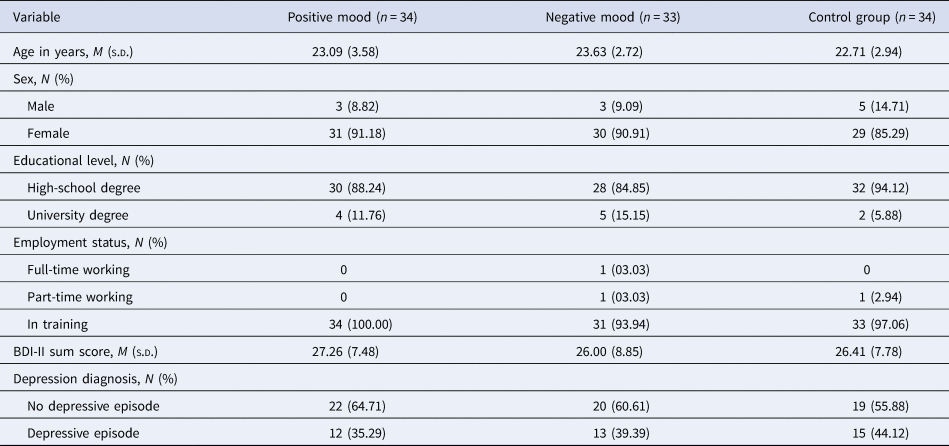
A total of 101 people participated in the study. As noted in the pre-registration of the study, we planned to exclude participants from the analyses if participants (1) were > 3 s.d. above/below the mean on the dependent variable; (2) expressed serious doubts about the cover story and guessed the real purpose of the study; (3) discontinued participation in the study before entering 2/3 of all data points. These pre-defined criteria did not apply to any of the participants. Thus, we based our analyses on the entire sample of 101 people (89.1% female). The mean age of the participants was M = 23.13 (s.d. = 3.10). Most participants (89.1%) had a high-school degree as the highest educational degree, and 97% were students. The mean BDI-II score was M = 26.49 (s.d. = 10.93), indicating moderate symptoms of depression (Beck et al., Reference Beck, Steer, Ball and Ranieri1996). The SCID interview indicated that 40 individuals (39.6%) met the criteria of a current depressive episode. The sociodemographic and clinical characteristics of the sample are presented for the three groups separately in Table 1. The three experimental groups did not differ in any baseline variable, as presented in the online supplement.
Sociodemographic and clinical characteristics of the sample in study 1

Note. M, mean; s.d., standard deviation; N, number; BDI-II, Beck Depression Inventory II.
Manipulation check
The full results of the manipulation check for changes in positive and negative affect are presented in the online supplement. In sum, the results of the manipulation check indicate that the mood induction was partly successful: While the positive mood induction increased positive affect and decreased negative affect, the negative mood induction did not increase negative affect but only decreased positive affect, as depicted in online Supplementary Fig. S1 in the supplement.
Main analyses
Changes in generalised expectations
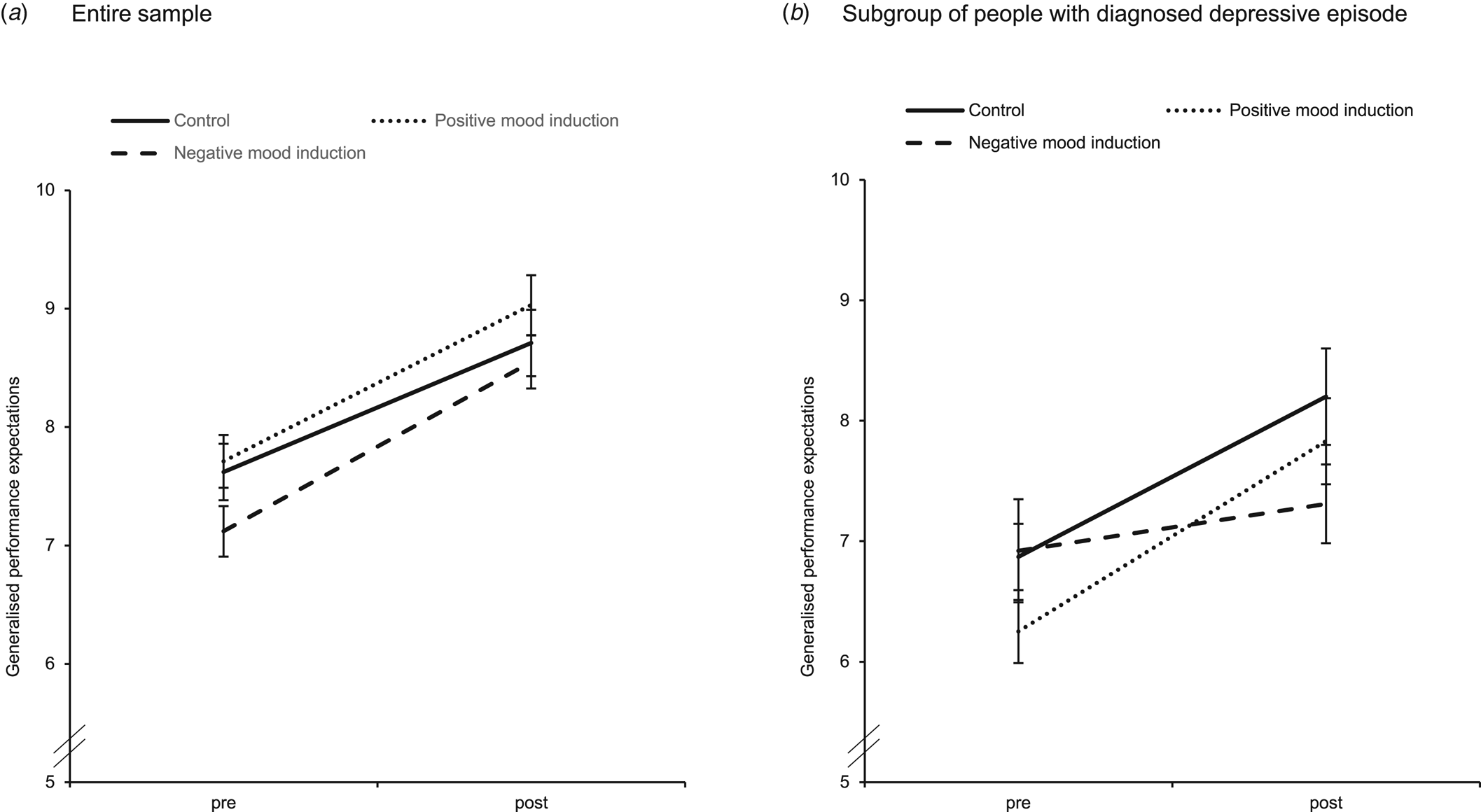
The Time by Condition ANOVA indicated a significant main effect of Time, F (1, 97) = 33.975; p < 0.001; ɳ2p = 0.257; 95% CI (0.121–0.389), with more optimistic expectations after feedback (M = 8.76; s.d. = 2.93) than before working on the test (M = 7.49; s.d. = 2.61). The main effect of Condition was not significant, F (2, 97) = 0.370; p = 0.692; ɳ2p = 0.007; 95% CI (0–0.057), nor was the Time by Condition interaction, F (2, 97) = 0.206; p = 0.814; ɳ2p = 0.004; 95% CI (0–0.043). Figure 2a shows the results for changes in generalised expectations.
Results of the main analyses regarding changes in generalised performance expectations in study 1: (a) in the entire sample (N = 101); (b) in the subgroup of participants who met the criteria of a depressive episode (n = 40).

Changes in task-specific expectations
The Time by Condition ANOVA indicated a significant main effect of Time, F (1, 97) = 101.877; p < 0.001; ɳ2p = 0.510; 95% CI (0.372–0.612), with more positive expectations after feedback (M = 10.94; s.d. = 2.34) than before working on the test (M = 7.66; s.d. = 2.77). The main effect of Condition was not significant, F (2, 97) = 1.692; p = 0.190; ɳ2p = 0.033; 95% CI (0–0.116), nor was the Time by Condition interaction, F (2, 97) = 0.020; p = 0.980; ɳ2p < 0.001; 95% CI (0–0.009).
Influence of depressive symptoms and state mood on belief updating
A linear regression analysis indicated that the severity of depressive symptoms (i.e. the BDI-II sum score) predicted a reduced adjustment of generalised performance expectations (β = −0.220; p = 0.037). Neither positive affect (β = 0.085; p = 0.412), nor negative affect (β = −0.086; p = 0.433) had significant effects on belief updating. Taken together, the three predictors explained 8.5% of the variance in differences in revising generalised performance expectations (p = 0.033)Footnote 2.
Analysis of the diagnostic status
To take the mental health status of the participants into account, we examined whether the presence of a diagnosed depressive episode moderates the effects of the mood induction on the adjustment of generalised performance expectations. In this moderation analysis, we found that neither the group factor [t = 1.744; p = 0.084; 95% CI (−0.084 to 1.295)], nor the diagnosis of depressive episode [t = 1.583; p = 0.117; 95% CI (−0.463 to 4.107)] had significant effects on expectation update. The product term Condition by Diagnosis narrowly failed to reach significance, t = −1.980; p = 0.051; 95% CI (−2.131 to 0.003)Footnote 3. Further exploring this non-significant trend, Fig. 2b displays that among people who met the criteria of a depressive episode, expectation update was somewhat smaller in the negative mood condition than in the other two experimental groups.
Group differences in cognitive immunisation
A one-way ANOVA indicated that the three experimental groups did not differ in their CIPF total scores, F (2, 98) = 1.391; p = 0.254; ɳ2p = 0.028; 95% CI (0–0.104), meaning that they did not differ in their engagement in cognitive immunisation strategies after receiving the positive feedback.
Discussion
The aim of this study was to investigate the effects of state mood on the revision of negative beliefs in people with elevated levels of depressive symptoms. In contrast to our primary hypothesis, the three experimental groups did not differ in updating their generalised performance expectations in response to positive feedback for their performance. The same null-effect was found for the secondary outcome, that is, changes in task-specific expectations. Thus, it seems that the induction of positive v. negative mood did not differentially affect the way participants integrated the positive feedback into their beliefs. This is also reflected by the non-significant group differences in the cognitive immunisation total scores, showing that the groups did not differ in the way they appraised the unexpectedly positive feedback received. The non-significant group differences in belief updating might, at least to some extent, be related to the fact that the negative mood induction did not really increase negative mood; rather, it decreased positive mood. In other words, it might be that negative mood was not pronounced enough to actually hamper the revision of negative beliefs.
In line with our second hypothesis, the results of the regression analysis confirmed that, overall, the severity of depressive symptoms negatively predicted the extent to which negative expectations were updated in response to positive feedback. This is consistent with previous research indicating that depression is related to difficulties in revising negative beliefs after novel positive information (Everaert et al., Reference Everaert, Bronstein, Cannon and Joormann2018, Reference Everaert, Bronstein, Castro, Cannon and Joormann2020; Kube et al., Reference Kube, Rief, Gollwitzer, Gärtner and Glombiewski2019c; Liknaitzky et al., Reference Liknaitzky, Smillie and Allen2017). In this study, most participants reported subclinical levels of depressive symptoms, while about 40% met the criteria of a depressive episode. Although the moderation analysis, taking participants' diagnostic status into account, failed to reach significance (p = 0.051), there was a trend indicating that participants with a diagnosed depressive episode exhibited particularly little adjustment of their initial expectations if they underwent the negative mood induction. Based on this non-significant trend, we aimed to further explore the effects of current mood on belief updating in more severely depressed people. That was the objective of study 2.
Study 2
In study 2, we again investigated how the induction of positive v. negative mood affects the update of negative performance expectations in response to unexpectedly positive performance feedback, using the same experimental paradigm. Besides the use of an inpatient sample, study 2 differed from study 1 also with respect to the mood induction method, since study 1 provided mixed results regarding the effects of the film-based mood induction. Therefore, study 2 used the recall of positive v. negative autobiographic life events, accompanied by happy v. melancholic music, as an additional mood induction method, with the aim of eliciting more pronounced sad mood in the negative mood induction condition. The use of this additional mood induction method would allow us to examine whether the lack of a significant effect of state mood on belief updating in study 1 might be related to the only partly successful mood induction via film-clips. Unlike study 1, study 2 did not include a control group receiving no mood manipulation, as study 1 failed to find differences between the two experimental groups and the control group; instead, we preferred to increase the sample size with respect to the two groups undergoing positive v. negative mood induction. Thus, study 2 relies on a 2 by 2 design, varying the factors valence of the mood induction (positive v. negative) and mood induction method (film clip v. autobiographic recall + music).
Methods
Participants
Similar to the procedure from study 1, we determined the minimum sample size via a-priori power analysis. For this power analysis, we focused on the comparison between the positive and negative mood induction in terms of their effects on the adjustment of expectations (irrespective of the particular induction method). Expecting a small to medium effect, the power analysis (expected f = 0.16; power = 0.80; two groups; correlation between the two points of measurement r = 0.50) indicated a minimum sample size of 80 participants. Participants were recruited at a German inpatient acute psychosomatic hospital, where all participants received non-manualised cognitive-behavioural therapy. The inclusion criteria were: current diagnosis of major depression according to ICD-10; at least 18 years old; and sufficient German language skills to complete the questionnaires used in the study. Patients were diagnosed by trained clinical psychologists and psychotherapists working at the psychosomatic hospital according to the hospital's routine diagnostic procedure using semi-structured clinical interviews based on the SCID-I interview (First, Reference First2015; Wittchen et al., Reference Wittchen, Wunderlich, Gruschwitz and Zaudig1997).
Experimental groups
The basic procedure was the same as in study 1, except for the fact that we dropped the control group in study 2 receiving no mood manipulation. Participants were randomly assigned to one of 2 (happy v. sad mood) × 2 (film v. autobiographical recall + music) experimental conditions, resulting in a total of four experimental groups (film-positive; film-negative; recall-positive; recall-negative).
Participants who were randomised to those two experimental conditions in which film clips were used for the mood induction underwent the same procedure as described for study 1 (including the same two film clips). Participants who were assigned to the two experimental conditions ‘autobiographical recall + music’ underwent a mood induction similar to the one used by Huffziger and Kuehner (Reference Huffziger and Kuehner2009), which has been proven to be effective in altering the mood of patients with depression. Specifically, participants from these conditions were asked to recall ‘at least one event in your life that made you feel good’ (positive mood induction) v. ‘at least one event in your life that made you feel bad’ (negative mood induction), and to describe it in a text field below. Next, participants were instructed to put on the headphones, listen to the piece of music, ‘think about the event[s] you described and remember how you felt’. Subsequently, participants were presented with the previously noted event(s), while a mood-inducing piece of music was played: a 2 min and 13 s lasting excerpt of Joseph Haydn's symphony no. 70 in d major (positive mood induction) v. a 1 min and 57 s lasting excerpt from Tomasio Albinoni's Adagio in g minor arranged for strings and organ by Remo Giazotto (negative mood induction). Both pieces have been shown to successfully elicit happiness v. sadness (Kreutz, Ott, Teichmann, Osawa, & Vaitl, Reference Kreutz, Ott, Teichmann, Osawa and Vaitl2008). After listening to the respective piece of music, participants rated their mood again. Online Supplementary Fig. S2 in the supplement illustrates the design of study 2.
Data collection
The experimental sessions were conducted in an examination room at the hospital. The experimenters were three female psychology master students who were supervised by TK and LK. Data were collected between January and July 2020. All measures were completed online via the commercial survey platform Unipark®.
Measures
Study 2 used precisely the same measurements as study 1. Therefore, we do not reiterate their description here, but only report their internal consistency as found in study 2: Generalised Performance Expectations Scale α = 0.71; Task-Specific Expectations Scale α = 0.72; PANAS subscale positive affect α = 0.92 (Omega = 0.92); PANAS subscale negative affect α = 0.86 (Omega = 0.87); CIPF scale α = 0.71 (Omega = 0.72).
Statistical analyses
Data screening, the analysis of potential baseline differences, as well as the general statistical procedure was the same as for study 1. The manipulation check was performed by running two separate 2 (Time: before v. after mood induction) by 2 (Valence: positive v. negative mood induction) by 2 (Induction Method: film v. autobiographic recall + music) mixed ANOVAs, with positive affect and negative affect as the dependent variables. For the main analysis, we conducted a 2 (Time: before v. after feedback) by 2 (Valence: positive v. negative mood induction) by 2 (Induction Method: film v. autobiographic recall + music) ANOVA with the generalised performance expectations as the dependent variable. As in study 1, we also conducted a linear regression analysis to examine the influence of the severity of depressive symptoms and state mood on the update of generalised performance expectations.
Results
Sample characteristics
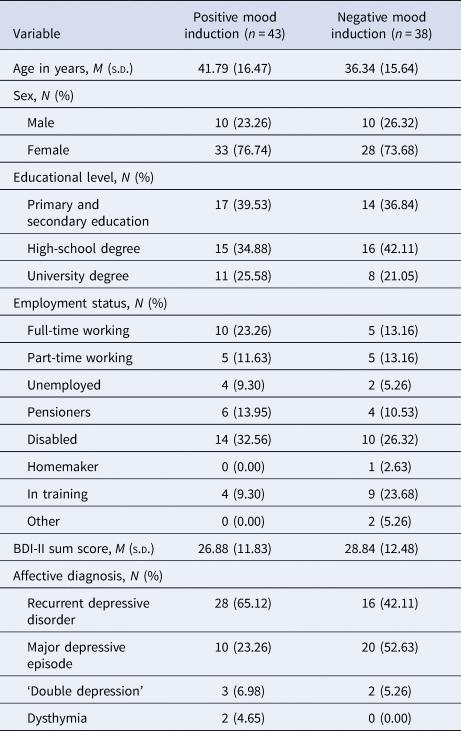
In total, 87 individuals participated in the study. Of these, six participants had to be excluded because they did not meet the criteria of a major depressive disorder according to diagnostic interviews. No other pre-defined exclusion criteria applied to any of the participants; thus, all subsequent analyses were based on data from 81 individuals (with n = 43 undergoing the positive mood induction and n = 38 undergoing the negative mood induction; n = 42 mood induction via film-clip and n = 39 mood induction via autobiographic recall + music). The mean age of the sample was M = 38.23 (s.d. = 16.22), and 75.3% were female (24.7% females). In our sample, 38.3% had a high-school degree as the highest educational degree, while another 38.3% reported to have had secondary education and 23.5% had a university degree. The mean BDI-II score was M = 27.80 (s.d. = 12.10), indicating moderate to severe symptoms of depression (Beck et al., Reference Beck, Steer, Ball and Ranieri1996). Regarding the specific diagnoses, 54.3% were diagnosed with recurrent depressive disorder, 37.0% with a major depressive episode, 6.2% with a ‘double depression’ (dysthymia plus current major depressive episode), and 2.5% with dysthymia. A majority (63.0%) had at least one comorbid mental disorder, of which eating disorders (19.8%), anxiety disorders (18.5%), and somatoform disorders (14.8%) were the most common comorbid disorders. The sociodemographic and clinical characteristics of the groups undergoing the positive v. negative mood induction, separately, can be found in Table 2. The results of the analysis of baseline differences between the experimental groups is presented in the online supplement.
Sociodemographic and clinical characteristics of the sample in study 2

Note. M, mean; s.d., standard deviation; N, number; BDI-II, Beck Depression Inventory II.
Manipulation check
The results of the manipulation check indicate that the mood induction in study 2 was successful: the negative mood induction increased negative affect and decreased positive affect, whereas the positive mood induction increased positive affect and decreased negative affect. The mood induction method did not differentially affect the results. The full results of the manipulation check are presented in the online supplement (see also online Supplementary Fig. S3 for an illustration).
Main analyses
Changes in generalised expectations
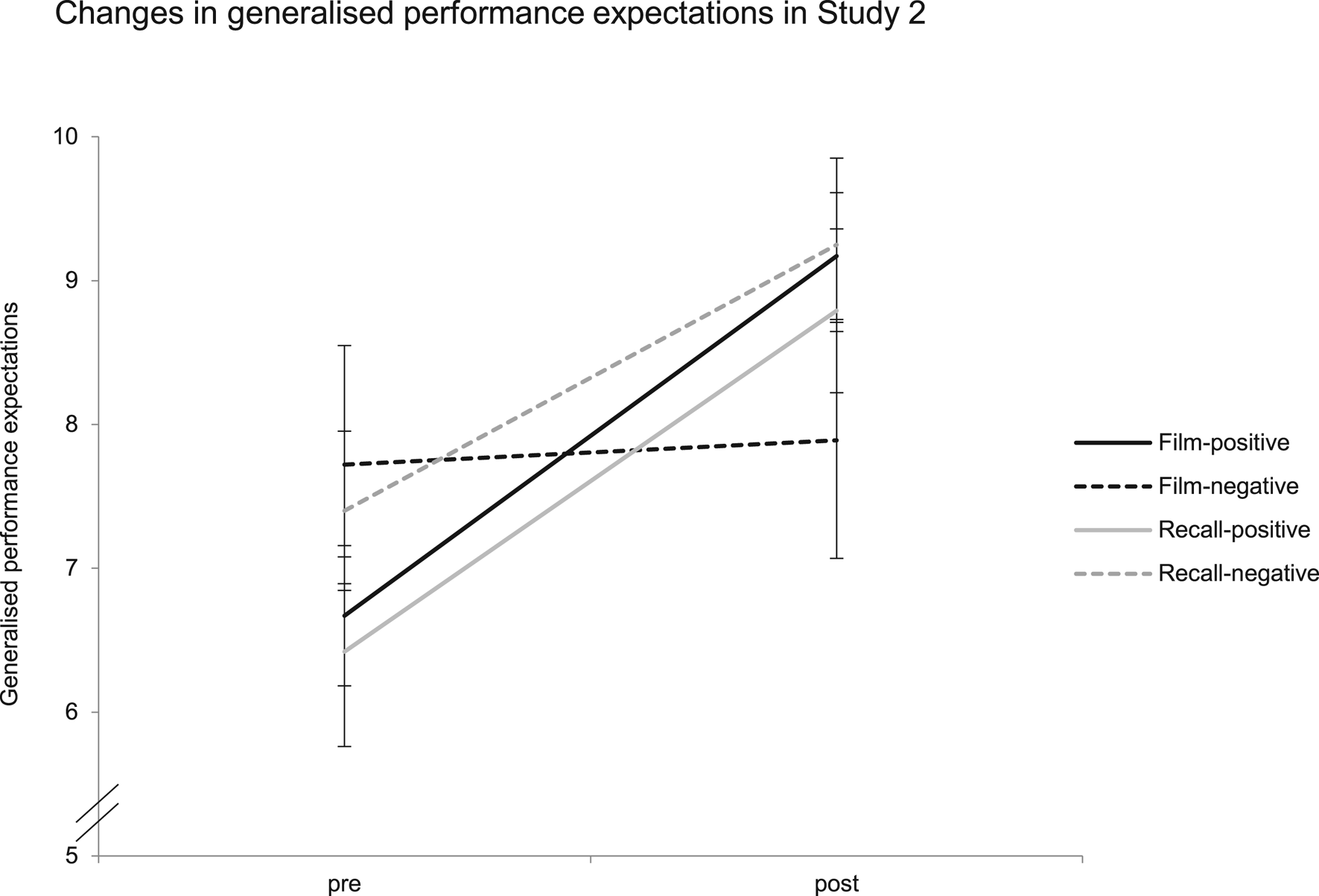
The Time by Valence by Induction Method ANOVA indicated a significant main effect of Time, F (1, 77) = 25.315; p < 0.001; ɳ2p = 0.247; 95% CI (0.096–0.392), with more positive expectations after feedback (M = 8.81; s.d. = 2.70) than before feedback (M = 7.02; s.d. = 2.80). The main effects of Valence (F (1, 77) = 0.353; p = 0.554; ɳ2p = 0.005; 95% CI (0–0.076) and Induction Method [F (1, 77) = 0.041; p = 0.840; ɳ2p = 0.001; 95% CI (0–0.022)] were non-significant. The Time by Valence interaction was significant, F (1, 77) = 4.343; p = 0.040; ɳ2p = 0.053; 95% CI (0.001–0.173), with greater expectation adjustment among participants who underwent the positive mood induction (M = 2.44; s.d. = 3.13) than among participants who underwent the negative mood induction (M = 1.05; s.d. = 3.01), reflecting a medium effect (d = 0.451) as transformed to Cohen's d (Cohen, Reference Cohen1988). The Time by Induction Method interaction was not significant, F (1, 77) = 1.286; p = 0.260; ɳ2p = 0.016; 95% CI (0–0.108), nor was the Time by Valence by Induction Method interaction, F (1, 77) = 1.759; p = 0.189; ɳ2p = 0.022; 95% CI (0–0.121). The results of this main analysis are illustrated in Fig. 3.
Main results of study 2 regarding changes in generalised performance expectations as a function of induced mood and the induction method (film v. autobiographic recall + music).

Changes in task-specific expectations
There was a significant main effect of Time, F (1, 77) = 109.705; p < 0.001; ɳ2p = 0.588; 95% CI (0.441–0.682), with more positive expectations after feedback (M = 10.88; s.d. = 2.56) than before feedback (M = 7.02; s.d. = 2.89). The main effects of Valence (F (1, 77) = 0.360; p = 0.550; ɳ2p = 0.005; 95% CI (0–0.076) and Induction Method [F (1, 77) = 0.003; p = 0.955; ɳ2p < 0.001; 95% CI (0–0.002)] were non-significant. The Time by Valence interaction was not significant, F (1, 77) = 0.026; p = 0.871; ɳ2p < 0.001; 95% CI (0–0.014). The Time by Induction Method interaction was significant, F (1, 77) = 4.393; p = 0.039; ɳ2p = 0.054; 95% CI (0.001–0.173), revealing greater expectation adjustment for participants who underwent a mood induction via autobiographic recall + music (M = 4.62; s.d. = 3.33) than participants from the film-based mood induction group (M = 3.14; s.d. = 3.21), reflecting a medium effect (d = 0.452). The Time by Valence by Induction Method interaction was not significant, F (1, 77) = 1.538; p = 0.219; ɳ2p = 0.020; 95% CI (0–0.115).
Influence of depressive symptom severity and state mood across conditions
The results of the linear regression analysis showed that state negative affect significantly predicted the adjustment of generalised performance expectations, β = −0.305; p = 0.039. Positive affect (β = 0.217; p = 0.112) and depressive symptom severity (β = −0.103; p = 0.446), however, did not predict expectation adjustment in this inpatient sample. Together, the three predictors explained 6.2% of the variance of differences in revising generalised performance expectations (p = 0.172). There was a significant interaction between negative affect and depressive symptom severity (F (1, 77) = 8.536; p = 0.005), adding another 7.7% of explained variance, indicating that the influence of negative affect on updating was more pronounced in participants with higher symptom burdens.
Group differences in cognitive immunisation
The Valence by Induction Method ANOVA with the CIPF sum scores as the dependent variable indicated no significant main effect of Valence, F (1, 77) = 0.959; p = 0.331; ɳ2p = 0.012; 95% CI (0–0.099). For the main effect of the induction method, there was a non-significant trend [F (1, 77) = 3.047; p = 0.085; ɳ2p = 0.038; 95% CI (0–0.149)] pointing to somewhat more cognitive immunisation among participants who underwent the film-based mood induction than participants who underwent the mood induction via autobiographic recall + music. The Valence by Induction Method interaction was not significant, F (1, 77) = 0.055; p = 0.816; ɳ2p = 0.001; 95% CI (0–0.029).
Discussion
The aim of this study was to further explore the influence of current mood on belief updating in an inpatient sample of depressed individuals. In line with our main hypothesis, we found that the induction of negative mood, relative to positive mood, hindered the revision of negative generalised performance expectations in response to unexpectedly positive performance feedback. Since the time by valence interaction was significant only for the update of generalised, but not for task-specific expectations, the results suggest that the reduced belief updating in the event of negative mood pertains particularly to the use of positive feedback from a specific task to adjust global beliefs about one's performance, but not to the update of expectations for the particular task. In other words, this study indicates that the activation of negative mood, relative to positive mood, hampers learning from new positive experiences and impairs transfer effects in clinically depressed individuals.
The procedure by which mood was induced (via film-clips v. autobiographic recall + music) did not influence the update of generalised performance expectation. It did affect, however, the update of task-specific expectations: Regardless of the valence of the mood induction, participants updated their task-specific expectations overall to a greater extent when mood was induced via autobiographic recall and music than via film-clips. This unexpected finding suggests that the recall of a personal life event (no matter whether positive or negative), accompanied by a mood-congruent piece of music, is more effective in eliciting the adjustment of task-specific performance expectations than film-based mood inductions. Speculatively, the former reminds participants of what (challenging) situations they have gone through in life, which helps them attribute the positive performance feedback internally, thus entailing more belief update as compared to the film-based mood induction. In the latter, participants more passively watch a scene that may be less salient for their beliefs about their performance. This interpretation would be consistent with the trend towards lower cognitive immunisation in the autobiographic recall condition. It is also possible, though, that the main effect of the mood induction method merely reflects a Type-I error and does not hold in future studies.
Unlike study 1, this study did not find that the severity of depressive symptoms (negatively) predicted the degree to which participants updated their beliefs. Potentially, this can be explained by the lower heterogeneity of the sample from study 2 as compared with study 1 (as well as other studies referenced above). While study 1 included participants with largely varying symptom severity and impairment – ranging from people with only mild symptoms to more severely depressed people who met the criteria of a depressive episode – study 2 was more limited with respect to the variance of depressive symptom severity due to the use of an inpatient sample. This may have reduced the chance of finding significant effects in regard of the influence on belief updating. Of note, the recruitment of the last 20 participants from study 2 coincided with the COVID-19 pandemic. It appears unlikely, though, that this fact limits the generalisability of the results due to the experimental design (i.e. if there was any effect of the pandemic, it should have applied similarly to each experimental condition).
General discussion
In two independent experiments, the present work aimed to examine how the induction of positive and negative mood influences the adjustment of negative beliefs in response to novel positive information. In study 1, we used a sample of (on average) sub-clinically depressed people to compare a film-based negative mood induction with a positive mood induction and a control condition in terms of their effects on the revision of negative beliefs. In study 2, we examined an inpatient sample of people with major depression; in this study, we used the recall of an autobiographic event, accompanied by a mood-congruent piece of music, as an additional mood induction method to further explore the effects of state mood on belief updating. The main finding of study 1 was that the three experimental groups did not differ in belief updating; there was a non-significant trend, however, when examining the subgroup of participants who met the criteria of a depressive episode (~40% of the entire sample), pointing to detrimental effects of negative mood on belief updating in this group. In accordance with this trend, study 2 demonstrated that in an inpatient sample of depressed patients, the induction of negative mood, relative to positive mood, reduced the extent to which participants revised their generalised performance expectations in line with unexpectedly positive performance feedback.
The current findings are consistent with the results of a previous study using a non-clinical sample showing that the induction of negative mood (using the same film-clip as the two present studies) hindered the revision of negative beliefs in response to positive feedback as a function of the severity of depressive symptoms (Kube & Glombiewski, Reference Kube and Glombiewski2021). Examining the role of current mood in belief updating in depression, the present work thus bridged previous research into the influence of mood on negative thinking in depression (Kuehner et al., Reference Kuehner, Huffziger and Liebsch2009; Lyubomirsky et al., Reference Lyubomirsky, Caldwell and Nolen-Hoeksema1998; Nolen-Hoeksema et al., Reference Nolen-Hoeksema, Morrow and Fredrickson1993, Reference Nolen-Hoeksema, Parker and Larson1994; Yoon & Joormann, Reference Yoon and Joormann2012) with research on cognitive aspects of aberrant information processing (Everaert et al., Reference Everaert, Bronstein, Cannon and Joormann2018; Korn, Sharot, Walter, Heekeren, & Dolan, Reference Korn, Sharot, Walter, Heekeren and Dolan2014; Kube et al., Reference Kube, Rief, Gollwitzer, Gärtner and Glombiewski2019c). This bridge is important, in our view, as the current findings suggest that cognitive and affective factors may not be independent in depression, but can influence each other. Drawing on our work, future research may thus aim to elucidate the specific interplay of affective and cognitive factors in the context of belief updating in depression. The present findings can also be linked to the non-clinical psychological literature, where the presence of negative mood has been associated with deficits in positive information processing and learning (Brand et al., Reference Brand, Reimer and Opwis2007; Hammer & Stone-Romero, Reference Hammer and Stone-Romero1996; Ziegler, Reference Ziegler2010, Reference Ziegler2013), although other studies also found positive effects of negative mood on information processing and judgement (Bless & Fiedler, Reference Bless, Fiedler and Forgas2006; Forgas, Reference Forgas1999; Forgas, Laham, & Vargas, Reference Forgas, Laham and Vargas2005; Matovic, Koch, & Forgas, Reference Matovic, Koch and Forgas2014).
Extending this prior work, our studies suggest that negative mood can hinder the update of negative beliefs in line with new positive experiences; yet, there are two important specifications relating to this effect that need to be highlighted. First, the aforementioned detrimental effects of negative mood seem to apply only to the revision of generalised expectations, but not task-specific expectations. That is, negative mood does not impair the integration of positive feedback from a given task to update one's expectations for that task; rather, our results suggest that negative mood hinders the use of such positive experiences to adjust more general beliefs about performance, speaking to impaired inferential learning in depression under negative mood. Second, the present findings indicate that the clinical severity of depression might matter with regard to the influence of current mood on belief updating. In people with rather mild to moderate depressive symptoms, who did not meet the criteria of a depressive episode, current mood did not affect belief updating, study 1 showed. In more severely depressed people who met the criteria of a major depression, however, negative mood did have a negative effect on belief updating, as demonstrated in study 2. Thus, our work contributes to a nuanced picture of how negative mood is involved in aberrant belief updating in depression.
In addition, it should be noted that the present work did not examine a healthy control group, hence limiting any conclusions about possible differences in belief updating between depressed and non-depressed people. Rather, our work aimed at improving the understanding of factors that might be involved in deficient information processing in people with depressive symptoms. As such, we focused particularly on state mood. Importantly, since depression is characterised by (persistently) low mood, possible common and specific effects of depression and state mood on belief updating warrant further discussion. In study 1, the results of the regression analysis indicated that depressive symptoms, but not state mood, predicted reduced expectation adjustment, whereas in study 2, state negative mood, but not depressive symptom severity, was associated with reduced belief update. Whether these findings speak to differential effects of state mood v. depressive symptoms on belief updating in different samples (subclinical v. clinical), cannot be assessed with certainty, since the manipulation of study 1 was not successful in increasing negative affect and study 2 included only depressed inpatients (as opposed to the subclinical sample from study 1).
Theoretical implications
Recent theoretical models have discussed depression in terms of blunted responses to rewards (Eshel & Roiser, Reference Eshel and Roiser2010; Pizzagalli, Reference Pizzagalli2014; Whitton, Treadway, & Pizzagalli, Reference Whitton, Treadway and Pizzagalli2015) and reduced integration of positive prediction errors into prior beliefs (Barrett, Quigley, & Hamilton, Reference Barrett, Quigley and Hamilton2016; Clark, Watson, & Friston, Reference Clark, Watson and Friston2018; Kube et al., Reference Kube, Schwarting, Rozenkrantz, Glombiewski and Rief2020). Our results further specify these models by suggesting that the affective state in which people with depressive symptoms receive new positive/rewarding information critically influences the extent to which new information is used to update negative prior beliefs. In particular, the current findings suggest that difficulties in revising negative beliefs in depression are especially pronounced when negative affect is activated, and are less pertinent in the absence of it. Of note, since study 1 did not find significant differences between the positive mood induction and the control group, our results do not allow the mirrored conclusion that positive mood enhances belief updating.
Thus, the present findings speak to a psychopathology of depression that is characterised by deficient processing of novel positive information when negative affect is present. These results also raise questions for future research about what specific mechanisms may account for the reduced integration of positive information into prior beliefs in the presence of negative mood. It is conceivable that cognitive reappraisal of positive information, as examined in previous research (Kube et al., Reference Kube, Glombiewski, Gall, Toussaint, Gärtner and Rief2019a, Reference Kube, Rief, Gollwitzer, Gärtner and Glombiewski2019c), is more likely when negative affect is activated, thereby reducing the weight of new information when forming the posterior belief. Alternatively, it is also possible that elevated negative affect simply limits the extent to which people with depression can direct their attention to unexpectedly positive information, resulting in a neglect – rather than in a devaluation – of positive information. The latter would be consistent with the observation that neither study 1 nor study 2 revealed any group differences in the appraisal of positive feedback. Moreover, it is conceivable that in people with depression, negative mood facilitates the emergence of rumination which then interferes with the integration of novel positive information. Future work may aim to address these hypotheses by combining a mood manipulation with a reappraisal and/or attention manipulation in order to disentangle their relative contributions to aberrant belief updating. Furthermore, future research may investigate whether/how negative mood can become self-perpetuating in depression: based on the present results, one can hypothesise that negative mood hinders the integration of disconfirmatory positive information, and that reduced positive updating likely dampens positive experiences that otherwise might have the potential to alleviate negative mood (Everaert et al., Reference Everaert, Bronstein, Castro, Cannon and Joormann2020), thus maintaining both negative mood and reduced integration of positive information
Clinical implications
In addition to their theoretical value, the present findings may also have some implications for the psychological treatment of depression. In particular, within cognitive-behavioural treatment (CBT) of depression, clinicians often aim to provide patients with disconfirming positive information to challenge their established negative views (Beck, Reference Beck2011). For instance, therapists use behavioural experiments to provide patients with novel positive experiences that are supposed to alter their negative beliefs (Dobson & Hamilton, Reference Dobson, Hamilton, O'Donohue and Hayes2003; Kube & Hildebrandt, Reference Kube and Hildebrandt2021). Our results suggest that this aim might be compromised when patients are in negative mood, as the presence of negative mood may reduce the degree to which patients can use novel positive information to update their beliefs. Therefore, therapists may consider the conduction of a mood intervention before engaging in a behavioural experiment (or any other type of intervention that relies on experiential learning) to help the patient be in a state where new learning experiences can be integrated. In doing so, it might be particularly important to prevent patients from being in negative mood while learning, our results suggest, e.g. through brief mood-alleviating interventions (Berking, Ebert, Cuijpers, & Hofmann, Reference Berking, Ebert, Cuijpers and Hofmann2013; Hofmann, Reference Hofmann2015). In this context, it is worth noting that the present findings may also provide one explanation for why behavioural activation is a particularly powerful intervention type in the treatment of depression: it might be that behavioural activation helps patients reduce negative mood and thus supports patients to be in a state where they can use novel information to revise their established negative beliefs. Yet, it should be noted that preventing negative mood might not necessarily be the same as promoting positive mood, and the present results do not allow definite conclusions about whether learning from new experiences is optimal in a positive emotional state or in a neutral state. Our results only allow to say that a positive emotional state might be preferable to a negative one. Thus, future work may investigate the effects of interventions aimed at increasing positive mood v. interventions aimed at reaching a neutral emotional state.
Strengths and limitations
To our knowledge, the present studies are the first to systematically investigate the effects of positive v. negative mood on belief updating in depression. Strengths of our work can be seen in the conduction of two consecutive experiments, focusing on two independent samples with varying levels of depression severity; the use of a previously validated experimental paradigm that was supplemented with a mood manipulation; and the conduction of manipulation checks. Notwithstanding these merits, the present studies also have limitations that need to be considered.
One general limitation is that we focused only on the update of performance-related expectations, and did not examine other types of expectations, such as expectations about social rejection. Moreover, we focused on the integration of unexpectedly positive information only, and future studies may examine how positive v. negative mood influences belief updating in response to negative information. Another general limitation pertaining to both studies is that the second assessment of participants' expectations was conducted immediately after the reception of the positive feedback, such that we could not examine any long-term effects of expectation change. In addition, both studies focused on individuals with elevated symptoms of depression and did not include healthy control subjects (or other clinical control subjects), hence limiting conclusions about the specificity of the current findings to depression. Furthermore, the generalisability of the findings might be somewhat limited in view of the overrepresentation of females in both studies. Given the somewhat reduced updating in male participants in study 1 as presented in the online supplement, it is possible that with more male participants the overall amount of updating would have been somewhat smaller had we reached a more equal gender distribution. Aside from that, the internal validity of the results does not appear to be compromised by the underrepresentation of males, because due to the randomisation, the distribution of male and female participants did not differ across experimental conditions.
A limitation of study 1 is that we did not assess a lifetime history of depression in the diagnostic interview; thus, it is possible that there were some people with a history of depression in the group of people with no current depressive episode. This may have influenced the results such that people with a history of depression (but not meeting the criteria of a current depressive episode) may also show reduced positive updating, hence potentially accounting for the non-significant differences between the groups. Another limitation of study 1 is the failure of the mood induction to increase negative affect. Unlike study 1, study 2 did not use a control group undergoing no mood induction, which prevented us from drawing conclusions about whether the induction of positive mood might be able to enhance belief updating, relative to the absence of any mood intervention. A further limitation is that we did not control for the effects of antidepressant (or other psychopharmacological) medication, nor did we control for possible effects of the inpatient CBT treatment in study 2.
Concluding remarks
The present research aimed to examine the effects of current mood on the revision of negative beliefs in response to novel positive experiences in people with elevated levels of depression (study 1) and patients from an inpatient setting (study 2). Collectively, the results of these studies are consistent with the hypothesis that the presence of negative affect hinders the integration of unexpectedly positive information in people with a diagnosed depressive disorder. Thus, the current findings suggest that the occurrence of negative mood can hamper learning from new experiences, as aimed in various psychological interventions such as behavioural experiments. From a clinical point of view, it might therefore be important to ensure that patients are in a state that allows them to process new learning experiences, and mood might be one critical factor in this respect, our results suggest. Accordingly, therapists may aim to identify strategies to alleviate patients' mood before providing them with positive learning experiences to make sure that new information can be used to update prior beliefs.
Supplementary material
The supplementary material for this article can be found at https://doi.org/10.1017/S0033291721002798
Acknowledgements
We are very grateful to Lisa Schwenzer and Hannah Willems for their help with study 1. Also, we thank Inga Borchert, Lydia Ifland, and Saskia Lücke for their help with study 2. In addition, we would like to thank Stephanie Brausewetter and the entire team of the Schön Klinik Bad Arolsen, who were incredibly supportive in organising the completion of study 2 despite the restrictions resulting from the COVID-19 pandemic.
Conflict of interest
Study 1 was supported by the University of Koblenz-Landau, which provided TK with a start-up funding to conduct the study (grant number 922-3.1). Funding had no influence on the design of the study or the analysis/interpretation of the results. Aside from that, the authors declare no conflict of interest.