Truly informed consent is a fundamental and legal obligation for each interventional cardiologist,Reference Steffenino, Aimar and Bogetti1 but is also one of few occasions when medical education can be provided to the patient. The production of anxiety by the consent form describing the risks of invasive procedures is controversial, especially when dealing with adults having congenitally malformed hearts, such patients often being particularly anxious with regard to their clinical conditions and the potential for transcatheter repair.Reference Chessa, De Rosa and Pardeo2 Multimedia programmes for education and preparation may be useful for increasing knowledge of the disease and its percutaneous treatment, for obtaining a truly informed consent, for decreasing anxiety-related complications, and finally for improving global comfort during catheter-based repair of congenital cardiac disease. In this study, we aimed to evaluate the impact of such a programme in a population of consecutive adults who underwent transcatheter repair of their congenitally malformed hearts.
Methods
Between September, 2006, and May, 2008, we enrolled 100 consecutive patients, with a mean age of 45 ± 19 years, of whom 69 were female, in the programme for adults with congenital cardiac disease at Rovigo General Hospital, a 600-bed secondary referral centre. The patients were scheduled to undergo catheter-based repair of either defects within the oval fossa, or probe patent oval foramens, under intracardiac echocardiographic guidance.
In the first 50 patients, we obtained written informed consent using a form administered by the referring physician 15 days before the procedure, combined with a personal interview of 30 minutes consisting of verbal explanation of the pathophysiology of the lesions, their anatomy, the planned intervention, the potential complications, the predicted length of stay in hospital, and the likely limitations to physical activity and work before and after the procedure.
In the last 50 patients, obtaining the signature for informed consent was preceded by provision of a multimedia programme of education and preparation during a free 30 minute visit to the catheter laboratory 15 days before the procedure. The package comprised a book of 4 pages with simple and brief explanations, including simplified cartoons, of the anatomy, pathophysiology, the devices used and their composition, the likely limitations to physical activity and work, and pictures of the operating room and its staff. It also contained a digital film of 4 minutes explaining the standard procedures for closure of the atrial septal defect or the patent oval foramen as performed at Rovigo General Hospital, with a commentary provided by the referring physician.
We then compared the anxiety scores, as calculated using the Spielberger Statement Anxiety Inventory questionnaireReference Spielberger, Gorusch and Lushene3 at baseline, so as to obtain an idea of the state of anxiety at the time of obtaining consent, thus identifying potentially hyperanxious subjects, before and after the procedure, along with pre-operative cardiac frequency, frequency of vaso-vagal episodes at the start of the procedure, and the need for conscious sedation, all of which were compared between the groups. A 3-point scale of tolerability score was also recorded prior to discharge. Scoring in the first grade indicated poor tolerability and poor satisfaction, with either pre-procedural or procedural anxiety and pain being poorly tolerated, and the informed consent failing to answer completely the requirements of the patient. A score in the second grade was indicative of mild tolerability and mild satisfaction relative to pre-procedural and procedural anxiety and pain, and when informed consent answered only part of the requirements of the patient. Scoring in the third grade indicated full tolerability, with the patient expressing no doubts about the procedure, and with all questions being fully answered and doubts resolved by the process of consent.
Intracardiac echocardiography and the protocol for closure
Patients underwent an intracardiac echocardiography study using the mechanical 9French 9 megaherz UltraICE catheter, as musnfactured by EP Technologies, Boston Scientific Corporation, San Jose, California, United States of America. The echocardiographic study was conducted as previously described,Reference Zanchetta, Onorato and Rigatelli4, Reference Rigatelli and Hijazi5 by performing a manual pull-back from the superior to the inferior caval vein through 5 sectional planes. Intracardiac echocardiographic monitoring of the implantation was conducted using the 4-chamber plane. Combined antibiotic therapy, giving Gentamicin at 80 milligrams together with 1 gram of ampicillin, or 1 gram of Vancomicin if allergy had been previously noted, was administered intravenously 1 hour before the procedure. The right femoral vein was catheterized through an 8 French sheath, being used for preoperative catheterization of the right heart, and then replaced with a 10 or 12 French long sheath for implantation of the device, whereas the left femoral vein was catheterized through an 8 French sheath and replaced with a precurved 9 French long sheath for the echocardiographic study. On the basis of the echocardiographic study, the operators selected the appropriate occluder from the Amplatzer family, either the PFO, Cribriform, or ASD Occluder, or the Premere Closure System as produced by St. Jude Medical Inc., all as previously described.Reference Rigatelli, Cardaioli, Braggion, Giordan, Aggio and Roncon6
Statistical analysis
We used Fisher’s exact test and the unpaired Student’s T test to compare frequencies and continuous variables between the groups. Statistical analysis was performed using a statistical software package SAS for Windows, version 8.2; SAS Institute; Cary, North Carolina. A probability value of less than 0.05 was considered to be statistically significant.
Results
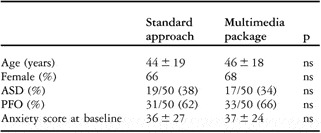
The groups were similar with regard to their characteristics and scores regarding anxiety at baseline (Table 1). Patients who had been supplied with the multimedia programme were significantly less anxious immediately before the procedure, at 20 ± 11 as opposed to 34 ± 21 (p = 0.03), and had a significantly lower heart rate, at 70 ± 15 versus 91 ± 14 (p = 0.03). Vaso-vagal episodes were significantly less in the group provided with the multimedia package compared with those having standard informed consent, with 7 of the latter group suffering such episodes (14%) as opposed to none who had received the multimedia package (p = 0.006). Conscious sedation was needed more frequently in those undergoing standardised informed consent, being used in 42 of these patients (84%) compared to 10 (20%) of those receiving the multimedia education (p < 0.01). All the procedures were successful, with no periprocedural complications. The mean global scores for tolerability and satisfaction were also higher in those educated with the multimedia package, at 2.9 ± 0.1, compared to scores of 1.8 ± 0.9 in those undergoing standardized consent (p < 0.01).
Demographic and clinical data of the enrolled patients.

ASD: atrial septal defect; PFO: patent oval foramen ovale.
Discussion
Adult patients with congenitally malformed hearts can prove difficult patients for several reasons. Firstly, because their state of health can be impaired not only by the process of aging but also by the underling congenital defect,Reference Rigatelli and Rigatelli7 accounting for late mortality which is more than trivial even after correction.Reference Morris and Menashe8 Secondly, because in most cases, such as patients with a patent oval foramen or an atrial septal defect within the oval fossa, they perceive themselves as being substantially healthy, their disease being discovered at the time that they have become adult, when symptoms are mostly subtle. Both reasons serve to increase their anxiety and therapeutic expectations, making such patients those mostly likely to benefit from a multimedia programme for preparation and education.
The use of some kinds of multimedia programmes for informed consent have previously been reported in other fields of medicine, such as the process of enrollment for clinical trials, before surgical interventions,Reference Flory and Emanuel9–Reference Rossi, McClellan, Chou and Davis12 or prior to percutaneous coronary arterial interventions.Reference Steffenino, Viada, Marengo and Canale13–Reference Astley, Chew, Aylward, Molloy and De Pasquale15 Almost all such programmes included only a self-explanatory compact disc, or other types of audiovisual support.
Unlike those multimedia programmes providing support for informed consents, our protocol included a guided visit to the operating laboratory, audiovisual computerized support including a commentary by the physician, and a simply written booklet. In our opinion, such material should provide a more comprehensive and explanatory approach for patients with congenitally malformed hearts.
The Spielberger Statement Anxiety Inventory scoreReference Spielberger, Gorusch and Lushene3 used in our study is a self-reporting instrument that differentiates between a temporary state of anxiety and the longstanding quality of a trait towards anxiety, thus permitting appropriate treatment to be developed. The results of the score also help to distinguish between symptoms of depression and symptoms of anxiety. It consists of two scales, each containing 20 items. One scale addresses the state of anxiety, while the other scale addresses the trait towards anxiety. The total score indicates which type of anxiety is prevalent. It has been proven to correlate with the other scores, such as the Taylor Manifest Anxiety Scale, the IPAT Anxiety Scale, and the Multiple Affect Adjective Check List.
Despite the clear limitations of our study, including the specific score used to grade anxiety, the small size of our sample, and the nature of the protocol involving a single centre, our brief study suggests that a comprehensive multimedia programme of preparation supporting truly informed consent increases the tolerability of the patients, and decreases their emotional state, before and during catheter-based closure of simple lesions such as atrial septal defects within the oval fossa or probe patency of the oval foramen. Larger studies are needed to clarify if this approach may be useful also for patients with complex malformations, and the cost-effectiveness of the production of such multimedia productions.