Implications
Tail biting in groups of pigs is a welfare problem and is often not recognised before the first victims with tail damage appear. This study aimed to characterise biters and victims before a tail-biting outbreak occurred. This can provide predictors to identify potential biters or victims at an early stage and take appropriate measures accordingly.
Introduction
Tail biting is an adverse behaviour performed by pigs who are likely to be bored or frustrated, and not only reduces the welfare among pigs but also has significant economic consequences (Bracke et al., Reference Bracke, Hulsegge, Keeling and Blokhuis2004). Tail biting is often found among finishing pigs, but is also increasingly found among weaned piglets (Bracke et al., Reference Bracke, Hulsegge, Keeling and Blokhuis2004). Thus far, most tail biting studies have focused on the herd or group level, but while the resultant information is useful for evaluating epidemiological risk factors it does not provide a mechanistic understanding of the development of tail-biting behaviour at the individual animal level (Edwards, Reference Edwards2006). Before a tail-biting outbreak occurs, it is often only one or a few pigs that perform this tail-biting behaviour with a higher frequency (so-called biters), and only one or a few victims that receive tail biting with a higher frequency (Zonderland et al., Reference Zonderland, Kemp, Bracke, den Hartog and Spoolder2010b). However, little is known about the characteristics of such biters and victims before and during a tail-biting outbreak. Early recognition of biters and victims in practice would be very helpful in order to apply appropriate measures at an early stage and to prevent a tail-biting outbreak.
Although there is some debate (Blackshaw, Reference Blackshaw1981; Breuer et al., Reference Breuer, Sutcliffe, Mercer, Rance, O'Connell, Sneddon and Edwards2005), it has been proposed that biters are the lighter pigs in the pen (Fritschen and Hogg, Reference Fritschen and Hogg1983; Sambraus, Reference Sambraus1985). Indeed, Van de Weerd et al. (Reference Van de Weerd, Docking, Day and Edwards2005) found that the more ‘fanatical’ biters (individuals who were hyperactive, biting tail after tail during a tail-biting outbreak) were the lighter pigs in the group, whereas victims were the heavier ones. Furthermore, Zonderland et al. (Reference Zonderland, Bracke, Kemp, den Hartog and Spoolder2010a) found that female pigs were more often biters compared to intact male pigs. On the other hand, more males (intact and castrated) than females became victims (Penny et al., Reference Penny, Hill, Field and Plush1972; Valros et al., Reference Valros, Ahlstrom, Rintala, Hakkinen and Saloniemi2004; Kritas and Morrison, Reference Kritas and Morrison2007). It has also been suggested that biters are more active than their penmates in the week before a tail-biting outbreak (Svendsen et al., Reference Svendsen, Olsson and Botermans2006), show more aggressive behaviour (Hansen and Hagelsø, Reference Hansen and Hagelsø1980) and that victims tend to be more inactive (Van Putten, Reference Van Putten1980; EFSA, 2007).
This study aimed to clarify the characterisation (gender and performance) of biters and victims and to quantify their behavioural development during the 6 days preceding the tail-biting outbreak. This could improve our understanding of the ‘individual piglet contribution’ to a tail-biting outbreak and thereby provide predictors to identify potential biters or victims at an early stage.
Material and methods
A library of video records of 96 mixed-sex pens of 10 weaned piglets had been built in a previous experiment (Zonderland et al., Reference Zonderland, Wolthuis-Fillerup, van Reenen, Bracke, Kemp, den Hartog and Spoolder2008; see section ‘Husbandry’). For present purposes we used the video records for 14 selected pens (see Zonderland et al., Reference Zonderland, Kemp, Bracke, den Hartog and Spoolder2010b), based on the appearance of tail damage and the availability of records for the required observation period. This observation period ranged from 6 days before (D−6) to the first day with a minimum of one piglet with a tail wound or at least two piglets with bite marks (i.e. tail-biting outbreak; D0).
Husbandry
The 14 identical pens were fitted with partially slatted floors and provided a space allowance of 0.4 m2 per weaned piglet (Zonderland et al., Reference Zonderland, Wolthuis-Fillerup, van Reenen, Bracke, Kemp, den Hartog and Spoolder2008). Each pen contained a dry feeder with two feeding spaces and piglets were fed ad libitum. The 140 weaned piglets were not tail docked after birth and not teeth clipped, and the males were not castrated. The average age of the weaned piglets at the start of the experiment was 28.2 (s.d. = 3.2) days and start weight was 7.9 (s.d. = 1.3) kg. At the end of the 32-day weaning period, the average end weight was 26.7 (s.d. = 3.9) kg. The weaned piglets received creep feed for the first 8 days after weaning (14.06 MJ metabolic energy (ME), 180 g/kg protein, 11.88 g/kg lysine and 3.0 g/kg Na (as-fed basis)). Over the next 4 days this was gradually switched to a pre-starter diet (13.81 MJ ME, 175 g/kg protein, 11.54 g/kg lysine and 2.5 g/kg Na), which was fed until day 26. Thereafter, the feed was gradually switched to a starter diet (13.48 MJ ME, 175 g/kg protein, 10.30 g/kg lysine and1.2 g/kg Na), which was fed until the end of the weaning period. A water bowl drinker (situated next to the dry feeder) provided unlimited water. The pens were located in rooms in which the environmental temperature was automatically regulated by forced ventilation. The room temperature was set at 28°C when the piglets entered, 26°C after 5 days, 23°C after 21 days and then 22°C after 28 days until the end of the experiment (32 days). No bedding material was provided, but environmental enrichment devices, either a 0.5-m metal chain suspended from the pen partition or two rubber hose tubes (length: 0.4 m and diameter: 30 mm) tied in a cruciform shape and suspended on a chain (rubber toy). Each pen was digitally video recorded (Poseidon, DVR, eight frames per second) using colour cameras (TC-506CEX) every other day between 1400 h and 1900 h. Spray paint markings (red, blue and green) on the back facilitated individual recognition of the piglets.
Biters, victims and control piglets
On the basis of the previous tail-biting data (Zonderland et al., Reference Zonderland, Kemp, Bracke, den Hartog and Spoolder2010b), the weaned piglet performing the most tail bites in the period from 6 days before (D−6) the first tail-biting outbreak to 6 days after (D6) was selected as the biter in each of the 14 pens. Similarly, the weaned piglets receiving the most tail bites were designated the victims. In one pen, the biter and victim was the same piglet. To prevent any distortion of the data this piglet was excluded from the observations and the ones with the second highest performed tail bites and the second highest received tail bites were selected instead. Finally, one piglet with an intermediary frequency for both performed and received tail bites was selected as a control in each pen. These were the designated biters, victims and control piglets and observed in depth.
Observations
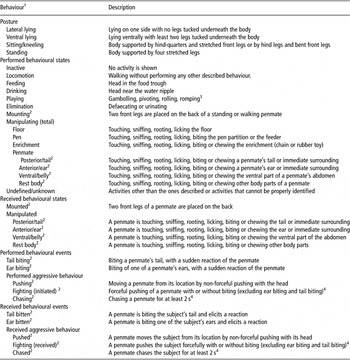
When the tail biting outbreak became apparent in a pen (i.e. D0), video recordings of D−6, D−4, D−2 and D0 (observation days) were used for behavioural observations of the biter, victim and control piglet for each of the 14 pens. The 14 tail-biting outbreaks occurred throughout the 32-day observation period (average of 16.6 days after weaning with a standard deviation of 6.7). Due to the labour-intense character of these observations, the piglet types were observed for only a part of the day. From an earlier study on tail-biting behaviour it became clear that the pig's activity was highest in the late afternoon (Zonderland et al., Reference Zonderland, Kemp, Bracke, den Hartog and Spoolder2010b). In addition, other studies showed an activity peak late in the afternoon (e.g. Feddes et al., Reference Feddes, Fraser, Buckley and Poirier1993). It was expected that the behavioural differences between the piglet types was highest during the late afternoon and therefore the piglet types were observed between 1600 h to 1610 h, 1630 h to 1640 h, 1700 h to 1710 h, 1730 h to 1740 h, 1800 h to 1810 h and 1830 h to 1840 h. The piglet types were observed individually using focal sampling (Martin and Bateson, Reference Martin and Bateson1986) and appropriate software (Observer XT, Noldus, Wageningen, The Netherlands). In total, 1008 ten-minute video recordings were observed (14 pens × 4 observation days × 6 observation times × 3 piglet types). These recordings were observed in random order by three observers who were unaware of the piglet type. A broad behavioural ethogram was used (Table 1) to characterise the piglet types. This ethogram was partly based on descriptions of pig behaviours from earlier studies (Zonderland et al., Reference Zonderland, de Leeuw, Nolten and Spoolder2004; Bolhuis et al., Reference Bolhuis, Schouten, Schrama and Wiegant2005) and partly on the visibility of the piglets’ behaviour.
Ethogram

1Behaviour was recorded as time spent (state) or frequency (events).
2This behaviour involved a penmate whose identity was recorded. Normally, the penmate receiving the behaviour was recorded, but in the case of ‘Interactions received’, the identity of the penmate performing this behaviour was recorded.
3Gambolling: running across the pen, occasionally accompanied by jumping/bouncing, nudging, pushing gently or chasing penmates; Pivoting: jumping and turning around the body axis; Rolling: lying on the back and moving from side to side; Romping: combination of mutual pushing and gentle fighting, often accompanied by chasing.
4These events may occasionally have a long duration. In that case the event will be scored, whereas the remainder of the time will be scored as undefined/unknown.
During observation, two behavioural categories were used: behavioural states (duration of behaviour) and behavioural events (frequency). Piglets’ posture and performed behavioural states were recorded of behaviour simultaneously for every 10 min of video observation. Performed behavioural events and received behaviours (states and events) were recorded separately. If the observed piglet performed an unlisted behaviour (state), this was recorded as undefined/unknown. The duration when the behaviour of the observed piglet was not clearly visible was also recorded as undefined/unknown. Furthermore, in some cases the observed piglet spent time interacting with unknown piglets from the neighbouring pen; this time was again recorded as undefined/unknown.
The duration of each posture and behavioural state per piglet type was summed within and over the observation days (D−6, D−4, D−2 and D0) and converted into a behavioural duration expressed as min/h. Similarly, the behavioural frequency was treated and expressed as number per hour. The behavioural duration and frequency per piglet type per observation day were used for statistical analyses. To the observed list of behaviours, three behavioural measures were added.
As a measure of restlessness, the parameter ‘Posture changes’ (Harris and Gonyou, Reference Harris and Gonyou1998) was calculated from the number of changes in postures (lateral lying, ventral lying, sitting/kneeling and standing) per 10-min observation period and converted into a frequency of posture changes per hour. The parameter ‘Performed aggressive behaviour’ was added by summing the frequency of performed fighting, pushing and chasing. Similarly, the parameter ‘Received aggressive behaviour’ was added by summing the frequency of received fighting, pushed and chased.
The gender, start and end weight (i.e. when moved respectively in and out of the weaning facility) and daily weight gain per individual piglet were available from the previous records (Zonderland et al., Reference Zonderland, Wolthuis-Fillerup, van Reenen, Bracke, Kemp, den Hartog and Spoolder2008).
Statistical procedures
GenStat was used for all statistical procedures (GenStat 11.1; VSN International Ltd, Hemel Hempstead, UK). All fixed factors in the statistical models were tested using the corresponding Wald tests. Differences between pair-wise treatment means were tested using Fisher's least significant difference test.
Differences in performance characteristics (start weight, end weight and daily weight gain) between the three piglet types were tested using a restricted maximum likelihood (REML) procedure with pen as a random factor and piglet type as a fixed factor. Differences in the male : female ratio in each piglet type group were analysed using a χ 2 test on the percentage of male piglets per piglet type group.
To quantify the behavioural development of the three piglet types during the 6 days preceding a tail-biting outbreak, differences in behavioural duration and behavioural frequency were analysed using several statistical procedures. The behaviours – lateral lying, ventral lying, sitting/kneeling, standing, posture changes, inactive, locomotion, feeding, undefined/unknown, manipulation (total), manipulating floor, manipulating pen and manipulating rest of body – were normally distributed. Drinking, playing, manipulating penmate, manipulating enrichment, manipulating posterior/tail, manipulating anterior/ear, manipulating rest of body, mounted, manipulated posterior/tail, manipulated anterior/ear, performed aggressive behaviour and received aggressive behaviour were log-transformed to achieve normal distribution. The above behaviours were all analysed using an ANOVA with blocks of observation day per piglet type per pen, to test the effects of piglet type, observation day and their interaction. Elimination, mounting, manipulating ventral/belly and manipulated ventral/belly were still skewed after log-transformation and were therefore analysed using an iterative reweighted REML (IRREML) procedure with binomial distribution, with piglet type within pens as a random factor and piglet type and observation day as fixed factors. The behavioural frequency (except for performed and received aggressive behaviour) were tested using a similar IRREML procedure, but with a poisson rather than a binomial distribution.
Furthermore, to test whether the behavioural differences between piglet types preceding a tail-biting outbreak were caused by a difference in activity level, all the behavioural durations per piglet type per observation day were expressed as the proportion of being active (ranging from 49% to 100%). The activity-corrected behavioural durations were analysed similar to those described above.
Results
The following tables and figures present the effects of piglet type (including standard error of differences (s.e.d.)) and observation days. Only one significant interaction was found between piglet type and observation period (received tail bites); this is described but the non-significant interactions were omitted.
Gender and performance
There were no significant gender effects on performance characteristics (start and end weight, daily weight gain) and behaviours; therefore, gender was omitted from the end model for both performance and behaviour.
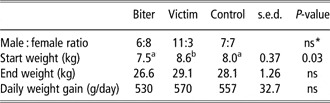
The numerical difference between male victims (n = 11) and male biters (n = 6) failed to reach significance across the piglet types (χ 2 test, P = 0.13; Table 2). Victims had a higher start weight than biters and control piglets. There was no piglet type effect on end weight and daily weight gain.
Male : female ratio and the predicted mean and s.e.d. of start weight, end weight and daily weight gain per piglet type (including P-values)

a,bMeans within a row with different superscripts are significantly different at P < 0.05.
*χ 2 test (P < 0.05) on the percentage of male piglets per piglet type.
Posture and posture changes
Control piglets tended (P = 0.08) to spend less time sitting/kneeling (1.7 min/h; s.e.d. = 0.6) than biters (3.1 min/h). There were no significant differences between types in the other postures. The overall time spent lying ventrally decreased (P = 0.05) over time (24.8, 25.5, 21.6 and 22.2 min/h at D−6, D−4, D−2 and D0, respectively; s.e.d. = 1.6), whereas sitting/kneeling increased (P = 0.001) during the observation period (1.9, 1.9, 3.1 and 3.4 min/h at D−6, D−4, D−2 and D0, respectively; s.e.d. = 0.4).
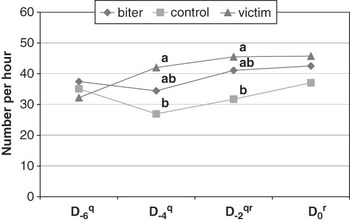
Control piglets tended (P = 0.07) to change posture less often (38.9 times/h; s.e.d. = 3.7) than victims (41.4 times/h). At D−4 and D−2, victims showed more posture changes than control piglets (Figure 1). The frequency of posture changes increased (P = 0.03) during the observation period (34.9, 34.5, 39.4 and 41.8 times/h at D−6, D−4, D−2 and D0, respectively; s.e.d. = 2.8).
The predicted mean frequencies (times/h) of posture changes per piglet type (biter, victim and control piglet; s.e.d. = 3.7) on each observation day (s.e.d. = 2.8). Different superscripts between piglet type (a, b) and between observation days (q, r) indicate a significant difference (P < 0.05). No interaction between piglet type and observation period was found.

Aggressive behaviour
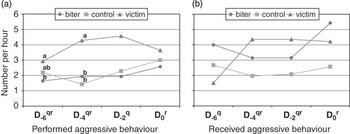
Victims were chasing (P = 0.04) their penmates more often (0.23 times/h; s.e.d. = 0.1) than biters (0.04 times/h). Furthermore, victims showed (P = 0.02) aggressive behaviour more often (4.09 times/h; s.e.d. = 0.7) than both biters (2.06 times/h) and control piglets (2.40 times/h; Figure 2). In contrast, biters tended (P = 0.08) to be chased by penmates more often (0.32 times/h; s.e.d. = 0.1) and tended (P = 0.06) to receive more aggressive behaviour (4.25 times/h; s.e.d. = 0.7) than controls (0.11 and 2.43 times/h, respectively). The frequency at which piglets were pushed by a penmate increased (P = 0.02) over time (1.1, 1.0, 1.1 and 2.1 times/h at D−6, D−4, D−2 and D0, respectively; s.e.d. = 0.4.
The predicted mean frequencies (times/h) of performed aggressive behaviours (a) per piglet type (biter, victim and control piglet; s.e.d. = 0.7) per observation day (s.e.d. = 0.7) and received aggressive behaviours (b) per piglet type (s.e.d. = 0.8) per observation day (s.e.d. = 0.8). Different superscripts between piglet type (a, b) and between observation days (q, r) indicate a significant difference (P < 0.05). No interaction between piglet type and observation period was found.

Despite a tendency (P = 0.06) for biters to receive more aggressive behaviour than controls there was no significant difference between piglet type across the observation days (Figure 2).
General behaviours
The general behaviours consisted of inactivity, total manipulation, locomotion, playing, feeding, drinking, mounting, elimination and undefined/unknown. There were no significant differences in general behaviours between piglet types.
Period effects were found for inactivity and undefined/unknown behaviours. Piglets’ inactivity decreased (P = 0.01) during the observation period (26.6, 26.4, 23.1 and 21.0 min/h at D−6, D−4, D−2 and D0, respectively; s.e.d. = 1.8), whereas the average time spent in undefined/unknown behaviours increased (11.7, 14.5, 15.3 and 17.8 min/h at D−6, D−4, D−2 and D0, respectively; s.e.d. = 1.2).
Manipulation behaviour
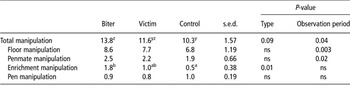
Biters tended (P = 0.09) to perform more total (directed at either floor, pen, penmate or enrichment) manipulative behaviour (13.9 min/h; s.e.d. = 1.6) than control piglets (10.3 min/h; Table 3). Of total manipulation, biters spent longer manipulating the enrichment device (1.8 min/h; s.e.d. = 0.4) compared to control piglets (0.5 min/h), but there were no other detectable piglet type effects.
Predicted mean duration (min/h) and s.e.d. of total manipulation, manipulating the floor, penmate, enrichment device and pen per piglet type (biter, victim and control piglet) and the P-values of piglet type and observation period

a,bMeans within a row with different superscripts are significantly different at P < 0.05.
y,zMeans within a row with different superscripts indicate a tendency (P < 0.10).
Total manipulation behaviour decreased (P = 0.04) during the observation period (13.6, 11.0, 12.0 and 10.9 min/h at D−6, D−4, D−2 and D0, respectively; s.e.d. = 1.0). In addition, manipulation of the floor (9.3, 6.5, 8.0 and 7.1 min/h at D−6, D−4, D−2 and D0, respectively; s.e.d. = 0.8) and of penmates (2.6, 2.6, 1.6 and 2.0 min/h at D−6, D−4, D−2 and D0, respectively; s.e.d. = 0.4) decreased over the observation period.
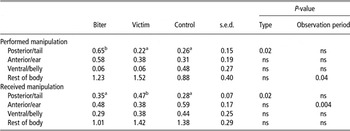
Of penmate manipulation, biters directed more at the posterior/tail part of the penmate's body compared to victims and control piglets (Table 4). Victims received more posterior manipulation than biters and controls. Manipulation of the rest of body decreased over the observation period (1.6, 1.4, 0.8 and 1.1 min/h at D−6, D−4, D−2 and D0, respectively; s.e.d. = 0.3). The frequency of received anterior/ear manipulation increased over time (0.3, 0.5, 0.3 and 0.9 min/h at D−6, D−4, D−2 and D0, respectively; s.e.d. = 0.2).
Predicted mean duration (min/h) and s.e.d. for manipulating (received and performed) specific period body parts per piglet type (biter, victim and control piglet) and the P-values of piglet type and observation day

a,bMeans within a row with different superscripts are significantly different at P < 0.05.
Correction for activity
After the correction for activity was applied, the significant differences in duration of activities across piglet types was still apparent, except for the trend that biters perform more total manipulative behaviour than control piglets. This difference was no longer found after correction.
Tail and ear biting
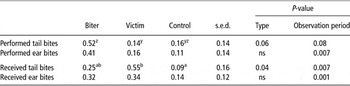
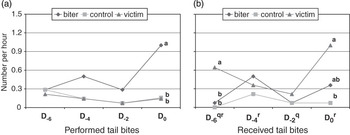
Biters tended to perform more tail bites (0.52 times/h; s.e.d. = 0.1) than victims (0.14 times/h; Table 5). The frequency of performed tail bites was higher for biters than victims and controls at D0 (P < 0.05), but no differences were found at the other observation days (Figure 3). A significant interaction between piglet type and observation period was found for received tail bites (P < 0.05) and the differences between piglet types varied between observation days (see Figure 3). The frequency of received tail bites was higher for victims than controls at D−6 and D0 (P < 0.05), but no differences were found at D−4 and D−2. The frequency of tail bites received by victims increased over time (0.2, 0.4, 0.1 and 0.5 times/h at D−6, D−4, D−2 and D0, respectively; s.e.d. = 0.1). For performed and received ear bites and received tail bites, a period effect was found (see Table 5). The frequency of performed ear bites increased over time (0.2, 0.2, 0.1 and 0.5 times/h at D−6, D−4, D−2 and D0, respectively; s.e.d. = 0.2). Similarly, the frequency of received ear bites increased over time (0.1, 0.2, 0.2 and 0.5 times/h at D−6, D−4, D−2 and D0, respectively; s.e.d. = 0.2).
Predicted mean frequencies (times/h) and s.e.d. of performed and received tail and ear bites per piglet (biter, victim and control piglet) type and the P-values of piglet type and observation period

a,bMeans within a row with different superscripts are significantly different at P < 0.05.
y,zMeans within a row with different superscripts inicate a tendency (P < 0.10).
The predicted mean frequencies (times/h) of performed tail bites (a) per piglet type (biter, victim and control piglet; s.e.d. = 0.1) per observation day (s.e.d. = 0.1) and received tail bites (b) per piglet type per observation day (s.e.d. interaction = 0.2). Different superscripts between piglet type (a, b) and between observation days (q, r) indicate a significant difference (P < 0.05). For the frequency of received tail bites an interaction between piglet type and observation period was found (P < 0.05).

Discussion
With the current characterisation (gender and performance) of biters and victims the results showed that a previous suggestion that biters were more likely to be female (Zonderland et al., Reference Zonderland, Bracke, Kemp, den Hartog and Spoolder2010a) was not supported by the findings of this study (six male v. eight female biters). A numeric difference for more victims to be male than female found in this study was consistent with previous observations (e.g. Penny et al., Reference Penny, Walters and Tredget1981; Hunter et al., Reference Hunter, Jones, Guise, Penny and Hoste1999; Zonderland et al., Reference Zonderland, Bracke, Kemp, den Hartog and Spoolder2010a). We found no effect of gender on activity, although it has been suggested that the lower activity levels of male pigs might make them more attractive targets for tail biting by penmates (EFSA, 2007).
The victims in this study had a higher start weight than biters or control piglets, which is in agreement with Van de Weerd et al. (Reference Van de Weerd, Docking, Day and Edwards2005). It has been suggested that heavier and more dominant piglets will be the first ones to start feeding during the active periods, and it is conceivable that the exposed tails of feeding pigs could make them a target for tail biters (Taylor et al., Reference Taylor, Main, Mendl and Edwards2010; Zonderland et al., Reference Zonderland, Kemp, Bracke, den Hartog and Spoolder2010b). Indeed, it was found earlier that victims were more often the dominant pigs (Ushijima et al., Reference Ushijima, Rodenburg and Zonderland2009). In contrast, our hypothesis that biters are the lighter pigs in the group must be rejected because both the start and end weight of biters and controls were similar. Whether so-called ‘fanatical’ biters (animals that are hyperactive during an outbreak and are moving from tail to tail to bite; Van de Weerd et al., Reference Van de Weerd, Docking, Day and Edwards2005) are the lighter pigs in the group could not be concluded from our data.
With the quantification of the behavioural development of biters and victims during the 6 days preceding the tail-biting outbreak, an indication was found that the restlessness in a pen increased before this outbreak. This was shown by the increase in total activity and posture changes before the outbreak, whereas the time spent lying ventrally decreased. This increase in activity could also reflect an ageing effect of the weaned piglets. However, the probability of an age effect within such a short period is small. Furthermore, a higher general activity in a pen before a tail-biting outbreak was also found by Statham et al. (Reference Statham, Green, Bichard and Mendl2009) and mentioned earlier by Van Putten (Reference Van Putten1969) and Svendsen et al. (Reference Svendsen, Olsson and Botermans2006).
Neither general activity nor the frequency of posture changes was significantly higher for biters than victims or controls. Conversely, victims tended to change posture more often and were more active than controls, suggesting that victims became more restless before the outbreak. This fact has not been reported before and might reflect greater disturbance of victims being bitten by biters, as these biters increased their tail-directed behaviour.
Biters performed the lowest number of aggressive behaviours but received more than victims and controls. This refutes our hypothesis that biters are more aggressive. A surprising finding was that victims initiated the most aggressive interactions. Certainly, tail bites from the biter can lead to an aggressive reaction from the victim; however, this can only partly explain the received aggression of the biters because this frequency is higher (4.25 times/h) than the frequency of tail bites (0.52 times/h). Another explanation might be that these aggressive interactions reflect confrontations of a dominant piglet (victim) with a subordinate penmate (biter). This is in line with observations by Ushijima et al. (Reference Ushijima, Rodenburg and Zonderland2009), who found victims being more often dominant and biters being more often subordinate. Subordinate piglets may become frustrated due to restricted access to food and water during preferred feeding and drinking periods. This frustration may result in the redirection of feeding-related behaviour to penmates or enrichment device, or in a heightened motivation to perform unusual forms of aggressive behaviour directed at the posterior/tail (Hansen and Hagelsø, Reference Hansen and Hagelsø1980; Morrison et al., Reference Morrison, Johnston and Hilbrands2007).
As expected, biters showed significantly more tail bites as well as longer posterior/tail manipulation. The average duration of posterior/tail manipulation of biters before the tail-biting outbreak remained relatively constant; however, the biters’ tail-biting frequency increased by a factor of 3.5 from D−2 to D0. This strong increase in tail-biting behaviour by the biters several days prior to the tail biting outbreak in the pen is in accordance with the exponential increase in tail-biting behaviour from D−6 to D0 reported by Zonderland et al. (Reference Zonderland, Kemp, Bracke, den Hartog and Spoolder2010b). This increase in biting behaviour might be explained by the presence of blood (Sambraus, Reference Sambraus1985; Fraser, Reference Fraser1987). Indeed, at D0 some tails with blood were present in the group. However, even though a few bleeding tails were apparent here, they mainly showed bite marks with little fresh blood. Hence, the blood-induced escalation of biting is unlikely to be the sole factor involved. An additional explanation might be that the reaction of the bitten piglet (e.g. vocalising or moving away) has a rewarding effect that increases the biter's motivation to specifically search for more tails to bite (Zonderland et al., Reference Zonderland, Kemp, Bracke, den Hartog and Spoolder2010b).
The overall time spent manipulating the penmates’ bodies did not differ between biters, victims or control piglets. This suggests that biters directed their attention primarily to the posterior/tail region, whereas victims and control piglets directed their manipulation more to the other body parts. This might be related to the motivation for sexual behaviour as Schrøder-Petersen et al. (Reference Schrøder-Petersen, Heiskanen and Ersbøll2004) speculated that as females approach sexual maturity they show more anogenital investigation, especially of the opposite sex. Indeed, Ford (Reference Ford1990) showed that sexual behaviour between male and female pigs is already different as early as 1 month of age. However, in our study we found no gender effect in the performance of posterior/tail manipulation.
Biters spent longer manipulating the enrichment devices (chain, rubber toy) before the tail-biting outbreak occurred than either victims or controls (both devices drew comparable amounts of attention from the biters). Similarly, pigs with a high propensity to chew suspended ropes subsequently performed more tail-biting behaviour (Breuer et al., Reference Breuer, Beattie, Dunne, Slade, Davies, Mercer, Rance, Sneddon, Sutcliffe and Edwards2001). Increased manipulation of enrichment devices might be useful in identifying potential biters in practice, for example, using automated recordings of animal material interactions (Zonderland et al., Reference Zonderland, Vermeer, Vereijken and Spoolder2003). Furthermore, the increase in restlessness might be a good indicator for an upcoming tail-biting outbreak. Therefore, using automated activity monitoring in practice, a relative increase in activity, what may indicate an upcoming outbreak, could be easily detected and the necessary measures taken to prevent an outbreak.
Conclusions
The main aim of this study was to characterise biters and victims according to gender and performance and to quantify the behavioural development during the 6 days preceding a tail-biting outbreak. The main conclusions can be summarised as follows:
• Biters were neither the lighter pigs in the group, nor were they more often female.
• Biters tended to receive more aggressive behaviour than victims or control piglets.
• Though there were no effects of piglet type on general manipulative behaviour, biters directed their manipulation more to the enrichment device and to their penmates’ posterior/tail body parts.
• Victims were the heavier pigs in the pen.
• Victims tended to be more restless preceding the tail-biting outbreak. They also performed more aggressive behaviour and received more tail manipulation.
These potential characteristics could conceivably contribute to an early identification of biter or victim piglets and thereby guide the development of practical strategies to minimise tail biting.
Acknowledgements
This research project was carried out within the Knowledge Base Research for the Ministry of Agriculture, Nature and Food Quality theme 8: Animal Health and Welfare. We would also like to thank John de Leeuw, Anita Beijers and Bas Rodenburg (Wageningen University) for their contribution, Johan van Riel (Wageningen UR Livestock Research) for statistical support and Dr Bryan Jones for editing this manuscript.