Introduction
Cereal production has provided the main source of calories for humankind since the wild plants were domesticated ~10,000 years ago (Feuillet et al., Reference Feuillet, Langridge and Waugh2007), at the same time as agriculture was founded in the Near East (Zohary and Hopf, 1988). This region of agricultural development is known as the Fertile Crescent and is the centre of origin, diversity and domestication of many crop species including cereals (Zohary and Hopf, 1988). Four of the most important cereal crops are barley, oat, rye and wheat. Wheat itself is the third most valuable crop in the world after rice and maize (in terms of gross production value 2004–2006 million dollars; FAOSTAT, 2018), with all four crops having a significant role in the staple diet of much of the human population.
Due to extensive domestication of these cereal crops the cultivated gene pools have become limited in their genetic diversity (Feuillet et al., Reference Feuillet, Langridge and Waugh2007). This poses a potential problem due to the increasingly uncertain environmental effects of climate change, such as drought and increases in pests and diseases, as well as the need to produce more food for a growing human population. One solution may be to exploit crop wild relatives (CWRs) which are the most closely related wild species to our crops and as such may contain useful traits along with adaptations to pest and diseases and extreme environmental conditions. Barley (Hordeum vulgare L.) has 31 CWR taxa, of which H. vulgare subsp. spontaneum (C. Koch.) Thell. is in the primary genepool and the other 30 taxa are in the tertiary genepool (Vincent et al., Reference Vincent, Wiersema, Kell, Fielder, Dobbie, Castañeda-Álvarez, Guarino, Eastwood, Leόn and Maxted2013). H. vulgare subsp. spontaneum has been used widely by plant breeders for its soil salinity tolerance (Shavrukov et al., Reference Shavrukov, Gupta, Miyazaki, Baho, Chalmers, Tester and Collins2010), drought tolerance (Inostroza et al., Reference Inostroza, del Pozo, Matus and Hayes2013) as well as other traits (Vincent et al., Reference Vincent, Wiersema, Kell, Fielder, Dobbie, Castañeda-Álvarez, Guarino, Eastwood, Leόn and Maxted2013). Oat (Avena sativa L.) has 29 CWR with A. byzantina K. Kock, A. fatua L., A. hybrida Peterm., A. occidentalis Durieu, A. sterilis L., A. trichophylla K. Koch in the primary genepool and the remaining taxa in the secondary and tertiary genepools (Vincent et al., Reference Vincent, Wiersema, Kell, Fielder, Dobbie, Castañeda-Álvarez, Guarino, Eastwood, Leόn and Maxted2013). Many of the CWR have been used in breeding activities for a range of traits including stem rust resistance (Gnanesh et al., Reference Gnanesh, Fetch, Zegeye, McCartney, Fetch, Pratap and Kumar2014) and cold tolerance (Jellen and Leggett, Reference Jellen and Leggett2006). Rye (Secale cereale L.) has nine CWR of which the S. cereale subspecies are within genepool 1B and the remaining taxa are in the tertiary genepool. S. strictum (Presl.) Presl. has been used in breeding for its fertility and phenological traits (Tang et al., Reference Tang, Ross, Ren, Yang, Zhang, Chikmawati, Gustafson and Kole2011) and has potential to be utilized for other traits (Vincent et al., Reference Vincent, Wiersema, Kell, Fielder, Dobbie, Castañeda-Álvarez, Guarino, Eastwood, Leόn and Maxted2013). Wheat (Triticum aestivum L.) has 272 CWR (Vincent et al., Reference Vincent, Wiersema, Kell, Fielder, Dobbie, Castañeda-Álvarez, Guarino, Eastwood, Leόn and Maxted2013) of which eight are in the primary genepool, 34 are in the secondary genepool and the remainder are in the tertiary genepool. Wheat CWR have been utilized widely in breeding from powdery mildew resistance in Aegilops geniculata Roth (Chaudhary et al., Reference Chaudhary, Kaila, Rather, Badiyal, Hussain, Jamwal, Mahato, Pratap and Kumar2014) to drought tolerance in Triticum turgidum subsp. dicoccoides (Korn. Ex Asch. & Graebn.) Thell. (Nevo and Chen, Reference Nevo and Chen2010).
To harness the genetic potential of CWRs we must first find and conserve them both in situ and ex situ which will allow ease of access to plant pre-breeders for identification of important traits. In situ conservation involves the use of protected areas to conserve populations within their environment, thus allowing continuing evolution and adaptation. At present in situ conservation of cereal CWR includes the establishment of the Erebuni State Reserve, Yerevan, Armenia in 1981 (Avagyan, Reference Avagyan, Maxted, Ford-Lloyd, Kell, Iriondo, Dulloo and Turok2008), the Ammiad reserve in Israel (Anikster et al., Reference Anikster, Feldman, Horovitz, Maxted, Ford-Lloyd and Hawkes1997) and Ceylanpinar in Turkey (Ertug Firat and Tan, Reference Ertug Firat, Tan, Maxted, Ford-Lloyd and Hawkes1997), however the current level of conservation activity within these reserves in unknown. Many more cereal CWR may be passively protected within reserves if they occur within such an area but do not have any current management strategies for their populations.
Ex situ conservation tends to take the form of seed collection and storage within genebanks but can also include conservation within botanical gardens. In a study by Castañeda-Álvarez et al. (Reference Castañeda-Álvarez, Khoury, Achicanoy, Bernau, Dempewolf, Eastwood, Guarino, Harker, Jarvis, Maxted and Müller2016) wheat, oat, barley and rye CWR were identified as being fairly well represented within genebanks, due to their long history of use in crop improvement. However specific taxa within the wheat genepool were assessed as medium or high priority for collection (Castañeda-Álvarez et al., Reference Castañeda-Álvarez, Khoury, Achicanoy, Bernau, Dempewolf, Eastwood, Guarino, Harker, Jarvis, Maxted and Müller2016). The most critical locations for collecting all CWR in the study was identified as the region across the Mediterranean, Near East, southern and western Europe (Castañeda-Álvarez et al., Reference Castañeda-Álvarez, Khoury, Achicanoy, Bernau, Dempewolf, Eastwood, Guarino, Harker, Jarvis, Maxted and Müller2016), the same area where these wild taxa originated. Once these taxa are conserved it is vital that the investment and resources are available for pre-breeding activities to isolate the genetic traits required for breeding into our crops, such as those activities taking place by the Adapting Agriculture to Climate Change project by the Crop Trust (Dempewolf et al., Reference Dempewolf, Eastwood, Guarino, Khoury, Müller and Toll2014).
The aim of this study is to identify a potential in situ reserve network for the conservation of the four cereal crops, barley, oat, rye and wheat, across the region of the Mediterranean and the Near East. This will be achieved by using a gap analysis approach to in situ conservation which will identify areas high in taxa diversity, but which are not being effectively managed for conservation of CWR populations. Once these locations and populations have been identified this information can be harnessed by country stakeholders such as conservation, agricultural and governmental organizations to enhance conservation of these plant genetic resources.
Materials and methods
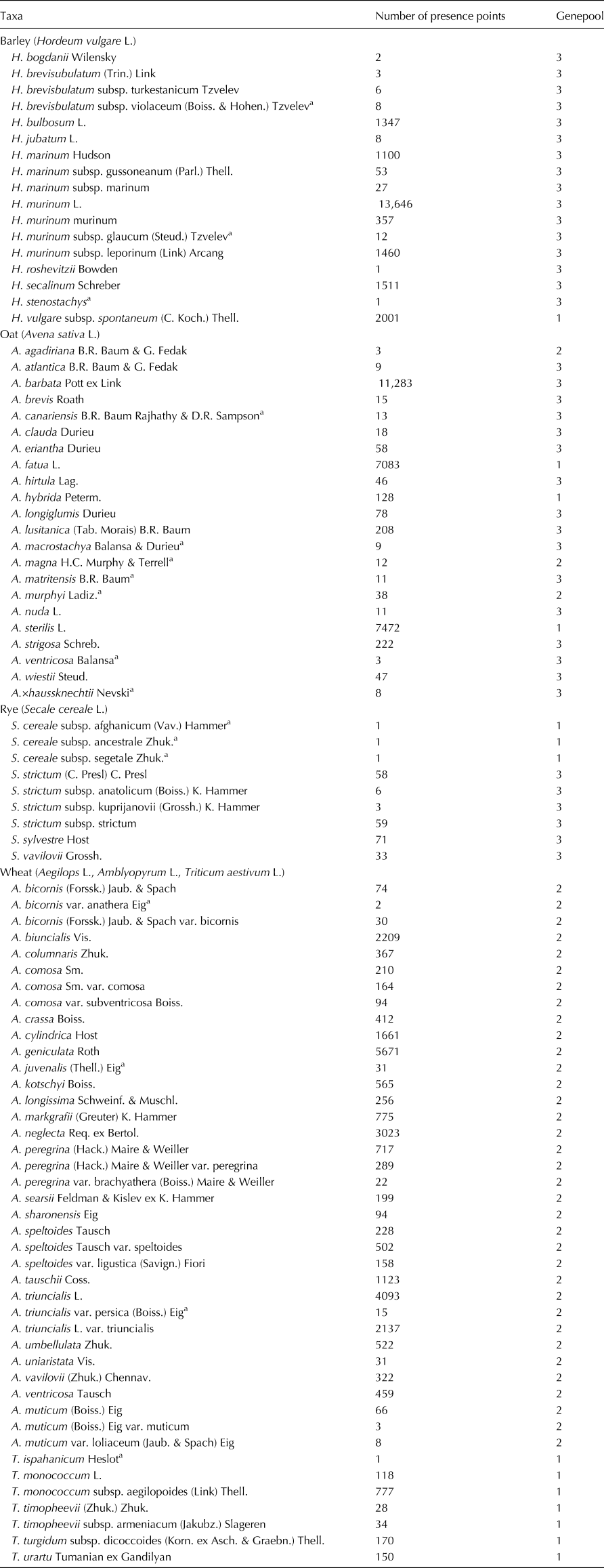
The four cereal crops and their genera used in this study included barley (Hordeum), oat (Avena), rye (Secale) and wheat (Aegilops, Amblyopyrum, Triticum). Due to the large numbers of taxa in the wheat genepool and the limited resources of this study, it was decided to limit the analysis to the primary and secondary genepool taxa of wheat (T. aestivum L.) as these are the most accessible taxa for potential breeding (Vincent et al., Reference Vincent, Wiersema, Kell, Fielder, Dobbie, Castañeda-Álvarez, Guarino, Eastwood, Leόn and Maxted2013). The taxonomy of the four genera was checked against GRIN-ARS (https://npgsweb.ars-grin.gov) and only taxa that were native to the Mediterranean Basin and Asian centre of diversity were included in the analysis. In total 90 different taxa (Table 1) spread across 44 countries were used in the analysis.
The number of taxa and number of presence points used in the analysis

a Taxa not found within the top 10 grid cell complementary reserve network. Genepool concept follows that of Harlan and de Wet (Reference Harlan and de Wet1971) within genepool information from Vincent et al. (Reference Vincent, Wiersema, Kell, Fielder, Dobbie, Castañeda-Álvarez, Guarino, Eastwood, Leόn and Maxted2013).
To try to ensure the full range of available data was utilized in this analysis, distribution data were collated directly from the International Center for Agricultural Research in the Dry Areas (ICARDA; personal communication), the Bioversity International collecting missions dataset (http://www.bioversityinternational.org), EURISCO (http://www.eurisco.ecpgr.org) and GBIF (2018a, b, c, d, e, f) (http://www.gbif.org – see reference list for detailed database citations) with additional data from herbarium specimens at the Royal Botanic Gardens, Kew, UK (digitized by Katherine Whitehouse). Presence points consisted of GPS longitude and latitude coordinates. An important consideration within this study was the effect of sampling bias upon the results (Araujo and Guisan, Reference Araujo and Guisan2006; Loiselle et al., Reference Loiselle, Jørgensen, Consiglio, Jiménez, Blake, Lohmann and Montiel2008). Presence points were checked for erroneous data such as those with incomplete coordinates, coordinates with no decimal places or only to one decimal place which was deemed too inaccurate for use within this study. It was apparent that some presence points had been incorrectly georeferenced to the centre of the country if location data were lacking and some presence points were recorded as being located within ex situ collections of national and regional genebanks and botanical gardens. These inaccuracies as well as data with incorrect or ambiguous taxon names were removed from the dataset. Of the total 76,343 presence points used 28.28% were for barley, 35.02% were for oat, 0.37% were for rye and 36.33% were for wheat taxa.
Analysis of taxa richness and observational bias per genus and for all taxa combined was conducted in QGIS (version 2.18.17; QGIS Development Team, 2009) using the TomBio Tool plugin (version 2.8.0; Field Studies Council, 2017) to identify the number of records within each grid cell and the number of different taxa (richness) within each grid cell. Complementary reserve selection, which ensures areas chosen for conservation enhance but do not replicate each other, was carried out in DIVA GIS (Hijmans et al., Reference Hijmans, Guarino and Mathur2004) for each crop and for all taxa combined. This method determines appropriate locations for the establishment of a network of reserves based upon an iterative procedure (Rebelo, Reference Rebelo and Huntley1994) whereby in this study, the first reserve location contains the highest number of unique taxa, then the next reserve contains the next highest number of unique taxa which are not found in the previous reserve and so on until all taxa are contained within the network. Once grid cell locations were determined they were compared with the current protected areas network across the study region, using protected area data obtained from Protected Planet (http://www.protectedplanet.org). This allowed the comparison of the proposed complementary reserve network to the current protected areas and the identification of gaps where protected areas do not overlap the proposed reserve network. The above analyses were conducted on a grid cell size of 2° (equivalent to 110 km2), which gave a large enough scale to be easily seen across the wide area of study but a small enough resolution to enable patterns of species distribution to be identified. All maps were displayed in WGS 84 projection.
Results
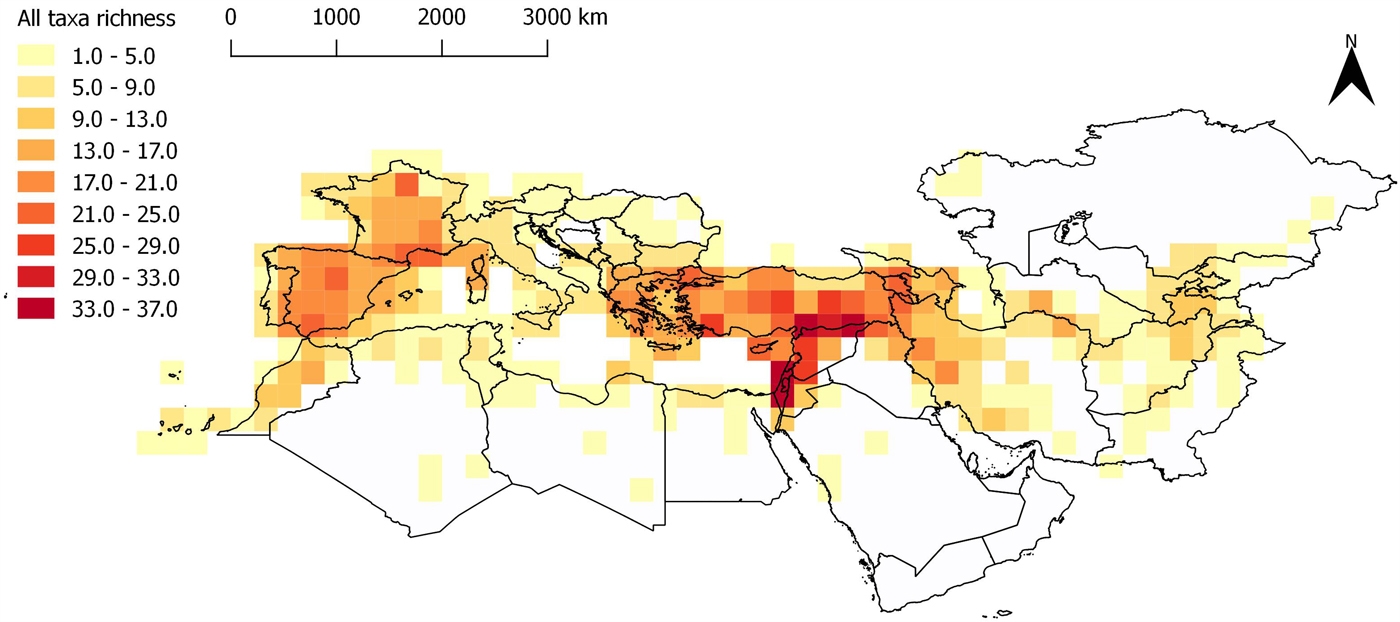
The combined taxa richness analysis (Fig. 1) highlighted the region throughout the Fertile Crescent as the most taxa rich with up to 37 different taxa within one grid cell (110 km2). This region covers the areas of Israel, Lebanon, the west of Syria and through to the northern Syrian border and southern Turkish border. The areas with the highest number of presence points, and therefore potential areas of data bias were found across the borders of Israel, Lebanon, Jordan and Syria as well as in the Balearic Islands of Spain (online Supplementary Fig. S1). Some taxa had high numbers of presence points (Table 1) which may have contributed to data bias; H. murinum L. had 13 646, A. barbata Pott Ex Link had 11 283 and A. sterilis L. had 7472 presence points and A. geniculata Roth had 5671 presences. In contrast, 21 of the taxa had less than 10 presence points and six taxa had only one presence point for the analysis, although all taxa had at least one data point (Table 1).
Map showing the combined taxa richness of all four cereal crops.

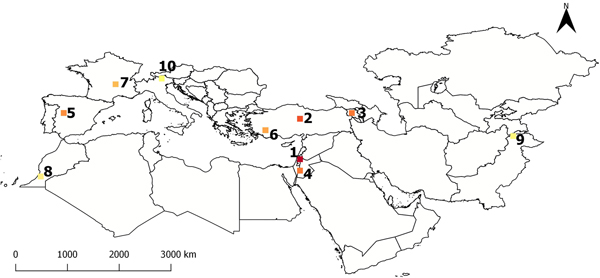
The complementary reserve analysis identified 10 potential reserve locations (110 km2) which conserved 73 of the 90 taxa (Fig. 2 and online Supplementary Table S1). All of the proposed complementary reserves contained protected areas, apart from grid cell 2, located within Turkey to the east of Ankara, which did not contain any according to our data. The number one reserve location conserved 31 of the taxa and was located on the border of Israel, Jordan and Syria (Fig. 2, online Supplementary Fig. S2, Table S1). Within this location, 19 Aegilops taxa, five Avena taxa, six Hordeum taxa and one Triticum taxa were found, there were no Secale taxa located within the priority cell one. There were 93 protected areas within grid cell 1 of which 81 were in Israel, nine in Jordan and three in Palestine. Of the 93 reserves, 21 were national parks, 64 were national nature reserves, six were special conservation areas, one was a national forest reserve and one was a RAMSAR site. Current protected areas within this cell included the large reserves of Mount Meron and Mount Caramel in Israel and Yarmouk Forest Reserve and Al Khayouf in Jordan (online Supplementary Fig. S2). To conserve all the 90 taxa 25 complementary reserve locations were required (online Supplementary Fig. S3).
The complementary reserve analysis for the combined taxa, showing the top 10 locations for reserves.

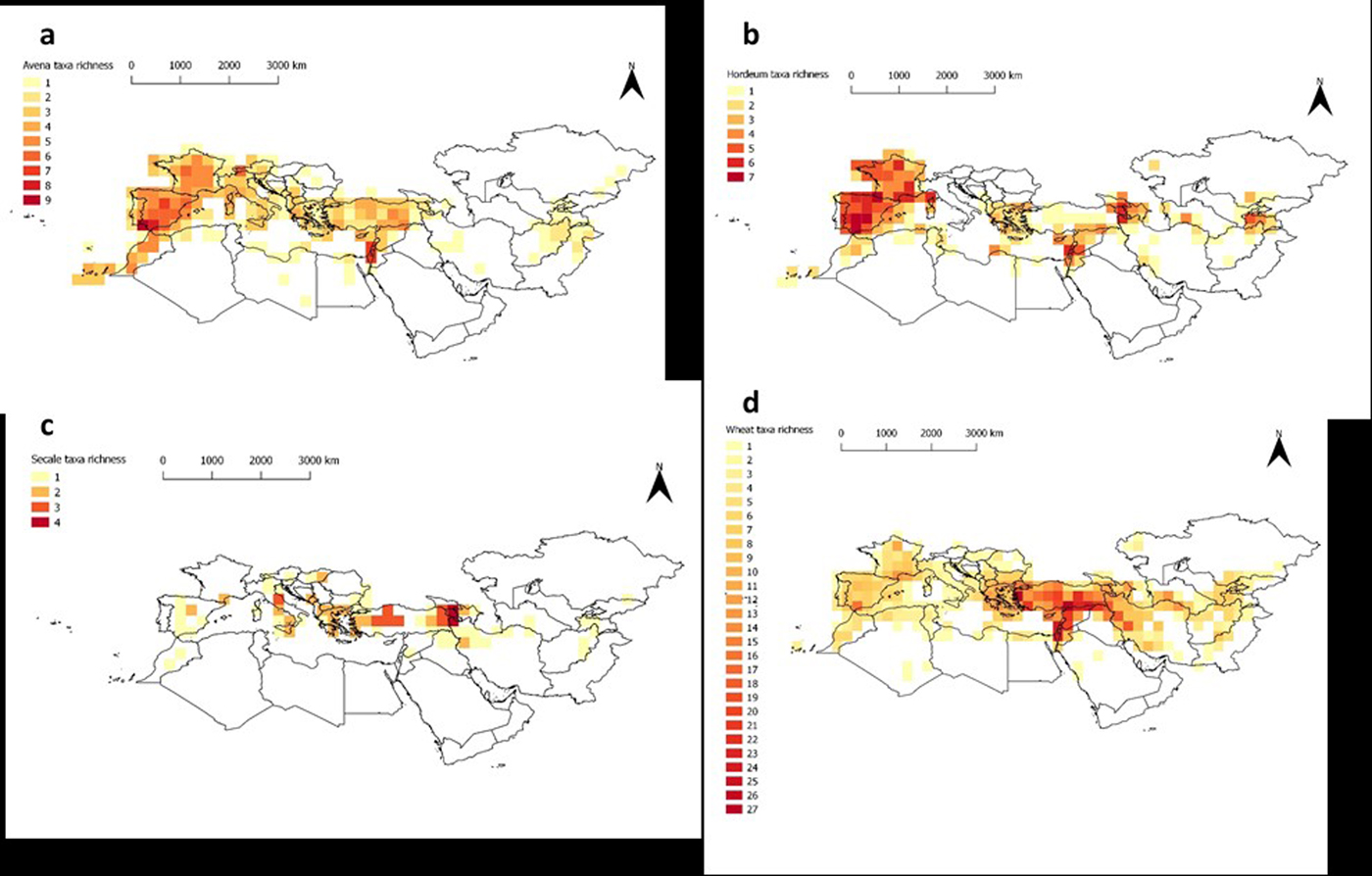
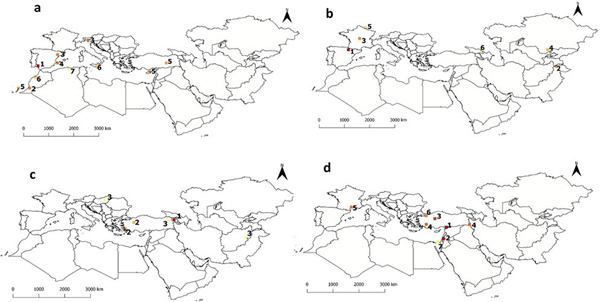
At the genus level for Avena, the most taxa rich areas were found in south west Spain including the areas of Seville and Malaga and also across the border of Israel and Lebanon (Fig. 3a). The same locations as were in the combined taxa analysis had the highest number of presence points and potential recording bias (results not shown). Five taxa had less than 10 presence points (Table 1) which may contribute to bias within the dataset. The genus level complementary analysis (Fig. 4a, online Supplementary Table S1) identified 11 areas which protected all 22 taxa. The number one location was in south west Spain across the provinces of Huelva and Sevilla and contained eight of the 22 taxa.
The taxa richness for the four crop taxa (a) Avena, (b) Hordeum, (c) Secale and (d) Aegilops, Triticum and Amblyopyrum.

The complementary reserve locations for the four crop taxa (a) Avena, (b) Hordeum and (c) Secale, (d) Aegilops, Triticum and Amblyopyrum. Repeated numbers indicate there are equal numbers of taxa at these locations.

The most taxa rich areas for the Hordeum genus were located across mainland Spain (Fig. 3b) with other locations on the border of Jordan, Israel and Lebanon and in Armenia. The same potential recording bias as the combined taxa analysis (results not shown) was also apparent and seven taxa had less than 10 presence points. The reserve complementary analysis identified six locations to protect all 17 taxa (Fig. 4b, online Supplementary Table S1). The number one location was on the northern border of Spain in the province of Navarra and contained seven of the 17 taxa.
For the Secale genus the most taxa rich areas were located across the eastern border of Turkey, across Armenia and the north west Iranian border (Fig. 3c). The areas with the highest number of records were found within Hungary and also the Iranian and Armenian boarder (results not shown). Five of the nine taxa had less than 10 presence points with S. sylvestre Host having the highest number of presence with 71 unique records (Table 1). The complementary reserve analysis identified six locations to protect the nine taxa (Fig. 4c, online Supplementary Table S1). The number one priority location, which protected four of the taxa, was found in Armenia close to the Turkish border.
The analysis for the wheat genepool which contained Aegilops, Amblyopyrum and Triticum taxa identified the region across the Fertile Crescent as the most taxa rich (Fig. 3d). The areas with the highest level of presence points were located across the borders of Israel, Lebanon, Jordan and Syria as well as in the Balearic Islands of Spain (results not shown). Four taxa had less than 10 presence points (Table 1). To protect the 42 taxa, eight reserve locations were required (Fig. 4d, online Supplementary Table S1). The number one location which protects 21 of the taxa was located in the Hatay region of Turkey on the north Syrian border.
Discussion
Cereal crops are some of the most important crop species in the world, yet conservation of their wild relatives is currently incomplete. Ex situ conservation for the four genera is fairly good (Castañeda-Álvarez et al., Reference Castañeda-Álvarez, Khoury, Achicanoy, Bernau, Dempewolf, Eastwood, Guarino, Harker, Jarvis, Maxted and Müller2016), but in situ conservation is lacking (Maxted and Kell, Reference Maxted and Kell2009). By focusing this study on the Mediterranean Basin and the Asian centre of diversity for these crop species, conservation efforts may be more efficient in protecting the potentially important levels of genetic diversity for these taxa across this region.
This pattern of taxa richness across the Fertile Crescent and Turkey has been identified in past studies (Damania, Reference Damania, Damania, Valkoun, Willcox and Qualset1998; Valkoun et al., Reference Valkoun, Waines Giles, Konopka, Damania, Valkoun, Willcox and Qualset1998; Waines, Reference Waines Giles, Damania, Valkoun, Willcox and Qualset1998) and more specifically for the CWR of six Legume genera (Maxted et al., Reference Maxted, Hargreaves, Kell, Amri, Street, Shehadeh, Piggin and Konopka2012). A complementary reserve selection analysis for the priority legume species identified the same locations on the border in Israel, Lebanon, Syria and Jordan as priority reserve locations. This highlights the importance of this region for a potential single network of reserves that protect multiple CWR taxa. However, it is important to note that there is diversity of the cereal crop genera analysed in this study outside of this region, for example here are large numbers of Hordeum species present in North and South America and such diversity should not be overlooked if implementing global conservation activities.
The importance of having a network of complementary reserves means that a fully representative reserve system with maximum efficiency in terms of land and number of distinct species can be achieved with minimal costs (Maxted et al., Reference Maxted, Iriondo, Dulloo, Lane, Iriondo, Maxted and Dulloo2008). The combined taxa complementary reserve selection identified halve of the top 10 reserve locations as within or near to the Fertile Crescent region. The individual oat, rye and wheat analyses also identified reserves here, with only barley not having complementary locations within this region, despite the region containing high taxa richness. This is an interesting result for the Hordeum genus as the Fertile Crescent region in a centre of diversity and has been previously highlighted as a taxa rich region (Valkoun et al., Reference Valkoun, Waines Giles, Konopka, Damania, Valkoun, Willcox and Qualset1998) for this crop so we would expect reserves to be located here. The result may be due to the data used in the analysis or the coarse level of resolution used due to the large area the analysis covers. Nevertheless, over 80% of the total taxa are protected within the proposed complementary network of 10 locations across the study region. The remaining taxa outside this top 10 reserve network are listed in Table 1. For these taxa it is important to gather more information upon them in case they hold important conservation value, in terms of usefulness in breeding and threat status level which would add to their need to be protected. These 17 taxa may also be better conserved ex situ if resources did not allow them to be protected within an in situ network.
A network of 25 reserve locations is required to protect all 90 taxa, but this may be unrealistic to implement across all locations due to increasing cost associated with each reserve location and the fewer number of taxa protected within each area. If regional efforts are to take place to conserve these cereal taxa the network of 10 reserve locations, which conserve 80% of taxa, will be an appropriate place to begin further conservation analysis. A more detailed analysis takes focusing upon national level conservation of these taxa will also be appropriate. This will allow the involvement of local stakeholders and an opportunity to engage with the people who look after the land in educating them that protection of these taxa may only require adjustments to current management plans. This was an effective approach for Norwegian CWR conservation and led to the implementation of management strategies for CWR within the Fræder National Park (Phillips et al., Reference Phillips, Asdal, Magos Brehm, Rasmussen and Maxted2016).
The current protected area network within the proposed complementary reserves should be a starting point for the further conservation of these taxa. This in situ network is already protecting taxa passively due to their presence within a wider protected area. There is range of protected areas found within the complementary network, from national nature reserves to RAMSAR sites (online Supplementary Fig. S2), therefore the opportunities to implement active conservation of populations will vary. Adjusting management plans within national reserves will be the responsibility of the national authorities, whereas internationally recognized reserves such as RAMSAR may require a change in implementation strategies and legislation at a more global level. These international reserves present an opportunity for efficient conservation of a broad range of taxa, not just cereal CWR, if management plans for plant genetic resources were incorporated into such schemes. A ‘top-down’ approach to adjusting management plans of internationally recognized reserves to incorporate active conservation of CWR might provide the necessary pressure for implementation within national level protected area networks.
However, focusing upon the current protected area network for implementation of conservation actions is not to say that unprotected areas are not important. On the border regions in the Near East there are areas which are classified as ‘no-man's’ land and which may be acting as unofficial reserves for populations. For example, the area around Hatay on the Turkish/Syrian border zone has confirmed populations of Triticum and Aegilops species growing (Waines, Reference Waines Giles, Damania, Valkoun, Willcox and Qualset1998). Informal conservation areas such as sacred groves, for example in Bsharri, Lebanon where trees are preserved also means other taxa such as Secale are also protected in situ (Lebbie and Guries, Reference Lebbie and Guries1995; Nair et al., Reference Nair, Gopikumar, Krishnan and Kumar1997). Archaeological sites also act as good in situ conservation areas and are somewhat protected from overgrazing (Waines, Reference Waines Giles, Damania, Valkoun, Willcox and Qualset1998). Conservation outside of protected areas may need to involve local stakeholders more heavily in creating informal conservation areas or legislation to protect specific taxa. The protection of the most appropriate CWR populations (MAWPS; Maxted et al., Reference Maxted, Avagyan, Frese, Iriondo, Margos Brehm, Singer and Kell2015) may be a complementary approach that could be taken for taxa outside protected areas, which once identified could be implemented through separate legislation.
Ex situ conservation may also become more urgent if there are currently no opportunities for in situ conservation, such as could also be the case along the Syrian/Turkish border. Either way, ex situ conservation should be used as a back-up to in situ practises in case of natural or man-made disasters. For example, detrimental activities related to human population growth in the Near East region, cultivation of land leading to fragmentation, degradation of land by animal overgrazing (Valkoun et al., Reference Valkoun, Waines Giles, Konopka, Damania, Valkoun, Willcox and Qualset1998) are all issues affecting in situ conservation. However, it should be remembered that once the genetic resource is removed from its natural environment it will stop the evolutionary process and limit the range of genetic diversity that is protected outside of reserves.
A more holistic approach to conservation of cereal taxa may be required in further studies to account for a wider range of factors such as land use change. The use of conservation management software such as Marxan (Ball et al., Reference Ball, Possingham, Watts, Moilanen, Wilson and Possingham2009) which takes account of multiple factors when selecting reserve locations could benefit this analysis. A detailed look at how many populations are being protected within complementary reserves is also necessary to ensure the full range of genetic diversity both within and among populations is conserved (Brown and Briggs, Reference Brown, Briggs, Falk and Holsinger1991). The inclusion of ecogeographic diversity and the use of ecological niche modelling will also be necessary to ensure that the full range of genetic diversity of taxa is being effectively protected (Greene and Hart, Reference Greene, Hart, Greene and Guarino1999; Parra Quijano et al., Reference Parra-Quijano, Iriondo, Frese, Torres, Maxted, Dulloo, Ford-Lloyd, Frese, Iriondo and Pinheiro De Carvalho2012). This could be achieved with the use of the CAPFITOGEN tools and creation of an ecogeographic diversity map for the study region (Parra Quiano et al., Reference Parra-Quijano, López, Iriondo, Torres and Molina2016). A more detailed analysis at national level could also be necessary and has proven to be effective in gaining stakeholder involvement and in the establishment of in situ CWR conservation (Phillips et al., Reference Phillips, Asdal, Magos Brehm, Rasmussen and Maxted2016).
In future studies utilizing presence point coordinates the use of ignorance map (Rocchini et al., Reference Rocchini, Hortal, Lengyel, Lobo, Jimenez-Valverde, Ricotta, Bacaro and Chiarucci2011; Ruete, Reference Ruete2015) may help to filter out unreliable data. For example, a concentration of wild barley in the western part of the Near East arc (borders of Israel/Syria) is where most ICARDA collecting missions were based in the 1990s (Valkoun et al., Reference Valkoun, Waines Giles, Konopka, Damania, Valkoun, Willcox and Qualset1998) and may contribute towards data bias. Furthermore, the small number of presence points for some taxa (Table 1) increases the uncertainty associated with their locations. Further data collection should target those taxa with fewer than 10 presence points for immediate surveying efforts. Only with more accurate collecting and recording of data can we be confident in using this type of data for further research activities.
For the cereal genera studied here a complementary network of 10 locations has been identified for in situ conservation of multiple taxa across the Mediterranean Basin and Asian centre of diversity. This analysis is performed at a coarse scale with reserve locations being 110 km2 in size, therefore it is not possible to implement in situ conservation over the whole of this area. However, it does allow for future projects to target these areas for further analysis, such as detailed species distribution modelling to predict where taxa may be found across these areas. By undertaking more detailed studies it will allow local and national stakeholders to be more involved in the conservation process for CWR and thus may help with successful implementation of both in situ and ex situ activities. The number one priority reserve location on the border of Israel, Jordan and Syria has already been identified in other studies as having a hugely rich diversity of CWR and this study only contributes to this literature. The region is currently a highly volatile area and implementation of conservation of these vitally important taxa is not possible. Perhaps with global pressure and education about the value of these resources a path to implementation of conservation can be found.
Supplementary material
The supplementary material for this article can be found at https://doi.org/10.1017/S1479262118000588