Introduction
The first successful total laryngectomy was performed by Billroth in 1873. Laryngectomy is effective in removing the primary carcinoma, but the subsequent loss of voice has a profound impact on the patient's quality of life. Tracheoesophageal speech has become the ‘gold standard’ in voice rehabilitation amongst post-laryngectomy patients. Despite providing better patient satisfaction and quality of life, compared with the other voice rehabilitation options available to post-laryngectomy patients, tracheoesophageal speech unfortunately carries a risk of potentially fatal aspiration of the prosthesis.
Case report
A 48-year-old man underwent a total laryngectomy after being diagnosed with squamous cell carcinoma of the larynx. The patient completed adjuvant radiotherapy four months later. A tracheoesophageal puncture was created five months after completion of radiotherapy to enable voice restoration, and a VoiceMaster prosthesis (Tracoe Medical, GmbH, Reichsforststr, Frankfurt, Germany) was inserted.
The patient presented three months later with infection around the fistula site and dysfunction of the voice prosthesis. The prosthesis was removed and repositioned. The infection resolved with treatment.
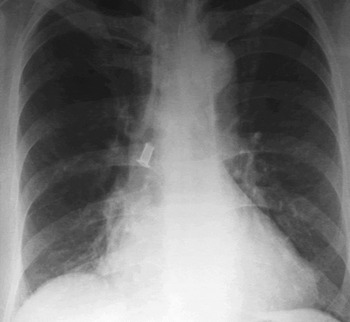
A year later, a new VoiceMaster speaking valve was used to replace the old one after the patient noted prosthesis dysfunction. He had no problems until four months later, when he suddenly had a bout of coughing associated with a choking sensation. A chest radiograph confirmed the presence of the prosthesis in the patient's right main bronchus (Figure 1). An emergency bronchoscopy was performed. The dislodged prosthesis was removed without complication. Post-operatively, the patient was commenced on enteral feeding via a nasogastric tube and discharged.
Chest radiograph showing aspirated voice prosthesis in right main bronchus.

A month later, a Provox voice prosthesis (Atos Medical, Horby, Sweden) was inserted.
Subsequently, the patient suffered repeated episodes of voice prosthesis dislodgement, and multiple reinsertions were required. Various steps were taken to overcome fistula dilatation. Temporary insertion of a smaller feeding tube via the fistula, to allow contraction of the stoma, was repeated. The brand and even the size of the voice prosthesis was changed. Purse string suturing was placed around the fistula opening. Unfortunately, despite the surgeons' attempts to overcome the problem, fistula dilatation and voice prosthesis dislodgement persisted.
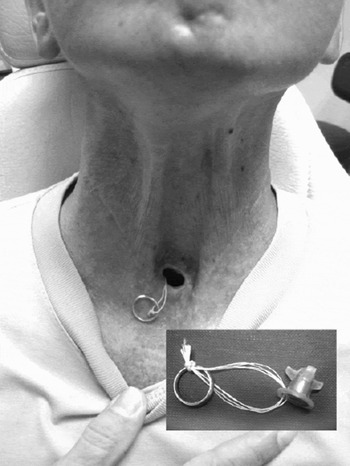
In view of repeated episodes of voice prosthesis dislodgement and the failure of multiple surgical interventions, the patient developed a method of preventing such episodes from occurring, by suturing a metal ring bigger than the size of his tracheostoma to the edge of his voice prosthesis (Figure 2). This ring enabled him to pull out the prosthesis himself when it became dislodged.
Inset picture shows the voice prosthesis sutured with a metal ring. Main picture shows the patient's neck with the customised voice prosthesis in situ.

Discussion
The overall success rate of tracheoesophageal speech varies between 78 to 92 per cent.Reference Paul, Wai-Kuen, Ambrose, Raymond, Anthony and William1, Reference Malik, Bruce and Cherry2 Despite this high success rate, tracheoesophageal speech has various complications, with an overall complication rate ranging between 23 and 52 per cent. Based on a survey of US speech and language therapists, involving 313 patients, Culton and Gerwin reported 18 complications associated with tracheoesophageal puncture, the commonest being leakage through and around the valve.Reference Stafford3 Leakage around the valve can occur due to thinning of the tracheoesophageal wall and widening of the fistula. Fistula enlargement has been described in 20 to 39 per cent of cases.Reference Malik, Bruce and Cherry2
Fistula enlargement can lead to devastating consequences. Leakage can lead to patients aspirating saliva, food and water, resulting in aspiration pneumonia and potentially death. Another dangerous sequel of a widened tracheoesophageal fistula is dislodgement of the voice prosthesis, which can also occur due to an ill-fitting valve or to the patient coughing during valve change. This should be treated as an emergency, as dislodgement can cause closure of the fistula tract within hours.Reference Stafford3 Prompt action should be taken to ensure patency so that the patient does not need to undergo unnecessary repeat tracheoesophageal puncture.
However, aspiration of the prosthesis is more dangerous still, and can occur in 0.75 to 13 per cent of patients.Reference Hathurusinghe, Uppal, Shortridge and Read4 The aspirated voice prosthesis acts as a foreign body and can compromise the patient's airway. Patients can present with symptoms of acute respiratory distress or chronic cough, or may even be asymptomatic (Ostrovsky et al. reported a case of unnoticed aspiration of a Blom–Singer prosthesis).Reference Ostrovsky, Netzer, Goldenberg, Joachims and Golz5 Philip et al. reported a case of ingestion of a voice prosthesis followed by potentially fatal aspiration, and suggested placement of a temporary stitch or tie to minimise the risk of troublesome dislodgement of the prosthesis after reinsertion.Reference Philip, Imran, Dinsuhaimi and Shahid6
The traditional management of a dilated fistula has been to remove the valve and to insert a fine-bore feeding tube into the fistula to allow the fistula to contract and also to enable feeding of the patient. Most fistulas will narrow, and reinsertion of a (preferably) narrower valve can then be performed. De-epithelialisation or cautery to the edges may hasten closure. This method temporarily deprives the patient of tracheoesophageal speech; however, for patients who are unwilling to suffer a period of voice loss, other alternatives can be offered.
The injection of collagen derivatives around the valve or the use of a purse string, absorbable suture has proven successful in treating perivalve leak. However, both substances are reabsorbed in the tissues and offer only temporary relief in cases of tracheal wall thinning. The injection of non-resorbable substances such as BioplastiqueTM into perivalvular tissues has been tried; the procedure was well tolerated, with no migration of the Bioplastique, and a reduction or cessation of leakage was noted, but this method only exhibited short term effectiveness.Reference Stafford3
• Aspiration of voice prosthesis is a potentially fatal complication of tracheoesophageal puncture
• The reported patient invented a practical, cheap method to enable him to remove his speaking valve immediately and easily, should it become dislodged, therefore preventing aspiration
We have attempted almost all the measures mentioned above, except injection of non-resorbable substances into the perivalvular tissue. Unfortunately, our attempts failed and, due to this, the patient invented his own cheap, safe, practical way to prevent aspiration of the prosthesis. Aspiration of voice prosthesis is potentially fatal. Therefore, we recommend adoption of our patient's innovation in order to minimise the risk of aspiration or ingestion, if all other methods have been exhausted.