Introduction
The majority of older adults live in the community rather than in long-term care settings (Bajekal, Reference Bajekal2002). With an increasing lifespan, many older adults suffer from chronic medical conditions and require further assistance in order to stay in their home environment. The decrease in births, the nuclearization and fragmentation of the family system, and the entry of women into the workforce have resulted in a shortage of informal (unpaid) caregivers and an increase in formal (paid) caregivers, who work with frail older adults (Popenoe, Reference Popenoe1993). This workforce is faced with issues related to managing mental health problems that arise inevitably from disability and isolation. The purpose of this paper is to review the literature on the rates of mental illness in older housebound adults and methods for addressing these illnesses. We place a specific emphasis on depression because this is the most prevalent mental illness among older home care recipients.
Home care services are paid services that are aimed at maintaining older adults in their current environment for as long as possible. Services vary widely and may include medical services offered by physicians or nurses, psychosocial services provided by social workers, psychologists or volunteers, and personal services ranging from meals on wheals to several hours of assistance in house care or even “round the clock” personal care (e.g. assistance in grooming, feeding, etc.) (Wiener et al., Reference Wiener, Tilly and Alecxih2002). Following Andersen's model of formal health service use (Andersen, Reference Andersen1995), use of these various services is likely determined by several factors including: (a) functional, medical, and cognitive needs of the individual; (b) financial, familial and social resources available to the individual; and (c) attitudes and norms concerning the use of formal vs. informal services.
Despite this great variability in home care services, home care recipients share several common characteristics. These include their relatively old age, high prevalence of chronic medical conditions and disability, high rates of cognitive impairment, and social isolation (Carpenter et al., Reference Carpenter2004). In addition, even when family members assist in caregiving tasks, they tend to focus on the provision of instrumental tasks and transfer the social and emotional tasks associated with caring for older adults to paid carers (Ayalon, Reference Ayalon2009). Given the characteristics of this population, it is not surprising that depression also is a common occurrence. The few studies conducted to date have estimated that the prevalence of major depression in home care recipients ranges from 12.6% to 26% (Banerjee and Macdonald, Reference Banerjee and Macdonald1996; Bruce et al., Reference Bruce2002). Depressive symptoms (i.e. symptoms that are not of a severity, frequency or range to justify a formal diagnosis of major depression), on the other hand, are present in as many as 57% of home care recipients (Lacasse et al., Reference Lacasse, Rousseau and Maltais2001).
Depression in this population of older recipients of home care services has several characteristics that justify a focus on its early detection and treatment. First and foremost, depression is a major risk for mortality among older adults who receive home care services (Fried et al., Reference Fried, Pollack and Tinetti1998). In addition, depression is associated with high medical morbidity and disability (Bruce et al., Reference Bruce2002), suicidal ideation (Raue et al., Reference Raue, Meyers, Rowe, Heo and Bruce2007), and pain (Bruce et al., Reference Bruce2002; Onder et al., Reference Onder2005). Not surprisingly, research has found that family caregivers of depressed home care recipients are likely to be distressed as well, with about 18.8% of the caregivers of depressed care recipients reporting high levels of distress vs. only 5.9% of the caregivers of non-depressed care recipients. Distressed caregivers also tend to report greater dissatisfaction with the home care services their loved ones receive, and to wish for higher levels of formal care (Soldato et al., Reference Soldato2008). As expected, depression in either caregiver or care recipient is a risk for nursing home admission of home care recipients, even after adjustment for a variety of demographic and clinical characteristics (Shugarman et al., Reference Shugarman, Buttar, Fries, Moore and Blaum2002; Onder et al., Reference Onder2007). Even though there is no doubt that depression is a major public health concern in this vulnerable population, research on this group of older home care recipients has been scarce, and interest in appropriate detection and treatment of depression in this population is only starting to emerge. The aim of this review paper is to summarize major challenges relating to depression in home care older adults, and its pharmacological and psychotherapeutic treatments, using findings from published and ongoing studies.
Challenges associated with the recognition of depression in older home care recipients
As already noted, many home care recipients are physically impaired. As a result of their physical impairment, care recipients are often housebound and unable to leave their home to access health services. Therefore, primary care physicians are less involved in their care and there is a stronger reliance on home care providers for the detection of problems, such as depression, and for accurate communication with primary care providers. Thus, the importance of collaborative care to facilitate a good interface between home care workers and primary care physicians cannot be overestimated. Nevertheless, many direct care providers are trained to provide personal care, such as grooming and feeding, and have little knowledge of common symptoms of depression or its etiology (Ayalon et al., Reference Ayalon, Areán and Bornfeld2008). Even when care providers have received professional training, they may still lack knowledge of mental illness and may be uncomfortable diagnosing depression in this populaiton (Ell et al., Reference Ell, Unützer, Aranda, Sanchez and Lee2005). In a recent study that evaluated the ability of nurses to detect depression using the Outcome and Assessment Information Set (OASIS) depression items relative to a diagnosis provided by the Structured Clinical Interview for DSM-IV (SCID-IV), nurses accurately documented the presence of depression in 13 of 35 cases (sensitivity = 37.1%; positive predictive value = 0.56) and agreed on the absence of depression in 175 of 185 cases (specificity = 94.6%; negative predictive value = 88.8%) (Brown et al., Reference Brown2004).
The limited social network of most home care recipients further hampers the possibility that family members or friends will detect depression in this population. Moreover, even when family members are present, they often fail to detect depression. A recent study of 335 home care recipients and family informants found that 37 home care recipients (10.4%) reported a depressive disorder (major or subsyndromal) that was also identified by their informant, whereas 27 (7.6%) care recipients self-reported depression that was left undetected by the informant (McAvay et al., Reference McAvay, Bruce, Raue and Brown2004).
Another challenge for the detection of depression in home care recipients is the way recipients report their depressive symptoms. There is ample research demonstrating that older adults in general tend to report their distress in more somatic terms than affective ones. This tendency is intensified in medically ill older adults, who probably represent the majority of home care recipients. To overcome these diagnostic difficulties, some researchers favor an exclusive approach that does not take into consideration any somatic symptoms. This approach provides good specificity, but may result in many undetected cases. On the other hand, an inclusive approach that takes into consideration both somatic and cognitive-affective symptoms tends to yield good sensitivity but, as a result, may include many false positives (i.e. low specificity). Currently, there are no gold standards for the diagnosis of depression in medically ill patients and one needs to be cautious of the approach used (Koenig et al., Reference Koenig, George, Peterson and Pieper1997; Christopher et al., Reference Christopher, Melinda, Julianne and Mark2006).
The fact that many home care recipients are not only physically impaired but also cognitively impaired further hampers their ability to communicate their needs clearly and forces care providers to infer beyond the spoken word. This has shown to be a difficult task in older adults with cognitive impairment as both depression and dementia share similar symptomatology, such as irritability and psychomotor retardation (Purandare et al., Reference Purandare, Burns, Craig, Faragher and Scott2001).
Despite these various challenges, research has shown that the detection of depression in older home care recipients can be improved following targeted training delivered to nurses (Ell et al., Reference Ell, Unützer, Aranda, Sanchez and Lee2005). Similarly, physicians’ knowledge and skills in detecting depression can also be enhanced through the use of educational interventions (McCabe et al., Reference McCabe, Russo, Mellor, Davison and George2008). Given the enormous costs associated with untreated depression and the fact that both pharmacological and non-pharmacological interventions have been shown to be effective in the treatment of depression in older adults, there is clearly a need to continue working towards accurate diagnosis of depression in older home care recipients.
Challenges associated with pharmacological treatment of depression in older home care recipients
There are several major challenges associated with the prescription of psychotropic medications to older home care recipients. First, the evidence from randomized controlled trials about the efficacy of psychotropic drugs (e.g. antidepressants) in older adults is still lacking because of the tendency to exclude older adults from clinical trials due to multiple physical and mental illnesses and concurrent treatments. For instance, according to a systematic literature review conducted by the European project PREDICT (7th Framework Project, 2008–2010), only 9–11% of clinical trials on contemporary antidepressant treatments were conducted in older adults (Beswick et al., Reference Beswick, Burke, Shlomo and Dieppe2008). Older home care recipients who are often housebound are even less likely to be included in such trials. The prescription of psychotropic drugs in older adults is further complicated by frequent medication errors due to a number of risk factors that contribute to a different risk/benefit ratio of psychotropic medication in older adults (e.g. pharmacokinetic and pharmacodynamic changes, genetic polymorphism, multiple morbidity, polypharmacy, changes in functional status, drug-related problems, noncompliance, etc.) (Maidment et al., Reference Maidment, Lelliott and Paton2006).
Despite these challenges, appropriate use of antidepressants is highly recommended in older adults. It has shown to control depression adequately, alleviate somatic problems (e.g. pain), increase quality of life, and prevent nursing home admissions among home care recipients (Onder et al., Reference Onder2007). In particular, newer antidepressant drugs (third and fourth generation) have a better risk/benefit profile than older drugs. They tend to demonstrate desired therapeutic effects in a significantly shorter period of time, demonstrate better adherence, decrease the incidence of antidepressant drug change, and reduce hospitalizations and overall healthcare costs (Sheehan et al., Reference Sheehan2008). In this section, we describe results from several epidemiological and clinical studies concerning pharmacological treatments of depression in older recipients of home care services.
Invaluable information about the characteristics of older home care recipients in Europe, services provided to them, and general aspects of their medication use – including appropriateness of the medications prescribed (Fialová et al., Reference Fiálova2005), antipsychotic drug treatment (Alanen et al., Reference Alanen2008), and general aspects of psychotropic drug use – comes from the findings of the European project ADHOC (AgeD in Home Care project, 5th Framework Project, 2001–2004) (Carpenter et al., Reference Carpenter2004; Sorbye et al., Reference Sorbye2009). Ancillary results evaluating the use of psychotropic medications in older home care recipients (65 years +) in eight European countries (Czech Republic, Denmark, U.K., Finland, Norway, Netherlands, Iceland and Italy) demonstrate a wide variability in the prevalence of psychotropic drug use across Europe, ranging from 27% in the U.K. to 62.6% in Finland, with the highest prevalence rates being in Finland, Iceland, and the Czech Republic. These last three countries also have the highest proportion of polymorbidity, as indicated by individuals who use psychotropic medications and polypharmacy (9+ medications). Considering the major classes of psychotropic drugs, hypnotics were the most frequently used medications (in total 23.4%; in Finland and Iceland ≥40%), followed by antidepressants (in total 15.9%; in Finland and Iceland around 30%) and anti-anxiety agents (in total 12.7%; in Iceland and Italy about 20%) (see Table 1).
Psychotropic medication use in older home care adults in Europe (the ADHOC project, 2001)

Prevalences are computed from the total sample, N = 2773.
aAt least one antidepressant, antipsychotic, anxiolytic or hypnotic medication.
NH = Netherlands.
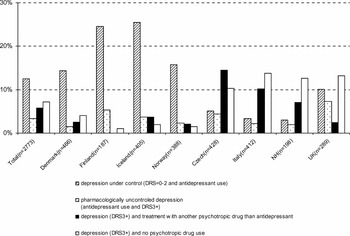
Prescription practice of antidepressant medications in Europe can be roughly divided into two main clusters. In the first cluster (characteristic of northern Europe), home care recipients are treated with antidepressant medications at high prevalence, a substantial number of antidepressant drug users (≥ 80%) have their depression under control, and a low number of depressed home care recipients remain untreated or receive other psychotropic medications instead of antidepressants. In the second cluster of European countries (Czech Republic, Italy, Netherlands), antidepressants are prescribed with great cautiousness and only 40% of home care recipients who receive antidepressant medications have their depression under control, whereas many individuals with substantial symptoms of depression are not prescribed antidepressants at all, but instead are prescribed hypnotic or anti-anxiety medications (see Figure 1). Interestingly, a similar pattern was reported in the U.S.A.; as shown by a recent study that found that only 22% of depressed home care recipients received antidepressant treatment. Yet, 31% of those receiving treatment, were prescribed sub-therapeutic doses and 18% of those prescribed appropriate doses reported noncompliance (Bruce et al., Reference Bruce2002).
Use of antidepressants in Home Care Older Adults in Europe.
DRS = Depression Rating Scale (Burrows et al., Reference Burrows, Morris, Simon, Hirdes and Phillips2000).
DRS = 0 (no depression).
DRS = 1-2. . . . . . . . .depressive mood, not clinically significant depression.
DRS = 3-14. . . . . . .clinically significant depression.
Czech = Czech Republic; NH = Netherlands; UK = United Kingdom.

Efficacy and safety of psychotropic medications also depend on a patient's behavior and compliance with pharmacological and non-pharmacological recommendations. Research has shown that the specific characteristics of the drugs are associated with compliance level. Interestingly, in polypharmacy users (9+ medications), selective serotonin reuptake inhibitors (SSRIs) demonstrated the highest rates of noncompliance, with 80% of those prescribed SSRIs being noncompliant, whereas nootropic agents were ranked fourth, with 53% of those prescribed being noncompliant. On the other hand, home care polypharmacy recipients treated with tricyclic antidepressants were highly compliant, with 83% of those prescribed being compliant users. It is obviously important to take these data into consideration when prescribing antidepressant medications to older home care recipients (Topinkova et al., Reference Topinkova, Fiálova, Carpenter and Bernabei2006).
Other factors also play a role in the response of home care recipients to antidepressant treatment. For instance, a recent study comparing psychogeriatric teamwork to treatment as usual provided by a physician found that whereas 19 (58%) older adults in the intervention arm recovered from depression, only 9 (25%) individuals in the control arm showed an improvement. These researchers concluded that improvement was not due to the simple effect of the antidepressants, but due to the overall teamwork involved (Banerjee et al., Reference Banerjee, Shamash, Macdonald and Mann1996). Similarly, a Total Quality Management intervention consisting of depression education provided to staff, regular depression screening, improved contact with physicians, interdiciplinary consultation, and the use of a pharmacotherapeutic algorithm resulted in decreased hospitalization rates for medically ill home care recipients with depressive symptoms (Flaherty et al., Reference Flaherty1998).
Challenges associated with psychotherapeutic interventions for the treatment of older home care recipients
Depression in ambulatory older adults is known to be highly responsive to psychotherapy (Mackin and Areán, Reference Mackin and Areán2005). Recent research has shown that depression in disabled older adults, such as those with macular degeneration (a progressive blindness often associated with diabetes) (Rovner and Casten, Reference Rovner and Casten2008) or disability associated with stroke (Mitchell et al., Reference Mitchell2009) is also responsive to psychotherapeutic interventions. In these studies, patients have been largely ambulatory and all treatment delivered in primary care or psychiatric settings. We may assume that if psychotherapeutic interventions are effective in alleviating late life depression and depression associated with disability, they will also be effective in housebound elderly. However, this assumption has only been tested recently and has yielded surprising results. In this section, we describe three completed trials of homebased management programs of depression in older, disabled adults relative to care as usual in order to demonstrate some of the complications associated with the delivery of psychotherapeutic interventions to home care older adults.
The Program to Encourage Active and Rewarding Lives (The PEARLS project; Ciechanowski et al., Reference Ciechanowski2004) evaluated a home-based depression prevention program for older adults who were already receiving home-based care for medical problems. The PEARLS intervention consisted of a combination of a problem-solving treatment (PST), an intervention found to be effective for treating depression in older medical patients (Areán et al., Reference Areán, Hegel, Vannoy, Fan and Unüzter2008), and physical activity scheduling. In this study, 138 people with either minor depression or dysthymia were randomized to receive the PEARLS intervention or care as usual; participants were aged 60 years or older. All participants were followed for approximately one year after treatment to determine the relative impact these programs had on depression and function. Participants who received the PEARLS intervention were in active treatment for approximately 20 weeks and the average case load for care managers in this program was no more than eight active cases at a time. The PEARLS intervention was found to be effective in reducing symptoms of depression, but there was no difference in response and remission rates between usual care and PEARLS. The greatest effect noted in this study was the impact PEARLS had on functioning.
The second trial, Collaborative Depression Care for Home Bound Elderly (HOPED project; Ell et al., Reference Ell2007), was designed to determine if a collaborative care model of depression treatment developed for primary care medicine (based on the Improving Mood: Promoting Access to Collaborative Treatment; Unützer et al., Reference Unützer2002) could be successfully transferred to visiting nurse specialist programs. The HOPED model consisted of training nurses in patient education, treatment outcome tracking, antidepressant monitoring and provision of PST. The model is a stepped care approach, in which participants choose between medication or therapy to treat their depression initially, and if they do not improve in eight to ten weeks, treatment augmentation is attempted, with eventual referral to specialty mental health services should participants not show improvement in six months. HOPED was compared to usual visiting nurse care. In this study, 311 older adults, who had recently been discharged from inpatient medical hospitals, were randomized to receive HOPED or usual care. Participants were followed for one year to determine the relative impact of HOPED and usual care on depressive symptoms and function. The results of this study show that whereas collaborative care models may be highly effective in ambulatory medicine, they are only marginally effective in very frail older adults who are house bound, as there were no differences between the two conditions on depression and functional outcomes.
The third trial is the CARED study (treating depression in low-income and disabled older adults; Areán and Alexopoulos, grant number MH 075900), which is an ongoing clinical trial to study the efficacy of PST combined with clinical case management relative to usual care clinical case management. Participants in this program are all low-income older adults who receive home-based services, either meals on wheels or in-home support. Although the pilot study of 30 participants had found both interventions acceptable and feasible, as well as demonstrating the efficacy of PST plus case management, the researchers have faced two very important challenges. The first is the degree to which major depression is actually present in this population. Whereas nearly all participants who are referred to the project and are interested in participating in the study have depressive symptoms, the majority (75%) do not meet the criteria for major depression and are therefore ineligible to participate in the study. Hence, the severity of depression encountered in low-income and disabled people is mild to moderate, and aggressive depression treatments may not be appropriate for this population. Second, of those who do qualify and participate in the study, many are medically unstable; approximately 35% of the current sample has had to be hospitalized for medical emergencies or procedures, or are too frail to participate fully.
Despite considerable research on the effectiveness of existing depression interventions in medically disabled older adults and even some pilot research attesting to the effectiveness of psychotherapeutic interventions for the treatment of depression in older home care recipients (Gellis et al., Reference Gellis, McGinty, Horowitz, Bruce and Misener2007), the degree of depression and fragility among home care recipients appears to compromise the effectiveness of these interventions. The PEARLS project may have been particularly effective because the participants in that program were not significantly frail and were only mildly depressed. On the other hand, in HOPED and CARED, where participants suffered from more severe depressive disorders and were more physically frail, the delivery and effectiveness of depression treatments appear to be compromised by the challenges associated with treating depression inconsistently (given the high rates of hospitalization in this population). In the face of these constraints, future interventions might be delivered more flexibly by using alternative modalities, such as the augmentation of behavioral interventions by formal or informal carers or via modalities such as email or telephone in order to improve the consistency of depression care to older home care recipients. It might also be useful to capitalize on some of the strides made in the management of medical illness among home care recipients. For instance, research has shown that an academic physician house calls program, in partnership with a healthcare system, can improve access to care for housebound frail older adults and improve quality of care and patient satisfaction (Beck et al., Reference Beck, Arizmendi, Purnell, Fultz and Callahan2009). Similarly, collaborative care programs for the detection and management of complex chronic conditions, such as depression, diabetes or arthritis pain, have been used successfully in primary care (Unützer et al., Reference Unützer2002; Lin et al., Reference Lin2003; Ralston et al., 2009) and may prove useful in the management of depression in home care recipients as well. The implementation of a collaborative care model via the internet may also prove useful as it has already shown preliminary success in the management of diabetes (Ralston et al., Reference Ralston, Hirsch, Hoath, Mullen, Cheadle and Goldberg2009).
Finally, it is important to note that epidemiological studies found that depressed home care recipients hardly ever receive psychotherapeutic interventions (Bruce et al., Reference Bruce2002; Ell et al., Reference Ell, Unützer, Aranda, Sanchez and Lee2005). Thus, although future research is much needed in order to improve psychotherapeutic interventions in this frail population of home care recipients, there is also a need to facilitate the use of psychotherapeutic interventions with older home care recipietns.
Conclusions
Depression is common in older recipients of home care services and is associated with a variety of negative concequences both for the care recipients and the caregivers (Onder et al., Reference Onder2007; Reference Onder2009). Because of its somewhat different presentation in this population of medically ill home care recipients and the lack of appropriate staff training, the appropriate detection and diagnosis of depression are difficult to achieve (Brown et al., Reference Brown, Bruce and Raue2003). Lack of consistent research on pharmacological and psychotherapeutic interventions in this population also poses a challenge. Despite these various challenges, there is some emerging research that shows that depression can be accurately detected in home care recipients (Ell et al., Reference Ell, Unützer, Aranda, Sanchez and Lee2005). Research has also shown that adequate pharmacological management of depression and the employment of an interdiciplinary psychogeriatric team can result in beneficial outcomes (Banerjee et al., Reference Banerjee, Shamash, Macdonald and Mann1996; Sheehan et al., Reference Sheehan2008). Nonetheless, the findings demonstrate that further research is needed, especially in the area of psychotherapeutic interventions as these should be flexible enough to meet the unique and evolving needs of this frail population of older adults.
Finally, given the fact that depression is also quite prevalent in caregivers of home care recipients (Onder et al., Reference Onder2009), further efforts should be made towards alleviating their burden of care and developing psychopharmacological and psychotherapeutic interventions to meet their mental health needs. Because research has shown a great variability across countries in terms of caregivers’ willingness to keep care recipients at home, interventions should be tailored to meet the specific needs and preferences of caregivers and care recipients alike. For example, in countries where caregivers are willing to keep older adults at home despite elevated distress levels (e.g. Italy, France and Germany), interventions aimed at improving in-home services and respite and family counseling to caregivers should be considered; in other countries, such as Iceland and the Netherlands, where there is a greater interest in a different living environment for care recipients, despite lower levels of distress, the facilitation of institutional care might be warranted (Onder et al., Reference Onder2009).
Conflict of interest
None.
Description of authors' roles
L. Ayalon and D. Fialová were responsible for developing the study concept. L. Ayalon drafted and integrated the various sections of the paper, and carried out major revisions. D. Fialová drafted the section on pharmacological treatment of depression; P. Areán drafted the section on psychotherapeutic interventions for the treatment of older home care recipients; and G. Onder drafted the section on the characteristics of home care recipients and their carers.
Acknowledgments
Dr. Fialová was supported by the InterRAI Consortium and initiators and researchers of the European projects ADHOC (AgeD in HOme Care), SHELTER (Services and Health for Elderly in Long TERm Care), and PREDICT (Increasing the Participation of Elderly in Clinical Trials). Work was supported by grants FP7-HEALTH-F4–2008-201917, IGA MZ NS/10029-4/2008 KJ 51219075 and FP7-HEALTH-2007-B223115. Dr. Patricia Areán was supported by grants from the National Institute of Mental Health: R01MH075900 & K24MH074717.