Implications
Post-harvest de-hulling of pistachio produces large amounts of pistachio by-product (PBP) over a short period of time. This by-product may have good potential for use in ruminant nutrition as a low price feed. Ensiling is the best method for long time preservation of this by-product as storage is difficult owing to its high moisture content. In recent years, sun-dried and ensiled PBP is used in ruminant nutrition and has also been repeatedly included in dairy cow rations. While the tannin content of pistachio by-product silage (PBPS) may have beneficial effects on rumen fermentation processes, there are no reports on the long-term feeding of PBPS in ruminant nutrition.
Introduction
According to the Food and Agriculture Organisation (2012), Iran is the greatest producer of pistachio worldwide and has an annual production of about 500 000 tons of fresh pistachio by-product (PBP) (Shakeri et al., Reference Shakeri, Riasi, Alikhani, Fazaeli and Ghorbani2013). PBP are produced after de-hulling (1.25 to –2 kg/kg dry pistachio) and contain high levels of pistachio epicarp and, to a lesser extent, peduncles, leaves, mesocarp, kernel and cluster (Shakeri and Fazaeli, Reference Shakeri and Fazaeli2007; Bohluli et al., Reference Bohluli, Naserian, Valizadeh and Eftekhar Shahrodi2009). Using PBP as an animal feed not only eliminates feed shortage in some countries but also reduces the risk of environmental pollution (Shakeri and Fazaeli, Reference Shakeri and Fazaeli2007; Bagheripour et al., Reference Bagheripour, Rozbehan and Alipour2008).
PBP is potentially suitable for use in ruminant nutrition and sun-dried PBP has been traditionally fed to ruminant animals (Shakeri and Fazaeli, Reference Shakeri and Fazaeli2007; Bagheripour et al., Reference Bagheripour, Rozbehan and Alipour2008; Mokhtarpour et al., Reference Mokhtarpour, Naserian, Tahmasbi and Valizadeh2012). Its chemical composition, phenolic compounds and digestibility depend not only on the cultivar and kernel maturity but also on de-hulling and drying processes (Bohluli et al., Reference Bohluli, Naserian, Valizadeh and Eftekhar Shahrodi2009; Shakeri et al., Reference Shakeri, Riasi, Alikhani, Fazaeli and Ghorbani2013). It has been established that PBP contains 9.2% to 12% CP, 32% to 37% NDF and 21% to 26% ADF on a dry matter (DM) basis (Bagheripour et al., Reference Bagheripour, Rozbehan and Alipour2008; Mokhtarpour et al., Reference Mokhtarpour, Naserian, Tahmasbi and Valizadeh2012). However, certain anti-nutritional factors such as phenolic compounds (5.6% to 15.2% DM basis) may reduce its nutrient availability (Vahmani et al., Reference Vahmani, Naserian, Valizadea and Nasirimoghadam2006; Bagheripour et al., Reference Bagheripour, Rozbehan and Alipour2008; Bohluli et al., Reference Bohluli, Naserian, Valizadeh and Eftekhar Shahrodi2009). Animal assays with (dried or ensiled) PBP are limited. Mokhtarpour et al. (Reference Mokhtarpour, Naserian, Tahmasbi and Valizadeh2012) reported that pistachio by-product silage (PBPS) with or without additives had no effects on dry matter intake (DMI) and nutrient digestibility of dairy cows during a 21-day experiment. The particle size of PBPS is different from that of corn silage because the by-product has about 25% pistachio clusters (Shakeri and Fazaeli, Reference Shakeri and Fazaeli2007) that are not chopped before ensiling.
To the best of our knowledge, the effects of long-term feeding PBPS on chewing behavior and nutrient digestibility have not been evaluated. Therefore, the objective of this study is to determine the nutritional potential of PBPS in feeding Holstein male calves.
Material and methods
The study was carried out in Bardsir Animal Science Research Center located in Kerman Province, Iran, where the climate is classified as arid with an average annual rainfall of 200 mm and a maximum annual temperature of 40°C.
Preparation of PBPS and corn silage
During the pistachio harvesting season (fall 2010), about 30 tons of fresh PBP was ensiled into a trench silo without any additives. At the same time, whole-plant corn (Zea mays L.) was harvested in a milk stage of maturity. The chopped forage was ensiled into another trench silo. After 3 months of storage, the samples were collected using a specific probe from different parts of the silos to be freeze-dried (Christ ALPHA 2-4 LD plus Martin Christ, Osterode, Germany) and ground before chemical analyses.
Chemical analysis
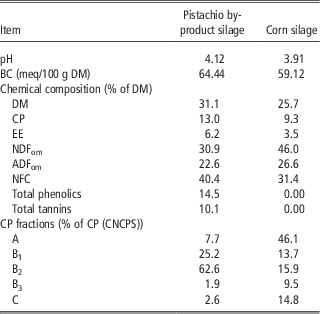
All feed samples were ground using a Willey mill (Arthur H. Thomas Co., Philadelphia, PA, USA) to pass through a 1 mm screen. Chemical analysis was conducted in triplicate and the chemical composition of the individual ingredients was used to calculate the chemical composition of the diet. Feed samples were analyzed according to Association of Official Analytical Chemists (1990) for DM, CP and ether extract (EE). NDFom and ADFom were determined and expressed without considering residual ash (Van Soest et al., Reference Van Soest, Robertson and Lewis1991). Total phenolic compounds (TP) and total tannins (TT) were determined using the Folin–Ciocalteu reagent with tannic acid as the chemical standard (Makkar, Reference Makkar2003). Samples of PBPS were analyzed for Cornell Net Carbohydrate and Protein System fractions (Licitra et al., Reference Licitra, Hernandez and Van Soest1996). The buffering capacity of the silage samples was determined using the method of Playne and McDonald (Reference Playne and McDonald1966). Table 1 presents the values for pH and buffering capacity as well as the chemical composition of both PBPS and corn silage.
Silage characteristics and chemical composition of pistachio by-product silage and corn silage (n=3)

BC=buffering capacity; DM=dry matter; EE=ether extract; NFC=non-fiber carbohydrate; CNCPS=Cornell Net Carbohydrate and Protein System; A=fraction of CP that is instantaneously solubilized at time zero; B1=fraction of CP that is soluble in borate–phosphate buffer and precipitates with trichloroacetic acid; B2=calculated as total CP minus the sum of fractions A, B1, B3, and C; B3=calculated as the difference between the portions of CP recovered with NDF and ADF; C=fraction of CP recovered with ADF and considered to be undegradable.
Animals, diets and management
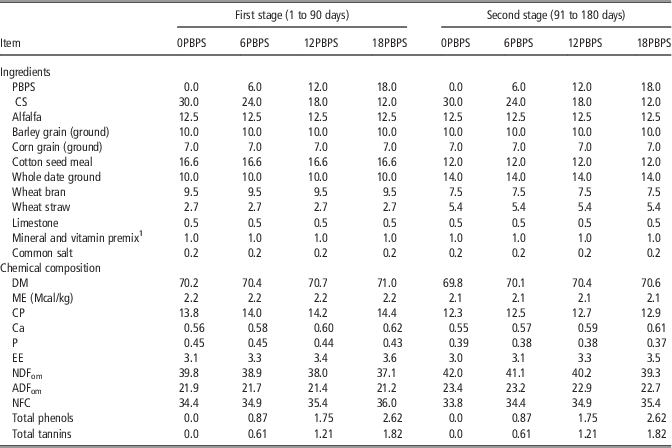
In all, 24 Holstein male calves (4 to 5 months of age and 155.6±13.5 kg BW) were assigned to four diets (n=6) in a completely randomized design. The diets were formulated by substitution of corn silage with different levels of PBPS (0%, 6%, 12% and 18% of DM) during two subsequent experimental periods (Table 2). Each sub-period was 90 days and the diets were formulated to support ~1 and 1.3 kg average daily gain, respectively (National Research Council, 1989). However, during the adaptation period, the calves in all groups had higher feed intakes than those predicted in the standard tables. The animals were kept in 9 m2 individual pens with concrete floor and sand bedding and had free access to feed and fresh water. Before the experiments, the calves were treated for internal and external parasites and routine vaccination (i.e. foot-and-mouth disesase, enterotoxemia and anthrax). After 4 weeks of adaptation, the animals received their total mixed ration (TMR) twice daily in two equal portions at 0500 and 1700 h.
Ingredients and calculated chemical composition (% of DM) of diets
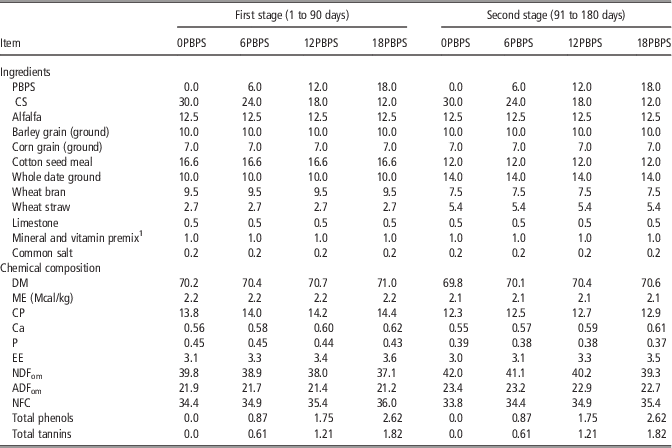
PBPS=pistachio by-product silage; CS=corn silage; DM=dry matter; ME=metabolizable energy, estimated by equation: ME (Mcal/kg)=(0.027+0.0427 digestibility of dry matter (DDM)×0.821); EE=ether extract; NFC=non-fiber carbohydrate calculated by equation: NFC (%)=100−(% NDF+% CP+% fat+% ash).
0PBPS=0% PBPS, 30% CS; 6PBPS=6% PBPS, 24% CS; 12PBPS=12% PBPS, 18% CS; 18PBPS=18% PBPS, 12% CS.
1 Vitamin and mineral premix contained 250 000 IU/kg vitamin A; 50 000 IU/kg vitamin D3; 1500 IU/kg vitamin E; 2.25 g/kg Mn; 120 g/kg Ca; 7.7 g/kg Zn; 20 g/kg P; 20.5 g/kg Mg; 186 g/kg Na; 1.25 g/kg Fe; 3 g/kg S; 1.25 g/kg Cu; 14 mg/kg Co; 56 mg/kg I; and 10 mg/kg Se (DM basis).
Chewing activity
The chewing activities (i.e. eating, ruminating, idling) of calves were monitored during 24 h on days 15 of the 3rd and 6th month of the experimental period by observing individual calves every 5 min and recorded. The whole activity was assumed to extend for the entire 5 min interval. Eating, ruminating and total chewing time per kg of DMI (min/kg of DMI) and per kg of NDFom intake (min/kg of NDFom) were calculated by dividing total times by the mean intake of each parameter (Krause et al., Reference Krause, Combs and Beauchemin2002).
Nutrient digestibility of diets
Fecal grab samples were taken on days 20 to 22 of the 6th month of the experiment. Sampling was performed every 4 h over a 12 h period between two feeding times (a total of three samples). The samples were frozen (−20°C) before being dried in a forced-air oven (55°C for 72 h). Total tract digestibility of the nutrients was determined using an internal marker prepared from acid insoluble ash (Van Keulen and Young, Reference Van Keulen and Young1977). Samples of the feed offered, orts and fecal content were ground to pass through a 1 mm screen and analyzed for their DM, organic matter (OM), total N, NDFom, ADFom and ash.
Rumen fluid sampling and laboratory analysis
Ruminal fluid samples were collected 4 h after the morning feeding on the last day of the 3rd and 6th month of the trial. Samples were obtained by evacuation using a vacuum pump and stomach tube (Model Shahmorady, Iran; Modified Model, Geishauser, Reference Geishauser1993). In an attempt to minimize errors because of salivary contamination, samples (~500 ml) were collected after discarding an initial 500 ml aliquot of the rumen fluid. Immediately after ruminal fluid sampling, pH was measured using a digital pH meter (CRISON Bassic20+ Crison Instruments, European Union). The samples were then filtered through four layers of cheesecloth and 15 ml of each sample was collected in a test tube and acidified with 3 ml of 25% metaphosphoric acid before being stored at −20°C. Molar proportions of acetate, propionate and butyrate were determined by gas chromatograph (CHROMPAC B.V. CP9002, the Netherlands and Forte GC Capillary Column BP21, SGE Forte GC, UK) using crotonic acid as an internal standard (Playne, Reference Playne1985). The NH3–N concentration of the rumen fluid was determined by the phenol–hypochlorite procedure of Broderick and Kang (Reference Broderick and Kang1980).
Statistical analysis
All variables were statistically analyzed using the mixed-model procedure of the Statistical Analysis Systems (Version 9.1, SAS Institute Inc., 2003, Cary, NC, USA) in a completely randomized design. Linear effects were determined utilizing polynomial orthogonal contrasts for equally spaced treatments. Animals were expected as the random effect in the experimental model. The means were compared using Tukey’s multiple comparisons procedure and the following statistical model was used:
 $$Y_{{ij}} =\mu {\plus}\tau _{i} {\plus}\delta _{{ij}} {\plus}{\varepsilon}_{{ij}} $$
In which, Y ijk is the dependent variable, μ the overall mean, τ i the PBPS treatment effect (i=1 to 4), δ ij the random error and ε ij the residual error. Furthermore, for analyzing apparent nutrient digestibility data, DMI was used as a covariate b(x−x̅) in the statistical model.
Results
Chewing activity parameters
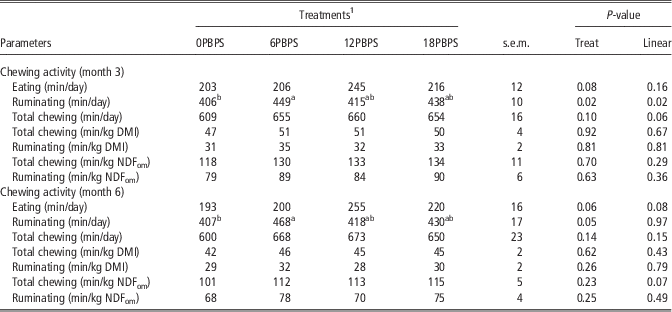
Effects of different levels of PBPS on chewing activities of male calves in months 3 and 6 are presented in Table 3. The time spent for eating per day ranged from 203.3 to 245.0 min in month 3 and from 193.3 to 255.0 min in month 6. The effect of PBPS on eating time was significant (P=0.08 in month 3 and P=0.06 in month 6). Calves fed 6% PBPS (6PBPS) spent more time ruminating in months 3 (P=0.02) and 6 (P=0.05) compared with the control group (0PBPS). There was no significant difference between 6%, 12% and 18% PBPS inclusion in this regard. Total chewing time per kg of DMI and NDFom content was not affected by different levels of PBPS in the two sub-periods of the experiment.
Effects of the different levels of pistachio by-product silage on the chewing activity of Holstein male calves

PBPS=pistachio by-product silage; CS=corn silage; DMI=dry matter intake.
a,bValues within a row with different superscripts differ significantly at P<0.05.
1 0PBPS=0% PBPS, 30% CS; 6PBPS=6% PBPS, 24% CS; 12PBPS=12% PBPS, 18% CS; 18PBPS=18% PBPS, 12% CS.
Nutrient digestibility
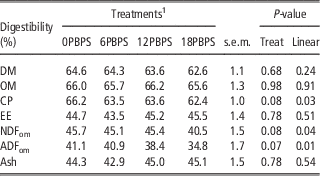
The mean apparent total tract digestibility values of DM, OM, CP, EE, NDFom, ADFom and ash are presented in Table 4. Increasing levels of PBPS linearly decreased the apparent digestibility values of CP (P=0.03), NDFom (P=0.04) and ADFom (P=0.01).
Effects of the different levels of pistachio by-product silage on apparent total tract digestibility in Holstein male calves

PBPS=pistachio by-product silage; DM=dry matter; OM=organic matter; EE=ether extract; CS=corn silage.
1 0PBPS=0% PBPS, 30% CS; 6PBPS=6% PBPS, 24% CS; 12PBPS=12% PBPS, 18% CS; 18PBPS=18% PBPS, 12% CS.
Rumen fermentation parameters
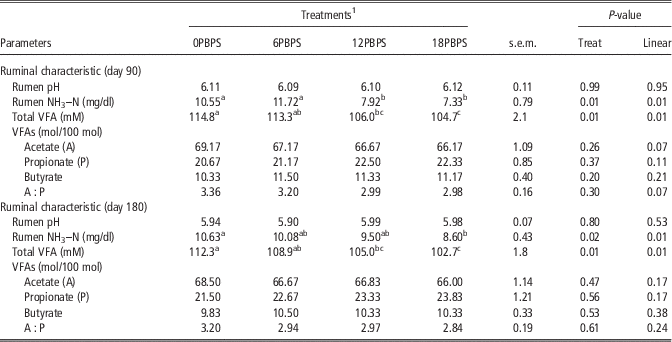
The pH levels as well as the concentrations of NH3–N and volatile fatty acids (VFA’s) of the rumen fluid are presented in Table 5. Results show that pH was not affected by different levels of PBPS. However, increasing levels of PBPS linearly decreased the concentrations of both NH3–N (P=0.02) and total VFA (P=0.01). Different levels of PBPS had no effects neither on the proportions of acetate, propionate and butyrate nor on the acetate (A) to propionate (P) ratio. A linear tendency was observed in A : P ratio with increasing PBPS inclusion in the diets in month 3 (P=0.07).
Effects of the different levels of pistachio by-product silage on ruminal fluid characteristics in Holstein male calves

PBPS=pistachio by-product silage; VFA=volatile fatty acid; CS=corn silage.
a–cValues within a row with different superscripts differ significantly at P<0.05.
1 0PBPS=0% PBPS, 30% CS; 6PBPS=6% PBPS, 24% CS; 12PBPS=12% PBPS, 18% CS; 18PBPS=18% PBPS, 12% CS.
Discussion
Chewing activity parameters
It is well demonstrated that chewing and ruminating time is positively correlated with dietary physically effective NDF (peNDF) (Zebeli et al., Reference Zebeli, Tafaj, Steingass, Metzler and Drochner2006). The results obtained in this study showed that corn silage substitution with PBPS affected daily ruminating time during the two sub-periods and 6% PBPS (6PBPS) inclusion had a greater effect on calves’ ruminating time. Chemical analysis (Table 1) revealed that PBPS had lower NDFom and ADFom values compared with corn silage. However, some large particles in PBP (i.e. pistachio clusters) may increase the peNDF of PBPS. On the other hand, it is reported that NDF digestibility and forage fragility could affect ruminating time (Grant, Reference Grant2010). Bohluli et al. (Reference Bohluli, Naserian, Valizadeh and Eftekhar Shahrodi2009) used 15% sun-dried PBP in the dairy cattle ration and reported significant decreases in ruminating time and total chewing activity compared with the same parameters under their control diet. The inconsistency might have been because of the fine particles of sun-dried PBP.
Nutrient digestibility
Increasing levels of PBPS linearly decreased apparent digestibility of CP, NDFom and ADFom. Substitution of corn silage with PBPS increased TP and TT of TMRs (Table 2). Frutos et al. (Reference Frutos, Hervas, Giraldez and Mantecon2004) reported that type, source and concentration of tannins affect nutrient digestibility, particularly protein digestibility. On the other hand, the effect of high levels of PBPS observed on CP apparent digestibility could be related to its lower A fraction (non-protein nitrogen (NPN)) (Table 1).
It is well defined that the irreversible bindings of tannins to fibrous fractions or to fibrolytic enzymes depress the ruminal digestion of dietary NDF and ADF (Barry and Manley, Reference Barry and Manley1986; Patra and Saxena, Reference Patra and Saxena2011). However, our results showed that only high levels of PBPS (18PBPS) had the potential to reduce the digestibility of CP, NDFom and ADFom. Mokhtarpour et al. (Reference Mokhtarpour, Naserian, Tahmasbi and Valizadeh2012) used 15% PBPS and Gholizadeh et al. (Reference Gholizadeh, Naserian, Valizadeh and Tahmasbi2010) included 10% sun-dried PBP in their experiments with dairy cows and found no effects of the by-product on CP, NDF or ADF digestibility.
Rumen fermentation parameters
Tannins are able to change microbial populations, which can alter the digestibility of nutrients and then the production of VFAs and NH3–N (Kruegera et al., Reference Kruegera, Gutierrez-Banuelos, Carstens, Min, Pinchak, Gomez, Anderson, Krueger and Forbes2010). In the present study, the higher levels of PBPS (12PBPS and 18PBPS) decreased total VFA and NH3–N concentrations compared with the control group. Beauchemin et al. (Reference Beauchemin, McGinn, Martinez and McAllister2007) showed that increasing levels of tannin concentration in a calf diet (0%, 0.9% and 1.8% Quebracho condensed tannin) decreased total VFA and NH3–N concentrations in the ruminal fluid. It is reported that the lower rate of carbohydrate digestion, especially that of fiber, may decrease total VFA concentrations in the rumen (Patra et al., Reference Patra, Kamar and Agarwal2006; Beauchemin et al., Reference Beauchemin, McGinn, Martinez and McAllister2007). This is consistent with our findings for NDF and ADF digestibility (Table 4).
Relatively high levels of TP and TT in PBPS (Table 1) could reduce the ruminal degradation of CP and, thereby, NH3–N concentration (Min et al., Reference Min, Barry, Attwood and McNabb2003). In addition, PBPS had a lower NPN compared with corn silage (7.70% v. 46.13% of CP). Thus, ruminal NH3–N concentration was lower after feeding rations with 12% and 18% PBPS. Similar to the present results, Bohluli et al. (Reference Bohluli, Naserian, Valizadeh and Eftekhar Shahrodi2009) reported a decreasing trend in ruminal NH3–N concentration with increasing levels (0% to 15%) of sun-dried PBP in the diet fed to dairy cows.
Ruminal fluid pH was not affected by different levels of PBPS, which is consistent with the results reported by Bohluli et al. (Reference Bohluli, Naserian, Valizadeh and Eftekhar Shahrodi2009) and Mokhtarpour et al. (Reference Mokhtarpour, Naserian, Tahmasbi and Valizadeh2012), who showed that sun-dried PBP and PBPS did not change the ruminal pH of dairy cows.
Conclusion
The results obtained from the present study showed that PBPS had a relatively high protein content with a good quality for ruminant animals. Dietary incorporation of different levels of PBPS (⩽18% of DM) during a long feeding period affected not only ruminating time but also total tract digestibility of CP, NDFom and ADFom as well as rumen fermentation parameters. The 6% substitution of corn silage with PBPS had no adverse effects on nutrient digestibility and rumen fermentation parameters. In addition, 12% substitution found to have potential, beneficial effects on ruminating time and acidosis prevention in ruminants.
Acknowledgments
The authors would like to acknowledge Kerman Agricultural and Natural Resources Research Center and Iran Research Institute of Animal Science, for their cooperation.