1 Introduction
Social capital is a concept often used to mean the social infrastructure of business, politics, and community (Coleman, Reference Coleman1990; Lin, Reference Lin2001; Putnam, Reference Putnam2000; Stolle, forthcoming in 2007; Inoguchi, 2007a). Social capital is crucial, as human interactions and actions are inherently full of uncertainties and risks. Social capital can create advantages to reduce costs and risks and to enhance the spirit to go together further onward. It is a stock on the basis of which one can try to bridge the differences between players in business and players in politics. It is also a stock that binds internal networks when overcoming barriers and obstacles in furthering their causes.
Social capital in the sense of social infrastructure is composed principally of norms and networks. Agreed norms and common networks are key to social capital. Since human actions are not confined to local community interactions or to joint business adventures, or to a new civil society group, the study of social capital poses a challenge when one tries to define or measure the degree of social capital.
Social capital is defined in various ways. A common definition focuses on interpersonal relations. This is natural since social capital enables interpersonal relations to run smoothly, efficiently, and to be mutually beneficial. In business, transactions entail substantial risk-taking under uncertainty, which could lead to unbearable losses; in politics, they could lead to political downfalls. In this kind of definition, social capital is the social infrastructure that enables actors to ineract, whether in business or politics, or other kinds of interactions, with confidence. Thus social capital is a type of collective good that enables actors to interact with understanding, efficiency, and effectiveness.
The problem of measuring social capital is related to the problem of defining social capital. My argument is that as long as social capital is conceptualized as a type of social infrastructure, one cannot be content with questions that tackle the problem by narrowly focusing on interpersonal relations. These questions are most typically about human nature (e.g. on the whole one cannot be too careful about others), about tolerance (e.g. see Borre, 2002; Vinken, Reference Vinken2006). Defining social capital as human nature exhibited in interpersonal relations seems to lead inquiries into social capital in a somewhat misguided direction. Most Western literature on social capital seems to presume that human nature should be measured in terms of good or evil, judging from the list of questions that are examined to measure social capital. It may be due in part to the relative homogeneity of Western societies in terms of Christianity, democratic values, and free market capitalist practice. My argument rests on the extraordinary diversity of many societies in Asia, in terms of religion (out of five major religions, Buddhism, Hinduism, Christianity, Islam, Judaism, four are vibrant in Asia), political system (out of 29 societies in Asia, democracy as measured by Freedom House amounts to less than ten, Japan, Korea, Taiwan, the Philippines, Indonesia, India, East Timor, Cambodia, the Maldives), and economic system (out of 29 societies, the floating exchange rate system is adopted by some six governments). In order to measure social capital, therefore, we need to extend the range of questions beyond those inquiring about human nature in interpersonal relations.
To understand the need to extend the range of questions on social capital, two examples are offered. One sometimes expresses the sentence about a person, ‘She/he is a nice person, but. . .’ This sentence might be followed by another sentence such as, ‘He is incompetent and useless.’ If someone is incompetent and useless, he is not to be trusted very much even if he is a good person. This same sentence might be followed by another sentence such as, ‘He is totally out of tune with the authorities.’ If someone is visibly out of tune with the prevailing regime of a non-democratic nature, again he cannot be trusted very much even if he is a good person. You cannot risk too much by counting on him in such a situation.
The fact that survey research has developed in relatively homogeneous social contexts such as Western Europe and North America in terms of Christian religion, democratic values and free market capitalist practice for the last 60 years (Inoguchi, Reference Inoguchi2005) may have blinded us to the simple fact that differences in religion, politics and economics may require a battery of questions on social capital that do not presume a relative homogeneity of population. By so saying I am not presuming that diversities within and among Western societies are close to negligible (Blondel and Inoguchi, Reference Blondel and Inoguchi2006). Rather I am of the view that the enormous diversity of Western societies (within and between) may have been played down by a seeming homogeneity of the three key denominators, Christian religion, democratic values and free market capitalist practice. Even if such a narrow range of questions has been used more or less without causing distortions and problems in Western societies for the last 60 years, this fact should not encourage us to continue to take this limited approach to questions on social capital. This applies not only to the visibly diverse societies in Asia but also to those seemingly homogeneous societies with their diverse undercurrents found in Western Europe and North America (see Davies, 2006 and Todd, 2000).
In dealing with this problem, we pay special attention to the Confucian tradition in Asia. Confucianism is very influential in East Asia and tells us that virtues must be nurtured at the individual level and then built up from the individual level through to the level of the world. Daxue, Great Learning, has the passage about this: kewu, zhizhi, xiushen, qijia, zhiguo, pingtianxia. Literally translated, tackle things, reach knowledge, nurture your virtue, take care of your family, govern the state, and pacify the world under heaven. But most important is the thinking that peace and stability must be built from the bottom up and that each individual must nurture a virtuous self and only on that basis can peace and stability of the family, the state and the world under heaven be achieved. The starting point is to inculcate virtue into yourself. Since everyone is taught to be a good natured man, we tend to assume that other persons are all more or less good-natured. Here we find a commonality with the thought of social capital.
With this traditional Confucian learning in mind, we focus on the relationship between globalization and social capital, which has rarely been examined with solid empirical data as far as we know. Could globalization strengthen or weaken social capital? Under the tide of globalization the concept of social capital, which minimizes transaction costs economically and politically and enhances the sense of community, will play an important role. If globalization strengthens social capital, establishing regional agreement and further economic development will be highly predictable. If globalization weakens social capital, such regional integration will still remain unpredictable. This paper, therefore, aims to investigate the possible influence of globalization on social capital in the region of Asia using the 2006 AsiaBarometer survey data, which covers seven ostensibly Confucian societies in East and Southeast Asia, namely China, Hong Kong, Japan, South Korea, Singapore, Taiwan, and Vietnam.
The AsiaBarometer Survey is an ongoing survey, conducting opinion polls covering 27 countries and 2 societies in Asia with focus on the daily lives of the ordinary people (Inoguchi, Reference Inoguchi2005). It intends to raise the standards of empirical research in social sciences in Asia to the levels comparable to those in the United States and Western countries. This paper shares the same aim as the AsiaBarometer project.
In what follows, in Section 2 we go over the questions to be analyzed from the AsiaBarometer Survey 2006. Then, in Section 3, we describe the way of operationalization of variables. After that, we present the results of our empirical test in Section 4, followed by their interpretation in Section 5. The last section will conclude.
2 Questions from AsiaBarometer Survey
We analyze the following four questions from the 2006 AsiaBarometer Survey. These questions are all related to the traditional type of social capital. Confucian learning starts from inculcating virtue by the learner himself. In Confucian learning everyone is taught to be a good-natured, and so one will tend to assume that other persons are all more or less good-natured.

These two questions are the most fundamental questions related to social capital (Newton, Reference Newton2006; Van Deth, 2005; Shin, 2006). The first question is about the general sense of trust and the second question is about goodwill or volunteerism or sense of community. These are questions on human nature and interpersonal relations and devoid of a social context and commonly asked in Western literature on social capital. The first question asks if you think others are helpful, while the second one asks if you think you are helpful. Both questions measure the same respondent's attitude just from opposite sides.
In Confucian societies, renzhi (rule by person) tends to be emphasized rather than fazhi (rule by law). Consequently, the key to make interpersonal relations smooth, efficient, and mutually beneficial is not confined to a sense of trust in others. Using personal connections is also one of the important techniques to overcome barriers and obstacles in daily life. Thus, we look at question 37. Likewise, Ren, or benevolence, care for others, mindfulness, thoughtfulness, is one of the Confucian virtues that keep a society workable, and question 44 is included.
Question 37 is also thought of from the point of view of the fairness of rules and trade under globalization. Certainly, the problems of solving conflicts in daily life can be best handled first with reliance on close family members, relatives and good friends, which is most commonly familialism or family-related communitarianism. However, in the context of globalization, transparency and accountability will be more preferable.
Similarly, ‘mindfulness’ in question 44 is contrasted to the concept of ‘competitiveness’ under globalization. Increased competition will require strength and self-sustainability instead of mindfulness.
3 Data
We operationalized dependent, independent, and control variables as follows.
Dependent variables
The dependent variables are the responses to the questions above concerning (1) general trust to others, (2) willingness to help others voluntarily, (3) reliance on personal connections to deal with public matters, and (4) the importance of one of the traditional values ‘mindfulness’ in educating children at home. Answers were coded as follows: in the first question, we coded 1 if the answer to the first question was ‘most people can be trusted’, and 0 if the answer was ‘can't be too careful in dealing with people’ or ‘don't know’. In the second questions, we assigned 1 if the answer was ‘I would always stop to help’, and 0 if ‘I would help if nobody else did’, ‘it is highly likely that I wouldn't stop to help’, or ‘don't know’. With regard to the third question, only the answer ‘use connections to obtain the permit’ was coded 1 and the other choices including ‘don't know’ were coded 0. Finally, since the original form of the fourth question permitted multiple choices, we coded 1 if ‘mindfulness’ was included in the answer and 0 otherwise.
Independent variables
The independent variables in this study can be divided into individual-level predictors and societal-level predictors. In the first category are (1) respondent's attitudes toward globalization, (2) respondent's familiarity with digital equipment and infrastructure such as the internet that electronically connects people around the world, (3) respondent's personal experience in engaging with people from different countries, and (4) respondent's proficiency in English, which is indispensable to globalize one's activities. We constructed the four corresponding indexes of individual levels of globalization following the formula devised by Hsiao & Po-san (forthcoming).
Support for the global forces index is a composite of three responses to the different questions. In one part of the interview respondents are asked whether they think the United States has a good influence on society; in another part of the interview they are asked to what extent they trust the World Trade Organization (WTO) and the multinational companies operating in their country to operate in the best interests of their society. If respondents gave positive answers to each of the three questions, we assigned a score of 1. The index is simply the number of positive answers and hence ranges from 0 to 3.
The digital connectivity index is a 7-point ordinal measure (ranging from 0 to 6), which is the sum of the three component indicators of frequency of Internet browsing, emailing, and mobile phone messaging. Based on the answers to the questions in other parts of this questionnaire, respondents were categorized into heavy users (‘almost everyday’ or ‘several times a week’), light users (‘several times a month’), and non-user (‘seldom’ or ‘never’) and were given 2, 1, and 0 scores, respectively.
The personal contact index is also the 7-point ordinal measure (ranging from 0 to 6), which is the number of items respondents chose from the list of a multiple-choice question in this questionnaire. The items are (1) ‘a member of my family or a relative lives in another country’, (2) ‘I have traveled abroad at least three times in the past three years, on holidays or for business purposes’, (3) ‘I have friends from other countries who are in my country’, (4) ‘I often watch foreign-produced programs on TV’, (5) ‘I often communicate with people in other countries via the Internet or email’, and (6) ‘my job involves contact with organizations or people in other countries.’
English language capacity is the 4-point ordinal measure (ranging from 0 to 3) based on one of the stationary question of the AsiaBarometer. We coded 0 if the answer is ‘Not at all’, 1 if ‘very little’, 2 if ‘I can speak it well enough to get by in daily life’, and 3 if ‘I can speak English fluently.’
The society-level predictors on which we focus first here are the Heritage Foundation's index of economic freedom and second internet users per 1000 people. The first is a simple average of 10 economic freedoms in a country, each of which is graded using a scale from 0 to 100, where 100 represents the maximum freedom. The items included are (1) business freedom, (2) trade freedom, (3) monetary freedom, (4) freedom from government, (5) fiscal freedom, (6) property rights, (7) investment freedom, (8) financial freedom, (9) freedom from corruption, and (10) labor freedom.Footnote 2 The second is literally meant to show how widespread Internet use among the population in a country.Footnote 3 We assume that the higher both of these values are, the more globalized the country is.
Control variables
We also included a series of control variables that could affect respondent's social capital. At the micro-level or individual level, we controlled for gender, age, marital status, education, income, and membership of any religious groups. At the macro-level or societal-level, we took into consideration ethnic, linguistic, and religious fractionalizationFootnote 4 as well as degrees of political rights and civil liberties.Footnote 5
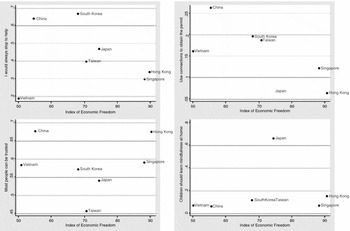
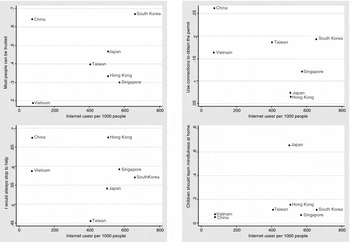
Before implementing a multivariate analysis, we briefly examine simple bivariate relationships between the four dependent variables and the six individual- and society-level predictors, which are our primary concerns here. Figures 1 to 6 describe how the percentages of positive answers in each of the four questions change as the level of globalization at the individual as well as country level deepens. As we expected, we see that social capital with respect to a sense of trust and volunteership positively correlates with some individual-level indicators, whereas social capital in terms of reliance on personal connections and importance of mindfulness show the opposite tendency: they decline as the level of individual globalization increases, or they correlate negatively with globalization. However, the relationship with macro-level globalization is not that obvious.
Support for Globalization Forces Index and Social Capitals
Note: Support for globalization forces index: 0 = lowest; 3 = highest.

Digital Connectivity Index and Social Capitals
Note: Digital connectivity index: 0 = lowest; 6 = higest.

Personal Contant Index and Social Capitals
Note: Personal Contact index: 0 = lowest; 6 = higest.

English Capacity Index and Social Capitals
Note: English capacity index: 0 = not at all; 1 = very little, 2 = well enough to get by in daily life; 3 = able to speak fluently.

Index of Economic Freedom and Social Capitals

Internet Users and Social Capitals

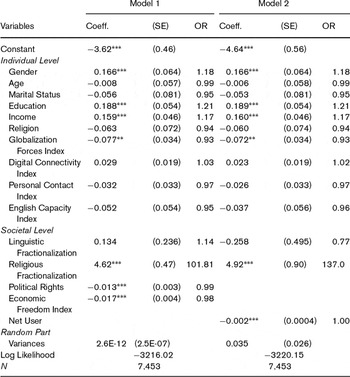
Two level logit regression (random intercept model)
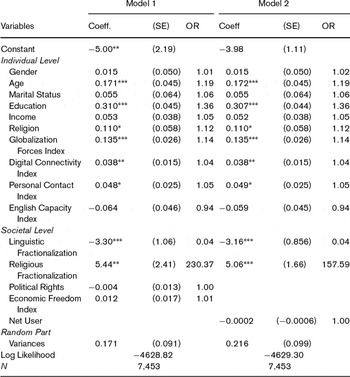
Dependent variable (= 1 if the respondents choose ‘Most people can be trusted’; = 0 otherwise)

Notes:
***Significant at 1% level; **5% level; *10% level.
Standard errors of the coefficients are reported.
OR stands for Odds Ratio.
4 Estimation results
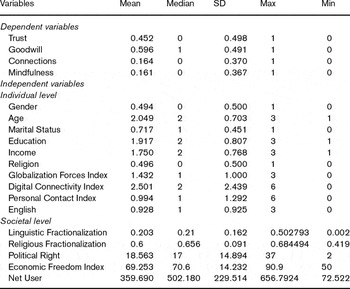
To test the hypothesis, we applied a two-level logit regression with a random intercept model. In order to carry out the logit regression equations working on the two levels, the STATA program is used (Rabe-Hesketh and Skrondal, Reference Rabe-Hesketh and Skrondal2005). Also the descriptive statistics of these variables are indicated in Appendix 1.
Two level logit regression (random intercept model)
Dependent variable (=1 if the respondents choose ‘I would always stop to help’; = 0 otherwise)

Notes:
***Significant at 1% level; **5% level; *10% level.
Standard errors of the coefficients are reported.
OR stands for Odds Ratio.
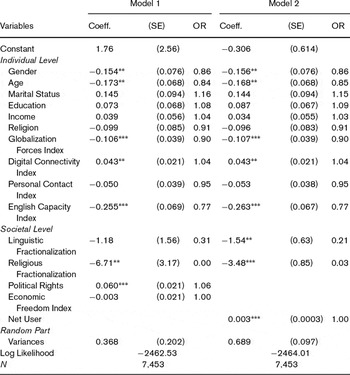
Two level logit regression (random intercept model)
Dependent variable (=1 if the respondents choose ‘Use connections to obtain permit’; = 0 otherwise)

Notes:
***Significant at 1% level; **5% level; *10% level.
Standard errors of the coefficients are reported.
OR stands for Odds Ratio.
Two Level Logit Regression (Random Intercept Model)
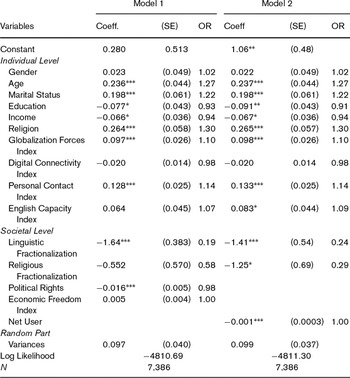
Dependent variable (=1 if the respondents choose ‘Mindfulness’; = 0 otherwise)

Note:
***Significant at 1% level; **5% level; *10% level.
Standard errors of the coefficients are reported.
OR stands for Odds Ratio.
These tables show the estimation results of the two-level logit regression with a random intercept model. According to Table 1, the tide of globalization has a positive impact on the general sense of trust. The coefficients on the Globalization Forces Index, Digital Connectivity Index, and Personal Contact Index are all positive and statistically significant in both models 1 and 2. The relationship with the Globalization Forces Index is very strong with z-score of 5.11. The odds ratio 1.14 indicates that as Globalization Forces Index increases by one unit, on average the respondents are 1.14 times more likely to choose ‘Most people can be trusted’ than to choose ‘Can't be too careful in dealing with people’ and ‘Don't know.’ It would follow that the tide of globalization enhances a sense of trust.
We can see from Table 2 that the estimation results show that the tide of globalization augments goodwill and volunteerism. The estimated coefficients on the Globalization Forces Index and Personal Contact Index are again positive and statistically significant. As the Personal Contact Index increases by one unit, the respondents are 1.14 times more likely to choose ‘I would always stop to help’ than other choices on average.
These estimation results indicate that the tide of globalization reinforces the traditional type of social capital if they are related to interpersonal relations and human nature, narrowly defined (not in a negative meaning) in Western social science.
On the other hand, the estimation results in the third and forth tables indicate that globalization undermines the traditional type of social capital if related to transparency and competitiveness. According to Table 3, the Globalization Forces Index has a negative impact on the dependent variable, which is statistically significant. Thus globalization would threaten the good old practices of familialism and communitarianism.
According to Table 4, the negative coefficients on the Globalization Forces Index and English Capacity Index have stronger effects than the positive coefficient on the Digital Connectivity Index. As the Globalization Forces Index increases by one unit, the respondents are 0.90 times less likely to choose ‘Mindfulness’ than other choices. Thus, the results show globalization undermines the scope for mindfulness to other persons.
The estimation results of Model 1 and Model 2 are qualitatively the same.
Looking at other estimated coefficients in the individual-level independent variables, Age and Education are generally statistically significant and have a positive effect on the dependent variable. In the societal-level variables, Political Right in the first model and Net User in the second model are generally statistically significant and have a negative affect, while Religious Fractionalization has a positive impact on the dependent variable.
5 Interpretation of estimation results
The findings from the previous section are summarized as follows. The tide of globalization enhances the sense of trust and goodwill and volunteerism. On the other hand, the tide of globalization threatens the good old practices of familialism and communitarianism and the scope for mindfulness to other persons.
The sense of trust, goodwill, connection or familialism and mindfulness are all about the traditional type of social capital. However, the first two kinds of social capital are related more fundamentally to human nature and interpersonal relations. Our findings show that these traditional types of social capital would remain, even with the vigorous assault of globalization. In contrast, the findings indicate that the third and fourth traditional types of social capital, which are related inversely to transparency and accountability and competition, would vanish with the steady permeation of globalization.
An interesting question will be why is this the case. In the midst of globalization, people have more opportunities to associate with foreigners in political activities and when doing business. Another question in the AsiaBarometer, regarding the influence of other countries on their own society, reveals that Japan, China, and South Korea usually do relate well to each other. However, this is not necessarily so at the individual level – for example, if a Japanese person made friends with some people from either China or South Korea, a more trusting and cooperative relationship could develop. What is important here is that as people have more opportunities to meet people from foreign countries, they realize that their preconceived ideas about people from a certain country are wrong when they get to know them at the individual level.
Inoguchi (2007a and 2007b) discusses the perceptions of Japan at the individual and state levels due to the influence of the United States. Matsusaka (Reference Matsusaka2004) discusses the possibility that politicians may not represent the opinions of the majority of people even in democratic states due to information asymmetry on both the politicians’ side and voters’ side. Politicians also may follow the model of representation which postulates that politicians should pursue their own ideology to serve the constituents’ interests because voters might make a mistake when casting a vote.Footnote 6 These discussions suggest that the image of the country thus may not match the image of the individual citizen.
In short, with globalization comes better understanding of, and therefore trust in, people from foreign countries, particularly when close friendships are developed with people from overseas. People learn more about the advantages and disadvantages, the strong and weak points, of both their own country and that of their friends. In particular, understanding of the comparative advantages and disadvantages of different countries will lead to the concept of trade, in which people can exchange goods and services. In tandem with the increasing involvement in globalization would develop goodwill, volunteerism and cooperation by appreciating and accumulating knowledge of other countries’ culture, tradition and reality.
On the other hand, although solving the problems of daily life can be best handled firstly by reliance on close family members, relatives and good friends, known as familialism or family-related communitarianism, once away from this narrow but thick communitarian circle, caution, vigilance, and prudence must be exercised. The good old practices of familialism and communitarianism or in a negative form, nepotism and clientelism will be usurped by the steady permeation of globalization. That is, in doing business and trading globally, we need more emphasis on fairness, penetration, and accountability in order to be trusted by business partners and customers. Otherwise, success will be highly unlikely. In an era of globalization, an integrated and sophisticated financial market has developed. Money moved rapidly around the globe, seeking those areas where profits are projected to accrue, but avoiding those where profits least likely to be generated. When faced with globalization, a sense of trust is important, since as Fukuyama (Reference Fukuyama1997) argues, if trust is high, capital business transactions will be more certain, faster, and less costly, while if trust is low, business transactions will be more uncertain, slower, and more costly.
It is of course best to be mindful of other people. Asserting yourself irrespective of other people may not result in a good society. It is best to be sensitive to other peoples preferences and beliefs. This assertion is absolutely true. Most famously, Confucious and Kant echoed this folk view. Confucious from a negative angle, Kant from a positive angle. However, acting mindfully becomes less important as globalization increases. This is because with globalization, the emphasis is more on competitiveness, strength and self-sustainability. Rapid financial markets and highly competitive markets will tend to sharpen the zero-sum profit.
6 Conclusion
This paper considered whether globalization augments or undermines social capital. Relying on traditional Confucian learning, this paper retrieved four questions from the AsiaBarometer Survey 2006, namely, sense of trust, volunteerism, connection or familialism, and mindfulness. Applying two-level logit regression analysis, the estimation results indicate that traditional social capital in terms of human nature and interpersonal relationships would be enhanced by globalization because globalization would make people realize, when they associate with trustful and benevolent foreign friends, that they had been obsessed by an initial bad image of a foreign country. On the other hand, globalization threatens the good old practices of familialism and communitarianism and the scope for mindfulness to other persons because in an era of globalization such concepts as transparency, accountability, competitiveness, strength, and self-sustainability would be more highly evaluated.
The questions analyzed in this paper will be reexamined from different perspectives in sociology, which will be the theory of universalism as opposed to particularism. For example, question 11 will be a more general question, while question 13 will be a more specific question.Footnote 7
Inoguchi (Reference Inoguchi2004), on the other hand, demonstrates that social capital is conceptualized along the three dimensions of interpersonal relationships, merit-based utility, and system-linked harmony. Then Inoguchi argues that these three dimensions would be a proxy for the three major dimensions of social capital: fairness, utility, and institutions. It will be most interesting in analyzing these three dimensions with respect to the tide of globalization and fascinating to ask whether each of the three dimensions is reinforced or undermined by the tide of globalization one by one, and how strong the effects will be. All these analyses will be left to future research.
Descriptive statistics