Why do some national communities, such as Europe’s Roma or the Murcians of Spain, remain politically quiescent, while others, such as the Scottish or Québecois, undergo a ‘Quiet Revolution’ that gives rise to a purely conventional electoral claims-making strategy or a non-violent social movement approach; while others still, such as the Corsicans or Basques, supplement those approaches with violent rebellious tactics? Moreover, why do certain groups, such as the South Tyrolians or the Catalans, flirt with violent rebellion before ultimately renouncing it, while others, like the Tamils or the Chechens, escalate to rebellion and not look back? To begin to answer these questions, we must address three separate issues. First, what impels a particular ethnonational group to begin contending in the first place? Secondly, when a group does choose to contend, why does it choose to employ conventional versus non-conventional forms of contention? And thirdly, under what circumstances does a group choose to intensify – or, conversely, to moderate – its contentious behaviour?
Previous theory-building on this subject has been constrained by the almost exclusive use of dependent variables that focus on only one form of nationalist political expression – voting, protest or rebellion – in isolation from the others. The problem is that the impact of key theoretical variables cannot be compared and contrasted if these forms of contention are viewed in isolation from one another, and neither can the connections among the diverse forms of political expression be ascertained if the actions themselves are examined independently. We posit that the pathways by which actors move up and down the ladder of contention are at least as, if not more, interesting than a group’s static placement on the ladder at any given point in time. The use of previously established dependent variables, however, makes it impossible to examine these pathways.
Consequently, we have developed a new, integrated dependent variable that taps the intensity of the three primary strategic forms of contention on a single scale. Using a multinomial logit technique on original data from the seventeen Spanish autonomous communities over a twenty-year period, we test the ability of the predominant model of regional-level ethnopolitical conflict (developed by Ted Robert Gurr)Footnote 1 to predict the various paths of action measured by this variable. In so doing, we gain something that prevailing tests of ethnopolitical conflict had not been capturing: the dynamic movement of nationalist actors along the numerous pathways of contention. By employing the four primary factors in Gurr’s model – identity, incentives, capacity and opportunities – in conjunction with our framework and new dependent variable, we are able to acquire a better understanding of which features of a group’s environment tend to have an ‘escalatory’ impact on contention (especially repression), and which others have a generally ‘ameliorative’ effect (for example, economic transfers). We find that there are crucial differences in what accounts for a community’s shifts between electoral, protest and rebellious political behaviour.
Interpreting the making of nationalist claims: electoral politics, protest and rebellion
Previous studies of the political expression of nationalist demands centre on explanations of voting patterns, of non-violent social movement protest or of violent anti-state rebellion. One of the most limiting features of existing research is, in fact, this almost exclusive focus on only one strategic form of political activity in isolation from the others. The majority of the literature on conflict processes focuses on the intensity of either nationalist protest or rebellion or, alternatively, on the move from no action to action. The literature on nationalism, in turn, tends to concentrate on case studies of violent and non-violent behaviour or on the likelihood or intensity of electoral participation. The resultant constraint on the building of theory, and in turn on our understanding of nationalism writ large, is considerable.
Our studies would yield greater understanding were we to use theory to more tightly link the diverse political activities of nationalist actors. The conceptual umbrella that permits such a connection is the notion of contentious politics,Footnote 2 which Tarrow defines as ‘collective activity on the part of claimants – or those who claim to represent them – relying at least in part on non-institutional forms of interaction with elites, opponents or the state’.Footnote 3 According to this idea, there is no essential discontinuity between institutional and non-institutional politics; in fact, protest, rebellion and conventional electoral politics should each be viewed as ‘one strategic choice among others’.Footnote 4 Working through the notion of contentious politics, our solution is thus to view protest, rebellion and conventional electoral politics as strategic choices of differing intensity whose ultimate selection is dependent on the identity, incentives, capacity and opportunities of each ethnopolitical community.
The literature also contains useful prototypes of more appropriate empirical and methodological referents. In particular, we could learn from the example of researchers in the domestic conflict processes field, who have in the past attempted to integrate either different forms or levels of conflict. Most notably, the ‘potential for political violence’ scale, the ‘aggressive behaviour index’ and the ‘aggressive’ and ‘democratic’ participation scales of Muller and various co-authors measure the varying intensity of violent and non-violent political protest activity in a single variable.Footnote 5 Davenport, meanwhile, has developed a measure that taps the strategic variety of political activity (encompassing anti-government demonstrations, general strikes, guerrilla warfare and riots) without ordering the intensity of that activity.Footnote 6 And, more recently, Benson and Rochon have developed an indicator of the intensity of conventional and non-conventional protest behaviour in a cross-national setting.Footnote 7 In short, the literature on conflict processes contains important examples of efforts to integrate either the forms or intensity of political behaviour. Unfortunately, such approaches have not crossed over to the study of nationalism.
For this reason, instead of following past practice by examining in isolation levels of electoral contention, the extent of rebellion or the magnitude of protest, we are interested here in something new: the development and testing of a syncretic methodological and theoretical framework that will allow us to examine the continuities and discontinuities between the three primary forms of political expression. When we apply this framework concurrently to the study of the full range of political behaviour of nationalist groups – the participation in electoral politics, the engagement in social movement protest activities and the violent rebellious actions of covert organizations – we can address the fluctuating, multifaceted relationships between institutional and non-institutional politics. We can, in the process, examine whether what motivates groups to engage in electoral politics is the same as what motivates them to engage in protest or rebellion. We can, furthermore, address the fundamental question of what incites nations to intensify or moderate their claim-making behaviour.
Data and specification
To test our hypotheses, we utilize original data gathered from a variety of sources about the seventeen regions in Spain over a twenty-year period (1977–96).Footnote 8 The analysis begins as the democratic transition (1975–82) was in its initial stages and ends after the democratization process had been firmly entrenched, thereby affording ample variation in the regime-level opportunity factors central to the theoretical model. There is considerable cultural, linguistic and economic diversity between the seventeen regions of Spain; many contain a national identity that is culturally and linguistically distinct from Castilian Spain (most notably Catalonia, Valencia, Balearic Islands, Galicia, the Basque Country and Navarre), while others (such as Extremadura and Murcia) have only distinct ‘regional’ identities. In the present test, we make no a priori assumption about the existence or strength of a unique ethnic or national identity in any of the given regions. Instead, our dataset captures this variation both in national identity and in the level of regional-nationalist contention.Footnote 9 We find the Spanish case to be especially rich in that it contains a number of important regional ethnopolitical movements that vary in terms of strength, the use of violence and outcomes.Footnote 10 In order to get a more realistic view of how nationalism does, or does not, develop, we must account for this variation without sampling on the dependent variable.Footnote 11 The present design avoids this problem by measuring contention in all seventeen regions of the country.
Précis of Regional Nationalism in Spain
Much of the last 500 years has involved a struggle over control of Iberia between the ‘Spanish’-speaking Castilians of the geographic and political centre of the peninsula and the ethnic groups at the periphery. The most salient of the latter groups were historically the Basques, Catalans, Galicians, Portuguese, Andalusians, Valencians, Balears, Asturians, Navarrese and Aragonese. Of these, only the Portuguese were successful in forming their own state. The rest, along with several other modifications and additions along the way, continue to be reflected in the modern territorial division of the peninsula.
Iberia has experienced four distinct stages of regional nationalism. First, there was a period of purely cultural and literary expressions that flourished across Europe in the mid-nineteenth century. Secondly, a right-wing, traditionalist phase of political nationalism began at the end of the Spanish-American War and coincided with the political disarray of the early-twentieth century. A third, covert, phase developed under the dictatorship of Franco with the convergence of left-wing non-nationalist and centre-right nationalist political forces in the historic regions of the peninsula. In the fourth, post-Franco phase, these new ‘converged’ nationalist movements have risen as substantial and persistent regional political forces.
By the time el máximo líder died in 1975, nationalist movements, especially in Catalonia and the Basque Country, had already achieved substantial strength. There was a consensus that some form of regional devolution would have to be implemented, and during the slow but steady process of democratization and decentralization known as the ‘Transition’ (1975–82), leaders from both the right and the left worked together to reach consensual agreements on this and other major components of political reform. With an implicit threat of a military coup, reformers had to be particularly mindful of the still considerable power of entrenched reactionary forces. The Constitution thus represented a compromise between right-wing groups, who desired a centralized Spanish state, and leftist and nationalist forces, who favoured a federalist state.Footnote 12 A trade-off was reached in the stipulation that, while there was one Spanish ‘nation’, there were several distinct ‘regional’ identities that deserved recognition via the creation of ‘autonomous communities’. The Constitution states: ‘The Constitution is based on the indissoluble unity of the Spanish Nation, common and indivisible fatherland of all Spaniards, and it recognizes and guarantees the right of autonomy of the nationalities and regions that comprise it, and the solidarity among them all.’Footnote 13
Political leaders were intentionally vague regarding the ostensibly contradictory aims of autonomy and unity contained in this Constitution.Footnote 14 The word ‘autonomy’, in fact, is never explicitly defined. Moreover, the Constitution does not specify the organization of the regions: it ‘does not stipulate their number, rights, or relationships with the central state or other regions’.Footnote 15 Still, over the course of the Transition, Spain was transformed from a centralized state to a quasi-federal one; by February 1983, it had effectively been divided into seventeen autonomous communities to which a fair amount of the federal government’s powers, in a still ongoing process, were to be devolved.
These concessions to the regions did not, however, signal the end of regionalist demands. At the root of much of the conflict was the ‘asymmetric’ quality of the decentralization. The Constitution had created two different tracks to gaining autonomy, with a ‘fast track’ accorded automatically to the three ‘historic communities’ of Galicia, the Basque Country and Catalonia, as well as two different systems – a foral regime for Navarre and the Basque Country and a common regime for the rest.Footnote 16 Moreover, within the common regime, five regions (Catalonia, Valencia, Galicia, Canary Islands and Andalusia) took a quicker ‘high responsibility’ route to the transfer of powers, while others pursued the assumption of responsibilities under a different, more gradual, path.Footnote 17 In brief, the distribution of rights, responsibilities and money proceeded unevenly across regions, and with an overall context of asymmetric decentralization, most regions’ dependence on transfer payments from Madrid, contentious inter-territorial ‘solidarity’ funds and continual arguments about fiscal ‘imbalances’ between the regions and the central state, the stage was effectively set for protracted negotiations and conflict between Madrid and the regions.Footnote 18 The issue of central transfers, in particular, was one of the biggest irritants in centre–periphery relations during the period under examination.
Whatever the cause was, the democratization and decentralization of the state were characterized by several important transformations in regional nationalist political behaviour. First, nationalism diffused to other previously quiescent regional communities. This encompassed not only electoral nationalist claims, but also non-violent contentious politics in such regions as Valencia, Aragon, Andalusia and the Canary Islands. More perverse was the development of violent new nationalist groups (now defunct) during and after the Transition in the Canary Islands (1976), Catalonia and Valencia (1980) and Galicia (1987).
In short, what we see is that the processes of democratic transition, decentralization of powers and centre–regional conflict were not ‘complete’ in 1983, which makes it of further interest to examine regional–nationalist phenomena in Spain over a longer period of time. Our model and independent variables capture critical factors in this evolutionary process of conventional and non-conventional centre–region interactions over a twenty-year period.
Gathering the Data
As we describe in the next section, in order to create a dependent variable that integrates electoral, protest and rebellious behaviour in a single scale, we first gathered data separately on the levels of voting for regional nationalist political parties and on the number of violent and non-violent contentious actions undertaken by regional nationalist actors throughout Spain from 1977 to 1996. The heart of this data-gathering effort was the contentious-event data that were derived from a non-sampled investigation of the annual indices to the Spanish daily newspaper El País. These annual indices contain categorized summary reports of all the articles appearing in the print version, and include sufficient information on the time, place, actions, actors and incidents surrounding each episode to permit a valid operationalization of each event.Footnote 19 A sample of these index reports (with translations in parentheses) from 1977 highlights the diversity of actions and targets undertaken by budding ethnonationalists in the atmosphere of a rapidly democratizing country:
— 1/5/1977: Estalla una bomba en las oficinas de una compañía aérea en Las Palmas cuya autoría se adjudica el MPAIAC (a bomb exploded in the offices of an airline company in Las Palmas, attributed to the MPAIAC, el Movimiento por la Autodeterminación e Independencia del Archipiélago Canario).
— 3/29/1977: Violentos incidentes en Barcelona tras la celebración de una manifestación catalanista (violent incidents in Barcelona after the holding of a pro-Catalan demonstration).
— 4/5/1977: Protesta multitudinaria en Bilbao reivindicando la ikurriña, la cooficialdad del euskera y la amnistía total (A protesting mob gathered in Bilbao demanding recognition of the Basque national flag, the official recognition of the Basque language equally with Spanish and total amnesty for Basque political prisoners).
— 6/19/1977: Atentado de ETA sin víctimas contra el coche de un policía armado en Bilbao (terrorist attack without death or injury against the car of an armed police officer in Bilbao).
— 9/27/1977: Diez mil personas asisten a una manifestación celebrada en Burgos a favor de la autonomía de Castilla y León (10,000 people attend a demonstration held in Burgos in favour of autonomy for Castille and León).
— 10/18/1977: 15.000 personas en una manifestación en Guipúzcoa a favor de las ikastolas (15,000 people hold a demonstration in Guipuzcoa in favour of ikastolas, schools that provide education entirely in Euskera, the Basque language).
— 11/13/1977: Enfrentamientos entre la policía y grupos de manifestantes durante una manifestación abertzale en San Sebastián (confrontations between police and groups of demonstrators during a Basque nationalist demonstration in San Sebastian).
— 12/20/1977: Voladura de una estación de radio en Tenerife a cargo de un comando del MPAIAC (radio station in Tenerife blown up by a commando unit of the MPAIAC).
We recorded information on 4,267 such nationalist contentious events throughout Spain between 1977 and 1996. Using the same classificatory scheme for each event as the Minorities at Risk project,Footnote 20 non-violent events were coded as ‘protest’ (n = 2,071) and intentionally violent events as ‘rebellion’ (n = 2,196), and each event was assigned a single ‘region’ label according to which of the seventeen Spanish regions formed the basis of support for the action; i.e. protest demonstrations undertaken by ‘Galician’ ethnopolitical actors were counted as ‘Galician’ protest events, wherever the action took place. In practice, in our dataset the region on behalf of which an organization struggles is almost invariably the same as that in which the event takes place. The primary exception is the Basque Country, because Euskadi Ta Askatasuna (ETA), a Basque organization fighting to win an independent state, carried out violent ethnopolitical actions throughout Spain, and these bombings are all counted as ‘Basque’ events.
Our raw data show that the entire post-Franco period is notable for the sustained ethnonationalist contentious actions – ranging from small and spontaneous to massive and organized; from peaceful petitions to bloody executions; and from non-violent exchanges to violent inter-group clashes – that have had an impact on numerous regions throughout the country, some of which had never before been noted for nationalist tendencies. The point is, whenever a region chooses to act, or not to act, on its nationalist potential, it is difficult to predict a priori the form and intensity of contention that will predominate.
Dependent variable: the intensity of nationalist political expression
As argued earlier, we believe a constraint on previous theory-building efforts has been the almost exclusive use of dependent variables that focus on only a single form of nationalist political expression – voting, protest or rebellion – in isolation from the others. We could have followed past practice and examined in isolation the extent of rebellion, or levels of electoral contention or the magnitude of protest; our central aim here, however, is to help address this collective ‘single-strategy’ constraint in previous research by measuring something new, something that prevailing tests of ethnopolitical conflict have thus far been unable to capture: the dynamic movement of nationalist actors up and down the ladder of contention. For this very reason, our solution is to develop an integrated dependent variable that taps the intensity of nationalist contention in a single scale.
The analytical focus here is on the level of contentious activity within entire national communities (also referred to here as ‘groups’), such as the Basques, rather than on the activities of specific nationalist organizations (such as ETA) acting within those communities (a focus on the latter would require a different set of theoretical tools and also invite analysis of different actors, especially elites, in the political process). A national community is not a homogeneous entity; there can be numerous organizations, each with distinct strategies and goals, operating on its behalf at any given time. The community-level study conducted here focuses on the determinants of the aggregate of these organizations’ contentious actions.
To create our measure of Nationalist Political Expression, we first had to establish when nationalists in each of the seventeen communities had engaged in contentious electoral, protest or rebellious activities. To measure electoral strategies, we examined data on all regional elections in the post-Franco era.Footnote 21 Whenever the regional vote for nationalist political parties – such as the Basque Nationalist party in the Basque Country or the Valencian Nationalist Bloc in Valencia – exceeded a 5 per cent threshold for political party representation (i.e., when the vote was effectively sufficient for a nationalist party to acquire a seat in a regional parliament),Footnote 22 we considered that community to have generated an ‘electoral’ strategy.
To measure the occurrence of protest and rebellion strategies, we utilized the ethnonationalist contentious event dataset described earlier, and considered a regional community to have used a ‘protest’ strategy for each year it generated two or more protest events, and a ‘rebellious’ strategy whenever it generated at least two rebellious events.Footnote 23 We then use these data to create an integrated scale of nationalist political expression. Using a scaling procedure similar to that employed by Muller,Footnote 24 Barnes and KaaseFootnote 25 and Benson and Rochon,Footnote 26 for each year we assign every community one of the following scores depending on the highest level of political expression that takes place:
0. no claims-making (no nationalist contention)
1. electoral (nationalist parties obtain 5 per cent or more of regional electoral vote)
2. protest (two or more nationalist protest events)
3. rebellion (two or more nationalist rebellious events).
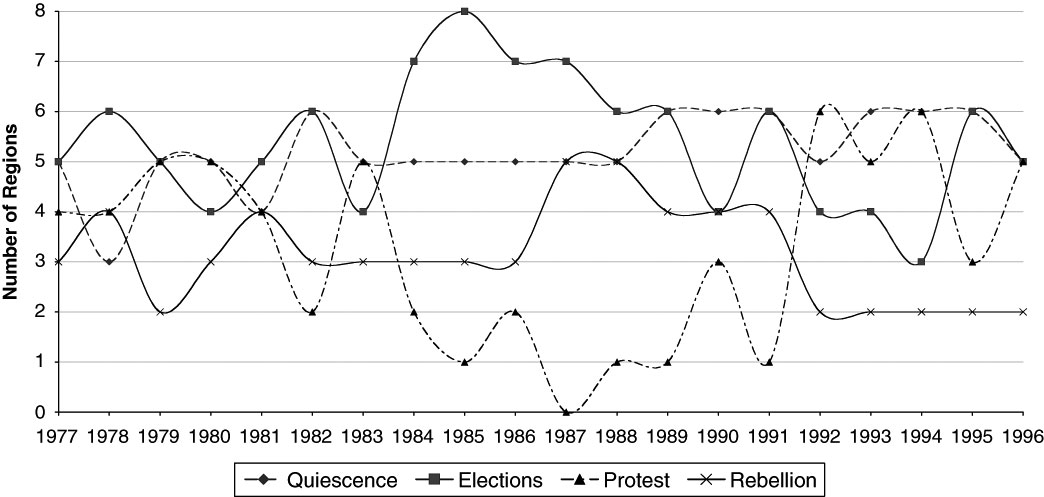
Each region’s yearly expression score is thus dictated by its most militant political manifestation of nationalism. Figure 1 shows the number of communities coded at each level annually from 1977 to 1996. As illustrated in the figure, there is a great deal of variation in the form of expression of nationalist demands both across time and across regions. Immediately striking is that rebellion is never used exclusively by Basque separatists: in any given year, between two and five regions are coded as having a ‘rebellion’ strategy (i.e., rebellion is the highest level of action) and, over the course of the study, rebellious tactics are used by organizations working on behalf of six of the seventeen autonomous communities. Electoral and protest activity are more diffuse: each is manifest in twelve of the regions over the course of study and, in any given year, between three and eight are coded as having an ‘electoral’ strategy (i.e., electoral strategy is the highest level of action), between zero and six are coded as having a ‘protest’ strategy (i.e., protest is the highest level of action), and between three and six are coded as ‘quiescent’ (none of the above strategies are pursued). Only three regions – Murcia, Madrid and Castile-La Mancha – failed to generate any form of nationalist contention between 1977 and 1996.
Number of regions at each level of expression, 1977–96
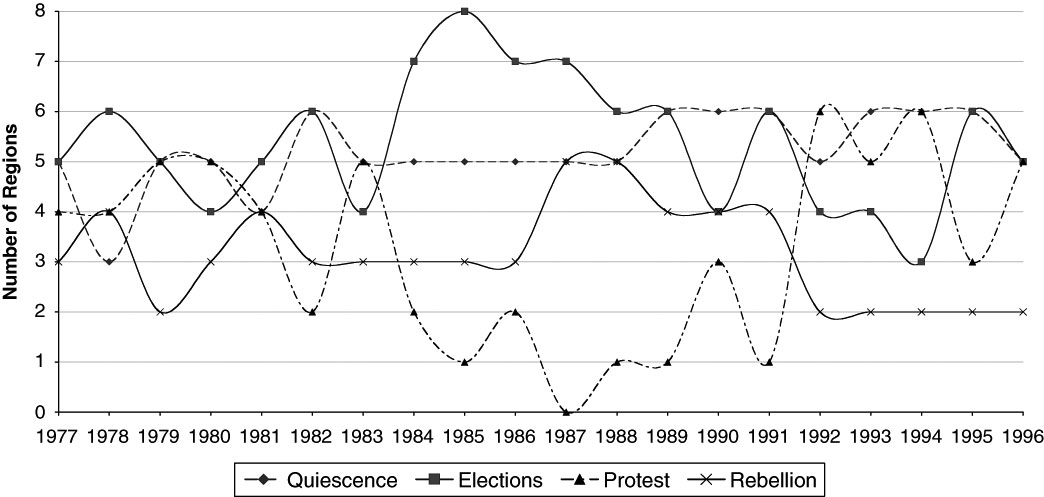
The development and spread of nationalism within Spain has therefore been highly diverse across regions. For example, over the twenty years of this study, Castile-La Mancha never pursued regionalist demands, while La Rioja has always pursued such demands electorally, and the Basques have always employed rebellious tactics. In addition, there has been important temporal variation within regions. Our dataset shows that the Balearic Islands use a predominantly electoral strategy but flirted with protest in the 1990s, while Asturias moved from periods of quiescence straight to protest and the Canary Islands moved from rebellion to electoral contention to quiescence, and then undertook protest along with electoral tactics in the 1980s and 1990s. This article aims to address the causes of these differences in contention. We posit that, theoretically, Gurr’s approach is well suited to account for the impact of the post-Franco political opportunity structure on ethnonationalist action.
Accounting for intensity: identity, incentives, capacity and opportunities
The theoretical model we employ to explain the intensification and moderation of contentious nationalist behaviour is the model that is now predominant in explaining regional-level ethnopolitical conflict, as developed by Ted Gurr.Footnote 27 Using this well-known model will help us see both what is missing in earlier tests of ethnonationalist political behaviour as well as what is gained through our enhanced framework and research design. At the core of Gurr’s model is a theoretical synthesis of the central concepts of the three main approaches to understanding civil conflict – mobilizational capacity from resource mobilization,Footnote 28 incentives (primarily grievances) from relative deprivationFootnote 29 and opportunities from structural political opportunity theory.Footnote 30 The chief theoretical adaptation to the model supplied by the nationalism literatureFootnote 31 is the importance placed on group identity and cohesion in facilitating ethnopolitical mobilization and rebellion.Footnote 32 In short, Gurr posits that ethnopolitical protest and rebellion are more likely to develop within those groups that have the strongest, most cohesive identities; the greatest extent of grievances supplying the incentive to organize; the most elaborate networks and leadership capabilities that give them the capacity successfully to mobilize; and a set of external political factors furnishing the opportunities to mobilize against the state.
We describe below our measurement procedures for each of these four factors.Footnote 33 The unit of analysis is the region/year; variables are coded individually for each of the seventeen regions each year, for a total of 340 observations.Footnote 34
Identity
To begin with, we operationalize identity with both a ‘subjective’ and an ‘objective’ measure, which collectively should provide insights into the extent to which contentious activity is dependent on psychological and historical conceptions of a distinct regional identity. The first is a survey-based indicator (Identity) that reflects the percentage of each region’s population that believes their region to be a distinct ‘nation’ rather than a mere ‘region’ of Spain. Such an indicator makes sense in the Spanish context, where residents are particularly cognizant of the different political ramifications of a ‘region’ (región) versus a ‘nation’ (nación). The greater the number of people with such a strong subjective adherence to the regional national identity, the easier it will be for nationalist organizations to mobilize the community at large.
The second indicator is Castile, a dichotomous variable (1, 0) denoting the five autonomous communities that comprise the historic Castilian ‘centre’ of Spain – Cantabria, La Rioja, Castile and Leon, Madrid, and Castile-La Mancha. Given their history as the cultural and political ‘core’ of the country, these regions should be much less likely to give rise to ethnonationalist political activity; in contrast, the remaining twelve regions are the historic ‘periphery’, whose residents should be more prone to retain or develop a distinct regional identity.
Incentives
Gurr posits three basic categories of grievances that lend a group the incentive to mobilize for political action: (1) collective disadvantages in material, cultural or political circumstances; (2) the loss of political autonomy; and (3) government use of force.Footnote 35
Collective disadvantages – regional gross domestic product, unemployment and central transfers
We measure ‘collective disadvantages’ through a series of three indicators that tap inter-regional inequalities in material well-being.Footnote 36 First, in line with Gurr’s argument that unequal economic growth sharpens the communal sense of relative deprivation,Footnote 37 we posit a strong negative role for regional income or gross domestic product (GDP) per capita in the mobilization of grievance. Regional economic disparities in Spain are stark compared to other European countries. The values for this variable range from a low of 61.43, for Extremadura in 1977, to a high of 151.85, for the Balearic Islands in 1996. One interesting feature about modern Spain is that there continues to be a divide between ‘rich Spain’ and ‘poor Spain’. Starting at Asturias in the Northwest, the imaginary dividing line between these two would travel down to Madrid in the centre of the country and then to Valencia on the East coast. To the west lie the regions of ‘poor Spain’ – Galicia, Asturias, Extremadura, Andalusia, Cantabria, Castile–La Mancha, Castile and Leon, Murcia and the Canary Islands. To the east of this line lie the regions of ‘rich Spain’ – Valencia, the Balearic Islands, Madrid, Aragon, La Rioja, Navarre, Catalonia and the Basque Country. What distinguishes Spain from many other countries in this regard is that the regions of ‘rich Spain’, with the exception of Madrid and tiny La Rioja, comprise regions in which ethnonationalist sentiment has traditionally been strongest.
We also believe that the astonishingly high regional rate of Unemployment that plagued many regions of Spain in the 1980s and 1990s could provide a potent material incentive for collective action. Lastly, we posit that a redistribution of economic wealth could dampen a region’s motivation to contend. Therefore, we include a lagged measure of Central Transfers, the total amount of central government funds transferred annually (in millions of 2002 euros) to each of the seventeen regions. Given both the importance of these funds and their earlier noted role as a continual irritant in centre–periphery relations during the period covered by our study,Footnote 38 this variable should play a strong role in the generation of regional nationalist demands.
Political autonomy grievances
The second category of incentives derives from resentment over the loss of political autonomy.Footnote 39 In response to a predominant usage of objective yet indirect indicators of grievances in the literature, Gurr set out to measure ‘active’ political autonomy grievances – those that are actually felt or expressed by political actors – directly.Footnote 40 We employ a similar measure here (Political Autonomy Grievances) by summing the percentage of residents in each community who respond in favour of federalism or independence in periodically recurring surveys. These respondents desire greater autonomy for their home region than that allowed for under current ‘quasi-federal’ arrangements; they presumably feel, by extension, a sense of autonomy-related grievance that could lead to mobilization into nationalist organizations.
Repression and use of force
To measure this third category of incentives, we employ two variables derived from the ‘protest policing’ approach used in Davenport,Footnote 41 BeissingerFootnote 42 and della Porta and Reiter.Footnote 43 First, the Rate of Repression taps restrictions on political activity through the annual number of arrests, injuries or deaths attributable to the state that occur per nationalist protest event in each region. Secondly, because the regional rate of repression will always be ‘0’ unless a community has actually generated protest (which would effectively cancel out any understanding of the impact of repression on the escalation to electoral nationalism or protest), we also use the National Rate of Repression, the annual rate of arrests, injuries and deaths per protest event for all other regions in Spain.Footnote 44 Both variables are lagged to guard against reverse causality and to ensure that past repression is impacting current nationalist political expression.Footnote 45
Capacity
In addition to the strength of the ethnopolitical identity, three of the most powerful determinants of a regional group’s mobilizational capacity are size, territorial concentration and control over a regional government.Footnote 46 The latter two are constants for the groups in this test: all are territorially concentrated and, since the early 1980s, have attained some autonomy in the form of regional governments. Accordingly, the best way to tap variation in mobilizational capacity is with Relative Population, each region’s proportion of the population of the whole country. In line with several recent empirical tests,Footnote 47 we assume Gurr’s logic that proportionately larger groups ‘are more likely than small groups to mobilize for substantial political action’.Footnote 48
Opportunities
While identity, incentives and capacity are more important in determining a region’s latent ‘mobilization potential’, political opportunity structures (POS) have a primary impact on the timing and strategic choice between electoral participation, protest and rebellion. In line with other literature,Footnote 49 Gurr posits six key characteristics of the state and the ethnopolitical group’s external relationships as being critical in determining group opportunities to engage in contentious political behaviour: the contagion or diffusion of communal conflict, the expansion of state power, the level of institutional democracy, regime durability, the extent and direction of regime change, and support from external actors. We include all except the last, since none of the groups receive support substantial enough to impact the intensity of political expression.Footnote 50
Level of Democracy, Democratic Durability and Democratic Regime Change
In Minorities at Risk, Gurr argues that the values and institutions of democracy tend to pacify the rebellious tendencies of potentially violent ethnic communities in so far as democratic states are less likely to rely on coercive means of social control.Footnote 51 He further argues that the more durable the democratic regime, the more pronounced the characteristic practice of democratic accommodation under pressure becomes.Footnote 52 In either case, claims-making is effectively channelled towards conventional and non-violent unconventional forms of expression. As a result, both Democracy, Polity’s annual indicator of regime openness, and Democratic Durability, a dynamic measure of the number of years the country goes without major or abrupt change in its political institutions after a transition to democracy, should have a positive relationship with electoral expression and protest but a negative relationship with rebellion.
Conversely, as Gurr and othersFootnote 53 have found, the instability and insecurity engendered by democratic regime change can create a substantial, albeit transient, increase in the opportunities for group mobilization and contention.Footnote 54 We therefore expect our measure of Democratization, the year-to-year change in the democracy score, to be positively associated with all levels of contention.
Contagion
In ‘contagion effect’ arguments, ethnopolitical conflict in other regions provides an action model or ‘signal’ for other potential contenders, especially comparable groups in the same country.Footnote 55 We thus expect Contagion, the average annual Expression score in neighbouring regions, to be positively associated with the intensity of ethnopolitical strategic behaviour.
Nationalist Representation in Government
Lastly, we include a measure of the scope of state power. Gurr, Lindström and Moore, and Gurr and MooreFootnote 56 found that rebellion diminishes the more thoroughly a state penetrates society, but the role of the variable as they operationalized it was primarily to delineate ‘hollow’ developing states from the far-reaching states of the developed world.Footnote 57 Since the Spanish state has a high level of capacity throughout the time frame of the study, such a traditional ‘state power’ variable would be inappropriate. We have, however, created a measure for that facet of power related to state attempts to assimilate minority ethnopolitical groups and to restrict their collective autonomy and political access.Footnote 58 Our Nationalist Representation scale (0–5) measures this by tapping the extent to which ethnopolitical groups’ interests are incorporated into the state’s political decision-making processes, as reflected by nationalist political party involvement in the regional government. The logic is that, to the extent a region’s demands can be met via conventional means – such as occurs in federal systems – there is less reason to resort to non-conventional claims-making in the form of protest or rebellion.Footnote 59
Estimation and results
Our dependent variable, Nationalist Political Expression, is categorical and hence requires a Maximum Likelihood Estimation procedure. Recall that communities are assigned annually a value from 0 to 3 depending on the highest level of political expression that takes place.
An approximate likelihood test suggests that the independent variables do not have a uniform effect on different categories of the dependent variable. In addition, Hausman testsFootnote 60 for the independence of irrelevant alternatives (IIA) assumption illustrate that the dependent variable outcomes are distinct and that an estimation technique for nominal (rather than ordinal) outcomes is appropriate.Footnote 61 The determinants of contention, therefore, do not have a statistically similar effect in moving groups from one type of action to another.
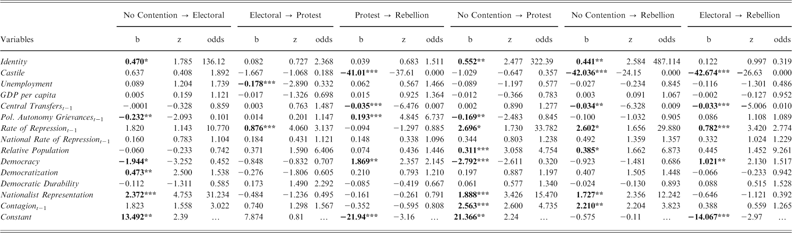
We consequently employ a multinomial logit (MNL) model with Huber–White corrected standard errors clustered on the region for all estimations. In so doing, we are able to capture the odds of moving between categories of contention as a result of the influence of the independent variables. Table 1 illustrates how each of the independent variables changes the odds of moving from no political expression to electoral contention; from electoral to protest behaviour; and from protest to rebellion. As implied in our discussion above, we also find it instructive to look at the outcomes of the moves from no action to protest; from no action to rebellion; and from electoral to rebellious action. Overall, these logit coefficients along with the associated odds ratios tell us how changes in the identity, incentives, capacity and opportunities of ethnonational communities affect their odds of moving up and down the ladder of contention.Footnote 62 The results below illustrate a large variation in effects of the various identity, incentive, capacity and political opportunity structure variables on the four different levels of contention.
Multinomial Logit on Level of Nationalist Expression in Seventeen Regions of Spain, 1977–96
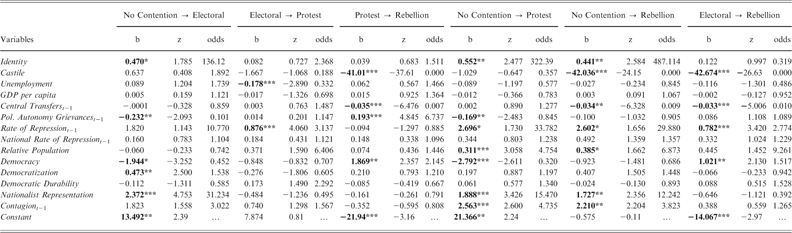
Notes: Log Likelihood, −213.541, χ 2 = 447.84***, N = 323, Pseudo R 2 = 0.512, *p ⩽ 0.1, **p ⩽ 0.05, ***p ⩽ 0.01 for two-tailed tests of significance.
Identity
We find that the stronger the subjective group identity, the more likely it is that a group will be engaged in contentious action – electoral action, protest or rebellion – rather than remaining politically quiescent.Footnote 63 Objective conceptions of identity, by contrast, obtain a different pattern. Castile is significant only (albeit importantly) in reducing the likelihood of a region developing rebellion over all other forms of contention – whether protest, electoral contention or quiescence. In fact, its effect is strong enough for it to be almost wholly unlikely that the historical, political and cultural ethnonational groups that make up the Castilian core of the country would choose to employ a rebellious strategy.
Incentives
We examine three measures of collective disadvantages. To begin with, Unemployment obtains a significant negative coefficient only with the electoral contention versus protest outcome. GDP per capita has no significant impact on contention. These two forms of economic grievances thus have little effect on ethnonationalist contention. The extent of Central Transfers, however, has a consistently important effect on moving groups away from rebellion. These findings suggest the possibility that groups place more weight on grievances that are directly traceable to central government policies than to those that are also likely to have a strong basis in the economic infrastructure and policies of the autonomous communities themselves.
We next focus on both subjective and objective measures of grievances related to political autonomy. Since autonomy-seekers should be those most amenable to mobilization into both conventional and non-conventional political organizations, we first expected that those communities with the greatest percentage of autonomistas and independentistas (as measured by Political Autonomy Grievances) would contain more intense levels of political expression. The findings here suggest that, controlling for the other structural and political factors, subjective levels of autonomy-related grievances are not overly powerful.Footnote 64 In fact, higher grievance values render the community more likely to remain politically inactive than to engage in either electoral or protest politics. Only in differentiating protesting from rebelling regions does the variable obtain a positive relationship with conflict escalation.
In addition, we included two measures of repression. The National Rate of Repression does not have a significant effect on action at any level. However, the direct repression of members of an ethnopolitical group (as measured by the region-specific Rate of Repression) is shown to have an important positive impact in moving groups up the ladder of intensity. Overall, a state that kills, wounds or arrests protesters increases the likelihood of the occurrence of protest and rebellious ethnopolitical contention over both no action and electoral action.
Taken as a whole, these variables clarify how incentives actually affect nationalist expression. More abstract, indirect causes of ethnopolitical grievances, such as the level of regional unemployment, disparate levels of economic development, how repressive the government is overall or the desire to obtain more regional autonomy, generally do not affect expression and occasionally even decrease the likelihood of electoral or protest action. Since a smaller GDP, higher unemployment levels and a more intense national rate of repression cannot be said to be aimed specifically at one’s own ethnopolitical movement, it is perhaps not surprising that they generally fail to intensify levels of contention. Likewise, the subjective desire to obtain more regional autonomy may be too soft an incentive to push a group over the threshold of quiescence to action. In short, it seems as if there must literally be a ‘smoking gun’ for the motive for contentious action to either materialize or de-materialize. In consequence, focused government repression involving the wounding, killing and arresting of protesters leads to an almost certain future of ethnonationalist contention and a progression from conventional electoral expression to more militant forms of contention. On the flip side of the coin, the direct disbursement of federal government money, via central transfers, appears to act as a consistent disincentive to rebellion.
Capacity
As mentioned earlier, all of the groups have a high level of, yet constant, absolute capacity in terms of territorial concentration and control over an autonomous regional government. What the results show here is that variation in capacity in the form of relative population is of some import in determining the progression of contention. Larger relative populations are associated with increased likelihoods of rebellion and protest over no contention.
Political Opportunity Structure
We examine three key factors tapping the democratic nature of the state. The level of Democracy has the surprising effect of significantly increasing the likelihood of rebellion over either an electoral or a protest strategy and decreasing the odds of electoral participation and protest over no contention. And for a quiescent community, Democratization significantly increases the likelihood of escalating to electoral expression. The durability of democracy, however, has no effect on contention. While these results do not fully support Gurr’s hypotheses, the findings may be explained by his argument that democracy is actually ‘a proxy variable for state preferences for policies of accommodation vs. repression, and that it is the mix of the latter rather than democratic institutions per se which affects conflict strategies’.Footnote 65
The two remaining POS variables have a much more important and consistent impact on ethnonationalist expression. Both the extent of regional political control (Nationalist Representation) and the average level of ethnonationalist voting, protest and rebellion in neighbouring regions (Contagion) have an incendiary effect on expression versus no contention.
Predicted Probabilities
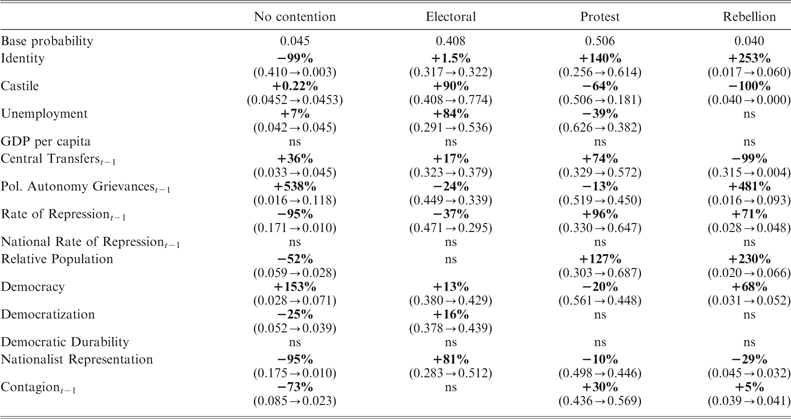
Table 1 describes the odds of one type of contention versus another as derived from the multinomial logit estimation, and therefore allows us to examine the effects of variables on one level of contention relative to another. These results are essential in examining the effect of diverse variables on the likelihood of groups’ movements along the ladder of contention. Nevertheless, many find an examination of the plethora of multinomial logic coefficients to be tedious. Consequently, we also present the predicted probabilities of no contention, electoral action, protest and rebellion in Table 2.
Change in the Predicted Probability of Contention for a One Standard Deviation Increase of Independent Variables around the MeanFootnote *
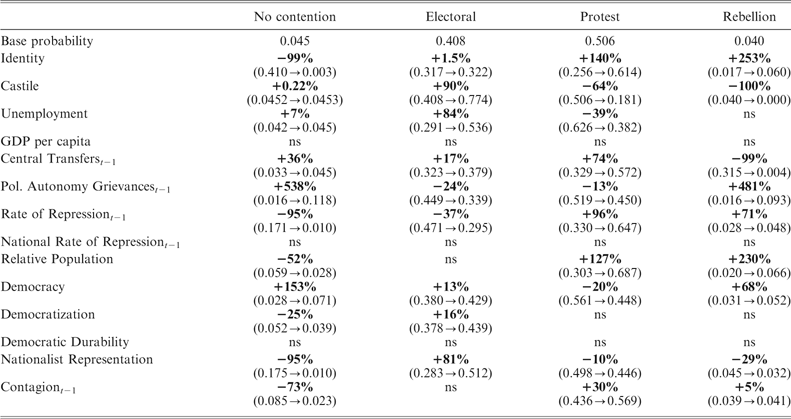
* Changes in predicted probabilities calculated in the difference from 0.5 s.d. below the mean to 0.5 s.d above the mean for each independent variable, except Castile (one-unit increase). Base probabilities are calculated with continuous independent variables set at their respective means, with Democracy, Democratic Durability, and Democratization at approximately mean values (i.e., 10, 8, 0) and Castile at 0.
This table illustrates the substantive effect of the independent variables on the probability of contention at different levels when the independent variables are set at specific values. We focus here on the change in predicted probabilities of contention for the average non-Castilian region for a set change in independent variables.Footnote 66 In each cell, the predicted percentage change in probabilities is presented in bold, while the actual probability levels are in parentheses. The top row of Table 2 presents the base predicted probabilities of different levels of contention, which clearly illustrates that the probabilities of no contention and rebellion, on the one hand, are very low (0.045 and 0.040, respectively). Electoral contention and protest, on the other hand, are more common, with predicted probabilities at 0.408 and 0.506, respectively.
Several variables have important effects on contention. Not surprisingly, for electoral contention, representation appears to beget representation, where an increase in democratization as well as prior nationalist representation at the regional level pushes groups towards electoral action and away from quiescence. Additional important variables include Castile, Relative Population, Identity and Political Autonomy Grievances. However, from a policy standpoint, these variables are either impossible or difficult for a government to change (as is the case for Castile and Relative Population) or are generally outside the scope of government control (as with Identity and Political Autonomy Grievances). We consequently pay particular attention to two variables that are direct results of government policies – namely, Repression and Central Transfers – on protest and rebellion, respectively.
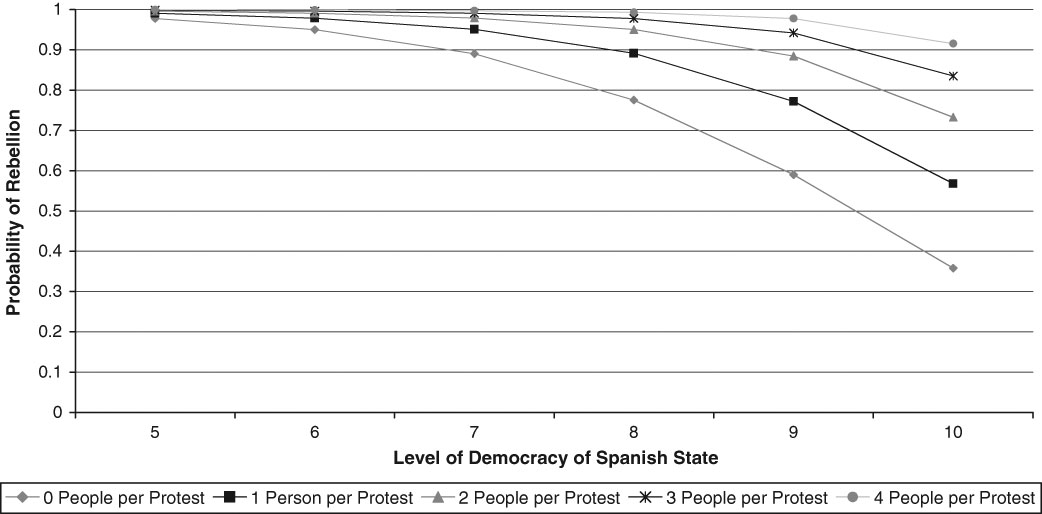
In Figure 2, we look at the effect of different levels of Repression, for different levels of Democracy, on the predicted probability of protest. For these examples, we examine the case of an average non-Castilian region with slightly elevated levels of Identity, which we find to be an important motivator for contention.Footnote 67 As regards nationalist sentiment, Figure 2 presents an example of regions such as the Canary Islands and Navarre, both of which have slightly elevated Identity scores (Galicia, Catalonia and the Basque Country, for example, each have higher scores, with values of 16.67, 37.33 and 35.33, respectively).
Predicted probability of protest for different levels of repression and democracy
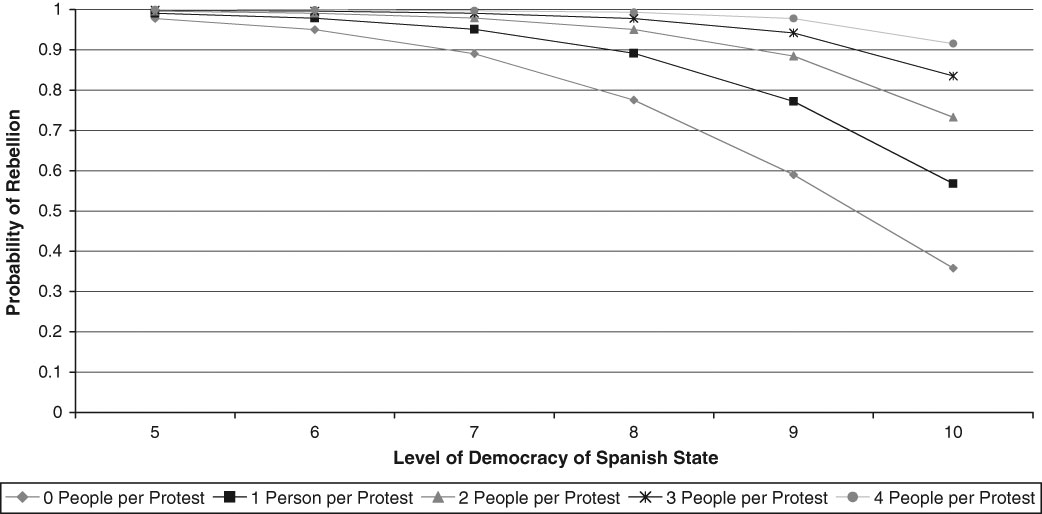
In essence, Figure 2 illustrates the interaction between democracy and repression in these non-Castilian cases. While protest is almost certain for lower levels of democracy regardless of the level of repression (for example, Spain in 1977), it becomes less and less likely at the highest level of democracy (for example, Spain from 1982 onwards) when paired with low levels of repression. However, the level of democracy has surprisingly little ameliorative effect on the probability of protest at higher levels of repression, when four or more people per protest are arrested, wounded or killed.Footnote 68 The findings here illustrate that, for current democracy levels in Spain, every additional person arrested, wounded or killed increases the probability of protest substantially. Indeed, for non-Castilian regions in a highly democratic Spain, the predicted probability of protest is over 0.50 for one person repressed and jumps to over 0.90 for four people.
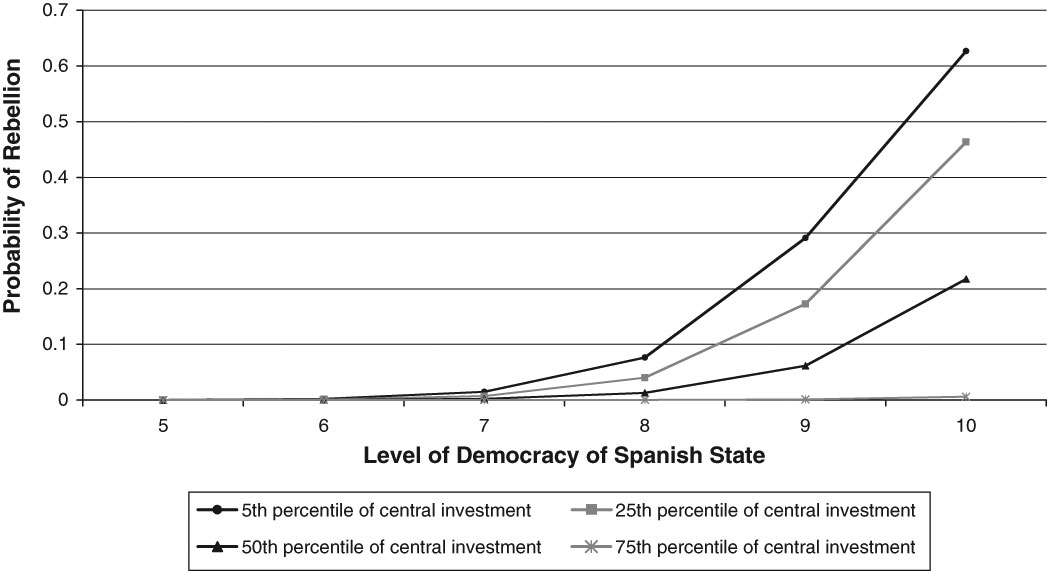
Figure 3 illustrates the effects of central investment on rebellion for different levels of Democracy. We set Central Transfers at its 5th, 25th, 50th and 75th percentiles. What is immediately apparent is the surprisingly positive relationship between democracy and rebellion. The important interactive effect between democracy and central investment is also clearly illustrated here. At higher levels of democracy, the predicted probability of rebellion ranges from 0.006, when central investment is very high (as is the case for Andalusia, Aragon, Castile and Leon, and Madrid, for example), to 0.63, when investment is very low (such as in the Canary Islands).
Predicted probability of Rebellion for different levels of central investment
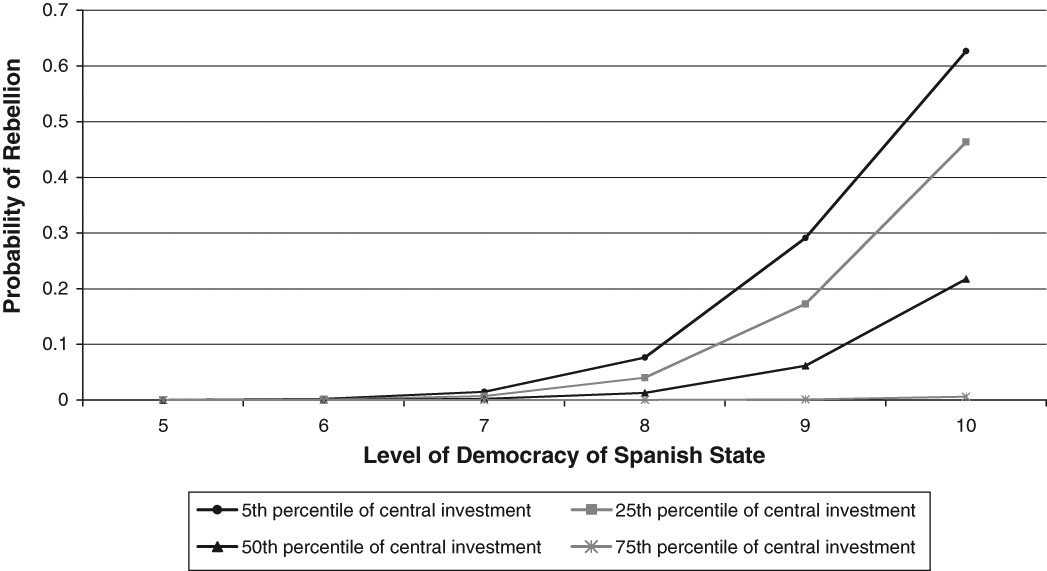
This finding has two interesting implications, depending on whether ethnonational groups focus on absolute or relative benefits. If the former, then the central government could attempt to ‘buy its way’ out of rebellion by simply increasing the levels of central investment in rebelling regions. However, work on relative deprivation, among other things, suggests that regions are not mobilized so much by absolute benefits as they are by relative benefits. Given the almost certain lack of perfectly equitable central transfers, some regions will always feel relatively deprived compared to others. Consequently, the state should be strategic in its disbursement of funds; ceteris paribus, relatively more funds should be transferred to regions that have other hallmarks associated with rebellion (for example, high levels of identity, political autonomy grievances and repression), such as Galicia, Navarre, Catalonia and the Basque Country. In short, given the government’s interest in reducing violent contention, it should attempt to ensure that those regions with a higher probability of rebellion do not receive relatively less transfer funds.
Implications and conclusions
In this study, we have attempted to answer a fundamental question: what incites nations to intensify or moderate their claim-making behaviour between the primary strategic forms of political expression – quiescence, voting, protest and rebellion? Because existing research has focused almost exclusively on only one of the strategic forms of political activity in isolation from the others, the use of previously established dependent variables made it impossible to examine the strategic dynamism along this ladder of contention. Consequently, working through the notion of ‘contentious politics’ and building on recent operational developments in the literature of domestic conflict processes, we developed a new, integrated dependent variable that taps the intensity of the three primary strategic forms of contention in a single scale.
We then adapted Gurr’s model of ethnopolitical protest and rebellion to our examination of contentious strategies in post-Franco Spain. Using this predominant model of ethnopolitical behaviour has allowed us to see what is gained through our conceptual framework and research design compared to earlier tests. In this study, quiescence, conventional electoral politics, protest and rebellion are choices of differing intensity, whose ultimate selection is dependent on the identity, incentives, capacity and opportunities of each ethnopolitical community.
What has been missing in previous approaches? The results presented here especially highlight the difficulty in imputing monotonic causality to such general factors as capacity, identity, incentives and opportunities. Gurr’s valuable theory suggests that the first three of these would essentially work in concert to more or less uniformly increase a community’s contention. That this was not the case is noteworthy; it also lends additional credence to the utility of the design chosen for this study. How are we ever to know, for example, the relative impact of incentives or capacity on the movement between different levels of contention unless we allow for such potential movement in the research design?
In concurrently testing the impact of Gurr’s four primary factors on the different forms of contentious politics, we are able to link individual variables to different forms of ethnopolitical contention. For example, stronger ethnonationalist identities and larger groups work primarily to increase the odds of a community engaging in protest and rebellion. Thus, the Basques, Catalans, Galicians and Valencians, with relatively higher levels of nationalist identity and average or above-average relative populations, are found always to be more likely to engage in protest and rebellion than the Murcians, Riojans, Aragonese, Asturians and Extremadurians. In terms of electoral contention, however, the size of regions has no discernible effect. Instead, increases in the likelihood of a solely electoral strategy depend upon changes in the political opportunity structure, namely, the democratization of Spain over time as well as a region’s incorporation into the state’s political decision-making process through regional nationalist representation.
Only two variables, Rate of Repression and Central Transfers, seem to play a uniformly important role in pushing ethnonationalist groups up or down the ladder of expression. Fortunately, these two variables are also those well within government control and thus have important policy implications. We found the effects of such variables to be dramatic, with a government strategy of arresting, wounding or killing of four or more people per protest being almost certain to generate an ultimately protesting or rebelling strategy rather than an electoral or quiescent strategy.
Likewise, those groups that are in the lowest echelons of receiving central government transfers are more likely than not to employ an ultimately rebellious strategy in their quest for nationalistic gains. When paired with the finding on regional GDP, these results are particularly important in suggesting that contention is driven less by how relatively wealthy regions are than by how much they receive, relatively, in terms of transfers from the central government. While our findings do not suggest there is a single cause of rebellion, they do suggest that central transfers can play an important role in exacerbating or ameliorating contention in Spain. For example, compared to 1978, central transfers to Catalonia dropped 12 per cent in 1979, the same year Catalan nationalists employed protest in pursuit of their goals (and, notably, the same year that the Statute of Autonomy for Catalonia marked the restoration of Catalan as an official language of the region). This drop in central transfers was followed in 1980 by a renewed series of bombings by Catalan nationalists, this despite the previous year’s gains in autonomy. Similarly, we see a 9.5 per cent drop in central transfers in Galicia in 1985–86, followed by the newly rebellious tactics of Galician nationalists in 1987. Our results suggest it is likewise not surprising that a 21 per cent increase in transfers in Galicia in 1990–91 was associated with a de-escalation from ethnonational rebellion to protest in 1992. In sum, we found central transfers to be one of the biggest irritants in centre–periphery relations in Spain. This is in line with the fiscal federalism literature as well as the empirical reality in Spain and elsewhere, with regional governments in such places as Catalonia, Quebec and Scotland being consistently strong supporters of efforts to remove ‘fiscal imbalances’ with regard to their respective central governments.Footnote 69 These findings hence serve as an example of the utility of our model for nationalism in Spain and other decentralizing countries.
The remaining variables in the model prove to be more adept at explaining a group’s initiation into the three levels of contention from quiescence than at predicting escalation from one form of expression to another. Thus, while we are able to illustrate that ethnonationalist groups clearly employ multiple strategies of contention, we still find that there is much room for a more nuanced explanation of such dynamism.
Our findings substantiate the belief that violent and non-violent ethnonationalist behaviour can be theoretically and empirically linked by an all-inclusive framework of ‘contentious politics’. When we applied this framework concurrently to the study of the full range of political behaviour of nationalist groups – the participation in electoral politics, the engagement in social movement protest activities and the violent rebellious actions of covert organizations – we were able to examine whether what motivates groups to engage in electoral politics is the same as what motivates them to engage in protest or rebellion. When contention is viewed through this overarching lens, we effectively acquire a better sense of the causes of and connections between aggregate contentious strategies in ethnonational communities. What we show is that, as the configuration of capacity, identity, incentive and opportunity variables in a community changes, organizations acting within that community may respond to the altered incentives and changing political context by moving up or down the ladder of contention. The findings thus suggest an under-explored ‘strategic dynamism’ in force in these communities.
These results represent a substantial confirmation of the merits of the integrated scale of ethnopolitical contention. It suggests the knowledge that could accrue by continuing the search for a more integrated science of contentious politics. We believe that the ladder of contention is a generalizable explanatory tool that could usefully be employed in cross-national datasets like Minorities at Risk, since it is essentially applicable to any situation where the primary forms of expression are permissible. In essence, the lessons learned here are highly relevant to all democratic and democratizing states dealing with regionally autonomous, territorially concentrated ethnic or national groups – such as France, Indonesia, Britain, India, Canada, Serbia, the Ukraine, Mexico, Russia, Iraq and scores of other countries. This study effectively underscores the complex determinants of strategic choices of ethnopolitical contenders in these countries’ geographic and cultural peripheries. When we build our models to specifically account for the strategic dynamism that regularly obtains in these communities, we will move a step closer to understanding not only the contentious cycle of nationalism that burst onto the scene with the demise of Franco in Spain, but also the occurrence – and quiescence – of nationalism throughout the world.
Appendix: Measurement of explanatory variables
Identity
Identity. The cohesiveness of the ethnopolitical group’s identity has proved to be difficult to operationalize on a cross-national basis.Footnote 70 Our focus on a single country allows for the use of subjective, survey-based group cohesion measures derived from the social psychology literature.Footnote 71 Specifically, Identity reflects the percentage of each region’s population that believes their region to be a distinct ‘nation’ rather than a mere ‘region’ of Spain, as measured by the average percentage (0–100) of those that responded favourably to the question, ‘Is your autonomous community a distinct “nation”?’, in surveys conducted in 1990, 1992 and 1996. This approach not only offers greater validity than anything possible in a large-N cross-national test,Footnote 72 but also the emphasis on the subjective element of group cohesion is a recognition of the fact that ethnopolitical groups are, in Anderson’s sense,Footnote 73 ‘imagined’ communities – the cohesiveness of the group is not based on interpersonal contact among group members. Values are the average for each community in the three surveys, and range from 1 for Murcia and La Rioja to 37.33 for Catalonia (mean = 9.92, std. dev. = 10.45).Footnote 74
Castile. This is an ‘objective’ dichotomous measure of regional identity. We code the five autonomous communities that comprise the historic Castilian ‘centre’ of Spain – Cantabria, La Rioja, Castile and Leon, Madrid, and Castile–La Mancha – as ‘1’ and all others as ‘0’.
Incentives
Regional Gross Domestic Product per capita. Regional GDP per capita measured as a proportion of the overall Spanish average of 100, adjusted annually. These data were available for each of the seventeen regions for 1973, 1985, 1989, 1991 and 1993. Missing years between 1977 and 1996 were given scores by interpolation and extrapolation.Footnote 75
Unemployment. Annual regional unemployment rates.Footnote 76
Central Transfers. We employ a lagged measure of the total amount of central government funds transferred annually (in 1,000 s of 2002 euros) to each of the seventeen regions, covering spending and public investment in the areas of highways, dams and water projects, ports, education and health, etc.Footnote 77
Political Autonomy Grievances. This variable is operationalized as the percentage of regional community members who responded in favour of independence or federalism in surveys conducted in 1976, 1979, 1980 and 1990. Values are lagged with interpolation and extrapolation used to assign values for missing years. Values range from 2 for Extremadura in 1980 to 47.2 for Catalonia in 1990 (mean = 13.74, std. dev. = 9.89).Footnote 78
Rate of Repression. This is measured as the annual number of state-caused arrests, injuries and deaths that occur per nationalist protest event in each region. Values are lagged one year. Ranges from 0 (for Extremadura in 1980, inter alia) to 17.0 for Navarre for 1987 (mean = 0.28, std. dev. = 1.31).Footnote 79
National Rate of Repression. This variable is the number of arrests, injuries and deaths per nationalist protest event in all other regions of Spain; measured annually for each region. Values are lagged one year.Footnote 80
Capacity
Relative Population measures regional population as a percentage (0–100) of the country’s total population in 1973, 1985 and 1991. Values for missing years are extrapolated (mean = 5.87, std. dev. = 5.00, min. = .672, max. = 18.08).Footnote 81
Political Opportunity Structures
Democracy. This indicator measures the relative openness of political competition. Calculated annually from 1977 to 1996 by using Polity’s well established Democracy–Autocracy index. Spain’s score ranges from 5 in 1977 to 10 in 1996 (mean = 9.79, std. dev. = 0.41).Footnote 82
Democratic Durability is a count of the number of uninterrupted democratic years since transition to democracy. Though the democratization process began in late 1975, the transition cannot be considered complete until 1982 – after the creation of the constitution, after regional autonomy negotiations with secessionist-prone regions, and after the failed military coup d’état of 1981 effectively de-legitimized remaining anti-democratic sentiments. Accordingly, the Durability count begins at ‘1’ in 1983 (for 1977–1982, the score is ‘0’). Since the state thereafter remained democratic, this count variable obtains a maximum value of ‘14’ by 1996.
Democratization
This variable is a measure of the extent of democratic regime change derived from the following formula:

Possible range of values is from −20 to +20; Spain’s range is from 0 to 4 (mean = 0.26, std. dev. = 0.91).
Contagion. We measure the spatial Contagion of ethnonational contention as the average annual Expression score in neighbouring regions (i.e., contiguous across land or water).
Nationalist Representation in Government
This variable taps the extent to which ethnopolitical groups’ interests are incorporated into the state’s political decision-making processes. In cross-national tests, it makes sense to operationalize regional incorporation into the polity via autonomy statutes and the like. However, since all of the Spanish regions have attained a relatively high degree of political autonomy since 1980, further sophistication was necessary for the present test. We thus combine a measure of regional autonomy with data on nationalist political party involvement in the autonomous regional governments. All communities receive a score of 0 for their respective pre-autonomic periods, and a score from 1 to 5 depending on the extent of nationalist political party involvement in the regional government: (1) no nationalist representation; (2) nationalists are minor partners in government (one seat in cabinet); (3) significant partner in government (several cabinet seats); (4) major partner (greater than 20% of cabinet seats); and (5) nationalist majority government. In the Basque Country and Catalonia, the value is ‘5’ for all years from 1980 to 1996. About half of the regions never receive a score above ‘1’. For others, a nationalist party ruled in a coalition government for only a few years during the time period under consideration (e.g., 1995 and 1996 in the case of Valencia).Footnote 83