

The tablinum, lying between the front and the rear of the house, was used as a reception room for guests who were not admitted into the privacy of the home; and here undoubtedly the master of the house received his clients.Footnote 1
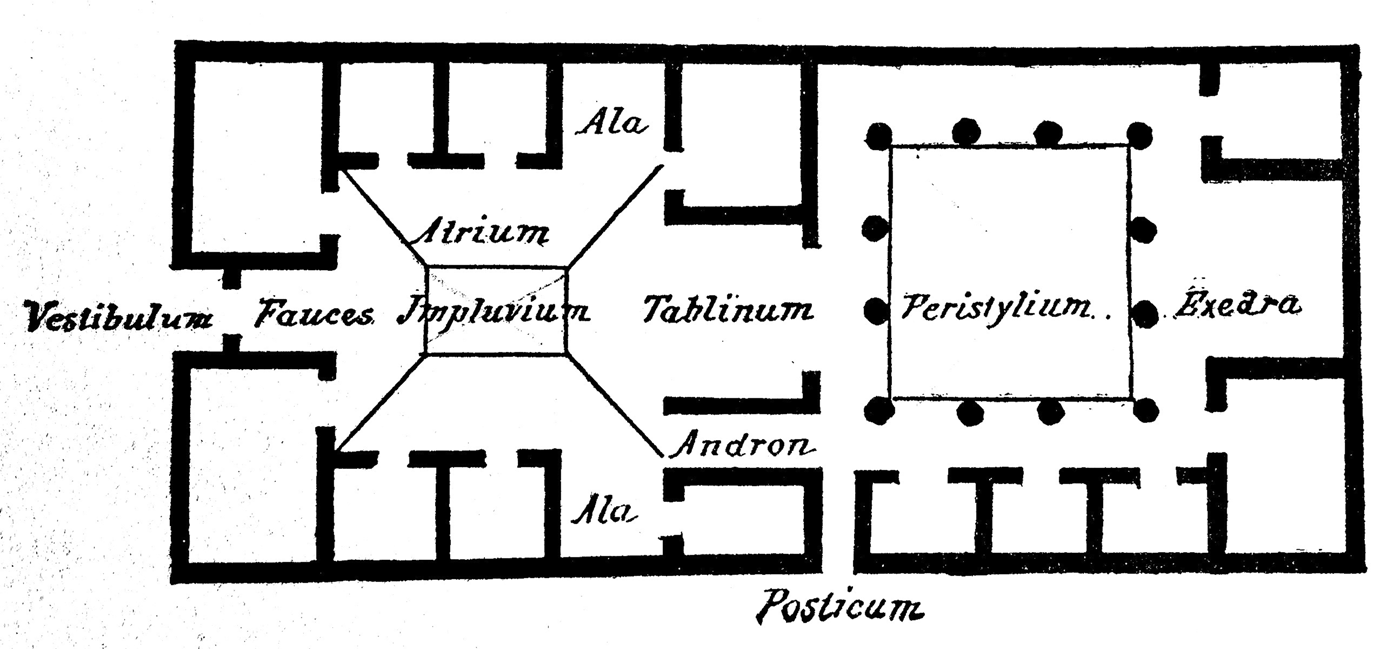
With these words, the 19th-c. German archaeologist August Mau described the position and use of the tablinum within the Roman house (Fig. 1).Footnote 2 Employing ancient literary sources, Mau was one of the first scholars to establish the traditional approach by which social activities and behaviors are associated with architectural remains, thus setting the groundwork for the understanding of the tablinum by the next generation of scholarship as a space associated with patron–client relationships.Footnote 3 Over the last few decades, this 19th-c. ideal plan of the Roman house has been the subject of intense discussion. In particular, while ancient terms remain useful today for studying the various areas and rooms within the house, scholars have demonstrated that they cannot be used to assign specific functions to the spaces they name.Footnote 4 The tablinum, described as typically a broad room opening at the far end of the main entrance, has acquired a canonical location within archaeological scholarship, and Mau's characterization of this room as a space for patronal activities has remained largely unchallenged.
Ideal plan of the Roman (or Vitruvian) atrium house. (Mau Reference Mau and Kelsey1899, 241, fig. 110.)

In modern scholarship, the tablinum has received less attention than other rooms of a Roman house and it has often been discussed in relation to the dominus's patronal activities and “public” needs.Footnote 5 Thus, it has become commonplace for the tablinum to be described as the formal reception space where the dominus conducted his business and presented himself to his clients during the daily morning greeting, or salutatio.Footnote 6 Yet none of the extant textual sources mentions the tablinum in connection with the salutatio, a ritual mainly linked to the vestibule and the atrium.Footnote 7 The assumption that the tablinum served as the master's reception room and the emphasis on its “public” nature have not only prevented a fuller discussion of this space but have also conditioned how modern scholars have interpreted its wall decoration. In particular, the mythological wall paintings found in tablina – such as the divine couple Mars and Venus, among others – have been interpreted in terms of moral ideals and social values and usually considered a commentary on marital relations or social power.
In this paper, I will not discuss the diverse uses of the tablinum,Footnote 8 but will concentrate on the mythological wall paintings recorded in this type of room in a large sample of atrium houses at Pompeii and Herculaneum.Footnote 9 In particular, I examine some of the mythological scenes in tablina from Pompeii, as this site presents more numerous and demonstrative examples compared to Herculaneum.Footnote 10 I show that the same subjects are found in other domestic as well as public spaces of the city, thus indicating the presence of a common visual vocabulary shared by different strata of society. The aim of this study is to liberate the tablinum's mythological wall paintings from the existing scholarly emphasis on social norms and expectations.
Mythological wall paintings: the tablinum and beyond
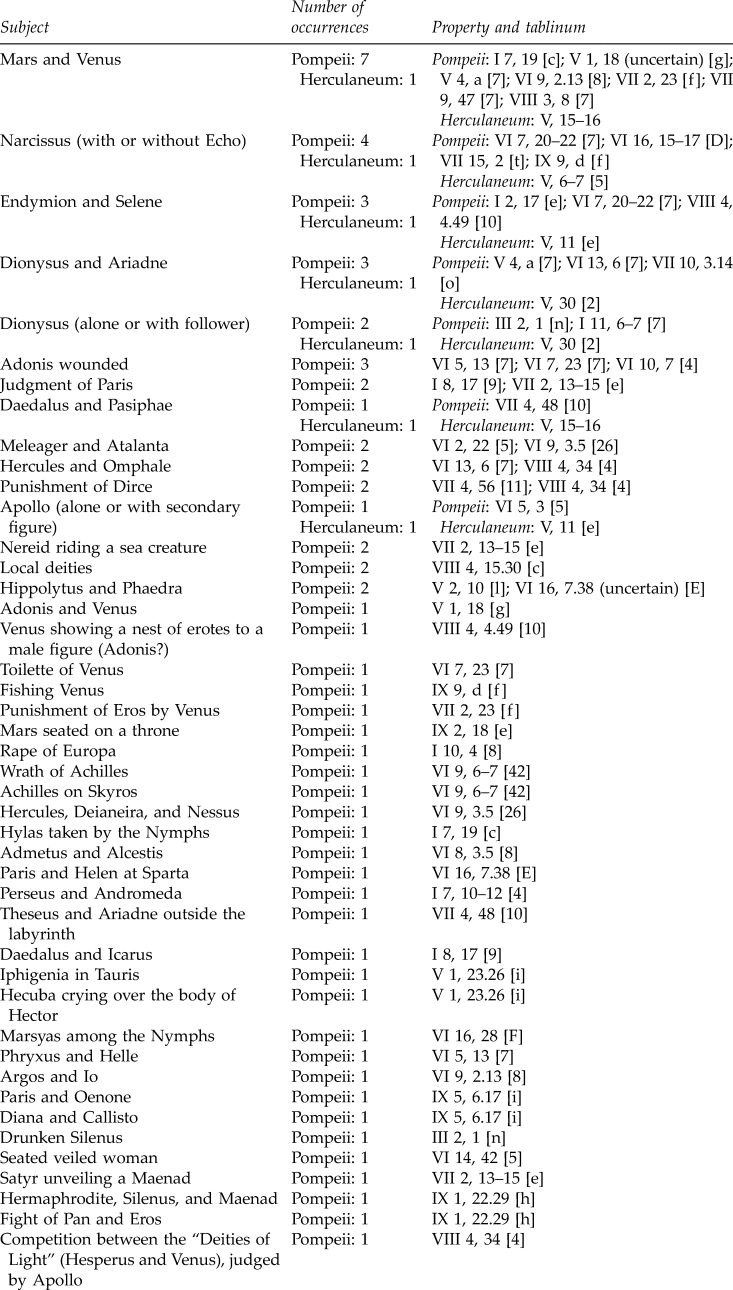
In the atrium houses selected for my survey, the majority of tablina are decorated in the so-called Fourth Style, which developed during the Claudian and Neronian periods and dominates the domestic (and public) landscape, as it is the style in vogue at the time of the eruption.Footnote 11 A total of 74 central mythological paintings were recorded in 45 tablina (Table 1).
Central mythological panels recorded in 45 tablina at Pompeii and Herculaneum. (Based on a sample of 160 atrium houses. The information in square brackets refers to the tablinum's number according to PPM or Maiuri Reference Maiuri1958)

Within Roman houses, mythological images often appear in “static” spaces where people spent time (and could in theory contemplate them at leisure), but it is clear that they should not be interpreted as thematic reflections of the activities carried on within those rooms.Footnote 12 Indeed, decoration does not necessarily indicate the “function” of spaces; rather, it reflects the hierarchical relationships among them. Thus, “paratactic” or repetitive decoration is often found in “dynamic” spaces such as vestibules, atria, and peristyle gardens, which are meant for the distribution or passage of people. Complex figural imagery, in contrast, appears more frequently in “static” rooms such as tablina, triclinia, and cubicula, where people passed time.Footnote 13
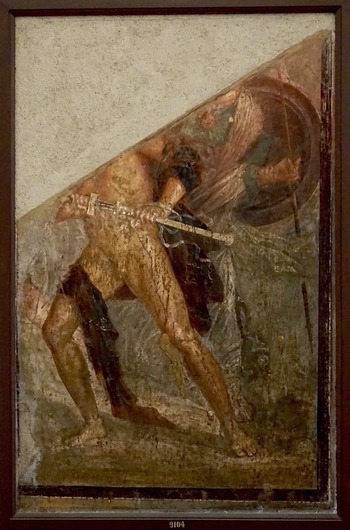
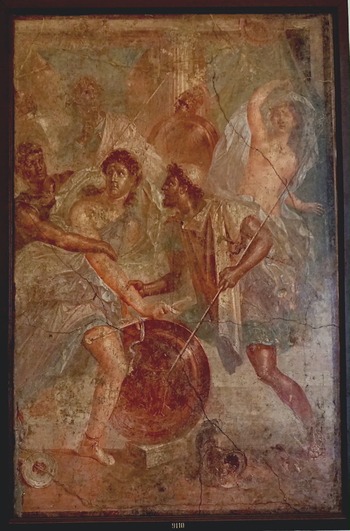
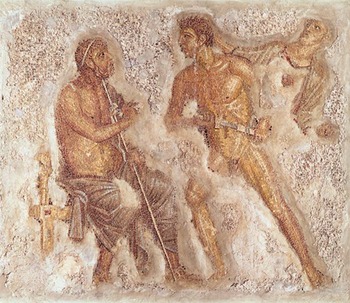
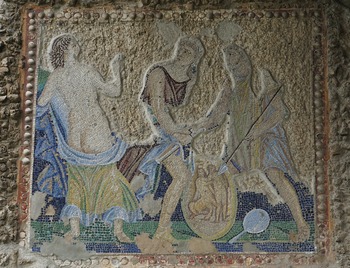
Despite this, the mythological scenes found in tablina have often been interpreted in relation to the social activities supposedly associated with this type of room, especially the morning salutatio. The walls of the tablinum (42) in the Casa dei Dioscuri at Pompeii (VI 9, 6–7), for example, were each painted with a large central mythological scene related to the life of Achilles. On the north (left) wall was a panel showing the quarrel between Achilles and Agamemnon, on the south (right) wall, the discovery of Achilles on the island of Skyros (Figs. 2, 3).Footnote 14 Both paintings are fragmentary, but through comparison with similar Pompeian images, such as two wall mosaics in the garden portico of the Casa di Apollo (VI 7, 23), we can reconstruct their original appearance (Figs. 4, 5).Footnote 15 In the fresco depicting Achilles on Skyros, therefore, the hero would have appeared between his lover Deidamia (now missing) and Ulysses, with Diomedes restraining Achilles from the left; in the image of the wrath of Achilles, Agamemnon and Athena would have stood respectively on the left and right sides of the hero from the viewer's perspective.Footnote 16
Fresco depicting the Wrath of Achilles. Left/north wall of the tablinum (42), Casa dei Dioscuri at Pompeii, VI 9, 6–7. MANN inv. 9104. (Photo by A. Spinelli, with the permission of the Ministero della Cultura – Museo Archeologico Nazionale di Napoli.)

Fresco depicting Achilles discovered on Skyros. Right/south wall of the tablinum (42), Casa dei Dioscuri at Pompeii, VI 9, 6–7. MANN inv. 9110. (Photo by A. Spinelli, with the permission of the Ministero della Cultura – Museo Archeologico Nazionale di Napoli.)

Wall mosaic depicting the Wrath of Achilles. Garden portico (24), Casa di Apollo at Pompeii, VI 7, 23. MANN inv. 10006. (Photo by A. Spinelli, with the permission of the Ministero della Cultura – Museo Archeologico Nazionale di Napoli.)

Wall mosaic depicting Achilles discovered on Skyros. Garden portico (24), Casa di Apollo Pompeii, VI 7, 23. In situ. (Photo by A. Spinelli, with the permission of the Ministero della Cultura – Parco Archeologico di Pompei.)

According to one scholarly interpretation, such decoration focused on the life of Achilles would have served to reaffirm the social position of the dominus and reflected the patronal activities that took place within the room.Footnote 17 This view maintains that a client would have experienced a “seeing and being seen” relationship between himself and his patron when he entered the tablinum, with its painting showing the analogous reciprocal recognition between Achilles and Ulysses.Footnote 18 Such a symbolic association would have been appropriate for a tablinum during the morning salutatio, the meeting between the patron and his clients.Footnote 19 However, these mythological subjects are also found, both alone and paired, in other domestic and public spaces at Pompeii.Footnote 20 For example, frescoes depicting the episode of the quarrel between Achilles and Agamemnon were found in the portico of the Temple of Apollo (VII 7, 32), as well as in the atrium of the Casa del Poeta Tragico (VI 8, 3.5).Footnote 21 The episode of Achilles and Ulysses on Skyros is found on the walls of a number of other Pompeian houses and especially in more “private” rooms like triclinia, attesting to the popularity of this myth in contemporary tastes.Footnote 22 The presence of this subject in the tablinum of the Casa dei Dioscuri, therefore, should not be explained as part of the “public” role of this space as a setting for the salutatio – for which, as I have pointed out, there is no evidence.
The emphasis on the “public” nature of the tablinum as a formal reception room has also conditioned other scholars’ interpretations. In particular, scenes of Mars and Venus recorded in tablina at Pompeii (there are seven in totalFootnote 23) have generally been interpreted in relation to the official role of this space and, consequently, in terms of the social values and moral ideals associated with the subjects depicted. According to some scholars, images of this divine couple depicted in a tablinum would have reflected the role models and virtues of a proper husband and wife to the family members and visitors admitted to the house.Footnote 24 Similarly, others have suggested that Mars and Venus were particularly popular in the tablinum because it was here that the dominus presented himself to his guests and clients.Footnote 25
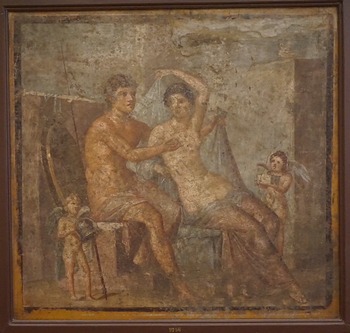
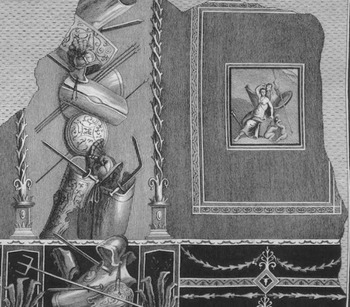
A systematic analysis of mythological wall paintings at Pompeii, however, demonstrates that the pairing of Mars and Venus was a very popular motif not only in tablina but also in other domestic rooms, as well as in civic and public buildings.Footnote 26 In the Casa di Meleagro (VI 9, 2.13), for example, this divine couple appears three times: in the tablinum [8] (Fig. 6), in a cubiculum [12], and in an unidentified room.Footnote 27 Often recorded in domestic rooms typically associated with more “private” activities, such as triclinia and cubicula, wall paintings with Mars and Venus also appear in other areas of the house.Footnote 28 Furthermore, panels with Mars and Venus were found in the Quadriporticus of the Theaters (VIII 7, 16–17; Fig. 7) and in the commercial property at VII 3, 8, and the same couple appears in a large stucco relief decorating the exterior wall of the Purgatorium of the Temple of Isis (VIII 7, 28).Footnote 29 The considerable number of scenes with Mars and Venus found on Pompeian walls attests to the popularity of this myth in contemporary local society, especially from the middle of the 1st c. CE, since the majority of these wall paintings are in the Fourth Style.Footnote 30 I argue, therefore, that the depiction of Mars and Venus in a tablinum does not necessarily relate to social habits and cannot serve to illustrate the use of this space for patron–client activities. Instead, it reflects the presence of a shared mythological visual imagery in the urban fabric.
Fresco depicting Mars and Venus. Right/south wall of the tablinum (8), Casa di Meleagro at Pompeii, VI 9, 2. MANN inv. 9256. (Photo by A. Spinelli, with the permission of the Ministero della Cultura – Museo Archeologico Nazionale di Napoli.)

Drawing of lost painting depicting Mars and Venus. Quadriporticus of the Theaters at Pompeii (VIII 7, 16–17). (Ornati delle pareti 1838, pl. 53.)

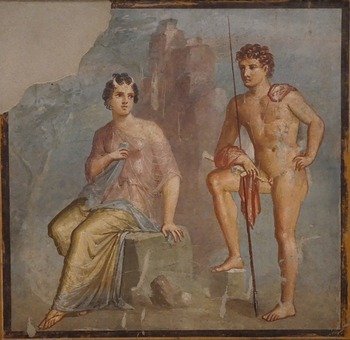
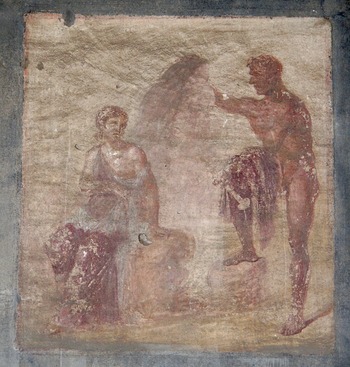
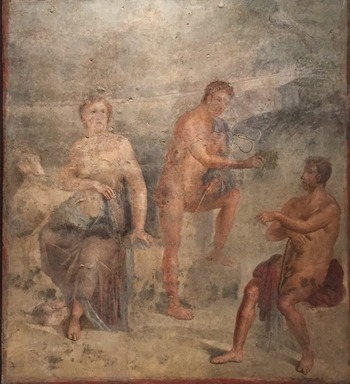
While prior scholarship on mythological wall paintings in the Roman house has been especially interested in discussing the range of responses to such imagery, exploring the ways in which Greek myths operated in the Roman world, or investigating the relations between architectural space and decoration, my focus here is on the circulation and dissemination of these mythological narratives across the urban context.Footnote 31 In fact, as with the representations of Mars and Venus, other mythological scenes with Argos and Io (Figs. 8–10), Phryxus and Helle, or Theseus and Ariadne, for example, are found not only in tablina but also in other domestic spaces, as well as in civic, commercial, and religious buildings throughout the city.Footnote 32
Fresco depicting Argos and Io. Left/north wall of the tablinum (8), Casa di Meleagro at Pompeii, VI 9, 2. MANN inv. 9556. (Photo by A. Spinelli, with the permission of the Ministero della Cultura – Museo Archeologico Nazionale di Napoli.)

Northwest corner of the Macellum at Pompeii (VII 9, 7) with central panel depicting Argos and Io. In situ. (Photo by A. Spinelli, with the permission of the Ministero della Cultura – Parco Archeologico di Pompei.)

Fresco depicting Argos and Io. Ekklesiasterion (6), Temple of Isis at Pompeii (VIII 7, 28). MANN inv. 9548. (Photo by A. Spinelli, with the permission of the Ministero della Cultura – Museo Archeologico Nazionale di Napoli.)

The appearance of such mythological imagery in places associated with the lower strata of society, such as taverns, has often been discussed in relation to the social and visual language of domestic space and explained as a sort of aspirational luxury.Footnote 33 This imagery's presence in commercial and industrial properties, including eating and drinking establishments, inns, and workshops, may therefore have provided an aura of refined taste.Footnote 34 Sometimes, it is difficult to determine whether these scenes belong to an earlier domestic phase of the property or whether they correspond to the conversion of the space from a domestic to a commercial function, according to the new owner's taste and agenda. Either way, such “shared” mythological imagery indicates that retail outlets were deeply integrated into social and cultural urban life, suggesting that this was not just a matter of aspiration nor an imitation of social refinement.Footnote 35
Whether painted on the walls of a domestic room (like a tablinum, cubiculum, or triclinium) or in a religious, civic, or commercial building (like a temple, marketplace,Footnote 36 or eating and drinking establishment), these mythological paintings attest to the presence of a visual thesaurus that was familiar to people from all social classes.Footnote 37 In discussing the ubiquitous presence and popularity of mythological tableaux across the urban fabric, we should also consider the role played by the written, oral, and visual traditions in making certain narratives quickly recognizable and appealing to a large audience. Mythological narratives were not limited to a well-read elite but were available to people from all social classes. Even lower segments of society, including freed people and slaves, might have learned mythological tales through various channels, from some sort of schooling, oral discourses, and mythological handbooks, and certainly from artifacts, wall paintings, and mosaics, as well as amphitheatrical and theatrical performances.Footnote 38 By contributing to the “democratization” of mythological narratives, all these factors very likely participated in the development of a shared visual culture. While the decoration of Vesuvian tablina reflected the cultural capital of the dominus of the house, it drew on a common and recognizable visual language to do so. The mythological scenes found in tablina, therefore, further demonstrate the sort of familiar vocabulary that circulated in these urban settings.Footnote 39
Conclusions
Throughout this paper, I have cautioned against the practice of projecting onto frescoes what we think we know about the uses of architectural spaces and the social rituals enacted there. In particular, analysis of the mythological frescoes decorating the walls of tablina at Pompeii and Herculaneum indicates that this type of room was decorated like many other domestic, civic, religious, and commercial spaces. Ultimately, rather than explaining the mythological frescoes of the tablinum in relation to the room's supposed social function, I have advocated for asking why such scenes are found in all kinds of rooms and buildings, and what the broader implications might be. Both the oral and the written traditions, as well as the passion for contemporary entertainments, are likely to have played an important, if not a dominant role in the promotion of a mythological visual imagery familiar to people from all social classes.Footnote 40 My aim here has been to show that the mythological scenes painted on the walls of the tablinum do not necessarily relate to social habits and moral ideals but reflect the presence of a shared Campanian visual culture.
Acknowledgments
I thank the anonymous reviewers for the JRA for their generous comments. This paper developed from research carried out for my PhD dissertation at the University of Southern California under the direction of John Pollini, to whom I am especially grateful for acute observations and invaluable support. My gratitude also goes to Ann Marie Yasin, Steven Ellis, Bettina Bergmann, Domenico Camardo, Christopher Hallett, Molly Swetnam-Burland, and Michael Mignanelli for fruitful conversations, as well as to Barbara Weiden Boyd and Kenneth Lapatin for insightful suggestions and constructive criticism. Permits to survey the houses of Pompeii and Herculaneum were generously granted by Massimo Osanna and Francesco Sirano. At the Museo Archeologico Nazionale di Napoli, I am grateful to Paolo Giulierini for permission to study the material, as well as to the entire staff of its conservation department, library and Archivio Storico, especially Luisa Melillo, Maria Rosaria Esposito and Andrea Milanese. Special thanks also go to the staff of the Getty Research Institute and the Photographic Archive of the American Academy in Rome, especially Emiliano Di Carlo. Translations are mine unless otherwise noted.