INTRODUCTION
In past decades, interest in the protection of natural environments has increased markedly worldwide (Mittermeier et al., Reference Mittermeier, Mittermeier, Robles-Gil, Pilgrim, da Fonseca, Brooks and Konstant2002). Because natural ecosystems are increasingly vulnerable to environmental degradation, the protection of particular areas has become essential to the conservation of cultural and natural resources (IUCN, 1994; Mittermeier et al., Reference Mittermeier, Mittermeier, Robles-Gil, Pilgrim, da Fonseca, Brooks and Konstant2002; Bortolus & Schwindt, Reference Bortolus and Schwindt2007). For more than 60 years, a system of protected areas in Argentina has evolved in diverse ways, including the design of appropriate regulations, geographical delimitations and management coordination (Administración de Parques Nacionales, 2007). Currently, Argentina contains more than thirty national parks, in addition to numerous reserves of varying hierarchy. These and other places in the country are home to charismatic species under strict protection. The Monte León National Park, created in 2004 and located in the south-east of Santa Cruz province, is the first continental Marine-Coastal Park of Argentina. Monte León has ~60,000 hectares of Patagonian steppe throughout 48 km of coast, and its intertidal zone contains a great variety of environments such as cliffs, rocky shores, mudflats and sandy beaches (Bortolus et al., Reference Bortolus, Schwindt, Mendez, Ortiz, Ré, Piriz, Elias, Gosztonyi, Kuba, Ciocco, Gagliardini and Orensanz2006).
Sandy beaches are dynamic systems in terms of their geomorphology, sediment characteristics and wave energy (McLachlan, Reference McLachlan, McLachlan and Erasmus1983, Reference McLachlan, Chelazzi and Vannini1988). In comparison to hard-bottom intertidal environments like rocky shores, organisms living in sandy beaches have the ability to explore a third physical dimension, the depth. Because the animals of sandy shores are able to burrow into the substratum, their zonation patterns are often less apparent than those of animals on rocky shores, and physical and biological constraints are usually reduced (Pearson, Reference Pearson2001). The infauna inhabiting soft-sediment environments can avoid thermal stress by burying themselves into the sediment, and competition does not represent an important restriction because the space is not usually a limiting resource (Lenihan & Micheli, Reference Lenihan, Micheli, Bertness, Gaines and Hay2001). Since primary production is not a critical process in sandy beaches (Brown & McLachlan, Reference Brown and McLachlan1990), these systems receive frequent inputs of nutrients from the phytoplankton in the adjacent water and from particulate organic matter derived from the land and adjacent intertidal habitats (Brown & McLachlan, Reference Brown and McLachlan1990). The dominant organisms in sandy beaches are polychaetes, bivalves, and crustaceans (principally amphipods, decapods and isopods; Dexter, Reference Dexter1992) and species richness is usually low in comparison to other intertidal environments (Stephenson, Reference Stephenson1999). The species composition and abundance patterns of the benthic macroinfauna are commonly driven by the physicochemical and biological characteristics of the sediment (e.g. organic matter content and grain size distribution; McLachlan, Reference McLachlan, McLachlan and Erasmus1983, Reference McLachlan, Chelazzi and Vannini1988; Jaramillo & McLachlan, Reference Jaramillo and McLachlan1993). The infauna needs certain combinations of these characteristics to survive in any sediment and, in turns, these species are able to modify the sediment according to their needs (Constable, Reference Constable1999; Lenihan & Micheli, Reference Lenihan, Micheli, Bertness, Gaines and Hay2001).
A variety of reasons justify the increase of interest in the knowledge of the fauna of sandy beaches. For example, many species have direct economic importance; such is the case with crustaceans and molluscs used for human consumption or as bait in fisheries. Also, polychaetes represent a very wealthy feed source for other organisms, principally fish, crustaceans and seabirds. Furthermore, polychaetes and peracarids are links in the trophic webs of a variety of subtidal species that represents important fisheries and tourism resources (e.g. squids, bivalves and seabirds). Different studies have demonstrated the importance of the utilization of benthic communities of sandy beaches as indicators of environmental quality (Tsutsumi, Reference Tsutsumi1990; Pocklington & Wells, Reference Pocklington and Wells1992; Elías et al., Reference Elías, Bremec and Vallarino2001). In spite of this, little research has been conducted on these environments along the Argentinean coastline, where they are relatively common (Escofet, Reference Escofet1983; Seeliger, Reference Seeliger1992; Zaixso et al., Reference Zaixso, Lizarralde, Pastor, Gómez Simes, Romanello and Pagnoni1998; Reference Pastor de WardPastor, 2000; Boschi & Cousseau, Reference Boschi and Cousseau2004). In this work we describe and compare the macroinfaunal assemblages of the two largest sandy beaches of Monte León National Park, Patagonia, Argentina. Specifically we studied: (a) the diversity and abundance of the macroinfauna; and (b) the organic matter content, grain size distribution and the depth of the sediment.
MATERIALS AND METHODS
Study site
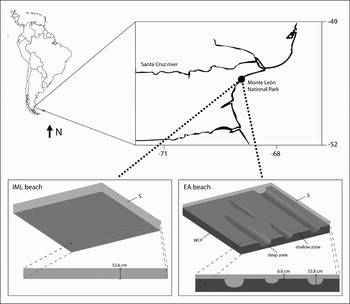
The study was performed on two beaches during May and November 2006 in order to contrast the cold and warm seasons of the year. The beaches were named Isla Monte León (hereafter IML, 50°20′40.7″S 68°52′39″W) and El Arco (hereafter EA, 50°22′53″S 68°55′32.2″W; Figure 1). These sites were selected because they are the largest sandy beaches in the Park and they look similar at the landscape scale, allowing for site replication. According to Defeo & McLachlan (Reference Defeo and McLachlan2005) the two intertidals studied are classified as dissipative beaches. However, after the first geomorphological survey we found these two beaches were different. Therefore, we decided to sacrifice site replication on behalf of a better description of inter-site variability. The major contrast between these two beaches is that in EA the sandy sediments lay on top of an old wave cut platform, with channels of approximately 0.10 to 2 m deep that create two different habitats for the macroinfauna that we named the ‘deep’ (i.e. inside the channels) and ‘shallow’ (i.e. outside the channels, ≤0.10 m deep) zones (Figure 1). Samples in IML were obtained at two zones defined as the upper (‘high’) and lower (‘low’) half of the elevation gradient covered by the intertidal. Samples from EA beach were taken in the deep and shallow zones and from IML in the high and low zones (Figure 1).
Map of South America showing the location of Monte León National Park and the zones of the sites studied. Numbers indicate average depths in each zone. WCP, wave cut platform; S, sediment.

Abundance and diversity of the macroinfauna
In order to estimate diversity and species density, ten samples were collected from each of the four zones by using a metal core (diameter: 20 cm, depth: 25 cm; volume: 0.00785 m3). Cores were separated into three vertical fractions (0 to 5 cm, 5 to 10 cm and 10 to 25 cm), and then sieved through a 0.5 mm mesh. All the samples collected were interspersed (sensu Hurlbert, Reference Hurlbert1984) within each zone and through the entire study sites. The organisms retained in the mesh were fixed in 4% formalin and preserved in 70% ethanol. In the laboratory, all organisms were identified to the lowest taxonomic level possible under a dissecting stereo microscope (80×). Values of the Shannon diversity index (Shannon & Weaver, Reference Shannon and Weaver1949) were calculated for each sample plot. Also, density values (individuals × m−3) of the species found were calculated to determine dominant species (i.e. species that represented more than 20% of the entire density for each beach).
Since the two beaches of the study were different in their topography, each beach was described and compared separately. Differences in diversity between beaches in both seasons were evaluated with a two-way fixed ANOVA (Zar, Reference Zar1999). In IML beach, seasonal differences in diversity between zones and depths were tested with a three-way fixed ANOVA. In EA beach, seasonal differences in diversity between zones were evaluated with a two-way fixed ANOVA. Subsequently, a one-way fixed ANOVA was performed for the deep zone for each season to evaluate differences in diversity among depths. Further, seasonal variations between zones and depths in dominant species density in IML beach were evaluated with a three-way fixed ANOVA. However, for EA beach, seasonal variations in dominant species density among depths in the deep zone were evaluated with a two-way fixed ANOVA. If the dominant species was concentrated (i.e. more than 75% of the entire density) in a given depth, a two-way fixed ANOVA (season and zone) was performed. When assumptions of homoscedasticity or normality were not met, data were transformed using a square root transformation. Vouchers of the identified invertebrates were stored at CENPAT.
Organic matter content, grain size and sediment depth
In order to determine the organic matter content, ten sediment samples were collected at each zone with the same sampling design described above (OMC, diameter: 3.5 cm, depth: 25 cm; volume: 240 cm3). In addition, one sample for standard mechanical-sieving grain analysis (diameter: 6 cm, depth: 25 cm; volume: 706 cm3) was obtained. Also, ten values of maximum depth of the sediment column were obtained at each zone. OMC was determined from the samples combusted individually at 450°C for 4 hours, obtaining ash-free dry weight. Grain size distribution was determined by sieving the samples through a series of screens with five different mesh openings ranging from 1000 to 62 µm. Sediment samples were previously processed following Carver (Reference Carver1971).
In IML beach, seasonal differences in OMC between zones were evaluated with a two-way fixed ANOVA. Differences between seasons were evaluated with a t-test. In EA beach, seasonal differences in OMC between zones were evaluated with a two-way fixed ANOVA. Then, for the deep zone a two-way fixed ANOVA was performed to evaluate seasonal differences in OMC among depths. Seasonal differences were evaluated, separately, with t-tests. Additionally, differences in the values of sediment column depth were evaluated with independent t-tests.
RESULTS
Abundance and diversity of the macroinfauna
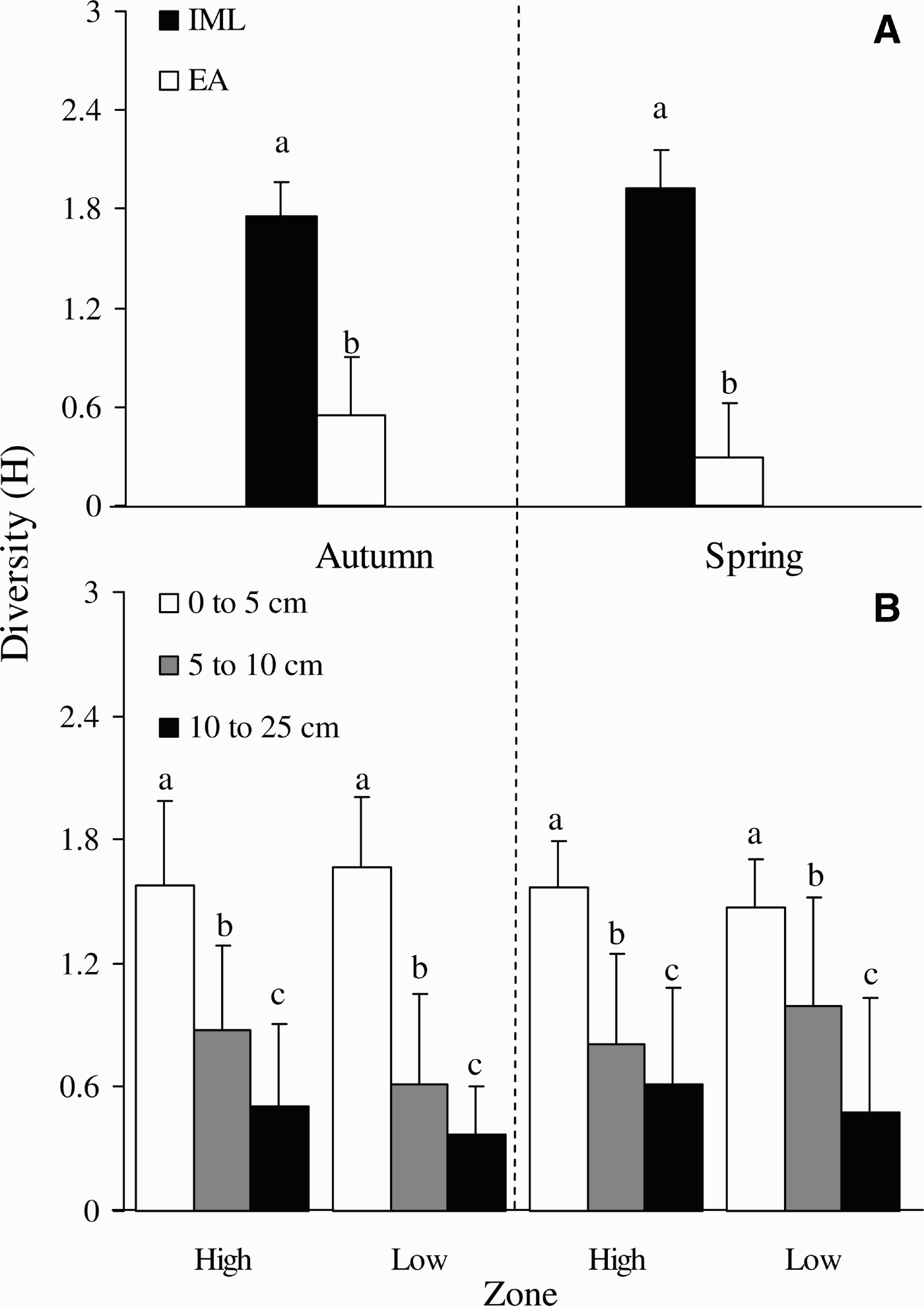
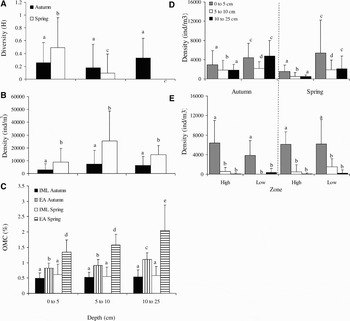
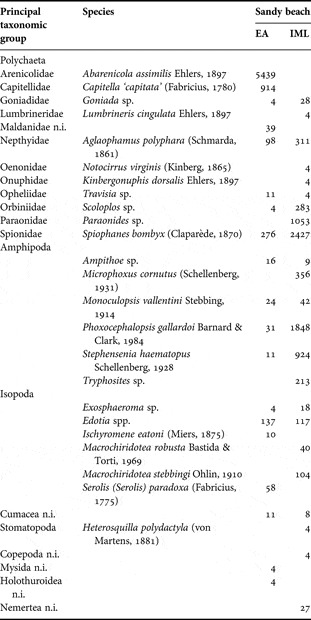
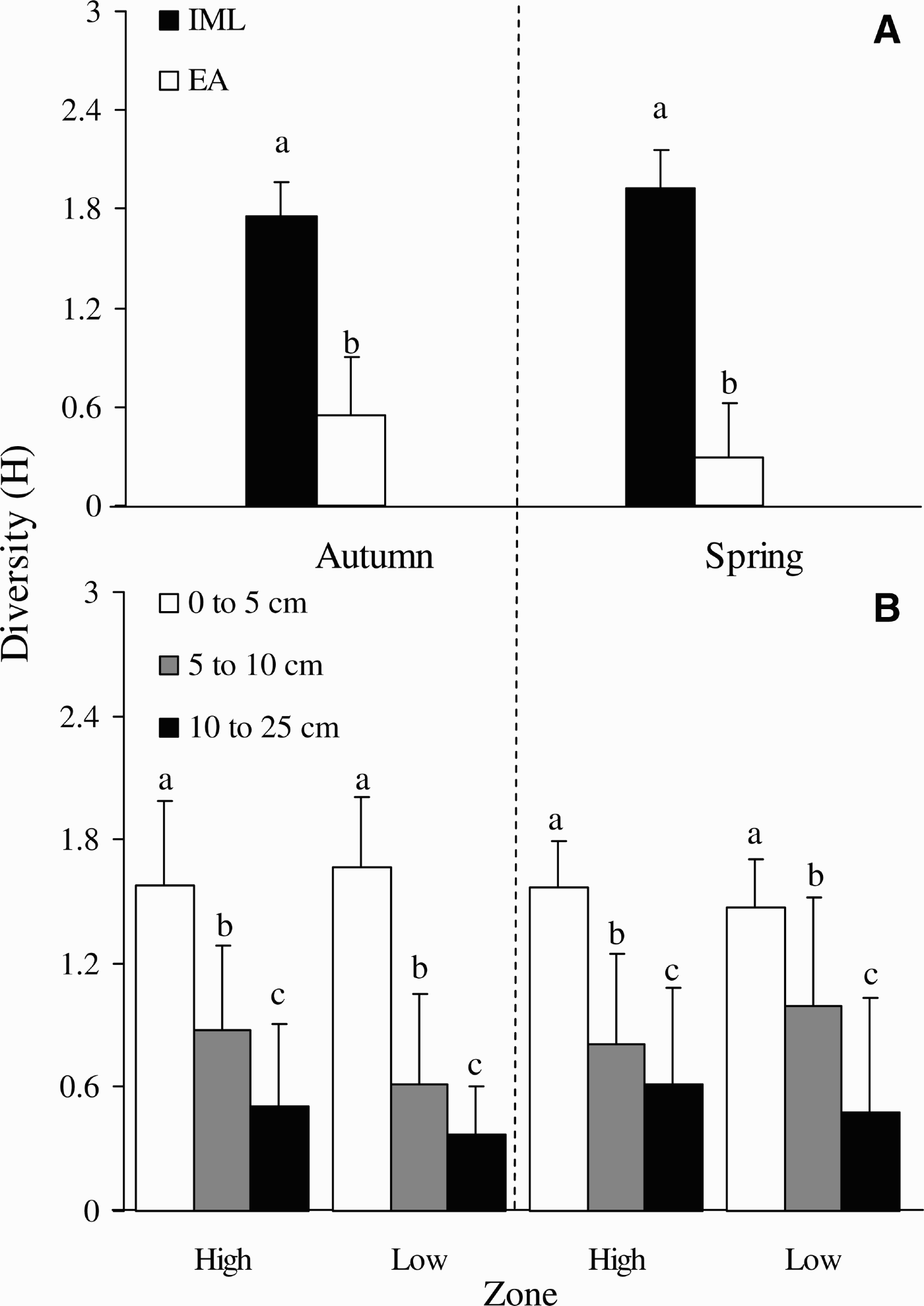
A total of 30 taxa of macroinfaunal invertebrates were found at the beaches studied (Table 1). The diversity of macroinfauna was higher in IML than in EA (F = 219.1, df = 36, P = 7 10−17; Figure 2). Differences between seasons were not found (F = 0.78, df = 36, P = 0.38). In IML, differences in diversity between seasons or zones were not found (Fseason = 0.5, df = 108, P = 0.48, Fzone = 0.64, df = 108, P = 0.42). However, the 0–5 cm depth presented the highest diversity (F = 74.97, df = 108, P = 3.8 10−21; Figure 2). Similarly, at EA, differences in diversity between seasons and zones were not found (Fseason = 0.96, df = 36, P = 0.33, Fzone = 0.24, df = 36, P = 0.62). However, at the deep zone, the 0–5 cm depth presented the highest diversity in spring (F = 6.59, df = 27, P = 0.005). In autumn, no differences in diversity among depths were found (F = 0.52, df = 27, P = 0.6; Figure 3) for the deep zone.
Average Shannon diversity index (H, +SD) in sandy beaches (A) of IML (black) and EA (white) and for different zones at IML beach (B) for different depths: 0 to 5 cm (white), 5 to 10 cm (grey) and 10 to 25 cm (black). Identical letters indicate no statistically significant differences.
Average Shannon diversity index (H, +SD, A) and average density of the polychaete Abarenicola assimilis (+SD, B) for different depths in the deep zone at EA beach in autumn (black) and spring (white). Average percentage OMC (+SD, C) for IML in autumn (black), EA in autumn (vertical lines), IML in spring (white) and EA in spring (horizontal lines). Average density of the polychaete Spiophanes bombyx (+SD, D) and average density of the amphipod Phoxocephalopsis gallardoi (+SD, E) for different depths: 0 to 5 cm (white), 5 to 10 cm (grey) and 10 to 25 cm (black) at IML beach. Identical letters indicate no statistically significant differences.

Taxonomic list of the organisms observed. EA, El Arco beach; IML, Isla Monte León beach; n.i., not indentified. Numbers indicate average density (ind · m−3) for each taxa.
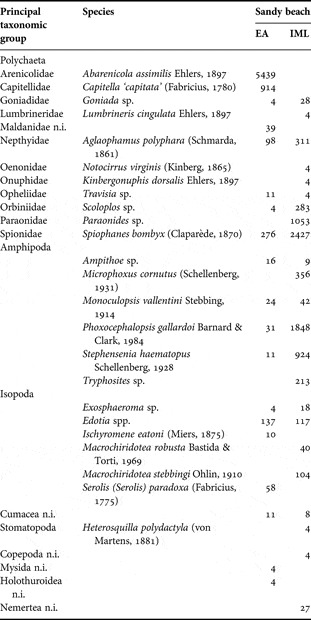
At IML the dominant organisms were the polychaete Spiophanes bombyx (31.09% of the entire macroinfaunal density) and the amphipod Phoxocephalopsis gallardoi (23.68% of the entire macroinfaunal density). The density of the polychaete S. bombyx was higher in autumn than in spring and, for both seasons, density was higher at the low zone than at the high zone (Fseason = 11.83, df = 108, P = 0.0008; Fzone = 13.82, df = 108, P = 0.0003). Also, the density was lowest at the 5–10 cm depth (F = 4.11, df = 108, P = 0.02; Figure 3). The density of the amphipod Phoxocephalopsis gallardoi in the 0–5 cm depth did not show significant differences among seasons or zones (Fseason = 1.17, df = 36, P = 0.29; Fzone = 1.55, df = 36, P = 0.22; Figure 3).
At EA, the polychaete Abarenicola assimilis was the dominant organism (76.64% of the entire macroinfaunal density). This species was absent in the shallow zone and in the deep zone, and its density was higher in spring than in autumn. For both seasons, density was highest in the 5–10 cm depth (Fseason = 14.71, df = 54, P = 0.0003, Fdepth = 4.06, df = 54, P = 0.023; Figure 3).
Organic matter content, grain size and sediment depth
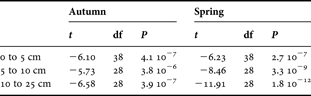
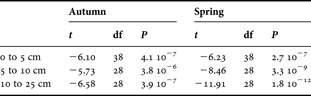
At IML, OMC did not show significant differences between seasons (t = –1.35, df = 118, P = 0.18). In autumn, OMC did not show significant differences between zones (F = 0.06, df = 54, P = 0.81). However, in spring OMC was highest at the high zone (F = 9.61, df = 54, P = 0.003). For both seasons, OMC did not show significant differences among depths (Fautumn = 0.24, df = 54, P = 0.78, Fspring = 0.22, df = 54, P = 0.8). At EA, OMC was higher in spring than in autumn (F = 30.23, df = 36, P = 3.2 10−6) and no differences between zones were found (F = 1.8, df = 36, P = 0.19). In the deep zone, OMC was highest in the 10–25 cm depth and also OMC was highest in spring (Fdepth = 10.34, df = 54, P = 0.00016, Fseason = 86.91, df = 54, P = 7.7 10−13). Finally, when the beaches were compared, the OMC was always significantly higher at EA than IML for both seasons at all depths (Table 2; Figure 3).
Results of the t-tests evaluating differences in the OMC between beaches at different depths for the two seasons.
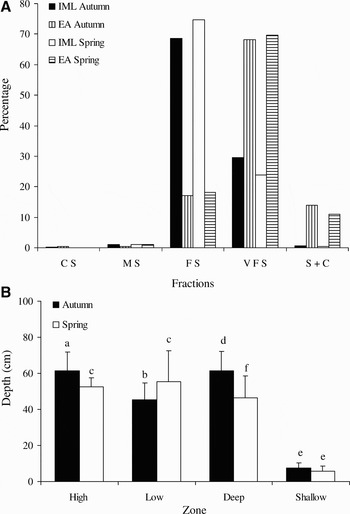
Grain size distribution was different in the beaches studied. The percentages of the sediment fractions were similar in the different zones and depths at each beach, thus they were pooled by beach and season. Fine-sand fraction dominated the IML beach while the EA was characterized by very fine sand deposits (Figure 4) for both seasons.
Percentages of the different grain size fractions (A) (CS, coarse sand; MS, medium sand, FS, fine sand; VFS, very fine sand; S+C, silt+clay) for IML in autumn (black), EA in autumn (vertical lines), IML in spring (white) and EA in spring (horizontal lines). Average depth of the sediment column (+SD, B) for autumn (black) and spring (white) in IML and EA. Identical letters indicate no statistically significant differences.

The sediment column at the high zone at IML was deeper than the low zone in autumn (t = 3.55, df = 18, P = 0.002). However, no significant differences were found in spring (t = –0.5, df = 18, P = 0.62). Also, the depth at the high zone in autumn was higher than in spring (t = 2.4, df = 18, P = 0.02, Figure 4). At EA, the depth at the deep zone was higher than at the shallow zone in both seasons (tautumn = 15.18, df = 18, P = 1 10−11; tspring = 10.14, df = 18, P = 7.2 10−9). Also, deep zone depths were higher in autumn than in spring (t = 2.89, df = 18, P = 0.01, Figure 4). No significant differences in the depth of the shallow zone between seasons were found (t = 1.22, df = 18, P = 0.24, Figure 4).
DISCUSSION
The two sandy beaches we studied had different macroinfaunal assemblages and physicochemical characteristics in the sediment that tended to mask non-visible ecological patterns below ground. We found that the IML beach had higher species diversity, lower OMC, coarser sand, and the depth of the sediment column was highly homogeneous throughout the beach. In comparison with IML, the EA beach had lower species diversity, higher OMC, finer sands and a deeper sediment column. Therefore, despite the visual similarity in appearance of these two coastal environments at the landscape scale, they provide distinct habitats to local macroinfaunal assemblages.
Polychaetes, bivalves and crustaceans are usually considered the most common taxa in sandy beaches (Dexter, Reference Dexter1992; Stephenson, Reference Stephenson1999), and our results agreed with this. The dominant groups in our study sites were polychaetes and crustaceans, while nemerteans and holothurians were less common (Table 1). The variation in relative abundance of these groups could be influenced by few specific habitat characteristics within each beach. In soft-sediment systems, physical and biological factors play a crucial role in the timing of species survival (Jaramillo et al., Reference Jaramillo, Contreras, Duarte and Quijón2001; Lenihan & Micheli, Reference Lenihan, Micheli, Bertness, Gaines and Hay2001), such as determining the availability of critical resources (i.e. food or oxygen) and affecting the animal mobility. However, the infauna is no longer considered a passive member of the environment conditioned by physical factors, as it has been demonstrated to possess the capacity to modulate and alter its habitat (Woodin, Reference Woodin1999). Within this context, different authors (e.g. Wells, Reference Wells1962; Fauchald & Jumars, Reference Fauchald and Jumars1979) reported the deposit-feeder polychaete Abarenicola assimilis usually appears positively associated with the amount of organic matter in the substratum (Fauchald & Jumars, Reference Fauchald and Jumars1979). Accordingly to this, we found that A. assimilis was the dominant organism at EA beach, where we found the highest values of OMC. Moreover, we found that the density of A. assimilis in the beach was highest in spring, when OMC was also highest. However, the absence of A. assimilis in the shallow zone of EA beach, where the OMC was similar to that in the deep zone, may be due to the very low depth reached by the sediment column (average 6.5 cm). Abarenicola assimilis is a relatively large species in comparison to other local polychaetes (approximately 10 cm in length), and with a high mobility that continually displaces sediment, building complex gallery systems (Wells, Reference Wells1962). It has been postulated that these kinds of activities may inhibit or prevent the establishment of other species with a lower capacity for movement (Fauchald & Jumars, Reference Fauchald and Jumars1979; Hall, Reference Hall1994). Our results suggest that this process may be occurring in EA beach where A. assimilis is virtually the only species present while the amphipods and isopods observed in IML beach were absent. However, experimental research is needed to properly evaluate this mechanistic hypothesis.
Community and population patterns of distribution and abundance of infauna in sandy beaches have been assumed to be principally controlled by physical factors such as sediment composition (McLachlan, Reference McLachlan, McLachlan and Erasmus1983, Reference McLachlan, Chelazzi and Vannini1988; McLachlan et al., Reference McLachlan, Jaramillo, Donn and Wessels1993; Defeo et al., Reference Defeo, Brazeiro, de Alava and Riestra1997). Although the relationship between grain-size distribution and the abundance of infauna may not always be identical (Hall, Reference Hall1994), it is likely that food availability negatively relates to grain size, which may indirectly shape or affect the abundance of infaunal organisms. This is because in general, as grain size increases, deposit feeders need to process a greater amount of sediment to obtain a given amount of food (Wells, Reference Wells1962; Fauchald & Jumars, Reference Fauchald and Jumars1979). Our results agree with this idea in IML beach, where grain size was associated to higher number of species with different feeding biology, such as the carnivorous polychaetes Aglaophamus polyphara and Goniada sp. (Fauchald & Jumars, Reference Fauchald and Jumars1979). The species of amphipods we found were concentrated within the top 5 cm of sediment, independently of the grain size, probably because their feeding behaviour occurs exclusively in the sediment/water boundary. These infaunal organisms live in superficial burrows they dig to avoid desiccation stress and also to lower predation risks (Pearson, Reference Pearson2001). The results of our study strongly suggest that the combination of physical and biological factors, such as grain size, depth of the column of sediment and destabilization of the substratum by organisms like A. assimilis, are responsible for the distribution of species found in these beaches.
In conclusion, our results suggest that sandy beaches with different physicochemical characteristics are associated with different macroinfaunal assemblages. Although they may appear similar at the landscape scale in preliminary visual surveys, the geomorphological differences we found between habitats are likely to drive strong differences in the structure of these assemblages. However, although the observed patterns confirmed those within the scientific literature (e.g. McLachlan et al., Reference McLachlan, Jaramillo, Donn and Wessels1993; Defeo et al., Reference Defeo, Brazeiro, de Alava and Riestra1997; Jaramillo et al., Reference Jaramillo, Contreras, Duarte and Quijón2001), specific experimental research is needed to evaluate and identify the causal processes shaping this ecological pattern. Our results show that environmental similarities at the landscape scale may mask important differences in faunal assemblages. Environmental managers in Marine Protected Areas (MPAs) should consider this with special care before designating a given area as intangible or highly sensitive by using visual criteria. Considering that some components of the fauna (e.g. polychaetes Capitella ‘capitata’ and Spiophanes bombyx) are important indicators of environmental integrity, the selection and preservation of the appropriate sandy beach must be a top priority. Therefore, it is recommended that the designation of sites with different restriction categories inside the MPAs, like Monte León National Park, should include the description of geomorphological variability and other habitat characteristics along with the floral and faunal taxonomy and the standard ecological descriptions.
ACKNOWLEDGEMENTS
We thank Emilia Diez, Agustina Ferrando, Elena Gómez Simes, Lobo Orensanz and Berenice Trovant for their help with taxonomic identification; Pablo Bouza and Lina Videla for their guidance with sediment analysis, Lucho Zanetta for his patience with Figure 1, Sarah O'Neal for her corrections to the language and the entire ‘Leones Group’ for their kind help and support in the field. Alejandro Bisigato, P. Bouza and Luis Bala improved an earlier version of this manuscript with helpful comments. We are especially grateful to the National Park staff who assisted us so kindly during this study and to the National Park Administration for allowing us to work inside the park. The manuscript was greatly improved by the comments of two anonymous referees. This project was supported by research grant UEP Donación BIRF/GEF TF 028372-AR and Subproyecto PNUD-GEF AB-54. M. Mendez wants to dedicate this work to the Argentinean public education system, for nurturing her academic interest in marine biology.