Rating presidents is one of the few political activities that engages elites and citizens equally. Pundits and politicians keep a running tab on the president, and ordinary people have no trouble coming up with a pecking order when some presidential decision goes awry on an issue they care about. I seek to explicate and sharpen the way we rate the quality of presidential economic policy leadership.
Comparison entails standardization, and if possible measurement, of different units along a common, intuitively-shared dimension. When we think about rating presidents as stewards of the national economy, three quite different ideas come to mind. Together, they yield four criteria for comparing presidents' economic policy leadership. The first asks about the president's success at gaining Congressional approval for his agenda of economic policies. In a system of separated institutions sharing policy authority, this is a logical place to begin. The second looks at presidential leadership of the economy through the eyes of the public, bringing together survey data tracking the electorate's evaluation of the administration's economic policy. Both these approaches take the president's goals as given and define accomplishment in terms of support from key audiences; they complement each other in distinguishing between whether the audience consists of elite representatives or the mass electorate. As evaluative dimensions, they are intuitively attractive and widely-used approaches to the concept of “presidential success”: most of the time, good leaders are popular politicians and good policies gain the assent of congress. But the correlation is not so regular as to constitute an adequate account of presidential accomplishment: public popularity and even congressional enactment might, for instance, reflect the superficial attraction of a policy with quick payoffs, even though a more patient alternative would have yielded larger long-run gains. Judging the quality of presidential leadership, then, requires some independent assessment of how the president's policies affected the material well-being and economic opportunities of citizens. The third approach takes up this intuition, asking how different presidential administrations have shaped Americans' welfare, in terms of overall economic growth and the distribution of the product of that growth. While the two “popularity” criteria register how different audiences perceive and respond to the president's goals, the two economic criteria reflect a complementary vantage point, comparing actual accomplishments to more objective, external standards.
Legislative Success
On average over the forty-eight year period from 1953 to 2000, the White House was victorious on just over half the legislative votes on which the president publicly announced his position. Figure 1 tracks support for the president's economic initiatives in the House.Footnote 1
Presidents' legislative success on economic initiatives, 1953–2000
Note: Average = 46.7; data labels show % favorable.
Source: Compiled by author from Congressional Quarterly and Economic Report of the President, various years.

Media reports and popular commentary characteristically personalize political narratives, attributing the variation among presidents to personal traits or idiosyncratic features of leadership style. But the research literature underlines the importance of other features of the political context, and sorting out the influence of the president requires taking these into account.Footnote 2 Presidents with greater electoral support, particularly if their party controls the Congress and if they have run ahead of their congressional partisans, can count on a larger and more reliable legislative coalition; conversely, divided government constrains the president's prospects. In addition, for most of the postwar period, the legislators elected under the same party banner have been far from monolithic in supporting the national program. For instance, Southern Democrats, although a minority in their own party, were key players in shaping Congressional enactments through most of the post-war years, whether voting with Republicans as the Conservative Coalition or using their positions as senior committee leaders to modify or block legislative proposals. Similarly, it was often possible for presidents to assemble majorities for centrist compromises by building cross-party coalitions of liberal Republicans and conservative Democrats. More recently, the parties have become much more ideologically polarized and programmatically homogeneous, with the proportion of “cross-pressured” members of the House and Senate falling from nearly half in the 1950s and 1960s to less than 10 percent by the 1990s. The graph of presidential support in figure 1, then, reflects two sources of variation, short-run differences in political resources from one election or one president to the next, and the secular trend of increasingly polarized elite politics at the national level. As party and ideology have become more closely aligned, and members and coalition leaders have translated that polarization into hostile parliamentary tactics, later presidents have faced a less supportive legislative environment than chief executives who served earlier in the postwar period: while the support of their own party in Congress has increased slightly, the prospects for the president to gain votes from opposition partisans has declined precipitously.Footnote 3
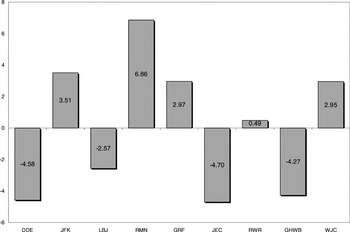
Sorting out the influence of the president requires controlling for these structural and political sources of legislative support. Models of presidential success emphasize the balance of legislative seats held by each party, divided government, and party polarization. I estimate a model that includes variables tapping each of these constructs, and then deduct their effect from the observed level of legislative support. Parsing out the degree to which a given president's success can be attributed to the partisan and ideological composition of the Congress leaves that portion associated with political skill or leadership strategies that are within the president's control.Footnote 4Figure 2 shows the degree to which each president garnered greater or less legislative support than would have been predicted by the distribution of preferences in Congress.
Presidents' legislative success on economic initiatives, 1953–2000
Note: Wins or losses not predicted by president's party and ideological resources.
Source: Calculated from data on support for the president's economic initiatives in the House (see n. 1). Data labels show annual victories in excess of (or fewer than) the level predicted by the president's party and ideological resources.

Once we separate out the way in which elections yielded a particular partisan and ideological configuration in Congress, abetted by the advantage that Congressional procedures lend to the majority party, it is clear that postwar presidents have varied greatly in the extent to which their own strategic and leadership skills contributed to building a successful legislative record. It is notable, for instance, that nearly all the legislative success of presidents Johnson and Reagan can be accounted for by the political and ideological configuration of Congress. President Nixon, on the other hand, gained more victories than his political resources would predict, largely by framing his initiatives so as to command the support of the Conservative Coalition, in spite of the Democrats' party majority in the Congress.Footnote 5 Of the four presidents whose economic policy success exceeded their electorally-mandated legislative resources, three—Nixon, Ford, and Clinton—were minority party presidents facing a Congress controlled by the opposition. The four presidents who fall below the line include two Republicans, Eisenhower and Bush, facing Democratic Congresses, and two Democratic presidents, Johnson and Carter, whose political potential could have been used to greater advantage in promoting their economic programs.Footnote 6
Popular Evaluations of Presidential Economic Leadership
In democratic polities, questions of leadership and responsiveness are intimately tied to the public's view of the quality of the government's policies, and electorates are more consistently and closely attentive to the government's performance in the economy than in any other policy area.Footnote 7 This section analyzes a new index of public evaluations of the quality of presidential economic leadership, combining information from the familiar “presidential popularity” question that elicits citizens' opinions on “the way the President is handling his job,” with an original compilation of historical data from national surveys inquiring explicitly about economic management. The approach thus melds the strengths of the conventional presidential popularity data—the frequency of observations and the longevity of the time series—with the more specific and concrete content of items focused on evaluations of economic policy performance.
The most prominent trait of the conventional presidential approval question is the general nature of the cue it presents to the respondent. This is logical, given that the aim of the question is to track the ups and downs of presidential popularity: the fact that the content of the item is independent from current issues maximizes its openness to whatever impressions are at the top of the voter's head.Footnote 8 At the same time, the open-ended content makes the interpretation of responses problematic: answers to this question tell a very different story depending on the issues of the day and on voters' predispositions. When international issues are at the top of the country's agenda, presidential approval rises or falls with the outcome of foreign negotiations; when domestic problems such as crime or education are the most salient, presidential popularity covaries with social issues; and so on.
Scholars have sought to divine the meaning of presidential approval by tracking the covariation of responses with events or external conditions,Footnote 9 and I use this approach to estimate the proportion associated with the state of the national economy. Although this approximation is no substitute for directly eliciting voters' views of the government's performance on economic issues, the approach does allow us to draw on the dense time series of presidential approval. I first analyze the extent to which the presidential popularity series covaries with conditions in the economy, then use the estimated parameters from this analysis to generate predicted values for the “economic” component of the series.Footnote 10 The resulting series, which amounts to the presidential popularity readings purged of variation not associated with the economy, is one component of our index of public opinion on presidential economic leadership.
The other component measures economic evaluations directly. It consists of a newly-constructed time series culled from a search of every public opinion survey that elicited voters' evaluations of the president's success at managing the economy, over the 48-year period from 1953 to 2000. Compared with the conventional “presidential approval” data, these observations of public opinion are thus more narrowly targeted, not only to the specific issue area, but usually also to identifiable policies (“What do you think of the president's wage-price control program?”) or salient indicators of economic conditions (“How well do you think the president is dealing with the problem of unemployment?”). Moreover, polling organizations typically ask questions about economic conditions in part because some specific problem or policy is prominent in the news. These observations, in short, connect quite closely with the record of presidential success in Congress, since they generally track public opinion on the same economic problems or legislative issues. Both the more specific and concrete referents of these items, and the fact that respondents can readily anchor their thinking in considerations that draw on personal experience or recent media coverage, mean that responses to questions about economic management are less likely to echo the diffuse “climate of opinion” or the president's popularity at the moment, and also that responses are less likely simply to register voters' pre-existing partisan biases. These observations, in short, have a strong prima facie claim as especially valid indicators of opinion about national economic management.
Data collection sought to identify all the available surveys from the early 1950s to the end of the century, turning to the Roper Center Archive as the pre-eminent collection of historical public opinion data. Using the online access to the Archive, I conducted an extensive search of all the public opinion polls fielded between 1953 and 2000.Footnote 11 For each survey question that elicited a rating of the government's economic policy from a nationally representative sample, I recorded the wording of the item, the date of the survey, the response categories and the percent choosing each one, and the sample size. The analysis groups together positive responses (approve/satisfied with the government's handling of the economy; the incumbent is a better choice to manage the economy than the opposition; approve/praise the president's plan for the economy), and findings are presented as the percentage of the public reporting that they approve of the president's program or believe that the government's policies have made economic conditions better.Footnote 12 Finally, I combine this indicator with the estimated economic component of the general presidential approval time series.Footnote 13Figure 3 shows the distribution of favorable evaluations of national economic policy over the post-war years.
Public approval of presidents' economic policies, 1953:1–2000:4
Source: nationally-representative surveys; various polling organizations. See text for details.

The broad contours of the public's views of presidential economic management show that voters' evaluations mark a sensible response to events. For instance, the periods when the public's ratings of the sitting president were at their lowest occur during the deep recessions of 1959–60 and 1991–92, along with the two oil crises of the 1970s. And spans of economic growth, such as the early 1960s, 1982–85 and 1993–99, register in rising percentages of the public praising the president's economic leadership.Footnote 14 Several patterns reveal evidence of a reasonably well-informed linkage process in which the public holds governments accountable and thus signals an electoral incentive for good economic stewardship.Footnote 15
First, public approval for the president's economic leadership clearly reflects the impact of recessions and prosperity. The major recessions of the post-war period—1955–56, 1959–60, 1973–74, 1980–81, and 1991–92—register as significant downturns in support for the president's program. Opposite this trend is the public's visible willingness to praise the president for his role in promoting prosperity. This pair of responses is, however, not a mirror image: blame for disliked actions weighs more heavily than praise.Footnote 16
The second pattern reflects the public's distinction between temporary economic booms and sustained prosperity. The public's favorability toward the president's economic management spikes upward during cyclical recoveries, to be sure, but the trend is quickly reversed if the government cannot convert recovery into growth. This pattern is visible, for instance, in the Eisenhower years, following the two energy supply shocks of the 1970s, and in the period of hesitant growth in the late 1980s. The pattern is quite different, however, through the post-war years' two long period of sustained economic growth. During the 1960s and the 1990s—eras of unusual growth not only in overall productivity but also of jobs and earnings for the less well-off—public approval of the president's economic policies set records for favorability.
The third pattern relates the trend of public opinion to the transition between economic policy regimes. Not every president views economic policy as central to his governing goals, of course, but a president who hopes to embark on a new direction needs the early momentum of popular optimism about the prospects for his program. As candidates, economically ambitious presidents campaign on the issue of the economy, in the process seeking to inform the electorate about their plans and to enlist the public support the administration will need to enact a change in the status quo. The data in figure 3 display this pattern, an “economic policy honeymoon” as it were, in the sharp upward shift of public favorability in the early months of such transitional administrations: Kennedy in 1961, Reagan in 1981, and Clinton in 1993. Early-term favorability is not by any means unconditional, however. In each of these cases, initial praise for the promise of the new president's program falls off quite quickly, and the return to high levels of approval appears to be contingent on the visible results of the president's efforts to enact and implement his plans. For instance, the public's initial high favorability toward Reagan's economic promises fell by more than ten points and remained there through the recession of 1981–82, but then rose to a plateau as the economy recovered and began growing by the mid-1980s. The profile of the public's economic views follows a slightly different pattern during the Clinton years: favorability toward the new president's economic leadership dropped off almost immediately after he entered office, only later beginning its steep if somewhat jagged ascent to record high levels of public approval, as the economy progressed through the longest period of sustained growth in the nation's history.
The process of opinion formation mapped in these data—a pattern that opens with supportive optimism for the new president's plans but shifts promptly to watching and verifying on the strength of actual economic conditions—strongly suggests that the public's evaluations are based on a realistic appraisal of the timing and influence of presidential economic initiatives. In this respect, the public's response to presidents' actions in the economy can play a central role in the process of democratic accountability.
How do the post-war presidents stack up as economic leaders, in the eyes of the public? In figure 4, all the readings of public opinion on a given president's economic management are aggregated into an average over the administration, and the degree of public approval is shown relative to the average over the span from Eisenhower to Clinton.
Public approval of presidents' economic policies, compared to average over post-war presidents
Note: Average = 46.7; data labels show % favorable.
Source: Authors' calculations, from nationally-representative surveys, various polling organizations. See text for details.

Clearly, the public's standards for economic stewardship are demanding ones. The only presidents with above-average ratings are those who explicitly embraced the role of economic leadership and who staked the reputations of their administrations on economically innovative and politically risky initiatives—Kennedy, Johnson, Reagan, and Clinton. Presiding over prosperous times doubtless contributes to the public's favorable opinion of the job the chief executive is doing at managing the economy. But poor macroeconomic conditions have an even more dramatic impact on the public's view of the administration: the three presidents whose economic programs rated lowest in the public's esteem served during the 1970s when exogenous shocks to the economy made managing domestic growth unprecedentedly challenging.
Economic Outcomes
Gaining congressional and public support for the administration's legislative proposals is perhaps the most visible measure of presidential success, but the legacy of a president's economic stewardship depends ultimately on how his actions affect outcomes for American households. Government policy affects national economic well-being on two dimensions: the overall growth of the economy and the distribution of the wealth and income that reflect the value of the goods produced. How the country fares on each of these dimensions is important to presidents, but they take on political significance in quite different ways.
Because economic growth is almost universally approved, the parties do not take opposing stands on the issue, and voters distinguish candidates not by their different positions but by the degree to which each is associated with prosperity. Such “valence issues” have the potential to cement a large electoral coalition, because they attract support that spans traditional cleavages. Naturally, this gives incumbent presidents, regardless of party, a strong incentive to ensure that the economy is growing as the election approaches.Footnote 17 The distribution of national income and wealth, on the other hand, is a “position issue,” on which parties compete for voters' support by taking opposing stands on policy questions that divide the electorate.Footnote 18 For the political parties, and particularly for activists, distributional issues are ideologically defining and resonate with the class composition of their core constituencies. The desire to respond to party activists gives presidents a strong incentive to advocate distributional policies, but over against this incentive is the fact that such issues are deeply divisive and thus risky when both parties depend on attracting independents and defectors from the opposition in order to win presidential elections.
Presidents and Economic Growth
Already the world's largest economy by early in the twentieth century, the fact that America was alone among the advanced countries in escaping the destruction of the Second World War meant that peacetime growth would resume from an established material foundation. Citizens' expectations of the government's role in the economy, however, had undergone a sea change in the 1930s and 1940s. With the memory of the Great Depression still vividly in mind, citizens came to expect that the government would manage the economy to ensure a pace of growth vigorous enough to foster productive employment for a growing population, and a path of growth steady enough to avoid the ruinous lurches from boom to bust that had typified the economy since the nineteenth century. The first of these expectations has been fulfilled with notable success: the overall growth of the American economy during the post-war years has been dramatic. Even corrected for inflation and for the growth of the country's population, the value of aggregate output nearly tripled, with per capita GDP (in 2000 dollars) rising from $13,083 in 1953 to $35,721 in 2000.Footnote 19
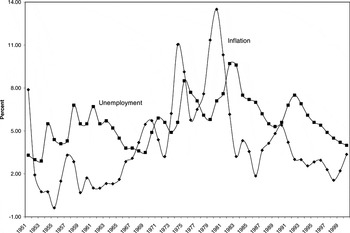
While the image of growing material output is the most prominent impression when the performance of the economy is viewed from the vantage point of a half-century retrospective, politics and policy take shape in real time, where neither governments nor citizens have the luxury of the long view backward. Presidents choose economic policies to meet the conditions of the day, and citizens hold political leaders accountable for current conditions and those of the recent past. In the real world, then, fluctuations around the long-run growth path matter a great deal, and the American economy's path has not been a smooth one. Figure 5 shows the two components of macroeconomic performance, unemployment and inflation, that are most salient to voters.
Unemployment and inflation, 1953–2000
Source: Economic Report of the President, various years

The unemployment series maps the ebb and flow of economic growth, with rising unemployment registering weak demand and declining utilization of the economy's human and material resources. Eight recessions define the historical span from Eisenhower to Clinton, with the economy actually shrinking (i.e., growth dipping below zero) in seven years.Footnote 20 Inflation is the other prominent indicator of economic performance. Although modest price rises are a normal aspect of growth in advanced economies, sharp increases in the rate of inflation, especially if sustained, undermine the predictability needed for sound decisions about purchasing or investing, and create unfair inequalities between those with and those without the market power to raise the price for their products or the wages for their work. The highest rates of inflation in the post-war period are associated with the two oil supply shocks of the 1970s.
Figure 5 also shows the changing relation between unemployment and inflation that developed over the period, a change in the operation of the economy that confronted policymakers with a challenge for which past experience provided little guidance. During the 1950s and 1960s, the primary cause of inflation was excessive demand in an economy expanding too quickly; when the government imposed contractionary measures to slow the inflation, the result was to push the rate of unemployment up. The trade-off made fiscal policy a potent instrument for guiding economic growth. The supply shocks of the 1970s fundamentally upset the equation on which stabilization policy had been based. The increases in the price of energy and food during this period were not occasioned by excess demand but by the actions of external producers and the misfortune of a series of bad harvests. When consumers tried to accommodate the increased cost of food and energy by cutting back on other purchases, this reduced demand (and raised unemployment) throughout the rest of the economy. The novelty of the situation in which unemployment and inflation could rise together—“stagflation” as it came to be called—had immediate and visible impacts in the poor performance of the macroeconomy.
Stagflation also evoked a change in economists' and policymakers' thinking about inflation, and this change in the realm of ideas had a lasting impact on national economic policy. So long as price increases could, to a substantial extent, be controlled with available monetary and fiscal instruments, the problem of inflation ranked as just one of several challenges to the goal of stable growth. Supply shocks posed an altogether more intractable policy problem. With the rate of price increase no longer responding to familiar policy tools, the potential arose that high and persistent inflation would eventually undermine the monetary stability needed to foster saving and investment. The effect of this realization—for leaders in both political parties—was to elevate the salience of inflation relative to older concerns about avoiding recession and unemployment, a change signaled by the rise of monetarism and the shift toward aggressively targeting inflation.Footnote 21
Although figure 5 provides a good summary of the path of economic growth, the data there lack validity for evaluating how well presidents have performed as managers of the economy. The most frequent objection to unemployment as a summary indicator is that it impacts only a small percentage of the population.Footnote 22 Inflation is also limited, primarily because individuals' subjective impressions of inflation are highly susceptible to misperception. People tend to focus on rising prices without calculating whether these are balanced out by wage and salary increases, and hence overestimate the occurrence and economic impact of inflation.Footnote 23
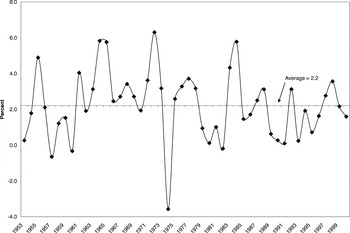
Real disposable income per capita is a more representative and analytically preferable measure of economic conditions. Calculated as the aggregate of all the various sources of income (wages, salaries, rents, interest, and transfer payments), corrected for population and for inflation, real disposable personal income captures the impact on material welfare of unemployment as well as other symptoms of economic decline, while parsing out purely monetary changes in the price level. The result is a more valid picture of economic well-being than any other aggregate indicator.Footnote 24Figure 6 summarizes the main contours of the American economy's performance, charting the growth of real personal disposable income over the post-war years.
Percent change of real disposable income per capita, 1953–2000
Source: Bureau of Economic Analysis, National Income and Product Accounts, Table: “Personal Income and Its Distribution.”

Economic growth appears to have become smoother over time, as the magnitude of fluctuations from one year to the next has diminished; and the pace of growth tends to remain either above average or below average for several years at a time.Footnote 25 This record is the essential starting point for any evaluation of presidents as managers of the economy, but drawing valid inferences about presidential performance requires taking account of the economic and political context. Media coverage, candidates' campaign rhetoric, and even scholarly research on economic voting imply that the president deserves the credit—or the blame—for economic conditions during his administration. But any government's ability to steer the economy over the short-run is limited, and presidents are not the sole authors of stabilization policy. I control for four aspects of the economic policy context: conventional stabilization policy; military mobilization during the Vietnam conflict; the actions of the Federal Reserve; and the effect of international economic events.
The president's leeway is greatest in fiscal policy. The administration's budget maps out revenues and expenditures for the coming year, and although Congress inevitably modifies it, the president's ideas frame the debate; he sets the legislative agenda on longer-run policies such as tax cuts and regulatory initiatives; he appoints the heads of executive agencies tasked with overseeing the economy; and his interpretation of the flow of economic statistics is influential in shaping the public's understanding of events and trends. The president has been viewed as the “manager of prosperity” at least since the Depression, and in embracing this role all post-war presidents have accepted the government's responsibility to shepherd the macroeconomy so as to avoid severe recession or inflation.Footnote 26 Much of this stabilization function is accomplished without explicit governmental action, in the work of the “automatic stabilizers,” programs such as unemployment insurance and income tax collections designed to compensate for cyclical fluctuations; but presidents regularly push for the enactment of additional fiscal measures in response to rising unemployment or inflation. To estimate a given president's impact on stabilization and growth, then, I first control for the conventional response of fiscal policy to short-term changes in macroeconomic conditions. During the late 1960s and early 1970s, military mobilization for the Vietnam War imparted a significant fiscal stimulus that was largely independent of economic policy goals, and we need to control for that effect in estimating presidents' impact on income growth.Footnote 27 In addition to the fiscal balance, the growth of real income is affected by monetary policy, and the actions of the Federal Reserve with respect to domestic interest rates, the money supply, and the value of the currency in international transactions are largely outside the president's sphere of influence.Footnote 28 Finally, the dominant position occupied by the U.S. in global markets at mid-century has given way to a more balanced and interdependent world, in which events and policies in other countries have a greater impact on domestic economic conditions—a shift of relative position first clearly visible in the oil supply shock of 1973.
Modeling Stabilization Policy
I draw on the economics literature on stabilization policy to estimate a model that takes account of these considerations.Footnote 29 Specifically, I estimate how the growth of real personal disposable income varies across presidential administrations, after allowing for the effects of (a) the conventional reaction of government fiscal policy to changes in aggregate economic conditions, (b) military involvement in Vietnam during the Johnson and Nixon administrations, (c) the monetary policy stance of the Federal Reserve, and (d) the greater external constraints on domestic policy discretion that date from the supply shocks of the mid-1970s. Here I describe the specification of these adjustments, beginning with a simple reaction function model of fiscal stabilization policy.
In pursuing the objective of maintaining growth and moderating the swings of business cycles, the government employs revenue and spending policy to adjust the deficit/surplus position of the budget, depending on the levels or trends of unemployment and inflation. In recessionary times, policy shifts toward deficit, in order to pick up the slack in the private economy; when inflation threatens, the government shifts toward surplus. Although there are economic and political limits to the flexibility of the deficit as a policy instrument, the development and expansion of automatic spending and revenue stabilizers, plus the effect of inflation (during most of the period) to increase tax revenues, meant that politicians could move the budget toward surplus without taking any action and could expand deficits by enacting politically popular tax cuts. I control for the common use of fiscal stabilization policy by modeling the deficit/surplus as a function of the trend and level of unemployment, after testing specifications that also include inflation and shifts in the target rate of unemployment.Footnote 30 The resulting model captures that portion of the net fiscal balance accounted for as a response to short-run economic conditions.
The next step is to combine this estimate of the conventional fiscal policy reaction function with causal influences on the growth of real disposable personal income that are independent of short-run macroeconomic conditions or that lie outside the president's control. These include military mobilization during the Vietnam period, Federal Reserve monetary policy, and post-1973 external constraints on fiscal flexibility.Footnote 31 The residuals from this regression are a measure of the change in real disposable personal income not attributable to conventional fiscal policy commitments, the expansion of the military during the Vietnam conflict, or other actors and international constraints. Although this indicator has the inevitable imperfections that follow from trading off qualitative detail for comparability, it yields a good foundation for inferring, to a first approximation, that differences between administrations in the resulting measure of real income growth can be attributed to the discretionary actions of the president.
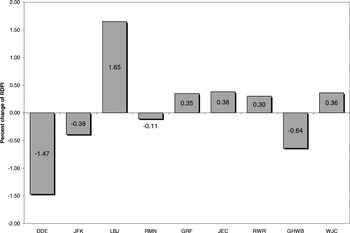
The declining volatility of real income growth, which was visible in figure 6, is apparent even after controlling for economic influences outside the president's discretion. More notable, however, are the differences among presidential administrations. The net decline of real income during the 1950s registers Eisenhower's consistent concern with quelling inflation at the first sign of rising prices. Unlike his successors in the 1960s, Eisenhower and his advisors were skeptical of Keynesian activism: the economic model that guided thinking in both the White House and the Federal Reserve centered on the danger of inflation and held that pushing the economy beyond full employment (i.e., unemployment at about 5 percent) would create upward pressure on prices and eventually cause inflation to accelerate. The outcome of Eisenhower's economic policies was slower growth but much less inflation than later presidents would experience.Footnote 32 Kennedy's economic policy moderated this restrictive trend, but his narrow electoral margin and a Congress highly skeptical of deficit spending impeded the enactment of the ambitious Keynesian aims of the New Frontier. The Johnson years opened with the new president persuading a reluctant Congress to approve the tax cut that Kennedy had proposed, and this initiative, intended to move the national economy onto a higher growth path, signaled an historic departure. Compared with the 1950s, economic policymakers in the 1960s and early 1970s held a much more optimistic view of the prospects for expanding output and employment without triggering inflation. The dominant economic model not only pointed toward policies, such as the 1964 tax cut, that would directly spur growth and income, but also strengthened the case for spending initiatives (such as the Great Society's education, civil rights, and urban programs) which promised indirect economic effects via investments in human capital and weakened budgetary opposition to increasing military expenditures in Vietnam. As growing opposition to the war and the cost of Great Society programs threatened to constrain Johnson's principal initiatives, he used several expedients, from disguising expenditures to playing on his advisors' uncertainty about the inflationary process, to keep up the momentum.Footnote 33 The net stimulative effect of the sustained government deficit was bound to spawn inflationary pressures, even against the background of a long period of very low inflation, but the process of economic growth initially generated increases in output and employment and only later took root in rising inflationary expectations. The result was that President Johnson largely escaped the inflation to which his policies contributed; as figure 7 shows, most of the expansion of the Johnson years amounted to genuine growth in Americans' purchasing power and standard of living.
Change of real disposable personal income
Note: Corrected for conventional stabilization policy, post-1973 constraints on fiscal flexibility, Federal Reserve monetary policy, and military mobilization.
Source: Calculated by the author. See text for details.

Real income gains were essentially null during the Nixon years, but this average summarizes an unusually turbulent period. “Nixonomics” began with moderately restrictive fiscal and monetary policy during the administration's first couple of years. Nixon had been skeptical of the policy of “gradualism” from the start, and when it appeared that economic growth would be flat or declining in the run-up to the 1972 election, he lost patience with his economic advisors and brought in John Connolly, the flamboyant former Texas governor, to implement a dramatic program that combined economic stimulus with wage and price controls. Although clearly not a sustainable policy, the combination produced several months of non-inflationary growth in the period just before the election.Footnote 34 The artificial cap on prices and wages inevitably generated rising pressure for catch-up increases, and once controls were relaxed the resulting inflation, along with the impact of the OPEC oil price rise, erased most of the gains of the administration's early years. Both Presidents Johnson and Nixon benefited from economic expansions whose inflationary consequences were visible only after the political benefits of increased national output and income had been pocketed. The episodes thus highlight the difficulty of attributing responsibility for economic outcomes, and I discuss that in more detail below.
The recession that marked Nixon's last two years in office ended in the first quarter of 1975, with unemployment peaking at more than 8 percent, its highest level since the Great Depression. President Ford's brief tenure (beginning in August 1974) thus coincided with the recovery phase of the business cycle. Although Ford's preference was to attack inflation, which remained at historically high levels, the Democratic Congress rejected virtually all such plans, and the resulting standoff meant that no action was taken that would inhibit the recovery. Carter's presidency, like Nixon's, was marked by a sharp change of direction. The moderately stimulative policies of the first three years, largely the result of activist pressures from congressional Democrats, initially helped extend the recovery from the 1974 recession but by 1978 had reignited inflation. Although the White House sought to publicize the danger of inflation, it was only in the wake of the tripling of oil prices during 1979 that President Carter clearly shifted to focus aggressively on inflation, by implementing temporary credit controls and appointing the staunch monetarist Paul Volcker to head the Federal Reserve.Footnote 35
The overall path of the economy during the Reagan years was largely defined by the central bank's fight against inflation.Footnote 36 The long period of stringent monetary policy produced the deepest recession of the post-war period, with unemployment peaking at nearly 10 percent in 1982. Once the Fed relaxed its monetary stance, the pace of activity quickened as inflation continued to fall through the early years of the recovery, until rising prices provoked the Fed to tighten monetary policy in 1987, thus slowing the recovery. The fiscal activism of Reagan's first two years, including tax cuts and increased defense spending, undoubtedly contributed to the economy's growth in subsequent years, but from the perspective of macroeconomic policy its most significant legacy related to the distribution of taxes and government spending. As figure 7 shows, most of the variation in real disposable income during the Reagan years is accounted for by monetary policy.
Like Jimmy Carter, George H.W. Bush found it difficult to take a real interest in economic policy, and the resulting presidential uncertainty, along with in-fighting among his advisors, led to delay and inaction in responding to economic developments. Facing a stand-off with the Democratic Congress and personally convinced of the necessity of reducing the deficit, Bush's reluctant decision to raise taxes alienated his partisans but won praise from economists. Once the economy entered the recession of 1990–91, Michael Boskin, the chair of the Council of Economic Advisors, sought to persuade President Bush to increase spending to stimulate job growth. Boskin calculated that such a policy would strengthen the recovery and make Bush's record of managing economic cycles comparable to the post-war average. But he was sidelined by Bush's political advisors, and the president went on to veto stimulative initiatives passed by the Congress. The result was the sharply contractionary policy course tracked in figure 7.Footnote 37
President Clinton entered office focused strongly on the economy, and early in his first year he settled on an unconventional approach to deficit reduction as the top priority. Robert Rubin and several other advisors argued that the growing deficit was undermining confidence in the economy and, by driving up interest rates, cutting off the flow of productive investment. The policy was risky both economically and politically. The economic implication of the diagnosis ran counter to conventional Keynesian theory, suggesting that tightening fiscal policy—raising taxes and cutting expenditures so as to shrink the deficit—would foster higher and more sustainable growth by easing pressure on capital markets and driving down interest rates. The political climate was unusually hostile, as the Republicans in Congress mounted an unprecedentedly unified opposition to the plan. The 1993 budget, enacted on a one-vote majority, translated this theory into policy, and the subsequent growth of real disposable income exceeded what would have been expected from the conventional mix of fiscal and monetary policy.Footnote 38
Presidents and the Distribution of National Income
The gap between the rich and the rest of the population, which was a leitmotif of national politics from the late nineteenth century and the center of presidential campaigns during the Great Depression of the 1930s, hardly registered as a political issue from World War II until the 1980s. The growing concern since then reflects the trajectory of inequality in the U.S. political economy. Whether we look at income, wealth, or the prospects for economic mobility, the distribution of the rewards from work has become much more unequal and economic opportunity much more limited. Change in the American economy along this dimension is perhaps the most historically significant development over the nearly five-decade span of our research.
The pattern characteristic of several measures of inequality is clearly visible in changes in the distribution of income. From the early 1950s through the 1970s, the richest ten percent of the population received just over 30 percent of the nation's total income. But that share began to grow in the 1980s: by the end of the century, the richest 10 percent received some 44 percent of total income. The bulk of this increasing concentration is accounted for by disproportionate gains at the very top of the income distribution: the share of national income going to the top 1 percent rose from less than 8 percent in the 1970s to over 17 percent in 2000, more than the combined income received by the poorest 40 percent of the population. If the share of income going to those in the top stratum increases, then of course it follows that the amount left for those further down the scale must have fallen, and the average real income of the lowest 90 percent declined by 7 percent over the last two decades of the century.Footnote 39
Inequality has also increased if we look at wealth. Where income measures current earnings, wealth or net worth summarizes the total assets households command, and for most families it represents their ability to invest in future-oriented projects such as higher education or home ownership.Footnote 40 Wealth is more unequally distributed than income: for instance, households in the bottom 25 percent of the distribution hold less than three-tenths of 1 percent of total net worth. And the distribution of wealth has become more concentrated: in 1962, families in the bottom 90 percent of the distribution owned about 37 percent of total net worth, but by 2001 this proportion had fallen to 30 percent. The changes at the bottom of the scale were driven by gains in the share of total national wealth going to the already well-off. Between 1962 and 2001, the share of total net worth held by the top 5 percent grew from 51.6 percent to 57.4 percent, and the wealth share held by the top 1 percent grew from 30 percent to 35.3 percent.Footnote 41 By the end of the century, in short, the share of the nation's total net worth owned by the richest 1 percent exceeded the combined wealth of the bottom 90 percent of the population.
Economic inequality poses less of a challenge to values such as equal opportunity and political equality if there is a high degree of movement from one class to another. When there is a great deal of mobility in a market economy, this suggests that economic rewards are a result of each individual's merit and hard work; where mobility is limited, children are much more likely to inherit the socioeconomic status of their parents. Social mobility has declined significantly over the past few decades. As recently as the early 1970s, some 23 percent of men whose fathers were in the bottom quarter of the income distribution had risen to the top quarter; by 1998, that figure had fallen by more than half, to 10 percent. Research drawing on multiple data sources and analytical techniques confirms that the correlation has increased substantially between parents' and children's social class, a trend Business Week summarizes by noting that the U.S. economy “is slowly stratifying along class lines.”Footnote 42
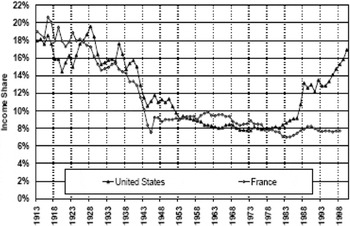
Rising inequality in the U.S. is attributable to a number of sources—for instance, technological advances, the movement of women into the workforce and other changes in families, the proliferation of low-wage jobs and the disappearance of manufacturing jobs paying middle-class salaries, and the effect of international competition on domestic markets. These forces have impacted advanced economies across the globe. But national governments have responded to the pressures of technological change and globalization in different ways, choosing whether to use tax policy, regulation and social programs to redress the growth of market-based inequalities. When we compare countries, the U.S. stands out: disparities in socioeconomic resources have grown much more sharply in the U.S. than in other advanced countries.Footnote 43 Piketty and Saez have undertaken the most detailed comparison of economic inequality in the advanced countries, and figure 8, showing income trends for households in the U.S. and France from World War I to the end of the century, typifies comparisons between the U.S. and European economies. The two countries moved roughly in tandem through most of the period, reducing inequality from the 1930s through the 1970s. But from the early 1980s on, the U.S. has diverged quite dramatically, becoming far more unequal: by the end of the century, the share of U.S. national income going to the very rich was double that in France.Footnote 44
Percent of total national income going to the top 1% in the United States and France, 1913–2000
Source: Saez Reference Saez2003.

Two sorts of policies influence the distribution of economic well-being, and the president's goals and actions in the economy are crucial in shaping both. The first are compensatory tax and transfer programs, such as Social Security, unemployment insurance, subsidized health care for low income families, etc., along with a system of progressive taxation of income and wealth. The cluster of policies enacted together under the Poverty Program in the Johnson years, for example, moved the distribution of income toward more equality, while the Reagan tax and budget cuts of 1981 increased inequality.Footnote 45 The second are macroeconomic policies that influence the rate of growth—slower overall growth and increases in unemployment produce income shifts from the lower portion of the distribution toward the top, while faster growth strengthens the purchasing power of families lower down the scale.Footnote 46
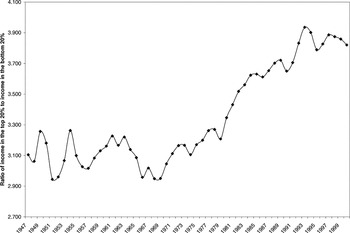
Figure 9 traces the evolution of inequality over the post-war years, showing the ratio of the share of national income going to the most affluent 20 percent (those at or above the eightieth percentile) to the share received by the poorest 20 percent (those at or below the twentieth percentile), called the “80/20 ratio.”Footnote 47
U.S. economic inequality: 80/20 income ratio, 1947–2000
Source: U.S. Census Bureau, Historical Tables, Table F-1.

The path of economic inequality over the second half of the twentieth century shows three distinct phases. From the end of the Second World War through the late 1960s, inequality fluctuated but remained essentially stable. At the end of the period, its level was slightly lower than at the beginning. In 1947, the income of families at the twentieth percentile was $10,662 (in 2001 dollars), while that of families at the eightieth percentile was $33,103, for a ratio of 3.10. By 1969, the income of families at the twentieth percentile was $20,690 and that of families at the eightieth percentile was $61,040, for a ratio of 2.95. During the 1970s and 1980s, inequality increased dramatically, with the 80/20 ratio growing to 3.94 by 1993. During the 1990s, the degree of income inequality decreased, ending the decade at 3.82.
Different presidents clearly made very different contributions to the development of economic inequality over the post-war years. I can summarize the variation in the growth of inequality from one president to the next by taking the average of the annualized rate of change in the 80/20 ratio during a given administration. Figure 10 shows this coefficient for each president, relative to a baseline of no change in the distribution of income.
Average annual change in economic inequality (80/20 income ratio), by administration
Source: Calculated from U.S. Census Bureau, Historical Tables, table F-1.

Since the 80/20 ratio measures inequality, a positive score indicates that the distribution of income became increasingly unequal under the president's policies, while negative scores show expanding equality. Unlike economic growth, where the parties agree on the goal if not on the means, the party affiliation of the president provides a reliable first cut at accounting for variation in the growth of inequality. As a rule, the policies of Republican presidents lead to increasing inequality, while Democratic presidents push toward greater equality. Moreover, when a long-standing party regime is replaced, it occasions a quite striking reversal in the trajectory of inequality. For instance, when Nixon's economic policies replaced Johnson's the effect was a net shift of nearly 8 percent in the pace of growth of inequality, while the change accompanying the transition to Clinton's economic policies after a dozen years of Republican rule amounted to a shift of over 4 percent in the direction more equality. This pattern replicates earlier analyses showing strong and consistent differences between party governments in the U.S. and in other advanced democracies.Footnote 48 At the same time, substantial differences among presidents are worth noting.
Eisenhower's presidency, which included modest expansions of the coverage of Social Security and unemployment insurance during his first term, was dominated by two recessions and the president's consistent resistance to liberal initiatives from Democrats in Congress. Although the 80/20 ratio fluctuated during the Eisenhower years, overall his presidency had no discernable effect on the distribution of income. Both Kennedy and Johnson were committed to programs that would improve the economic welfare of those at the bottom, but Kennedy's tenuous legislative majority ruled out translating ambitions into enactments. When Johnson's landslide election brought in an unprecedentedly liberal Congress, the president took advantage of his brief window of opportunity to pass a wide range of initiatives that cut economic inequality both directly, as in the Poverty Program, and indirectly by attacking the racial discrimination that had kept black Americans from gaining education or well-paying jobs.
The economy was far down the list of topics that inspired Nixon's politically ambitious presidency, but when growth faltered in his first year, he embarked on a series of initiatives that were stunningly effective at delivering short-run political payoffs but showed virtually no concern for longer-run economic outcomes. From the anti-inflation “freeze” of his first term, which constrained wage increases much more narrowly than price rises, to an aggressively contractionary response to the supply shocks of 1973, the policies followed by Nixon and Ford had the effect of sharply reversing the 1960s trend toward greater equality.Footnote 49 The Carter presidency marked a crucial transition, coming to terms both with the exhaustion of the activist ideology forged in the New Deal and with an economy prone to inflation and declining productivity. Moreover, Carter's personal economic conservatism oriented him toward limiting new programs and toward market-based initiatives such as deregulation. Overall, the Carter presidency continued the trend of growing economic inequality, although the pace of increase slowed considerably.
If Carter's presidency closed the chapter on the Democratic Party's economic activism, Reagan's first term set national economic policy on a new course. Defining his presidency with unusual clarity, Reagan's rhetoric of old-fashioned individualism shaped a consistent policy direction that produced lasting shifts in both the incidence of taxes and the level of spending on redistributive social programs. The administration's legislative strategy combined well-publicized tax cuts with less visible opposition to adapting established programs to an economy now defined by growing risks to workers' employment and income.Footnote 50 The resulting growth of inequality during the Reagan and Bush years was greater than during any comparable period back at least to the 1920s.
Clinton, elected as an “opposition president” in an era dominated by a conservative public philosophy,Footnote 51 focused initially on getting the deficit under control, seeking to stimulate investment and growth by lowering interest rates. Although he had mapped out an ambitious agenda of programmatic initiatives that aimed at expanding economic equality, he could not command the legislative support to enact these proposals. In the end, the bulk of the movement toward greater equality during the Clinton years is attributable to his macroeconomic policies, which generated unprecedented job growth through the longest economic expansion in the post-war period.
Conclusion
In comparing post-war presidents' economic leadership, I have distinguished four indicators of presidential accomplishment—support for the president's program in Congress, the public's evaluation of his economic management, the impact of the president's decisions on economic prosperity and on the distribution of the economy's output—and developed quantitative measures of each. These indicators tell both about how elite and mass audiences saw these presidents' programs, and about how adroitly their policies met the economic challenges of the time while protecting the material equality that undergirds effective democratic citizenship. This concluding section looks at the project of comparing presidents from two perspectives, first summarizing the analysis by bringing the separate dimensions together into an overall indicator of presidential economic leadership, and then considering the strengths and limitations of a quantitative approach.
The over-arching concept of presidential economic leadership points toward combining these measures into a global summary. I first align all the indicators so that high scores show better performance (more legislative support, higher public approval, more—and more widely-shared—economic growth), then convert the original measures to standard scores, and finally average the scores on the four dimensions. Figure 11 shows this global summary of the quality of economic policy leadership for the post-war presidents from Eisenhower to Clinton.
Comparing the economic policy performance of post-war presidents: Congressional support, public approval, economic growth, income distribution
Source: Calculated by the author. See text for details.

Perhaps the clearest inference from this analysis of presidential stewardship is that managing the economy well requires a combination of policy commitment and political skill that, while not unique, is certainly in short supply. Guiding the national economy in the context of political accountability involves shaping policy so that it serves both to foster the growth of material productivity and to spread the opportunity and legitimacy that nourishes democratic participation. Timing and the good fortune of favorable events also come into it, of course; no president is above blaming his predecessor or market transactions.Footnote 52 But over a four-year term, the president has the opportunity to fashion a trajectory and a configuration of outcomes that will place his stamp on the economic history of his administration.Footnote 53 The president cannot master the job simply by resolving to respond promptly as new economic contingencies arise. To keep the national economy on an even keel—leaving aside any intention to steer it in a particular direction—he needs to have a clear idea of his own goals, and enough economic knowledge, curiosity, and self-confidence to seek constructive diversity in his advisors, and then to engage them in the give-and-take of genuine deliberation.
Finally, studying presidents' economic performance reveals concrete opportunities for conversation between quantitative and qualitative approaches. By classifying presidential performance along these four salient dimensions, this analysis strengthens our capacity to make clear and precise statements about the economic accomplishments of each administration, yielding comparisons that are less a matter of judgment or partisan sentiment than of measurement. But comparison involves standardization, the move away from idiosyncratic features and toward categories. This step inevitably rests on decisions about how to classify presidential actions and economic outcomes, and how much information, particularly retrospective knowledge, to include. In weighing such choices both quantitative and qualitative approaches have a contribution to make. Returning for another look at the economic policies of the late 1960s and early 1970s provides an apt illustration of the interplay between different methods.
The task of “managing prosperity” is undoubtedly complex, but monetary and fiscal policy have been reasonably well-understood since World War II: policy could, that is, have restrained the rising inflation of the Johnson and Nixon years before it reached unacceptable levels. Whether the resulting failure to maintain steady economic growth should be attributed to the president, however, depends on parsing the nature of the policy mistakes. Early in the postwar period, for instance, the acceleration of inflation was due to the central bank's policy of accommodating the Treasury's management of the national debt by keeping interest rates low, while the relatively brief inflations of the 1950s appear to have been the result of limitations on the economic statistics available to the government. The inflation of the late 1960s and early 1970s, however, is less easily attributed to inexperience or faulty data: discretionary policy was clearly stimulative, even though output growth and inflation were already high. During the Johnson years, the primary engine of expansion was fiscal policy, although the central bank accommodated the macroeconomic effects of rising expenditures on the Vietnam War and the Great Society. In the run-up to the 1972 election, monetary policy was the primary source of stimulation, although payments to Social Security recipients were increased substantially in the month before the election.
The unusually expansive policy, as well as the balance between fiscal and monetary initiatives, is tracked well by the analyses summarized in figure 7. Moreover, economists and political scientists are in agreement in seeing these episodes as systematic and intentional. The quantitative approach is, however, less suited to detailing the causal mechanism. Among economists, DeLong argues that the memory of the Great Depression sensitized officials toward avoiding the possibility of recession, and this led to errant interpretations of trends and underestimation of the risk of inflation. Taylor and Romer place more emphasis on mistaken economic theories, particularly the belief that a stable tradeoff between unemployment and price rises permitted expanding demand without the danger of accelerating inflation. Political scientists and historians, on the other hand, have stressed the way economic expansion served the policy and electoral aims of the president, allowing Johnson to deflect criticism of the Great Society and Vietnam, and permitting Nixon to fulfill his goal of vigorous economic growth in the months before the election.Footnote 54 In this debate, the quantitative analysis helps to sort out the net effects of fiscal and monetary policy and shifts of popular support for the president, thus sharpening questions about the intentions of the president and the beliefs of his economic advisors, queries for which qualitative approaches are better suited.
This analysis shows the potential of well-grounded, clearly conceptualized quantitative comparisons of presidential performance. By sharpening the precision with which we can make some comparisons, it also points toward other aspects of presidential economic leadership that are not well-indexed by a quantitative approach. The analysis, then, can provide solid grounding for more qualitative research on how presidents have set economic goals, organized their resources of information and persuasion, and orchestrated political strategies to build support for their policies in Congress and the public.