Introduction
Various original studies have shown that personality traits are substantially related to mental disorders, psychosocial functioning impairments and behavioural problems, including depression and anxiety (De Graaf et al. Reference De Graaf, Bijl, Ravelli, Smit and Vollebergh2002; Hettema et al. Reference Hettema, Neale, Myers, Prescott and Kendler2006; Kendler et al. Reference Kendler, Gatz, Gardner and Pedersen2006), personality disorders (Samuel & Widiger, Reference Samuel and Widiger2008; Hengartner et al. Reference Hengartner, De Fruyt, Rodgers, Müller, Rössler and Ajdacic-Gross2014b ), substance abuse (Krueger, Reference Krueger1999; Turiano et al. Reference Turiano, Whiteman, Hampson, Roberts and Mroczek2012), sexual problems (Harris et al. Reference Harris, Cherkas, Kato, Heiman and Spector2008; Leeners et al. Reference Leeners, Hengartner, Rössler, Ajdacic-Gross and Angst2014), psychological and pharmacological treatment response (Quilty et al. Reference Quilty, De Fruyt, Rolland, Kennedy, Rouillon and Bagby2008; Spek et al. Reference Spek, Nyklicek, Cuijpers and Pop2008), schizophrenia spectrum disorders (Van Os & Jones, Reference Van Os and Jones2001; Macare et al. Reference Macare, Bates, Heath, Martin and Ettinger2012; Rössler et al. Reference Rössler, Ajdacic-Gross, Müller, Rodgers, Haker and Hengartner2015) and mental health service use (Goodwin et al. Reference Goodwin, Hoven, Lyons and Stein2002; ten Have et al. Reference ten Have, Oldehinkel, Vollebergh and Ormel2005). In accordance, recent phenotypic and genetic findings suggest that personality is one of the main factors underlying general psychopathological impairment and both the severity and co-morbidity of mental disorders (Khan et al. Reference Khan, Jacobson, Gardner, Prescott and Kendler2005; Tackett et al. Reference Tackett, Lahey, van Hulle, Waldman, Krueger and Rathouz2013; Caspi et al. Reference Caspi, Houts, Belsky, Goldman-Mellor, Harrington, Israel, Meier, Ramrakha, Shalev, Poulton and Moffitt2014). It has thus legitimately been stated that maladaptive personality, that is, excessively high scores on normal personality traits as well as pathological personality traits and personality disorders, play a crucial role in the onset and development of psychopathology (Kotov et al. Reference Kotov, Gamez, Schmidt and Watson2010; Krueger & Eaton, Reference Krueger and Eaton2010; Klein et al. Reference Klein, Kotov and Bufferd2011; Hengartner, Reference Hengartner, Angst, Ajdacic-Gross, Rössler and Angst2015). The impact of personality is also highly significant for public health policies, preventive medicine and health economics (Lahey, Reference Lahey2009; Bogg & Roberts, Reference Bogg and Roberts2013). In their seminal study, Cuijpers et al. (Reference Cuijpers, Smit, Penninx, de Graaf, ten Have and Beekman2010) demonstrated that the excess costs uniquely related to the trait neuroticism are tremendous. For the year 2007 the authors estimated that in the Netherlands the excess costs attributable to the 25% highest scores of neuroticism were $1.39 billion per 1 million inhabitants, which was approximately 2.5 times higher than the costs attributable to mood, anxiety and substance use disorders (SUD) combined. However, the exact form of the relationship between personality and psychopathology is not unequivocally clear and there are various competing aetiological models (Klein et al. Reference Klein, Kotov and Bufferd2011; Widiger, Reference Widiger2011).
The predisposition model posits that personality constitutes an independent causal risk factor for the subsequent development of psychopathology, whereas according to the pathoplasty model personality affects only the course and severity of a mental disorder, but has no causal effect on the onset of the disorder. In addition, psychopathology may alter personality traits, as defined by the scar model (enduring effects) and the complication model (transient state effects). Finally, both the shared-factor model and the spectrum model posit that personality and psychopathology share the same underlying aetiological factor, with the former stating that both conditions have a common cause and the latter that both conditions are different manifestations along the same continuum (Clark, Reference Clark2005). Presumably, the aetiological model with the greatest importance for psychiatric practice and public mental health is the predisposition model. If personality were to be confirmed as an independent risk factor causally related to psychopathology, then the clinical implication is that prevention and intervention should be targeted at personality traits, and not at their secondary psychopathological consequences (Soskin et al. Reference Soskin, Carl, Alpert and Fava2012; Barlow et al. Reference Barlow, Sauer-Zavala, Carl, Bullis and Ellard2014).
However, a critical test of the predisposition model is methodologically demanding. First, in order to draw causal conclusions, longitudinal studies that cover a long observation period are necessary. Second, due to confounding, pathoplastic effects and common-cause factors, studies are needed that account not only for concurrent and subsequent psychopathology, but also for a thorough history of mental disorders prior to the assessment of personality. The aim of the present study was thus to provide a critical test of the predisposition model by using data from the Zurich Cohort Study, a longitudinal epidemiological study covering 30 years.
Method
Participants and sampling procedure
The Zurich Cohort Study originally comprised a cohort of 4547 subjects (males = 2201; females = 2346) representative of the canton of Zurich in Switzerland, who were screened in 1978 with the Symptom Checklist 90-R (SCL-90-R; Derogatis, Reference Derogatis1977) when the men were 19 and the women 20 years old. Men and women were sampled with different approaches. In Switzerland, every male citizen must undertake a military screening test at the age of 19 years. Therefore, conscripts within a defined catchment area comprise its respective, complete male age group. With the consent of military authorities, but independent of their screening procedure, we randomly screened 50% of all male conscripts of the canton of Zurich of this age group. The refusal rate was 0.3%. Almost all men participated in the screening because they had to fill out various questionnaires for the armed services anyway. Since, with the exception of severely disabled persons, all Swiss men had to undergo military conscription at that time, drawing a random sample from conscripts allowed for the most representative male sample possible. As women were not obliged to serve in the army, female participants were identified from the complete electoral register of the canton of Zurich. Again, 50% of them were randomly selected and received questionnaires by mail, of which 75% responded. In order to increase the probability of the development of psychiatric syndromes, a stratified subsample of 591 persons (men = 292; women = 299) was selected for comprehensive interview, with two-thirds consisting of high scorers [defined by the 85th percentile or more of the Global Severity Index (GSI) of the SCL-90-R] and one-third being a random sample of subjects with scores below that 85th percentile. Such a two-phase procedure, i.e. initial screening and subsequent interview with a stratified subsample, is fairly common in epidemiological research (Dunn et al. Reference Dunn, Pickles, Tansella and Vazquez-Barquero1999). A detailed description of the sampling method has been provided elsewhere (Angst et al. Reference Angst, Dobler-Mikola and Binder1984).
Altogether seven interview waves have been conducted, specifically, in 1979 (n = 591), 1981(n = 456), 1986 (n = 457), 1988 (n = 424), 1993 (n = 407), 1999 (n = 367) and 2008 (n = 335). The corresponding attrition rates were 0, 22.8, 22.7, 28.3, 31.1, 37.9 and 43.3. That is, even after 30 years of study duration, more than half of all participants continued to participate. Participant flow is indicated in Fig. 1. The initial allocation to the two groups, above and below the 85th percentile of the GSI, remained stable throughout the study; the dropouts were more frequent among the extremely high and extremely low GSI scorers (Eich et al. Reference Eich, Ajdacic-Gross, Condrau, Huber, Gamma, Angst and Rössler2003). We repeated the attrition analyses after the most recent interview. There we found, in addition, no significant difference between subjects who had left the study and those who remained with regard to socio-economic status and education as measured at the study outset, nor in their initial psychopathological impairment according to the nine SCL-90-R subscales. However, there was a moderate sex bias, with more dropouts among men [odds ratio (OR) = 1.82, 95% confidence interval 1.31–2.53, p < 0.001].
Participant flow over the 30 years of study duration.

Instruments and measures
Interviews were conducted using the ‘Structured Psychopathological Interview and Rating of the Social Consequences of Psychological Disturbances for Epidemiology’ (SPIKE) (Angst et al. Reference Angst, Dobler-Mikola and Binder1984). This semi-structured interview collects data on sociodemography, somatic syndromes, psychopathology, substance use, medication, health services, impairment and social activity. Its good reliability and validity have been reported previously (e.g. Angst et al. Reference Angst, Gamma, Neuenschwander, Ajdacic-Gross, Eich, Rössler and Merikangas2005). In contrast to other interviews [e.g. Composite International Diagnostic Interview (CIDI) and Structured Clinical Interview for DSM Disorders (SCID)], which focus on Diagnostic and Statistical Manual of Mental Disorders (DSM) diagnoses using a top-down approach with multiple cut-offs, the SPIKE interview uses a bottom-up approach assessing the past-year presence of about 14 somatic and 15 psychiatric syndromes, checking symptoms, duration, frequency and recency of episodes, distress, impairment and treatment. As described in detail elsewhere, diagnoses were based on DSM 3rd edition (DSM-III), 3rd edition revised (DSM-III-R) and 4th edition (DSM-IV) criteria (Angst et al. Reference Angst, Gamma, Neuenschwander, Ajdacic-Gross, Eich, Rössler and Merikangas2005). Major depressive episode (MDE) was diagnosed according to DSM-III-R and subsequently DSM-IV criteria. Dysthymia and minor depression were not included. For the present study we condensed generalized anxiety disorder (GAD), agoraphobia and social phobia into an umbrella diagnosis of anxiety disorder. We omitted obsessive–compulsive disorder and panic disorder from this umbrella diagnosis because they did not show a sufficiently large incidence of new cases after personality assessment in 1988 (see Angst et al. Reference Angst, Paksarian, Cui, Merikangas, Hengartner, Ajdacic-Gross and Rössler2016). Specific phobia was not included because the disorder is only moderately impairing or disabling when not secondary to other mental disorders (Depla et al. Reference Depla, ten Have, van Balkom and de Graaf2008). The proportion of participants with the umbrella diagnosis of anxiety disorder who specifically met criteria for social phobia across the follow-up period from 1993 to 2008 was 50.0% in 1993, 26.8% in 1999, and 40.9% in 2008. The corresponding proportion of persons with an anxiety disorder who specifically met criteria for GAD across the same period was 51.4% in 1993, 58.9% in 1999, and 43.2% in 2008. Alcohol as well as drug abuse and dependence were subsumed under the broad umbrella diagnosis of SUD. Finally, professional treatment was defined as having consulted a medical doctor or psychologist in the 12 months prior to each interview and was analysed as a dichotomous variable (yes/no). Treatment was assessed separately for each syndrome and comprises psychological and psychopharmacological interventions. A diagnosis of MDE was not prerequisite for depression treatment use. Moreover, it is important to note that treatment is readily available in Switzerland. Every resident has a mandatory basic private health insurance and access to general and other practitioners, including psychotherapists. Use of professional treatment for depression was included in the analysis because it has been demonstrated to be a robust indicator of particularly severe and impairing depression episodes (Hengartner et al. Reference Hengartner, Angst, Ajdacic-Gross, Rössler and Angst2016). Since the common diagnosis of MDE according to DSM criteria shows little clinical utility as well as questionable reliability and validity (Parker, Reference Parker2005; Lorenzo-Luaces, Reference Lorenzo-Luaces2015), including an indicator of burdensome depression episodes irrespective of the diagnosis of major depression is clinically useful.
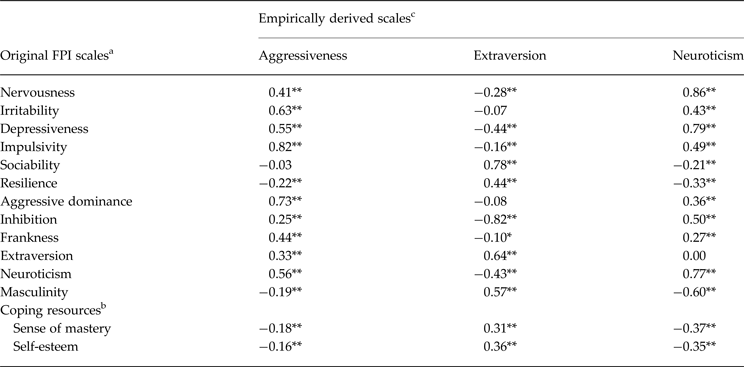
At the assessment in 1988, when participants were 29/30 years old, we examined the participants’ personality traits using the Freiburg Personality Inventory (FPI; Fahrenberg et al. Reference Fahrenberg, Hampel and Selg1984). At that time the FPI was a widely used German personality inventory depicting personality traits on nine distinct scales. These traits are: (1) nervousness; (2) irritability; (3) depressiveness; (4) impulsivity; (5) sociability; (6) resilience; (7) aggressive dominance; (8) inhibition; and (9) frankness. The higher-order domains of the FPI originally proposed by the authors are neuroticism, extraversion and masculinity (Fahrenberg et al. Reference Fahrenberg, Hampel and Selg1984). However, some primary scales and in particular the domain of masculinity are conceptually outdated nowadays. Moreover, the original FPI scales do not bear close resemblance to the currently most frequently used big-five traits. Using a very large sample (n > 5000) and replication in six random subsamples thereof, extensive factor-analytic examination on item-level showed that the FPI items map onto the three domains of aggressiveness, extraversion and neuroticism (Angst & Clayton, Reference Angst and Clayton1986). In the present study aggressiveness consists of 21 items and captures facets of proneness to violence, callousness and lack of self-control. The internal consistency of the aggressiveness domain was good (Cronbach's α = 0.81). Extraversion consists of 13 items and describes the broad domain of positive affectivity; that is, being outgoing, cheerful and self-confident. The internal consistency of this domain was acceptable (Cronbach's α = 0.72). Finally, neuroticism consists of 16 items and captures the broad domain of negative affectivity, which comprises emotional liability, somatization and worry. Its internal consistency was also acceptable (Cronbach's α = 0.77). The correlations between these empirically derived domains and the original FPI scales are shown in Table 1. Further evidence for discriminant and convergent construct validity of these empirically derived personality domains was provided by examining their associations with the well-established coping resources of sense of mastery and self-esteem as assessed in the interview from 1986. Those coping dimensions were adapted from the highly cited work of Pearlin & Schooler (Reference Pearlin and Schooler1978). In accordance with a comprehensive meta-analysis conducted by Connor-Smith & Flachsbart (Reference Connor-Smith and Flachsbart2007), neuroticism and aggressiveness related negatively to both self-esteem and sense of mastery, while extraversion was positively associated. Taken together, the FPI has shown good reliability and validity (see also Fahrenberg et al. Reference Fahrenberg, Hampel and Selg1984, Reference Fahrenberg, Hampel and Selg2001). In addition, the higher-order domains of aggressiveness (also termed disinhibition or antagonism), extraversion and neuroticism are well replicated and very common in personality and psychopathology research (Clark, Reference Clark2005; Markon et al. Reference Markon, Krueger and Watson2005; Hengartner et al. Reference Hengartner, Ajdacic-Gross, Rodgers, Müller and Rössler2014a ). Those domains also correspond closely to the three dimensions of neuroticism, extraversion and psychoticism as included in the Eysenck Personality Questionnaire (Eysenck & Eysenck, Reference Eysenck and Eysenck1975).
Pearson correlations of the empirically derived FPI personality domains with the original FPI scales and two dimensions of coping resources

FPI, Freiburg Personality Inventory.
a Derived from Fahrenberg et al. (Reference Fahrenberg, Hampel and Selg1984).
b Derived from Pearlin & Schooler (Reference Pearlin and Schooler1978).
c Derived from Angst & Clayton (Reference Angst and Clayton1986).
* p < 0.05, ** p < 0.01.
Statistical analysis
The longitudinal associations between personality and repeated measures of mental disorders were estimated using generalized estimating equations (GEE). These statistical models were introduced to fit regression analyses that account for within-subject correlation, which is an inherent part of longitudinal studies that rely on repeated measures (Zeger et al. Reference Zeger, Liang and Albert1988). GEE use all available data and impute missing values under the assumption of missing completely at random (MCAR). Prerequisite to the application of GEE is therefore a thorough missing value analysis, which revealed that all outcomes of interest met the criteria of MCAR according to Little's MCAR test. In a first series of prospective GEE models (see model 1) the repeated measures of mental disorder and depression treatment use from 1993, 1999 and 2008 were included consecutively as the dependent variables, while the three personality domains from 1988 were entered simultaneously as the independent predictor variables. We additionally adjusted for mental disorder prior to 1988; that is, the cumulative prevalence of a given disorder between 1979 and 1988, which was entered as a further independent variable. Adjustment for mental disorders between 1979 and 1988 allows for controlling for the effects attributable to the shared-factor and the spectrum models, since all variance in the outcome of interest that was accounted for by prior mental disorders rather than by the independent effects of personality domains per se was partialled out. Participants’ sex was also included as a covariate since it relates significantly to both personality and mental disorders. Since the predisposition model requires a strict temporal sequencing where elevated personality scores have to be present before the first onset of severe mental health problems, we additionally ran a second series of prospective GEE models (see model 2) on a subset of participants with no history of MDE, anxiety disorder, SUD and depression treatment use from 1979 to 1988. In so doing, model 2 exclusively predicts the first incidence of depression, anxiety or SUD, respectively, between 1993 and 2008 after the personality assessment in 1988. By excluding participants with a diagnosis of affective disorders or SUD across the past 10 years prior to personality assessment, we also precluded that any association between personality and psychopathology was attributable to reversed causality such as the scar and the complication models. Owing to the dichotomous structure of the DSM-based diagnoses we computed all models with a binomial distribution and logit link-function. The within-subject covariance was specified with the ‘unstructured’ correlation type to avoid having any constraints on the covariance structure, and a robust estimator was used to reduce the effects of outliers and influential observations. All analyses were performed with SPSS 23 for Windows (USA).
Ethical standards
All procedures contributing to this work comply with the ethical standards of the relevant national and institutional committees on human experimentation and with the Helsinki Declaration of 1975, as revised in 2008.
Results
Evidence for the convergent and discriminant construct validity of the personality domains of aggressiveness, extraversion and neuroticism is provided in Table 1. The correlation of aggressiveness with extraversion and neuroticism was r = −0.096 and r = 0.480, respectively, and the correlation between neuroticism and extraversion was r = −0.367.
In 1988 (i.e. at age 29/39 years), when personality traits were assessed, 15.9% of all participants lived alone, 85.6% lived in a committed relationship (in men 71.0% and in women 87.9%), 51.7% were single, 42.2% were married, and 6.1% were separated/divorced or widowed. A total of 36.1% had children (in men 24.0% and in women 46.9%), 55.9% worked full-time (in men 84.5% and in women 30.4%) and 26.7% worked part-time (in men 12.0% and in women 39.7%). Further, in 1988 the unweighted 12-month prevalence rates of the mental health problems included in the analysis were as follows: 11.3% for MDE, 9.9% for depression treatment use, 11.6% for anxiety disorder, and 13.9% for SUD (12.0% alcohol use disorder and 3.8% drug use disorder). Comprehensive epidemiological analyses of other mental disorders have been published previously (Angst et al. Reference Angst, Paksarian, Cui, Merikangas, Hengartner, Ajdacic-Gross and Rössler2016) and are not repeated in detail here.
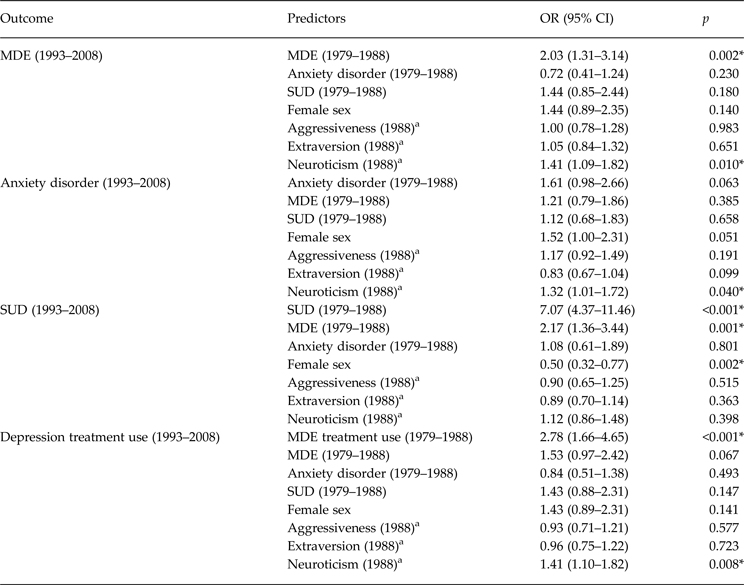
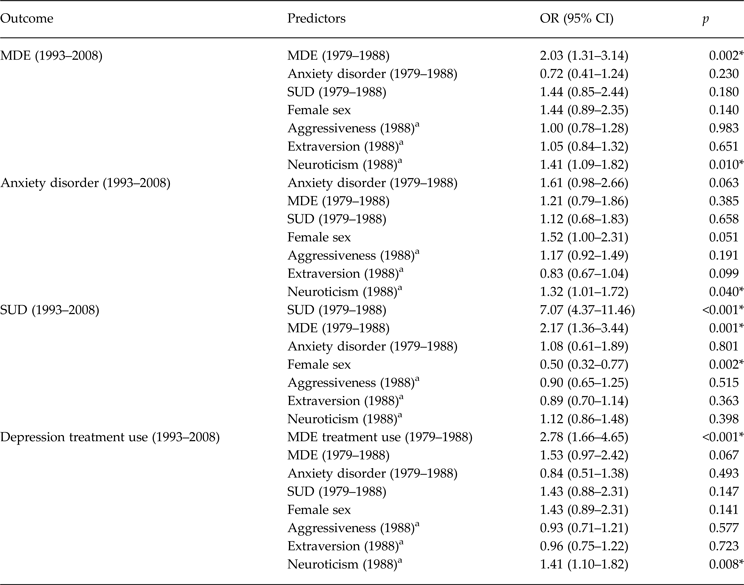
The results of model 1 are shown in Table 2. The cumulative prevalence rates of MDE, anxiety disorders and SUD between 1979 and 1988 were 31.5% (n = 141), 20.2% (n = 117) and 26.9% (n = 119). The prospective associations of personality on repeated subsequent occurrence of psychopathology yielded no significant effects for both aggressiveness and extraversion. In contrast, neuroticism as assessed in 1988 significantly predicted the subsequent repeated occurrence between 1993 and 2008 of MDE (OR = 1.41), anxiety disorder (OR = 1.32) and depression treatment use (OR = 1.41). Since neuroticism was assessed as a standardized continuous variable, its OR refers to a one standard deviation (s.d.) increase. That is, with respect to a future major depression, a 1 s.d. increase in neuroticism increased the odds of MDE and depression treatment use by 41% each, whereas the odds of subsequent anxiety disorder were increased by 32%. Note that the risk increases exponentially with each further increase of 1 s.d. unit: while the OR for a 1 s.d. increase was 1.41 (i.e. 41%), it corresponds to 1.96 for a 2 s.d. increase (i.e. 96%) and to 2.75 for a 3 s.d. increase (i.e. 175%).
Model 1: prospective associations between personality domains and psychopathology (407 participants)
OR, Odds ratio; CI, confidence interval; MDE, major depression episode; SUD, substance use disorder.
a Continuous variable. ORs for continuous variables refer to a one standard deviation increase on the respective scale.
* Significant predictor (p < 0.05).
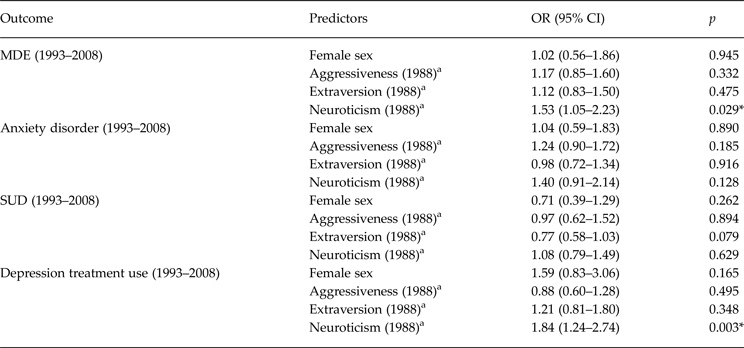
To ascertain a strict temporal sequencing where scores on personality domains precede onset of psychopathology, we excluded all participants with a past 10-year history of either MDE, anxiety disorder, depression treatment use and SUD prior to personality assessment and reran the GEE model (see model 2 in Table 3). The cumulative rates of first-onset cases between 1993 and 2008 of MDE, anxiety disorders and SUD were 15.5% (n = 63), 20.9% (n = 85) and 12.3% (n = 50). The results of model 2 show that neuroticism significantly predicted the first-time incidence of subsequent MDE (OR = 1.53) and depression treatment use (OR = 1.84). Using the formula provided by Zhang & Yu (Reference Zhang and Yu1998) to transform ORs into risk ratios produced a relative risk for first-time MDE of 1.41. As indicated above the unconditional risk for first-time occurrence of MDE between 1993 and 2008 was 15.5% (cumulative incidence); hence, persons with a neuroticism score of 1 s.d. above the mean had an absolute risk of 21.9%. This represents an absolute risk increase of 6.4%. Being 2 s.d. above the mean in neuroticism increased the risk for future MDE from 15.5% to 30.0%, which corresponds to an absolute increase of 14.5% (relative risk 1.9).
Model 2: prospective associations between personality domains and psychopathology in persons without MDE, anxiety disorder and depression treatment use between 1979 and 1988 (204 participants) as well as in persons without SUD between 1979 and 1988 (280 participants)

MDE, Major depression episode; SUD, substance use disorder; OR, odds ratio; CI, confidence interval.
a Continuous variable. ORs for continuous variables refer to one standard deviation increase on the respective scale.
* Significant predictor (p < 0.05).
We conducted sensitivity analyses using the original FPI scales of extraversion and neuroticism as defined by the authors (Fahrenberg et al. Reference Fahrenberg, Hampel and Selg1984). Those analyses consistently replicated the results indicated above by producing the same significant associations between personality and affective disorders. We additionally reran all analyses by including the stratification weight to adjust the results for the sample stratification. The stratification weight was not significantly related to any outcome when personality traits were included and it did not significantly alter the associations between mental disorders and personality as reported in Tables 2 and 3. Finally, an alternative conceptualization of the umbrella diagnosis of anxiety disorder comprising all DSM-IV anxiety disorders, that is, social phobia, specific phobia, agoraphobia, obsessive–compulsive disorder, panic disorder and GAD was additionally tested. This broad anxiety disorder diagnosis produced the identical significant personality main effects as reported in Tables 2 and 3.
Discussion
Summary of the evidence
This longitudinal epidemiological study is unique in various respects. First, to the best of our knowledge, it is the only study to span a total observation period of 30 years in a prospectively followed and repeatedly assessed adult cohort. Second, in contrast to studies that adjusted baseline measurement for concurrent psychopathology only (e.g. Krueger, Reference Krueger1999; De Graaf et al. Reference De Graaf, Bijl, Ravelli, Smit and Vollebergh2002), in a first step we statistically controlled for the past 10 years of mental disorder prevalence and, in a second step, we restricted our prospective analysis to persons with no history of mental disorders across the past 10 years prior to personality assessment, which provides a more stringent adjustment. Third, instead of predicting the outcome as assessed at one single time point only (e.g. Kendler et al. Reference Kendler, Gatz, Gardner and Pedersen2006; Turiano et al. Reference Turiano, Whiteman, Hampson, Roberts and Mroczek2012), here we projected the effect of personality traits to repeatedly assessed subsequent measures of psychopathology, again providing a more accurate estimate due to probable fluctuations in symptomatology over time and substantially biased retrospective prevalence estimates (see Moffitt et al. Reference Moffitt, Caspi, Taylor, Kokaua, Milne, Polanczyk and Poulton2010; Takayanagi et al. Reference Takayanagi, Spira, Roth, Gallo, Eaton and Mojtabai2014). We additionally included depression treatment use because it serves as a good proxy for particularly burdensome depression episodes (Hengartner et al. Reference Hengartner, Angst, Ajdacic-Gross, Rössler and Angst2016). Since the categorical DSM diagnosis of major depression lacks reliability, validity and clinical utility (Parker, Reference Parker2005; Lorenzo-Luaces, Reference Lorenzo-Luaces2015), consideration of distinctly severe depression episodes independent of DSM diagnostic criteria provides valuable information.
The results show that neuroticism as assessed in 1988, with a prior 10-year history of mental disorders (i.e. 1979–1988) adjusted for, significantly predicted future MDE, anxiety disorders and depression treatment use as assessed three times between 1993 and 2008. Moreover, when persons with a history of MDE, depression treatment or anxiety disorder between 1979 and 1988 were excluded, neuroticism significantly predicted the first-time incidence of subsequent MDE (OR = 1.53) and depression treatment use (OR = 1.84). The strength of associations was substantial and the effect of neuroticism is highly significant from a public health perspective, as expressed by an absolute increase of 6.4% in the risk of first-time occurrence of MDE over the subsequent 15-year follow-up period for persons with a neuroticism score 1 s.d. above the mean. With respect to persons with a neuroticism score of 2 s.d. above the mean, the absolute risk increase was a remarkable 14.5%. This figure is even more impressive when one considers that the annual prevalence rate for major depression in the general population in Europe and the USA falls well below 10% (see Alonso et al. Reference Alonso, Angermeyer, Bernert, Bruffaerts, Brugha, Bryson, de Girolamo, Graaf, Demyttenaere, Gasquet, Haro, Katz, Kessler, Kovess, Lépine, Ormel, Polidori, Russo, Vilagut, Almansa, Arbabzadeh-Bouchez, Autonell, Bernal, Buist-Bouwman, Codony, Domingo-Salvany, Ferrer, Joo, Martínez-Alonso, Matschinger, Mazzi, Morgan, Morosini, Palacín, Romera, Taub and Vollebergh2004; Kessler et al. Reference Kessler, Chiu, Demler, Merikangas and Walters2005).
Competing aetiological models
Conceptually we may delineate three broad aetiological models of the personality–psychopathology association: the pathoplasty model, the shared-factor/spectrum model and the causal model (Widiger, Reference Widiger2011). Within these broad categories there are more fine-grained distinctions. For instance, some authors differentiate the common-cause model from the spectrum model, while others commonly refer to the predisposition or vulnerability model instead of the causal model (Clark, Reference Clark2005; Klein et al. Reference Klein, Kotov and Bufferd2011). As summarized above, we found compelling evidence for a temporally sequenced relationship between neuroticism and depression that may be suggestive of a causal relationship. That association not only held for psychiatric diagnoses, but also for carefully assessed depression treatment use, which provides compelling convergent validity and support for the notion that persons scoring high on neuroticism use mental health services more frequently (Goodwin et al. Reference Goodwin, Hoven, Lyons and Stein2002; ten Have et al. Reference ten Have, Oldehinkel, Vollebergh and Ormel2005).
The common-cause and spectrum models posit that mental disorders and personality traits arise from the same causal factor, but are themselves not causally related (Klein et al. Reference Klein, Kotov and Bufferd2011). In order to rule out effects of common-cause and spectrum models, aetiological influences (genetic and environmental) should be strictly adjusted for. This is a test that we cannot perform with our data and that is not advised by the literature anyway, since neuroticism and major depression show a considerable genetic overlap (Hettema et al. Reference Hettema, Neale, Myers, Prescott and Kendler2006; Kendler et al. Reference Kendler, Gatz, Gardner and Pedersen2006). It is therefore legitimate to conclude that shared (genetic) factors are certainly involved in the development of both neuroticism and major depression (for a review, see Klein et al. Reference Klein, Kotov and Bufferd2011). Yet, by adjusting for a history of MDE and anxiety disorder we ensured that variance in personality domains attributable to shared aetiological factors was removed. Moreover, by replicating the prospective effect of neuroticism on the subsequent development of MDE in persons with no immediate history of affective disorders, we established a clear temporal sequencing that is prerequisite for the predisposition model and that cannot be accounted for by the shared factor models. Testing and accounting for the pathoplasty model was not possible, because we had no detailed information on the course of disorder episodes and no data on treatment responses. However, since the pathoplasty model does only account for the trajectory and severity of a disorder, but not for its occurrence (Klein et al. Reference Klein, Kotov and Bufferd2011), focusing on the first-time incidence of mental disorders subsequent to personality assessment as applied in model 2 rules out its effects. Finally, we were not able to examine reversed causality, that is, effects of psychopathology on personality, since in the Zurich Cohort Study personality was assessed at one single time point only. However, by examining the association between personality and psychopathology in persons with no history of affective disorders across the past 10 years prior to personality assessment we were also able to rule out the effects of both the scar and complication models on the outcome (see Clark, Reference Clark2005). By this means we can preclude that high scores in neuroticism were merely caused by preceding affective disorders. Thus, in line with the literature, there is no compelling evidence for both the scar and complication models (Ormel et al. Reference Ormel, Oldehinkel and Vollebergh2004; De Fruyt et al. Reference De Fruyt, Van Leeuwen, Bagby, Rolland and Rouillon2006; Morey et al. Reference Morey, Shea, Markowitz, Stout, Hopwood, Gunderson, Grilo, McGlashan, Yen, Sanislow and Skodol2010).
The exact nature of the personality–depression association is most likely the result of a synergism between different causal effects and best explained by the dynamic interplay of several aetiological models, in particular, (a) the shared-factor models, (b) the predisposition model, and (c) the pathoplasty model (Klein et al. Reference Klein, Kotov and Bufferd2011). Specifically, (a) major depression and neuroticism share a substantial proportion of genetic variance (e.g. Kendler et al. Reference Kendler, Gatz, Gardner and Pedersen2006), but (b) neuroticism is also causally related to the onset of MDE by increasing the vulnerability for depression following stressful life events (e.g. Kendler et al. Reference Kendler, Kuhn and Prescott2004). Finally, once an episode of major depression has developed, (c) persons scoring high on neuroticism show a less favourable illness course and poorer treatment response (e.g. Quilty et al. Reference Quilty, De Fruyt, Rolland, Kennedy, Rouillon and Bagby2008). Thus, although alternative aetiological models may certainly explain some variance in the outcome, on the basis of our stringent statistical modelling we suggest that neuroticism is in part an independent risk factor that predisposes persons to severe and impairing depression episodes. Further evidence of a causal link between neuroticism and internalizing disorders would also provide a unique opportunity for effective and sustainable prevention and intervention programmes in these disorders (Lahey, Reference Lahey2009; Barlow et al. Reference Barlow, Sauer-Zavala, Carl, Bullis and Ellard2014).
Conflicting with some findings (e.g. Krueger, Reference Krueger1999), but in accordance with others (e.g. De Graaf et al. Reference De Graaf, Bijl, Ravelli, Smit and Vollebergh2002), neuroticism did not independently predict subsequent SUD in our prospective prediction model, because in our data the effect of past SUD markedly outweighed the effects of personality (see Table 2). However, that does not necessarily imply that the predisposition model does not apply to SUD. It could be that the specific temporal sequencing in the Zurich Cohort Study made it impossible to detect an independent effect of personality. Probably, personality traits assessed around age 20 years, that is, before the vast majority of people had started to abuse substances (see Angst et al. Reference Angst, Paksarian, Cui, Merikangas, Hengartner, Ajdacic-Gross and Rössler2016), would have produced different results. An alternative interpretation would be that neuroticism correlates with SUD, but does not independently predict SUD (for a comprehensive meta-analysis, see Kotov et al. Reference Kotov, Gamez, Schmidt and Watson2010). This would suggest that the relationship between neuroticism and SUD corresponds to the pathoplasty or the common-cause/spectrum models, but not to the causal predisposition model. Finally, extraversion failed to independently predict MDE or anxiety disorders in our test of the predisposition model. This finding converges with the literature insofar as various studies have shown that the prognostic validity of extraversion is either weak or fails to independently predict psychopathology in prospective studies (Krueger, Reference Krueger1999; Kendler et al. Reference Kendler, Gatz, Gardner and Pedersen2006; Fanous et al. Reference Fanous, Neale, Aggen and Kendler2007). Nevertheless, it should be kept in mind that in interrelation with neuroticism, introversion may influence the severity of depression (Clark, Reference Clark2005; Kotov et al. Reference Kotov, Gamez, Schmidt and Watson2010).
Limitations
The following limitations need to be considered when interpreting these findings: first, all data relied on self-report. Although psychiatric information was carefully evaluated and gauged through repeated comprehensive semi-structured interviews, we cannot exclude a certain bias due to either the effects of social desirability or reduced self-awareness. In a related vein, since all data relied on the same source, shared method variance might have inflated the reported associations. However, as suggested by an anonymous reviewer, self-reported personality dimensions appear to outperform clinical diagnoses of personality disorders with respect to their predictive validity (Morey et al. Reference Morey, Hopwood, Markowitz, Gunderson, Grilo, McGlashan, Shea, Yen, Sanislow, Ansell and Skodol2012), which is why self-report personality inventories may not necessarily constitute a limitation. Second, all analyses were based on cumulative information over the 12 months prior to the interviews (i.e. 12-month prevalence rates of mental disorders). This restriction was necessary in order to collect reliable data that was not biased through recall, since retrospective assessments of lifetime prevalence have been shown to yield markedly underestimated rates (Moffitt et al. Reference Moffitt, Caspi, Taylor, Kokaua, Milne, Polanczyk and Poulton2010; Takayanagi et al. Reference Takayanagi, Spira, Roth, Gallo, Eaton and Mojtabai2014). Nevertheless, persons may have suffered from mental disorders during the time gaps that were not covered by the annual prevalence rates from one of the seven measurement occasions, which would result in an underestimation of the true effect size. Moreover, since the first assessment of mental disorders was at age 20/21 years, we do not know whether some participants may have experienced serious mental health problems during adolescence that were not captured through reoccurrences during adulthood. But again, since prospectively followed cohort studies (e.g. Moffitt et al. Reference Moffitt, Caspi, Taylor, Kokaua, Milne, Polanczyk and Poulton2010; Angst et al. Reference Angst, Paksarian, Cui, Merikangas, Hengartner, Ajdacic-Gross and Rössler2016) yield considerably higher lifetime prevalence rates than retrospectively assessed lifetime prevalence rates that should, theoretically, also cover adolescence (e.g. Alonso et al. Reference Alonso, Angermeyer, Bernert, Bruffaerts, Brugha, Bryson, de Girolamo, Graaf, Demyttenaere, Gasquet, Haro, Katz, Kessler, Kovess, Lépine, Ormel, Polidori, Russo, Vilagut, Almansa, Arbabzadeh-Bouchez, Autonell, Bernal, Buist-Bouwman, Codony, Domingo-Salvany, Ferrer, Joo, Martínez-Alonso, Matschinger, Mazzi, Morgan, Morosini, Palacín, Romera, Taub and Vollebergh2004; Kessler & Wang, Reference Kessler and Wang2008) we suggest that serious mental health problems were mostly captured in the present study (for a direct comparison of prospective v. retrospective assessment, see Takayanagi et al. Reference Takayanagi, Spira, Roth, Gallo, Eaton and Mojtabai2014). Third, personality domains were assessed only once in 1988 when participants were aged 29/30 years. This made it possible for us to adjust effects of personality for the 10-year prevalence of mental disorder prior to 1988, which is a substantial advantage of the present study. On the other hand, the drawback of this onetime assessment was that personality was measured at a point in life when the incidence of many mental disorders had already occurred (Angst et al. Reference Angst, Paksarian, Cui, Merikangas, Hengartner, Ajdacic-Gross and Rössler2016). As a consequence, a large proportion of psychopathology that could have been attributable to personality if the latter had been assessed for instance at age 19/20 years was partialled out through the adjustment for preceding mental disorders. This has certainly reduced the strength of prospective personality associations, which is why the present analysis provides a conservative test of the predisposition model rather than a liberal one. This is also a plausible explanation as to why personality domains failed to prospectively predict SUD. Nevertheless, we do not regard this conservative estimation as a weakness of our study, but rather as a strength, since it increases the validity of the reported associations. Fourth, there is some phenomenological overlap between personality and psychopathology. For instance, many personality traits include psychopathological symptoms, which may spuriously increase the association between personality and psychopathology (Klein et al. Reference Klein, Kotov and Bufferd2011). However, since we rigorously adjusted our prediction models for past psychopathology, we contend that this potential bias was adequately addressed in the present study.
Conclusions
Consistent with recent reviews (Lahey, Reference Lahey2009; Klein et al. Reference Klein, Kotov and Bufferd2011; Hengartner, Reference Hengartner, Angst, Ajdacic-Gross, Rössler and Angst2015), the present study demonstrates that maladaptive personality, and in particular excessively high neuroticism, is substantially related to poor mental health and functioning. In particular, our data corroborate the notion that neuroticism is an independent risk factor that predisposes to future depression episodes and treatment thereof, even when past mental disorders are rigorously accounted for. This has serious and far-reaching clinical implications that by now have also started to be emphasized in various psychiatric specialities. In fields such as psychopharmacology (Tang et al. Reference Tang, DeRubeis, Hollon, Amsterdam, Shelton and Schalet2009), genetics (Genetics of Personality Consortium et al. Reference de Moor, van den Berg, Verweij, Krueger, Luciano, Arias Vasquez, Matteson, Derringer, Esko, Amin, Gordon, Hansell, Hart, Seppälä, Huffman, Konte, Lahti, Lee, Miller, Nutile, Tanaka, Teumer, Viktorin, Wedenoja, Abecasis, Adkins, Agrawal, Allik, Appel, Bigdeli, Busonero, Campbell, Costa, Davey Smith, Davies, de Wit, Ding, Engelhardt, Eriksson, Fedko, Ferrucci, Franke, Giegling, Grucza, Hartmann, Heath, Heinonen, Henders, Homuth, Hottenga, Iacono, Janzing, Jokela, Karlsson, Kemp, Kirkpatrick, Latvala, Lehtimäki, Liewald, Madden, Magri, Magnusson, Marten, Maschio, Medland, Mihailov, Milaneschi, Montgomery, Nauck, Ouwens, Palotie, Pettersson, Polasek, Qian, Pulkki-Råback, Raitakari, Realo, Rose, Ruggiero, Schmidt, Slutske, Sorice, Starr, St Pourcain, Sutin, Timpson, Trochet, Vermeulen, Vuoksimaa, Widen, Wouda, Wright, Zgaga, Porteous, Minelli, Palmer, Rujescu, Ciullo, Hayward, Rudan, Metspalu, Kaprio, Deary, Räikkönen, Wilson, Keltikangas-Järvinen, Bierut, Hettema, Grabe, van Duijn, Evans, Schlessinger, Pedersen, Terracciano, McGue, Penninx, Martin and Boomsma2015), health economics (Cuijpers et al. Reference Cuijpers, Smit, Penninx, de Graaf, ten Have and Beekman2010), nosology (Griffith et al. Reference Griffith, Zinbarg, Craske, Mineka, Rose, Waters and Sutton2010) and psychotherapy (Barlow et al. Reference Barlow, Sauer-Zavala, Carl, Bullis and Ellard2014), new trends in research have suggested that it might prove beneficial in the long term to focus on neuroticism instead of its various secondary clinical consequences that comprise the disorders of the internalizing spectrum. Neuroticism is also the predominant trait underlying personality disorders (Samuel & Widiger, Reference Samuel and Widiger2008; Hengartner et al. Reference Hengartner, Ajdacic-Gross, Rodgers, Müller and Rössler2014a ). These are highly debilitating disorders that pervasively increase the persistence of common mental disorders, including depression (Skodol et al. Reference Skodol, Grilo, Keyes, Geier, Grant and Hasin2011), anxiety disorders (Skodol et al. Reference Skodol, Geier, Grant and Hasin2014) and SUD (Hasin et al. Reference Hasin, Fenton, Skodol, Krueger, Keyes, Geier, Greenstein, Blanco and Grant2011), as well as social functioning deficits (Hengartner et al. Reference Hengartner, Müller, Rodgers, Rössler and Ajdacic-Gross2014c ) and low quality of life (Cramer et al. Reference Cramer, Torgersen and Kringlen2006). Most importantly, the conceptual revision of the personality disorders for International Classification of Diseases, 11th revision (ICD-11) proposes that personality dysfunction may be diagnosed as early as in childhood and adolescence (see Tyrer et al. Reference Tyrer, Reed and Crawford2015), which would allow researchers to put the assumption that maladaptive personality predates severe and persistent psychopathology to the test (Tyrer, Reference Tyrer2015). In concert with many others (e.g. Clark, Reference Clark2005; Krueger & Eaton, Reference Krueger and Eaton2010; Barlow et al. Reference Barlow, Sauer-Zavala, Carl, Bullis and Ellard2014; Skodol et al. Reference Skodol, Geier, Grant and Hasin2014; Tyrer et al. Reference Tyrer, Reed and Crawford2015) we therefore suggest that dimensional ratings of (maladaptive) personality traits play an important role in psychopathology and should be addressed in both psychiatric research and clinical practice.
Acknowledgements
This work was supported by the Swiss National Science Foundation (grant number 32-50881.97).
Declaration of Interest
None.