Introduction
The increase in the global demand for poultry products in the face of human population growth has made it difficult for chickens to be raised in a pathogen-free environment (Klasing et al., Reference KLASING, LAURIN, PENG and FRY1987; Iji and Odunsi, Reference IJI and ODUNSI2009; Yang et al., Reference YANG, IJI and CHOCT2009) despite the beneficial effect of growing faster than those grown under conventional conditions. This has become even more important as the use of in-feed antibiotics (IFAs) in the regulation of harmful pathogens in the gut of chickens has been restricted in most countries. This has increased the search for methods and products for modulating indigenous gut bacteria that will support correct gut microflora development, encouraging more beneficial organisms and preventing the proliferations of pathogenic organism that have negative effects on host nutrition, health, immune status and growth performance (Barrow, Reference BARROW1992).
Studies have focused (Yang et al., Reference YANG, IJI and CHOCT2009; Olnood et al., Reference OLNOOD, BESKI, CHOCT and IJI2015) on the influence of gut microflora on the growth of the host chicken principally from the stand point of reduction in the efficiency of nutrient utilisation. This is because gut microbes depend on the form and availability of feed components for nutritional sustenance through a complex interaction that is depended on the composition and activity of the gut microflora and direct interaction of microorganisms with the lining of the gastrointestinal tract (Klasing et al., Reference KLASING, JOHNSTONE and BENSON1999; Olnood et al., Reference OLNOOD, BESKI, CHOCT and IJI2015). This directly affects the physiology of the tract and the immunological status of the bird.
The roles of commensal gut microbiota as important inducers for the development of the gut (Choct et al., Reference CHOCT, HUGHES, WANG, BEDFORD, MORGAN and ANNISON1996) and maturation of both innate defence mechanisms and adaptive immune responses of chicken (Muir et al., Reference MUIR, BRYDEN and HUSBAND2000; Brisbin et al., Reference BRISBIN, GONG and SHARIF2008) has demonstrated the involvement of commensal bacterial in inducing the accumulation of certain immune cell populations in the intestine (Kogut, Reference KOGUT2013). The gastrointestinal tract microflora is reported to form synergistic relationship with their poultry host during the early post-hatch period (Choct et al., Reference CHOCT, HUGHES, WANG, BEDFORD, MORGAN and ANNISON1996). This confirms the impact of the gastrointestinal microorganisms on nutrient uptake and energy utilisation by host poultry, even at early stages of development.
It is important to note that certain groups of commensal bacteria have been associated with the ability to activate the intestinal immune system and increase host resistance to diseases, in part through the release of low-molecular weight peptides which induce immune activation (Muir et al., Reference MUIR, BRYDEN and HUSBAND2000; Antonissen et al., Reference ANTONISSEN, CROUBELS, PASMANS, DUCATELLE, EECKHAUT, DEVREESE, VERLINDEN, HAESEBROUCK, EECKHOUT, DE SAEGER, ANTLINGER, NOVAK, MARTEL and VAN IMMERSEEL2015). Sugiharto (Reference SUGIHARTO2014) observed that these bacteria produce a wide variety of short chain fatty acids (SCFAs) that are bacteriostatic for a subset of bacterial species either directly or by reducing pH of the intestinal environment. They also produce bacteriocins with microbicidal or microbiostatic properties that contribute to the colonisation resistance against pathogenic microbes by modifying the receptors used by the pathogenic bacteria.
The process of selective increase in beneficial bacteria by competitive exclusion (CE) such as Bifidobacterium spp., Lactobacillus spp. and the reduction in the population of bacteriodes and clostridium can be considered a biological control option for control of pathogenic organisms such as Pseudomonas spp. (Weinack et al., Reference WEINACK, SNEOYENBOS, SMYSER and SOERJADI1981; Miller, Reference MILLER2002; Rinttila and Apajalahti, Reference RINTTILA and APAJALAHTI2013; Cisek and Binek, Reference CISEK and BINEK2014; Hatab et al., Reference HATAB, ELSAYED and IBRAHIM2016). However, the entire processes are triggered by feed intake, enzyme activities, antibiotics, prebiotics, probiotics and other nutraceuticals and their effects on the production of short chain fatty acids ( SCFAs) and other metabolites that favour the renewal and barrier function of the gastrointestinal epithelium (Yang et al., Reference YANG, IJI and CHOCT2009; Ari et al., Reference ARI, AYANWALE, ADAMA and OLATUNJI2012a; Kogut, Reference KOGUT2013 and Sugiharto, Reference SUGIHARTO2014). This review discusses the influence of gut microflora, population control and application in poultry nutrition and the future of microbiology on productivity of poultry.
Development of gut microflora in poultry
An understanding of the factors responsible for microbial growth, composition, ecology and factors associated with gastrointestinal tract development are still under investigation. However, commensal microorganisms that colonise the gastrointestinal tract during the early post-hatch period have been reported to form a synergistic relationship with their poultry host (Choct et al., Reference CHOCT, HUGHES, WANG, BEDFORD, MORGAN and ANNISON1996; Klasing et al., Reference KLASING, JOHNSTONE and BENSON1999; Torok et al., Reference TOROK, OPHEL-KELLER, LOO and HUGHES2005), impacting on the physiology, immunity and nutrition of the host chicken. Therefore, the development of the gut microflora in poultry is basically in response to two critical functions of the gastro intestinal tract i.e., the digestion and host defence.
GIT microbial community structure, diversity and functions are species-specific under environmentally similar conditions (Grond et al., Reference GROND, RYU, BAKER, SANTO DOMINGO and BUEHLER2014). Rinttila and Apajalahti (Reference RINTTILA and APAJALAHTI2013) and Sugiharto (Reference SUGIHARTO2014) reported that to achieve a well-functioning and healthy gut, the dynamic balance of gut ecosystem through natural and induced processes of controlling a wide range of factors related to diets and infectious disease agents (pathogenic organisms) must be attained. The health status and productive performance of the chicken are other important considerations.
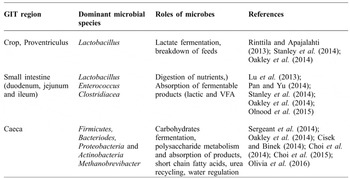
The entire process of microflora development is stimulated by a number of factors acting either in collaboration or independently. These include feed intake, enzyme activities, antibiotics, prebiotics, probiotics and other nutraceuticals, age of host, genetic modification and the host environment. These factors influence the population and diversity of gut microflora due to the production of short chain fatty acids (SCFAs) and other metabolites that favour the renewal and barrier function of the gastrointestinal epithelium (Weinack et al., Reference WEINACK, SNEOYENBOS, SMYSER and SOERJADI1981; Miller, Reference MILLER2002; Torok et al., Reference TOROK, OPHEL-KELLER, LOO and HUGHES2008; Yang et al., Reference YANG, IJI and CHOCT2009; Kogut, Reference KOGUT2013; Sugiharto, Reference SUGIHARTO2014 and Olivia et al., Reference OLIVIA, LISA, SCOT, ANA and RICHARD2016) The dominant microbes along the different regions of the gastro intestinal tract and their functions in metabolism are highlighted in Table 1 .
Dominant microbes along the gastrointestinal tract of chickens.

The effects of feed intake type and enzymes on gut ecology, physiology and productive performance of poultry has been well documented (Yang et al., Reference YANG, IJI and CHOCT2009; Ari et al., Reference ARI, AYANWALE, ADAMA and OLATUNJI2012a; Mateos et al., Reference MATEOS, JIMÉNEZ-MORENO, SERRANO and LÁZARO2012). The chicken small intestinal growth during the first week post-hatch is rapid (Smirnov et al., Reference SMIRNOV, TAKO, FERKET and UNI2006; Kadam et al., Reference KADAM, BAREKATAIN, BHANJA and IJI2013) and can be maximised as a result of in ovo and early post hatch feeding. This can lead to the alteration and modification of gut microflora development within the first two weeks post hatch. These feed resources at the various stages of the intestinal development may include IFAs, endogenous and exogenous enzymes, pre- and probiotics, and nutraceuticals. The use of a variety of microbial species such as Bacillus, Bifidobacterium, Enterococcus, Escherichia, Lactobacillus, Lactococcus, Streptococcus, Enterococcus, and Saccharomyces spp. and a variety of live yeast, and undefined mixed culture probiotics have been used extensively in humans and livestock, especially broiler chickens (Simon et al., Reference SIMON, VERWOOLDE, ZHANG, SMIDT, DE VRIES REILINGH, KEMP and LAMMERS2016; Jin et al., Reference JIN, HO, ABDULLAH and JALALUDIN2000; Kalavathy et al., Reference KALAVATHY, ABDULLAH, JALALUDIN and HO2003; Ari et al., Reference ARI, AYANWALE, ADAMA and OLATUNJI2012a; Iji, Reference IJI2012 ; Cisek and Binek, Reference CISEK and BINEK2014). It is reported that these various zootechnical ingredients can have profound effects on feed intake gut ecology, health status and animal performance.
The influence of age of host chicken on the gut and gut microbial community compositions and development have been studied (Torok et al., Reference TOROK, OPHEL-KELLER, LOO and HUGHES2008). Changes were observed in chickens within the first three weeks of age before stabilising between five and six weeks old, when final changes occur in the microbial community (Knarreborg et al., Reference KNARREBORG, SIMON, ENGBERG, JENSEN and TANNOCK2002; Lu et al., Reference LU, IDRIS, HARMON, HOFACRE, MAURER and LEE2013). The application of molecular techniques, such as terminal restriction fragment length polymorphism (T-RFLP), has increased the opportunity for researchers to examine changes in gut microbial communities in response to diet change or feed intake, age and performance of birds (Torok et al., Reference TOROK, OPHEL-KELLER, LOO and HUGHES2005; Sun et al., Reference SUN, TANG, FANG, YAO, WU, WANG and FENG2013; Oakley et al., Reference OAKLEY, LILLEHOJ, KOGUT, KIM, MAURER, PEDROSO, LEE, COLLETT and COX2014).
Yegani and Korver (Reference YEGANI and KORVER2008) and Antonissen et al. (Reference ANTONISSEN, CROUBELS, PASMANS, DUCATELLE, EECKHAUT, DEVREESE, VERLINDEN, HAESEBROUCK, EECKHOUT, DE SAEGER, ANTLINGER, NOVAK, MARTEL and VAN IMMERSEEL2015) stated that the gut is the major site of potential exposure to environmental pathogens as it serves as a pivotal organ system which mediates in nutrient uptake and use by the animals. The influence of the environment on gut microflora development of chickens is largely accounted for by the relationship between host chicken and the management and conditions under which the chicken is raised (Zhao et al., Reference ZHAO, ZHAO, MA, LIU, ATILGAN and XIN2016). The initial environmental influence on the gut microbiome is bacteria in the air, especially at the hatchery, which can seep through the pores in the shell and enter the embryo (van der Wielen et al., Reference VAN DER WIELEN, KEUZENKAMP, LIPMAN, VAN KNAPEN and BIESTERVELD2002). This is closely followed by the influence of the hatchery facility where different intestinal bacterial communities (Pedroso et al., Reference PEDROSO, MENTEN and LAMBAIS2005) are found in chicks of the same genetic line but from different hatcheries. Caecal microbial communities can be influenced by the type and re-use of litter materials, which have been seen to increase the concentration of Gram negative bacteria, for example, in laying birds raised on floor pens. The differences between birds raised on the various managed litter materials may be due to re-used litter acting as a bacterial inoculum for gut microflora establishment (Torok et al., Reference TOROK, OPHEL-KELLER, LOO and HUGHES2008) particularly in young chicks, and the concentrations and emissions of airborne total and Gram-negative bacteria in rearing houses (Zhao et al., Reference ZHAO, ZHAO, MA, LIU, ATILGAN and XIN2016).
Lumpkins et al. (Reference LUMPKINS, BATAL and LEE2010) reported that differences in GIT bacterial community between chickens, especially across broiler breeds, may be due to differences in genetic traits such as villi height, which would result in increasing the distance of the crypt away from the lumen as greater villus height, provided a niche for certain bacterium (Suau et al., Reference SUAU, BONNET, SUTREN, GODON, GIBSON, COLLINS and DORE1999; Salzman et al., Reference SALZMAN, DE JONG, PATERSON, HARMSEN, WELLING and BOS2002). Other possible contributors include mucin production and pH of gut.
Influence of gut microflora on productivity of poultry
The productivity of poultry is dependent on two key factors; nutrition and health status. The role of these critical factors are pivoted on microbe-host interactions which are categorised as commensal (with the microbes benefiting while the host is unharmed), mutualistic (in which both partners benefit) and parasitic (with the microbes benefiting while the host is harmed) (Apajalahti and Kettunen, Reference APAJALAHTI and KETTUNEN2006; Iji, Reference IJI2012; Rinttila and Apajalahti, Reference RINTTILA and APAJALAHTI2013).
The influence of the commensal and mutualistic gut microflora on the growth and productivity of poultry include metabolic process and synthesis of dietary compounds (energy metabolism and vitamins synthesis); development of gastrointestinal tract; regulating proliferation of potentially harmful enteric microorganisms on intestinal epithelial (competitive exclusion) and developing inflammatory immune responses by the host (Weinack et al., Reference WEINACK, SNEOYENBOS, SMYSER and SOERJADI1981; Miller, Reference MILLER2002; Choct, Reference CHOCT2009; Rinttila and Apajalahti, Reference RINTTILA and APAJALAHTI2013). Growth performance and other productivity indices in chickens are influenced by feed properties and its effects on enzymes, immunocompetence and the microflora. Cowieson et al. (Reference COWIESON, HRUBY and PIERSON2006) reviewed the influence of concentration of metabolically active organisms on the hosts’ ability to combat disease and to metabolise nutrients. They inferred that changes in diet composition or nutrient density have dramatic effects on the intestinal microfloral populations consequently, influences the ability of the animal to digest and absorb dietary nutrients for growth and productivity.
Control of gut microbial profiles in poultry
Gut microflora profiles are directly or indirectly regulated by factors that support or inhibit their growth and multiplication. Wagner and Thomas (Reference WAGNER and THOMAS1977) and Jiang et al. (Reference JIANG, SONG, WU and JIANG2014) stated that dietary intake determined bacterial community and population dynamics depends on source of substrates for microbial and host metabolism and growth. The regulatory influence of IFAs, endogenous and exogenous enzymes, pre- and probiotics, nutraceuticals in the alteration of microbial populations within the GIT are reported to be directly or indirectly through inhibitory actions; their actions on the substrates that bacteria use (Choct et al., Reference CHOCT, HUGHES, WANG, BEDFORD, MORGAN and ANNISON1996; Bedford and Cowieson, Reference BEDFORD and COWIESON2012; Cowieson et al., Reference COWIESON, HRUBY and PIERSON2006; Yang et al., Reference YANG, IJI and CHOCT2009; Ari et al., Reference ARI, BARDE, OGAH, AGADE, YUSUF, HASSAN and MUHAMMED2012b; Barekatain et al., Reference BAREKATAIN, ANTIPATIS, CHOCT and IJI2013). Other feed related factors include gut pH, the rate of feed passage, feed particle size, gizzard activity and secretion of endogenous antimicrobial compounds such as bile salts (Bedford and Cowieson, Reference BEDFORD and COWIESON2012; Iji, Reference IJI2012; Bhuiyan et al., Reference BHUIYAN, ISLAM, COWIESON and IJI2012).
These factors acting in concert with the host readily fill microbiological niches that promote the dominance of beneficial organism in the gut as against the colonisation of gut by potentially harmful enteric microorganisms.
The future of microbiology in poultry nutrition
The relationship between gut micro-organisms and host chickens are better placed within the context of the important nutritional and metabolic role of microorganisms that are beneficial to poultry. The focus of microbiology in poultry nutrition transcends beyond the conventional view of microbe-host interactions being parasitical, to a more holistic relationship characterised as being commensal or mutualistic. Therefore, the future of microbiology in poultry nutrition should include in-depth investigations on the role and dynamics of microorganisms. This gives the basis for future strategies regarding optimal utilisation of feed resources and combating disease (Pan and Yu, Reference PAN and YU2014).
The future of microbiology and its applications in poultry nutrition should focus in the isolation, characterisation, taxonomic information of microorganisms (Choi et al., Reference CHOI, LEE and SU2015) and preservation of potentially useful bacteria by the deployment of fermentation technologies and genomics technologies such as gene-targeted-metagenomic, 16S ribosomal RNA gene targeted microarray and immunohistochemical methods. This will allow better understanding of microflora-host relationships and nutritional modelling, which will impact and enhance the productivity of poultry and other animals (Lu et al., Reference LU, IDRIS, HARMON, HOFACRE, MAURER and LEE2013; Oviedo-Rondón, Reference OVIEDO-RONDÓN2009; Choi et al., Reference CHOI, LEE and SU2015; Mazzoni et al., Reference MAZZONI, BOMBARDI, VALLORANI, SIRRI, de GIORGIO, CAIO., GRANDIS, STERNINI and CLAVENZANI2016; Simon et al., Reference SIMON, VERWOOLDE, ZHANG, SMIDT, DE VRIES REILINGH, KEMP and LAMMERS2016).
An understanding of the relationship between microbes and the Paneth cells in the chicken small intestine and its implication to poultry nutrition considering the occurrences of lysozyme c and lysozyme g mRNAs in the small intestine of chickens (Kogut, Reference KOGUT2013; Wang et al., Reference WANG, LILBURN and YU2016) at different ages is needed. In addition, the attachment of microorganisms in the epithelium of the small intestines of birds should receive attention. Bacterial microbiota determination using denaturing gradient gel electrophoresis, cloning, sequencing, and real-time quantitative PCR analysis (Sun et al., Reference SUN, TANG, FANG, YAO, WU, WANG and FENG2013) and pyrosequencing approaches will provide better understanding on microbial composition and diversity in the GIT of chickens.
Conclusions
Monitoring and promoting the proliferation of beneficial microbial populations in chickens is considered to be essential mechanism for the achievement of efficient nutrient utilisation and increased birds health, in the face of strict legislation on the use of IFAs. Endogenous and exogenous enzymes, pre and probiotics, nutraceuticals will continue to influence the proliferation of beneficial microorganism, and their population dynamics within the GIT for the productive gains of host chickens. The isolation, characterisation and preservation of potentially useful microorganisms using fermentation and genomics technologies will provide the fulcrum upon which future benefits of microbes-host interactions will be pivoted.