Introduction
Mental health services have evolved in recent decades from providing a predominantly institutional model of care to being increasingly multidisciplinary and community oriented (Walsh & Daly, Reference Walsh and Daly2004; Mental Health Commission, 2006). The Irish mental health policy documents, Planning for the Future and A Vision for Change, set out plans for expanded multidisciplinary community mental health teams delivering a wider range of psychosocial interventions (Study Group on the Development of the Psychiatric Services, 1984; Expert Group on Mental Health Policy, 2006). Crisis resolution, even in the absence of formal mental illness, is now seen as a fundamental role for community mental health teams (HSE National Vision for Change Working Group, 2012). The media focus and public discourse around mental health and suicide in particular has increased dramatically in Ireland in recent years (Headline: The National Media Monitoring Programme, 2014) and there is some evidence that this increases help-seeking behaviours (Niederkrotenthaler et al. Reference Niederkrotenthaler, Reidenberg, Till and Gould2014). Recent public education campaigns have encouraged seeking of professional help and have attested to the value of talk therapies (Health Service Executive, 2014).
There is limited evidence of the impact of these changes on referrals to community mental health services. We hypothesised that community mental health services have experienced an increase in referral numbers, and that referrals are now more likely to be concerned with suicide risk and the seeking of talk therapies. We also hypothesised that although multidisciplinary staffing levels have increased over the period, this would not be proportionate to the increase in referral numbers.
Methods
The Cluain Mhuire Community Mental Health Service is a publicly funded adult mental health service in South County Dublin serving a catchment population of ~1 80 000 people. New patients must be referred to the service by another health professional, generally a doctor. The service has a comprehensive information management system that has details of all referrals to the service since the 1970s and which has developed in the past 15 years into a full electronic patient record (EPR), including scanned referral letters.
New patient (not previously attending) referral numbers to the Cluain Mhuire Service were retrieved using the EPR, from four different years over a 30-year period, 1983, 1993, 2003 and 2013. Referrals from 1983 and 1993 were also cross-checked with an older paper-based database. A total of 100 referrals from each time point (or all referrals if there were <100 in any 1 year) were randomly sampled using a random number generator. Original referrals were retrieved and anonymised before data were extracted. Dates were obscured to provide some blinding to year of referral. Referrals were compared with regard to the referring agency, gender, age, number of words in the referral letter, whether psychoactive medications were already being prescribed, whether or not the patient was admitted to the associated psychiatric inpatient unit immediately following their assessment and whether or not the patient remained an active patient of the service on 31 December 2013. The primary reason for referral was identified from the letters. It was noted if the referral was marked urgent or if it made reference to recent or current self-harm, death wish or suicidal ideation. A reference to counselling or any other form of talking therapy was also recorded. The referrals were divided between the two authors and any uncertainties were discussed and agreed between both authors. Where a referral could not be found or where a patient had presented without a referral letter, some basic demographics and information on admission and continued attendance was gathered from the electronic record.
Data were analysed using SPSS version 21 (IBM Corp., 2012). χ 2 tests (or Fisher’s exact tests where any cell number was five or less) were used to compare categorical data, whereas t-tests were used for continuous data. Information regarding population change in the catchment area served by the Cluain Mhuire Service was sought from the Central Statistics Office (2015). Staffing levels on community mental health teams in Cluain Mhuire at the various time points was obtained from the human resources department. Ethical approval for the study was provided by the Provincial Ethics Committee, St John of God Community Services.
Results
According to information obtained from the Central Statistics Office, the population of the area of South Dublin served by the Cluain Mhuire Service increased by ~11% between 1991 and 2011. Multidisciplinary staffing in Cluain Mhuire increased over the study period as shown in Table 1.
Breakdown of professionals employed on Cluain Mhuire adult community mental health teams

NCHDs, non-consultant hospital doctors; CMHNs, community mental health nurses.
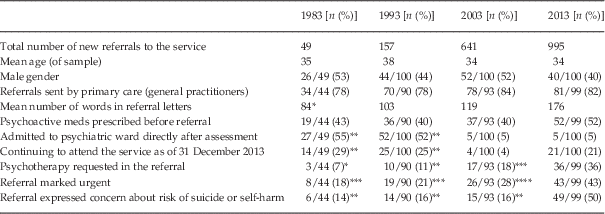
The number of new referrals received by the service increased 20-fold over the study period: 49 in 1983, 157 in 1993, 641 in 2003 and 995 in 2013. A total of 44 out of 49 (90%) original referral letters were retrieved from 1983, 90 out of the random sample of 100 (90%) from 1993, 93 out of 100 (93%) from 2003 and 99 out of 100 (99%) from 2013. The mean age of referral or gender breakdown among the sample did not significantly change over the period (Table 2). Close to 80% of all referrals in each period came from general practitioners with the remainder mostly coming from emergency departments or other psychiatric services (Table 2).
Referral comparisonsFootnote a

a 2013 used for comparison purposes except for ‘continuing to attend the service as of 31 December 2013’ as it was thought that not enough time had elapsed to allow for a valid comparison.
*p<0.001, **p<0.0001, ***p<0.01, ****p<0.05.
The mean number of words in referral letters more than doubled between 1983 and 2013 (Table 2). There was no significant change in the proportion of patients that were already on psychoactive medications at the point of referral over the study period (Table 2). There was a significant decline in the proportion of patients admitted to a psychiatric ward directly after their initial assessment between 1983/1993 and 2003/2013 (Table 2). A significantly lower proportion of people referred to the service in 2003 were still attending at the end of 2013 than of people referred in 1983 or 1993 (Table 2). There was a significant increase in requests for talking therapies over the study period, particularly in 2013 (Table 2). The proportion of referrals that were marked urgent increased from 18% in 1983 to 43% in 2013 (Table 2). There was a very significant increase in the proportion of referrals that noted recent or current self-harm, death wish or suicidal ideation between 1983/1993/2003 and 2013 (Table 2).
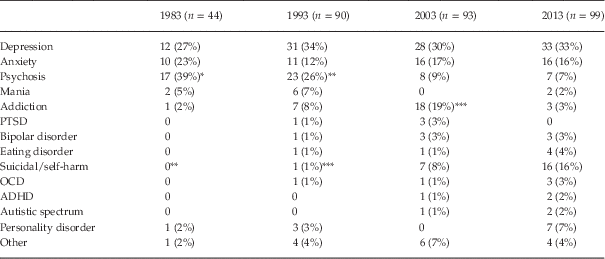
Over the 30-year period, there was a significant decrease in the proportion of referrals in which the referrer was concerned about psychosis (Table 3). The proportion of referrals in which depression or anxiety was the primary concern did not change significantly over the period (Table 3). Addiction was a significantly greater referral reason in 2003 compared with 2013. The proportion of referrals that cited suicidal thinking or self-harm as the reason for referral but without reference to other mental health symptoms or conditions increased significantly over the study period (Table 3). Mania, bipolar disorder, post-traumatic stress disorder, obsessive–compulsive disorder, personality disorder, eating disorder, attention-deficit hyperactivity disorder, autistic spectrum disorder and others were the primary concern in small numbers of referrals (Table 3).
Primary concern communicated in referrals
PTSD, post-traumatic stress disorder; OCD, obsessive–compulsive disorder; ADHD, attention-deficit hyperactivity disorder.
*p<0.0001 v. 2013, **p<0.01 v. 2013, ***p<0.001 v. 2013.
Discussion
This study indicates that there has been a dramatic increase in referrals to this community mental health service over the past 30 years. Other services are likely to have experienced similar increases. Those referred in 2003 and 2013 appear less likely to have been psychotic, less likely to have been admitted and less likely to have needed long-term input from the mental health services than those referred in 1983 and 1993. Those referred in 2013 were more likely to be in suicidal crisis and the referrer was more likely to be seeking a psychological intervention on their behalf. This likely reflects greater awareness of suicide risks among referrers and the population in general, as well as a greater willingness to talk about suicide. Similarly, the requests for talk therapy indicate greater awareness of its benefits as well as better availability owing to the development of community services. Fewer referrals identified addiction as the primary concern in 2013 than 2003. One explanation may be that, following the publication of Vision for Change in 2006, which argued that mental health and addiction services should be separated, the Cluain Mhuire Service decided to no longer accept referrals for alcohol addiction unless there was comorbidity (Expert Group on Mental Health Policy, 2006).
The main weakness of this study is that several referrals from 1983 and 1993 are likely to have been missed. This is owing to less robust information systems at the time, a lower proportion of referrals being found and the fact that referrals were only registered on the system at that time when they actually attended an outpatient appointment. Hence, many people who were seen once as an emergency or who were referred but never attended would have been excluded from the earlier years. This missing data would likely have distorted the figures somewhat, but would be very unlikely to have substantially altered the overall findings of this study. Another weakness is that concerns expressed in the referral letters may not have reflected what was actually found on assessment. A review of clinical records using an assessment instrument could have properly explored this question, but we could not do this in our study. Another limitation was that the information available in relation to population change over the study period in the catchment area was inadequate. This was owing to census dates not matching the study dates, the catchment geographical area not being contiguous with census areas and limited information being available on age breakdown.
One consequence of the increased referral numbers is that, in the past few years, it has been necessary for the Cluain Mhuire Service to operate a notional severity threshold and to thus reject a proportion of referrals. This is estimated to happen with 10% of referrals received by the service at the present time. Another consequence is that it is no longer realistic for all referrals to be initially assessed by a doctor. These changes have the potential to create communication difficulties between primary care and the mental health services.
Presumably, the changing nature of referrals observed in this study reflects an increase in crisis mental health presentations in primary care settings and a concomitant increase in demand for professional help with these. There is some evidence of a recent cultural shift in Irish society with regard to suicidal expression and the responses to it. Derek Beattie and Patrick Devitt explore this question in their book, Suicide: A Modern Obsession, calling it a ‘moral panic’ with ‘the suicide tail wagging the dog of the mental health services’ (Beattie & Devitt, Reference Beattie and Devitt2015). The Health Service Executive has ambitious plans to develop suicide crisis assessment and talking therapy capacity at a primary care level, which will certainly help to address some of this need (Health Service Executive, 2013; HSE National Vision for Change Working Group, 2013). Community mental health services have expanded and are now in a better position to provide a wider range of psychosocial interventions. However, as demonstrated, this expansion has not been commensurate with the increase in demand. There is a significant risk, if this is not addressed, that the care of the most severely mentally ill will be compromised as a result.
In conclusion, this study indicates that increased numbers of referrals are being made to community mental health services, particularly of people in suicidal crisis. Brief psychosocial interventions are indicated in many of these cases and mental health services need more resources to deliver these.
Acknowledgements
The authors assert that all procedures contributing to this work comply with the ethical standards of the relevant national and institutional committee on human experimentation with the Helsinki Declaration of 1975, as revised in 2008. The authors assert that ethical approval for publication of this study has been provided by their local REC. The authors declare that they have no conflicts of interest and that this study received no funding.