Introduction
Food choice represents a major challenge for animals. Intake of the preferred amount of nutritious food increases the chance for survival and reproduction. Animals need to select suitable amounts of nutritious food (Rozin Reference Rozin, Shepherd and Raats2006; Larson and Story Reference Larson and Story2009; Enriquez and Archila-Godinez Reference Enriquez and Archila-Godinez2021) and also avoid consuming lethal amounts of toxic plants and animals that they encounter. Various models in literature have attempted to explain food choice (Shepherd Reference Shepherd1999; Sobal and Bisogni Reference Sobal and Bisogni2009). Models such as Conner and Armitage’s (Reference Conner and Armitage2006) social physiological model and Furst et al.’s (Reference Furst, Connors, Bisogni, Sobal and Falk1996) conceptual model explain the wide range of factors and types of processes involved in making food-choice decisions in humans. In animals, biological factors, including visual, olfactory, gustatory, tactile signals (Prescott and Tepper Reference Prescott and Tepper2004; Small and Prescott Reference Small and Prescott2005; Lawless and Heymann Reference Lawless, Heymann, Lawless and Heymann2010), nutritional (Barreiro-Hurlé et al. Reference Barreiro-Hurlé, Gracia and de Magistris2010; Matavelli et al. Reference Matavelli, Carvalho, Martins and Mirth2015; Righini et al. Reference Righini, Garber and Rothman2017), physiological (Babicz-Zielińska Reference Babicz-Zielińska2006; Zellner et al. Reference Zellner, Loaiza, Gonzalez, Pita, Morales, Pecora and Wolf2006), and environmental factors (Wood and Neal Reference Wood and Neal2009; Neal et al. Reference Neal, Wood, Wu and Kurlander2011), among others, influence food choices, and these factors differ from individual to individual. The role of these factors has been studied in protozoa (Seravin and Orlovskaja Reference Seravin and Orlovskaja1977), marine amphipods (Duffy and Hay Reference Duffy and Hay1991), insects (Lee et al. Reference Lee, Cory, Wilson, Raubenheimer and Simpson2006), and many other taxa (Ganas et al. Reference Ganas, Ortmann and Robbins2008; Hegab et al. Reference Hegab, Pan, Dong, Wang, Yin, Yang and Wei2014).
Various laboratory studies and mathematical models have analysed food-choice behaviour in arthropods. For example, the Arctic soil arthropod, Cryptopygus antarcticus (Willem) (Collembola: Entomobryidae), selectively feeds on algae and lichens over mosses (Bokhorst et al. Reference Bokhorst, Ronfort, Huiskes, Convey and Aerts2007), adaptive learning based on nutritional differences influences the food choice in the spider mite, Tetranychus urticae Koch (Trombidiformes: Tetranychidae) (Egas et al. Reference Egas, Norde and Sabelis2003), and aggregation behaviour increases choice accuracy in blow fly larvae, Lucilia sericata (Meigen) and Calliphora vicina (Robineau) (both Diptera: Calliphoridae) (Fouche et al. Reference Fouche, Hedouin and Charabidze2021).
Studies investigating the food habits of coccinellids (Coleoptera: Coccinellidae) are among the earliest undertaken in this field of research because of the economic value of ladybird beetles as potential biocontrol agents (Majerus Reference Majerus2016). Coccinellids feed on a wide variety of prey species (Hodek Reference Hodek, Hodek and Honěk1996), for example, aphids (Hemiptera), adelgids (Hemiptera), scale insects (Hemiptera: Coccoidea), mealybugs (Hemiptera: Pseudococcidae), psyllids, whiteflies (Hemiptera: Aleyrodidae) (Hodek and Honek Reference Hodek and Honěk2009; Obrycki et al. Reference Obrycki, Harwood, Kring and O’Neil2009), mites (Acariformes) (Biddinger et al. Reference Biddinger, Weber and Hull2009), coleopterans, and lepidopterans (Evans Reference Evans2009), and nonprey food (Lundgren Reference Lundgren2009; Sutherland and Parrella Reference Sutherland and Parrella2009), having a dynamic evolutionary history with respect to changes in host preferences (Escalona et al. Reference Escalona, Zwick, Li, Li, Wang and Pang2017). The majority of ladybirds are generalist predators with a high range of accepted prey (Sloggett and Majerus Reference Sloggett and Majerus2000; Giorgi et al. Reference Giorgi, Vandenberg, McHugh, Forrester, Ślipiński and Miller2009; Hodek and Honěk Reference Hodek and Honěk2009). Their prey preferences differ in nutritive content and energetic value, as well as cost associated with their capture and ingestion. The food preferences of ladybirds have been studied (Soares et al. Reference Soares, Coderre and Schanderl2004), either by using single prey species (Omkar and Bind Reference Bind1998; Pervez and Omkar Reference Pervez2004; Omkar and Mishra Reference Mishra2005) or by providing a choice of multiple prey species and other food types (Ferrer et al. Reference Ferrer, Dixon and Hemptinne2008; Nedved and Salvucci Reference Nedved and Salvucci2008; Šenkeříková and Nedvěd Reference Šenkeříková, Nedvěd, Sloggett, Brown and Roy2013). In ladybird beetles, it has also been established that food preferences of individuals are concurrent with that of its population, which in turn is influenced by geography.
Food selection by ladybird beetles directly affects its survival, development, and reproduction. Food selection behaviour in ladybird beetles can be modulated by different factors, including aphid–host combination (Ferrer et al. Reference Ferrer, Dixon and Hemptinne2008; Giorgi et al. Reference Giorgi, Vandenberg, McHugh, Forrester, Ślipiński and Miller2009; Pervez and Chandra Reference Pervez and Chandra2018), predator mass, temperature, arena size, predator–prey body mass ratio, and predator traits (Biesinger and Haefner Reference Biesinger and Haefner2005; Tschanz et al. Reference Tschanz, Bersier and Bacher2007; Kalinoski and DeLong Reference Kalinoski and Delong2016; Canovai et al. Reference Canovai, Benelli, Ceragioli, Lucchi and Canale2019) such as species, cost of capture, prey mobility, and prey defensive mechanisms (Provost et al. Reference Provost, Lucas, Coderre and Chouinard2006). Boivin et al. (Reference Boivin, Roger, Coderre and Wajnberg2010) have shown that learning experience influences prey preference by ladybird beetle Coleomegilla maculata (De Geer) larvae. Some coccinellids have been shown to be nonselective in prey choice (Blackman Reference Blackman1967; Honěk and Hodek Reference Honěk, Hodek, Hodek and Honěk1996) and unable to avoid toxic and unsuitable prey (Nedved and Salvucci Reference Nedved and Salvucci2008; Nesbit et al. Reference Nesbit, Wilby, Roberts and Menendez2015). Although multiple factors have been found to influence ladybird prey choice, little work has been done on how energy expenditure determines prey choice. The depletion and reduction of an animal’s energy stores indicate physiological stress, which may impose food selection pressure on the organism. For instance, in caterpillars of Spodoptera litura (Fabricius) (Lepidoptera: Noctuidae), change in nutritional demands due to physical stress induces a compensatory shift in food selection (Lipp et al. Reference Lipp, Wolf and Lehmann2005).
In the present study, we undertook to assess the effect of energy expenditure on food choice in immature stages of ladybird, Propylea dissecta Mulsant (Coleoptera: Coccinellidae). This species was selected as an experimental model because of its range of prey, high reproductive output, and abundance in local fields (Omkar and Bind Reference Bind2004; Omkar et al. Reference Pervez, Mishra, Srivastava, Singh and Gupta2005). Physical activities such as walking – to search for prey or escape from predators – mating, and reproduction cause energy losses. In the present study, we induced fourth-instar P. dissecta to walk on a glass rod to induce energy expenditures and to mimic food-searching behaviour when food is unavailable. We hypothesised that an increase in the duration of physical activity (i.e., walking time) would affect food choice and that the beetles would become less discriminating in terms of prey. The food choices we provided the fourth-instar P. dissecta were conspecific eggs, heterospecific eggs of Menochilus sexmaculatus (Fabricius) (Coleoptera: Coccinellidae), and aphid prey, Aphis craccivora (Hemiptera: Aphididae). We chose eggs of P. dissecta and M. sexmaculatus as food choices in the study because they coexist in local agricultural fields and share common prey guild. Intraguild interaction between the two coexisting coccinellid species in the presence of suitable prey is less likely in nature because they prefer conspecific eggs over heterospecific eggs (Omkar et al. Reference Pervez and Gupta2004). Therefore, it would be more interesting to determine their food choice in presence of their suitable prey, A. craccivora.
Materials and methods
Stock culture
Adults of P. dissecta and M. sexmaculatus were collected from the agricultural fields surrounding Lucknow, India (26° 50' N, 80° 54' E). Adults were paired in Petri dishes (9.0 × 2.0 cm), placed in biochemical oxygen demand incubators (Yorco Super Deluxe, YSI-440, New Delhi, India) at 25 °C ± 1 °C, 65 ± 5% relative humidity, and a 14:10-hour light:dark photoperiod. A supply of A. craccivora reared on Vigna unguiculata Linnaeus (Fabaceae) in a glasshouse (25 °C ± 2 °C, 65 ± 5% relative humidity) was provided daily to the P. dissecta and M. sexmaculatus adults. Ladybird beetle eggs were collected daily and incubated under the same physical conditions as discussed above. Within 2–3 days after hatching, the first-instar larvae were isolated: each larva was assigned to its own clean Petri dish (9.0 × 2.0 cm) and fed ad libitum with A. craccivora aphids. For acclimatisation of beetles to standardised laboratory conditions, the beetle larvae were reared for one additional generation. Thereafter, the fourth-instar larvae of P. dissecta, which are the most voracious feeders (Rashed Reference Rashed2020), were used in the present experiment.
Collection of conspecifics and heterospecific eggs
For the collection of predator eggs, sexually mature 10-day-old male and females (n = 30) of M. sexmaculatus and P. dissecta were taken from the experimental stock and allowed to mate in plastic Petri dishes under the physical conditions described above and were provided with ad libitum aphids for the rearing culture. After mating, the females were placed in clean Petri dishes for oviposition. Eggs laid were collected every 24 hours and then provided as a dietary choice in the experiment. All eggs offered as possible food to the predators in the Petri dishes were 24 hours old.
Experimental design
The second-generation first instars of P. dissecta were isolated in Petri dishes and were supplied with ad libitum A. craccivora until they reached the fourth-instar stage. To assess the effect of energy expenditure on food choice, one freshly moulted fourth-instar larva was transferred via a fine camel-hair paint brush onto a horizontally placed glass rod (length: 45.72 cm; diameter: 0.80 cm) and allowed to move on the rod (Fig. 1). The fourth-instar individuals were subjected to nine time-duration walking treatments: 0 (no walking), 30, 60, 120, 240, 360, 480, 600, and 900 seconds of walking. Fresh individuals were used for each treatment. During observation, the replicates in which the larvae did not walk or fell down before completing the given time-duration walking treatment were discarded. Only those trials in which larvae walked straight on the glass rod were kept for the observation. Walking distance and walking speed were recorded. Immediately after walking, each fourth-instar ladybird beetle was placed in a separate Petri dish (9.0 × 2.0 cm) in which three foods were placed equidistantly, i.e., (1) conspecific eggs (100 eggs), (2) heterospecific eggs (100 eggs), and (3) second- and third-instar A. craccivora (15 mg). Second- and third-instar A. craccivora were provided on leaves to restrict their mobility during the experiment. After each fourth-instar coccinellid predator was introduced into a Petri dish containing food, the “first encounter time” (the duration of time from the fourth instar’s placement into the Petri dish to its first encounter with food), the “first encountered prey item” (the type of prey first encountered by the fourth instar; i.e., conspecific eggs, heterospecific eggs, or aphids), the “first consumption time” (the duration of time from the fourth instar’s first encounter with the food to its first consumption of food), and the “first consumed prey item” were recorded. In addition, the larvae were reared on the prey they preferably consumed until the prepupal stage. Each of the nine time-duration treatments was repeated 15 times, for a total of 135 trials.
Diagrammatic representation of walking of a fourth-instar Propylea dissecta larva on a glass rod.

Statistical analysis
Chi-square (χ2) goodness-of-fit analysis was used to analyse the first consumed prey (food choice) and the first encountered food by the larvae. Data on distance covered in a given time, walking speed, first encounter time, and first consumption time were first tested for normality (Kolmogorov–Smirnoff test). Because the data were found to be non-normally distributed, data on distance covered and walking speed were subjected to the Kruskal–Wallis test. Data on first encounter time and first consumption time were subjected to the Kruskal–Wallis test and were also analysed separately using a generalised linear model with respect to type of prey first encountered and prey first consumed, respectively. All statistical analyses were conducted using SPSS 20 software, version 20.0 (IBM, Armonk, New York, United States of America).
Results
Distance travelled and walking speed significantly differed with time duration (χ2 = 115.916, df = 7, P < 0.05 versus χ2 = 29.929, df = 7, P < 0.05). Distance covered by fourth instars significantly increased from 30 to 900 seconds of walking duration. However, walking speed was lowest in the 240- and 360-second walking duration treatments and highest in the 30-second walking duration treatment (Fig. 2).
Walking speed and distance travelled by fourth-instar Propylea dissecta larvae at different walking durations. Data are significant (χ2 speed = 29.929, df = 7, P < 0.05; χ2 distance = 115.916, df = 7, P < 0.05).

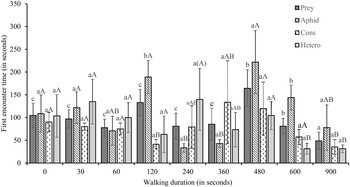
Data on time taken for the first encounter of larva irrespective of type of food first encountered differed significantly with increase in walking duration (χ2 = 23.505, df = 7, P < 0.05). The shortest encounter times were recorded after walking durations of 900 seconds, with the 600-second walking time preceding the second-shortest encounter time, whereas longer encounter times were recorded after the 120-second walking time. However, when we analysed first encounter time separately according to type of prey first encountered, it was found to be insignificantly affected with increase in walking-time duration (F = 1.115, df = 26 108, P > 0.05) and with first prey encountered (F = 1.121, df = 2108, P > 0.05). The interaction of these variables was also found to be insignificant (F = 0.921, df = 16 108, P > 0.05). Similar encounter durations were recorded for individuals of all the treatments (Fig. 3).
First encounter time of larva with food first encountered after walking for different walking durations. Prey data points represent the first encounter times of larvae with food, irrespective of type of food first encountered after walking for different walking durations. Data are significant (χ2 prey = 23.505, df = 7, P < 0.05). “Aphid”, “Cons”, and “Hetero” represent the first encounter times of larvae with specific prey type after walking for different walking durations. Data are insignificant (F = 1.115, df = 26 108, P > 0.05). Upper-case letters denote comparison of means across the treatment. Lower-case letters represent the comparison of means within the treatments.

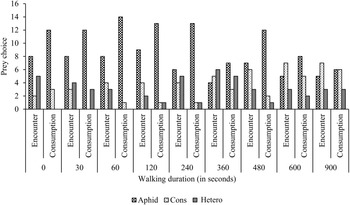
The first prey encounter of each larva was not statistically influenced by walking distance (χ2 = 9.712, df = 14, P > 0.05). First prey encounter was found to be random in all the treatments (Fig. 4).
First encountered prey (χ2 encounter = 9.712, df = 14, P > 0.05) and first consumed prey (i.e., food choice; χ2 consumption = 28.809, df = 14, P < 0.05) of fourth-instar Propylea dissecta larvae after walking for different walking durations.

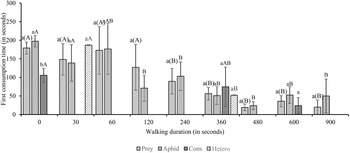
Data on time taken for consumption of larva irrespective of type of food first consumed differed significantly with increase in walking duration (χ2 = 25.668, df = 7, P < 0.05). Time of first prey consumption significantly declined from 480 to 900 seconds of walking duration. Shorter time durations were recorded for first consumption of prey at 480 seconds, followed by 600 and 900 seconds, whereas longer time durations were recorded for first consumption at 60 seconds of walking duration followed by 30, 120, 240, and 360 seconds of walking duration. Time of prey consumption was also found to be significant when we analysed it separately according to type of first prey consumed. Time of prey consumption was found to be statistically significant with increase in walking time (F = 2.911, df = 23 111, P < 0.05) and first food consumed (F = 2276, df = 2111, P < 0.05). Their interaction was also found to be significant (F = 2986, df = 13 111, P < 0.05; Fig. 5).
First consumption time of fourth-instar Propylea dissecta larvae after walking for different walking durations. Prey data points represent larvae’s first consumption times, irrespective of type of food first consumed. Data are significant (χ2 Prey = 25.668, df = 7, P < 0.05). Letters within parentheses “()” denote comparison of means of each treatment with control (no walking). “Aphid”, “Cons”, and “Hetero” represent first consumption time of specific prey type after walking for different walking durations. Data are significant (F = 2.911, df = 23 111, P < 0.05). Upper-case letters denote comparison of means across the treatment. Lower-case letters represent the comparison of means within the treatments.

First prey consumed – that is, food choice – was significantly influenced by change in walking duration (χ2 = 28.809, df = 14, P < 0.05). As walking duration increased, food choice shifted from aphids to conspecific eggs (Fig. 4). At shorter walking durations of 30, 60, 120, 240, 360, and 480 seconds, food choices were unaffected – that is, the P. dissecta preferred to feed on aphids mostly. But at higher activity levels – walking durations of 600 and 900 seconds – changes in their food choices were observed: the beetles’ preference for aphids decreased and conspecific egg consumption increased.
Discussion
Our investigations on the energetic cost of walking in fourth-instar P. dissecta suggest that increased walking modulated the insect’s food choices. Increased walking activity also influenced the insect’s consumption time. The encounter time with prey decreased, whereas it remains insignificant with type of prey, and the first encountered prey was found to be random and not directed, whereas the first consumed prey was significantly influenced as a result of increased energy expenditure. In addition, time until the first consumption also decreased with increased walking duration – P. dissecta consumed prey more quickly when the predators had been subjected to more walking.
Although increased walking duration significantly affected encounter times, the encounter choices (the first prey encountered) were random, especially after increased walking. The randomness of food selection after extensive walking may be attributed to increased energy expenditure. It is possible that the predator might have opted to consume the first prey it encountered instead of continuing the search for a longer duration, thereby increasing its chances of survival. Studies have reported a significant effect on encounter time in response to increased physical activity (Trakimas et al. Reference Trakimas, Krams, Krama, Kortet, Haque and Luoto2019), hunger level (Biesinger and Haefner Reference Biesinger and Haefner2005), instar stage (Mishra et al. Reference Mishra, Omkar, Kumar and Pandey2012), and biomass of the predator (Cabral et al. Reference Cabral, Soares and Garcia2009; Kratina et al. Reference Kratina, Vos, Bateman and Anholt2009; Uiterwaal and DeLong Reference Uiterwaal and Delong2018; Crookes et al. Reference Crookes, Deroy, Dick and MacIsaac2019). In addition, the first encounter time per prey type was random. The randomness in encounter duration may be driven by clues shown by prey. Previous studies have established that prey type can affect the encounter time because prey-capture success depends on prey mobility (Eubanks and Denno Reference Eubanks and Denno2000), prey defensive mechanisms (Roger et al. Reference Roger, Coderre and Boivin2000; Francke et al. Reference Francke, Harmon, Harvey and Ives2008), and prey quantity and quality (Yasuda and Ishikawa Reference Yasuda and Ishikawa1999; Provost et al. Reference Provost, Lucas, Coderre and Chouinard2006). Increased prey mobility and prey defensive mechanisms lead to increased prey-capturing and -handling time (Rosenheim and Corbett Reference Rosenheim and Corbett2003), which influences the encounter rate and encounter time.
First consumption of prey was influenced by increased walking durations, especially at the higher walking durations of 480–900 seconds. Compared to the controls, P. dissecta takes less time to consume first prey after longer walking durations. This accelerated consumption was also accompanied by a shift in diet from aphids to conspecific eggs. This accelerated consumption may be due to the energy deficit created by the increased energy expenditure. This energy deficit likely results in increased hunger, thereby causing the beetles to seek instant gratification, which is accompanied by reckless decision making and abandonment of hitherto displayed food preferences. Previous studies suggest that P. dissecta prefers conspecific eggs over mobile or defenceless aphids (Omkar et al. Reference Pervez and Gupta2006; Pervez et al. Reference Pervez, Chandra and Kumar2021).
Earlier studies reported that, during energy-demanding activities such as walking, hormone regulation, protein, lipid and glycogen synthesis (Lorenz and Gäde Reference Lorenz and Gäde2009), and flight activity (Abdel-Wahab et al. Reference Abdel-Wahab, Michaud, Bayoumy, Awadalla and El-Gendy2017) contribute to nutritional deficits. These deficits may affect food selection, growth, development, reproduction, and progeny fitness. Increases in physical activity are reported to increase metabolic rate by up to 3.4–6.9 times over the resting-state rate in insects, which indicates an increase in biological oxygen demand (Reinhold Reference Reinhold1999; Lipp et al. Reference Lipp, Wolf and Lehmann2005). This extreme demand for energy influences the development of well-defined storage systems for metabolic fuels. In ladybird beetles, adipokinetic hormones play an important role in metabolising carbohydrates during energy-depleting activities, such as flight and walking (Neupert Reference Neupert2007). In locusts (Acrididae), diet preferences gradually change from carbohydrates to lipids during prolonged flights (Wegener Reference Wegener1996).
Conclusions
All life processes, including dynamic performance traits such as fight, swimming, walking, and flight and regulatory performance traits such as egg production, larval growth, and moulting, require energy. An imbalance between energy expenditure and the consumption of required amounts of nutrition will hinder the walking ability of beetles such as P. dissecta. The need for energy and, more specifically, food is essential for insects to restore their nutrient levels and to maintain energy balance. At the same time, physical and psychological stress adversely influences food preferences and choices. Ladybird beetles encounter both physical and psychological stressors, with changes in food choices assumed to follow. Indeed, in the present study, we observed that fourth-instar P. dissecta experiencing low activity levels chose to eat preferred and familiar food – aphids – but after high energy expenditures, they opted to feed on conspecific eggs and aphids.
Acknowledgements
The lead author gratefully acknowledges the Department of Zoology, University of Lucknow, Lucknow, Uttar Pradesh, India. This research did not receive any specific grant from funding agencies in the public, commercial, or not-for-profit sectors.
Conflicts of interest
The authors declare that they have no conflicts of interest.