In recent decades interest has been growing in the study of aggression because of the increase in aggressive behavior in our society, and the great social impact of its effects on such different fields as education, work and family. About 40 per cent of students have witnessed or participated in aggressive behaviors at school (Cangas, Gázquez, Pérez-Fuentes, Padilla, & Mira, Reference Cangas, Gázquez, Pérez-Fuentes, Padilla and Miras2007), and aggression is the basis of a wide variety of behaviors that have a high impact on society (e.g. mobbing or bullying) and which are also related to various psychopathologies (Aquino & Thau, Reference Aquino and Thau2009; Cosi, Hernández-Martinez, Canals, & Vigil-Colet, Reference Cosi, Hernández-Martínez, Canals and Vigil-Colet2011).
Despite its importance, relatively few self-reports measure aggressive behavior and they are somewhat limited. The most widely used is the Buss and Perry (Reference Buss and Perry1992) aggression questionnaire (BPAQ), which has four factors: physical aggression (PA), verbal aggression (VA), anger (AN) and hostility (HO). Although the BPAQ has been adapted to many languages and it is widely used, several studies have found it difficult to replicate its factor structure (i.e. Harris,1997) so various refined versions have been proposed to override these limitations (Vigil-Colet, Lorenzo-Seva, Codorniu-Raga, & Morales-Vives, Reference Vigil-Colet, Lorenzo-Seva, Codorniu-Raga and Morales-Vives2005). Although these refined versions may solve the factor structure problem, the BPAQ still has other limitations. Firstly, the items on the verbal scale refer only to behaviors associated with arguing with others but do not include behaviors that are more often related to verbal aggression such as insulting or shouting. Secondly, several studies have found that the BPAQ is highly impacted by social desirability (Becker, Reference Becker2007; Vigil-Colet, Ruiz-Pamies, Anguiano-Carrasco, & Lorenzo-Seva , 2012), defined as the tendency of subjects to attribute to themselves, in self-reports, personality statements with socially desirable values and to reject those with socially undesirable values. This last issue is of some considerable importance when a highly undesirable behavior such as aggression is to be measured. Thirdly, all the items of the refined versions of the BPAQ are directly worded so the effects of acquiescence (AC), the tendency to agree with positively worded questions irrespective of content, cannot be controlled for. Finally, the BPAQ only measures direct forms of aggression and does not provide any information about indirect forms of aggression, the kind of aggression that is most frequent in adults.
Indirect aggression (IA) has been defined as a sort of social manipulation in which the aggressor acts on the people around the attacked person with the sole aim of harming him or her without having to face them directly (Warren, Richardson, & McQuillin, Reference Warren, Richardson and McQuillin2011). These forms of aggression are intended to cause harm by using others, spreading rumors, gossiping, and excluding others from the group or ignoring them. IA appears during the socialization process, replacing PA, which is more frequent in children (Teisl, Rogosch, Oshri, & Cicchetti, Reference Teisl, Rogosch, Oshri and Cicchetti2012). So, while PA reaches a peak in early childhood but subsequently shows a progressive decrease, IA begins during childhood and progressively increases until it peaks during adolescence and becomes the most frequent form of aggression in adulthood. Furthermore, IA is closely related to behaviors associated with bullying and work harassment such as rumors or social isolation, and may also be related to various psychopathologies (Aquino & Thau, Reference Aquino and Thau2009; Keenan, Coyne, & Lahey, Reference Keenan, Coyne and Lahey2008).
At the assessment level, IA has problems similar to the ones described for direct aggression. Firstly, there are very few measures of IA: for instance, in Spanish there is only the adaptation of the Direct and Indirect Aggression Scales made by Toldos (Reference Toldos2005) and the adaptation of the Indirect Aggression Scales made by Anguiano-Carrasco and Vigil-Colet Reference Anguiano-Carrasco and Vigil-Colet(2011), and there are no measures that simultaneously assess both kinds of aggression in adults. Secondly, IA is also deeply impacted by social desirability (SD) so methods need to be developed so that it can be controlled. And finally, all the items of the scales are positively worded so AC effects cannot be controlled for (Ferrando & Lorenzo-Seva, Reference Ferrando and Lorenzo-Seva2010).
As far as response bias control is concerned, SD has usually been controlled by the method known as “partialling”: that is, the joint administration of an SD scale with the content measures of interest, with the subsequent use of the SD scale to partial out the SD effects. In this method an SD scale is used to remove the effects of this response bias by regressing the SD scores onto the trait scales of interest and computing a residual score. This approach has several problems. Firstly, it may remove meaningful variance from the relevant trait and reduce its relationships with other variables. Secondly, the procedure assumes that all items are parallel measures of the trait of interest, which is almost never true. Thirdly, a second test needs to be administered together with the content that is intended to be measured so the effects of partialling will depend on its properties. And finally, it is difficult to obtain individual scores on the scales of interest (Leite & Cooper, Reference Leite and Cooper2010).
One approach which can override those limitations and which can control AC effects was proposed by Ferrando, Lorenzo-Seva, and Chico (Reference Ferrando, Lorenzo-Seva and Chico2009). In an initial step, it identifies a factor related to SD by using items that are taken as markers of SD. The inter-marker correlation matrix is then analyzed using factor analysis and the corresponding loading values are used to compute the loading values of the content items on the SD factor. Subsequently the variance explained by the SD factor is removed to obtain an inter-item residual correlation matrix without SD effects.
The residual inter-item correlation matrix is then analyzed and a factor related to acquiescent responding is identified using the procedure developed by Ferrando and Lorenzo-Seva (Reference Ferrando and Lorenzo-Seva2010). Once the factor related to AC is available, the variance explained by this factor is removed to obtain a new residual inter-item correlation matrix that is free of SD and AC. Finally, a classical exploratory (EFA) or confirmatory factor analysis (CFA) is performed on this residual matrix to determine the item loadings on content factors or the degree of fit of the items to a proposed structure.
The application of this procedure provides three loading estimates for each item: a loading on the content factor that the test intends to measure, and two loadings on two factors identified as SD and AC, which allow an individual’s score to be obtained free of response bias effects. It should be noted that these SD and AC factors are orthogonal with respect to one another and with respect to the content factors, so they do not have the problem described above when partialling methods are used, because the removal of SD and AC bias does not affect the content factors’ valid variance. Furthermore, using factor scores based upon the residual matrix it is easy to obtain SD-and AC-free scores and the whole procedure only requires the addition of a few SD markers (Ferrando et al. Reference Ferrando, Lorenzo-Seva and Chico2009 proposed that four items are enough to get good results). This method has proven that it can efficiently develop new bias free measures or compute bias-free scores on previously existing tests (Vigil-Colet, Morales-Vives, Camps, Tous, & Lorenzo-Seva, Reference Vigil-Colet, Morales-Vives, Camps, Tous and Lorenzo-Seva2013; Vigil-Colet et al., Reference Vigil-Colet, Ruiz-Pàmies, Anguiano-Carrasco and Lorenzo-Seva2012).
For all the reasons discussed above, the aim of the present study is to develop a new aggression questionnaire that can be applied to a wide age range and which overrides the limitations of the existing questionnaires. To this end, in a single test, the questionnaire will analyze both direct (physical and verbal) and indirect forms of aggression, and control for SD and AC using the method developed by Ferrando et al. (Reference Ferrando, Lorenzo-Seva and Chico2009).
Development of the I-DAQ
We wanted the Indirect-Direct Aggression Questionnaire (I-DAQ) to assess three traits: Physical Aggression (PA), Verbal Aggression (VA) and Indirect Aggression (IA). We did not include such other dimensions as hostility or anger, which are present in questionnaires like the BPAQ, because they do not refer specifically to aggressive behavior but to the feelings and cognitions associated with it. Furthermore, most of the dimensionality problems found in the BPAQ are associated with these dimensions.
Taking into account that the limitations of the existing questionnaires are not related to the content of their items, the questionnaire was developed from items drawn from different aggression questionnaires (Anguiano-Carrasco & Vigil-Colet, Reference Anguiano-Carrasco and Vigil-Colet2011; Buss & Durkee, Reference Buss and Durkee1957; Buss & Perry, Reference Buss and Perry1992; Connelly, Newton, & Aarons, Reference Connelly, Newton and Aarons2005; Infante & Wigley, Reference Infante and Wigley1986; Kaukiainen et al., Reference Kaukiainen, Salmivalli, Björkqvist, Österman, Lahtinen, Kostamo and Lagerspeltz2001; Lawrence, Reference Lawrence2006; Toldos, Reference Toldos2005). The items were translated using back-translation. Almost all the original items measured the trait in the same direction, so AC could not be controlled for. To overcome this limitation, approximately half of them were rewritten in the reverse direction. As a result we obtained 55 items which were then rated by 15 judges with experience in personality test development. The judges assigned each item to one dimension (PA, VA or IA) and rated its adequacy on a ten-point scale. Twelve of these items were found to be inadequate because they were ambiguous or troublesome.
Finally, the 43 items with best ratings were used in a pilot study with 556 undergraduate students, and the items with loadings lower than λ = .30 on the content factor or with complex loadings (greater than λ = .30 on more than one content factor) were removed. It should be noted that many items that in a classical exploratory factor analysis (EFA) could have shown high loadings in their content factor were removed because after controlling for SD and AC their loading was low.
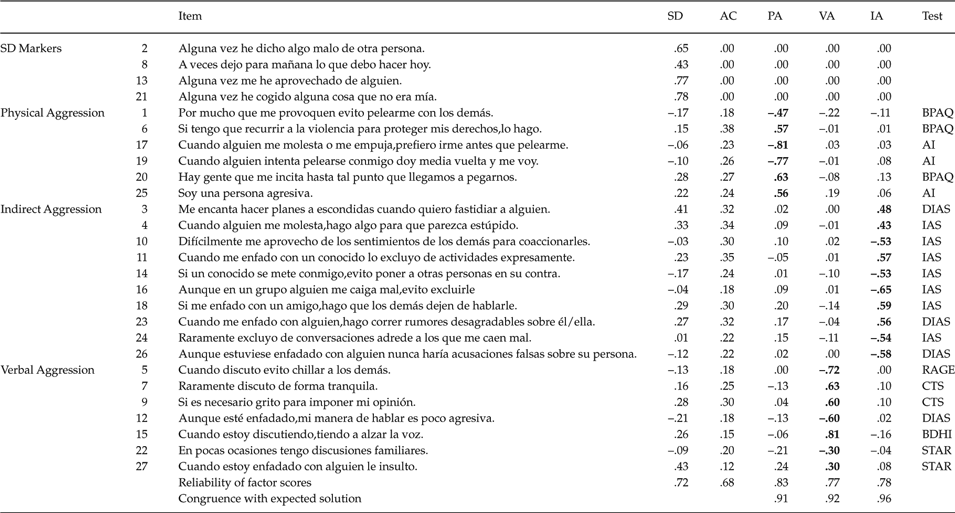
Table 1 shows the 27 items of the final version of I-DAQ. It includes 23 content items and the four markers of SD proposed by Ferrando et al. (Reference Ferrando, Lorenzo-Seva and Chico2009), and negatively keyed items for controlling acquiescence on each scale. Participants rate each item using a five-point Likert-type scale, where 1 indicates that the statement applied slightly or not at all, and 5 indicates that the statement applied to a considerable extent.
Method
Participants
The participants were 750 volunteers (57.6% women and 42.4% men) aged between 18 and 96 years old (M = 32.50; SD = 22.3) from a variety of samples: the test was administered to students from different faculties of the Rovira i Virgili University (Tarragona, Spain) in their classrooms, students from the Escola Politècnica Superior d’Enginyeria (Vilanova i la Geltrú, Spain), workers from several companies who attended training sessions, and elderly people in their nursing homes and senior community centers.
Instruments
In addition to the I-DAQ, several questionnaires were used to assess convergent and criterion validity. They were:
Indirect Aggression Scale (IAS)
We used the aggressor form of the Spanish adaptation (Anguiano-Carrasco & Vigil-Colet, Reference Anguiano-Carrasco and Vigil-Colet2011). This scale is unidimensional and has a good reliability (α = .87). As some of the IAS items were chosen for I-DAQ they were not used to compute the scores.
Buss and Perry Aggression Questionnaire (BPAQ)
We administered the reduced Spanish adaptation of the questionnaire (Vigil-Colet et al., Reference Vigil-Colet, Lorenzo-Seva, Codorniu-Raga and Morales-Vives2005). It measures four scales: physical aggression (PA), verbal aggression (VA), anger (AN) and hostility (HO) with Cronbach’s alphas of .92, .75, .79 and .75, respectively. This adaptation is free from sex-related biases (Condon, Morales-Vives, Ferrando, & Vigil-Colet, Reference Condon, Morales-Vives, Ferrando and Vigil-Colet2006). As some of the items of PA and VA were chosen for I-DAQ they were not used to compute these scores.
Dickman’s Impulsivity Inventory (DII)
We administered the Spanish adaptation of DII (Chico, Tous, Lorenzo-Seva, & Vigil-Colet, Reference Chico, Tous, Lorenzo-Seva and Vigil-Colet2003). We administered only the dysfunctional impulsivity (DI) scale because it is the one that has been related to aggression (Vigil-Colet, Morales-Vives, & Tous, Reference Vigil-Colet, Morales-Vives and Tous2008).
The Overall Personality Assessment Scales (OPERAS; Vigil-Colet et al., Reference Vigil-Colet, Morales-Vives, Camps, Tous and Lorenzo-Seva2013)
This test measures the personality dimensions of the Five-Factor Model of personality and was developed using the method developed by Ferrando et al. (Reference Ferrando, Lorenzo-Seva and Chico2009). It gives SD- and AC-free scores with good reliability and temporal stability for the factors Extraversion (EX; α = .86; r tt = .70), Emotional Stability (ES; α = .86; r tt = .70), Conscientiousness (CO; α = .77; r tt = .75), Agreeableness (AG; α = .71; r tt = .73) and Openness to experience (OE; α = .81; r tt = .79).
Finally we administered the Spanish adaptation of the Mini-Mental Status Examination (Lobo et al., Reference Lobo, Saz, Marcos, Día, Cámara, Ventura and Aznar1999) to the elderly group. This is a quick test for screening cognitive function deficits in the elderly. As in other versions of the MMSE the authors found that the optimal cut-off point for the cognitive deficits associated with dementia was 23, which gives good sensitivity (90%) and specificity (75%), with an area under the ROC curve of .92.
Procedure
The tests were administered by a psychologist to students and workers in groups of between 20 and 40 individuals. In the case of elderly people the test was administered individually or in small groups (up to five people) by a psychologist with experience in elderly people. These participants were also tested to exclude people with dementias. To avoid fatigue and boredom, the participants answered the I-DAQ and only one of the tests used for validation. The participants were asked for no information that could have identified them, thus guaranteeing their anonymity.
A non-response was observed in less than 5% of the participants’ answers. In these cases we replaced it with the mode of the corresponding item.
Data analysis
Taking into account that the questionnaire was developed to be three dimensional and that we carried out a previous pilot study with EFA, we subjected the data to a semi-confirmatory factor analysis. More specifically we fitted an independent cluster basis solution with one marker per factor. This approach was chosen because, when a full independent cluster (i.e. confirmatory) factor analysis is performed on personality or psychopathology questionnaires, the model proposed is usually rejected because many items are factorially complex (Ferrando & Lorenzo-Seva, Reference Ferrando and Lorenzo-Seva2000; Hopwood & Donnellan, Reference Hopwood and Donnellan2010). Instead, semi-restricted models are usually more appropriate and provide reasonable fits. This method involves using one or two items for each dimension which act as markers, and are usually chosen from among those that have the highest loadings in a previous EFA. In our case we chose as markers the items which showed the highest loading in a previous pilot study. The analysis was performed on the residual inter-item correlation matrix obtained after SD and AC effects had been removed from the polychoric correlation matrix between the items from I-DAQ.
In a test developed using the method proposed by Ferrando et al. (Reference Ferrando, Lorenzo-Seva and Chico2009), individuals’ scores for the IDAQ must be obtained using factor score estimates. In order to obtain the loadings needed for them to be computed, we performed an EFA and retained three content factors using Minimum Rank Factor Analysis (MRFA). In MRFA the observed variables are decomposed into common parts and unique parts that satisfy the following requirements: the covariance matrices for both common and unique parts are positive semidefinite, and the covariance matrix for the unique parts alone is diagonal. To determine the loading factors related to the content factors, we computed a partially specified target oblique rotation in which the specified values were the loadings that were expected to be zero. To assess the fit of the rotated loading matrix, we computed the congruence index between the rotated loading matrix and the ideal loading matrix. We also computed a factor analysis and retained a single factor in order to be able to estimate overall factor scores. We computed the factor scores using the procedure proposed by Ten Berge, Krijnen, Wansbeek, and Shapiro (Reference Ten Berge, Krijnen, Wansbeek and Shapiro1999). The factor weights used to compute these factor scores are available on request from the authors. The analyses were performed using SPSS 19.5, MATLAB 5.0 and LISREL 8.5.
Results
We tested the fit of the three-factor model using the semi-restricted model described above. The goodness of fit indexes were NFI = .97; CFI = .98; AGFI = .97; RMRS = 0.04 and RSMEA = .078 (90% C.I. = .074 –.083), which indicated a good fit to the proposed model taking into account the cut-off values proposed by Hu and Bentler (Reference Hu and Bentler1999).
After verifying the factor structure proposed, we performed an EFA on the residual correlations matrix in order to obtain the loadings needed to compute the factor scores.
Factor loadings of I-DAQ items on content and bias factors, factor reliabilities, congruence with expected factor solution and original test of the item. In bold, dominant loadings
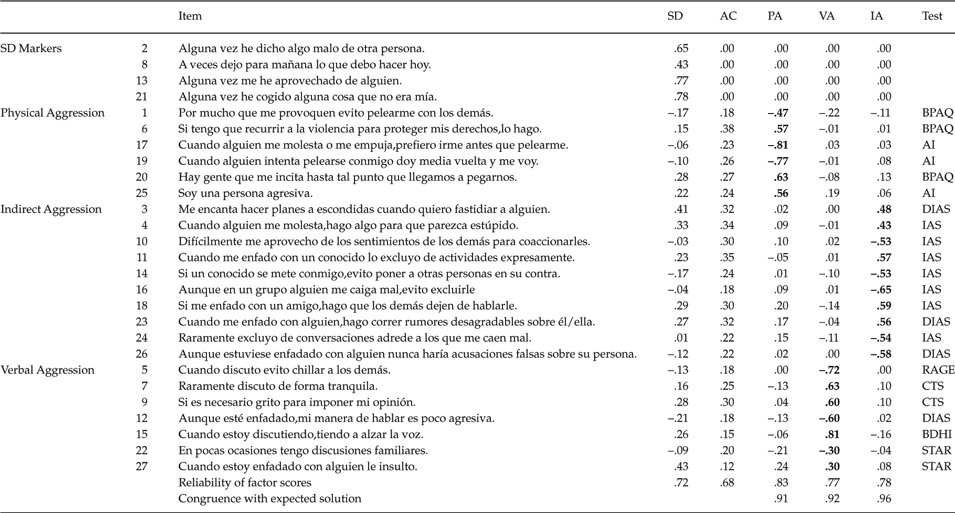
Note: SD: Social Desirability, AC:Acquiescence, PA: Physical Aggression, VA: Verbal Aggression, IA: Indirect Aggression. BPAQ: Buss and Perry Aggression Questionnaire. AI: Aggression Inventory. DIAS: Direct/Indirect Aggression Scales, RAGE: Rating Scale for Aggressive Behaviour in the Elderly. CTS: Conflict Tactics Scale. BDHI: Buss and Durkee Hostility Inventory. STAR: Situational Triggers of Aggressive Responses.
Table 1 shows the loading of each item on their content factor and response bias factors. As can be seen, each item showed the highest loading on the content variable to which it is supposed to be related. This is reflected in the appropriate congruence coefficients between the expected and the obtained solutions using the threshold value of .85 (see for example, Hopwood & Donnellan, Reference Hopwood and Donnellan2010). The correlations among factors ranged from .32 to .44. Furthermore, all the scales showed adequate factor reliabilities.
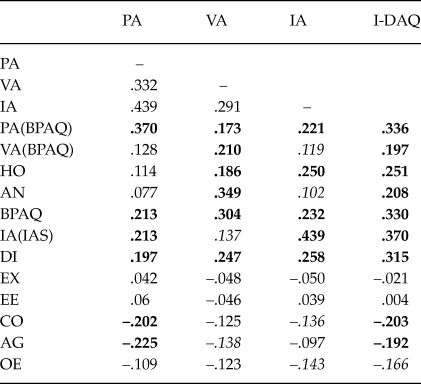
Table 2 shows the Pearson correlation coefficients between the I-DAQ scales and the measures used for convergent and criterion validity. As can be seen, each I-DAQ scale showed the highest correlation with its corresponding BPAQ and IAS scale. It should be taken into account that the correlations with the physical and verbal scales of the BPAQ cannot be high because the best items of these scales were included in the I-DAQ and therefore had to be removed. Furthermore, the content of verbal scales is different because the BPAQ does not include any items related to insulting or shouting. The positive correlations of I-DAQ with dysfunctional impulsivity were in the same direction as the ones reported in previous research with other aggression measures. The correlations with OPERAS also showed the pattern reported for other aggression measures; that is, the measures of aggression are mainly related to dimensions such as agreeableness and conscientiousness but not to neuroticism, which is more related to anger and hostility (Sharpe & Desai, Reference Sharpe and Desai2001).
Validity coefficients for I-DAQ

p < .01; p < .05 (two tailed).
Note: PA: Physical Aggression, VA: Verbal Aggression, IA: Indirect Aggression, I-DAQ: Overall Score, PA (BPAQ): Physical Aggression (BPAQ), VA (BPAQ): Verbal Aggression (BPAQ), HO: Hostility, AN: Anger, BPAQ: Overall Scores (BPAQ), IA(IAS): Indirect Aggression (IAS), DI: Dysfunctional Impulsivity.
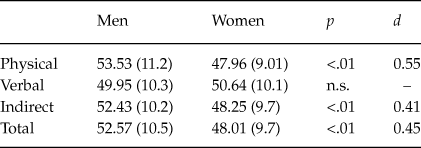
To assess whether I-DAQ reflected the sex differences reported in previous research using other aggression questionnaires, we compared the scores of men and women on I-DAQ scales. Table 3 shows these comparisons, and shows that the greatest differences are associated to sex for PA, and also that there are differences in IA and the overall test score. No differences were found for VA.
Mean for men and women on I-DAQ scales and effect sizes. (Standard deviations in parentheses)

Discussion
The control of response bias in measures of aggression is an important issue because aggression is highly socially undesirable and self-reports are, therefore, deeply impacted by response bias and especially by SD (Vigil-Colet et al., Reference Vigil-Colet, Ruiz-Pàmies, Anguiano-Carrasco and Lorenzo-Seva2012). This effect means that individuals with high levels of SD underreport their aggressive behavior, especially the more undesirable forms such as PA. It should be taken into account that SD can not only distort individual scores but also affect the relationships between self-report scales and other variables of research interest such as age (Soubelet & Salthouse, Reference Soubelet and Salthouse2011). Furthermore, all the items in the most widely used aggression measures are worded in the same direction so AC cannot be controlled for, which may result in an increase in the measurement error of these measures.
The results reported above show that I-DAQ may control for this response bias: it fits the proposed three-factor structure well and combines measures of direct (physical and verbal) and indirect aggression in one questionnaire. The method applied gives psychologists an additional measure of overall aggression in addition to the three specific scales in a short test, which only takes about 10 minutes to administer. Furthermore, all the I-DAQ scales show good factor reliability.
I-DAQ also shows good convergent and criterion validity. As far as convergent validity is concerned, the I-DAQ scales showed the expected relationships with BPAQ and IAS, each scale showing the highest correlation with its analog scale of the tests used for validity. And as far as criterion validity is concerned, all the I-DAQ scales showed positive relationships with dysfunctional impulsivity, replicating the results previously found with other aggression measures (Anguiano-Carrasco & Vigil-Colet, Reference Anguiano-Carrasco and Vigil-Colet2011; Vigil-Colet et al., Reference Vigil-Colet, Morales-Vives and Tous2008).With regard to the relationships between I-DAQ and personality dimensions, we found that AG and CO were related to physical aggression and the overall aggression score of I-DAQ. This pattern of relationships is similar to the one reported by Bettencourt, Talley, Benjamin, and Valentine (Reference Bettencourt, Talley, Benjamin and Valentine2006), who pointed out that while the dimensions associated to emotional stability are related to measures of anger and hostility but not to PA and VA, others such as AG show relationships with all the scales of BPAQ.
I-DAQ is also sensitive to the sex differences usually found in aggression measures. In this regard, the most consistent effects of sex on aggression measures have been found for PA across all age ranges, from children to the elderly, while in many cases there are no sex differences for VA or they have a small effect size (Archer, Reference Archer2004; Morales-Vives & Vigil-Colet, Reference Morales-Vives and Vigil-Colet2010). Although the meta-analysis carried out by Archer (Reference Archer2004) pointed out that in European samples there were no, or almost negligible, sex differences for IA, I-DAQ showed that men presented higher scores than women. Taking into account that women seem to show higher levels of IA during adolescence, further research with younger samples will be required to show if the difference observed in the I-DAQ scores is due to the lack of adolescents in the present sample.
Taking all the above into account, I-DAQ shows good psychometric properties. The main advantage it has over other measures is that it is the first to provide scores that are free of the two best known response biases: social desirability and acquiescence. This is particularly important if it is taken into account that aggression measures are considerably affected by SD at least. Nevertheless, future research should focus on such pending issues as the appropriateness of I-DAQ in young samples, and the presence or absence of sex biases.
This research was supported by a grant from the Spanish Ministerio de Economía y Competitividad (PSI2011–22683).