A wave of democratization is a group of transitions from nondemocratic to democratic regimes that occur within a specified period of time and that significantly outnumber transitions in the opposite direction during that period of time.Footnote 1
Transitions to democracy occur in clusters and waves. Democratization—the shift from autocratic to democratic rule—is neither randomly distributed in time nor in place but quite often occurs in multiple countries in given regions at specific moments. Since Huntington famously identified three waves of global democratization since 1828, scholars have identified numerous regional and temporal clusters, raising the question of what explains these patterns.Footnote 2
The dominant explanation has been “diffusion.” Cross-border dependencies between states explain why democratization is more likely to occur once democracy has taken hold in neighboring states. Specifically what constitutes a cross-border dependency varies considerably in the literature, where it chooses to define dependency at all. The research that mentions a mechanism beyond simple “neighbor emulation” has speculated that democratic neighbors create a less-threatening regional environment that bolsters domestic reformers, that democracies support democratic opposition abroad, and that democratization among neighbors demonstrates to the local population that their own authoritarian regime is not impervious. Rather puzzlingly, however, empirical tests of the diffusion hypothesis almost uniformly study the effect of democratic neighbors on changes in democracy at home, largely ignoring the mechanism of how such an effect comes about.
Equally, if not more, puzzling is that these empirics, regardless of their results, do not test their theory. Although waves of democratization motivate the study of diffusion, most of the literature on diffusion ignores diffusion's temporal component by testing only whether the presence of democratic neighbors is associated with democratization. Thus, in these models, it does not matter when a neighbor democratized, only that it is a democracy. The democratization of Mexico in 2000, for example, would count as evidence of diffusion of democracy, since it borders the United States, a country that democratized more than 200 years earlier. Much convincing research suggests that democratic neighbors increase the probability of transition to democracy at home but these results hardly explain why democratization clusters in time. In short, the democratization attributed to diffusion in the literature does not match the temporal clustering noted by Huntington and others.Footnote 3
Although we are not the first to observe inconsistencies in the foundation of the diffusion of democracy literature or the fragility of its empirical support,Footnote 4 we offer, to the best of our knowledge, the first study of democratization waves to recognize the distinction between the causes of authoritarian breakdown and the selection of a new regime type. We advance the following two-step argument to explain the occurrence of waves: (1) economic and international political shocks, which are clustered spatially and temporally, induce the breakdown of authoritarian regimes; then (2) democratic diffusion, in turn, influences, but does not determine whether a fallen dictatorship will be replaced by a democracy or a new autocracy. Diffusion thus has only a conditional effect on democratization, often requiring the preceding condition of autocratic breakdown. By demonstrating its conditional nature, our model helps explain the extant fragile and specification-dependent evidence for diffusion's effect and improves our understanding of how and when diffusion, understood as uncoordinated interdependence,Footnote 5 influences democratization.
As Huntington argues, “At the simplest level, democratization involves: (1) the end of an authoritarian regime; (2) the installation of a democratic regime; and (3) the consolidation of the democratic regime. Different contradictory causes may be responsible for each of these three developments.”Footnote 6 More recently, KennedyFootnote 7 and MillerFootnote 8 have shown that economic development has opposite effects on the collapse of authoritarian regimes and on the subsequent choice to establish a democracy, meaning that distinguishing between these two moments of the transition process is crucial. We build on this insight and argue that while spatially and temporally clustered economic and political shocks prompt the breakdown of authoritarian regimes (Huntington's first step), diffusion influences whether the fallen autocracy is replaced by another autocracy or a democracy (Huntington's second step).Footnote 9 Combining these two arguments explains why democratization occurs in waves.
Deficits, recessions, and debt and financial crises trigger the transition process by disrupting the patronage networks upon which many autocrats rely for their authority and by reducing their capacity to remain in power through costly coercion. Domestic economic shocks are themselves often clustered because neighboring countries share similar economic profiles, factor endowments, and terms of trade, and often pursue similar development strategies and are subject to synchronous international economic crises. Similarly, political events with international ramifications, such as the emergence or decline of a military hegemon, can also induce regime breakdown, especially among client and satellite states. Yet not all collapsed autocracies are replaced by democracies. Following the breakdown of an autocracy, countries that find themselves in a context where many other countries are democratic will be more likely to establish a democracy as opposed to a new autocracy. Although it is an important contributing factor, diffusion, on its own, is thus insufficient to explain why democratization happens in waves.
Using data on 125 autocracies from 1875 to 2004, we first demonstrate that, given properly specified models, diffusion cannot account for the spatial and temporal clustering in transitions to democracy. We then distinguish between two phases of the transition process: (1) the breakdown of the authoritarian regime; and (2) the choice to establish a democracy, rather than another dictatorship, once the regime has collapsed. Two-stage Heckman probit models then enable us to demonstrate that while democratic diffusion plays a key role during the second step, economic and political shocks serve as primary driving forces during the first. Our results hold up under a variety of robustness tests.
Diffusion and Democratization
Democratic Waves
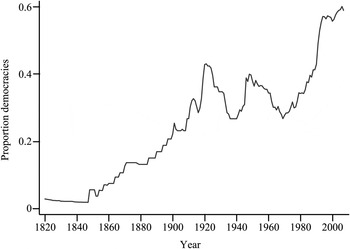
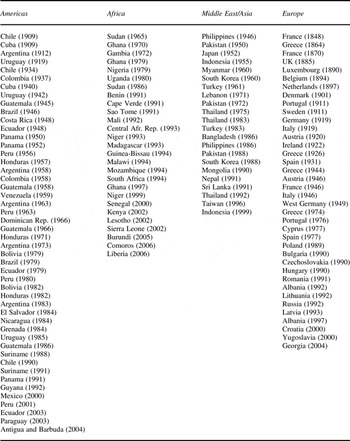
Table 1 lists all transitions to democracy occurring between 1820 and 2007.Footnote 10 The tendency of transitions to occur in temporal clusters is confirmed in Figure 1, which gives the evolution in the proportion of countries in the world that are democracies across time. We observe sharp increases in the proportion of democracies after both world wars, and especially, between the mid-1970s and the mid-1990s.
Proportion of democracies in the world

Transitions to democracy by region

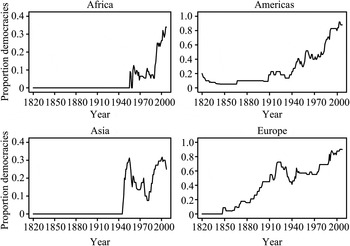
Transitions, as evident in Table 1, are not only clustered temporally but also spatially. Indeed, they are more finely clustered in time and space than Huntington's three long waves would suggest.Footnote 11 Countries from the same regions have tended to be affected by the global waves of democratization around the same time.Footnote 12 This trend is also apparent in Figure 2, which shows the evolution in the proportion of democracies for each continent (except Oceania).Footnote 13 Several periods emerge that might be considered regional “waves” of democratization: the Americas from 1945 to 1959, and 1979 to 1986; Africa from 1990 to 1994, and 1999 to 2002; Asia from 1988 to 1992; and Europe from 1944 to 1946, 1974 to 1977, and 1989 to 1993.
Proportion of democracies by region

Scholars have explained the temporal and spatial clustering of democratization shown in Table 1 and Figures 1 and 2 with “diffusion.”Footnote 14 According to this view, democratization in one autocracy also induces other autocracies to transition to democracy, such that democracy spreads across countries. The diffusion-of-democracy literature builds on other related literatures on the diffusion of policies,Footnote 15 protests and revolutions,Footnote 16 civil wars,Footnote 17 and human rights,Footnote 18 for instance.
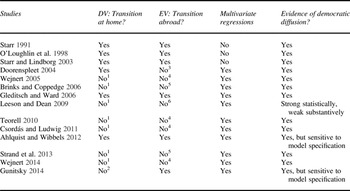
Table 2 lists some of the most prominent empirical tests of the diffusion of democracy. As the last column of Table 2 shows, all studies, with the partial exceptions of Leeson and DeanFootnote 19 and Ahlquist and Wibbels,Footnote 20 find strong evidence in favor of diffusion. The main drawback with these studies is neglecting the dynamics implied by diffusion. As shown in the third column of Table 2, rather than demonstrating temporally proximate transitions—that is, that democratization abroad induces democratization at home—most authors have shown that countries near democracies are more likely to democratize, no matter how long ago the neighbors democratized. For example, Brinks and CoppedgeFootnote 21 show that states converge to the Polity score level of their neighbors. The actual cause of democratization, however, and an explanation for geographic, let alone temporal, clustering are left unaddressed. The central finding of the diffusion-of-democratization literature—that democratic neighbors are a strong predictor of democratization at home—is indisputably important. However, it explains neither the temporal clustering of democratization nor democratization itself.
Empirical studies on democratic diffusion

Notes: DV refers to “dependent variable” and EV refers to “explanatory variable” (or “independent variable”). Numbers in superscripts denote variables used by authors. 1. Change in the democracy level at home. 2. Democracy level at home. 3. Proportion of neighbors that are democratic. 4. Average democracy level of neighbors. 5. Difference between the average democracy level of neighbors and democracy level at home. 6. Change in the average democracy level of neighbors.
The few studies that have looked at the effect of transition abroad on transition at home often suffer from other limitations. For example, as shown in the fourth column of Table 2, a number of early studies did not employ multivariate regression analysis.Footnote 22 Others looked at the effect of change in democracy abroad but omitted the issue of regime transition. For example, Leeson and Dean examine how changes in the Polity score abroad affect change in the Polity score at home.Footnote 23 However, they do not account for whether variation in the Polity score is caused by the breakdown of democracy, democratization, or an increase in the quality of democracy in already democratic states. Differentiating between these possibilities is important because the previous empirical literature found that the variables affecting the establishment of democratic regimes are different than those that affect their survival.Footnote 24 In fact, diffusion is likely to play a larger role during the consolidation of democracies than during the transition to democracy itself.
Only two studies listed in Table 2 use regression analysis to test the effect of democratization abroad on democratization at home. Gleditsch and Ward show that having a neighbor that has democratized increases the likelihood of democratization at home during the same year.Footnote 25 Ahlquist and Wibbels obtain similar results, although their findings are not robust to model specification.Footnote 26
The Diffusion Mechanism
The diffusion literature often has not clearly defined what does and does not constitute diffusion when seeking to explain clustering in democratization. Until recently, the diffusion literature as a whole, most of which focuses on the cross-border diffusion of policy among elites, suffered from an abundance of overlapping and imprecisely defined terms associated with various aspects of diffusion.Footnote 27 We follow Elkins and Simmons in reserving the term diffusion for processes of uncoordinated interdependence. Many processes can result in clustered outcomes but not all constitute diffusion. Common responses to similar conditions, such as wealth levels or economic shocks, do not qualify as diffusion, nor does explicit coordination via cooperation or coercion, such as adoption of common regulations by members of an international organization.
This leaves a third category—uncoordinated interdependence—that we, following Elkins and Simmons, understand as diffusion.Footnote 28 Under this rubric fall processes of learning (sometimes described as imitation, emulation, demonstration effects, mimicry, bandwagoning, and more) and adaptation (for example, the breaking or establishment of norms and expectations or even competition). Learning captures processes in which the actions yield information that affect the actions of other actors; adaptation captures processes in which an action influences the circumstances and, thus, the behavior of other actors. Some adaptation mechanisms rest on the idea that democracies have some competitive advantages over nondemocracies. For example, democracies may be better at attracting foreign direct investmentsFootnote 29 and democracies may be more willing to trade with other democracies,Footnote 30 implying that nondemocracies finding themselves in regions dominated by democracies may be penalized. Diffusion need not result in convergence. Actors can learn, for example, from negative demonstration effects and avoid a policy adopted elsewhere.
Most of the empirical literature is not as careful about the definition of diffusion. Out of necessity—coordination prior to decision making is hard to observe in historical data—what most researchers test is spatial and temporal clustering, an outcome that can emerge from diffusion, but also from common shocks or coordination/coercion.
How the Diffusion of Democracy Differs
The actors in international diffusion processes are most often elites who observe and then adopt or eschew policies from abroad. For the diffusion of democracy, however, both the elite and the masses matter. When the masses witness that their counterparts in a neighboring country were able to overthrow a regime similar to theirs, they learn that their own authoritarian regime is not impervious and they also learn about effective means to bring it down. The diffusion of protests or revolts, however, differs from the diffusion of democracy. As Houle explains, in contrast to revolts that do not depend on the elite and democratic breakdown that requires only a decision by the elite to seize power, democratization requires both demands from the masses and an elite decision to accommodate them.Footnote 31 Ideas can diffuse internationally among the elite—witness the international spread of pension reforms,Footnote 32 economic liberalization,Footnote 33 or cutbacks in unemployment benefitsFootnote 34 —and even across the masses—consider the spread of revolts against authoritarian governments across multiple countries during the “Arab Spring” of 2011—but diffusion of democracy, because of its multiple actors, is not as simple.
The greater complexity of the diffusion of democracy becomes even more apparent when one considers that even the first step, the breakdown of the authoritarian ancien regime, is itself double-edged. Processes of learning and adaptation affect not only the ability of the masses to demand change but also that of the ruling elite to resist them.Footnote 35 The population learns from successful regime transitions abroad, but the ruling elite also learn from the mistakes of fallen dictators. Koesel, Bunce, and Wolchik, for example, explain how dictators in Saudi Arabia, Azerbaijan, China, and Russia used the experiences of fallen autocracies during the Color Revolutions and Arab Spring to develop more effective means to retain power at home.Footnote 36 The same type of learning and adaptation by the ruling elite can also be seen more widely during the Arab Spring, when autocrats learned from the cases of Tunisia, Egypt, and Yemen and adopted more repressive measures (with their own consequences), particularly in Libya and Syria.
Bratton and van de Walle make a similar argument about the role of diffusion during the regional wave of democratization in sub-Saharan Africa during the early 1990s.Footnote 37 In some countries, such as Togo, dictators have altered their strategy in light of the experiences of countries like Benin and Zambia. In a study of countersummit protests, Della Porta and Tarrow demonstrate that both protestors and governments have adapted their protest and antiprotest techniques as a result of past experiences.Footnote 38 They call this process “interactive diffusion” and “coevolution.”
In some instances protests that spread across countries may be successful at overthrowing autocracies and establishing democracy, but as the 1848 revolutions in Europe and the Arab Spring illustrated, such instances are rare. In the words of Hale, “cascading can occur in protest calling for regime change as well as revolution in the name of regime change, but these rarely lead to actual regime change [toward democracy].”Footnote 39 In fact, democratization is rarely the result of the population's overthrow of authoritarian regimes.Footnote 40
These arguments do not imply that diffusion has no effect. It is possible that cases of successful democratization abroad can demonstrate to the local population that the regime is not infallible and show which type of protest techniques are the most likely to destabilize the regime. However, we cannot simply assume—as the literature on the diffusion of democratization has done—that this demonstration effect will straightforwardly lead to waves of democratization, nor can we conflate diffusion of protest with diffusion of democracy. The latter requires that democratization induces democratization.
Even some recent studies looking at policy convergence—for which diffusion is more plausible—have found that previous empirical tests have substantially overestimated the true effect of diffusion because of the failure to properly account for alternative explanations, such as the presence of domestic triggers that independently but synchronously affect similar countries (or states) and common shocks that simultaneously affect neighbors.Footnote 41 Hale also makes the related point that although waves of protests and revolutions can be caused by diffusion, “common external causes and contemporaneous domestic triggers can cause events outwardly resembling them.”Footnote 42
Similarly, it is not because democracies may have some advantages in terms of tradeFootnote 43 and foreign direct investmentsFootnote 44 that autocracies with democratic neighbors will necessarily democratize. Holding free and fair elections is likely to cause an alternation of power—in fact, an alternation of power is often considered as a prerequisite for a regime to be democratic.Footnote 45 Therefore, those that make the decision to democratize—the ruling elite—would not benefit from these competitive advantages.
This argument has two important implications. First, diffusion can have different effects on the establishment of democracy and on its survival. While transitions to democracy are the results of a compromise between different groups, transitions away from democracy almost never are.Footnote 46 Therefore, previous studies that have confounded the effect of diffusion on transitions to democracy with its effect on transitions away from democracyFootnote 47 have most likely overestimated the former.
Second, diffusion may have very different effects on the breakdown of an authoritarian regime and on the choice of establishing a democracy (as opposed to another dictatorship) once the regime has broken down. Following the collapse of an autocracy, prodemocracy ideas can more easily influence the form of the new regime. Therefore, although diffusion on its own is unlikely to explain the occurrence of waves—notably because it cannot account for the timing of the breakdown of authoritarian regimes—it does play a key role by fostering democratization after the collapse of the regime.
A Theory of Clustered Democratization
We advance a two-step argument to explain clustering and waves in democratization. Neither step, on its own, is new to the literature or even controversial. Taken together, however, they offer a strong alternative to the dominant diffusion explanation of clustered democratization. First, economic crises, which are themselves clustered among neighbors, and international political shocks cause the breakdown of authoritarian regimes thereby triggering the transition process. Second, once the regime has fallen, diffusion influences the new regime's form. Countries that find themselves in neighborhoods dominated by democracies are more likely to opt for democracy as opposed to a new autocracy.
Economic and Hegemonic Shocks Induce Regime Collapse
Rather than democratic diffusion, it is hegemonic shocks to the international system and economic crises that initiate the clustered transition process by causing the breakdown of authoritarian rule. The case for political shocks to the international system is straightforward. The transitions to democracy listed in Table 1 display clusters associated with changes in the international system. Two intense periods of democratization occured after the two world wars as expansionist states were checked and colonial influence receded. The wave of democratization in Eastern Europe and Mongolia in the 1990s, as another example, arose not from diffusion per se, but the end of the Brezhnev doctrine, which Mikhail Gorbachev abandoned by 1988.Footnote 48 Without the threat of a Soviet invasion, communist regimes throughout Eastern Europe would most likely have fallen before 1989.Footnote 49 Political shocks associated with shifts in the power and ideology of global and regional hegemons undoubtedly influence the timing of regime transitions.Footnote 50
Economic shocks—either domestic or international in origin—require more explanation. They induce authoritarian regimes to collapse when they can no longer afford the payments necessary for patronage and co-optation or the upkeep of the forces necessary for repression. Crises, be they debt driven, currency, financial, trade driven, or simply contractionary, all pose a threat to autocratic governments because they impinge on the government's ability to pay off potential rivals and finance repression. Research on the functioning and stability of autocratic regimes commonly describes them as relying on a combination of patronage and repression to remain in power. Rivals are co-opted in a process, to paraphrase Geddes, in which “both mass and elite are better off supporting the ruling party and opponents are trapped investing in the survival of the autocratic status-quo.”Footnote 51 When economic crises disrupt patronage networks and weaken the tools of repression, however, the elite's grip on power can slip, clearing the way for democratization.Footnote 52
Autocratic rulers’ legitimacy might also be especially susceptible to deterioration of material conditions. Lacking the democratic legitimacy conferred by elections, autocrats rely on what Huntington dubs “negative legitimacy”Footnote 53 —autocracies can be perceived as legitimate by the population only if they perform well economically and politically (for example, by maintaining political order). Autocratic governments’ vulnerability to economic performance is reflected in their management of the economy. Many authoritarian regimes, to take an example best documented in Latin America, preferred creating inefficient patronage positions in state-owned enterprises to implementing economic reforms necessary to move to more sophisticated stages of import-substituting industrialization.Footnote 54 When the debt crises of the 1980s caused the collapse of their economies, their wariness of economic instability proved correct as previously co-opted elites and newly unemployed workers overturned many autocratic regimes.Footnote 55 Even in large samples of autocratic states from a broad swath of regions, economic crisis is associated with regime change.Footnote 56 Further evidence suggests that droughts,Footnote 57 earthquakes,Footnote 58 and increasing food pricesFootnote 59 also destabilize autocracies.
But how do economic shocks induce geographically clustered waves of regime collapse? Clusters emerge because neighboring economies tend to be interdependent and share many characteristics. Neighbors are likely to experience similar domestic economic shocks simultaneously and to be affected in a similar way by the same international shocks. National economies, pace North Korea, are almost never autarkic. Trading economies are highly dependent on regional and international business cycles and in more recent decades international financial markets have played an increasingly important role. For geographic and historical reasons, economies in given regions have similar natural resource and factor endowments and historically many have followed similar development strategies. As a consequence, a key part of our argument emphasizes that national economic outcomes covary regionally and even internationally. Domestic economic variables drive domestic regime change but the correlation of domestic economic performance subjects multiple countries to synchronous shocks, enabling similarly synchronous democratization.
Moreover, countries in geographic proximity are likely to experience the same natural catastrophes, such as droughts, which can, in turn, fuel unrest. For example, Brückner and Ciccone note that most of West Africa experienced an important drought in the early 1990s, just before the third wave of democratization swept through the region.Footnote 60 Fluctuations in the international price of commodities also tend to affect all countries of the same region in the same way because they depend on the importation/exportation of the same goods. For example, the Middle East—the region most dependent on food imports—witnessed numerous food riots after the sharp increase in food prices in 2007–2008.Footnote 61 The deterioration in the terms of trade of commodities such as coffee and cacao in the 1980s also contributed to recessions throughout sub-Saharan Africa.
Even a casual consideration of history associates several of the clusters of democratization in Table 1 with common regional economic shocks, such as the 1980s debt crisis in Latin America, or purely domestic economic shocks that affected similar economies synchronously. Economic crises—whether they originate as a currency crisis such as the 1997 East Asian financial crisis, debt crisis such as began in Mexico in 1982, or credit crisis such as began in 2008—can all induce waves of regime reversals. Because geographically clustered states hold similar economic positions and similar economic structures—such as weakly collateralized lending in East Asia in the late 1990s, and debt fueled by petrodollars in Latin America in the early 1980s—waves of democratization are often regionally clustered.
What has often been claimed to be evidence in favor of the role of diffusion during regime transition is in fact evidence of the role of the economy. For example, Ulfelder finds that diffusion played a key role in instigating only seven out of forty-three recent episodes of liberalization that he examined.Footnote 62 In thirty-three of them, he found that the main immediate cause of the dictatorship's breakdown was an economic crisis. Moreover, six of the seven cases where diffusion played an important role are countries previously under Soviet influence in Eastern Europe as well as Mongolia–Mali being the only exception.
This situation is even clearer in other regional waves. Joseph, for example, argues that the wave of democratization in sub-Saharan Africa in the early 1990s was triggered by the economic crisis of the 1980s, which was itself partially caused by the deterioration of the terms of trade of most African countries.Footnote 63 The economic crisis forced the ruling elite to increase their debt level repeatedly, which prevented them from maintaining the patronage networks that formed the basis of the regimes. As Bratton and van de Walle argue, “Perversely, the economic crisis undercut the material foundations of neopatrimonial rule: With ever fewer resources to distribute, political elites faced a growing problem of how to maintain control of clientelist networks.”Footnote 64 Consequently, African countries became increasingly dependent on international donors. In exchange for further support, international donors imposed structural adjustment programs, aimed at decreasing the size of African governments and at making them more efficient. This further decreased the capacity of these regimes to hold to power, for example, by providing highly paid jobs in the public sector. Notice that this explanation relates to the common economic difficulties experienced by similar economies—not diffusion.
A common economic shock also seems to have triggered another celebrated cluster of democratization in Latin America in the 1980s. Following independence, many Latin American countries turned to the policies of import substitution (ISI) in an attempt to industrialize. They systematically overvalued their currencies to make the import of machine tools and industrial materials more affordable. This had the unintended consequence of making their mostly agricultural commodity exports more expensive on world markets that, in turn, reduced inflows of foreign currency, depleted reserves, and stoked inflation. Unsound fiscal and monetary positions, however, were not an impediment for lending from Western banks flushed with petrodollars from the 1973 and 1979 oil embargoes.
This pattern of cheap petrodollar loans to cover the hard currency needs of Latin American countries running trade deficits from ISI policies came to an abrupt halt, however, in 1979 when the US Federal Reserve raised interest rates. Suddenly, multiple developing countries in Latin America (and elsewhere) could not afford to refinance their debts, leading to the debt crisis and the beginning of what is sometimes called the “lost decade” in Latin America.Footnote 65 This period also saw democratization arrive twelve times in the region, beginning with Bolivia, Brazil, and Ecuador in 1979 and continuing to Guatemala in 1986. As with Africa in the 1990s, it was a common economic shock imposed on countries in similar economic positions that provided the impetus for geographically and temporally clustered democratization. Diffusion of policy ideas might explain the regional adoption of ISI policies that eventually placed most countries in the region in a similar economic position. But the most direct cause for the wave of democratization was most likely simultaneous debt crises in multiple countries that damaged autocrats’ patronage networks and undermined their ability to buy off and repress the opposition.
Diffusion Promotes Democratization After Breakdowns
Not all authoritarian reversals, however, result in the establishment of democracies. Countries have experienced economic crises and political shocks throughout history but modern representative democracy is a relatively new phenomenon. Countries facing economic difficulties or political shocks before many democracies were established often suffered political instability and/or regime reversals but, in the end, remained authoritarian. It is only once democracy became available as a model to emulate that economic crises and political shocks could plausibly induce democratization. As Figure 1 shows, there is a clear temporal trend in the proportion of democracies in the world, suggesting that whether an economic or political shock eventually leads to democracy or not depends on other factors.
The second part of our argument is that fallen autocracies become more likely to be replaced by democracies rather than other autocracies when they find themselves in environments dominated by democracies. This is not to say that democratization cannot take place without diffusion. Diffusion is not a necessary condition for democratization. Nevertheless, following an autocratic collapse, countries with recently democratized neighbors are more likely to choose democracy as their new form of government. Processes of learning and adaptation matter here more than in the first stage for the simple reason that the elite is less able to employ coercion after an autocracy has collapsed. It is much easier for the population to prevent new autocracies from taking hold or, after the regime has broken down, to tilt the balance of power toward factions of the elite that support democracy, than to topple an already-consolidated autocracy and install democracy. As Miller argues, after an autocracy breaks down, the elite is in a position of weakness and is more vulnerable to pressure from the masses to adopt democracy.Footnote 66 Therefore, to a large extent, the effect of diffusion is no longer double edged. The masses are encouraged to demand democracy, and even learn which tactics to use, when transitions have succeeded in neighboring states. Furthermore, the potential advantages of democracy, for example, in terms of trade and foreign direct investments,Footnote 67 may now foster democratization since the ruling elite is too weak to prevent it.
Elites face the choice of trying to establish a new autocracy or yielding to the establishment of a democracy. Like the masses, they also learn from recent experience abroad, especially in similar neighboring states. If neighbors’ transitions have avoided retaliation against old regime elites and protected their property rights—often a precondition for the elite to accede—then they are more likely to support democracy.Footnote 68
Democracy promotion by foreign actors is also likely most successful following autocratic breakdowns. Regional organizations with many democratic members, for example, have been shown to promote democracy among nondemocratic members, notably through sanctions.Footnote 69 Again, it is easier for regional organizations to prevent the emergence of new autocracies than to depose the authoritarian ruling elite—which has access to the full resources the state—through the use of sanctions. If rules penalizing autocracies come into place only once many states are democracies, then the choice of democracy can also be considered a process of adaptation to new conditions.Footnote 70 These arguments are consistent with Marinov and Goemans's findings that coups often lead to democratization in periods dominated by democratic super powers.Footnote 71 It is more difficult to establish a new autocracy—even after staging a successful coup—in an environment dominated by democracies because such a regime would lack international support.
To return to the earlier examples, although international political and economic crises caused the breakdowns of autocracies throughout Latin America and Africa in the 1980s and 1990s respectively, it is the context at the time that explains why they eventually transitioned to democracy rather than new forms of autocracies. Thus, in the second step of our theory and empirical tests, the proportion of neighbors who are democratic—which is a proxy for the extent to which a country finds itself in an environment conducive to democracy—and the proportion of neighbors who have recently democratized predict the probability that a given country that has experienced an autocratic breakdown adopts democracy.
Data
Our unit of analysis is the country-year. Our main sample covers about 5,500 observations on 125 autocracies between 1875 and 2004. Contrary to most previous studies that focus on very short periods, ours covers the vast majority of transitions. Our sample is restricted to nondemocracies. We rely on the binary indicator of Boix, Miller, and Rosato to classify regimes.Footnote 72 Regimes are defined as democratic if office holders are selected through free and fair elections and at least 50 percent of the male adult population has the right to vote.Footnote 73
Testing Strategy and Dependent Variables
First, we test the effect of democratic diffusion on transition from autocracy to democracy. A democratic transition in year t occurs if a regime that was classified by Boix, Miller, and Rosato as authoritarian at the end of year t − 1 becomes democratic in year t.Footnote 74 Following Przeworski and colleagues and Boix, among others, we use dynamic probit models.Footnote 75 These estimate the likelihood that a country that starts the year as authoritarian will democratize before the end of the year.
In the second part of the analysis, we follow Kennedy and Miller and decompose the transition process into two sequences: (1) the breakdown of the authoritarian regime; and (2) the establishment of a democracy following the breakdown.Footnote 76 We estimate the effect of diffusion and shocks on the two sequences using Heckman probit models.Footnote 77 In the first stage, we run a probit model in which the dependent variable is a dummy variable for whether an autocracy has collapsed or not. The second stage runs a probit model with only cases in which an authoritarian breakdown has occurred. The dependent variable takes the value 1 if the regime is replaced by a democracy, and 0 if it is replaced by another autocracy.
We measure authoritarian breakdowns as cases in which an irregular leader turnover occurred. To identify irregular turnovers, we use Miller's data set,Footnote 78 who himself relies on the Archigos data set.Footnote 79 However, while transitions from an autocracy to another autocracy almost inevitably involve the use of violence, transitions from autocracy to democracy can occur without violence. Whereas the former are (almost) always covered by Archigos, some transitions to democracy are not. Consequently, our variable authoritarian breakdown takes the value 1 if during a given year an autocracy has (1) experienced an irregular leader turnover (as defined by the Archigos) and/or (2) has transitioned to democracy (as defined by Boix, Miller, and Rosato).Footnote 80 In the second stage, our dependent variable transition to democracy is once again based on the definition of regimes of Boix, Miller, and Rosato.Footnote 81
Model specification is also critically important in estimating diffusion effects. Recall that we define diffusion as uncoordinated interdependence as observed in processes of learning (emulation, demonstration effects) and adaptation (changing norms, competition). Since diffusion cannot be measured directly and is inferred via outcomes—clustered democratization—it is imperative to control for rival determinants. Most notable among these are systemic political shocks and spatially and temporally clustered economic crises, along with several other controls.
Independent Variables
neighbor diffusion (spatial lag of 1): Like most previous authors, we use the proportion of an autocracy's neighbors that are democratic (% democracies neighbor). A neighbor is defined as any country that shares a border or that is within 400 miles by water. However, as we discussed, this measure is problematic because it does not capture the temporal dimension of diffusion. As the example of Mexico and the United States illustrates, if an autocracy democratizes after it had a democratic neighbor for an extended period of time, then it cannot be considered as evidence that democratic diffusion drives waves of transitions to democracy. Diffusion must take place within a reasonable period.
Therefore, we define a second set of diffusion variables. These capture the change within a given period in the proportion of neighbors that are democratic. We calculate three diffusion variables that cover between one and three years, with each variable scaled from –1 to 1. For example, the change % democratic neighbor last 2 years variable measures the proportion of neighbors that are democratic today minus the proportion that were democratic two years ago. It thus gives the change in the proportion of neighbors that are democratic over the past two years. A value of 1 signifies that while none of a country's neighbors were democracies two years ago, they are now all democracies.
regional diffusion (spatial lag of 2): Neighbor diffusion uses a spatial lag of 1—it looks only at whether a country's regime is influenced by the regime of its contiguous neighbors. However, diffusion may not be restricted to direct neighbors. For example, the direct neighbors of Ivory Coast are Ghana, Burkina Faso, Mali, Guinea, and Liberia. But, one may argue that Ivory Coast could also be influenced by countries such as Senegal. Therefore, we also construct a second series of regional diffusion variables that use a spatial lag of 2. These variables capture both the regime of a country's direct neighbors and that of its neighbors’ neighbors. So, in the case of Ivory Coast, these variables cover not only the regimes of Ghana, Burkina Faso, Mali, Guinea, and Liberia, but also those of Togo, Niger, Algeria, Mauritania, Senegal, Guinea-Bissau, and Sierra Leone.
In the online appendix, we also reestimate all models using predefined regions.Footnote 82 We believe that using a spatial lag of 2 is better than using predefined regions, notably because predefined regions require us to make arbitrary decisions about the classification of countries. For example, one could classify Mexico as being either from North or Central America. Choosing either option is problematic since Mexico is highly influenced by both the United States and countries from Central America. Using a spatial lag of 2, which de facto defines a new “region” for each and every country, enables us to capture the influence of both sets of countries.
world diffusion: The indicators of diffusion discussed earlier focus on neighbor and regional diffusion. However, global or systemic factors can also promote diffusion. The end of the Cold War, for example, has been argued to have influenced democratization outside Eastern Europe.Footnote 83 Therefore, all regressions also include an indicator (% democracies world) that gives the proportion of countries worldwide that are democratic. This indicator enables us to capture world diffusion. Since it is highly correlated with neighbor and regional measures of diffusion, we redo all models without this variable.Footnote 84 We also redo the main tables with the change in the proportion of democracies worldwide over the past year rather than the level variable.Footnote 85
economic shocks: We use a number of variables to capture economic shocks. Our main variable is the average growth rate of the gross domestic product (GDP) per capita that a country has experienced over the past three years. We use moving averages instead of simply the lagged value of growth for two reasons. First, moving averages are less sensitive to outliers. Second, we should not expect growth during only the past year to affect the legitimacy of a regime as well as its capacity to finance patronage and repression. Results are unchanged when we use the average growth rate over the past one to five years.Footnote 86 Data on growth are taken from Boix.Footnote 87
We also use rainfall both as an independent variable and as an exogenous instrument for growth.Footnote 88 We employ the precipitation data set of Matsuura and Willmott, which covers, among other states, 113 autocracies from 1960 to 2006.Footnote 89 Because a large proportion of the dictatorships during that period are found in warm-weather countries with economies dependent on agriculture, we expect low rainfall levels to lower growth and induce authoritarian breakdowns.Footnote 90
To make sure that we do not simply capture differences in rainfall levels across countries, we use a variable (rain deviation) that captures the difference, in percentage, between the total amount of rain a country received in a given year and the average yearly amount of rain that country has received between 1950 and 2006. The use of rainfall enables us to be confident that our results are not driven by endogeneity.
Different types of economic crises (not only growth crises) can induce waves of democratization. For example, as discussed earlier the debt crisis of the 1980s played a significant role during the wave of democratization in Latin America. High debt levels are likely to prevent authoritarian rulers from having access to resources enabling them to maintain their patronage networks and to fund repression. Other types of crises, such as inflation and banking crises, can also have similar effects.
Consequently, we also include variables capturing other types of crises. We rely on the indicators of crises constructed by Reinhart and RogoffFootnote 91 and Laeven and Valencia.Footnote 92 Reinhart and Rogoff cover external debt, banking, stock market, and inflation crises, and cover fifty-nine autocracies from 1875 to 2004. These data, as is also the case with those of Laeven and Velencia, are publicly available and have been vetted by multiple scholars who have employed them in other research. Laeven and Valencia's data set includes external debt and banking crises in 108 autocracies from 1971 to 2004. The variable rr/lv crises merges both data sets and indicates whether a country is experiencing a crisis according to either definition. Because these alternative economic crises often happen concurrently to growth crises, we cannot include a separate control for growth rate. Therefore, the variable rr/lv crises also takes the value 1 if a country is experiencing a growth crisis (defined as a growth rate below –2 percent in the past three years). In the online appendix, we also employ the two indicators of crises—lv crises and rr crises—separately.Footnote 93
political shocks: To capture shocks to the international political system, we use a measure (hegemonic power volatility) that Gunitsky developed but did not use in his regressions.Footnote 94 It measures the average volatility in the share of power held by each hegemon each year. The share of power is given by the Composite Indicator of National Capability (CINC) measure of the Correlates of War (COW).Footnote 95 Gunitsky takes the absolute value of the change in the share of power of each hegemon during each year and then averages them. This provides a measure of whether there is an important shock to the international system since it measures the extent to which the balance of power among hegemons is shifting. We expect hegemonic shocks to induce regime collapses. Gunitsky's data stop in 2001, so we have updated them to 2004 to match ours. We take the average volatility over the past three years (so that it matches with our growth measure) rather than over one year. In the online appendix, we show that the results are unchanged if we use the absolute value of the change in the share of power of the United States rather than of all hegemons.Footnote 96
Control Variables
Many economic variables that are not directly related to international shocks, such as economic developmentFootnote 97 and natural resourcesFootnote 98 have been claimed to affect democracy. The analysis controls for GDP per capitaFootnote 99 and oil income.Footnote 100 Other scholars associate the social and cultural context with democracy and democratization. Islam and Catholicism are thought to be harmful and Protestantism conducive to democracy.Footnote 101 In addition, some scholars suggest that divided societies are less likely to democratize.Footnote 102 Variables measuring the proportion of the population that is Muslim, Catholic, and Protestant are included, as well as variables measuring ethnic and religious fractionization.Footnote 103
Previous studies find that countries that have experienced many transitions in the past are more likely to experience transitions in the future.Footnote 104 We add a variable (no. of past transitions) measuring the number of democratic breakdowns that a country has experienced. We also include a dummy variable for former British colonies.Footnote 105 Finally, in the Heckman probit models, the first stage, in which the dependent variable is whether an autocracy breaks down, includes the age of the regime, its square, and its cube.Footnote 106
Empirical Analysis
Are Economic Shocks Clustered?
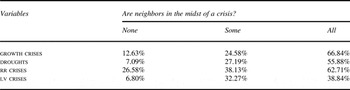
Before estimating the determinants of democratization, we show that countries from the same regions indeed tend to experience economic shocks simultaneously. Table 3 reports the proportion of autocracies experiencing diverse types of crises classified depending on whether none, some, or all of their neighbors are in the midst of a crisis. The variable droughts indicates whether a country has a yearly rainfall below the 20th percentile of its country-specific distribution between 1960 and 2006, and growth crises indicates whether a country has experienced a growth rate below –2 percent in the past three years. Autocracies are clearly more likely to experience economic shocks when their neighbors also do. We also ran multiple regressions that suggest that crises in neighbors are associated with crises at home. For all types of economic shocks shown in Table 3, the effect of the proportion of crises in neighbors is significant at the 1 percent level in all regressions, regardless of the control variables we include (among the list used in this article) and whether country fixed-effects are included are not.Footnote 107 Economic shocks, indeed, do occur in clusters. Since our measure of political shocks (hegemonic power volatility) captures volatility in the share of power of all hegemons, it varies only through time (not across units). Therefore, we do not run the equivalent analysis for political shocks.
Proportion of autocracies that experience an economic crisis

Notes: The proportion of autocracies that experience an economic crisis when none, some, or all of their neighbors experience a crisis, tabulated by type of economic crisis. The variable growth crises indicates whether a country has experienced a growth rate below –2 percent in the past three years. The variable droughts indicates whether a country has a yearly rainfall below the 20th percentile of its country-specific distribution between 1960 and 2006. The variable rr crises indicates whether a country is experiencing a crisis as defined by Reinhart and Rogoff Reference Reinhart and Rogoff2011. The variable lv crises indicates whether a country is experiencing a crisis as defined by Laeven and Valencia Reference Laeven and Valencia2013.
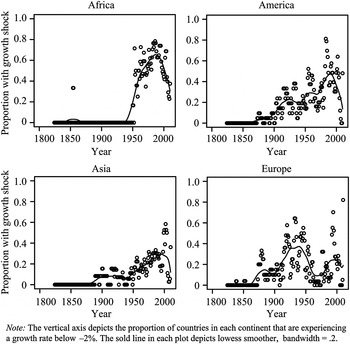
Figure 3 presents the proportion of countries in a given continent and year that are experiencing a growth crisis, defined as a growth rate of GDP per capita below –2 percent. Many of the regional waves identified in Figure 2 correspond to periods of crisis. For example, as the first panel in the figure shows, the economies in about 80 percent of the countries in Africa were experiencing severe economic crises during the late 1980s and early 1990s. The Latin American debt crisis of the early 1980s is also apparent.
Proportion of countries experiencing a growth shock by region

Does Diffusion Cause Democratization Waves?
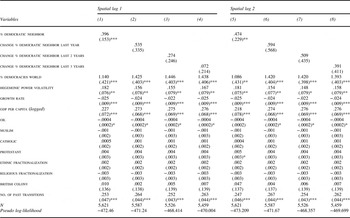
Table 4 tests whether diffusion can account for the clustering of democratization. We use dynamic probit models to estimate each explanatory variable's effect on the probability that a country that starts the year as an autocracy will transition to democracy within that same year. In all tables, standard errors are clustered by country and explanatory variables are lagged. Column (1) shows that, consistent with the findings of previous authors, autocracies that have many democratic neighbors (% democracies neighbor) are more likely to democratize. Results also show that countries are more likely to democratize when many countries in the world are democratic.Footnote 108
Effect of diffusion on democratization

Notes: Dynamic probit estimations. Robust standard errors clustered by country in parentheses. All explanatory variables are lagged. *p < .1; **p < .05; ***p < .01.
However, because % democracies neighbor does not capture the temporal dimension of waves, in columns (2) to (4), we instead use variables that capture transitions among neighbors. change % democractic neighbor last x years gives the difference between the proportion of a country's neighbors that are democratic today and x years ago, where x varies between one and three.Footnote 109
Results show that the effect of diffusion is actually weak and short lived. It never attains statistical significance and the size of the coefficient decreases as x increases. These findings illustrate the importance of using the appropriate measure of diffusion. The previous literature, by focusing on the effect of the level of democracy abroad on change in democracy at home—instead of on the effect of change in democracy abroad on change in democracy at home—has overestimated the effect of diffusion.Footnote 110 This is consistent with the previous literature that, with the exception of Gleditsch and Ward,Footnote 111 has found that the effect of diffusion is weaker once one looks at change in democracy abroad.Footnote 112 Columns (5) to (8) show that the results are unchanged once we use the diffusion variables with a spatial lag of 2.
One potential problem with Table 4 is that neighbor and world diffusion are correlated, which may explain why democratization among neighbors is not found to induce democratization at home. Therefore, the online appendix redoes Table 4 without controlling for % democracies world.Footnote 113 The only difference is that diffusion is now significant at the 10 percent level in Models 2 and 7. We also redo Table 4 using world diffusion and find that only the effect of change % democracies world last 2 years attains statistical significance.Footnote 114 We redo the analysis with predefined regions and only change % democracies region last year is statistically significant.Footnote 115 Section 3 of the online appendix shows that these results are robust to the use of spatial probit models.
What, If Not Diffusion, Causes Democratization Waves?
The previous section has shown that diffusion cannot, on its own, account for the existence of waves. In this section we show that diffusion can contribute to the formation of waves but only in an indirect manner. To understand the effect of diffusion on democratization, we divide the transition process into two periods: (1) the breakdown of the authoritarian regime; and (2) the choice to replace the collapsed autocracy by a democracy rather than a new authoritarian regime. Although democratic diffusion plays an important role during the second stage, it has very little effect on the first. Instead, systemic shocks and economic shocks, which often affect neighbors simultaneously, trigger the breakdown of authoritarian regimes. It is the combination of shocks and democratic diffusion that explains why transitions occur in waves.
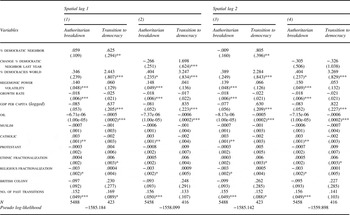
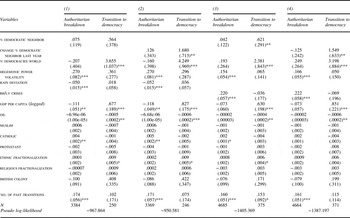
Table 5 tests the effect of diffusion, economic growth, and hegemonic power share volatility using Heckman probit models. The first stage runs a probit estimation of the likelihood that an autocracy breaks down. The second stage runs a probit estimation of the likelihood that an autocracy that has just collapsed transitions to democracy as opposed to another authoritarian regime. Model 1 employs the proportion of neighbors that are democratic to measure diffusion. It also includes the proportion of countries that are democratic in the world. Results on both variables suggest that the likelihood that an autocracy breaks down is unrelated to diffusion. However, once an autocracy has collapsed it is much more likely to transition to democracy if many of its neighbors are democratic and if a large proportion of countries in the world are democratic.
Effect of diffusion and shocks on authoritarian breakdowns and transitions to democracy

Notes: Heckman probit estimations. The first stage runs a probit estimation of the likelihood that an autocracy breaks down. The second stage runs a probit estimation of the likelihood that an autocracy that has just broken down transitions to democracy as opposed to another authoritarian regime. Models on authoritarian breakdown include the age of the regime, its square, and its cube. Robust standard errors clustered by country in parentheses. All explanatory variables are lagged. *p < .1; **p < .05; ***p < .01.
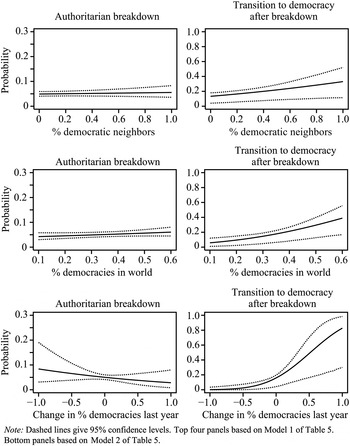
Figure 4 plots out the substantive magnitude of the effects of % democracies neighbor and % democracies world on both phases of the transition process. Diffusion exhibits no relationship with the probability that the regime breaks down (left panels) but does substantially increase the probability that it subsequently adopts democracy (right panels).Footnote 116
Effect of diffusion on the probability of authoritarian breakdown and transition to democracy

Model 2 redoes the analysis with the variable capturing transitions to democracy among neighbors over the last year. Again, diffusion affects the choice to establish a democracy after an authoritarian breakdown, but not whether an autocracy collapses in the first place. The bottom two panels of Figure 4 show the effect of democratization among neighbors on the probability of authoritarian breakdown (bottom left) and democratization at home following an autocratic breakdown (bottom right) computed based on Model 2 of Table 5. Again, diffusion has no substantive effect on authoritarian breakdown. In contrast, its effect on democratization after the collapse of an authoritarian regime is large. Democratization by half of a country's neighbors in the past year is associated with a 50 percent probability of democratization domestically. Note that diffusion's effect is not deterministic. Countries can and do choose democracy after autocratic collapse even if no neighbors are democratic (a 14 percent probability as Figure 4 shows) or none have recently become democratic but the diffusion influence of democratic or recently democratized neighbors increases these figures substantially. For example, if all of a country's neighbors have democratized in the last year, we estimate a 78 percent probability of a given country democratizing after an authoritarian breakdown.
Columns (3) and (4) redo columns (1) and (2) with the measures of diffusion using a spatial lag of 2. Although countries in democratic neighborhoods are still more likely to adopt democracy after a breakdown, transitions abroad are no longer associated with transition at home. This finding is unsurprising since a country should be more closely affected by its contiguous neighbors than by the neighbors of its neighbors; hence the weaker effect of diffusion.Footnote 117
The online appendix redoes the analysis using change in the proportion of democratic neighbors over the past two and three years.Footnote 118 Neighbor diffusion never reaches statistical significance. This is consistent with Table 4, which suggests that the effect of diffusion is short lived.Footnote 119 Finally, the online appendix uses the change % world democracies last year rather than % democracies world.Footnote 120
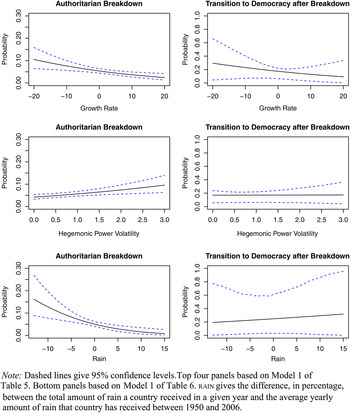
Economic growth, in contrast, demonstrates very different effects. While diffusion exhibits an effect on the choice of regime type only after an authoritarian breakdown, growth influences whether such a breakdown occurs. In all specifications in Table 5 that predict breakdown, growth rate is negative and statistically significant at the 1 percent level. The top two panels of Figure 5 show the effect of economic growth on the predicted probabilities of authoritarian breakdowns and democratic transitions post-breakdown, calculated based on Model 1 of Table 5. As shown in the figure, growth has a much more variable effect on the second phase of the transition process and the standard errors are so wide that one cannot make clear inferences. Growth does significantly lower the probability of authoritarian breakdown in the first phase, however. A severe economic contraction is associated with about a 10 percent probability of authoritarian breakdown in each year.
Effect of shocks on the probability of authoritarian breakdown and transition to democracy

Given the statistically significant effects of growth and, for that matter, hegemonic power volatility, on authoritarian regime collapse—a necessary and preceding condition for democratization—one could contend that growth (or international political shocks) leads to democratization. Indeed, as we see in Table 4, the growth rate, unlike diffusion, is a significant predictor of democratization. We know from Table 5 that most of this effect is from growth's effect on authoritarian breakdown rather than the explicit choice of democracy but that does not diminish its importance in the overall relationship. Although there is an indirect relationship between growth and democratization, we offer two caveats that advocate for our two-stage model as a more complete explanation. First, even when economic contractions do induce authoritarian regime collapse, the subsequent regime is most often not a democracy.Footnote 121 Therefore, our two-stage model offers a more complete explanation for democratic waves. Second, the neglect of the intervening mechanism between growth and democratization—diffusion—yields a weakly identified causal claim. That said, it remains true that negative growth shocks increase the probability that a country democratizes.
The effect of hegemonic power volatility mirrors that of economic growth. Shifts in the balance of power of hegemons spur the breakdown of authoritarian regimes. However, they have little effect on whether the new regime will be democratic or authoritarian. The effects are once again shown in Figure 5. The online appendix redoes Table 5 but measures political shocks with the absolute value of the change in the share of hegemonic power of the United States (rather than of all hegemons).Footnote 122 Results are unchanged. Although Gunitsky has already demonstrated that hegemonic shocks are associated with democratization,Footnote 123 we are the first to show that it affects mainly the breakdown of the authoritarian regime rather than the subsequent choice to democratize.
Table 6 looks at different types of economic shocks. It uses the spatial lag of 1.Footnote 124 Models 1 and 2 estimate the effect of rainfall on democratization using rainfall data from Matsuura and Willmott.Footnote 125 We expect low rainfall levels to be associated with low growth rates. As explained earlier, our variable (rain deviation) captures the deviation, in percentage, between precipitations within a given year and its average over the 1960–2006 period. Low precipitation levels are found to increase the likelihood of an authoritarian breakdown and the relationship is highly significant. Using data from sub-Saharan Africa between 1980 and 2000, Brückner and Ciccone have already reported that low rainfall fosters democratization.Footnote 126 Here, we extend this analysis beyond sub-Saharan Africa and show that rainfall (like growth) is most relevant to the breakdown of authoritarian regimes rather than the subsequent transition to democracy.
Effect of alternative economic shocks on authoritarian breakdowns and transitions to democracy (spatial lag 1)

Notes: Heckman probit estimations. The first stage runs a probit estimation of the likelihood that an autocracy breaks down. The second stage runs a probit estimation of the likelihood that an autocracy that has just broken down transitions to democracy as opposed to another authoritarian regime. Uses spatial lag 1. rain deviation gives the difference, in percentage, between the total amount of rain a country received in a given year and the average yearly amount of rain that country has received between 1950 and 2006. The variable rr/lv crises indicates whether a country is experiencing a crisis as defined by either Rogoff and Reinhart Reference Reinhart and Rogoff2011 or Laeven and Valencia Reference Laeven and Valencia2013. Models on authoritarian breakdown include the age of the regime, its square and its cube. Robust standard errors clustered by country in parentheses. All explanatory variables are lagged. *p < .1; **p < .05; ***p < .01.
The bottom two panels of Figure 5 show the effect of rainfall on the predicted probabilities of authoritarian breakdown and transition to democracy. These findings also provide evidence that our results are not driven by the endogeneity of growth. Neighbor diffusion becomes insignificant in Model 1 of Table 6. However, this is most likely caused by the important decrease in the number of observations, and the high correlation between world and neighbor diffusion. In fact, when, in the online appendix, we omit world diffusion, neighbor diffusion becomes significant in the second stage of all regressions shown in Table 6.Footnote 127
Models 3 and 4 of Table 6 consider the effects of alternative types of crises: banking crises, external debt crises, inflation crises, and stock market crises. We combine the data set of Reinhart and RogoffFootnote 128 with that of Laeven and Valencia.Footnote 129 The online appendix redoes the models with each data set separately.Footnote 130 Crises are found to substantially increase the likelihood that an autocracy breaks down, but have only a negligible effect on the subsequent transition to democracy. In the online appendix, we redo Table 6 with the change in the proportion of democratic neighbors over the past two and three years, using predefined regions, and with the change in the proportion of democracies in the world over the last year.Footnote 131
Stepping away from our main findings for a moment, we see the control variables in most instances affect democratization in the same manner as the previous literature found. For example, like MillerFootnote 132 and Kennedy,Footnote 133 we find that richer autocracies are less likely to collapse, but that once they do, they are more likely to transition to democracy. Our analysis also yields novel findings. Oil income, for instance, is found to have an ambiguous effect on authoritarian breakdown but to substantially decrease the probability of transition to democracy. This could be explained by the fact that oil increases both the incentives of outsiders to take power and the capacity of the ruling elite to maintain power through repression and co-optation. However, once the regime is overthrown, the new ruling elite has more incentives to hold onto power and prevent elections to retain control over rents.
Robustness Tests
The online appendix presents additional robustness tests. First, the analysis presented in Table 5 starts in 1875, at a time when there were very few democracies. To make sure that our results are not driven by the fact that very few democracies existed before the end of the nineteenth century, we rerun Table 5 with samples covering the periods 1900–2004Footnote 134 and 1945–2004.Footnote 135 The results on neighbor diffusion weaken. However, once world diffusion is omitted, neighbor diffusion once again attains statistical significance in the second stage.Footnote 136
We rerun Models 2 and 4 of Table 5 using the number (rather than the proportion) of neighbors that have democratized over the past year.Footnote 137 To make sure that our results are not driven by a single region, we also redo Model 1 of Table 5 while excluding each region in succession. When either sub-Saharan Africa or Latin America is excluded, the results on neighbor diffusion weaken. However, once again, when we omit world diffusion, neighbor diffusion attains statistical significance in the second stage.Footnote 138
One problem with looking at the implications of growth is that there are observations with very high or very low growth rates. We reduced this problem in the main analysis by using three-year moving averages of the growth rates. Still, while growth varies between –33.291 and 158.606 percent within the sample, 99 percent of the observations have growth rates between –20 and 20 percent. Thus we redo Table 5 with only observations with growth rates between –20 and 20 percent. We also replicate Table 5 with a dummy variable indicating whether a country has experienced a growth shock (a growth rate below –2 percent) at least once over the past three years rather than with the continuous growth rate variable.Footnote 139 Results are robust.
When assessing the performance of its leaders, the population does not necessarily consider how its country performs in isolation only but also how it performs compared with other economies.Footnote 140 An economic crisis may not harm the legitimacy of a leader to the same extent if many other countries are also experiencing economic crises. Therefore, our online appendix reproduces the first two columns of Table 5 but with a new variable (benchmarked growth rate) that gives the difference between the growth rate of a country and the average growth rate in the world in a given year.Footnote 141 Our results are robust.
The recent literature on democracy insists on the importance of including country fixed effects to control for country-specific unobserved factors.Footnote 142 The online appendix replicates Table 4 with country fixed effects.Footnote 143 Results are again unaltered.
One potential problem with the estimation of the effect of growth on regime change is endogeneity. Our main measure of growth gives the average growth rate during the previous three years, which reduces the possibility of reverse causation. Therefore, we follow Miguel, Satyanath, and SergentiFootnote 144 and Brückner and Ciccone,Footnote 145 among others, and instrument for growth using rainfall.Footnote 146 Rainfall is not a weak instrument of growth.Footnote 147 Moreover, it is unaffected by regime change and is unlikely to affect regime change other than through its effect on growth. We reestimate Models 1 and 2 of Table 5 using rainfall as an instrument for growth.Footnote 148 As before, we find that economic contractions increase the likelihood that an autocracy collapses.
Conditional relationships also warrant consideration, particularly the possibility that economic shocks become more destabilizing when they occur concurrently with political shocks, and vice versa. We redo Tables 4 and 5 with an interaction term between growth rate and hegemonic power volatility.Footnote 149 In all models, the interaction term is insignificant. However, one must be cautious when interpreting interaction terms in nonlinear models.Footnote 150 We thus provide marginal effect plots in the online appendix.Footnote 151 There is some prima facie evidence consistent with the notion that the effect of growth rate (hegemonic power volatility) on authoritarian breakdowns is conditional on hegemonic power volatility (growth rate). On closer examination, however, the evidence proves weak. Models predicting democratization yield even more clear-cut results: the effect of both growth rate and hegemonic power volatility on democratization after authoritarian breakdowns is not significant at any value of the respective conditioning variables.Footnote 152
Conclusion
This article provides a novel explanation for one of the most important observations of the democratization literature, namely that transitions to democracy happen in spatial and temporal clusters. Our explanation moves away from the simple diffusion explanation that has dominated the literature to a more nuanced two-stage argument. International political shocks as well as economic crises, that are themselves clustered, trigger the transition process by causing the breakdown of authoritarian regimes. Democratic diffusion, in turn, increases the likelihood that democracy will be adopted once the previous regime has collapsed.
We test our hypothesis using a sample of 125 autocracies between 1875 and 2004. After demonstrating that economic shocks are indeed clustered regionally, we show that diffusion, on its own, cannot explain the occurrence of waves of democratization, notably because it cannot account for the temporal dimension of the waves. We then use Heckman probit models to show that international political shocks and economic crises are the primary driving forces of authoritarian reversals, while the subsequent choice of adopting democratic institutions is mainly influenced by diffusion.
These findings suggest that, as Huntington already pointed out,Footnote 153 the factors that cause the breakdown of authoritarian regimes and the choice of installing a democracy may be very different. Democratization occurs in waves because international political shocks and economic crises, which are themselves clustered in time and space, play a key role in authoritarian breakdown. Diffusion alone cannot account for democratic waves but democratization in neighbors does influence democratization at home once autocratic regimes have collapsed. Both factors contribute to democratic waves, just at different steps.
Supplementary Material
Supplementary material for this article is available at http://dx.doi.org/10.1017/S002081831600028X.