It is well known that Bertolt Brecht’s concept of Verfremdungseffekt was first used in his famous essay on Chinese theatre, “Verfremdungseffekte in der chinesischen Schauspielkunst” [Alienation/estrangement effects in the Chinese art of acting]. Brecht’s essay was completed in 1936 but was not published in German until 1957, one year after his death.Footnote 1 It became the text basis of John Willett’s English translation published in 1964.Footnote 2 Nevertheless, in the winter of 1936, an English translation by Eric Walter White of Brecht’s essay was published in the London-based journal Life and Letters To-day. Footnote 3 White’s translation differs significantly from Willett’s, indicating that White’s and Willett’s translations were based on two different German texts. Although the German text that provided the basis of Willett’s translation, with the difference of a few negligible editorial corrections, has been reprinted (as I discuss below) in different editions of Brecht’s works, the German text for White’s translation has hitherto never been found and published, even as White’s 1936 translation has been reprinted in the now standard Berliner und Frankfurter Ausgabe of Brecht’s works.Footnote 4
Recently, I have found the German typescript of Brecht’s essay on which White’s English translation was based in the Eric Walter White Papers hosted by the Harry Ransom Center at the University of Texas at Austin.Footnote 5 This new discovery has allowed me to locate, through the online inventory of the Bertolt-Brecht-Archiv at the Akademie der Künste in Berlin, more full-length manuscripts as well as some fragments of Brecht’s essay,Footnote 6 including, significantly, one typescriptFootnote 7 that is mostly identical with the typescript found in the Eric Walter White Papers, one so-called unabridged typescript,Footnote 8 and two identical abridged typescripts.Footnote 9 In this article, I offer a comparative study of the manuscript of Brecht’s essay that forms the text basis of White’s translation and those other manuscripts of his essay found in the Bertolt-Brecht-Archiv, with references to the German texts of his essay published in different editions of his works. My study underscores the historical and political, as well as artistic and theoretical, interests underlying the changes and revisions that Brecht made of his essay, and I believe that it contributes to a better understanding of the making of Brecht’s concept of Verfremdungseffekt as well as his interpretation of the Chinese art of acting.
Historical Context: The Manuscripts and Publications
Before I delve into my comparative study of those manuscripts, I want to give a brief account of the early publications of Brecht’s essay, both in German and in English, and of their relationship to those manuscripts.
A short text of Brecht’s essay “Bemerkungen über die chinesische Schauspielkunst” [Remarks on the Chinese art of acting], written in 1935,Footnote 10 was first published in 1949Footnote 11 and then again in 1955 in the East Berlin Sonntag. Footnote 12 This short text forms the main part of the full-length text of Brecht’s essay as translated, respectively, by White and Eric BentleyFootnote 13 and the main part of the German text first published in 1957, as mentioned above. In 1963, Werner Hecht included Brecht’s essay in his edition of Brecht’s works.Footnote 14 Four years later, Elisabeth Hauptmann published her edited text of Brecht’s essay.Footnote 15 Though neither Hecht nor Hauptmann provided the source for their edited texts, these (as I discuss below), like the abridged text published in 1957, were based on one of the two identical abridged typescripts preserved at the Brecht Archive (BBA 89/15-25; BBA 657/17-27). As Hauptmann noted, the text she reproduced “takes into account the markups intended by Brecht.”Footnote 16
Today what has been considered the standard German text of Brecht’s essay is the one included in the Berliner und Frankfurter Ausgabe of Brecht’s works, edited by Hecht and others and published in 1993 (BFA, 22: 200–10). Also reprinted in this edition was the short text of Brecht’s essay (BFA, 22: 151–5). While including a reprint of White’s 1936 English translation (BFA, 22: 960–8), the editors did not include the complete German text (EWP-C2.4/1-12) on which White’s translation was based—evidently because they either did not know of its existence or had not found it.
A short note on the text basis of Brecht’s essay included in the Berliner und Frankfurter Ausgabe states:
A later copy based on the presumably last correction (only incompletely preserved) was used as the basis of the text. The copy was made for publication in the 1950s, presumably for the edition of Schriften zum Theater, edited by Siegfried Unseld, Frankfurt am Main 1957, and contains minor corrections by Elisabeth Hauptmann. Compared with the (earlier) English translation, the text basis is insignificantly shortened. Since the essay was only published in English during Brecht’s lifetime and Brecht presumably authorized the translation by Eric Walter White, the first print is reproduced here. (BFA, 22: 960)
The first line in the note is too vague for us to determine what exactly is the text or version to which it refers. The second line is also imprecise. As I have indicated above (and also show later), the copy that the editors claim to be the text basis of Brecht’s essay included in the BFA was undoubtedly prepared for the text published in Schriften zum Theater in 1957, and it is one of the two identical abridged typescripts (the editors’ “later copy”) found in the Brecht Archive, which were evidently made out of what Hauptmann noted as the “unabridged” typescript of Brecht’s essay (BBA 89/1-14: 14). This allegedly “unabridged” typescript is what the editors call “the presumably last correction”; the two identical abridged typescripts also match the 1957 published text, as these typescripts incorporated all those handwritten additions and corrections originally made in the “unabridged” typescript, and as those words and lines originally struck through in that typescript were erased from the texts of the two identical abridged ones. Hauptmann’s handwritten note, “Geschrieben 1937; ungekürzt” (“written 1937; unabridged”), appears at the end of the “unabridged” version, and the same note was typed at the end of the two identical abridged ones. While the date 1937 given by Hauptmann is incorrect, her note is also misleading, since the two identical typescripts were in fact abridged and changed in accordance with the “unabridged” one.
Similarly, in a note on the “origin” of the standard German text of Brecht’s essay, the editors state:
Compared with “Remarks on the Chinese Art of Acting” [“Bemerkungen über die chinesische Schauspielkunst”], from which it takes passages, the text represents a significantly expanded, independent version. Numerous transcripts, including an abridged text, have been handed down in the estate. The dating “(written 1937)” added later by Elisabeth Hauptmann to some of them, including the text basis, is inaccurate. (BFA, 22: 959)
Here “an abridged text” likewise refers to one of the two identical typescripts, and “some of them” refers to both—as well as to the “unabridged” text (“the text basis” of the identical typescripts), as they all bear Hauptmann’s inaccurate dating.
In yet another note, equally imprecise and unclear, the editors give some clues as to the other texts they probably consulted (BFA, 22: 969). According to the note, the editors corrected three errors in the text basis of the version included in the Berliner und Frankfurter Ausgabe: “schwach,” “Kunstbegriff,” and “den” (“den untersten der Höllen”) (969). That text could be either of the two identical typescripts, which contain the same three errors, in that order.Footnote 17 The editors note that they corrected those three errors “according to an earlier typescript” (969), which they did not specify. According to my finding, this “earlier typescript” must be the “unabridged” typescript noted above, which has the three correct words typed: “schwer,” “Kunstgriff,” and “der” (“der untersten der Höllen”) (BBA 89/1-14: 5, 8, 13). All three of those correct words were also typed in the typescript on which White’s translation was based (EWP-C2.4/1-12: 4, 7, 11).
This indicates that the editors most likely consulted the “unabridged” typescript. However, certainly not knowing the complete German text on which White’s translation was based, they compared the text basis (one of the two identical abridged typescripts) of their edited (and now standard) BFA text with White’s English translationFootnote 18—but not with the “unabridged” typescript—and found that “the text basis is insignificantly shortened” (BFA, 22: 960). But, as I demonstrate below, in the two identical abridged typescripts—and, most important, the typescript on which White’s translation was based—the corrections, revisions, cuts, and additions, all told, are neither minor nor insignificant.
As seen from the foregoing account, what we now have as the standard German text of Brecht’s essay included in the BFA (22: 200–10) and in those earlier editions (1957; 1963; 1967) were all based on one of the identical abridged typescripts derived from the “unabridged” one. Therefore, they are all truncated or abridged as compared to the complete German text of Brecht’s essay—namely, the typescript found among the White Papers that served as the text basis of both White’s and Bentley’s translations. Even the allegedly “unabridged” typescript is in fact a significant revision, compared to the text basis of White’s translation, as I demonstrate below.
Thus, except for White’s and Bentley’s English translations, all other translations (English, French, Italian, Russian, and Chinese)Footnote 19 are abridged renditions of Brecht’s essay. In the English-speaking world, Willett’s translation has become, since its publication, the most readily available and most often used one, whereas White’s and Bentley’s translations, ironically, have been nearly forgotten or rarely used, even though based on the earliest extant complete text of Brecht’s essay—and were most likely approved by Brecht, who knew of their publications at the time.Footnote 20
White’s added title for Brecht’s essay, “The Fourth Wall of China,” and his translation of the keyword Verfremdungseffekt as “the effect of disillusion” appear puzzling and questionable. But a closer look at White’s translation makes me realize that it is as reasonable as any other translation to date. What Chinese acting pursues is a kind of imaginative or spiritual illusion (or what Brecht described as “an impression of mysteriousness”),Footnote 21 not a naturalistic illusion. Thus, it can be seen as the “Fourth Wall of China,” different from the Western naturalistic “fourth wall,” which Brecht’s epic theatre was intended to break. Hence White’s conscious translation of Brecht’s Magie as “illusion”: “Only those who have learnt to think dialectically will hold it possible that a technique derived from the realm of illusion can be used as a weapon in the struggle against illusion.”Footnote 22 It is worth noting that White initially jotted down on the typescript his translation of Magie as “magic” (EWP-C2.4/1-12: 8). Evidently, he later changed it to “illusion” in his translation, just as he did with his translation of Verfremdungseffekt, initially jotted down as “the effect of alienation” (1) but with “alienation” later changed to “disillusion.” Here White must have understood Brecht’s idea of the mystifying Chinese “magic” as a suggestion of a different kind of “illusion” that Chinese acting creates, in contrast to that of European naturalism, even as Brecht observed that “the Chinese actor does not play as though a fourth wall existed apart from the three that surround him on the stage”Footnote 23—thus producing “the effect of disillusion” that eliminates the naturalistic illusion created on the European stage.
Of all the English translations of Verfremdungseffekt, including White’s, the most popular and circulated remains Willett’s “alienation effect.”Footnote 24 But it is worth noting that it was Bentley who first translated Verfremdungseffekt as “alienation effect” and that Brecht, who knew Bentley’s translation, never voiced his disapproval of it. And yet, like the phrase “disillusion effect,” the term “alienation effect” has been questioned as an unfaithful translation. For instance, according to Peter Brooker, “the term ‘alienation’ is an inadequate and even misleading translation of Brecht’s Verfremdung”; in contrast, “the terms ‘defamiliarisation’ or ‘estrangement’, when understood as more than purely formal devices, give a more accurate sense of Brecht’s intentions.”Footnote 25 By the same logic, however, I would argue that if the term “alienation” as a translation is understood as more than a purely Hegelian or Marxist concept, it is not as inadequate and even misleading as the terms “defamiliarization” and “estrangement” when they are, or tend to be, understood more as aesthetic or formal devices. Here the difficulty, or even impossibility, of a faithful and precise translation of Brecht’s concept is significantly compounded by his interchangeable use of the two terms, Entfremdung (usually translated as “alienation”) and Verfremdung (arguably as “estrangement”) in his writings, and by the coexistence of Entfremdungseffekt and Verfremdungseffekt in the complete German typescript of his essay on Chinese acting (used by White’s translation), as I examine later in this article.
Analysis of the Manuscripts: Revisions and Erasures
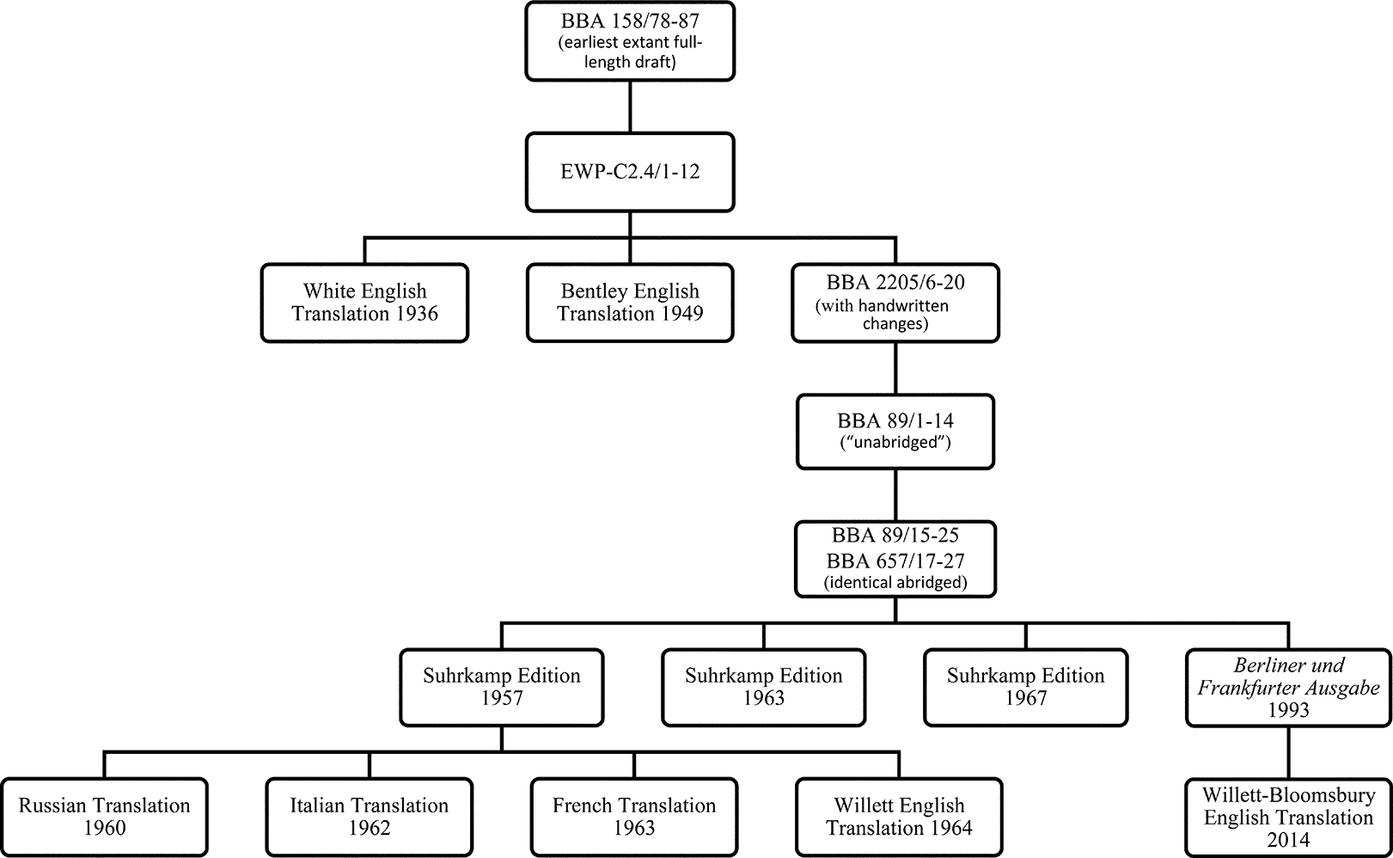
Before I start my comparison, I want for clarity’s sake to give a brief account of the relationship between the complete German typescript used for White’s translation (EWP-C2.4/1-12) and the full-length typescripts of Brecht’s essay found at the Brecht Archive (see Fig. 1). In the archive, there is one typescript that, as the text indicates, is what I believe is the earliest extant full-length draft of Brecht’s essay.Footnote 26 The text of this typescript was marked with Brecht’s handwritten revisions and additions, and its paragraphs, originally arranged in a different order, were rearranged as indicated by Brecht’s hand-drawn lines. Those revisions and additions, together with the rearrangement of the paragraphs, were incorporated into the typescript used for White’s translation. In addition, the text of the draft is relatively incomplete, as it does not include the important paragraph “Der chinesische Artist befindet sich nicht im Trance” (“The Chinese artist is in no trance”) (BBA 158/78-87: 83),Footnote 27 which was later added to the complete German typescript (EWP-C2.4/1-12: 7). Also missing in the draft is the concluding section about Brecht’s idea of how to perform a scene in Piscator’s adaptation of Theodore Dreiser’s An American Tragedy, and about his experience of a performance in a Yiddish theatre in New York. However, the missing section was found in a separate two-page typescript (BBA 610/71-72) that originally belonged to the draft.Footnote 28 In the missing section, Brecht left blank the name of the author of the Yiddish play (72), as he did in the typescript used for White’s translation (EWP-C2.4/1-12: 11).Footnote 29
The relationship of Bertolt Brecht’s manuscripts of his essay on the Chinese art of acting.

As mentioned earlier, among the many typescripts of Brecht’s essay on Chinese acting at the Brecht Archive, there is one (BBA 2205/6-20) mostly identical with the typescript used for White’s translation, not only in content but also in formal presentation, paragraph by paragraph and line by line, including the hyphenation and the original pagination. The short paragraph about Piscator’s production of The Good Soldier Schweik was presented as a note on a separate small piece of paper (9), as it was in the typescript used for White’s translation (EWP-C2.4/1-12: 3).Footnote 30 It was incorporated into the main text of the later versions.Footnote 31 Both of these typescripts were based on the earliest extant full-length draft (BBA 158/78-87 plus BBA 610/71-72) that I have discussed above. However, there is also a significant difference: while the typescript used for White’s translation was clean, the other (BBA 2205/6-20) was marked with Brecht’s handwritten corrections, additions, strikethroughs, and erasures, which I discuss below. All these changes must have been made by Brecht later on, sometime after the publication of Bentley’s translation in 1949: that translation, like White’s more than a decade earlier, does not feature those changes. It is worth noting that Bentley, unlike White, added both the author (“Samuel Ornitz”) and title of the Yiddish play (“Haunch, Paunch and Jowl”) in his translation.Footnote 32 Likewise, Brecht added the author’s name (“S. Ornitz”) of the Yiddish play in his marked typescript (19). The proof that Brecht made those changes in the 1950s can be further found in his handwritten note at the top of the opening page (6), in which he referred the underlined terms in the opening paragraph, “epischen Theater” [“epic theatre”] and “nichtaristotelischer (nicht auf Einfühlung beruhender) Dramatik” [“non-Aristotelian drama, not based on empathy”], to “Heft 10, ‘Strassenszene’ S. 125.” (Brecht’s famous essay “Die Straßenszene” [“The Street Scene”] was first published in Versuche in 1950.)Footnote 33
Furthermore, as I have indicated above, Brecht’s essay on Chinese acting gave an example in one paragraph showing the sharp contrast between the ways “the bourgeois theatre” and “the historicizing theatre” (Brecht’s “epic theatre”) would perform a scene in Piscator’s adaptation of An American Tragedy. Footnote 34 Later, in his essay “Kurze Beschreibung einer neuen Technik der Schauspielkunst” (see note 7), Brecht quoted that whole paragraph, including the important line, “Wichtig ist, was für ein junges Mädchen es ist, also ihr Charakter” (“What is important is what kind of young girl she is, that is, her character”). He noted specifically that he quoted it from his essay “Über den Verfremdungseffekt in der chinesischen Schauspielkunst” [On the alienation/estrangement effect in the Chinese art of acting] (BFA, 22: 641–59, at 655). The title, including the keyword Verfremdungseffekt (singular), matches exactly that of the draft, the typescript used for White’s translation, and its identical version.Footnote 35 This indicates that Brecht copied the paragraph from the same text shared by the typescript for White’s translation (EWP-C2.4/1-12: 9–11) and its identical version (BBA 2205/6-20: 17–19) before the latter was marked with Brecht’s handwritten changes, including the strikethrough of the line about the girl (18). He did not copy the paragraph from the later versions, all titled “Verfremdungseffekte in der chinesischen Schauspielkunst,” in which the same line was likewise struck through and was then erased.Footnote 36 Thus, the editors of the Berliner und Frankfurter Ausgabe erred in noting that Brecht quoted the paragraph from “Verfremdungseffekte in der chinesischen Schauspielkunst.”Footnote 37
To sum up this whole genealogical textual relationship, illustrated in Figure 1: following the earliest extant full-length draft (BBA 158/78-87) and the typescript used for White’s translation (EWP-C2.4/1-12), the typescript (BBA 2205/6-20) identical with the latter (but with Brecht’s own handwritten changes) serves as the text basis for the “unabridged” typescript (BBA 89/1-14); this “unabridged” typescript, with its additional changes, serves as the text basis for the two identical abridged typescripts (BBA 89/15-25; BBA 657/17-27), which in turn serve as the text basis for the first publication of the text in 1957 and all later editions.
Now, in the following, I give a detailed comparative analysis of these manuscripts.
1. Some words mistyped in the typescript used for White’s translation, which were typed correctly in the original (BBA 158/78-87), were corrected in the later versions.
2. As indicated above, some handwritten additions were made for the sake of clarity.Footnote 38 An important line, “Der Verfremdungseffekt hatte seine Wirkung verfehlt,”Footnote 39 was first added to the fragment “Der chinesische Artist befindet sich nicht im Trance” (BBA 332/78), before this fragment or paragraph, together with the addition, was incorporated into the text of the typescript used for White’s translation; it was further revised as “Der V-effekt hatte seine Wirkung bei ihnen verfehlt.”Footnote 40 The addition and revision of this line is only one of the instances in his essay that show how deeply Brecht was transfixed by his preconceived idea of Verfremdungseffekt, as I have noted elsewhere.Footnote 41
3. As I have indicated, there are words and lines struck through and erased in the later versions that had appeared in the earlier texts. For instance, the cut of “tief” (deep) from one line—“Ein Vergleich mit der asiatischen Schauspielkunst zeigt das tief Pfäffische, in dem unsere Kunst noch befangen ist”Footnote 42—clearly softens Brecht’s argument against the Western art of acting. A whole line originally in the earlier texts, “Als Reiz und neue Finesse, als formalistische Spielerei würde es keinerlei Bedeutung erlangen können,”Footnote 43 was erased from the later versions.Footnote 44 The cut appears to have been made, against the political background of the antiformalist campaigns in the 1950s, to avoid any suggestion that a technical device like what Brecht perceived as the Verfremdungseffekt in Chinese acting is formalistic. Here my observation finds support in Brecht’s argument for the “principle” underlying the alleged “pure aestheticism” of Chinese acting in the 1935 short text of his essay mentioned above:
Der westliche Zuschauer wendet sich leicht gegen diese Art Vortrag, indem er ihn als reinen Ästhetizismus bezeichnet. Nun ist viel an dieser Schauspielkunst tatsächlich nicht mehr als Formel und Linie; das kommt von ihrem Alter, davon, daß ihre mit solcher Kraft und Feinheit gegebenen Gedanken veraltet sind; aber das Prinzip selber ist kaum veraltet—für uns ist es sehr neu, und es aufnehmend folgen wir keineswegs ästhetischen Gesichtspunkten.Footnote 45
Aside from those relatively small changes noted above, there are some more significant alterations. I begin with what Brecht perceived as the “star cult” in Asian theatre.
In the 1935 short text, there is a whole paragraph about the cult of the star in Asian theatre,Footnote 46 and it remains intact in the first full-length versions (BBA 158/78-87: 80; EWP-C2.4/1-12: 4). However, beginning in the version that is identical to the typescript used for White’s translation and in the ensuing “unabridged” typescript, those lines about the Asian star in the paragraph were struck through:
Die Durchkältung kommt daher, dass das Individuum nicht so im Mittelpunkt steht wie auf der westlichen Bühne. Zwar gibt es kaum auf einem Theater einen solchen Starkult wie auf dem asiatischen. Die Augen der Zuschauer hängen sklavisch am Star. Die anderen Figuren geben ihm die Stichworte, stellen ihm die Hindernisse, zeigen ihn. Aber der Schauspieler sich in der erwähnten Art von der Figur, die er darstellt, distanziert.Footnote 47
They were also later erased from the two identical abridged typescripts.Footnote 48 Here the cut must have been made to avoid criticizing “the cult of the star” in Asian or Chinese theatre. During the decade of the 1950s, Mei Lanfang’s political as well as artistic status in China reached its pinnacle, marked by his initiation into the Chinese Communist Party in 1959 and by his political transformation from an old star actor of traditional Chinese theatre to a new icon of Chinese national culture. Thus, it would be considered politically incorrect to associate Mei Lanfang’s new popularity with the star cult that he had enjoyed for decades from his devoted audience.
As he refrained from discussing the star cult in Asian theatre, Brecht moved away from criticizing the Chinese theatre as a mystifying magic. In both the earlier and later versions, Brecht states: “Es ist zunächst schon schwierig, sich, wenn man Chinesen spielen sieht, freizumachen von dem Gefühl der Befremdung, das sie in uns, als in Europäern, erregen. Man muss sich also vorstellen können, dass sie den V-Effekt auch erzielen bei ihren chinesischen Zuschauern.”Footnote 49 However, the part that follows in those texts differs significantly. In the two earlier versions, it reads:
Es darf einen aber, was weit schwieriger ist, auch nicht stören, dass der chinesische Artist den Eindruck des Geheimnisvollen zu einem gänzlich anderen Zweck schafft, als wir ihn im Auge haben können. Nur wer dialektisch zu denken gelernt hat, wird es für möglich halten, dass eine Technik, die aus dem Bereich der Magie genommen wird, zur Bekämpfung der Magie verwendet wurden kann. Der chinesische Artist mag vermittels des V-Effekts beabsichtigen, die von ihm dargestellten Vorgänge seinem Zuschauer geheimnisvoll, unverständlich und unbeherrschbar zu gestalten und doch kann dieser Effekt dazu verwendet werden, die Vorgänge gerade verständlich, beherrschbar und irdisch zu machen. Die Haltung des Forschers, der seinen Gegenständen gegenüber sich zunächst staunend gibt, kann sehr wohl der Haltung des Magiers gleichen; jedoch hat die anscheinend gleiche Haltung in den beiden Fällen eine ganz entgegengesetzte Funktion.Footnote 50
Here, Brecht essentially considered the Chinese art of acting as a mystifying magic, where the Chinese artist creates “the impression of the mysterious for a purpose completely different from any” that Brecht could envision for his new epic theatre, and where the Chinese artist may intend to use what Brecht perceived as the Verfremdungseffekt to make the events he is depicting “mysterious, incomprehensible, and uncontrollable” to his audience. Thus, for Brecht, “Only those”—like Brecht—“who have learned to think dialectically will believe it possible that a technique taken from the realm of magic can be used to fight against magic”Footnote 51 and that “this effect can be used to make the events understandable, controllable, and earthly.”Footnote 52
In contrast, in the typescript identical to the one used for White’s translation, the passage cited above was replaced by the following lines on a separate page:
Es darf einen aber, was weit schwieriger ist, auch nicht stören, dass der chinesische Artist, wenn er den Eindruck des Geheimnisvollen erzeugt, kein Interesse zu haben scheint, uns ein Geheimnis zu entschleiern. Aus den Geheimnissen der Natur (besonders der menschlichen) macht er sein Geheimnis, er lässt sich nicht hineinschauen, wie er das natürliche Phänomen hervorbringt, auch die Natur gestattet ihm, der das Phänomen schon hervorbringt, noch nicht die Einsicht.Footnote 53
It was also later repeated in the “unabridged” typescript and the two identical abridged typescripts.Footnote 54 This line of argument concerning mainly the artistic or professional aspect of Chinese acting allows Brecht to avoid likening the Chinese art of acting as a whole to a mystifying magic but instead to associate it with science or “a primal stage of science”:
Wir stehen vor dem künstlerischen Ausdruck einer primitiven Technik, einer Urstufe der Wissenschaft. Der chinesische Artist holt seinen V-Effekt aus dem Zeughaus der Magie. Das “wie man es macht” ist noch geheimnisvoll, das Wissen ist noch das Wissen von Tricks, es ist in der Hand weniger, die es sorgsam hüten und aus ihrem Geheimwissen Gewinn ziehen.Footnote 55
Here, instead of rejecting entirely the Chinese art of acting as a magic that renders natural events “mysterious, incomprehensible, and uncontrollable,” Brecht was pointing out how in the future the researcher of the new theatre approaches natural events and phenomena and makes them “understandable, controllable, and earthly”:
dennoch wird hier schon in das Naturgeschehen eingegriffen, das Machenkönnen erzeugt die Frage, und in Zukunft wird der Forscher, bemüht, das Naturgeschehen verständlich, beherrschbar und irdisch zu machen, immer wieder zunächst einen Standpunkt aufsuchen, von dem aus es geheimnisvoll, unverständlich und unbeherrschbar erscheint. Er wird sich in die Haltung des Staunenden bringen, den V-effekt anwenden.Footnote 56
In the middle of 1961, White apparently sent the typescript of Brecht’s essay to Martin Esslin for the latter’s comment. In his response, dated 15 June 1961, Esslin referred to the variant as “the most significant difference” that concerns the discussion of “the relationship between magic and Chinese acting,” noting that the original text in question (EWP-C2.4/1-12: 8) “has been completely rewritten in the 1954 [i.e., 1957] version, so as to avoid any suggestion that there is an element of magic in Chinese popular culture.”Footnote 57 “Instead,” Esslin continues, “it is now stressed that the principles of classical Chinese acting are based on primitive forms of scientific thought (a polite and very Brechtian solution: for primitive forms of scientific thought are—pace Frazer’s Golden Bough—magic).”Footnote 58 For Esslin, in this instance—as in the one that avoids referring to Stanislavsky’s system as consisting of some “tricks,” which I discuss later—“Brecht clearly tried to put his thought in a form that would be less offensive and more tactful for the very touchy cultural censors of the Communist world.”Footnote 59 Here, first, as I agree with Esslin, I want to underscore the close political and cultural ties established between the People’s Republic of China (PRC) and the German Democratic Republic (GDR) in the 1950s, which may have influenced Brecht’s reworking of his essay. During the 1950s, with the political and ideological sanction of the Soviet Union, political and economic treaties were signed, and cultural exchange programs were established between the two newly founded socialist countries.Footnote 60 State and regional performing arts groups from the two countries toured each other’s country numerous times.Footnote 61 In his speech on the fifth anniversary of the founding of GDR, Chen Yi, then the Deputy Premier of the State Council of PRC, lauded the deep friendship between the two nations and the political, economic, and cultural collaborations and exchanges between the two socialist states.Footnote 62 The GDR newspaper Sonntag published in February 1954 a review of the socialist reform of classical Chinese theatre in new China, authored by Franz Carl Weiskopf, a communist writer who once served as the ambassador of Czechoslovakia to PRC and later moved to GDR. Weiskopf spoke of the important and indispensable role the “reformed” Chinese theatre played in “the revolutionary struggles of the recent past” against the Japanese invasion and the nationalist Kuomintang regime and in “the construction of the new social order in the People’s Republic.”Footnote 63 Perhaps it is not a coincidence that in January 1955 the same newspaper reprinted Brecht’s 1935 short text on Chinese theatre, “Bemerkungen über die chinesische Schauspielkunst” (see Footnote note 1). It was an unmistakable signal of the Soviet-centered international relationship between the two emerging socialist countries, as Brecht’s essay was the geopolitical product of a German Communist writer enjoying, during his pilgrimage to the Soviet Communist utopia, a performance by a visiting Chinese troupe of the classical Chinese theatre, entitled “New Theatre of Ancient Forms.”Footnote 64 The publication of the short text was also timed to celebrate Brecht’s acceptance of the Stalin Peace Prize in 1954, as it was featured on the same page of Sonntag as Brecht’s acknowledgment of the significance of the prize as “the highest and most desirable of all the prizes that can be awarded today”Footnote 65 and Johannes R. Becher’s open letter to Brecht, in which the GDR Minister of Culture spoke of the awarding of the prize to Brecht as “yet another triumph for our literature.”Footnote 66
Likewise, it was in the same decade that Brecht experienced a Maoist turn in his dialectical overhaul of his theory of epic theatre. Brecht studied Mao Tse-tung’s (Mao Zedong’s) philosophical treatise On Contradiction and referred to Mao’s work in his discussions, in 1953, with his collaborators on the adaptation of William Shakespeare’s Coriolanus for the Berliner Ensemble, which formed the main part of his theoretical project “Dialectics in the Theatre.”Footnote 67 As Mao’s dialectical materialist approach to the phenomenon of contradiction had an important influence on Brecht’s new concept of “Dialectical Theatre,” the Berliner Ensemble staged on 1 April 1954 an adaptation, by Hauptmann and Manfred Wekwerth, of a Chinese revolutionary folk play, Hirse für die Achte (Millet for the Eighth). According to Wekwerth, “Millet for the Eighth is a small part of a major effort that the Berliner Ensemble has been pursuing since around 1954: dialectics in the theatre.”Footnote 68 Wekwerth’s detailed analysis of the Ensemble’s work shows clearly the influence of Mao’s materialist idea of contradiction on the production of the play.Footnote 69 In November 1954, following the success of the play and to encourage its actors’ interest in Chinese theatre, the Ensemble asked the GDR Society for Cultural Relations with Foreign Countries to allow Wekwerth to travel to China with a delegation (BBA 736/102). Later Brecht noted, in a letter dated 31 August 1955: “In the theatre, we have benefited greatly from Mao Tse-tung’s treatise on contradiction. We are still performing Millet for the Eighth. The play gives the audience a great deal of pleasure” (BFA, 30: 371).Footnote 70
Thus, all in all, given the GDR’s political, ideological, and philosophical-aesthetic fellowship with the Chinese socialist state and its supreme spiritual leader, it was no longer an opportune time for Brecht to speak of China’s classical theatre as a mystifying magic to be fought against. Instead, “a primal stage of science” was politically an acceptable characterization of a time-honored national and cultural tradition and heritage that, for Brecht and the Chinese Maoist reformers, can be reformed, recuperated, and refunctioned to serve and further new social and political causes.
Aside from such apparent political and ideological considerations, I want to emphasize that there was a philosophical significance underlying Brecht’s revision. I want to draw attention to a hitherto unknown handwritten note by Brecht on another, one-page typescript—one featuring the same passage on magic and Chinese theatre that was replaced in the typescript (BBA 2205/6-20: 14). Brecht’s note reads as follows: “kein Gegensatz zur ‘Magie’ (s. Neurath!)” (“no contradiction/opposition to ‘magic’ [see Neurath!]”) (BBA 332/82). Here, Brecht refers to the Austrian-born socialist philosopher of science and sociologist Otto Neurath (1882–1945) and his empirical scientific view of magic. Brecht read Neurath’s essay “Wege der wissenschaftlichen Weltauffassung” [Ways of scientific worldview],Footnote 71 and later his book Empirische Soziologie [Empirical sociology].Footnote 72 In his essay, drawing on Lucien Lévy-Bruhl and James George Frazer, Neurath investigates primarily the close affinity of magic to modern science and the close relationship between the primordial “magical way of thinking” and that of “the modern scientific worldview.”Footnote 73 He arrives at his “way” of the materialistic modern scientific worldview, which, “beginning with magic, leads through religion and philosophy to materialistic empiricism.”Footnote 74 In his book, Neurath reaffirms his main argument that “the primal forms of all sciences, traced back to the emergence of writing, are ultimately rooted in the magic of prehistoric times.”Footnote 75 For him, “Magic does not denote anything mysterious”; preanimistic and animistic magic, “like modern behavior, is set for essentially finite and earthly [irdisch] purposes.”Footnote 76 Thus, magic does not contradict the unified goal that Neurath expected of the development of the materialistic scientific worldview, that is, consciously to shape “the order of life with a view to earthly [irdisches] happiness with the help of earthly [irdisch] justified means”;Footnote 77 nor does it run against the materialistic social and scientific objective of Brecht’s new theatre consciously to make natural events and phenomena “understandable, controllable, and earthly [irdisch].” In his revision, by associating the “magic” of Chinese theatre with “a primal stage of science” that leads to modern science, and not opposing it as anathema to the latter, Brecht—who proposed epic theatre as the theatre for a scientific age but traced it artistically (or “stylistically”) back to the ancient Asian theatre and didactically (or pedagogically) to the medieval mystery plays, the classical Spanish theatre, and the theatre of the Jesuits (BFA 22: 116)—was clearly in sympathy with Neurath’s view of magic.Footnote 78
In the latter part of the 1930s, Brecht’s concern over the rising influence of Stanislavsky’s system played a significant part in his theoretical thinking, and his essay on Chinese acting clearly reflects his firsthand experience of Stanislavsky’s influence on the American stage and his own study of Stanislavsky’s theory while he was also working on the final version of his essay.Footnote 79 Indeed, of all his writings, it was in his full-length essay on Chinese acting that Brecht spoke, for the first time, of Stanislavsky’s system and tied it to his interpretation of Chinese acting. To a significant degree, Mei Lanfang was Brecht’s argument against Stanislavsky. Thus, having described some exemplary uses of Verfremdungseffekt in Chinese acting, Brecht presented, in contrast, his critique of the Western actor’s portrayal of dramatic characters, or what he called the actor’s “restlose Verwandlung” (“complete transformation”),Footnote 80 associating it with Stanislavsky’s “system”:
Dieser Akt der restlosen Verwandlung ist ein sehr mühevoller. Stanislawski gibt eine Reihe von Kunstkniffen, ein ganzes System davon, an, vermittels derer dieses creative mood (die Schaffenslaune) immer von neuem, bei jeder Vorstellung herbeigezwungen werden kann.Footnote 81
It was altered, however, in the later versions as follows:
Dieser Akt der restlosen Verwandlung ist übrigens ein sehr mühevoller. Stanislawski gibt eine Reihe von Kunstmitteln, ein ganzes System, an, vermittels derer das, was er creative mood, Schaffenslaune nannte, immer von neuem, bei jeder Vorstellung herbeigezwungen werden kann.Footnote 82
Esslin attributed this “really significant” variant to Brecht’s desire “to avoid falling foul of the Communist authorities in East Germany”: instead of “Kunstkniffen” (“artful tricks”), “the German printed text has Kunstmittel[n], artistic means, clearly to respect the by now holy and officially accepted doctrine of Stanislawski [sic].”Footnote 83 Here, although referencing only the 1957 published German text, Esslin made his point clear, and I agree with him, as the change was made clearly first on the “unabridged” typescript (BBA 89/1-14: 5) and was followed by the two identical abridged typescripts (BBA 89/15-25: 18; BBA 657/17-27: 20), on which the 1957 published German text was based.
In the 1950s when the Stanislavsky system was officially accepted as orthodox in GDR—as demonstrated by the opening of the Stanislavsky Conference in April 1953 in East Berlin, which Brecht attendedFootnote 84—his stance toward Stanislavsky had apparently changed, as shown in a few short studies he did in the first half of the 1950s. In those studies, approaching Stanislavsky from the perspective of his theory of epic or dialectical theatre (BFA, 23: 167–8), Brecht found in Stanislavsky’s system “a real development from naturalism to realism” (BFA, 23: 225). According to Brecht in his thoughts on the Stanislavsky Conference, “Even a brief study of Stanislavsky’s working method reveals a great wealth of exercises and procedures useful for realistic representation” (BFA, 23: 236). Even when he still questioned, in those altered versions of his essay on Chinese acting, the ideas of “complete transformation,” “creative mood,” and “‘intuitive’” process,Footnote 85 as he did in the earlier versions,Footnote 86 he did so rather levelheadedly and pragmatically, speaking of Stanislavsky’s whole system as comprising “a series of artistic means,” instead of explicitly belittling it as “a series of artful tricks.” In contrast, in some of his writings in the latter part of the 1930s, Brecht sharply criticized what he described as Stanislavsky’s idea of “complete transformation” (identification and empathy) (BFA, 22: 178–80, 280–1), associated naturalism with Stanislavsky’s silent and authoritative “templelike theatre” (BFA, 22: 177), and exposed the “mystical, cultic character” of Stanislavsky’s system (BFA, 22: 281).
Theoretical Significance: Entfremdungseffekt versus Verfremdungseffekt
Of all the revisions Brecht made in his essay, the most important one, in my view, concerns the onetime presence of the critical word Entfremdungseffekt in the typescript used for White’s translation: “Auch die chinesische Schauspielkunst kennt den Entfremdungseffekt, sie wendet ihn in sehr raffinierter Weise an” (EWP-C2.4/1-12: 1).Footnote 87 It is significant to underscore the fact that in the version that is identical with this typescript, the whole line, including the word “Entfremdungseffekt,” remains intact (BBA 2205/6-20: 6), even as Brecht made many handwritten corrections and revisions on the text. However, in the “unabridged” typescript, the prefix “Ent” in “Entfremdungseffekt” was crossed out and marked with the prefix “Ver” on top of it (BBA 89/1-14: 1), and the whole word was later replaced by “Verfremdungseffekt” in the two identical abridged typescripts: “Auch die alte chinesische Schauspielkunst kennt den Verfremdungseffekt, sie wendet ihn in sehr raffinierter Weise an.”Footnote 88
In his letter to White, Esslin noted in passing that “Entfremdungseffekt instead of Verfremdungseffekt” is “clearly an error which is corrected in the printed version.”Footnote 89 But, for me, it is important to note that, whereas White uniformly used the phrase “effect of disillusion” or “disillusion effect” in his translation of both Verfremdungseffekt and Entfremdungseffekt,Footnote 90 Bentley used, one time, the phrase “effect of estrangement,” even as he consistently used the term “alienation effect” as a translation of Verfremdungseffekt: “This effect of estrangement is also known to the Chinese actor, who uses it in a very subtle manner.”Footnote 91 This variant, distinctively italicized in Bentley’s translation but not in the original, indicates to me that it is exactly a translation (as intended by Bentley) of Entfremdungseffekt in the same line cited above in the typescript used for White’s translation (EWP-C2.4/1-12: 1) and its identical copy (BBA 2205/6-20: 6). This exception in Bentley’s translation can be proved by his translation, as “self-estrangement,” of Brecht’s critical term Selbstentfremdung in “ein künstlicher und kunstvoller Akt der Selbstentfremdung” (EWP-C2.4/1-12: 3; BBA 2205/6-20: 8).Footnote 92 Thus Bentley clearly did not see Entfremdungseffekt as “an error,” as he translated it faithfully to differentiate it from his consistent translation of Verfremdungseffekt as “alienation effect.”
More important, however, as I demonstrate in the following, is that even if it is “an error,” a so-called Freudian slip, it speaks more about the creation of Brecht’s “new” concept of Verfremdungseffekt.
Although Entfremdungseffekt first appears, along with Verfremdungseffekt, in Brecht’s essay on Chinese acting, it is not the first time that Brecht used the critical term Entfremdung. It had been used, in precisely the same sense, in an earlier essay, “Vergnügungstheater oder Lehrtheater?” (“Theatre for Pleasure or Theatre for Instruction?”):
Von keiner Seite wurde es dem Zuschauer weiterhin ermöglicht, durch einfache Einfühlung in dramatische Personen sich kritiklos (und praktisch folgenlos) Erlebnissen hinzugeben. Die Darstellung setzte die Stoffe und Vorgänge einem Entfremdungsprozeß aus. Es war die Entfremdung, welche nötig ist, damit verstanden werden kann.Footnote 93
Brecht defined the aesthetic and artistic modernity of Entfremdung in terms of what made the modern theatre, particularly the German “epic theatre” that “showed the development trend of modern theatre at its purest,” truly “modern”: its introduction of “technical and artistic innovations” (BFA, 22: 106–7; emphases in original). For Brecht, the representation of the epic theatre subjected the subject matter and the events that appear “natural” and “self-evident” to “a process of alienation” (Entfremdungsprozeß), thus making them appear artificial, strange, and striking, and “it was the alienation [Entfremdung] that is necessary to be able to understand” (BFA, 22: 109). All these mean that Brecht’s concept of Entfremdung is not just a Hegelian or Marxist philosophical or sociopolitical idea but also a fully developed artistic method, without his knowledge and absorption of the Russian formalistic ideas and without the benefit of his experience of Chinese acting as exemplified by Mei Lanfang’s performances. Thus, Entfremdung as understood by Brecht differs from Verfremdung only in name but not in substance.
Brecht also used this key term in the title of a short piece, “Episches Theater, Entfremdung” [Epic theatre, alienation/estrangement], and defined it thus:
Gesucht wurde eine Art der Darstellung, durch die das Geläufige auffällig, das Gewohnte erstaunlich wurde. . . . Damit der Vorgang als das gesellschaftlich bedeutende und problematische Ereignis erscheint, das er ist, muß er dem Publikum entfremdet werden durch die Darstellung.Footnote 94
This undated text was probably written in 1936. The editors of the Berliner und Frankfurter Ausgabe grouped it together with the other pieces on Verfremdungseffekt written in the period of Brecht’s Scandinavian exile, noting that they “were probably written in connection with the first use of the term in 1936” in his essay “Verfremdungseffekte in der chinesischen Schauspielkunst” (BFA, 22: 969).
The idea of Entfremdungseffekt was also crystalized in the 1935 short version of Brecht’s essay on Chinese acting, in the spirit of Brecht’s first use of Entfremdung in “Vergnügungstheater oder Lehrtheater?” before he ever coined the term Verfremdungseffekt:
Der Artist wünscht offenbar, dem Zuschauer fremd, ja befremdlich zu erscheinen. Er erreicht das dadurch, daß er sich selbst und seine Darbietungen mit Fremdheit betrachtet. Dadurch bekommen die Dinge, die er vorführt, etwas Erstaunliches. Alltägliche Dinge werden durch diese Kunst aus dem Bereich des Selbstverständlichen gehoben.Footnote 95
And it was echoed in Brecht’s idea of the actor’s Sichselberzusechen (or Sich-selber-Zusechen—self-observation) as “ein künstlicher und kunstvoller Akt der Selbstentfremdung” in the full-length versions of his essay.Footnote 96
Critics have tried to distinguish between Brecht’s two terms, Entfremdung and Verfremdung. For instance, Reinhold Grimm has defined these two terms thus: “Entfremdung denotes the state of alienation, of being estranged; it stands for a passive experience. Verfremdung denotes the device or act of alienation, of making strange; it stands for an active experience.”Footnote 97 However, as I have demonstrated above, there are no such distinctions between the two terms as understood and used by Brecht, and there is nothing “passive” about the Entfremdung defined by Brecht as a technical and artistic innovation necessary for knowledge and understanding. Brecht himself often used the two terms interchangeably, and did so even after coining the term Verfremdungseffekt. As Jan Knopf has pointed out, Brecht was already using the term Entfremdung as early as 1930, in the sense of Verfremdung, in his note on “Die Große und die Kleine Pädagogik” [The big and the small pedagogy]:
Im Zuschauer [soll] nicht an das Gefühl appelliert werden, das ihm erlauben würde, [sich] ästhetisch abzureagieren, sondern an seine Ratio. Die Schauspieler müssen dem Zuschauer Figuren und Vorgänge entfremden, so daß sie ihm auffallen. Der Zuschauer muß Partei ergreifen, statt sich zu identifizieren.Footnote 98
Speaking of the “juxtaposition” of the two terms, Entfremdung and Verfremdung, in Brecht’s later writings, Knopf argues that “possibly” this juxtaposition “also indicates a difference, namely insofar as the term ‘Entfremdung’ in the Hegelian sense remains epistemologically fixed, while the term ‘Verfremdung’ refers to the aesthetic aspect: the actor ‘verfremdet’ in order to make ‘Entfremdung’ possible.”Footnote 99 Citing from Brecht’s essay “Neuen Technik der Schauspielkunst” (1940), Knopf notes that both terms appear immediately after one another in Brecht’s note on the actor’s technical device of “historicization”: the one used in the Hegelian sense (“Constant evolution alienates [entfremdet] us from the behavior of those born before us”), and the other in the Brechtian aesthetic sense (“The actor now must take the same distance from the events and behaviors of the present as the historian takes from the events and behaviors of the past. He must alienate/estrange [verfremden] these processes and characters from us”).Footnote 100 But for me, as noted above, Brecht also used Entfremdung and entfremdet in an aesthetic sense (as artistic methods and acting techniques), as shown in his essay “Vergnügungstheater oder Lehrtheater?,” where he spoke of the production of epic theatre as “a process of Entfremdung,” and in his essay on Chinese acting, where he underscored the Chinese actor’s art of “self-observation” as “an artificial and artistic act of self-alienation/estrangement [Selbstentfremdung]” (BFA, 22: 202). As previously noted, Knopf himself has cited Brecht’s earlier statement that underscores exactly the same idea about entfremden as an artistic method, one used by the actor to alienate (entfremden) the characters and events from the spectator.
Considering incorrect a direct association of the Marxist idea of Entfremdung, particularly Selbstentfremdung, with Brecht’s idea of Verfremdung, Knopf argues that “it can be assumed that Brecht knew Marx’s concept of ‘alienation’ [Entfremdung] but he does not use it explicitly; in one passage only the term ‘self-alienation’ [Selbstentfremdung] appears.”Footnote 101 Here, Knopf refers to Brecht’s use of the term Selbstentfremdung in his essay on Chinese acting.Footnote 102 However, Knopf’s passing reference to the term Selbstentfremdung does not say anything about its significance as an artistic technique, as it was used by Brecht to describe Mei Lanfang’s acting. For me, it is a critical part of Brecht’s idea of the epic style of acting, namely, the actor’s “self-observation” as “self-alienation/estrangement” (BFA, 22: 202), the Brechtian reaction against what was perceived as Stanislavsky’s core tenet of “complete transformation,” as noted above. Here, its significance lies in its use as an artistic technique but not in its Marxist sociopolitical association, as Brecht had a deep ideological suspicion of the social motives of what he perceived as the Chinese “Alienation/Estrangement Effects.”
As early as 1959, Willett noted that Verfremdung’s “obvious derivation is from that ‘Priem Ostrannenija,’ or ‘device of making strange’ (or ‘Verfremdungseffekt’) of the Russian Formalist critics.”Footnote 103 Two years later, in a letter dated 6 November 1961, Willett asked Erwin Piscator whether he too saw Mei Lanfang’s performance that Brecht attended during his visit to Moscow in 1935, and whether Brecht discussed the idea of “Priem Ostrannenija” with Russian literary and art critics such as Osip Brik, Boris Arvatov, and Viktor Shklovsky.Footnote 104 Piscator replied to Willett on 9 January 1962:
Mei Lan-fang’s guest performance was a big event in Moscow, attended by all the prominent personalities, including émigrés. Who Brecht met in Moscow, what he saw—I don’t know. The term “Verfremdung” goes back to Schopenhauer (“Entfremdung”). I can’t imagine that Brecht borrowed it from the Russian system.Footnote 105
Notwithstanding, in a note to his translation of Brecht’s essay on Chinese acting in 1964, Willett formally claimed that “The formula [Verfremdungseffekt] itself is a translation of the Russian critic Viktor Shklovskij’s phrase ‘Priem Ostrannenija’, or ‘device of making strange’, and it can hardly be a coincidence that it should have entered Brecht’s vocabulary after his Moscow visit.”Footnote 106
In 1970, in his memoirs, Bernhard Reich, who claimed that while in Moscow in 1935 he was present at a meeting where playwright and critic Sergei Tretyakov and Brecht “talked about a wholly exceptional theatrical performance,” stated that “I have to assume that Tretjakow [sic] conveyed this terminology [Verfremdung] to Brecht,” even though he acknowledged that “I can no longer say whether [it was] about Mei Fan-lan [sic] or a production by Ochlopkow [sic].”Footnote 107 Having made up his mind about the Russian source of Brecht’s term and citing Reich’s recollection, Willett chose to ignore Piscator’s objection and to reaffirm his position, stating in 1984 that “This new phrase, the Verfremdungseffekt, appears to be a precise translation of Viktor Shklovsky’s term Priëm Ostranneniya” and that “there seems to me every reason to accept the view of Bernhard Reich.”Footnote 108
As early as 1974, Knopf began to question Willett’s thesis (and some other assumptions that support Willett’s view) of the Russian formalistic influence on Brecht’s idea of Verfremdung as a result of his 1935 Russian experience.Footnote 109 Knopf concluded that “the proponents of the theory have invented facts that are based on nothing but. . . ‘pure speculation’” and that “the direct or even internal connection between ‘Verfremdung’ and ‘ostranenije’ cannot be proven, neither as far as the purely external facts are concerned, nor as far as the alleged agreement in content is concerned.”Footnote 110 More than a decade later, Knopf further argued that the “coexistence” or “juxtaposition” of the two terms—Entfremdung as defined by Hegel and Verfremdung as Brecht used to describe the Hegelian term in his writings between 1936 and at least 1940—“proves in any case that the replacement of the terms, their historical succession, which is repeatedly presented in research, does not exist at all, at least at first.”Footnote 111 Still, decades later, speaking of Brecht’s “Moscow Trip: Without Verfremdung,” Knopf continued his rebuttal of the thesis of Russian formalistic influence on Brecht’s theory of Verfremdung, noting that “Brecht never referred to Shklovsky—he evidently did not know him; especially since he expressly emphasized that he had not invented Verfremdung, why should he have overlooked the Russian?”Footnote 112 Following Knopf’s observation, I want to add that the term Verfremdungseffekt did not appear in the short version of Brecht’s essay on Chinese acting that he drafted in 1935 while he was in Russia or shortly after his Russian trip.Footnote 113 Likewise, it is important to underscore the fact that, in all his surviving letters to Brecht and in his essay on Brecht—which he revised following Brecht’s 1935 visit to the Soviet Union—Tretyakov never mentioned Shklovsky, never spoke of “Ostrannenija” or of anything that suggests it.Footnote 114
Conclusion
In this article, I have offered a comparative study of the different manuscripts of Brecht’s essay on Chinese theatre. It reveals that significant revisions and erasures had been made before the German text of the essay was first published in 1957. Compared to the complete text (typescript) of Brecht’s essay used for White’s and Bentley’s translations, what we have seen since 1957 as the final version of Brecht’s essay published in different editions of his works— particularly what we have now as the standard text included in the Berliner und Frankfurter Ausgabe—is an altered and abridged text. So are all those translations based on the altered and abridged text, compared to White’s and Bentley’s translations.
My study also demonstrates that, evolving over two decades from the middle of the 1930s to the 1950s, Brecht’s approach to Chinese theatre and Stanislavsky, as shown in his essay on Chinese acting, had been acutely affected by the political and ideological conditions that shaped the cultural relations in the 1950s among the three socialist states: the German Democratic Republic, the Soviet Union, and the People’s Republic of China.
Most significantly, my study finds that the coexistence of the two critical terms Entfremdungseffekt and Verfremdungseffekt in his essay, like the interchangeable use of Entfremdung and Verfremdung in his other theoretical writings, shows that when he used Entfremdung, Brecht approached it not merely in the Hegelian philosophical sense or the Marxist sociopolitical sense but also in the Brechtian aesthetic sense (as an artistic concept or method), much like his approach to his new concept of Verfremdung. When a different translation (alienation, estrangement, defamiliarization, disillusion, distancing, or displacement)Footnote 115 is used to render the two German terms, it speaks merely of the difference between the translations, and not of any real substantial difference between the two terms as understood and used by Brecht. In essence, Verfremdung is Entfremdung, and Verfremdungseffekt is Entfremdungseffekt. Ultimately, there is no evidence (except some speculations) that Brecht was informed (by Tretyakov) of the Russian formalist idea of “Ostrannenija” that supposedly gave birth to his concept of Verfremdung. At the same time, as an aesthetic idea, not just a Hegelian or Marxist one, Entfremdung preconditions and inheres in Brecht’s concept of Verfremdung. Brecht made the known and familiar idea of Entfremdung appear strange and unusual by seemingly displacing it with his “neologism” Verfremdung, which was associated with the less known and less familiar word Verfremden. Footnote 116 Likewise, Brecht coined and used, for the first time, the term Verfremdungseffekt in his essay while his imagination of the Chinese art of acting—a foreign and exotic art that he believed arouses “the feeling of strangeness” (see note 49) in his European spectators—was haunted by the spectre of the familiar Entfremdung, which finds its natural place in the two critical terms that appear in the same essay: Entfremdungseffekt and Selbstentfremdung. Footnote 117
Just over half a century ago, having presented his rebuttal of the thesis of the Russian formalist influence on Brecht, Knopf hoped that “the thesis, for which there is no evidence, will finally disappear from (Western) Brecht research.”Footnote 118 Today, while the thesis still persists, I hope my investigation through a comparative study of Brecht’s manuscripts on Chinese theatre further proves the invalidity of that thesis. At the same time, and more important, I hope that I have demonstrated that the concept of Verfremdungseffekt, as first introduced by Brecht in his essay on the Chinese art of acting, is a self-projection of a Brechtian act of Selbstentfremdung that makes strange, striking, and thereby “new” his long conceived familiar idea of Entfremdung and Entfremdungseffekt.