Introduction
In 2000, the Department of Health (DoH) 1 proposed the introduction of the Consultant Practitioner to allow quicker access to health care by patients being seen by a professional with the appropriate skills, rather than a particular background to produce better outcomes. Reference Kennedy, McDonnell, Gerrish, Howarth, Pollard and Redman2 The development of the role of Consultant Radiographer (CR) for palliative radiotherapy (RT) was introduced within the trust due to a national shortfall 3 and inability to recruit into Clinical Oncologist (CO) vacancies. Booth et al. Reference Booth, Henwood and Miller4 and Paterson Reference Paterson5 realised this as a potential concern where local issues could be resolved with local solutions. However, the perception of all CR posts is that they improve service delivery and patient care experience regardless of the reason behind their development. Reference Henwood, Booth and Miller6
This specialist role facilitates rapid access to treatment for bone pain using an extended scope of practice, which includes assessment, informed consent, localisation, image approval, radiation prescription, on-treatment review and follow-up.
A recent audit showed that the current patient pathway, from initial clinic appointment to delivery of RT, takes on average 18 days for all patients requiring palliative RT for bone pain. A process that needs streamlining for quicker access is recommended by the DoH. 1
What is Informed Consent?
Consent is ‘the voluntary and continuing permission of a patient to receive a medical treatment, based on adequate knowledge of the purpose, nature, likely effects and risks of the treatment including the likelihood of its success and any alternatives to it. Permission given under any unfair or undue pressure is not a true consent’. 7
Informed consent is an interactive process Reference Everett, Griffiths and Nandasoma8 not just a signature on a form Reference Nandasoma9 and has three dimensions—legal, ethical and practical. 10 Legally, it is a contract between a doctor or Healthcare Professional (HCP) and a patient, where the patient has made an informed decision to have treatment with the understanding that the permission can be withdrawn at any time. 11,12 Ethically, it is the autonomous decision made by the patient about their care. Practically, it is the process of a patient-centred discussion where all aspects of those components that validate informed consent are addressed. Failure to obtain consent may result in claims of battery, assault and/or negligence if all aspects are not fulfilled Reference Herring13 while taking into consideration the wishes of the patient.
Legal, Ethical and Practical Considerations
The verdict in Bolam v Friern Hospital Management Committee (1957) gave rise to the ‘Bolam Test’ where any doctor or HCP could not be found negligent in their duty of care as long as their practice was deemed acceptable by a ‘responsible body of medical opinion’. Reference Herring13 This was the standard used in law for several other cases and until March 2015, the test was used in law where only the risks that were considered material needed to be disclosed and discussed with the patient. Reference Herring13 Then, a decision by the court in the case of Montgomery v Lanarkshire Health Board (2015) changed the law and Bolam no longer determined materiality. Reference Dyer14 A doctor has a duty to inform of all material risks where ‘a reasonable person in the patient’s position would be likely to attach a significance to the risk’ or ‘a doctor is or should reasonably be aware that a particular patient would be likely to attach significance to it’. Reference Dyer14
The consent process requires a frank and open conversation to ensure the patient is sufficiently informed to be able to make an autonomous decision. This should include discussion and information on the risks and benefits of the proposed treatment, of any alternatives available and of no treatment. Reference Hall, Prochazka and Fink15 Factors that may affect obtaining informed consent include the level of the patient’s understanding and autonomous decision-making and how the patient uses the information to make a decision. Reference Hall, Prochazka and Fink15 The level of understanding of the information supplied is affected by age, intelligence, Reference Lavelle-Jones, Byrne, Rice and Cuschieri16 education Reference Hekkenberg, Irish, Rotstein, Brown and Gullane17 and anxiety Reference Betti, Sironi, Saino, Ricci and Bonavina18 and is usually overestimated. Reference Lavelle-Jones, Byrne, Rice and Cuschieri16
The General Medical Council (GMC) recommends that an HCP should not assume how significant a risk is to a patient, but understand views and preferences. 12 Each patient is an individual and two patients having received exactly the same information could make very different decisions. 19
There also needs to be awareness that the reasons patients want or need varying levels of information are multifactorial. This can include current and previous personal experience, cultural and ethnic background and the severity/urgency of the proposed treatment. 20 A patient is within their rights to refuse information as supported by the judge in Montgomery v Lanarkshire Health Board (2015). Reference Dyer14 It could be argued that this does not fulfil the requirements of full informed consent 11,12 which is now a ‘partnership between patients and professionals’, Reference Dyer14 but risks are those which the patient attaches significance to and they may only consider the treatment to be of benefit. Documentation of this decision by the patient will ensure that the HCP will not be subject to a claim of negligence. 11,12
Giving consent voluntarily can be achieved by allowing a patient to consider the benefits versus the risks of the treatment offered and then are encouraged to ask questions to clarify any issues. 3 A bone metastases patient needs to carefully weigh the benefits of having RT that may give pain relief, with the possibility of various side effects, against travelling to the hospital for treatment with no guarantee that it will provide the anticipated effect on their Quality of Life (QOL). One study showed that patients who did achieve an analgesic effect from RT did have an improved QOL, but there was no method of predicting which patients would respond. Reference Westhoff, de Graeff and Monninkhof21 A patient needs to be fully informed of all possibilities to be able to reach a decision.
It is acknowledged that some patients want to rely on the knowledge and expertise of their doctor to make a decision Reference Ribas, Hotouras, Wexner and D’Hoore22 or they place more importance on the building of trust in their doctor during the consent process and less on the decision to be made. Reference McKneally and Martin23 This could result in a patient making a decision that is not autonomous. The Medical Protection Society 24 highlights the issue of coercion by friends and relatives, which is pertinent for this group of patients who are in the final stages of their disease. Pain is distressing to witness and the chance of treatment working, however minimal, can cause friends and relatives to try and persuade the patient to ‘have a go’. The patient should make an autonomous decision but when under pressure, they may agree, rendering the consent process invalid.
Clinical Oncologist Pathway
Patients enter the pathway via two routes—routine follow-up in the Haematology Clinic or from the Haematology Multidisciplinary Team meeting during which bone pain is identified as requiring treatment. Patients are then referred to the Specialist CO to be reviewed in their clinic.
The patient is assessed, treatment is discussed and informed consent is obtained by the CO or Specialist Registrar at this clinic appointment. The current shortage of COs has an impact on all outpatient’s clinics. They are often overbooked and time spent with a patient is at a premium. Time is a barrier that may result in a less than adequate conversation Reference Hall, Prochazka and Fink15,Reference Esmaeili, Cheraghi and Salsali25,Reference West, Barron and Reeves26 to obtain fully informed consent with full patient understanding. So, it should follow that the patient should have as much time as needed. There is no literature available to apprise on the optimum time required for informed consent in the outpatient setting. Reference Fink, Prochazla and Henderson27 One trial found that 15–30 minutes to consent for surgery improved comprehension as it allowed time for discussion, questions and completing the form. Reference Fink, Prochazla and Henderson27
The DoH 28 advocates that written information be given so that the patients can take it away and read it to support an informed decision. Patients with bone metastases, regardless of the primary site, have no trust produced supporting literature as other treatment sites do. They can access Macmillan information via the Information and Support Centre in the building or through online resources as required. Patients need enough information to validate consent 11 but it should enhance the consent process rather than replace the discussion, Reference Everett, Griffiths and Nandasoma8 only serving as an aid to the form filling. Reference Hall, Prochazka and Fink15
Continuity of care is acknowledged as important to cancer patients Reference Aubin, Giguère and Martin29 and increases patient satisfaction. Reference Cabana and Jee30 Myeloma patients may have many courses of treatment, which results in multiple episodes of consent. Patients in the clinic can be seen by different doctors, so that there is variable continuity of care or standard of consent. Reference Hall, Prochazka and Fink15 The consent process is part of care, so that it could result in decreased patient satisfaction; however, there is no literature available to support this.
Service Change
The CR-led service needed to fulfil all three aspects of fully informed consent and was delegated by the COs. The Royal College of Radiologists acknowledges that delegation of consent under a protocol by other HCPs will be required as practice evolves. 3 All national 11,12 and local policy 31 set out guidelines for delegation of consent and the need of the delegator to have suitable knowledge, skills and experience. 11,12,31 The person undertaking the consent needs to adhere to their regulatory bodies’ guidance. 32 There is a ‘restricted use’ of delegated consent within the trust to ensure that the patient’s information needs are met. 31 Competency was achieved as per trust recommendation to ensure that the quality of consent was comparable with that recommended by the GMC. 12
A direct referral pathway into the CR’s consent and planning sessions was implemented. Each session is 45 minutes long to facilitate high-quality informed consent to ensure comprehension. Reference Fink, Prochazla and Henderson27 This allows adequate time for reflection on the information given and further discussion if required before making a decision. Reference Schenker and Meisel33 The DoH questions the validity of consent that is taken just prior to a procedure; however, the patient is allowed time between consent and the scan. 11
Studies have shown that patients do not retain the information given to them during the informed consent process 34 and information leaflets can make the process easier. Reference Nandasoma9 Literature was developed to supplement the consultation process only and not to fulfil ‘the administrative and legal requirements’. Reference Hall, Prochazka and Fink15 Everett et al. Reference Everett, Griffiths and Nandasoma8 suggest that giving leaflets prior to consent permits the patient to consider their options and allows them to decide how much detail they require. The leaflet is posted to the patient with their appointment list to facilitate this process. Understanding will be tested by using the teach-back technique if there are signs that the patient does not comprehend the discussion. It facilitates the key points to be reiterated to the HCP by the patient in their own words. A randomised controlled trial found that that technique improved understanding with only a four-minute increase in the length of time to obtain informed consent for elective surgery. Reference Fink, Prochazla and Henderson27
The Impact
The impact of the service change was assessed with respect to the time taken from the decision to treat date (DTTD) until the date of the first fraction delivery and comments from a patient survey.
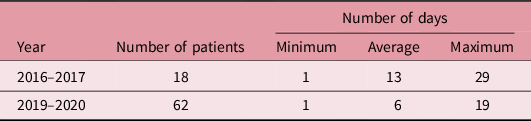
The service change was implemented in 2018 so data was extracted from the departmental statistics produced for submission to the National Radiotherapy Dataset between 2016–17 and 2019–20. The data were filtered using the International Classification of Disease Code for multiple myeloma (C90.0), DTTD and exposure date (delivery of the first fraction). DTTD is the date that the CO or CR completed consent and electronic referral for treatment. The data were imported into Microsoft Excel and the length of time, in days, from DTTD to delivery of the first fraction was manually calculated. The minimum, average and maximum number of days was calculated using the AutoSum functionality on Excel (Table 1).
Patient wait times

The introduction of CR-led consent has reduced the average patient wait time from 13 to 6 days.
Figure 1 shows the two patient pathways.
Patient pathways.

The new referral pathway has eliminated the need for a clinic appointment with the CO, which has reduced the average length of the pathway.
A patient survey, which was approved by the Trusts Questionnaire, Interview and Survey Committee, was carried out to seek patient and carers perspectives of the CR-led service. Comments collected regarding the planning and consent session included ‘excellent—completed treatment quicker’, ‘over and done with’, ‘saves a journey to clinic’ and ‘more convenient’.
Perceptions and comments about the quality of the consent process by the CR have not been collected formally, however, verbally patients have commented on how they prefer to see the same person every time, appreciate the time taken to explain the treatment and side effects and being allowed space to consider their decision.
The introduction of the information leaflet has been positive with patients arriving for their consent session informed and with questions ready to ask.
Conclusion
The introduction of CR-led consent has streamlined the pathway for multiple myeloma patients and has resulted in quicker access for treatment despite an increased rate of referrals. The service provides a balance between an appropriate length of time for consent, allowing the patient time to consider their options to make an informed decision versus the need to receive treatment for symptoms. The process is patient-centred with a named HCP providing continuity of care and information to support the autonomous decision-making process.
The Consultant-led service aims to streamline access for all patients requiring palliative RT for bone pain. The CR caseload includes patients from the local hospices, other NHS trusts and from other specialties including medical oncology and palliative care. These pathways are currently being audited and developed to reduce the average time for all bone metastases patients.
Acknowledgements
Petra Jacobs and Simon Smith for feedback and support.
Financial Support
Macmillan Support Grant (Grant Number SGSOW1908).
Conflicts of Interest
No conflict of interest was received for this study.