From epidemiology to animal models to clinical intervention
To guide further animal research in the field of Developmental Origins of Health and Disease (DOHaD), the Australia and New Zealand DOHaD Society (ANZ DOHaD) Animals Models of DOHaD Research Working Group convened at the 2nd Annual ANZ DOHaD Congress in Melbourne, Australia in April 2015.Reference Prescott, Allen and Armstrong 1 This review summarizes the contributions of animal research to the understanding of DOHaD, and makes recommendations for the design and conduct of animal experiments to maximize relevance, reproducibility and translation of knowledge into improving health and well-being.
The seminal epidemiological studies of leaders in the field of DOHaD in the 1980s and 1990s illustrated the link between early life and adult health and gave birth to a new scientific discipline. Epidemiological studies have taught us a great deal about DOHaD but they cannot explain mechanisms underlying the associations they observe. Hence, the development of animal models has been critical to our understanding of how early developmental events impact lifelong health.
The most valuable DOHaD animal models mimic complications of human pregnancies, cause similar changes in early life growth and development, and cause lasting alterations in phenotypes in the offspring. With these models, researchers have studied changes in specific organs at the physiological, structural and molecular level to discover likely mechanisms. With characterization of these underlying processes, it has been possible for scientists to identify potential interventions to prevent or ameliorate the negative impacts of early life events. Although it is tempting to test such interventions in a human population, without knowing the long-term effects of the intervention we may actually be causing harm. Thus, carefully designed studies in the same animal models are required to determine short- and long-term outcomes of proposed interventions, before translation into humans. If successful, such interventions have the potential to provide cost-effective strategies for preventing diseases associated with specific early life exposures at a population level. The introduction of folate fortification of bread–flour and recommendations for folate supplementation in early pregnancy, which resulted in dramatic decreases in the incidence of neural tube defects, the mechanisms for which have been explored in animal models,Reference Fleming and Copp 2 , Reference Denny, Jeanes and Fathe 3 provides a clear example of the cost-effectiveness of this approach.
Principles of study design in DOHaD
Here, we discuss a series of fundamental principles to be considered when designing animal experiments for DOHaD research. These principles are in addition to those outlined in the Animal Research: Reporting of In Vivo Experiments guidelinesReference Kilkenny, Browne, Cuthill, Emerson and Altman 4 and advice on study design considering reduction, refinement and replacement (www.nc3rs.org.uk). These guidelines and the principles described below ensure the validity of experiments; allow comparison between models and control of factors known to influence offspring development. It is only with these in place that such studies will achieve outcomes that contribute to our understanding of DOHaD and that will ultimately improve human health by optimizing individuals’ development early in life.
Animal models of DOHaD
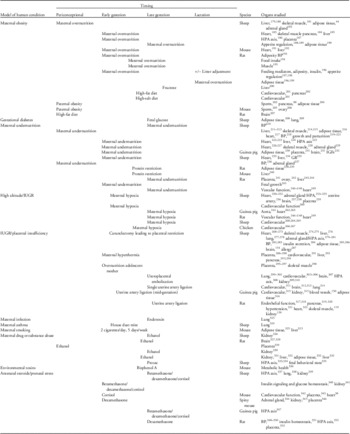
The original premise of fetal programming focused on the consequences of poor maternal nutrition. Thus, early DOHaD research using animals imposed restricted maternal nutrient intake through global nutrient restriction or restriction of protein intake, resulting in intrauterine growth restriction (Table 1). These interventions altered fetal and early postnatal growth, and confirmed maternal diet as an important factor in determining adult health. More recently, as a result of the increasing prevalence of overweight and obese individuals in our population, particularly in women of reproductive age, there have been an increasing number of animal studies of maternal overnutrition and/or obesity before and during pregnancy (Table 1).
Summary of animal models used to understand the impact of maternal health and fetal growth on development and health in adult life

HPA, hypothalamic–pituitary–adrenal; BP, blood pressure; GR, growth hormone.
This is not a comprehensive list of all publications in each model but summarizes the range of models and species used to study Developmental Origins of Health and Disease questions.
Experimental animal studies in DOHaD research have been performed in a range of species (Table 1). The selection of the species used in each study is important because there is significant inter-species variation in the timing of development relative to birth. This is acknowledged by classifying species as precocial, early (human, sheep, guinea pig, spiny mouse) or altricial, later (rats, mice, cats and dogs) developers, which generally refers to the timing of brain development in relation to birth.Reference Dobbing and Sands 5 For example, myelination of central brain regions occurs postnatally in the rat, but begins in late gestation in humans,Reference Ballesteros, Hansen and Soila 6 rabbits,Reference Derrick, Luo and Bregman 7 guinea pigs,Reference Chung, So, Kim, Kim and Jeon 8 spiny miceReference Quinn, Ratnayake, Dickinson, Castillo-Melendez and Walker 9 and sheep.Reference Barlow 10 , Reference Watson, Desesso, Hurtt and Cappon 11 Developmental timing differs even within these broader groupings and choice of an appropriate animal model thus needs to consider the developmental stages for organs and systems of interest during periods of prenatal perturbations and any interventions in the species used.Reference Hunter, Hazel and Kind 12
Species choice
A large range of species have been utilized by researchers in the DOHaD field to model events that may occur during human pregnancy, each of which comes with its own set of advantages and limitations. Recognizing these is critical when considering the most appropriate species to answer a particular research question.
Much of the original experimental DOHaD research was conducted in the sheep. Those studying fetal physiology have long recognized the value of chronically instrumenting the ovine fetus and studying the effects of various perturbations on fetal growth and development in vivo. The sheep has many advantages and greater similarities to the human compared with other animal models; a relatively long gestation (~145–150 days), a single fetus (or twins) of similar size to the human baby, making collection of blood and tissues samples feasible. Large animals, including sheep, cows and pigs, permit evaluation of several outcomes in the same animal in part due to their greater blood volumes and capacity for catheterization and study in the conscious state. Large animal studies also allow correlations between functional and structural/molecular changes, as well as longitudinal studies requiring repeated sampling. However, many of these attributes that make the sheep an excellent model for the human, including for studies across the life span, also present limitations: the long life span requires animals to be kept for a number of years in order to study disease development. This is both costly and extremely time-consuming. Studies examining genes and proteins are more challenging as the knowledge of the genome/transcriptome and available tools, including specific antibodies, are limited. Intervention studies involving injection of compounds may be prohibitively expensive due to the large body mass and the production of a single fetus/offspring requires twice as many dams to be treated to ensure the effects on both male and female progeny can be examined. Placentation in the sheep is dissimilar to the human, being cotylendory. Sheep, being ruminants also limits the relevance of nutritional studies and require careful approaches such as rumen-protected dietary supplements and factoring in ruminal degradation.Reference Sinclair, Allegrucci and Singh 13 Behavioral studies need to consider species-specific behaviors, such as flocking behavior. This tendency for flock animals to behave in a group may dilute effects of exposures or interventions when animals of several groups are housed together.Reference Morton, Rudiger and Wood 14 Species such as sheep are stressed by social isolationReference Hernandez, Matthews, Oliver, Bloomfield and Harding 15 and this needs to be considered in design and evaluation of behavioral tests. Similarly, co-housing within sight of other sheep and acclimatization to single housing are also required to minimize stress during metabolic tests that require individual housing in this species.
The majority of DOHaD research has been conducted in the rat (Table 1). A relatively short gestation (~22 days), and the production of a large litter (8–15 pups depending upon the strain) facilitate study of offspring of both sexes over the life course in rats. Placentation in rodents is similar to the human being discoid and hemochorial, although the human placenta is hemomonchorial and rodent placentae are hemotrichorial. Differences between species in the timing and nature of placental development and function need to be considered in DOHaD research both because the placenta itself responds to and modulates effects of the maternal environment on the fetus,Reference Burton and Fowden 16 and because events earlier in pregnancy may change the fetal environment through altered placental development and subsequent nutrient delivery.Reference Wallace, Regnault, Limesand, Hay and Anthony 17 Use of rats for DOHaD research allows offspring to be bred and effects on subsequent generations examined. The size of the rat permits multiple blood samples to be collected and many gold standard technologies including radiotelemetry for measurement of blood pressureReference Woods 18 and inulin clearance for measurement of glomerular filtration rateReference Gray, Denton, Cullen-McEwen, Bertram and Moritz 19 can be easily performed. Although not readily utilized as yet, recent technological advances allowing genetic manipulation in the rat provides an opportunity for sophisticated mechanistic studies on the function of specific genes during development. Limitations of the rat include the variable number of offspring (see below litter size and postnatal nutrition) altricial mode of development and nocturnal activity patterns. If normal light cycles are maintained in animal houses (lights off during the night), then many experiments are conducted during the day when rats should be sleeping. Disturbing circadian rhythms will alter normal hormonal production and behavioral patterns such as activity,Reference Varcoe, Boden and Voultsios 20 , Reference Barclay, Husse and Bode 21 and as discussed below (‘Tissue collection’), alter expression of genes in various tissues.
Somewhat surprisingly, fewer studies in the DOHaD field have been conducted in the mouse. This may be due to their small size making many of the studies examining physiological outcomes more difficult to perform. The advantage of mice is the ability to perform genetic manipulations including whole animal, organ or even cell-specific knockouts or over-expression of specific gene of interest. For example, tissue-specific knockouts of insulin-like growth factor-2 (IGF-2) have yielded important information about the role of IGF-2 in fetal and placenta growth and placental function.Reference Constancia, Hemberger and Hughes 22 , Reference Sibley, Coan and Ferguson-Smith 23 In addition, the knowledge of the mouse genome and the molecular tools available make it easier to perform genetic and epigenetic studies in inbred mouse strains. In studies examining metabolic outcomes, strain needs to be taken into account as genetic background can influence the metabolic response to interventions such as high-fat feeding.Reference Montgomery, Hallahan and Brown 24
Other species have been less widely used in DOHaD research to date, and often these species have been used to study specific outcomes. Studies in altricial species such as marsupials allow access to offspring at developmental stages equivalent to very early periods of development, and have been utilized in studies of imprinting and sexual differentiation.Reference Stringer, Pask, Shaw and Renfree 25 Guinea pigs are relatively mature at birth and are widely used in neurodevelopmental studies of prenatal stress and preterm birth,Reference Bennett, Palliser, Shaw, Walker and Hirst 26 , Reference Shaw, Palliser, Walker and Hirst 27 and have been used to evaluate the impact of maternal nutrition on metabolic outcomes.Reference Kind, Clifton and Grant 28 Similarities in placentation between guinea pig (hemomonochorial) and human have led to this species being used to evaluate effects of IGFs on placental growth and function and fetal development.Reference Sferruzzi-Perri, Owens, Pringle, Robinson and Roberts 29 – Reference Sferruzzi-Perri, Owens and Standen 31 The spiny mouse, a precocial rodent with a long gestation and small litter size, has been used extensively as a model of birth asphyxia and shown the efficacy of maternal creatine supplementation to improve neonatal outcomes, now being evaluated in human studies.Reference Dickinson, Ellery and Ireland 32 This spiny mouse is a menstruating species,Reference Bellofiore, Ellery and Mamrot 33 providing an opportunity for the study of reproductive consequences particularly in female offspring. Spiny mouse studies have shown sex- and tissue-specific effects of a brief, high maternal glucocorticoid exposure at mid-gestation,Reference Dickinson, Walker, Wintour and Moritz 34 – Reference O’Connell, Moritz, Walker and Dickinson 36 consistent with observations in sheep, rats and mice.Reference Dodic, Abouantoun, O’Connor, Wintour and Moritz 37 – Reference Singh, Moritz, Bertram and Cullen-McEwen 39 Use of primate models is restricted in the field, both by ethical and cost issues, but may be needed in future preclinical studies before progression to human trials. Studies in non-human primates have yielded important insight into the programming impact of maternal high-fat diet consumption on offspring behavior, including anxiety and depressive behaviors, and cognitive development.Reference Rivera, Kievit and Kirigiti 40 Other work has shown increased intake of palatable foods in offspring of mothers consuming high-fat diet, and this was accompanied by suppressed dopamine signaling relative to control offspring.Reference Rivera, Kievit and Kirigiti 40 Such non-human primate studies enable examination of the underlying mechanisms contributing to changes in behavior that are critical to developing therapeutic strategies.
Difference between species in developmental profiles
Development of particular organs varies significantly among species. For many organ systems, development that occurs in utero in more precocious species may occur postnatally in altricial species such as mice and rats. Events during lactation in rodents may therefore occur at equivalent developmental stages to mid–late gestation in human. To discuss the differing developmental profile of all species is beyond the scope of this review; here we provide examples of organs that are known to be vulnerable to altered development at some, but not all stages of their development. For example, the kidney of the human, sheep and spiny mouse all complete the formation of nephrons (nephrogenesis) before birth, but in rats and mice renal development continues for up to a week postpartum.Reference Moritz, Wintour, Black, Bertram and Caruana 41 Pancreatic development differs among species with a wave of remodeling and β-cell apoptosis and switch to glucose-stimulated insulin secretion occurring at 10–17 days of postnatal age in rats, but before birth in sheep and humans.Reference Gatford, Simmons, De Blasio, Robinson and Owens 42 The timing of maturation among species varies between and even within organs; for example, although β-cell development and maturation are at similar stages at birth in sheep and humans, these species differ in rate of brain maturation, with myelination of most structures complete at birth in sheep,Reference Barlow 10 unlike humans where myelination continues postnatally.Reference Paus, Collins and Evans 43
Recommendation: Treatment regimens or interventions should be replicated across a range of species to enable different strategies to be employed to explore common mechanistic pathways, and researchers should explicitly describe the rationale for their choice of species/experimental model. Experimental design needs to account for the timing of development of the particular organs/systems of interest, placental development and function, and account for species-specific environmental requirements and function.
Superovulation, artificial insemination, embryo transfer and paternal influences
An important recent consideration in DOHaD studies is the relative importance of maternal v. paternal influences in affecting the long-term health of the offspring. Similarly, separation of the maternal environment pre-conception v. peri-conceptually has enabled the delineation of effects on the oocyte and fertilization, separately from implantation, placental development and fetal growth.Reference Rattanatray, MacLaughlin and Kleemann 44 , Reference Zhang, Rattanatray and MacLaughlin 45
Embryo transfer
Rodent embryo transfer experiments involve flushed pre-implantation embryos from the oviduct or uterus being cultured for a specified time and then transferred to a recipient pseudopregnant female. These experiments provide an opportunity to delineate between the contribution of the maternal pregnancy environment and germ-line effects on developmental programming of adult-onset disease in offspring.Reference Garg, Thamotharan, Dai, Lee and Devaskar 46 – Reference Tran, Gallo and Hanvey 48 However, various authors have demonstrated that there are long-term effects of in vitro embryo transfer itself that confound results, and are difficult to distinguish unless an appropriate control group is included.Reference Tran, Gallo and Hanvey 48 , Reference Sjoblom, Roberts, Wikland and Robertson 49 As shown previously, in vitro embryo culture and manipulation has the potential to alter early developmental processes during the pre-implantation period that can go on to affect long-term offspring health.Reference Sjoblom, Roberts, Wikland and Robertson 49 , Reference Calle, Fernandez-Gonzalez and Ramos-Ibeas 50 In addition, there is evidence of alterations to mid-gestation placental gene expression and structural correlates of function simply in response to in vitro culture and manipulation of in vivo fertilized blastocysts,Reference Fauque, Ripoche and Tost 51 , Reference Rivera, Stein and Weaver 52 which can vary in severity depending on the media composition. These studies highlight the importance of appropriate in vivo controls, specifically, the inclusion of naturally gestated, non-transferred embryos. It is important to note that studies that include the use of artificial reproductive technologies (ART) (or in vitro fertilisation (IVF)) are performed using a technique that itself can program aspects of offspring health. For example altered glucose metabolism,Reference Chen, Wu and Zhao 53 birth defectsReference Davies, Moore and Willson 54 and an increase in imprinting disorders,Reference Lazaraviciute, Kauser, Bhattacharya, Haggarty and Bhattacharya 55 which occur in both animal models and humans.
Recommendation: When using in vitro technologies, ensure that appropriate naturally conceived, in vivo control groups are included.
Ovarian stimulation v. natural cycles for timed mating
Accurate assessment of the reproductive cycle is critical for timed mating, which is required in programming studies. One way to achieve accurate timing of pregnancies in rodents is to manipulate the ovarian cycle using exogenous gonadotrophins (this process is termed superovulation). Typically, equine chorionic gonadotrophin or pregnant mare serum gonadotrophin is used to promote follicle growth and maturation. This is followed 48 h later by human chorionic gonadotrophin to mimic the surge in luteinizing hormone that induces ovulation. Although this produces a predictable estrous cycle with enhanced mating success, this comes at the expense of oocyte quality.Reference Combelles and Albertini 56 – Reference Van Blerkom and Davis 59 Exposure to supraphysiological levels of hormones may result in a perturbed follicular microenvironment at a time when cytoplasmic maturation and redistribution of organelles in the oocyte is occurring, accompanied by nuclear maturation and resumption of meiosis in readiness for ovulation.Reference Albertini, Sanfins and Combelles 60 Ovarian stimulation may also induce chromosomal abnormalities in zygotes,Reference Elbling and Colot 61 , Reference Vogel and Spielmann 62 delay embryo developmentReference Ertzeid and Storeng 63 , Reference Van der Auwera and D’Hooghe 64 and reduce cell numbers in blastocysts.Reference McKiernan and Bavister 65 Superovulation may also induce oxidative stress, cytoplasmic fragmentation, meiotic spindle damage, abnormal mitochondrial distribution and aggregation of Golgi apparatus (observed in mouse oocytesReference Kalthur, Salian and Nair 57 ), resulting in reduced developmental competence and blastocyst formation. The mechanisms underlying cytoplasmic and chromosomal abnormalities in oocytes from stimulated cycles are poorly understood, but may relate to overriding natural selection of good quality oocytes or direct detrimental effects on oocyte maturation.Reference Santos, Kuijk and Macklon 66 Hyperstimulation causes alterations to the intrauterine environment that are potentially detrimental to the developing humanReference Boomsma, Kavelaars and Eijkemans 67 and rodent fetus.Reference Ertzeid and Storeng 63 , Reference Sibug, Helmerhorst, Tijssen, de Kloet and de Koning 68 , Reference Miller and Armstrong 69 Therefore, use of ovarian stimulation is not recommended for programming studies due to its potential effects on embryo and fetal development, irrespective of experimental maternal perturbations.
Estrous can be determined in naturally cycling animals to enhance timed mating success. The ‘gold standard’ in rodents is the use of vaginal cytology to determine the stage of the estrous cycle. The relative proportions of specific cell types in the vagina change predictably over the estrous cycle. Vaginal cytology has been relied on for decades for accurate assessment of estrous cycle stage and has recently been reviewed, including trouble-shooting advice.Reference Cora, Kooistra and Travlos 70 Recent improvements in technique make it a non-invasive and highly effective method for assessing estrous cycle stage and improving embryo transfer success.Reference Mamrot, Pangestu, Walker, Gardner and Dickinson 71
Electrical impedance measures of the vaginal wall provide a predictable measure of when domestic species and larger rodents such as rats and guinea pigs are in proestrous and thus receptive to mating.Reference Rezac 72 Rats exhibit an increase in electrical impedance, whereas most domestic species show a decrease.Reference Rezac 72 Pairing female rats when vaginal wall impedance is high (>4 kOhm) results in higher rates of mating and pregnancy.Reference Bartos 73 , Reference Jaramillo, Balcazar and Duran 74
Co-housing strategies may be used in rodents to expose females to male pheromones without direct contact.Reference Roulo, Fishburn, Alworth, Hoberman and Smith 75 – Reference Scharmann and Wolff 77 Clear plastic partitions are used to physically separate males from females but still allow pheromones to reach the female. Observing lordosis (a specific curved posture indicating willingness to mate) in the female indicates sexual receptivity. This strategy relies on the ‘Whitten effect’, whereby pheromones in males’ urine stimulate synchronous estrous in females.Reference Gangrade and Dominic 78 , Reference Whitten 79 Another example is exposure of females to male urine via soiled bedding added to their cage.Reference Dalal, Estep, Valentin-Bon and Jerse 80 Thus, there are various methods available for synchronizing estrous, particularly in studies involving rodents, which avoid the reliance on exogenous gonadotropins with known detrimental effects on oocytes and offspring. In sheep, progesterone treatment and withdrawal are used to synchronize follicular development and achieve a known mating date,Reference Iida, Kobayashi, Kohno, Miyamoto and Fukui 81 needed to allow treatment or study at specific gestational ages.
Recommendation: Ensure a consistent approach to determination/induction of estrous is used within the study, is appropriate to the species, and avoid use of exogenous hormonal stimulation where possible.
Paternal influences
The majority of programming studies have focused on maternal factors but paternal traits and exposure to environmental stressors can program embryo and offspring health. Animal experiments have provided critical evidence to show the key determinants of paternal programming are the molecular makeup of sperm and seminal plasma.Reference Schjenken and Robertson 82 , Reference Casas and Vavouri 83
A range of paternal exposures appear to transmit phenotypic traits, via effects on sperm, to offspring. For such transmission to occur, the sperm is presumably altered during spermatogenesis, and the paternal exposure must exert its effect across the blood testis barrier, which normally protects sperm from hormonal fluctuations, nutritional insults and some chemicals. Each sperm has a unique haplotype and therefore may be uniquely affected by environmental exposures. Unlike oocytes (which develop during fetal life and persist for years or decades until conception) sperm develop, mature and die in a short period of time. Thus, paternally mediated effects are likely from events close to the time of conception. Long-lasting programming effects mediated by effects on sperm are yet to be determined.
There are many examples in human and animal studies of paternal traits or environmental exposures programming offspring health. Occupational paternal organic solvent exposure is associated with increased risk of congenital malformations in children.Reference Sung, Wang and Chen 84 Paternal smoking increases the risk of cancer in childrenReference Chang 85 and increases DNA damage.Reference Linschooten, Verhofstad and Gutzkow 86 Children born to obese fathers are at increased risk of becoming obese themselves.Reference Danielzik, Langnase, Mast, Spethmann and Muller 87 Diet-induced paternal obesity in mice initiates defects in glucose metabolism in offspring,Reference Ng, Lin and Laybutt 88 comorbid with obesity and sub-fertility for two generations.Reference Fullston, Ohlsson Teague and Palmer 89 Paternal stress results in offspring with abnormal behavioral and metabolic responses.Reference Gapp, Soldado-Magraner and Alvarez-Sanchez 90 Advanced paternal age is also associated with an increased prevalence of neurological disorders in children.Reference Kong, Frigge and Masson 91 Offspring sired by male mice lacking seminal plasma exhibit metabolic defects in conjunction with obesity.Reference Bromfield, Schjenken and Chin 92
The potential mechanisms involved in paternal transmission from sperm into the embryo include differential DNA methylation changes, oxidative DNA damage, histone modifications (acetylation and methylation of retained histones),Reference Brykczynska, Hisano and Erkek 93 – Reference Jenkins and Carrell 96 altered sperm small non-coding RNA (including microRNAs) contentReference Fullston, Ohlsson Teague and Palmer 89 , Reference Filkowski, Ilnytskyy and Tamminga 97 – Reference Wang, Medvid, Melton, Jaenisch and Blelloch 102 and seminal fluid composition influencing the female reproductive tract before implantation.Reference Bromfield, Schjenken and Chin 92 All of these mechanisms are posited to ultimately impact on the molecular constitution of the developing embryo and induce pathologies in subsequent offspring.
Studying paternal programming using animal models circumvents many of the confounding factors and constraints that can create bias in studies of human cohorts. These include heterogeneous genetic backgrounds, lifestyle behaviors learnt from parents/grandparents (e.g. diet and/or exercise habits), genetic predispositions, protracted generation time and the limited capacity for invasive investigations. However, given that the likely basis for paternal programming is epigenetic, the divergent epigenomes of humans and species used for animal experiments must be considered when translating findings into a human setting. Furthermore, given our new appreciation of the impact of the paternal environment on outcomes, it is important that studies investigating effects of maternal and progeny exposures incorporate a description of the male environment and phenotype.
Recommendations: (1) Designing studies to assess paternal influence on DoHAD. A number of considerations apply when investigating programming effects through the paternal line. In such investigations, clear description of the scope and timing of paternal exposures, and background environment, is required in addition to the mating protocol. The environment of the females needs to be considered as a potential modulator of offspring phenotype, so information on maternal weight, age, diet and housing conditions are helpful inclusions in the methods description of manuscripts. Females should be standardized across paternal treatment groups to minimize potential maternal effects. Consider the possibility of maternal parameters as confounders in analyses and data interpretation. (2) Similarly, the possibility of paternal influences means that when investigating programming effects through the maternal line, the environment of males is a potential modulator of offspring phenotype; include details such as paternal weight, age, diet and housing conditions in the methods description in manuscripts. Do not segregate specific males as studs for single treatment groups but rather pool males and use across treatment groups to minimize potential paternal effects. Consider the possibility of paternal parameters as confounders in analyses and data interpretation.
Early postnatal environment
An optimal early postnatal environment is critical for growth and development. Adequate mammary gland development is necessary for effective nutrient transfer and delivery of calcium via the milk,Reference O’Dowd, Wlodek and Nicholas 103 which influences early postnatal growth via growth factors associated with lactationReference O’Dowd, Wlodek and Nicholas 103 and hormones such as leptin.Reference Briffa, McAinch, Romano, Wlodek and Hryciw 104 ‘Cross-fostering’ and reductions in litter size after birth allow investigation of the role of the early postnatal environment on offspring disease outcomes.
Cross-fostering involves separation of offspring from their biological mothers and rearing by surrogates.Reference Hager, Cheverud and Wolf 105 The timing of separation of the offspring can itself influence outcomes so this must be controlled and considered when interpreting data. To prevent confounding by the stress induced by cross-fostering in studies where some groups change environment/dam at specific developmental stages, it is therefore necessary to cross-foster all groups within a study.Reference Siebel, Gallo, Guan, Owens and Wlodek 106 Inclusion of additional non-fostered groups could also be considered to allow differentiation of the effects of cross-fostering itself.Reference Siebel, Gallo, Guan, Owens and Wlodek 106 Early cross-fostering at postnatal day 1 (PN1) in rats does not alter early growth.Reference Denenberg, Grota and Zarrow 107 , Reference Smith and Waddell 108 Later cross-fostering at PN5 and PN12 does not affect body weightReference Barbazanges, Vallee and Mayo 109 but it alters the locomotor response to novelty and alters spatial recognition at PN5,Reference Barbazanges, Vallee and Mayo 109 and increases corticosterone release in response to restraint stress at PN90. The 2nd postnatal week in rodents is critical for the establishment of appropriate responses to stressful stimuli.Reference Matsumoto, Higuchi and Togashi 110 Thus, although there may be no changes in early growth profiles, cross-fostering >1–2 days after birth may alter neurobiological activity in rodents. Selection of appropriate control groups is critical when designing studies using cross-fostering to avoid these confounding effects.
Cross-fostering allows separation of the effects of the early postnatal environment from the intrauterine environment, and therefore can provide insights into times during which specific exposures are likely to have greatest impact. For example, cross-fostering growth restricted offspring onto control mothers at birth restores offspring body weight and reverses organ deficits in offspring of placentally restricted rat pregnancies.Reference Siebel, Gallo, Guan, Owens and Wlodek 106 , Reference Romano, Wark, Owens and Wlodek 111 , Reference Siebel, Mibus and De Blasio 112 Cross-fostering mice at birth increases offspring body weight, insulin and leptin concentrations, liver triglycerides and markers of liver dysfunction in lean offspring suckling an obese mother.Reference Oben, Mouralidarane and Samuelsson 113
Litter size influences maternal behaviorReference Champagne, Francis, Mar and Meaney 114 as well as lactation performance and, therefore, nutrient transfer to the offspring,Reference Babicky, Ostadalova, Parizek, Kolar and Bibr 115 but early growth responses are variable. In Sprague Dawley rats, reduction in litter size results in an early and rapid postnatal weight gainReference Boubred, Daniel and Buffat 116 and hyperglycemia, as well as an increase in subcutaneous fat and adipocyte area in early postnatal life.Reference Munoz-Valverde, Rodriguez-Rodriguez and Gutierrez-Arzapalo 117 Consequently, this leads to hypertension and glomerulosclerosis in adult males.Reference Boubred, Daniel and Buffat 116 Reducing litter size in Wistar Kyoto rats decreases pup growth by reducing offspring milk intake and reducing mammary parathyroid hormone-related protein.Reference O’Dowd, Wlodek and Nicholas 103 , Reference O’Dowd, Kent, Moseley and Wlodek 118 In adulthood, Wistar Kyoto offspring from ‘reduced’ litters have an increased risk of altered metabolic activity and skeletal muscle mitochondrial biogenesis.Reference Wadley, Siebel and Cooney 119 Critically, the size of the litter is also important, with smaller litters growing faster postnatally due to enhanced nutrition, and larger litters growing slowly due to reduced nutrition.Reference Bai, Campbell, Moore, Morales and Gerdes 120 This can be clearly demonstrated when litter sizes are manipulated on day 1 of life, leading to long-lasting growth and adiposity changes.Reference Velkoska, Cole, Dean, Burrell and Morris 121 Compounding this, offspring gender influences maternal behavior and nutrition so that enhanced care is provided to males.Reference Alleva, Caprioli and Laviola 122 Thus, reduction in litter size has variable effects, which need to be considered when interpreting programming outcomes.
Recommendation: Use cross-fostering if the experimental intervention may continue to impact on maternal health such that postnatal pup growth may be compromised. Where possible, interventions should be applied to the control group and the experimental group and the findings reported for each. The age that pups are cross-fostered should be clearly stated and be consistent within each study. In experiments using reductions in litter size the consequences for neonatal nutrition and growth must be defined and considered.
Environmental enrichment
All studies should include environmental enrichment to provide opportunities for the natural behaviors of the species used in the study. For example, sheep are flock animals and should never be housed in isolation. 123 They should always be in sight of at least one other sheep or they should be able to see their own reflection in a mirror. Rodents feel more comfortable in smaller spaces so small tubes can be put in their cage. Rodents also chew bedding and thus cardboard can be put in the housing to allow them opportunity to chew, as well as to nest with their young. Environmental enrichments are important not only for welfare reasons, but impact on animal behaviors and physiology.Reference Toth 124
Recommendation: Provide species- and treatment-appropriate environmental enrichment and standardize across studies where possible.
Inter-generational studies
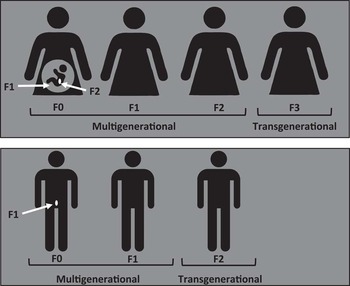
With the acceptance of DOHaD principles, studies designed with maternal or paternal interventions have increasingly focused on the offspring either before or after birth. However, it must be noted that developing oocytes (F2) in a female fetus (F1) are also exposed to the intrauterine environment of her mother (F1) and the nutritional environment of her grandmother (F0; Fig. 1). Ideally therefore, demonstration of inter-generational transmission requires study of the F3 generation in the female line or the F2 generation in the paternal line, which are not exposed to the insult.Reference Skinner 125 Due to the time-consuming nature of such studies, rodents are most often used.Reference Gallo, Tran and Cullen-McEwen 126 , Reference Weyrich, Lenz and Jeschek 127 Nevertheless, studies in sheep have shown inter-generational effects of maternal dexamethasone treatment during gestation (~0.7 of term) on growth, stress axis function, appetite and glucose metabolism of female progeny in both F1 and F2 generations.Reference Long, Shasa, Ford and Nathanielsz 128 – Reference Long, Smith, Ford and Nathanielsz 130
Multigenerational v. transgenerational investigation in Developmental Origins of Health and Disease. For transgenerational inheritance of phenotypes to be established, studies need to extend beyond multigenerational to transgenerational (F3 in maternal exposure and F2 in paternal exposures). This is because developing oocytes (F2) in a female fetus (F1) are also somewhat exposed to the same environment (via intrauterine exposure) as the maternal F0, and the developing sperm (F1) are similarly exposed to the same environment (during spermatogenesis) as the paternal F0.

Recommendation: Consideration of inter-generational/transgenerational effects should be made when interpreting data from DOHaD studies. More studies that include transgenerational investigations are needed to document multigenerational adversity caused by ancestral exposures, thus linking them to inter-generational transmissions.
Biological replicates
A common misconception is that all offspring from a single pregnancy can be considered as independent individuals or to have had similar exposures in utero. In all species there is competition for nutrients and space, and, in multi-conceptus species, this can lead to variability in distribution between fetuses and a range of offspring sizes within a litter. Therefore, it is important to consider multiple phenotypes within a single litter and incorporate this into the experimental design of the study. For example, fetuses at both the high and low extremes of the birth weight spectrum are at increased risk of developing diabetes and obesity, but the selection of the ‘average’ weight of a particular litter, may not capture the extremes of the phenotype. The idea that all rodent pups in one litter are exposed to the same maternal uterine environment and thus are more similar to each other than pups from a different litter, in this aspect, is wrong. Offspring that are an appropriate representative of a given litter should be studied, depending on the sorts of research questions being asked. How ‘representative’ subjects are selected from litters should be disclosed.
In studies where the maternal environment is manipulated the number of dams is the relevant sample size. It is appropriate to use one male and one female pup from each litter at each time point, mindful that the phenotype of individual may vary within a litter as noted above.
The nature of DOHaD effects are inherently small, as large perturbations of metabolism are often lethal. Thus, studies need to be appropriately powered. Power calculations need to be performed to determine the smallest number of dams required to see small effects, this is typically greater than eight for metabolic studies like glucose tolerance and obesity.
Recommendations: The mother represents an n of 1 for treatment; ideally no more than one representative male and female should be used for statistics from each litter in any test at a particular age, unless analyzed appropriately as follows. If multiple offspring from single pregnancies are assessed then their data can be averaged (this average represents a value for that pregnancy) or measures of individual progeny treated as repeated measures on the mother or nest offspring data within a maternal identifier, to account for the shared maternal environment. The phenotype of all offspring in a litter should guide selection of the offspring for phenotypic or detailed molecular analysis, or to be used as the founder of the next generation.
Sex
There is a 5.5:1 male offspring bias within biomedical research studies using animals of a single sex.Reference Beery and Zucker 131 This bias has the potential to mislead. Although it is established that there are differences in the rate of drug metabolism between sexes,Reference Farkas, Unger and Temple 132 studies using only males are justified on the basis that the reproductive cycle may affect physiological measurements in females and result in variation for which it is difficult to control.
A meta-analysis of 293 neuroscience and biomedical articles using mice found that the variability in many traits did not differ between sexes,Reference Prendergast, Onishi and Zucker 133 but in many studies that include males and females, females are often not included in sufficient numbers for statistical analysis. Using appropriate numbers of subjects from each sex to properly address potential sex differences adds cost to experiments. Legislative changes and changes to the standards required by scientific journals and funding bodies are required to address this issue.
There are sex-specific programming effects of various interventions, and sex differences in effects of timing of fetal exposures.Reference Aiken and Ozanne 134 , Reference Dunn, Morgan and Bale 135 As large parts of the placenta develop from the conceptus, its sex corresponds to that of the fetus, and placental development and function, including responses to environmental perturbations, are themselves sexually dimorphic.Reference Clifton 136 Fetal responses to insults differ between sexes, with males experiencing a higher mortality rate than females.Reference Clifton 136 Hormonal differences may underpin a number of the differences between males and females, but almost one-third of actively expressed genes in bovine blastocysts are different between sexes, before individual hormonal differences.Reference Bermejo-Alvarez, Rizos, Rath, Lonergan and Gutierrez-Adan 137 Studying differences in how each sex responds to early life events can provide valuable insight into organogenesis and the origins of non-communicable diseases.
Recommendation: Studies should include outcome measures in female and male offspring and test for both an effect of sex and an interaction between the effects of sex and treatment. Authors of studies investigating outcomes where only one sex is reported or studied in adequate numbers should discuss the potential limitation(s) of their findings as they relate to the study aims.
Fetal sex pairing can affect fetal growth and several early postnatal health indicators, indicating that twins from mixed-sex pairs are healthier in early life than twins from same-sex pairs.Reference Mulla, Plavsic, Ortiz, Nuwayhid and Ananth 138 Freemartin cattle demonstrate the extent to which different sexed fetuses can affect littermates. Freemartinism inhibits reproductive development in opposite-sexed fetuses with fused chorionsReference Jost, Vigier and Prepin 139 and subsequent hormonal transfer between fetuses. This condition causes sterility in females and occurs in several mammals.
Intrauterine positioning of fetuses in litter-bearing animals may affect fetal levels of circulating testosterone and estradiol, via diffusion through amniotic fluid or the maternal bloodstream, depending on the species.Reference Ryan and Vandenbergh 140 This means that within the same sex, littermates will have different exposure to steroid hormones, and therefore variability in programming of sex-related traits in response to treatments or stress. Numerous physiological traits, such as timing of puberty onset in mice, are sensitive to intrauterine positioning; female mice generally appear to be more sensitive to these than males.Reference Ryan and Vandenbergh 140
Recommendation: Consider possible hormonal variation and subsequent variation in sex-related traits due to fetal sex within multiple-birth pregnancies or as a result of individual intrauterine positioning of the fetus when interpreting data from litter-bearing animals.
Inbred/outbred strains and alloantigens
Immune cells and their soluble regulatory factors are important elements of the maternal environment at conception and throughout gestation and birth. Perturbation of immune function resulting from either maternal or paternal contributions can impact on pre-implantation embryo programming, fetal and placental development, timing of birth and later susceptibility to disease in offspring.Reference Bromfield, Schjenken and Chin 92 , Reference Madeja, Yadi and Apps 141 Difference or similarity in major histocompatibility complex (MHC) genes between the paternal and maternal genomes plays a critical role in this process. MHC disparity (so-called ‘allogeneic’ pairing) is linked with improved pregnancy success in mice and humans.Reference Madeja, Yadi and Apps 141 , Reference Ober, Hyslop, Elias, Weitkamp and Hauck 142 This is largely due to the more robust response in the adaptive immune compartment that occurs with MHC disparity, but is limited when MHC is shared between parents (so-called ‘syngeneic’ mating). The adaptive immune response is the source of the regulatory T cells (Treg cells) required for generation of the tolerogenic immune environment required for optimally healthy pregnancy outcome.Reference Robertson 143 Treg cells have anti-inflammatory properties and promote adaptation in the maternal vasculature and robust placental development.Reference Woidacki, Meyer and Schumacher 144 Given the evidence demonstrating natural preference for MHC dissimilar partners in humans,Reference Wedekind, Seebeck, Bettens and Paepke 145 it seems prudent that animal models of DOHaD should consider MHC haplotype and preferably employ allogeneic pairings, or possibly outbred pairings when inbred lines are not accessible, to mimic the physiological situation in humans. Outbred pairings are also a means to mimic natural outbred populations (such as human) and to promote MHC diversity between male and female parents. This reduces the chance of strain-specific effects that can occur in inbred mouse strains, but comes at the cost of greater biological variability between individuals within treatment groups that can require larger data sets to achieve appropriate power for statistical analysis.
Recommendation: Consider MHC haplotype and employ allogenic or outbred pairings when possible, particularly when immune mechanisms or outcomes are relevant.
Tissue collection
Timing
Accurate characterization of the programmed phenotype is critically dependent on the timing of measurement. Although this is generally well recognized from the perspective of long-term development (i.e. various aspects of the programmed phenotype emerge or change with age), for most physiological endpoints the time of day is also critical. Circadian variation is intrinsic to most physiological processes, and programmed outcomes may be missed if this variation is not considered.
Circadian variation is driven by a central clock located in the suprachiasmatic nucleus (SCN). Here, a set of core clock genes form transcriptional–translational feedback loops to drive circadian rhythmicity in their own expression. This SCN clock is entrained by environmental cues, particularly photoperiod, and coordinates function of peripheral tissue clocks including those in metabolic tissues such as the liver and adipose tissue. SCN and peripheral clock gene networks influence downstream gene expression and associated physiological functions.
Time-of-day variation is best accounted for by the use of automated, continuous measurement of physiological endpoints, such as telemetric recording of heart rate and blood pressure. This approach was used to identify programmed changes in the circadian variation of cardiovascular function due to fetal glucocorticoid excessReference O’Regan, Kenyon, Seckl and Holmes 146 or a maternal low-protein diet,Reference Bol, Desjardins, Reusens, Balligand and Remacle 147 and in these examples the severity of the programmed phenotype was time-of-day dependent.
Circadian variation in circulating hormone or metabolite levels is best detected by repeated blood sampling, as this can identify within-animal circadian rhythms. Circadian variation in other endpoints, such as gene expression in specific tissues, can generally only be assessed by cross-sectional data obtained from individuals at multiple time-points across the day. This is particularly so in rodents and other small species, whereas in larger animals (e.g. sheep) in which repeated biopsies are possible, analyses can be made longitudinally.Reference Varcoe, Gatford and Voultsios 148 In cases where actual rhythm characteristics are of interest, tissue collections should be made at four, or preferably six, time-points across a 24-h period. This provides sufficient power to conduct cosinor regression analyses and thereby generate key characteristics of the circadian profile, including mesor, amplitude and acrophase (i.e. time of peak expression).Reference Orozco-Solis, Matos and Lopes de Souza 149 If circadian collections are not a focus of the experiment, sample collection should ideally occur at a consistent time of day to minimize variability in experimental endpoints, particularly if the circadian status of the target has not been determined.
Recommendation: Age and time of day that tissue or blood samples are collected should be considered and consistent within a study.
Collection protocols to maximize endpoint analyses
Programming studies in animals often require a substantial investment of resources to establish and maintain pregnancies (usually with interventions) and maintain the progeny to adulthood. The experimental design may also include a ‘second-hit’ intervention in postnatal life (e.g. provision of an obesogenic dietReference Thompson, Sarr, Piorkowska, Gros and Regnault 150 ) to uncover an otherwise latent aspect of the programmed phenotype. The final experimental endpoints may often represent a relatively small part of total resource investment (e.g. measurement of hormone levels or specific gene expression in a particular tissue). In this circumstance, there may be value in exploring additional lines of investigation to enhance the value of a cohort, including experimental endpoints that were not primary objectives in the original study design. To maximize such opportunities it is crucial that suitably archived blood and tissue samples are available: to this end careful attention to collection protocols is crucial. Accordingly, it is recommended that investigators consider the following conditions for storage of material.
Tissues
Snap-freezing in liquid nitrogen and subsequent storage at −80°C provides the greatest protection of samples and flexibility for future use of multiple techniques (e.g. quantitative Polymerase Chain Reaction (qPCR), Western Blot, enzymatic assay). This protection can be enhanced by addition of reagents which stabilize RNA within the sample.
When cellular morphology needs to be preserved for immunohistochemical analysis or in situ hybridization, slower freezing of tissue is beneficial to prevent formation of ice crystals within the tissue. This can be achieved through placement of the sample on foil resting on crushed dry ice (solid CO2) or immersion in isopentane on dry ice. Other approaches include immersion fixation of the sample before storage to maintain intracellular localization of antigens.
The choice of analysis techniques will influence fixative selection, as each fixative will preserve different aspects of the original tissue. Fixatives can be categorized as either denaturing or cross-linking. Denaturing fixatives (e.g. ethanol) cause denaturation of proteins and lead to cell shrinkage.Reference Howat and Wilson 151 In contrast, cross-linking fixatives (e.g. neutral buffered formalin and paraformaldehyde) form cross-links within and between proteins and thus prevent shrinkage.Reference Suvarna, Layton and Bancroft 152
Blood
Whole blood preparations are typically not stored, but rather separated into various fractions for storage at −20 or −80°C. Plasma, red blood cells and buffy coat (white blood cells and platelets) can be prepared using simple centrifugation. Serum (plasma minus clotting factors) can be isolated after allowing whole blood to clot.
Recommendation: DOHaD studies should include collection and appropriate storage of samples of all major organs rather than just the organ of interest to the particular study.
Long-term studies and stress
Long-term studies
Experiments to determine effects of perinatal exposures on offspring have specific design requirements. One of the major challenges relates to the long-term nature of these studies, particularly those conducted in large animals and/or across multiple generations. These studies require researchers to generate and/or compare animal cohorts over extended periods, which can potentially cause variability in experimental endpoints and reduce reproducibility of programmed phenotypes. In addition, many perinatal exposures, such as maternal undernutrition and excess fetal glucocorticoid exposure, affect stress responsiveness of the offspring. Thus, it is critical to control and minimize exposure of offspring to stressful stimuli, to allow clear delineation between prenatal and postnatal influences on outcomes of interest.
Generation of an animal cohort may be carried out over months or years,Reference Hernandez, Harding and Oliver 153 , Reference Hunter, Hazel and Kind 154 particularly in experiments in large animals where logistical issues limit the numbers of intensive in vivo studies that can be performed concurrently and reliably in progeny. Such experiments may not occur in tightly controlled animal facilities (e.g. temperature and pasture availability in outdoor paddocks may differ in the same season across years). Therefore, the test environment needs to be kept as consistent as possible throughout generation and study of the cohort. Seasonal variation in environment, which might affect outcomes such as growth, needs to be minimized and controlled for in the analysis and interpretation of the results.
Certain environmental factors can be controlled (e.g. providing access to a consistent type/amount of feed) but even when feed is provided animals housed outdoors may still prefer to graze on available seasonal pastures, leading to variation in diet composition and energy intake. Careful consideration should be given to the volume and nutritional content of feeds provided to parents and their progeny: inadequate nutrition will restrict growth, whereas overnutrition may lead to obesity. Some prenatal exposures, including intra uterine growth restriction (IUGR) induced by maternal undernutrition, alter appetite regulation and the propensity for fat storage in progeny, thus making animals more susceptible to hyperphagia and/or weight gain following exposure to a palatable or overabundant food supply.Reference Vickers, Breier, Cutfield, Hofman and Gluckman 155 Food preference in progeny is also altered by nutritional exposures experienced during the perinatal period.Reference Gugusheff, Ong and Muhlhausler 156 Opportunities to over-eat or choose diets of differing composition therefore need to be considered as potential confounders in experimental design.
Other factors that can impact on outcomes, including maternal and paternal age and genotype, should be kept constant where possible. Maternal and paternal exposures can interact to drive outcomes in progeny; for example, maternal and paternal obesity in mice have additive effects on embryonic and fetal development.Reference McPherson, Bell and Zander-Fox 157 To minimize confounding by environmental variation, control and treatment groups (including intervention arms) should be run concurrently so environmental conditions are as consistent as possible between treatment groups and across time.
Recommendation: Ensure that studies run across years or seasons include control and treatment animals in each batch and test for batch effects.
Consistency
Postnatal environments have the potential to amplify or attenuate programming effects of earlier exposures and must be designed according to the aims of the experiment. A ‘second hit’, such as an obesogenic diet, may be desirable in some experimental models to expose latent metabolic defects in progeny.Reference Wallace, Milne, Adam and Aitken 158 Conversely, postnatal diet may also ‘rescue’ programmed phenotypes. For example, provision of a postnatal diet high in omega-3 fatty acids completely prevented adult offspring hypertension and hyperlipidemia otherwise programmed by maternal dexamethasone treatment in rat pregnancy.Reference Wyrwoll, Mark, Mori, Puddey and Waddell 159 This effect of omega-3 fatty acids reinforces the importance of consistent dietary approaches in animals (the original observation was made ‘serendipitously’ following an alteration in the dietary composition of standard rat chow by the manufacturer).
A further issue that needs to be considered in testing progeny is the need for consistency in the order and timing of tests. This is particularly important in behavioral testing, where animals with prior experience in a task have different outcomes than naïve counterparts. For example, young adult sheep previously exposed to a sequence of maze learning, memory and reversal tasks performed better than naïve animals of the same age.Reference Hunter, Hazel and Kind 160 This long-term memory means that, at least in sheep, separate experimental groups are necessary to compare behavioral outcomes between different ages, so that animals at both ages are naïve. Where this is not possible, tests need to be performed in a consistent order so that all groups have similar prior experience. Similarly, rodents require consistent order of tests (preferably from least to most stressful). It is critical to ensure that ambient conditions are consistent between experiments; especially lighting levels, which are particularly important for consistent engagement in behavioral tests.Reference Bouwknecht, Spiga and Staub 161 Similarly, metabolic tests need to be carried out in a consistent order (and with consistent temporal spacing) so that any ‘carry over’ effects are consistent between groups. Glucose tolerance improves when the same glucose load is administered repeatedly (the Staub-Traugott effect): in humans this reflects increased insulin secretion at the same glucose load (glucose potentiation) and greater suppression of endogenous glucose production after subsequent glucose challenges compared with the initial glucose bolus.Reference Bonuccelli, Muscelli and Gastaldelli 162
Recommendation: Timing and order of different tests across the experimental period should be consistent and should be scheduled to minimize any potential carry over effects of prior challenges.
Stress
Control and minimization of stress is a particularly pertinent issue in the DOHaD field because most known programming insults affect basal or stimulated hypothalamic–pituitary–adrenal function in the progeny. This is true of in utero exposure to elevated natural or synthetic glucocorticoids,Reference Long, Ford and Nathanielsz 129 , Reference Banjanin, Kapoor and Matthews 163 – Reference Waddell, Bollen, Wyrwoll, Mori and Mark 166 maternal undernutrition in earlyReference Poore, Boullin and Cleal 167 or late gestationReference Bloomfield, Oliver and Giannoulias 168 and variation in litter size.Reference Bloomfield, Oliver and Harding 169 Many programmed outcomes, including hypertension,Reference Esler, Eikelis and Schlaich 170 metabolic functionReference Nowotny, Cavka and Herder 171 and behavioral measures,Reference Schilling, Kolsch and Larra 172 are impaired in stressed states characterized by elevated endogenous circulating glucocorticoids.
Appropriate recovery times after procedures such as surgery and transport need to be incorporated into test schedules, to minimize effects of these stressors on subsequent outcomes. For example, glucose tolerance is impaired during pentobarbitone anesthesia in mice: although transient changes in insulin and glucagon seen during anesthesia normalize within 4 h after consciousness is regained, glucose tolerance still differs from controls and is actually improved at 4 h post anesthesia.Reference Bailey and Flatt 173 In large animals such as sheep, at least 24 h and up to 72+ h of recovery should be allowed after catheterization surgery under general anesthetic. This recovery allows for normalization of feed intake, before measurement of cardiovascular or metabolic outcomes.Reference Liu, Schultz and De Blasio 174 – Reference Owens, Thavaneswaran and De Blasio 176 Unless stress is minimized during experiments, including careful attention to habituation, appropriate pain relief following surgery and consideration of species-specific stressors, it will be impossible to determine whether effects of prenatal exposures and interventions are due to direct effects of the exposure on the outcome, or are indirect via altered stress axis responsiveness. As stress during pregnancy in the rodent is a known programming insult,Reference Brunton, Sullivan and Kerrigan 177 , Reference Smith, Seckl, Evans, Costall and Smythe 178 minimal cage changes and consistency in handling approaches should occur during the pregnancy.
Recommendation: Allow sufficient periods of time for recovery between interventions, acclimatization to new environments or diets, and habituation to tests. Manuscript methods should include details of recovery times, duration or any fasting before specimen collections or challenges, and acclimatization periods.
Overall Recommendation: Suggested strategies to improve consistency and reliability of findings in animal models of DOHaD therefore include maximizing consistency of the environment, including concurrent control groups within a cohort, using consistent protocols and order of protocols between and within cohorts where possible, minimizing confounders such as stress.
Conclusions and Overall Recommendations
In addition to the technical recommendations included throughout the body of this review, we suggest that a shift in the overall approach to DOHaD research should be embraced. In a time of reduced investment in basic research and a focus on translation to improving human health, our field will benefit from expanding collaborative networks to provide access to existing animal preparations, tissue banks and experimental data. One outcome of this approach would be a reduction in replication of animal preparations, allowing a focus on establishing national and global pipelines of discovery science models that include assessments of preclinical safety and efficacy. This will be enhanced by researchers establishing animal tissue/blood banks with an associated data repository that include regularly reviewed and updated protocols for all aspects of experimental design and data collection. It is our view that such a shift will promote a balance between ensuring robust study design, cost and feasibility of performing DOHaD research and delivering proven effective interventions to mothers that will improve short- and long-term health of their children for generations to come.
Financial Support
H.D., J.L.M., B.S.M., T.J.M., T.F., K.M.M. are funded by fellowships from the National Health and Medical Research Council of Australia. A.W. is supported by an Australian Postgraduate Award from the Australian Government and a Healthy Development Adelaide scholarship.