












1. Introduction
Throughout this paper, we assume that  $q$ is a complex number satisfying
 $|q| \lt 1$ and adopt the following customary notation:
 \begin{align*}
(a;q)_\infty &:=\prod_{j=0}^\infty(1-aq^j),\\
(a_1,a_2,\ldots,a_m;q)_\infty &:=(a_1;q)_\infty(a_2;q)_\infty\cdots(a_m;q)_\infty.
\end{align*}
For notational convenience, we write
 \begin{align*}
E(q)=(q;q)_\infty.
\end{align*}
Let  $r_s(n)$ denote the number of representations of a nonnegative integer
 $n$ as a sum of
 $s$ squares, that is, the number of integer solutions to
 \begin{align*}
n=x_1^2+x_2^2+\cdots+x_s^2.
\end{align*}
It is well known that the generating function of  $r_s(n)$ is given by
 \begin{align*}
\sum_{n=0}^\infty r_s(n)q^n=\Bigg(\sum_{n=-\infty}^\infty q^{n^2}\Bigg)^s
=\dfrac{E(q^2)^{5s}}{E(q)^sE(q^4)^s},
\end{align*}
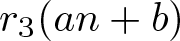
where the final identity follows from [Reference Andrews and Berndt1, p. 11, Eq. (1.1.6)]. Classical results of Hurwitz [Reference Hurwitz11] exhibit a remarkable phenomenon: in eleven cases, the generating function of  $r_3(an+b)$ reduces to a simple infinite product. For example,
 \begin{equation}
\sum_{n=0}^\infty r_3(4n+2)q^n=12\dfrac{E(q^2)^3E(q^4)^2}{E(q)^2}.
\end{equation}
Such identities provide early examples of unexpected product structures in arithmetic progressions.
To place these results in a modular framework, we recall the Dedekind eta function, defined by
 \begin{align*}
\eta(\tau)=q^{1/24}E(q),\qquad\textrm{where}\;\;q=\exp(2\pi i\tau),\;\;\textrm{Im}\;
\tau \gt 0.
\end{align*}
For a positive integer  $\delta$ and a residue class
 $g\pmod{\delta}$, the generalized Dedekind eta-function
 $\eta_{\delta,g}(\tau)$ is defined as
 \begin{align*}
\eta_{\delta,g}(\tau)=q^{\frac{\delta}{2}P_2{\left(\frac{g}{\delta}\right)}}
\prod_{\substack{n \gt 0\\ n\equiv\pm g\pmod{\delta}}}(1-q^n),
\end{align*}
where
 \begin{align*}
P_2(t)=\{t\}^2-\{t\}+\dfrac{1}{6}
\end{align*}
is the second Bernoulli function and  $\{t\}$ denotes the fractional part of
 $t$; see, for example, [Reference Robins13]. It follows that
 \begin{align*}
\eta_{\delta,0}(\tau)=\eta^2(\delta\tau)\qquad\textrm{and}\qquad
\eta_{\delta,\frac{\delta}{2}}(\tau)=\dfrac{\eta^2\big(\frac{\delta}{2}\tau\big)}
{\eta^2(\delta\tau)}.
\end{align*}
A generalized eta-quotient is a function of the form
 \begin{equation}
\prod_{\substack{\delta\mid M\\ 0\leq g \lt \delta}}\eta_{\delta,g}^{r_{\delta,g}}
(\tau),
\end{equation}
where  $M\geq1$ and the exponents
 $r_{\delta,g}$ satisfy
 \begin{align*}
r_{\delta,g}\in\begin{cases}
\frac{1}{2}\mathbb{Z} &\quad\textrm{if}\;\;g=0\;\;\textrm{or}\;\;
g=\frac{\delta}{2},\\[3pt]
\mathbb{Z} &\quad\textrm{otherwise}.
\end{cases}
\end{align*}
We note first that, when a generalized eta-quotient is expanded as a  $q$-series, the resulting exponents of
 $q$ need not be nonnegative integers. To normalize such expansions, we incorporate an appropriate factor of the form
 $q^{\epsilon_{\delta,g}}$ in (1.2). With this convention, (1.1) may be rewritten in the form
 \begin{align*}
\sum_{n=0}^\infty r_3(4n+2)q^n=12q^{-1/2}\dfrac{\eta^3(2\tau)\eta^2(4\tau)}
{\eta^2(\tau)}.
\end{align*}
For a fixed positive integer  $s$, if the generating function
 $\sum_{n=0}^\infty r_s(an+b)q^n$ can be expressed as a product of a factor
 $q^{\epsilon_{\delta,g}}$ and a generalized eta-quotient, where
 $a\geq2$ and
 $0\leq b \lt a$, then we refer to such a representation as a Hurwitz-type identity. Clearly, (1.1) provides a prototypical example.
Subsequent developments have revealed that such identities occur in remarkable abundance. In 2001, Hirschhorn and McGowan [Reference Hirschhorn, McGowan, Garvan and Ismail8] established sixty Hurwitz-type identities for  $r_2(n)$ and
 $r_4(n)$. Later, Cooper and Hirschhorn [Reference Cooper and Hirschhorn4] not only reproved Hurwitz’s original eleven identities, but also discovered twelve new ones and, more significantly, identified eighty infinite families of Hurwitz-type identities satisfied by
 $r_3(n)$. For instance, they [Reference Cooper and Hirschhorn4] proved that for any
 $k\geq0$,
 \begin{align}
\!\!\!\!\!\!\!\!\!\!\!\!\!\!\!\!\!\!\!\!\!\!\!\!\!\!\!\! \sum_{n=0}^\infty r_3\big(3^{2k}(3n+2)\big)q^n =4\times3^{k+1}
\dfrac{E(q^2)^4E(q^6)^3}{E(q)^2E(q^4)^2},
\end{align}
 \begin{align}
\sum_{n=0}^\infty r_3\big(3^{2k+1}(12n+11)\big)q^n =24\big(3^{k+1}-1\big)
\dfrac{E(q^4)^2}{E(q^2)}(-q,-q^5,q^6;q^6)_\infty^2.
\end{align}
The proofs of (1.3) and (1.4) rely on a pair of more fundamental identities, namely, for any  $k\geq0$,
 \begin{align}
\sum_{n=0}^\infty r_3\big(3^{2k}n\big)q^n &=\dfrac{1}{2}\big(3^{k+1}-1\big)
\dfrac{E(q^2)^{15}}{E(q)^6E(q^4)^6}\qquad\nonumber\\
&\qquad\qquad\qquad-\dfrac{1}{2}\big(3^{k+1}-3\big)\dfrac{E(q)^2E(q^4)^2E(q^6)^{20}}
{E(q^2)^5E(q^3)^8E(q^{12})^8},
\end{align}
 \begin{align}\sum_{n=0}^\infty r_3\big(3^{2k+1}n\big)q^n &=\dfrac{1}{2}\big(3^{k+1}-1\big)
\dfrac{E(q^2)^{20}E(q^3)^2E(q^{12})^2}{E(q)^8E(q^4)^8E(q^6)^5}\qquad\qquad\qquad\,\,\,\,\,\nonumber\\
&\qquad\qquad\qquad-\dfrac{1}{2}\big(3^{k+1}-3\big)\dfrac{E(q^6)^{15}}
{E(q^3)^6E(q^{12})^6}.
\end{align}
Analogous formulas hold for  $\sum_{n=0}^\infty r_3\big(5^{2k}n\big)q^n$ and
 $\sum_{n=0}^\infty r_3\big(5^{2k+1}n\big)q^n$; see [Reference Cooper and Hirschhorn4, Eqs. (5.1) and (5.2)].
These examples suggest a broader structural principle. To formalize this, let  $\{f(n)\}_{n\geq0}$ be an integer sequence. If the generating functions
 $\sum_{n=0}^\infty f\big(p^{mk+c}n+\delta_k\big)q^n$ can be expressed as the product of a factor
 $q^{\epsilon_{\delta,g}}$ and a linear combination of generalized eta-quotients, where
 $p$ is prime,
 $m\geq1$,
 $0\leq c \lt m$,
 $k\geq0$, and
 $\delta_k$ is a constant depending on
 $k$, then we call such representations Cooper–Hirschhorn type identity. This concept naturally extends the notion of a Hurwitz-type identity. Within this framework, Barrucand, Cooper, and Hirschhorn [Reference Barrucand, Cooper and Hirschhorn2] established numerous infinite families of Hurwitz-type identities for
 $r_s(n)$ with
 $s\in\{5,6,7\}$, relying crucially on identities of Cooper–Hirschhorn type. For example, they [Reference Barrucand, Cooper and Hirschhorn2, p. 359] proved that for any
 $k\geq0$,
 \begin{align}
\,\,\,\,\,\,\,\,\,\,\,\,\,\,\, \sum_{n=0}^\infty r_5\big(3^{2k}n\big)q^n &=\dfrac{1}{13}\big(5\times3^{3k+1}-2\big)
\dfrac{E(q^2)^{25}}{E(q)^{10}E(q^4)^{10}}\nonumber\\
&\qquad\qquad-\dfrac{15}{13}\big(3^{3k}-1\big)\dfrac{E(q^2)^5E(q^6)^{20}}
{E(q)^2E(q^3)^8E(q^4)^2E(q^{12})^8},
\end{align}
 \begin{align}\!\!\!\!\!\!\!\!\!\!\!\! \sum_{n=0}^\infty r_5\big(3^{2k+1}n\big)q^n &=\dfrac{5}{13}\big(3^{3k+3}-1\big)\dfrac{E(q^2)^{20}E(q^6)^5}{E(q)^8E(q^3)^2E(q^4)^8E(q^{12})^2}\nonumber\\
&\qquad\qquad-\dfrac{1}{13}\big(5\times3^{3k+3}-18\big)
\dfrac{E(q^6)^{25}}{E(q^3)^{10}E(q^{12})^{10}}.\end{align}
Parallel identities for  $r_7(n)$ are given in [Reference Barrucand, Cooper and Hirschhorn2, p. 364].
Inspired by these developments, a natural question arises: is this phenomenon isolated, or do similar identities occur more generally? In this paper, we address this question by establishing a broad collection of Cooper–Hirschhorn type identities for  $r_s(n)$ with
 $3\leq s\leq100$ using
 $q$-series methods. To streamline the exposition, we introduce the following notation:
 \begin{align}
\!\!\!\!\!\!\!\!\!\!\!\!\! \lambda =\dfrac{\eta^5(2\tau)}{\eta^2(\tau)\eta^2(4\tau)}
=\dfrac{E(q^2)^5}{E(q)^2E(q^4)^2}=\varphi(q),
\end{align}
 \begin{equation}
\mu =\dfrac{\eta^5(6\tau)}{\eta^2(3\tau)\eta^2(12\tau)}
=\dfrac{E(q^6)^5}{E(q^3)^2E(q^{12})^2}=\varphi(q^3),
\end{equation}
and
 \begin{equation}
\vartheta =\dfrac{\eta^6(2\tau)\eta^9(3\tau)\eta^9(12\tau)}{\eta^3(\tau)
\eta^3(4\tau)\eta^{18}(6\tau)}=q\dfrac{E(q^2)^6E(q^3)^9E(q^{12})^9}
{E(q)^3E(q^4)^3E(q^6)^{18}}.
\end{equation}
Theorem 1.1. For any  $k\geq0$ and
 $2\leq t\leq50$, the following identities hold:
(i)
(1.12) \begin{align}
\sum_{n=0}^\infty r_{2t-1}\big(3^{2k+1}n\big)q^n
&=\lambda^{-4\lfloor(t-1)/4\rfloor}\mu^{2t-1+4\lfloor(t-1)/4\rfloor}\nonumber\\
&\qquad\qquad\qquad\qquad\,\times\sum_{i=0}^{N_{2t-1}}g_{2t-1,2k+1,i}\,
\vartheta^i,
\end{align}(1.13)\begin{align}
\sum_{n=0}^\infty r_{2t-1}\big(3^{2k+2}n\big)q^n
&=\lambda^{-4\lfloor(t-1)/4\rfloor+\epsilon_{2t-1}}
\mu^{2t-1+4\lfloor(t-1)/4\rfloor-\epsilon_{2t-1}}\nonumber\\
&\qquad\qquad\qquad\qquad\,\times\sum_{i=0}^{N_{2t-1}}g_{2t-1,2k+2,i}\,
\vartheta^i,
\end{align}
where
and the coefficients
\begin{align*}
\epsilon_{2t-1} &=\begin{cases}
-1 &\quad\textrm{if}\;\;t\equiv0\pmod{2},\\[3pt]
\;1 &\quad\textrm{if}\;\;t\equiv1\pmod{2},
\end{cases}\\
\qquad N_{2t-1} &=\begin{cases}
\dfrac{2t-3-(-1)^{t/2}}{2} &\quad\textrm{if}\;\;t\equiv0\pmod{2},\\[15pt]
\dfrac{t-1}{2}+2\left\lfloor\dfrac{t-1}{4}\right\rfloor &\quad\textrm{if}\;\;
t\equiv1\pmod{2},
\end{cases}
\end{align*}
$g_{2t-1,k+1,i}$ are integers.(ii)
(1.14)\begin{equation}
\!\!\!\!\!\!\!\!\!\!\!\!\!\!\!\!\!\!\!\!\!\!\!\!\!\!\!\!\!\!\!\!\!\! \sum_{n=0}^\infty r_{2t}\big(3^{2k+1}n\big)q^n =\lambda^{-4\lfloor(t-1)/4\rfloor}
\mu^{2t+4\lfloor(t-1)/4\rfloor}\sum_{i=0}^{N_{2t}}g_{2t,2k+1,i}\,\vartheta^i,
\end{equation}(1.15)\begin{equation}
\sum_{n=0}^\infty r_{2t}\big(3^{2k+2}n\big)q^n
=\lambda^{-4\lfloor(t-1)/4\rfloor+\epsilon_{2t}}\mu^{2t+4\lfloor(t-1)/4\rfloor
-\epsilon_{2t}}\sum_{i=0}^{N_{2t}}g_{2t,2k+2,i}\,\vartheta^i,
\end{equation}where
\begin{align*}
\epsilon_{2t} &=\begin{cases}
\;0 &\quad\textrm{if}\;\;t\equiv0\pmod{2},\\[3pt]
\;2 &\quad\textrm{if}\;\;t\equiv1\pmod{4},\\[3pt]
-2 &\quad\textrm{if}\;\;t\equiv3\pmod{4},
\end{cases}
\end{align*}
\begin{align*}
\qquad N_{2t} &=\begin{cases}
\dfrac{2t-3-(-1)^{t/2}}{2} &\quad\textrm{if}\;\;t\equiv0\pmod{2},\\[15pt]
\;t-1 &\quad\textrm{if}\;\;t\equiv1\pmod{2},
\end{cases}
\end{align*}and the coefficients
$g_{2t,k+1,i}$ are integers.


Remark 1.2. Theorem 1.1 recovers, as special cases, several previously known identities. Indeed, combining (1.5)–(1.8) with (3.2), one obtains that for any  $k\geq0$,
 \begin{equation}
\!\!\!\!\!\!\!\!\!\! \sum_{n=0}^\infty r_3\big(3^{2k+1}n\big)q^n
=\mu^3\left\{1+4\big(3^{k+1}-1\big)\vartheta\right\},
\end{equation}
 \begin{equation}
\sum_{n=0}^\infty r_3\big(3^{2k+2}n\big)q^n =\lambda^{-1}\mu^4
\left\{1+4\big(3^{k+2}-1\big)\vartheta\right\},
\end{equation}
 \begin{equation}
\! \sum_{n=0}^\infty r_5\big(3^{2k+1}n\big)q^n =\mu^5\left\{1+\dfrac{40}{13}
\big(3^{3k+3}-1\big)\vartheta\right\},
\end{equation}
 \begin{equation}
\,\,\,\,\,\,\,\,\,\,\,\, \sum_{n=0}^\infty r_5\big(3^{2k+2}n\big)q^n =\lambda\mu^4\left\{1+\dfrac{8}{13}
\big(5\times3^{3k+4}-2\big)\vartheta\right\}.
\end{equation}
Moreover, substituting (3.2) into the identities labeled  $(\alpha)$ and
 $(\beta)$ in [Reference Barrucand, Cooper and Hirschhorn2, p. 364], we deduce that for any
 $k\geq0$,
 \begin{align}
\!\!\!\!\!\!\!\! \sum_{n=0}^\infty r_7\big(3^{2k+1}n\big)q^n =\mu^7\left\{1+\dfrac{140}{121}
\big(3^{5k+5}-1\big)\vartheta+\dfrac{224}{121}\big(3^{5k+5}-1\big)\vartheta^2\right\},
\end{align}
 \begin{equation}
\sum_{n=0}^\infty r_7\big(3^{2k+1}n\big)q^n =\mu^7\left\{1+\dfrac{4}{121}
\big(49\times3^{5k+7}+43\big)\vartheta+\dfrac{64}{121}\big(14\times3^{5k+7}-5\big)
\vartheta^2\right\}.
\end{equation}
These examples illustrate that Theorem 1.1 provides a unified framework encompassing the previously known cases  $s=3,5,7$.
Conjecture 1.3. The identities (1.12)–(1.15) hold for any  $k\geq0$ and
 $t\geq2$. Furthermore, it appears that the coefficient sequences
 $\{g_{2t-1,k+1,i}\}_{k\geq0}$ and
 $\{g_{2t,k+1,i}\}_{k\geq0}$ are comprised entirely of nonnegative integers.
The remainder of this paper is organized as follows. In Section 2, we derive three fundamental recurrences through some  $q$-series manipulations. The proof of Theorem 1.1 is given in Section 3. In Section 4, we present specific examples of Cooper–Hirschhorn type identities arising from these recurrences. Finally, we conclude this paper with some remarks, including a conjecture on internal congruences modulo high powers of
 $3$ for
 $r_s(n)$ with
 $s\geq3$.
2. Three fundamental recurrences
In this section, we establish three fundamental recurrences that form the core of the subsequent analysis, and will be used crucially in the proof of the main results.
For this purpose, we begin by introducing a collection of auxiliary functions that will streamline the formulation of our identities. Define
 \begin{equation}
Y=\mu(q^3),\quad Z=\vartheta(q^3),\quad\delta=\lambda Y^{-1},\quad
\iota=\lambda^{-1}\mu^4Y^{-3},\quad\varsigma=\vartheta\mu^4Y^{-4},
\end{equation}
where  $\lambda$,
 $\mu$ and
 $\vartheta$ are defined as in (1.9)–(1.11).
Next, let  $\sum_{n=n_0}^\infty a(n)q^n$ be a Laurent series. We define two operators, denoted by
 $H$ and
 $U$, which extract arithmetic subsequences in a manner compatible with the structure of our generating functions:
 \begin{align*}
H{\left(\sum_{n=n_0}^\infty a(n)q^n\right)} &=\sum_{n=\lceil n_0/3\rceil}^\infty
a(3n)q^{3n},\\
U{\left(\sum_{n=n_0}^\infty a(n)q^n\right)} &=\sum_{n=\lceil n_0/3\rceil}^\infty
a(3n)q^n.
\end{align*}
The following lemma constitutes the principal technical ingredient in the proof of Theorem 1.1.
Lemma 2.1. Let  $\vartheta$,
 $\delta$,
 $\iota$ and
 $\varsigma$ be defined as in (1.11) and (2.1). Then the following statements hold.
(i) For any
$i\geq0$,
(2.2)where the initial cases are given by\begin{equation}
U\big(\delta^{i+3}\big)=3U\big(\delta^{i+2}\big)-3U\big(\delta^{i+1}\big)
+(1+8\vartheta)U\big(\delta^i\big),
\end{equation}(2.3)\begin{equation}
U(1)=1,\qquad U\big(\delta\big)=1,\qquad U\big(\delta^2\big)=1.
\end{equation}(ii) For any
$i\geq0$ and
$j\geq-3$,
(2.4)and for any\begin{align}U\big(\iota^{i+3}\varsigma^{j+3}\big) &=3U\big(\iota^{i+2}\varsigma^{j+3}\big)
-3(1+8\vartheta)U\big(\iota^{i+1}\varsigma^{j+3}\big)\nonumber\\
&\quad+(1+8\vartheta)^2U\big(\iota^i\varsigma^{j+3}\big),\end{align}
$i\geq-3$ and
$j\geq0$,
(2.5)where the initial cases\begin{align}U\big(\iota^{i+3}\varsigma^{j+3}\big) &=9\vartheta\,U\big(\iota^{i+3}\varsigma^{j+2}
\big)+9\vartheta(1-\vartheta)U\big(\iota^{i+3}\varsigma^{j+1}\big)\nonumber\\
&\quad+\vartheta(1-\vartheta)^2(1+8\vartheta)U\big(\iota^{i+3}\varsigma^j\big),\end{align}
$U\big(\iota^i\varsigma^j\big)$ for
$0\leq i,j\leq2$ are given by
(2.6)\begin{align}
& U(\varsigma)=3\vartheta,\;\;\;U\big(\varsigma^2\big)=3\vartheta(2+7\vartheta),\;\;\;\qquad
U(\iota)=1,\;\;\;U(\iota\varsigma)=\vartheta(1+8\vartheta),
\end{align}(2.7)\begin{align}
\,\,\, & U\big(\iota\varsigma^2\big)=\vartheta(1+8\vartheta)(4+5\vartheta),\qquad\qquad
& U\big(\iota^2\big)=1-16\vartheta,\qquad\qquad\qquad
\end{align}(2.8)\begin{align}
\!\!\!\!\!\!\,\,\,\,\, U\big(\iota^2\varsigma\big)& =3\vartheta(1+8\vartheta),
& \qquad\qquad\qquad U\big(\iota^2\varsigma^2\big)=\vartheta(1+8\vartheta)^2(2+\vartheta).
\end{align}


Proof. We outline the main steps, emphasizing the structural ideas underlying the argument.
(i) We start with the identities
 \begin{equation}
H(\delta)=1,\qquad H\big(\delta^2\big)=1,\qquad H\big(\delta^3\big)=1+8Z.
\end{equation}
To prove (2.9), we require the following identity, equivalent to Corollary (i) in Berndt’s book [Reference Berndt3, p. 49],
 \begin{equation}
\varphi(q)=\varphi(q^9)\bigg(1+2q\dfrac{E(q^6)^2E(q^9)^3E(q^{36})^3}{E(q^3)E(q^{12})
E(q^{18})^6}\bigg).
\end{equation}
From (2.10) and the definition of  $\delta$, it follows that for any
 $m\geq1$,
 \begin{equation}
\delta^m=\bigg(1+2q\dfrac{E(q^6)^2E(q^9)^3E(q^{36})^3}{E(q^3)E(q^{12})E(q^{18})^6}
\bigg)^m.
\end{equation}
The identities in (2.9) follow immediately from (2.11).
Let  $\zeta$ be a third root of unity other than
 $1$, and define for
 $0\leq i\leq2$,
 \begin{align*}
\zeta_i=\delta\big(\zeta^iq\big).
\end{align*}
Then the powers sums  $p_1$,
 $p_2$ and
 $p_3$ of the
 $\zeta_i$ are given by
 \begin{equation}
p_i=\sum_{k=0}^2\zeta_k^i=3H\big(\delta^i\big).
\end{equation}
Applying Newton’s identities [Reference Mead12], we compute that the elementary symmetric functions  $\sigma_1$,
 $\sigma_2$ and
 $\sigma_3$ of the
 $\zeta_i$ satisfy
 \begin{align*}
\sigma_1 &=\sum_{0\leq i\leq2}\zeta_i=p_1=3,\\
\sigma_2 &=\sum_{0\leq i \lt j\leq2}\zeta_i\zeta_j=\dfrac{1}{2}(\sigma_1p_1-p_2)=3,\\
\sigma_3 &=\zeta_0\zeta_1\zeta_2=\dfrac{1}{3}(\sigma_2p_1-\sigma_1p_2+p_3)=1+8Z.
\end{align*}
Hence,  $\zeta_0$,
 $\zeta_1$ and
 $\zeta_2$ are the roots of the cubic equation
 \begin{align*}
(X-\zeta_0)(X-\zeta_1)(X-\zeta_2) &=X^3-\sigma_1X^2+\sigma_2X-\sigma_3\\
&=X^3-3X^2+3X-(1+8Z)=0.
\end{align*}
In particular,  $\zeta_0=\delta$ is a root, and thus, we obtain the following modular equation involving
 $\delta$:
 \begin{equation}
\delta^3-3\delta^2+3\delta-(1+8Z)=0.
\end{equation}
Multiplying (2.13) by  $\delta^i$
 $(i\geq0)$, applying the
 $U$-operator and using the identity
 $U\big(Z^i\big)=\vartheta^i$, we obtain the recurrence (2.2).
Finally, the first identity in (2.3) is trivial, while the last two identities in (2.3) are equivalent to the first two identities in (2.9).
(ii) The derivation of (2.4) proceeds in an analogous manner. One first establishes that
 \begin{equation}
H(\iota)=1,\qquad H\big(\iota^2\big)=1-16Z,\qquad H\big(\iota^3\big)=1-56Z+64Z^2.
\end{equation}
According to [Reference Hirschhorn and Sellers9, Theorem 1],
 \begin{equation}
\dfrac{1}{\varphi(-q)}=\dfrac{\varphi(-q^9)^3}{\varphi(-q^3)^4}+2q\dfrac{E(q^6)^3
E(q^9)^3}{E(q^3)^7}+4q^2\dfrac{E(q^6)^2E(q^{18})^3}{E(q^3)^6}.
\end{equation}
Replacing  $q$ by
 $-q$ in (2.15) and employing the definition of
 $\iota$ together with
 \begin{align*}
E(-q)=\dfrac{E(q^2)^3}{E(q)E(q^4)},
\end{align*}
we obtain, after simplification, for any  $m\geq1$,
 \begin{equation}
\iota^m=\bigg(1-2q\dfrac{E(q^6)^2E(q^9)^3E(q^{36})^3}{E(q^3)E(q^{12})E(q^{18})^6}
+4q^2\dfrac{E(q^6)^4E(q^9)^6E(q^{36})^6}{E(q^3)^2E(q^{12})^2E(q^{18})^{12}}\bigg)^m.
\end{equation}
The identity (2.14) follows from (2.16). A similar argument as in (i) then yields the modular equation involving  $\iota$:
 \begin{equation}
\iota^3-3\iota^2+3(1+8Z)\iota-(1+8Z)^2=0.
\end{equation}
Multiplying (2.17) by  $\iota^i\varsigma^{j+3}$
 $(i\geq0,\,j\geq-3)$ and applying the
 $U$-operator, we deduce (2.4).
The proof of (2.5) is slightly more delicate. We begin with the identities
 \begin{equation}
H(\varsigma)=3Z,\quad H\big(\varsigma^2\big)=6Z+21Z^2,\quad
H\big(\varsigma^3\big)=Z+87Z^2+147Z^3+8Z^4.
\end{equation}
To this end, we invoke the identity of Hirschhorn and Sellers [Reference Hirschhorn and Sellers10, Lemma 2.2] (with  $q$ replaced by
 $-q$):
 \begin{align}\dfrac{E(q^2)}{E(q)E(q^4)} &=\dfrac{E(q^{18})^9}{E(q^3)^2E(q^9)^3E(q^{12})^2
E(q^{36})^3}+q\dfrac{E(q^6)^2E(q^{18})^3}{E(q^3)^3E(q^{12})^3}\nonumber\\
&\quad+q^2\dfrac{E(q^6)^4E(q^9)^3E(q^{36})^3}{E(q^3)^4E(q^{12})^4
E(q^{18})^3}.\end{align}
According to (2.10), (2.19) and the definition of  $\varsigma$, we conclude that for any
 $m\geq1$,
 \begin{align}
\varsigma^m &=\bigg\{q\dfrac{E(q^3)E(q^6)^2E(q^9)^6E(q^{12})E(q^{36})^6}{E(q^{18})^{15}}
\bigg(1+2q\dfrac{E(q^6)^2E(q^9)^3E(q^{36})^3}{E(q^3)E(q^{12})E(q^{18})^6}\bigg)
\nonumber\\
&\qquad\times\bigg(\dfrac{E(q^{18})^9}{E(q^3)^2E(q^9)^3E(q^{12})^2E(q^{36})^3}
+q\dfrac{E(q^6)^2E(q^{18})^3}{E(q^3)^3E(q^{12})^3}\nonumber\\
&\qquad\qquad+q^2\dfrac{E(q^6)^4E(q^9)^3E(q^{36})^3}{E(q^3)^4E(q^{12})^4E(q^{18})^3}
\bigg)\bigg\}^m.
\end{align}
From (2.20), the identities in (2.18) follow directly. A parallel argument as before yields the following modular equation involving  $\varsigma$:
 \begin{equation}
\varsigma^3-9Z\varsigma^2-9Z(1-Z)\varsigma-Z(1-Z)^2(1+8Z)=0.
\end{equation}
Multiplying (2.17) by  $\varsigma^{i+3}\varsigma^j$
 $(i\geq-3,\,j\geq0)$ and applying the
 $U$-operator, we obtain (2.5).
Finally, the first two identities in (2.6) are direct consequences of the first two identities in (2.18), respectively. The third identity in (2.6) is equivalent to the first identity in (2.14). The second identity in (2.7) follows from the second identity in (2.14). Moreover, the remaining four cases in (2.6)–(2.8) can be proved by utilizing (2.16), (2.20), and some straightforward computations.
This completes the proof of Lemma 2.1.
Remark 2.2. An immediate consequence of Lemma 2.1, via induction, is that for any  $i\geq1$,
 \begin{align*}
U\big(\delta^i\big)=\mu^i\times P_i(\vartheta),\qquad U\big(\iota^i\big)=\lambda^{-4}
\mu^3\times Q_i(\vartheta),\qquad U\big(\varsigma^i\big)=\lambda^{-4}\mu^4\times
R_i(\vartheta),
\end{align*}
where  $P_i(\vartheta)$,
 $Q_i(\vartheta)$ and
 $R_i(\vartheta)$ are polynomials in
 $\vartheta$ with integer coefficients. Moreover, their degrees satisfy
 \begin{align*}
\textrm{Deg}(P_i(\vartheta))=\lfloor i/3\rfloor,\quad\textrm{Deg}(Q_i(\vartheta))
=\lfloor2i/3\rfloor,\quad\textrm{Deg}(R_i(\vartheta))=\lfloor4i/3\rfloor,
\end{align*}
where  $\textrm{Deg}(P)$ denotes the degree of the polynomial
 $P$.
3. Proof of Theorem 1.1
In this section, we present the proof of Theorem 1.1.
Proof of Theorem 1.1
We treat in detail the cases  $t=49$ and
 $t=50$, which illustrate the general mechanism. The remaining cases follow entirely analogous arguments and are therefore omitted.
Case I. The case  $t=49$ in Theorem 1.1 (i).
We begin by considering the initial step  $k=0$. Using the definition of the
 $U$-operator and the generating function of
 $r_{97}(n)$, we obtain that
 \begin{align*}
\sum_{n=0}^\infty r_{97}(3n)q^n=U\Bigg(\sum_{n=0}^\infty r_{97}(n)q^n\Bigg)
=U\big(\delta^{97}Y^{97}\big)=\mu^{97}U\big(\delta^{97}\big).
\end{align*}
Applying the recurrence (2.2) together with the initial conditions (2.3), it follows that
 \begin{equation}
\sum_{n=0}^\infty r_{97}(3n)q^n=\mu^{97}\sum_{i=0}^{32}c_{97,i}\,\vartheta^i,
\end{equation}
where  $\{c_{97,i}\}_{0\leq i\leq32}$ are positive integers. Next, we invoke the classical identity (see [Reference Hirschhorn7, Eq. (34.1.16)])
 \begin{align*}
\varphi(q)^4-\varphi(q^3)^4=8q\dfrac{E(q^2)^6E(q^3)E(q^6)^2E(q^{12})}
{E(q)^3E(q^4)^3},
\end{align*}
which is equivalent to
 \begin{equation}
\lambda^4=\mu^4(1+8\vartheta).
\end{equation}
Combining (3.1) with (3.2), we deduce that
 \begin{equation}
\sum_{n=0}^\infty r_{97}(3n)q^n=\lambda^{-48}\mu^{145}(1+8\vartheta)^{12}
\sum_{i=0}^{32}c_{97,i}\,\vartheta^i=\lambda^{-48}\mu^{145}
\sum_{i=0}^{48}g_{97,1,i}\,\vartheta^i,
\end{equation}
where  $\{g_{97,1,i}\}_{0\leq i\leq48}$ are nonnegative integers, with
 $g_{97,1,i}=0$ for
 $45\leq i\leq48$. This establishes (1.12) for
 $k=0$.
We now proceed by induction. Assume that (1.12) holds for some  $k\geq0$, namely,
 \begin{align}\sum_{n=0}^\infty r_{97}\big(3^{2k+1}n\big)q^n &=\lambda^{-48}\mu^{145}
\sum_{i=0}^{48}g_{97,2k+1,i}\,\vartheta^i\nonumber\\
&=\sum_{i=0}^{48}g_{97,2k+1,i}\,\mu^{-(47+4i)}Y^{144+4i}\iota^{48}\varsigma^i.\end{align}
Applying the  $U$-operator to both sides of (3.4) yields
 \begin{equation}
\sum_{n=0}^\infty r_{97}\big(3^{2k+2}n\big)q^n=\sum_{i=0}^{48}g_{97,2k+1,i}\,
\lambda^{-(47+4i)}\mu^{144+4i}U\big(\iota^{48}\varsigma^i\big).
\end{equation}
Using (2.4)–(2.8), one shows that for  $0\leq i\leq48$,
 \begin{equation}
U\big(\iota^{48}\varsigma^i\big)=\vartheta^{\lceil i/3\rceil}(1+8\vartheta)^i
\sum_{j=0}^{D_{48,i}}c_{48,i,j}\,\vartheta^j,
\end{equation}
where  $\{c_{48,i,j}\}_{0\leq i\leq48}$ are integers and
 \begin{equation}
D_{48,i}=\begin{cases}
32 &\quad\textrm{if}\;\;i\equiv0\pmod{3},\\
31 &\quad\textrm{otherwise}.
\end{cases}
\end{equation}
Substituting (3.6) into (3.5) and again using (3.2), we deduce that
 \begin{equation}
\sum_{n=0}^\infty r_{97}\big(3^{2k+2}n\big)q^n=\lambda^{-47}\mu^{144}
\sum_{i=0}^{48}g_{97,2k+2,i}\,\vartheta^i,
\end{equation}
for suitable integers  $\{g_{97,2k+2,i}\}_{0\leq i\leq48}$. This proves (1.13) for the case
 $k$.
To complete the induction, we apply the same procedure once more. From (3.8) we rewrite
 \begin{equation}
\sum_{n=0}^\infty r_{97}\big(3^{2k+2}n\big)q^n=\sum_{i=0}^{48}g_{97,2k+1,i}\,
\mu^{-(44+4i)}Y^{141+4i}\iota^{47}\varsigma^i.
\end{equation}
Applying the  $U$-operator to both sides of (3.9), we obtain that
 \begin{equation}
\sum_{n=0}^\infty r_{97}\big(3^{2k+3}n\big)q^n=\sum_{i=0}^{48}g_{97,2k+1,i}\,
\lambda^{-(44+4i)}\mu^{141+4i}U\big(\iota^{47}\varsigma^i\big).
\end{equation}
A further application of (2.4)–(2.5) shows that for  $0\leq i\leq47$,
 \begin{align*}
U\big(\iota^{47}\varsigma^i\big)=\vartheta^{\lceil i/3\rceil}(1+8\vartheta)^i
\sum_{j=0}^{D_{47,i}}c_{47,i,j}\,\vartheta^j,
\end{align*}
where  $\{c_{47,i,j}\}_{0\leq i\leq47}$ are integers and
 \begin{align*}
D_{47,i}=\begin{cases}
30 &\quad\textrm{if}\;\;i\equiv1\pmod{3},\\[3pt]
31 &\quad\textrm{otherwise}.
\end{cases}
\end{align*}
Moreover,
 \begin{align*}
U\big(\iota^{47}\varsigma^{48}\big)=\vartheta^{16}(1+8\vartheta)^{47}\sum_{j=0}^{32}
c_{47,48,j}\,\vartheta^j,
\end{align*}
where  $\{c_{47,48,j}\}_{0\leq j\leq32}$ are positive integers. Thanks to (3.2), it follows that for
 $0\leq i\leq47$,
 \begin{equation}
U\big(\iota^{47}\varsigma^i\big) =\lambda^{-4}\mu^4\vartheta^{\lceil i/3\rceil}
(1+8\vartheta)^{i+1}\sum_{j=0}^{D_{47,i}}c_{47,i,j}\,\vartheta^j.
\end{equation}
and, in addition,
 \begin{equation}
U\big(\iota^{47}\varsigma^{48}\big) =\lambda^{-4}\mu^4\vartheta^{16}
(1+8\vartheta)^{48}\sum_{j=0}^{32}c_{47,48,j}\,\vartheta^j,
\end{equation}
Plugging (3.11) and (3.12) into (3.10) and using (3.2), we conclude that there exist integers  $\{g_{97,2k+3,i}\}_{1\leq i\leq48}$ such that
 \begin{align*}
\sum_{n=0}^\infty r_{97}\big(3^{2k+3}n\big)q^n=\lambda^{-48}\mu^{145}\sum_{i=0}^{48}
g_{97,2k+3,i}\,\vartheta^i.
\end{align*}
This establishes (1.12) for  $k+1$.
Case II. The case  $t=49$ in Theorem 1.1 (ii).
We proceed in a manner parallel to Case I, beginning with the initial case  $k=0$. By the definition of the
 $U$-operator,
 \begin{align*}
\sum_{n=0}^\infty r_{98}(3n)q^n=U\Bigg(\sum_{n=0}^\infty r_{98}(n)q^n\Bigg)
=U\big(\delta^{98}Y^{98}\big)=\mu^{98}U\big(\delta^{98}\big).
\end{align*}
Applying the recurrence (2.2) together with the initial values (2.3), we obtain that
 \begin{align*}
\sum_{n=0}^\infty r_{98}(3n)q^n=\mu^{98}\sum_{i=0}^{32}c_{98,i}\,\vartheta^i,
\end{align*}
where  $\{c_{98,i}\}_{0\leq i\leq32}$ are positive integers. Invoking (3.2), we deduce that
 \begin{align*}
\sum_{n=0}^\infty r_{98}(3n)q^n &=\lambda^{-48}\mu^{146}(1+8\vartheta)^{12}
\sum_{i=0}^{32}c_{98,i}\,\vartheta^i=\lambda^{-48}\mu^{146}\sum_{i=0}^{48}
g_{98,1,i}\,\vartheta^i,
\end{align*}
for suitable nonnegative integers  $\{g_{98,1,i}\}_{0\leq i\leq48}$. This establishes (1.14) for the case
 $k=0$.
Assume now that (1.14) is valid for some  $k\geq0$, that is,
 \begin{align}\sum_{n=0}^\infty r_{98}\big(3^{2k+1}n\big)q^n &=\lambda^{-48}\mu^{146}\sum_{i=0}^{48}
g_{98,2k+1,i}\,\vartheta^i\nonumber\\
&=\sum_{i=0}^{48}g_{98,2k+1,i}\,\mu^{-(46+4i)}Y^{144+4i}\iota^{48}\varsigma^i.\end{align}
Applying the  $U$-operator to both sides of (3.13) gives
 \begin{equation}
\sum_{n=0}^\infty r_{98}\big(3^{2k+2}n\big)q^n=\sum_{i=0}^{48}g_{98,2k+1,i}\,
\lambda^{-(46+4i)}\mu^{144+4i}U\big(\iota^{48}\varsigma^i\big).
\end{equation}
Substituting (3.6) into (3.14) and utilizing (3.2), we conclude that there exist integers  $\{g_{98,2k+2,i}\}_{0\leq i\leq48}$ such that
 \begin{equation}
\sum_{n=0}^\infty r_{98}\big(3^{2k+2}n\big)q^n=\lambda^{-46}\mu^{144}
\sum_{i=0}^{48}g_{98,2k+2,i}\,\vartheta^i.
\end{equation}
This proves (1.15) for the given  $k$.
To complete the induction step, we rewrite (3.15) in the form
 \begin{equation}
\sum_{n=0}^\infty r_{98}\big(3^{2k+2}n\big)q^n=\sum_{i=0}^{48}g_{98,2k+2,i}\,
\mu^{-(40+4i)}Y^{138+4i}\iota^{46}\varsigma^i.
\end{equation}
Applying the  $U$-operator to both sides of (3.16) yields
 \begin{equation}
\sum_{n=0}^\infty r_{98}\big(3^{2k+3}n\big)q^n=\sum_{i=0}^{48}g_{98,2k+2,i}\,
\lambda^{-(40+4i)}\mu^{138+4i}U\big(\iota^{46}\varsigma^i\big).
\end{equation}
Using (2.4)–(2.8), we obtain precise expansions for  $U\big(\iota^{46}\varsigma^i\big)$. In particular, for
 $0\leq i\leq46$,
 \begin{align*}
U\big(\iota^{46}\varsigma^i\big)=\vartheta^{\lceil i/3\rceil}(1+8\vartheta)^i
\sum_{j=0}^{30}c_{46,i,j}\,\vartheta^j,
\end{align*}
where  $\{c_{46,i,j}\}_{0\leq i\leq46}$ are integers. While for the boundary cases
 $i=47,48$, one obtains analogous expressions with slightly different factors, given by
 \begin{align*}
U\big(\iota^{46}\varsigma^{47}\big) &=\vartheta^{16}(1+8\vartheta)^{46}
\sum_{j=0}^{31}c_{46,47,j}\,\vartheta^j,\\
U\big(\iota^{46}\varsigma^{48}\big) &=\vartheta^{16}(1+8\vartheta)^{46}
\sum_{j=0}^{32}c_{46,48,j}\,\vartheta^j,
\end{align*}
where  $\{c_{46,47,j}\}_{0\leq j\leq31}$ and
 $\{c_{46,48,j}\}_{0\leq j\leq32}$ are integers. Using (3.2), we deduce that for
 $0\leq i\leq46$,
 \begin{equation}
U\big(\iota^{46}\varsigma^i\big)=\lambda^{-8}\mu^8\vartheta^{\lceil i/3\rceil}
(1+8\vartheta)^{i+2}\sum_{j=0}^{30}c_{46,i,j}\,\vartheta^j.
\end{equation}
Moreover,
 \begin{equation}
U\big(\iota^{46}\varsigma^{47}\big) =\lambda^{-8}\mu^8\vartheta^{16}
(1+8\vartheta)^{48}\sum_{j=0}^{31}c_{46,47,j}\,\vartheta^j,
\end{equation}
 \begin{equation}
U\big(\iota^{46}\varsigma^{48}\big) =\lambda^{-8}\mu^8\vartheta^{16}
(1+8\vartheta)^{48}\sum_{j=0}^{32}c_{46,48,j}\,\vartheta^j.
\end{equation}
Plugging (3.18)–(3.20) into (3.17) and invoking (3.2) once again, we conclude that there exist integers  $\{g_{98,2k+3,i}\}_{0\leq i\leq48}$ such that
 \begin{align*}
\sum_{n=0}^\infty r_{98}\big(3^{2k+3}n\big)q^n &=\lambda^{-48}\mu^{146}\sum_{i=0}^{48}
g_{98,2k+3,i}\,\vartheta^i.
\end{align*}
This establishes (1.14) for  $k+1$.
Case III. The case  $t=50$ in Theorem 1.1 (i).
We begin by observing that
 \begin{align*}
\sum_{n=0}^\infty r_{99}(3n)q^n=U\Bigg(\sum_{n=0}^\infty r_{99}(n)q^n\Bigg)
=U\big(\delta^{99}Y^{99}\big)=\mu^{99}U\big(\delta^{99}\big).
\end{align*}
Invoking (2.2) together with (2.3), we deduce that
 \begin{align*}
\sum_{n=0}^\infty r_{99}(3n)q^n=\mu^{99}\sum_{i=0}^{33}c_{99,i}\,\vartheta^i,
\end{align*}
where the coefficients  $\{c_{99,i}\}_{0\leq i\leq33}$ are positive integers. Applying (3.2), we rewrite this expression in the form
 \begin{align*}
\sum_{n=0}^\infty r_{99}(3n)q^n=\lambda^{-48}\mu^{147}(1+8\vartheta)^{12}\sum_{i=0}^{33}
c_{99,i}\,\vartheta^i=\lambda^{-48}\mu^{147}\sum_{i=0}^{49}g_{99,1,i}\,\vartheta^i,
\end{align*}
where  $\{g_{99,1,i}\}_{0\leq i\leq49}$ are nonnegative integers. This establishes (1.12) for the case
 $k=0$.
We now proceed by induction on  $k$. Assume that (1.12) holds for some
 $k\geq0$, namely,
 \begin{align}\sum_{n=0}^\infty r_{99}\big(3^{2k+1}n\big)q^n &=\lambda^{-48}\mu^{147}\sum_{i=0}^{49}
g_{99,2k+1,i}\,\vartheta^i\nonumber\\
&=\sum_{i=0}^{49}g_{99,2k+1,i}\,\mu^{-(45+4i)}Y^{144+4i}\iota^{48}\varsigma^i.\end{align}
Applying the  $U$-operator to both sides of (3.21) yields
 \begin{equation}
\sum_{n=0}^\infty r_{99}\big(3^{2k+2}n\big)q^n=\sum_{i=0}^{49}g_{99,2k+1,i}\,
\lambda^{-(45+4i)}\mu^{144+4i}U\big(\iota^{48}\varsigma^i\big).
\end{equation}
Combining (3.2) with (3.6), we obtain that for  $0\leq i\leq48$,
 \begin{equation}
U\big(\iota^{48}\varsigma^i\big)=\lambda^{-4}\mu^4\vartheta^{\lceil i/3\rceil}
(1+8\vartheta)^{i+1}\sum_{j=0}^{D_{48,i}}c_{48,i,j}\,\vartheta^j,
\end{equation}
where  $D_{48,i}$ is defined in (3.7). Moreover, an application of (2.4)–(2.8) gives
 \begin{align*}
U\big(\iota^{48}\varsigma^{49}\big)=\vartheta^{17}(1+8\vartheta)^{48}\sum_{i=0}^{32}
c_{48,49,i}\,\vartheta^i,
\end{align*}
where  $\{c_{48,49,i}\}_{1\leq i\leq32}$ are positive integers. By (3.2), this may be rewritten as
 \begin{equation}
U\big(\iota^{48}\varsigma^{49}\big)=\lambda^{-4}\mu^4\vartheta^{17}(1+8\vartheta)^{49}
\sum_{i=0}^{32}c_{48,49,i}\,\vartheta^i.
\end{equation}
Substituting (3.23) and (3.24) into (3.22) and applying (3.2), we conclude that there exist integers  $\{g_{99,2k+2,i}\}_{0\leq i\leq49}$ such that
 \begin{equation}
\sum_{n=0}^\infty r_{99}\big(3^{2k+2}n\big)q^n=\lambda^{-49}\mu^{148}\sum_{i=0}^{49}
g_{99,2k+2,i}\,\vartheta^i.
\end{equation}
This establishes (1.13) for the given  $k$.
To complete the induction step, we rewrite (3.25) as
 \begin{equation}
\sum_{n=0}^\infty r_{99}\big(3^{2k+2}n\big)q^n=\sum_{i=0}^{49}g_{99,2k+2,i}\,
\mu^{-(48+4i)}Y^{147+4i}\iota^{49}\varsigma^i.
\end{equation}
Applying the  $U$-operator to both sides of (3.26) gives
 \begin{equation}
\sum_{n=0}^\infty r_{99}\big(3^{2k+3}n\big)q^n=\sum_{i=0}^{49}g_{99,2k+2,i}\,
\lambda^{-(48+4i)}\mu^{147+4i}U\big(\iota^{49}\varsigma^i\big).
\end{equation}
Using (2.4)–(2.8), we deduce that for  $0\leq i\leq49$,
 \begin{equation}
U\big(\iota^{49}\varsigma^i\big)=\vartheta^{\lceil i/3\rceil}(1+8\vartheta)^i
\sum_{j=0}^{32}c_{49,i,j}\,\vartheta^j,
\end{equation}
where the coefficients  $\{c_{49,i,j}\}_{0\leq i\leq49}$ are integers. Plugging (3.28) into (3.27) and again invoking (3.2), we conclude that
 \begin{align*}
\sum_{n=0}^\infty r_{99}\big(3^{2k+3}n\big)q^n=\lambda^{-48}\mu^{147}\sum_{i=0}^{49}
g_{99,2k+3,i}\,\vartheta^i,
\end{align*}
for suitable integers  $\{g_{99,2k+3,i}\}_{0\leq i\leq49}$. This verifies (1.12) for
 $k+1$.
Case IV. The case  $t=50$ in Theorem 1.1 (ii).
It suffices to establish that for any  $k\geq0$,
 \begin{equation}
\sum_{n=0}^\infty r_{100}\big(3^{k+1}n\big)q^n=\lambda^{-48}\mu^{148}
\sum_{i=0}^{49}g_{100,k+1,i}\,\vartheta^i,
\end{equation}
where  $\{g_{100,k+1,i}\}_{0\leq i\leq49}$ are integers.
We begin with the base case  $k=0$. Observing that
 \begin{align*}
\sum_{n=0}^\infty r_{100}(3n)q^n=U\Bigg(\sum_{n=0}^\infty r_{100}(n)q^n\Bigg)
=U\big(\delta^{100}Y^{100}\big)=\mu^{100}U\big(\delta^{100}\big),
\end{align*}
an application of (2.2) and (2.3) yields
 \begin{align*}
\sum_{n=0}^\infty r_{100}(3n)q^n=\mu^{100}\sum_{i=0}^{33}c_{100,i}\,\vartheta^i,
\end{align*}
where  $\{c_{100,i}\}_{0\leq i\leq33}$ are positive integers. Invoking (3.2), we rewrite this identity as
 \begin{align*}
\sum_{n=0}^\infty r_{100}(3n)q^n=\lambda^{-48}\mu^{148}(1+8\vartheta)^{12}
\sum_{i=0}^{33}c_{100,i}\,\vartheta^i=\lambda^{-48}\mu^{148}\sum_{i=0}^{49}
g_{100,1,i}\,\vartheta^i,
\end{align*}
where  $\{g_{100,1,i}\}_{0\leq i\leq49}$ are nonnegative integer. This establishes (3.29) for
 $k=0$.
Assume now that (3.29) holds for some  $k\geq0$, that is,
 \begin{align}\sum_{n=0}^\infty r_{100}\big(3^{k+1}n\big)q^n &=\lambda^{-48}\mu^{148}
\sum_{i=0}^{49}g_{100,k+1,i}\,\vartheta^i\nonumber\\
&=\sum_{i=0}^{49}g_{100,k+1,i}\,\mu^{-(44+4i)}Y^{144+4i}\iota^{48}\varsigma^i.\end{align}
Applying the  $U$-operator to both sides of (3.30) yields
 \begin{equation}
\sum_{n=0}^\infty r_{100}\big(3^{k+2}n\big)q^n=\sum_{i=0}^{49}g_{100,k+1,i}\,
\lambda^{-(44+4i)}\mu^{144+4i}U\big(\iota^{48}\varsigma^i\big).
\end{equation}
Plugging (3.23) and (3.24) into (3.31) and utilizing (3.2), we conclude that there exist integers  $\{g_{100,k+2,i}\}_{0\leq i\leq49}$ such that
 \begin{align*}
\sum_{n=0}^\infty r_{100}\big(3^{k+2}n\big)q^n &=\lambda^{-48}\mu^{148}\sum_{i=0}^{49}
g_{100,k+2,i}\,\vartheta^i.
\end{align*}
This verifies (3.29) for  $k+1$.
This completes the proof of Theorem 1.1.
4. Several specific examples
In this section, we present several explicit Cooper–Hirschhorn type identities that arise as special cases of Theorem 1.1. These examples illustrate the structural features of our general results and highlight the effectiveness of the recursive framework developed in the previous section.
As a first step, Lemma 2.1 yields the following evaluations of the  $U$-operator:
 \begin{align}
\,\,\,\,\,\,\,\,\,\,\,\,\,\, & U\big(\lambda^6\big) =\mu^6\big(1+160\vartheta+64\vartheta^2\big),
\end{align}
 \begin{align}
\,\,\,\,\,\,\,\,\,\,\,\,\,\,\,\,\,\,\,\,\, & U\big(\mu^6\big) =\lambda^{-2}\mu^8\big(1+16\vartheta+64\vartheta^2\big),
\end{align}
 \begin{align}
\,\,\,\, & U\big(\mu^6\vartheta\big) =\lambda^{-2}\mu^8\big(3\vartheta+24\vartheta^2\big),
\end{align}
 \begin{align}
& \,\, U\big(\mu^6\vartheta^2\big) =\lambda^{-2}\mu^8\big(6\vartheta+21\vartheta^2\big),
\end{align}
 \begin{align}
\!\!\!\!\!\!\!\!\!\!\!\!\!\!\!\!\!\!\! U\big(\lambda^{-2}\mu^8\big) =\mu^6(1-16\vartheta),
\end{align}
 \begin{align}
\!\!\!\!\!\!\!\!\!\!\!\!\!\!\!\!\!\!\!\!\!\!\!\!\!\!\!\!\!\!\!\!\!\!\!\!\!\!\!\!\! U\big(\lambda^{-2}\mu^8\vartheta\big) =3\mu^6\vartheta,
\end{align}
 \begin{align}
\!\!\!\!\!\!\!\!\!\!\!\!\!\!\!\!\!\!\!\!\!\!\!\!\! U\big(\lambda^{-2}\mu^8\vartheta^2\big) =\mu^6\big(2\vartheta+\vartheta^2\big).
\end{align}
Combining (4.1)–(4.7) with a straightforward induction argument, we deduce that for any  $k\geq0$,
 \begin{align}
\!\!\!\!\!\!\!\!\!\!\!\!\!\!\!\!\!\!\!\!\!\!\!\!\!\! \sum_{n=0}^\infty r_6\big(3^{2k+1}n\big)q^n & =\mu^6\left\{1+2\big(3^{4k+4}-1\big)
\vartheta+\dfrac{4}{5}\big(3^{4k+4}-1\big)\vartheta^2\right\},
\end{align}
 \begin{equation}
\sum_{n=0}^\infty r_6\big(3^{2k+2}n\big)q^n =\lambda^{-2}\mu^8\left\{1+\dfrac{2}{5}
\big(3^{4k+7}+13\big)\vartheta+\dfrac{4}{5}\big(3^{4k+8}-1\big)\vartheta^2\right\}.
\end{equation}
Applying the same strategy, we further obtain that for any  $k\geq0$,
 \begin{align}
\!\!\!\!\!\!\!\!\!\!\!\!\!\!\!\!\!\!\!\!\!\!\!\!\!\!\!\!\!\!\!\!\!\!\!\!\!\!\!\!\!\!\!\!\!\!\!\!\!\!\!\!\!\!\!\!\!\!\!\!\!\!\!\!\!\!\! \sum_{n=0}^\infty r_4\big(3^{k+1}n\big)q^n =\mu^4\left\{1+4\big(3^{k+2}-1\big)
\vartheta\right\},\qquad
\end{align}
 \begin{align}
\sum_{n=0}^\infty r_8\big(3^{k+1}n\big)q^n =\mu^8\left\{1+\dfrac{8}{13}
\big(3^{3k+6}-1\big)\vartheta+\dfrac{32}{13}\big(3^{3k+6}-1\big)\vartheta^2\right\}.
\end{align}
For the case  $r_9(n)$, the resulting identities admit a more compact formulation in terms of matrix products. Specifically, for any
 $k\geq0$,
 \begin{align}
\!\!\!\!\!\! \sum_{n=0}^\infty r_9\big(3^{2k+1}n\big)q^n =L_9(A_9B_9)^kP_9,
\end{align}
 \begin{equation}
\sum_{n=0}^\infty r_9\big(3^{2k+2}n\big)q^n =L_9(A_9B_9)^kA_9Q_9,
\end{equation}
where  $L_9$ is a
 $1\times5$ integer matrix,
 $P_9$ and
 $Q_9$ are
 $5\times1$ integer vectors, and
 $A_9$,
 $B_9$ are
 $5\times5$ integer matrices given by
 \begin{gather*}
L_9=(1,\,680,\,10752,\,43520,\,4096),\\
P_9=\big(\lambda^{-4}\mu^{13},\,\lambda^{-4}\mu^{13}\vartheta,\ldots,
\lambda^{-4}\mu^{13}\vartheta^4\big)^T,\\
Q_9=\big(\lambda^{-3}\mu^{12},\,\lambda^{-3}\mu^{12}\vartheta,\ldots,
\lambda^{-3}\mu^{12}\vartheta^4\big)^T,\\
A_9=\begin{pmatrix}
1 &-128 &640 &0 &0\\ 0 &19 &-56 &64 &0\\ 0 &-2 &13 &16 &0\\ 0 &1 &7 &19 &0\\0 &0 &10
&16 &1\end{pmatrix}\qquad\textrm{and}\qquad
B_9=\begin{pmatrix}
1 &-48 &-384 &512 &0\\ 0 &9 &72 &0 &0\\ 0 &0 &9 &72 &0\\ 0 &1 &15 &57 &8\\0 &0 &18
&54 &9\end{pmatrix}.
\end{gather*}
Although one may expand the right-hand sides of (4.12) and (4.13) into expressions analogous to (1.16)–(1.21) and (4.8)–(4.11), the resulting formulas become substantially more intricate and less transparent. Similar considerations apply to the remaining cases encompassed by Theorem 1.1.
5. Concluding remarks
We conclude this paper with two remarks.
First, for a given formal power series  $\sum_{n=0}^\infty f(n)q^n$, an internal congruence of
 $f(n)$ is a relation of the form
 \begin{align*}
f(An+B)\equiv\kappa\!\:f(Cn+D)\pmod{M},
\end{align*}
where  $\kappa$ is an integer,
 $M$ is a positive integer,
 $An+B$ and
 $Cn+D$ are arithmetic progressions. It is worth emphasizing that Cooper–Hirschhorn type identities frequently give rise to infinite families of such internal congruences. For instance, it follows from (1.16)–(1.21) that, for any
 $k\geq0$ and
 $n\geq0$,
 \begin{equation}
r_3\big(3^{2k+3}n\big) \equiv r_3\big(3^{2k+1}n\big)\pmod{3^{k+1}},
\end{equation}
 \begin{equation}
r_3\big(3^{2k+4}n\big) \equiv r_3\big(3^{2k+2}n\big)\pmod{3^{k+2}},
\end{equation}
 \begin{align}
\,\,\, & r_5\big(3^{2k+3}n\big) \equiv r_5\big(3^{2k+1}n\big)\pmod{3^{3k+3}},
\end{align}
 \begin{align}
\,\,\, & r_5\big(3^{2k+4}n\big) \equiv r_5\big(3^{2k+2}n\big)\pmod{3^{3k+4}},
\end{align}
 \begin{align}
\,\,\, & r_7\big(3^{2k+3}n\big) \equiv r_7\big(3^{2k+1}n\big)\pmod{3^{5k+5}},
\end{align}
 \begin{align}
\,\,\, & r_7\big(3^{2k+4}n\big) \equiv r_7\big(3^{2k+2}n\big)\pmod{3^{5k+7}}.
\end{align}
Similar internal congruences modulo high powers of  $3$ can also be derived for
 $r_s(n)$ with
 $s\in\{4,6,8\}$. Motivated by Theorem 1.1 and supported by numerical evidence, we propose the following conjecture.
Conjecture 5.1. For any  $s\geq3$,
 $k\geq0$ and
 $n\geq0$, there exist integers
 $\gamma_s \gt 0$ and
 $\delta_s\geq0$ such that
 \begin{align*}
r_s\big(3^{2k+4}n\big)\equiv r_s\big(3^{2k+2}n\big)\pmod{3^{\gamma_s k+\delta_s}}.
\end{align*}
Second, in a series of papers, the author [Reference Tang14, Reference Tang15] established numerous Cooper–Hirschhorn type identities. More precisely, the following families were investigated:
 \begin{align}
\sum_{n=0}^\infty r_{2t-1}\big(2^{2k}n\big)q^n, & \qquad\,\, \sum_{n=0}^\infty r_{2t-1}
\big(2^{2k+1}n\big)q^n, & \quad \sum_{n=0}^\infty r_{2t}\big(2^kn\big)q^n,
\end{align}
 \begin{align}
& \sum_{n=0}^\infty r_{2t-1}\big(5^{2k+1}n\big)q^n, \quad & \sum_{n=0}^\infty r_{2t-1}
\big(5^{2k+2}n\big)q^n, & \qquad\qquad \sum_{n=0}^\infty r_{2t}\big(5^{k+1}n\big)q^n.
\end{align}
It was shown in [Reference Tang15] that each case in (5.7) admits such identities for any  $t\geq2$, while in [Reference Tang14] this was established for (5.8) when
 $2\leq t\leq50$, together with the conjecture that the phenomenon persists for any
 $t\geq51$. More recently, Du and the author [Reference Du and Tang5] employed the theory of modular forms to prove eighty-two infinite families of Hurwitz type identities for
 $r_3(n)$, originally conjectured by Cooper and Hirschhorn [Reference Cooper and Hirschhorn4]. A key ingredient in their approach is provided by the following two Cooper–Hirschhorn type identities, namely, for any
 $k\geq0$,
 \begin{align}
\!\!\!\!\!\!\!\!\!\!\!\!\!\!\!\!\!\!\!\!\!\!\!\!\! \sum_{n=0}^\infty r_3\big(7^{2k}n\big)q^n & =\dfrac{E(q^2)^{15}}{E(q)^6E(q^4)^6}
+8\big(7^k-1\big)q\dfrac{E(q^2)^3E(q^{14})^{12}}
{E(q)^2E(q^4)^2E(q^7)^4E(q^{28})^4}\nonumber\\
&\quad-8\big(7^k-1\big)q^3\dfrac{E(q^2)^5E(q^7)^3E(q^{28})^3}{E(q)^3E(q^4)^3
E(q^{14})^2},
\end{align}
 \begin{equation}
\sum_{n=0}^\infty r_3\big(7^{2k+1}n\big)q^n =\dfrac{E(q^{14})^{15}}
{E(q^7)^6E(q^{28})^6}+8\big(7^{k+1}-1\big)q^2\dfrac{E(q^2)^2E(q^7)E(q^{14})E(q^{28})}
{E(q)E(q^4)}.
\end{equation}
Motivated by the results in (1.12)–(1.15) and the structural patterns exhibited in (5.7)–(5.10), a natural question arises: do analogous Cooper–Hirschhorn type identities exist for  $r_s(n)$ with
 $s\geq4$, reflecting similar structural features? We intend to pursue this problem in a forthcoming paper [Reference Du and Tang6].
Acknowledgements
The author would like to acknowledge the anonymous referee for his/her insightful comments and suggestions, which have substantially improved the quality of this paper. This work was partially supported by the National Natural Science Foundation of China (No. 12201093) and the Science and Technology Research Program of Chongqing Municipal Education Commission (No. KJQN202500501).


