


Introduction
All social life is based on people's ability to recognize what others are doing. Recently, the mechanisms that underlie this human ability have become the focus of a growing multidisciplinary interest. While social neuroscientists have dealt with the neurocognitive mechanisms that underlie these processes (Rizzolatti & Craighero Reference Rizzolatti and Craighero2004; van Overwalle & Baetens Reference van Overwalle and Baetens2009; Marsch, Kozak, Wegner, Reid, Yu, & Blair Reference Marsch, Kozak, Wegner, Reid, Yu and Blair2010; Spunt, Satpute, & Lieberman Reference Spunt, Satpute; and Lieberman2011; Becchio, Cavallo, Begliomini, Sartori, Feltrin, & Castiello Reference Becchio, Cavallo, Begliomini, Sartori, Feltrin and Castiello2012), empirical interaction researchers have described specific “action formats” by which people design their utterances to be recognizable, for example, as requests (Lindström Reference Lindström, Hakulinen and Selting2005; Heinemann Reference Heinemann2006; Curl & Drew Reference Curl and Drew2008), offers (Curl Reference Curl2006), proposals (Tykkyläinen & Laakso Reference Tykkyläinen and Laakso2009), or complaints (Ogden Reference Ogden, Barth-Weingarten, Reber and Selting2010). In this article, we contribute to this line of research by considering how people's orientations to who they are to each other pertain to how they format their actions to be recognized as such by others.Footnote 1
What certain two interaction participants are to each other is part of their “common ground,” their shared knowledge about the world (Clark Reference Clark1996; Tomasello Reference Tomasello2008). It is based on their (i) sociocultural knowledge—something that people, within a given community, are generally expected to know, (ii) personal knowledge—something that individuals assume each of them knows on the basis of their common history, and (iii) local knowledge—something that results from the participants' local interactional contributions. These together form what we call the momentary relationship of the participants. As a notion, it represents a nexus between the global and local aspects of the participants' common ground.
Now, we want to go further and explicate how different facets of the participants' momentary relationship pertain to the organization of action. Empirical interaction studies have pointed to three such facets, which appear to be omnirelevant. The epistemic facet denotes the issues that the participants have rights and obligations to know relative to their co-participants (Heritage & Raymond Reference Heritage and Raymond2005; Raymond & Heritage Reference Raymond and Heritage2006; Heritage Reference Heritage2012a). The deontic facet refers to the participants' entitlements to impose actions on their co-participants (Kent Reference Kent2012; Stevanovic & Peräkylä Reference Stevanovic and Peräkylä2012). The emotional facet concerns the emotions that the participants are allowed or expected to express to their co-participants (Couper-Kuhlen Reference Couper-Kuhlen2012; Maynard & Freese Reference Maynard and Freese2012; Peräkylä 2012). Through their sensitivity to these facets of their momentary relationship, the participants display their orientations to the social and moral order of their community and wider society (C. Goodwin Reference Goodwin2007:70–71).Footnote 2
Even if these three facets of the participants' momentary relationship are all interwoven in single actions, the participants usually treat one of these facets as more salient than the other two; humans always tend to pay attention to the most relevant phenomena available (Sperber & Wilson Reference Sperber and Wilson1986). This tendency is reflected in many theoretical classifications of language use. According to Bühler (Reference Bühler1934/2011), there are exactly three basic linguistic functions: representation, steering or appeal, and expression. Arguably, each of these makes relevant one facet of the participants' momentary relationship: representation makes relevant the epistemic facet, steering or appeal the deontic facet, and expression the emotional facet. Bühler's categories reverberate in Jakobson's (Reference Jakobson and Sebeok1960) thoughts about the referential, conative, and phatic communication functions, in Searle's (Reference Searle1976) talk about the assertive, directive, and expressive illocutionary speech acts, and in Tomasello's (Reference Tomasello2008) idea about the three basic human communicative motives—informing, requesting, and sharing. It seems as if the main difference between the major classes of social action would be related to the particular facet of the participants' momentary relationship that each class makes relevant.
In this article, we explore further the connection between action and social relations; we demonstrate how the epistemic, deontic, and emotional facets of the participants' momentary relationships are deployed as resources of action recognition—similarly to those resources accessible to bare senses: speech, bodily behavior, material artifacts, and so on. Some interaction studies have already pointed into this direction (see especially Heritage Reference Heritage2012a). In the following, we discuss this literature, while complementing it with observations from our own data set of church workplace meetings (for a more detailed description of the data set, see Stevanovic & Peräkylä Reference Stevanovic and Peräkylä2012; Stevanovic Reference Stevanovic2012a, Reference Stevanovic2012b). Thereby, we (i) outline a unifying theoretical framework within which the linkages between action recognition and the basic facets of social relations can be conceptualized, and (ii) apply this framework to the analysis of common ambiguities in action recognition and of relationship negotiations involving a complex interface between knowledge, power, and emotion. While it is clear that “without action understanding, social organization is impossible” (Rizzolatti & Craighero Reference Rizzolatti and Craighero2004:169), we put a special emphasis on the opposite direction of thinking: without social organization, action understanding is impossible (for neuroscientific evidence for the view, see van Berkum, van den Brink, Tesink, Kos, & Hagoort Reference van Berkum, van den Brink, Tesink, Kos and Hagoort2008; Marsch et al. Reference Marsch, Kozak, Wegner, Reid, Yu and Blair2010).
For some interaction researchers, our way of accounting for interactional phenomena with reference to interaction-external social structures is somewhat controversial. This is especially the case for those of us who maintain that the “interaction order” (Goffman Reference Goffman1983) should be studied as a substantive domain in its own right. Indeed, as pointed out by Goffman, the variation in social structure may not correspond to the variation in the structures of interaction; there is only a “loose coupling” between interactional practices, such as reciprocal first-naming, and people's structural relations, such as those between friends or neighbors (Goffman Reference Goffman1983:11). What we aim at in this article, however, is to invoke such “in-between” aspects of social organization that are tightly linked both to people's interactional practices and to their social relations with each other. Thereby, we wish to enhance the possibilities of deeper collaboration between the various branches of interaction research.
Three orders in the organization of human action
In this section, we demonstrate how the epistemic, deontic, and emotional facets of the participants' momentary relationship are deployed as resources of action recognition. Thereby, we systematize an already existing set of observations on how the interpretation of an utterance is shaped its context, including the “unstated assumptions about social relations” (Labov Reference Labov and Sudnow1972:304), the “differences in the status or position of the speaker and hearer” (Searle Reference Searle1976:5), or—more generally—the “social circumstances that apparently determine that, if factors X, Y, and Z are present, then utterance A counts as an example of P, but if X, Y, and W are present, then the same utterance counts as an example of Q” (Wardhaugh Reference Wardhaugh2010:308; see also Austin Reference Austin1962). Our endeavor is related to the work on membership categorization by Harvey Sacks (Reference Sacks and Sudnow1972a, Reference Sacks, Gumperz and Hymes1972b), who pointed out that, in order to make sense of what someone is saying, it is sometimes important to categorize that person in a specific way (see Schegloff Reference Schegloff2007a:467); for example, the grasping of a speaker as a “therapist” might be crucially what helps the client to interpret his utterance, for example, as a hint that the time for the therapy session is up (Sacks Reference Sacks and Jefferson1992:314–15; Schegloff Reference Schegloff2007a:473). Besides, it brings into the foreground the notion of “recipient-design” (see e.g. C. Goodwin Reference Goodwin and Psathas1979; M. H. Goodwin Reference Goodwin2007), which is about people designing their public conduct with regard to those interpretations that their recipients are inclined to make.
In the following, we outline a unifying theoretical framework within which the linkages between action recognition and the basic facets of social relations can be conceptualized in a way that enables their systematic analysis. Basically, we suggest that the basic facets of social relations are anchored in three orders: the epistemic order, deontic order, and emotional order, each of which also pertains to the organization of action. By talking about three “orders,” we want to draw attention to the orderliness in people's epistemic, deontic, and emotional orientations—orderliness that is founded on the participants' shared moral and cognitive presuppositions (cf. Stivers, Mondada, & Steensig Reference Stivers, Mondada; and Steensig2011). Besides, the term “order” highlights the embeddedness of these three types of orientations in people's complex relationship networks.
Epistemic order
Every time we talk in conversation we indicate what we know and what we think others do and do not know. As pointed out by conversation analysts, many different kinds of actions, such as assessments (Heritage & Raymond Reference Heritage and Raymond2005; Raymond & Heritage Reference Raymond and Heritage2006) and complaints (Heritage Reference Heritage and Mondada2011), which prima facie are not about knowledge, are still frequently performed in ways that put the participants in different positions vis-à-vis their knowledge about what is being talked about. But not only do we indicate what we know and what we think others do and do not know by how we design our utterances. We also interpret each other's utterances on the same basis. Indeed, in order to understand what others are up to, we constantly need to monitor who knows what and who knows better (Heritage Reference Heritage2012a). From this perspective, the epistemic facet of the participants' momentary relationship is inherently connected to action recognition.
People's orientations to knowledge are anchored in what can be called the epistemic order (Heritage & Raymond Reference Heritage and Raymond2005; Raymond & Heritage Reference Raymond and Heritage2006; Heritage Reference Heritage and Mondada2011, Reference Heritage2012a, Reference Heritage2012b). This order consists of an open-ended series of connections between people—connections that have to do with knowledge—and it is an inescapable context for any interaction. Two key dimensions of the epistemic order involve what Heritage (Reference Heritage2012a) has called epistemic status and epistemic stance.
The term epistemic status refers to the position that a participant has in a certain domain of knowledge, relative to his/her co-participant(s). It is one facet of the participants' momentary relationship. It is based on the participants' common personal history, while being shaped by the cultural and institutional expectations of who should know what, and about what. Importantly, however, epistemic status is continuously modified in the turn-by-turn sequential unfolding of interaction, as participants share their knowledge with each other. Besides, which domain of knowledge is relevant at each moment of interaction depends on the participants' overall activity framework, as well as on what has been said and done previously in the interaction. Despite being continuously in motion, epistemic status is nevertheless a “real-world circumstance,” which allows it to be deployed as a resource of action recognition.
The participants' relative epistemic statuses should be kept analytically separate from the participants' public ways of displaying how knowledgeable they are; such epistemic stances are often expressed through different grammatical realizations of the propositional content (e.g. Are you married? / You're married, aren't you? / You're married; Heritage Reference Heritage2012a:6). As pointed out by Heritage (Reference Heritage2012a:7), there is usually convergence between epistemic status and epistemic stance such that the epistemic stance encoded in an utterance is aligned to the epistemic status of the speaker. This convergence is, however, not inevitable: people may design their utterances in ways that make them appear more or less knowledgeable than they really are, or their position in social structure allows them to be.
As demonstrated by Heritage (Reference Heritage2012a), participants' judgments about their respective epistemic statuses are absolutely crucial for their understanding whether, for example, a declarative utterance is to be interpreted as a question or not. Extract (1), from Heritage (Reference Heritage2012a:8), provides a simple demonstration of the importance of the participants' relative epistemic statuses in this regard.
(1) Heritage Reference Heritage2012a:8Footnote 3

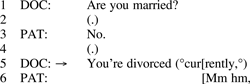
As noted by Heritage (Reference Heritage2012a:8), in this instance, the doctor's declarative formulation concerning the patient's marital status (line 5) is clearly asking for information, not providing it. This is because people usually have privileged access to their own marital status, compared to other people. In this case, the doctor's subordinate epistemic status in this particular domain of knowledge, relative to the patient, was also established interactionally, when the doctor, at the beginning of the fragment, asked about the marital status of the patient (line 1).
Heritage's analysis demonstrates that, in order to understand what others are up to, participants constantly need to monitor who knows what and who knows better. In other words, the participants deploy their sociocultural, personal, and local knowledge to make judgments about their relative epistemic statuses and use these judgments as resources as they design their utterances to perform certain actions and take the possible deployment of these resources into account as they interpret their co-participants' utterances as actions.
Deontic order
Next, we discuss another facet of the participants' momentary relationship that seems to be built-in in the organization of human action. This facet has to do with power, control, and agency—something that can be captured by the notion of “deontics” (Stevanovic & Peräkylä Reference Stevanovic and Peräkylä2012).
Participants' orientations to their own and each other's deontic rights—that is, their rights to determine actions—are ubiquitous to the micro-organization of social interaction. At the most fleeting level of an encounter, each initiative action of a participant poses constraints on others' responsive actions (Schegloff & Sacks Reference Schegloff and Sacks1973; Heritage Reference Heritage1984:245–53; Schegloff Reference Schegloff2007b:20–21), and thus involves an implicit claim of this participant having the right to do that (cf. Stivers & Hayashi Reference Stivers and Hayashi2010; Stivers & Rossano Reference Stivers and Rossano2010:5). In the turn-by-turn unfolding of interaction, more stable deontic asymmetries are manifested, for example, in pre-allocated turn-taking systems of institutional interaction (Atkinson & Drew Reference Atkinson and Drew1979; Macbeth Reference Macbeth1991). Likewise, there are differences in speakers' rights to initiate, maintain, and close up sequences of action and thus control the interactional agenda (Greatbatch Reference Greatbatch1986; Ruusuvuori Reference Ruusuvuori2000; McKinlay & McVittie Reference McKinlay and McVittie2006). And, of course, besides the rights to determine what is going to happen instantly in the interaction, people also orient to their respective rights to make overt requests for specific future actions (Heinemann Reference Heinemann2006; Curl & Drew Reference Curl and Drew2008) or decicions about them (Stevanovic & Peräkylä Reference Stevanovic and Peräkylä2012).
People's orientations to power, control, and agency are anchored in what we call the deontic order. In our usage, deontic order involves a web of oriented-to relations between people—relations that have to do with rights and obligations in requesting for, deciding about, and performing actions in the world. Like the epistemic order, the deontic order is an inescapable context for any interaction. And like the epistemic order, the deontic order involves deontic status and deontic stance as its key dimensions.
Deontic status refers to the position that a participant has in a certain domain of action, relative to his/her co-participant(s). As an aspect of the participants' momentary relationship, it is based on the participants' common personal history, along with their relative positions in the societal and institutional structures, but it is continuously modified in the turn-by-turn sequential unfolding of interaction, as participants pose constraints on each other's actions through their interactional contributions (on the notion of “conditional relevance,” see e.g. Schegloff Reference Schegloff2007b:20–21). Moreover, what domain of action is relevant at each moment of interaction depends on the participants' goals with respect to the interaction, as well as on the kinds of expectations that have been invoked in the immediately preceding utterances. Similar to epistemic status, also deontic status should be seen as a possible resource of action recognition.
We may invoke the notion of deontic stance as parallel to that of epistemic stance. By this we refer to the speakers' public ways of displaying how powerful they are—something that is expressed by the linguistic form of the utterance (Shut up! / Would you please be quiet? / I'm sorry. I can't hear the weather report; Stevanovic Reference Stevanovic2011). While deontic stance and deontic status are usually congruent with each other, this is not always the case: indeed, highly authoritative speakers rarely need to command, while speakers with low authority sometimes can try to inflate their authority with more assertive directives.
As pointed out above, deontic status is something that a certain person has in a certain domain, irrespective of whether she or he momentarily claims these rights or not. Thus, participants' judgments about their relative deontic statuses are critical for their understanding whether an utterance is to be interpreted, for example, as a request for action. This view is in line with Labov's (Reference Labov and Sudnow1972:304) mentioning that, when A requests B to do X, for this to be heard as a valid command, it is necessary for A to have the “right to tell B to do X.” This is especially clear when the request for action is formulated as a declarative, which embodies only a weak deontic stance. In such cases, it is entirely up to the recipient to sort out the implications that the speaker's utterance has on the recipient's future actions. This is something that has been pointed out already by Gumperz (Reference Gumperz1982:6–7), who noted that people's assumptions about value differences in terms of power, status, role, and occupational specialization “form the very basis for indirect communicative strategies.” As an example, let us consider extract (2). The extract was originally presented by Lindström (Reference Lindström, Hakulinen and Selting2005), who examined requests in interactions between senior citizens and home help providers in Sweden.
(2) Lindström Reference Lindström, Hakulinen and Selting2005:221–22

The senior citizen (SC) and the home help provider (HH) are in the kitchen. The home help provider is cleaning the kitchen as the senior citizen specifies the location of a lemon extract bottle that she is incapable of opening. These facts alone allow the statement to be interpreted as a request. According to Lindström, this is because the “home help provider is supposed to assist with tasks that the senior citizen is unable to manage on her own” (Lindström Reference Lindström, Hakulinen and Selting2005:222). Even though, verbally, there is only minimal uptake from the home help provider, the video shows a notable change in the bodily orientation of the home help provider right after the senior citizen's statement of incapability in line 2.
Requests for action may range from orders and commands to suggestions and hints, depending most fundamentally on the extent that the first speaker may assume that the second speaker will perform the relevant action without being directly asked for it. Declarative statements do not necessarily impose any action on the recipient. Hence, in line with what Lindström asserted, we argue that such an interpretation is contingent on the recipient's judgments about the speaker's high deontic status relative to the recipient in the domain in question.
Emotional order
Finally, we expand the previous considerations on epistemics and deontics to cover yet another facet of the participants' momentary relationships that pertains to the organization of human action. This facet has to do with affect, emotion, or “emotive involvement” (Selting Reference Selting1994).
Social scientific views on emotional expression have considered it as being scripted by sociocultural definitions and constraints on what emotions can and should be expressed in particular situations (e.g. Hochschild Reference Hochschild1979, Reference Hochschild1983). The rules governing emotional expression vary predominantly according to the degree of intimacy in a social relationship. Also, professional roles mold the emotion display rules: the “affective neutrality” of the medical profession is a case in point (Parsons Reference Parsons1951). Complying with these rules is an important part of being a moral member of the community (Goodwin & Goodwin Reference Goodwin, Goodwin, Budvig, Uzgiris and Wertsch2000; Cekaite Reference Cekaite2012).
People's affective displays have recently been addressed also in a number of empirical interaction studies (see e.g. Cekaite Reference Cekaite2012; Langlotz & Locher Reference Langlotz and Locher2012; Sorjonen & Peräkylä Reference Sorjonen and Peräkylä2012). These studies have shown that the timing and the design of emotional expressions is firmly embedded in the sequential organization of interaction (Couper-Kuhlen Reference Couper-Kuhlen2012; Maynard & Freese Reference Maynard and Freese2012; Peräkylä Reference Sorjonen2012).
The whole gamut of sociocultural, personal, and local expectations concerning the expression of affect within a participants' momentary relationship are anchored in what can be called the emotional order. Like the epistemic and the deontic orders, the emotional order serves as an inescapable context for any interaction, and has emotional statuses and emotional stances as its key components.
The term emotional status refers to the socially shared expectations regarding experiencing, expressing, and sharing of emotions, arising from the position that a participant has in a certain domain of experience relative to his/her co-participant(s). Objects or events in a given domain of experience are expected to have variably positive or negative emotional valence for the individual occupying a particular social position (Ellsworth & Scherer Reference Ellsworth, Scherer, Davidson, Scherer and Goldsmith2003)—for example, news of a birth of a baby is rather generally expected to have a positive valence, while the intensity of the valence varies regarding the position of the person who is receiving the newsfor the grandparents, the emotion is expected to be more intensive than for the baby's mother's brother's work mate. Furthermore, the social expectations regarding the sharing of emotions vary according to the social position of the participants. For many emotions, the degree of intimacy is a key factor: between intimates, there is a stronger expectation that A shows her emotions to B and that B reciprocates A's emotions, whereas between persons occupying more distant social positions, the expectation can be less so. We may assume that the participants' emotional statuses are regularly relatively symmetrical: if you are close to me then—hopefully—I am also close to you (cf. you are more knowledgeable/powerful than I).Footnote 4 Importantly, however, similar to epistemic and deontic statuses, emotional statuses are constantly in motion as a result of the participants' interactional contributions.
Similar to epistemic and deontic statuses, emotional statuses can be used as resources of action recognition. They play a role, for example, in the participants' management of irony (Kreuz, Kassler, Coppenrath, & McLain Allen Reference Kreuz, Kassler, Coppenrath and Allen1999), jokes (Schegloff Reference Schegloff2001), and complaints (Selting Reference Selting2010). Medical consultation is a classical example: the doctor does not hear the patient's description of suffering at the beginning of the consultation as an action soliciting sympathy, but as a request for help (diagnosis and treatment), and the doctor's way of recognizing the patient's action and constructing her own action arises not only from her epistemic and deontic statuses, but also from her emotional status vis-à-vis the patient (cf. Ruusuvuori Reference Ruusuvuori2000).
The notion of emotional stance denotes the affective dimension of interaction: it refers to the valence and the relative strength of emotional expression directed to a co-present or absent target. Such a target can be something abstract that is referred to, something perceived, an action that is being performed, or a co-participant in interaction (Sorjonen & Peräkylä Reference Sorjonen and Peräkylä2012). Emotional stance is expressed in verbal and nonverbal means: lexis, grammar, prosody, posture, and facial expression (on the functions of emotion talk, see e.g. Edwards Reference Edwards1999). A strong emotional stance may involve interactional phenomena such as extreme case formulations (Pomerantz Reference Pomerantz1986), response cries (Goffman Reference Goffman1981; Heritage Reference Heritage and Mondada2011; Couper-Kuhlen Reference Couper-Kuhlen2012), prosodic salience (Stevanovic Reference Stevanovic2012b), prominent facial expressions (Ruusuvuori & Peräkylä Reference Ruusuvuori and Peräkylä2009), and laughter (Kovarsky, Curran, & Nichols Reference Kovarsky, Curran; and Nichols2009). Less emphasized emotional stances may involve, for example, fine-grained prosodic or facial expressions or even “meta-talk about feelings” (Putnam Reference Putnam and Cooren2007). While there are also matter-of-fact types of utterances, which are difficult to hear as emotional at all, we might agree with those who maintain that even the objective, distant coolness is one type of emotional stance—it is heard against expectations of emotion display (Goffman Reference Goffman1981:120; Bakhtin Reference Bakhtin1986:84; Jaffe Reference Jaffe and Jaffe2009:3; Wilce Reference Wilce2009:3).
While emotional stance and emotional status are regularly congruent with each other, it is still useful to need to keep these notions separate from each other. Importantly, emotional status is something that a certain person has in a specific domain of experience relative to a particular recipient—irrespective of whether the person's overt actions involve any public displays of emotion. Teasing is a case in point. While teasing is often used to promote rapport and social closeness among the participants (Abrahams Reference Abrahams1962; Eisenberg Reference Eisenberg, Schieffelin and Ochs1986; Kovarsky et al. Reference Kovarsky, Curran; and Nichols2009), it is also a risky business: it can often lead to hostile outcomes (Keltner, Capps, Kring, Young, & Heerey Reference Keltner, Capps, Kring, Young and Heerey2001). However, utterances that might be heard as involving sharp criticism can be recognized as teasings when they are exchanged in situations where the participants' relative emotional statuses are “high.”Footnote 5 Let us consider extract (3), from Drew (Reference Drew1987). In this instance, Martha teases Gerald for being “late as usual” (line 2).
(3) Drew Reference Drew1987:225

Given the linguistic content Martha's utterance, it would not be difficult to hear it as conveying exceptionally harsh criticism. The recipient, Gerald, however, treats Martha's utterance as “just teasing” in its most affiliative sense: he laughs (line 3). Arguably, this is because Gerald relied on the emotional facet of his and Martha's momentary relationship when he interpreted Martha's utterance, and Martha counted on the very same facet of the relationship, as she designed her utterance.
The extract demonstrates how participants may deploy their sociocultural, personal, and local knowledge to make judgments about their relative emotional statuses and use these judgments as resources as they design their utterances to carry out certain actions (e.g. teasing). They also take the possible deployment of these resources into consideration as they interpret their co-participants' utterances as actions.
In this section, we described three ways in which the different facets of the participants' momentary relationship pertain to the organization of human action. We claimed that participants deploy their common ground to make judgments about their epistemic, deontic, and emotional statuses relative to each other and use these judgments as resources of action recognition. Thereby, we outlined a unifying theoretical framework revolving around threeFootnote 6 distinct orders that the participants orient to: epistemic order, deontic order, and emotional order.Footnote 7
Ambiguities in action recognition: Negotiating the momentary relationship
We now apply our three-order model to empirical data analysis. We demonstrate how it can be used to account for common ambiguities in action recognition (ones that we have encountered in our own data and/or seen described in interaction literature) and, thereby, elucidate relationship negotiations involving a complex interface between knowledge, power, and emotion. Central to these relationship negotiations is the question whether the participants' epistemic, deontic, and emotional statuses are acknowledged by their co-participants as resources of action recognition. If the recipient's subsequent turns do not involve acknowledgement of those facets of the participants' momentary relationship that have been crucial for the speaker's way of designing his utterance, the action may end up being treated as something else than it was intended to be and the participants' momentary relationship is modified—something that may possibly influence the participants' relationship in the long run.
Ambiguity between the epistemic and deontic orders
One of the most common ambiguities described in the interaction literature lies at the interface between epistemics and deontics. It concerns statements, such as This soup needs salt, which can be heard as “innocent” informings or as requests for action (Clark Reference Clark1979; Sacks Reference Sacks and Jefferson1992:671–72; see also Givón Reference Givón2005:171–77). While such utterances may frequently cause interactional trouble (Mother: That door is still open. Son: Yes it is; Ervin-Tripp Reference Ervin-Tripp1976:45), they also provide the participants with subtle ways to negotiate the epistemic and deontic aspects of their momentary relationships (Antaki Reference Antaki2012; Antaki & Kent Reference Antaki and Kent2012:884; Kent Reference Kent2012:713; Stevanovic & Peräkylä Reference Stevanovic and Peräkylä2012).
Let us consider an instance in which the first speaker apparently makes a mere informing, but this “piece of knowledge” has actually distinct consequences on the recipient, who needs to comply with the suggested plan in order for the informing to be accurate. The extract is drawn from a church workplace meeting, in which the participants—a pastor (P) and a cantor (C)—prepare the next Sunday's mass. The participants have previously selected the Praise Hymn of the mass. The extract starts at a point where the cantor states that this hymn will replace the Prayer of Thanks—a part of the liturgy that normally precedes the Praise Hymn.
(4) M2PAS 13:32
The cantor's assertion (line 1) conveys a rather exceptional decision that influences the pastor's duties in the upcoming mass. Even if it is the pastor who, according to sociocultural expectations, has the right to make such choices, the cantor does not indicate in any way that the decision in question would even be contingent upon the pastor's approval. The cantor's assertion can, therefore, be heard either as a rather blunt claim of superior deontic status in a domain where it is usually the pastor who has such status or as an informing about something to which neither he himself, nor the recipient, has a word to say. On the basis of what happens in the ensuing interaction, it is the former interpretation which makes more sense: after a relatively long pause (line 2), the pastor responds with the Finnish information receipt token aha ‘I see’ (line 3)—an acceptable response to an informing, but not to an announcement of a decision that calls for the recipient's compliance. In other words, the pastor's response is oriented to the epistemic order. The cantor, however, does not treat the pastor's response as satisfactory but, instead, starts to account for the decision (lines 5–9; Houtkoop Reference Houtkoop1990). Thereby, the cantor conveys an orientation to the deontic order. By offering an account for the decision, the cantor indicates that his utterance was indeed designed to make relevant the recipient's display of compliance. Furthermore, by accounting, he mitigates the superior deontic status that he claimed through his prior utterance (see Peräkylä Reference Peräkylä1998; Heritage Reference Heritage, Duchan and Kovarsky2005; for a more detailed description and analysis of the case, see Stevanovic & Peräkylä Reference Stevanovic and Peräkylä2012:309–12).
Extract (4) demonstrates how the common ambiguities between the informing and request readings of certain utterances make relevant considerations of the speakers' deontic statuses relative to their recipient in the domains. Simultaneously, it shows how these statuses can be negotiated in subtle but yet effective ways. If the recipient refrains from acknowledging the speaker's high deontic status as a resource of action recognition, the deontic facet of the participants' momentary relationship is modified.
Ambiguity between the epistemic and emotional orders
Another common ambiguity that has been well described in the interaction literature concerns the inherent connection between displays of knowledge and expressions of emotion. Since emotional expressions regularly have a target—we express our emotions about something (see Goodwin, Cekaite, & Goodwin Reference Goodwin, Cekaite; and Goodwin2012)—they unavoidably presuppose some knowledge about that target. This can pose a challenge, for example, to story recipients in displaying affiliation with the storyteller: the recipients may lack the epistemic rights on the basis of which they could construct their emotional stances (Heritage Reference Heritage and Mondada2011; Couper-Kuhlen Reference Couper-Kuhlen2012; see also Enfield Reference Enfield, Stivers, Mondada and Steensig2011). The other side of the coin is that, in many actions and activities—for example, in news deliveries (Maynard & Freese Reference Maynard and Freese2012)—what is produced with respect to emotion, can also be heard and responded to with respect to epistemics.
This connection between knowledge and emotion may sometimes lead the recipients to wonder what their responses actually need to deal with, in order to count as adequate responses. It is here that the emotional facet of the participants' momentary relationship comes into play, as a resource for the recipients to interpret the first speakers' conduct as actions. For example, an infant pointing to a clock while looking at his mother can be seen as sharing his enthusiasm about the ticking apparatus (cf. Tomasello Reference Tomasello2008). In contrast, if an adult points to a clock while looking at his work colleague in an office, the recipient might be inclined to search for interpretations other than enthusiasm.
The following instance demonstrates the critical role of the participants' emotional statuses as they judge whether an utterance is primarily about sharing knowledge (orienting to the epistemic order) or about sharing emotion (orienting to the emotional order). Extract (5) is from the beginning of the church workplace meeting, in which the participants—a pastor (P) and a cantor (C)—discuss their work tasks. Previously, the participants have talked about an upcoming church event in which the pastor is going. This event will take place in a village far away from where the participants normally work. This invokes a negative assessment by the pastor (line 1).
(5) K 0:41
Through her negative assessment the pastor, on one hand, asserts something about the world (how far away the village is) and, on the other, displays an emotional stance towards the asserted state of affairs (that she does not like it being so far away). Now, what does the recipient's response need to deal with in order to count as an adequate response? If the recipient could be assumed to have a low epistemic status in the domain in question, then, maybe, some news marker (e.g. Oh really, is it?) would be relevant. In contrast, if the recipient could be expected to be knowledgeable in the matter, then an affiliative display of agreement (e.g. Yeah, it will take hours to get there.) would be due. If in the latter-mentioned condition, however, the participants are close to each other, the pastor's assessment can also be heard as a real complaint that calls for a progressive sequence of escalating affiliation (Drew & Walker Reference Drew and Walker2009; Selting Reference Selting2010). Thus, it is the participants' respective epistemic and emotional statuses that are crucial for the interpretation of the pastor's utterance as an action.
The cantor's response is the second of the above-described options: it is an affiliative display of agreement with the pastor's assessment of the village as being far away (‘oh it certainly is,’ line 3). Immediately thereafter the cantor, however, initiates a change of topic and/or action (‘hey,’ line 3). The pastor is not ready to treat the sequence as closed, which is apparent by her renewing her complaint in overlap with the cantor (‘it is. it is so horribly far away,’ line 4–5). In response to that, the cantor repeats her agreement in a less affiliative manner than before (‘sure it is to there yea,’ line 6). Verbally, the cantor's utterance underlines not only her knowing about the matter, but also the self-evidence of such knowledge. Her overt orientation is thus to the epistemic order.
Remarkably, the cantor's conduct elicits yet another, renewed, complaint by the pastor (line 8). This time, the pastor uses the prosodic features of “heightened emotive involvement” (Selting Reference Selting1994)—with great emphasis on each of the word-initial syllables, with a pitch accent on the first syllable of the word mielettömän ‘insanely,’ and with a slow speech rate during the whole utterance (‘it is so insanely far away,’ line 8)—to make it clear that what she is up to is not to transmit new knowledge but to make a complaint. The pastor's action is thus firmly anchored in the emotional order.
In response to the pastor's third complaint, the cantor makes a somewhat irritated-sounding assertion about her knowing about the matter at hand (‘I know where it is,’ line 9) and offers an explanation for how she came to know it (‘I have been there,’ line 10). Overtly, she maintains her orientation to the epistemic order, but simultaneously, she also deals with the emotional thrust of the pastor's utterance—in a disaffiliating way. Instead of a complementary emotion display, she offers a contrasting one, as she meets the pastor's invitation for commiseration with a display of irritation.
Extract (5) demonstrates how the common ambiguities between the informing and complaining readings of certain utterances make relevant considerations of the speakers' epistemic and emotional statuses relative to their recipients. And then, through their choices of orientation, the participants may negotiate the emotional facet of their momentary relationships.
Ambiguity between the deontic and emotional orders
Finally, we discuss an ambiguity that is common in our data, but that we have not yet seen described in the interaction literature. This ambiguity lies at the interface between the deontic and emotional orders; it describes one way in which the remarkably consistent sequential organization of emotional expression (Couper-Kuhlen Reference Couper-Kuhlen2012; Maynard & Freese Reference Maynard and Freese2012; Peräkylä 2012) can be related to the deontics (see Stevanovic Reference Stevanovic2012b).
As an example, let us consider a situation where a speaker tells the recipient about a unilateral decision that she has made previously. In such context, a positively evaluative assessment by the recipient might be relevant; in vernacular terms, such a response would offer emotional support for the first speaker for his decision. The question whether such support is actually made relevant by the first speaker, however, is dependent on the participants' emotional statuses. Let us consider extract (6), where a pastor (P) and a cantor (C) discuss the Pentecost mass, and the cantor points at his papers showing the pastor one of his contributions for the event (‘this I dre- I wanted to make those flutes (play) I wrote this thing here,’ lines 1, 2).
(6) HM1 22:46
The cantor shows the pastor an arrangement of a hymn that he has selected for the mass. His utterance (line 1–2) thus involves a claim of deontic authority; it conveys an announcement of a decision, which calls for the pastor's acceptance (Stevanovic & Peräkylä Reference Stevanovic and Peräkylä2012). By showing the arrangement that he has done, however, the cantor can also be heard as inviting an assessment by the recipient. By designing his announcement in a “self-attentive” way—in foregrounding his own agency by referencing to himself—the cantor maintains the relevance of the assessment, while framing it as one that would be targeted to his own accomplishment. How these two options—a (mere) display of acceptance and an assessment—are weighted is linked to the participants' judgments of their emotional statuses relative to each other.
What happens is that the pastor treats the cantor's utterance as an announcement of a decision. After the cantor has categorized the hymn as a Pentecostal hymn (line 4), the pastor displays of having recognized it (‘uh huh,’ line 6) and starts leafing through her hymnal to find it (line 7–9). During that time, the cantor mentions the placement of the hymn in the mass (line 7) and hums its melody (line 8). And soon, after the pastor has found the hymn from her Hymnal (line 10) and stated its number (line 11), she displays acceptance of the cantor's decision by writing it down (line 12). Hence, so far, the reception of the cantor's decision has occurred under the auspices of the deontic order: the pastor has committed herself in collaborating in realizing the decision.
What happens next, however, indicates that the cantor has also been after something else. Starting to elaborate his self-attentive account on his choice of music he invokes the moment at which he reached his decisions (‘I thought that let's now take a Pente- Pentecostal,’ line 13)—something that the pastor receives with a single joo ‘yea’ (line 14). Thereafter, the cantor seems to pursue further response by explicating the grounds for his decision (‘it's this that kind of a meditating hymn so it fits to the Eu- Eucharist,’ lines 15–16). This makes relevant the pastor's evaluation of the cantor's choice of music. Importantly, because the cantor has already made the decision, he is not asking the pastor to participate in the decision-making process (Stevanovic Reference Stevanovic2012a). Instead, orienting to the emotional order, he seems to invite the pastor, as it were, to share the cantor's joy of having really accomplished something.
In her subsequent conduct, the pastor hardly provides such evaluation. Instead, by asking the cantor about the order of the musical items in the mass (‘will you still sing first that Flame of the Prayer,’ line 17), the pastor makes it apparent that she is going to stick “strictly to business,” orienting solely to the deontic order.
Extract (6) demonstrates how the recipients of unilateral decision announcements may accept the subordinate deontic statuses that have been imposed on them by the first speakers, and yet their responses are not treated as satisfactory by the first speakers. Instead, their displays of subordination are regularly followed by the first speakers' (in our data, often unsuccessful) attempts to pursue the recipients' emotional support for their decisions. To offer such support would, however, require of the recipient that she acknowledges the participants' respective emotional statuses, which she may not always be willing to do. Sometimes, perhaps especially in deontically asymmetric situations, the recipients may not want to increase the degree of closeness in the participants' momentary relationships but, rather, to modify the relationship in the opposite direction.
Conclusions
In this article, we outlined a unifying theoretical framework within which the linkages between action recognition and the basic facets of social relations could be conceptualized. After having introduced the notion of the participants' momentary relationship as a nexus between the global and local aspects of social relations, we asked how the epistemic, deontic, and emotional facets of the participants' momentary relationship pertain to the organization of action. We claimed that participants deploy their sociocultural, personal, and local knowledge to make judgments about their epistemic, deontic, and emotional statuses relative to each other and use these judgments as resources as they design their actions to be recognized as such by their co-participants.
Thereafter, we applied our three-order model to the analysis of common ambiguities in action recognition, by which we described relationship negotiations involving a complex interface between knowledge, power, and emotion. In each of our data analyses, the participants seemed to have differing views regarding some facet of their momentary relationships. This facet was then negotiated by the participants' deployment (or nondeployment) of their epistemic, deontic, and emotional statuses as resources of action recognition. These analyses point to the centrality of the question about the relative weight of statuses and stances—whether people's epistemic, deontic, or emotional statuses are treated as capable of overruling their epistemic, deontic, or emotional stances, or whether these stances are to be taken at their face value.Footnote 8 Importantly, both of these options can be equally accommodated within the formal organization of interaction.
Our three-order model may contribute, not only to our understanding of action recognition, but also to recent theorizing on the mechanisms of sequence organization (see Drew Reference Drew2012; Heritage Reference Heritage2012b). According to the classic conversation analytic view, utterances impose norm-based obligations for the participants in terms of their next utterances (Schegloff & Sacks Reference Schegloff and Sacks1973; Heritage Reference Heritage1984:245–53; Schegloff Reference Schegloff2007b:20–21). Recently, however, this “deontic” account of sequence organization has been challenged by an epistemic alternative: Heritage (Reference Heritage2012b) proposed that sequences of talk are driven largely by epistemic asymmetries between participants, which drive the conversation from one utterance to the next until speakers achieve a state of epistemic equilibrium. While the deontic and epistemic accounts of sequence organization can explain a lot of what happens in interactional sequences, there is research pointing to the need to consider sequence organization also from the perspective of emotion. Especially when people tell stories (Selting Reference Selting2010; Stivers Reference Stivers2008), report their experiences (Heritage Reference Heritage and Mondada2011), or complain about other people's behavior (Couper-Kuhlen Reference Couper-Kuhlen2012), they tend to expand their sequences—apparently—to achieve a point where their emotions are recognized and possibly reciprocated (cf. Goffman Reference Goffman1981:21). On a more general level, Goffman's account of face is highly relevant here: face involves the participants' primordial emotional investment and, according to Goffman, any action or nonaction is decided upon on the basis of its implications for the face of the self and the other (Goffman Reference Goffman1967:36). One challenge of future research is therefore to unravel the exact ways in which deontics, epistemics, and emotion work together to make utterances to appear, not only as intelligible actions, but also, as intelligible sequences of action.
While stressing the importance of the structural properties of social relations for people's interactional conduct, we have aligned with those sociolinguists who have shown how people's sociocultural differences may be reflected in the subtleties of their language use (see e.g. Gumperz Reference Gumperz1982; Heller Reference Heller1988; Tannen Reference Tannen1990; Schiffrin Reference Schiffrin1994). Simultaneously, while discussing the possible resources through which participants may design their interactional contributions to be recognized as particular social actions, we have also dealt with generic aspects of interactional organization—an issue that lies at the focus of conversation analytic inquiry. In this article, people's sociocultural differences have been incorporated into our notion of the participants' momentary relationship, the different facets of which have been considered as resources of action recognition—generically, as it were. Thereby, we hope having been able to build a bridge between the various research traditions that seek to understand how intelligible social action becomes possible.
Appendix: Transcription conventions
- .
pitch fall
- ?
pitch rise
- ,
level pitch
- ↑↓
marked pitch movement
- underlining
emphasis
- -
truncation
- [ ]
overlap
- =
latching of turns
- (0.5)
pause (length in tenths of a second)
- (.)
micropause
- :
lengthening of a sound
- hhh
audible out-breath
- .hhh
audible in-breath
- (h)
within-speech aspiration, usually indicating laughter
- #
creaky voice quality
- °
whisper
- ♫
singing or humming
- <word>
slow speech rate
- >word<
fast speech rate


