
 τ



%20--%3e%3c!DOCTYPE%20svg%20PUBLIC%20'-//W3C//DTD%20SVG%201.0//EN'%20'http://www.w3.org/TR/2001/REC-SVG-20010904/DTD/svg10.dtd'%3e%3csvg%20version='1.0'%20id='Layer_1'%20xmlns='http://www.w3.org/2000/svg'%20xmlns:xlink='http://www.w3.org/1999/xlink'%20x='0px'%20y='0px'%20width='64px'%20height='64px'%20viewBox='5.5%20-3.5%2064%2064'%20enable-background='new%205.5%20-3.5%2064%2064'%20xml:space='preserve'%3e%3cg%3e%3ccircle%20fill='%23FFFFFF'%20fill-opacity='0'%20cx='37.785'%20cy='28.501'%20r='28.836'/%3e%3cpath%20fill='%23595959'%20d='M37.441-3.5c8.951,0,16.572,3.125,22.857,9.372c3.008,3.009,5.295,6.448,6.857,10.314%20c1.561,3.867,2.344,7.971,2.344,12.314c0,4.381-0.773,8.486-2.314,12.313c-1.543,3.828-3.82,7.21-6.828,10.143%20c-3.123,3.085-6.666,5.448-10.629,7.086c-3.961,1.638-8.057,2.457-12.285,2.457s-8.276-0.808-12.143-2.429%20c-3.866-1.618-7.333-3.961-10.4-7.027c-3.067-3.066-5.4-6.524-7-10.372S5.5,32.767,5.5,28.5c0-4.229,0.809-8.295,2.428-12.2%20c1.619-3.905,3.972-7.4,7.057-10.486C21.08-0.394,28.565-3.5,37.441-3.5z%20M37.557,2.272c-7.314,0-13.467,2.553-18.458,7.657%20c-2.515,2.553-4.448,5.419-5.8,8.6c-1.354,3.181-2.029,6.505-2.029,9.972c0,3.429,0.675,6.734,2.029,9.913%20c1.353,3.183,3.285,6.021,5.8,8.516c2.514,2.496,5.351,4.399,8.515,5.715c3.161,1.314,6.476,1.971,9.943,1.971%20c3.428,0,6.75-0.665,9.973-1.999c3.219-1.335,6.121-3.257,8.713-5.771c4.99-4.876,7.484-10.99,7.484-18.344%20c0-3.543-0.648-6.895-1.943-10.057c-1.293-3.162-3.18-5.98-5.654-8.458C50.984,4.844,44.795,2.272,37.557,2.272z%20M37.156,23.187%20l-4.287,2.229c-0.458-0.951-1.019-1.619-1.685-2c-0.667-0.38-1.286-0.571-1.858-0.571c-2.856,0-4.286,1.885-4.286,5.657%20c0,1.714,0.362,3.084,1.085,4.113c0.724,1.029,1.791,1.544,3.201,1.544c1.867,0,3.181-0.915,3.944-2.743l3.942,2%20c-0.838,1.563-2,2.791-3.486,3.686c-1.484,0.896-3.123,1.343-4.914,1.343c-2.857,0-5.163-0.875-6.915-2.629%20c-1.752-1.752-2.628-4.19-2.628-7.313c0-3.048,0.886-5.466,2.657-7.257c1.771-1.79,4.009-2.686,6.715-2.686%20C32.604,18.558,35.441,20.101,37.156,23.187z%20M55.613,23.187l-4.229,2.229c-0.457-0.951-1.02-1.619-1.686-2%20c-0.668-0.38-1.307-0.571-1.914-0.571c-2.857,0-4.287,1.885-4.287,5.657c0,1.714,0.363,3.084,1.086,4.113%20c0.723,1.029,1.789,1.544,3.201,1.544c1.865,0,3.18-0.915,3.941-2.743l4,2c-0.875,1.563-2.057,2.791-3.541,3.686%20c-1.486,0.896-3.105,1.343-4.857,1.343c-2.896,0-5.209-0.875-6.941-2.629c-1.736-1.752-2.602-4.19-2.602-7.313%20c0-3.048,0.885-5.466,2.658-7.257c1.77-1.79,4.008-2.686,6.713-2.686C51.117,18.558,53.938,20.101,55.613,23.187z'/%3e%3c/g%3e%3c/svg%3e)
%20--%3e%3c!DOCTYPE%20svg%20PUBLIC%20'-//W3C//DTD%20SVG%201.0//EN'%20'http://www.w3.org/TR/2001/REC-SVG-20010904/DTD/svg10.dtd'%3e%3csvg%20version='1.0'%20id='Layer_1'%20xmlns='http://www.w3.org/2000/svg'%20xmlns:xlink='http://www.w3.org/1999/xlink'%20x='0px'%20y='0px'%20width='64px'%20height='64px'%20viewBox='5.5%20-3.5%2064%2064'%20enable-background='new%205.5%20-3.5%2064%2064'%20xml:space='preserve'%3e%3cg%3e%3ccircle%20fill='%23FFFFFF'%20fill-opacity='0'%20cx='37.637'%20cy='28.806'%20r='28.276'/%3e%3cg%3e%3cpath%20fill='%23595959'%20d='M37.443-3.5c8.988,0,16.57,3.085,22.742,9.257C66.393,11.967,69.5,19.548,69.5,28.5c0,8.991-3.049,16.476-9.145,22.456%20C53.879,57.319,46.242,60.5,37.443,60.5c-8.649,0-16.153-3.144-22.514-9.43C8.644,44.784,5.5,37.262,5.5,28.5%20c0-8.761,3.144-16.342,9.429-22.742C21.101-0.415,28.604-3.5,37.443-3.5z%20M37.557,2.272c-7.276,0-13.428,2.553-18.457,7.657%20c-5.22,5.334-7.829,11.525-7.829,18.572c0,7.086,2.59,13.22,7.77,18.398c5.181,5.182,11.352,7.771,18.514,7.771%20c7.123,0,13.334-2.607,18.629-7.828c5.029-4.838,7.543-10.952,7.543-18.343c0-7.276-2.553-13.465-7.656-18.571%20C50.967,4.824,44.795,2.272,37.557,2.272z%20M46.129,20.557v13.085h-3.656v15.542h-9.944V33.643h-3.656V20.557%20c0-0.572,0.2-1.057,0.599-1.457c0.401-0.399,0.887-0.6,1.457-0.6h13.144c0.533,0,1.01,0.2,1.428,0.6%20C45.918,19.5,46.129,19.986,46.129,20.557z%20M33.042,12.329c0-3.008,1.485-4.514,4.458-4.514s4.457,1.504,4.457,4.514%20c0,2.971-1.486,4.457-4.457,4.457S33.042,15.3,33.042,12.329z'/%3e%3c/g%3e%3c/g%3e%3c/svg%3e)
1.
 $\boldsymbol{\tau}$
CMa: Stellar multiplicity does not have to be simple

 $\tau$
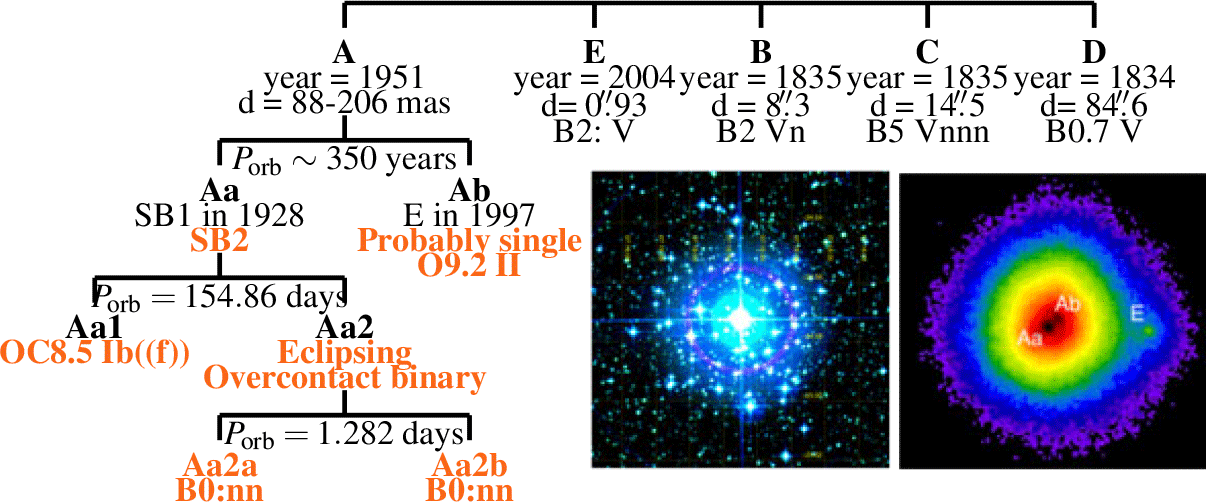
CMa, located at the center of NGC 2362, is among the 15 brightest O-type systems in our sky. Its multiplicity is complex, as illustrated in Fig. 1. We combined astrometry (Sect. 2), spectroscopy (Sect. 3), photometry (Sect. 4), and three-body simulations (Sect. 5) to disentangle
 $\tau$
CMa A’s, though more is to come (Sect. 6).
Hierarchy of
 $\tau$
CMa. Results of our analysis are in orange. First image: 3 channel DDS2 RGB image. Second image: AstraLux
 $3^{\prime\prime}\times3^{\prime\prime}$
cut-out of the region around
 $\tau$
CMa A.

2. Astrometry: Long visual outer orbit Aa–Ab
We combined data from Maíz Apellániz & Barbá (Reference Maíz Apellániz and Barbá2020) with new AstraLux and STIS data.
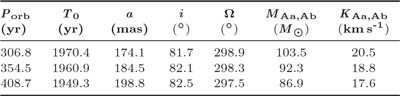
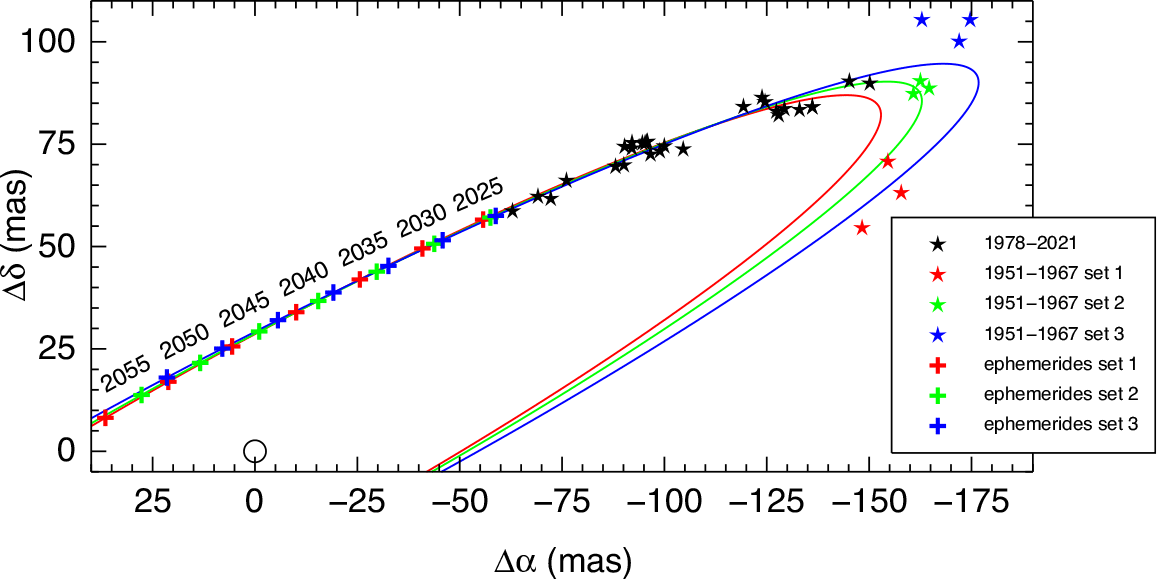
AstraLux lucky imaging. Data taken between 1951-1967 are incompatible with each others. We thus computed three possible orbits assuming
 $e=0$
(see Table 1 and Fig. 2), and showed that the parameters
 $i,\Omega, M_{\text{Aa,Ab}}, K_{\text{Aa,Ab}}$
are well-constrained.
Three possible orbital solutions for Aa–Ab.

Table 1 Long description
A table comparing orbital solutions for AaAb. The table has 3 rows and 8 columns. Column headers are P orb (yr), T 0 (yr), a (mas), i (degrees), Ω (degrees), M Aa,Ab (M☉), and K Aa,Ab (km/s). Row 1: P orb, 306.8; T 0, 1970.4; a, 174.1; i, 81.7; Ω, 298.9; M Aa,Ab, 103.5; K Aa,Ab, 20.5. Row 2: P orb, 354.5; T 0, 1960.9; a, 184.5; i, 82.1; Ω, 298.3; M Aa,Ab, 92.3; K Aa,Ab, 18.8. Row 3: P orb, 408.7; T 0, 1949.3; a, 198.8; i, 82.5; Ω, 297.5; M Aa,Ab, 86.9; K Aa,Ab, 17.6.
Visual orbit of Aa–Ab. Colours indicate three possible orbits based on different sets of data.

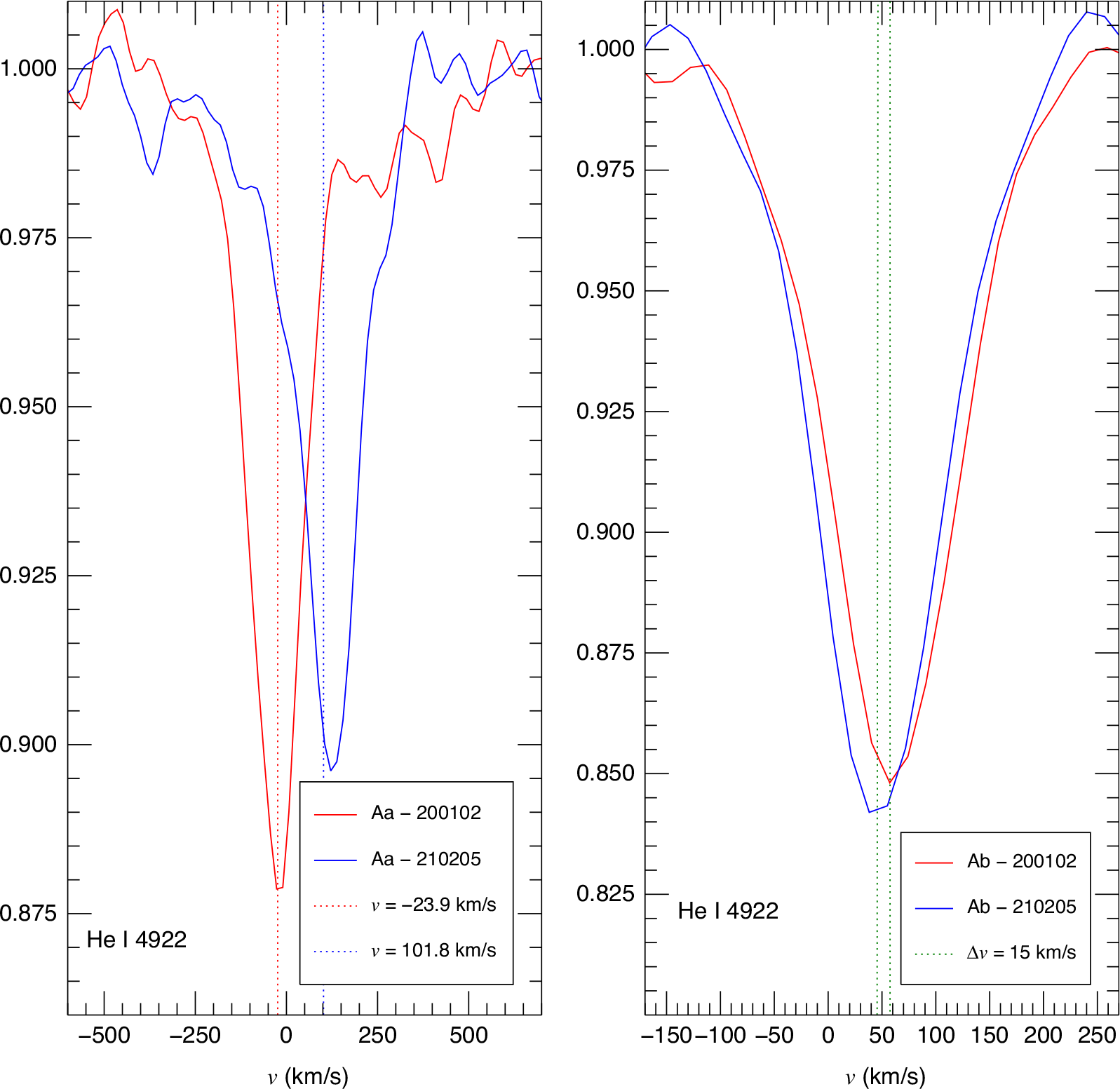
HST/STIS spectroscopy. Aa shows a broad component that moves in anti-phase with Aa1 (see Fig. 3). Thus, Aa is a SB2, with Aa2 a fast rotator. We determine the mass of Ab
 $\sim\,25\pm5\,M_\odot$
from the cluster age and its O9.2 II spectral type.
STIS spectroscopy: Aa (left) and Ab (right).

3. Spectroscopy: Intermediate orbit Aa1–Aa2
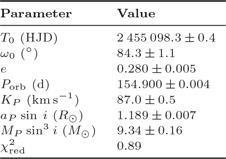
Radial velocity analysis. We combined 125 RVs spanning 117 years that we analysed as in Rosu et al. (Reference Rosu, Rauw, Conroy, Gosset, Manfroid and Royer2020); Rosu et al. (Reference Rosu, Rauw, Farnir, Dupret and Noels2022a); Rosu et al. (Reference Rosu, Rauw, Nazé, Gosset and Sterken2022b) to derive the orbital solution (Table 2). Newly accumulated data were combined with data from Struve & Pogo (Reference Struve and Pogo1928); Struve & Kraft (Reference Struve and Kraft1954); Stickland et al. (Reference Stickland, Lloyd and Sweet1998), and LiLiMaRlin (Maíz Apellániz et al. Reference Maíz Apellániz, Trigueros Páez and Jiménez Martínez2019). Combining
 $M_{\text{Aa,Ab}}$
with constraints on
 $\sin i_{\text{Aa1,Aa2}}$
and
 $M_{\text{Aa2}}/M_{\text{Aa1}} \sim 1.0-1.5$
, we deduced that the orbit is nearly edge on, and that
 $M_{\text{Aa1}} \sim 30\,M_\odot$
, and
 $M_{\text{Aa2}} \sim 38\,M_\odot$
. The only sign of Aa2 in the deconvolved spectra is under broad profiles in some lines, suggesting that Aa2 has early-B spectrum/spectra. Furthermore, the velocity amplitude of Aa2 is much lower than that of Aa1, thus
 $M_{\text{Aa2}} \gt M_{\text{Aa1}}$
. It only works if Aa2 is made up of two early-B fast rotators of
 $\sim 19\,M_\odot$
each!
Orbital solution for Aa1–Aa2.

Table 2 Long description
A table with two columns: Parameter and Value. The table has 7 rows, each listing a different orbital parameter and its corresponding value. Row 1: Parameter, T 0 (H J D); Value, 2 455 098.3 plus or minus 0.4. Row 2: Parameter, omega 0 (degree); Value, 84.3 plus or minus 1.1. Row 3: Parameter, e; Value, 0.280 plus or minus 0.005. Row 4: Parameter, P orb (day); Value, 154.900 plus or minus 0.004. Row 5: Parameter, K p (kilometer per second); Value, 87.0 plus or minus 0.5. Row 6: Parameter, a p sin i (R sun); Value, 1.189 plus or minus 0.007. Row 7: Parameter, M p sin 3 i (M sun); Value, 9.34 plus or minus 0.16. Row 8: Parameter, X squared red; Value, 0.89.
Secular changes in the SB2 orbit of Aa1. Over the period 2004-2025, we detected a relative average acceleration of the center of mass of Aa with respect to Ab of
 $0.22\pm0.06$
km s
 $^{-1}$
yr
 $^{-1}$
that is consistent with the expectations of the visual Aa–Ab orbit if it is circular (Sect. 2), as well as a mass ratio between Ab and Aa of
 $1.00\pm0.53$
consistent with the expected one (within the large error bar). Most likely, and to the first author dismay, there is no apsidal motion.
4. Photometry: Short-period orbit Aa2a–Aa2b
TESS light curves of
 $\tau$
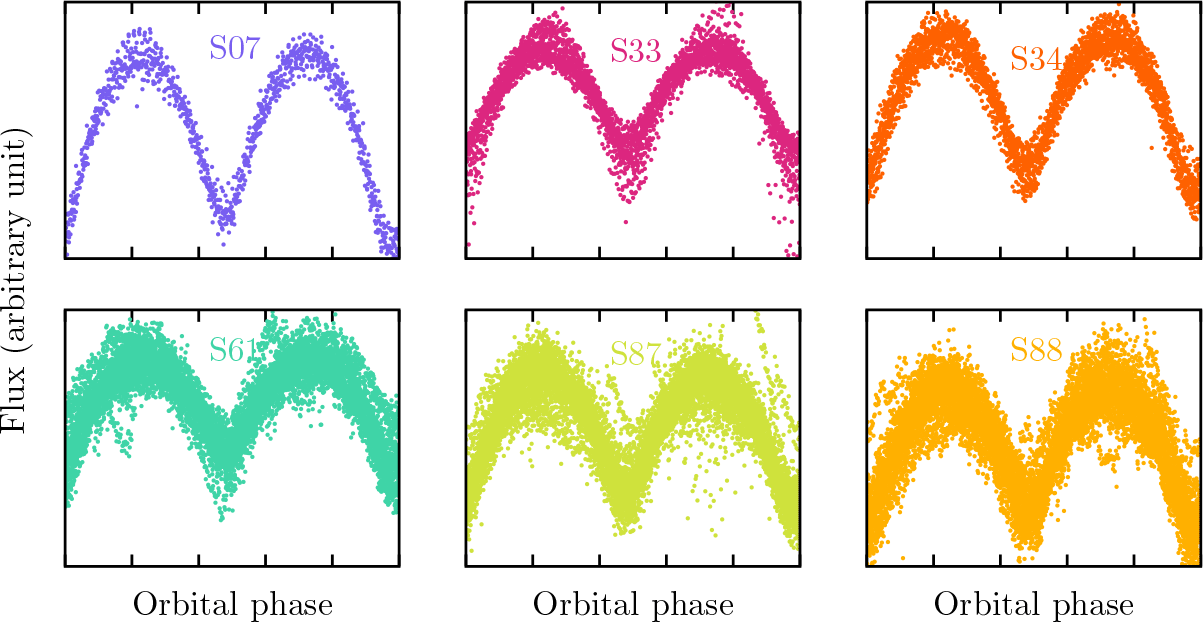
CMa reveal that the close eclipsing binary is an overcontact binary with a 1.282 days period (Fig. 4). Detailed analysis is ongoing to derive stars and orbital parameters.
TESS light curves of the eclipsing binary.

5. Three-body simulations with TRES
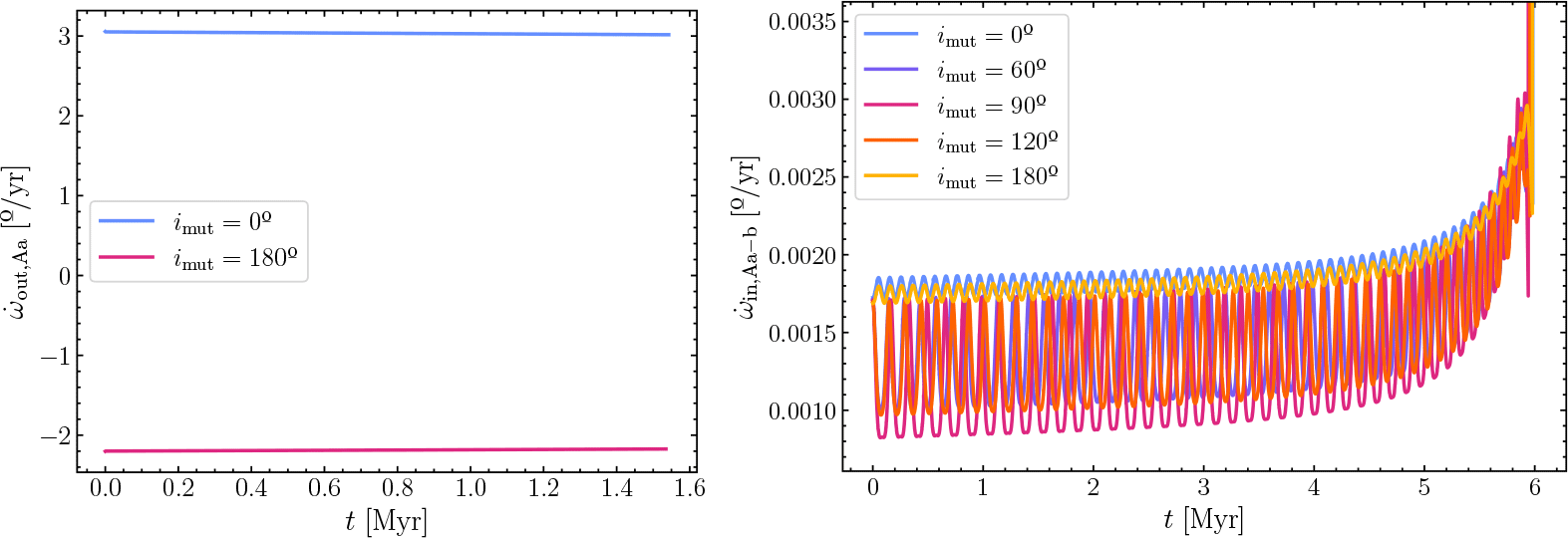
We performed three-body simulations with TRES (Toonen et al. Reference Toonen, Hamers and Portegies Zwart2016; Sciarini et al. Reference Sciarini, Ekström and Kummer2025) to assess whether Aa2a–Aa2b (Case 1, Fig. 5, left panel) and/or Ab (Case 2, Fig. 5, right panel) could be (partly) responsible for an apsidal motion in Aa1–Aa2.
TRES simulations:
 $\dot\omega$
in Aa1–Aa2 if induced by Aa2a–Aa2b (left) or Ab (right) for different
 $i_{\text{mut}}$
.

Case 1. We considered the triple system Aa1–(Aa2a–Aa2b). If the mutual inclination
 $i_{\text{mut}}$
between the two orbits is
 $0^\circ$
, the apsidal motion rate
 $\dot\omega$
amounts to
 $\sim 3.1^\circ$
yr
 $^{-1}$
, while if
 $i_{\text{mut}} = 180^\circ$
,
 $\dot\omega \sim -2.2^\circ$
yr
 $^{-1}$
. These are the two extreme cases; any other
 $i_{\text{mut}}$
leads to a value for
 $\dot\omega$
intermediate between 3.1 and
 $-2.2^\circ$
yr
 $^{-1}$
.
Case 2. We considered the triple system (Aa1–Aa2)–Ab. Whatever
 $i_{\text{mut}}$
,
 $\dot\omega \le 0.002^\circ$
yr
 $^{-1}$
.
Should an apsidal motion be measured in Aa1–Aa2, would Aa2a–Aa2b be the culprit, not Ab.
6. What we still do not know but will soon
Our analysis of
 $\tau$
CMa A allowed us to unravel its mystery. Yet, it remains to perform a quantitative spectroscopic analysis of its components Aa1, Aa2a, Aa2b, and Ab to derive the effective temperatures and luminosities of the stars as well as their surface chemical abundances and wind properties. Furthermore, the origin of the secular changes of the SB1 Aa1–Aa2 orbit as well as the properties of the overcontact binary Aa2 are still to be determined.
Supplementary material
To view supplementary material for this article, please visit https://doi.org/10.1017/S1743921325103815
 τ
 3′′×3′′
 τ
 ω˙
 imut


 Open access

