





1. Introduction
1.1 Multi-messenger astrophysics of globular and nuclear star clusters
Globular clusters (GCs), abundant in galactic disks and spheroids, serve as ideal laboratories for studying stellar evolution alongside Newtonian and relativistic dynamics. Nuclear star clusters (NSCs), which often host supermassive black holes in massive elliptical galaxies, generate tidal disruption events as stars or compact objects interact with the central black hole.
From a comprehensive set of computer models, multi-messenger observational signatures of GCs and NSCs can be deduced, including (1) star-by-star kinematic information for nearby star clusters (Gaia, LSST, JWST), (2) numbers of X-ray binaries in local globular clusters and in our own Galactic Center, (3) gravitational wave (GW) signals (and possible electromagnetic counterparts) of merging binary black holes (BHs) and neutron stars (NSs) in a local universe (LIGO/Virgo/KAGRA and future Einstein Telescope Branchesi et al. Reference Branchesi, Maggiore and Alonso2023 Cosmic Explorer Ricci et al. Reference Ricci, Carpenter and Fu2015), and (4) gravitational inspiral events produced by objects falling into BHs to be discovered years before their coalescence (LISA Amaro-Seoane et al. Reference Amaro-Seoane, Audley and Babak2017, TianQin Luo et al. Reference Luo, Chen and Duan2016, and Taiji Chen et al. Reference Chen, Yan and Lu2021; Ruan et al. Reference Ruan, Liu and Guo2021).
1.2 The DRAGON simulation family
The DRAGON simulations aim to model the largest star clusters to the most realistic degree, using accurate N-body methods with up-to-date treatment for stellar evolution recipes.
DRAGON-I (Wang et al. Reference Wang, Spurzem and Aarseth2016) is the first N-body simulation to simulate million-body GCs for Giga-years while DRAGON-II (Arca Sedda et al. Reference Arca Sedda, Kamlah and Spurzem2023; Arca Sedda et al. Reference Arca Sedda, Kamlah and Spurzem2024a; Arca Sedda et al. Reference Arca Sedda, Kamlah and Spurzem2024b) significantly improves stellar evolution models involving compact objects, and predicts gravitational wave signals from compact object mergers that would be measured by LIGO/Virgo/KAGRA.
The aim of DRAGON-III is to get step by step closer to realistic particle numbers for massive globular and nuclear star clusters. Furthermore, the inclusion of a novel feature, a large number of initially wide binaries, significantly changes the entire binary population during the evolution. Moreover, we follow all escaping stars to investigate how they build tidal tails with a more recent galaxy model.
2. Numerical methods
2.1 Code
NBODY6++GPU (Wang et al. Reference Wang, Spurzem and Aarseth2015) is one of the state-of-the-art codes capable of modelling star clusters to the most realistic degree possible. It has a long history as an offspring of Sverre’s N-body code (Aarseth Reference Aarseth1999), and is being continuously maintained by the Silkroad Team Footnote † and made publicly available Footnote ‡, with a major update for stellar evolution by Kamlah et al. (Reference Kamlah, Leveque and Spurzem2022). We refer readers to the review article Spurzem and Kamlah (Reference Spurzem and Kamlah2023) for its physics, algorithms, features, and achievements. Beyond the descriptions therein, we recently ported the Galactic potential MWPotential2014 from Galpy (Bovy Reference Bovy2015), for better comparison with results from other codes. In recent years, the MWPotential2014 has been adopted by other star cluster codes (e.g., MOCCA by Giersz Reference Giersz1998; PeTar by Wang et al. Reference Wang, Iwasawa and Nitadori2020). We have ported the CUDA code in NBODY6++GPU to HIP Footnote § software stacks, enabling our program to run large-scale simulations on next-generation non-CUDA architectures, including DCU-accelerated computing clusters from China and AMD-GPU-based LUMI supercomputer in Finland.
PeTar Footnote ¶ is one of the most popular codes for star cluster N-body simulations. It was first developed by Wang et al. (Reference Wang, Iwasawa and Nitadori2020), and then enriched with functions such as BSE (Wang et al. Reference Wang, Fujii and Tanikawa2021), BSEEMP (Wang et al. Reference Wang, Tanikawa and Fujii2022), and MWPotential2014 (Wang and Jerabkova Reference Wang and Jerabkova2021). We refer interested readers to the article of Wang (Reference Wang2026) in the same proceeding volume.
2.2 Initial conditions
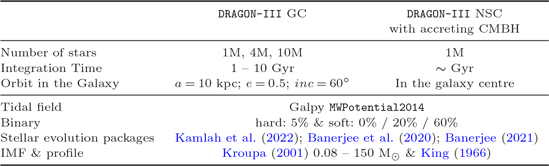
Table 1 shows the initial conditions of the ongoing and planned DRAGON-III simulations. We follow the model with 1 million stars in DRAGON-II for unlisted initial parameters, and refer readers to (Arca Sedda et al. Reference Arca Sedda, Kamlah and Spurzem2024a, Section 2.3) for them. Inspired by Offner et al. (Reference Offner, Moe, Kratter, Inutsuka, Aikawa and Muto2023), we explore three different fractions of initial soft (wide) binaries. We do not remove stars from simulations when they are far enough from the cluster centre and usually considered as escaping. Instead, we keep evolving them in the galactic tidal field. This allows us to investigate possible stellar streams formed by massive clusters.
Initial conditions for DRAGON-III simulations.

Table 1 Long description
A table comparing initial conditions for DRAGON-III simulations. The table has two columns: DRAGON-III GC and DRAGON-III NSC with accreting CMBH. It has six rows with the following headers: Number of stars, Integration Time, Orbit in the Galaxy, Tidal field, Binary, and Stellar evolution packages. Row 1: Number of stars, DRAGON-III GC: 1M, 4M, 10M; DRAGON-III NSC with accreting CMBH: 1M. Row 2: Integration Time, DRAGON-III GC: 1 – 10 Gyr; DRAGON-III NSC with accreting CMBH: ~ Gyr. Row 3: Orbit in the Galaxy, DRAGON-III GC: a = 10 kpc; e = 0.5; inc = 60°; DRAGON-III NSC with accreting CMBH: In the galaxy centre. Row 4: Tidal field, DRAGON-III GC: Galpy MWPotential2014; DRAGON-III NSC with accreting CMBH: (not specified). Row 5: Binary, DRAGON-III GC: hard: 5% & soft: 0% / 20% / 60%; DRAGON-III NSC with accreting CMBH: (not specified). Row 6: Stellar evolution packages, DRAGON-III GC: Kamlah et al. (2022); Banerjee et al. (2020); Banerjee (2021), IMF & profile: Kroupa (2001) 0.08 – 150 M☉ & King (1966); DRAGON-III NSC with accreting CMBH: (not specified).
Notes: [1] The accreting central supermassive black hole is added in NSC simulations. [2] The orbit of the GC is taken typical observational values from Vasiliev and Baumgardt (Reference Vasiliev and Baumgardt2021); Bajkova and Bobylev (Reference Bajkova and Bobylev2021) [3] In the initial setup, hard binaries means those with semi-major axis of
 $0.1~\mathrm{au} \leq a \leq 50~\mathrm{au}$
, while soft binary means
 $50~\mathrm{au} \le a \leq 5000~\mathrm{au}$
.
3. Selected preliminary results
Fig. 1 shows binaries related to compact objects in early time of one simulation with NBODY6++GPU. Many interesting objects appear after evolving for 84.16 Myr, especially:
-
• An IMBH is present in a wide BH–BH binary, with primary mass of 127 Me and secondary mass of 89 Me. This binary is escaping from the star cluster, and will likely be dynamically unbound to the cluster.
-
• An BH–MS binary (
 $a=1.29$
au,
$M_\mathrm{BH}=5.82$
Me) is located next to the recently observed BH–giant wide binary in the mass gap (Wang et al. Reference Wang, Zhao and Feng2024) (
$2.1 \lt a/\mathrm{au} \lt 5.1$
,
$3.1 \lt M_\mathrm{BH}/\mathrm{{\mathrm{M}_\odot}{}} \lt 4.1$
). With further evolution, we will see whether this simulated binary will resemble the observed binary.


Semi-major axis as a function of primary mass for binaries with at least one compact object component, in the simulation with 20% initial soft binary after evolving for 84.16 Myr, which equals 3749 initial crossing time, and 0.5 initial half-mass relaxation time. In the bottom left corner is the count of binaries by stellar types of their components. Meaning of the stellar type abbreviation in this table and in the legend can be found in Hurley et al. (Reference Hurley, Pols and Tout2000). Meaning of marker style: square - black hole as primary star, octagon - neutron star as primary star, pentagon - white dwarf as primary star.

As shown in Table 2, after evolving the cluster for 100 Myr, there are 41 pulsar sources, 191 X-ray binaries, 17 gravitational wave sources, and one black hole-black hole merger due to losing orbital energy in the form of gravitational wave emission. These results show that young globular clusters produce numerous observational candidates for multi-messenger astrophysics. Some of these binaries will escape from the cluster and scatter into the galactic field. Their distribution and subsequent evolution will be continuously tracked in the running DRAGON-III simulations.
Binaries with at least one compact object component, categorized by stellar types of stellar components, in the simulation with 20% initial soft binary after evolving for 106.8 Myr. Due to page limit, we refer readers to Hurley et al. (Reference Hurley, Pols and Tout2000), Section 4 for the meaning of abbreviations.

Table 2 Long description
A table categorizing binaries with compact object components by stellar types. The table has three rows and six columns. Column headers are Stellar Type, ONeWD-MS, NS-MS, COWD-MS, BH-MS, BH-BH, and ONeWD-CHeB. Row 1: Stellar Type, ONeWD-MS, NS-MS, COWD-MS, BH-MS, BH-BH, ONeWD-CHeB. Row 2: count, 46, 26, 26, 16, 16, 14. Row 3: Stellar Type, BH-LMS, ONeWD-ONeWD, NS-ONeWD, NS-CHeB, ONeWD-HEMS, COWD-LMS. Row 4: count, 9, 8, 7, 6, 2, 2. Row 5: Stellar Type, ONeWD-LMS, COWD-CHeB, NS-HG, BH-CHeB, BH-NS, NS-HEMS. Row 6: count, 2, 2, 1, 1, 1, 1.
The inclusion of initial soft binaries produced not only more wide binaries, but also more close binaries with unexpected properties as discussed above. An upcoming article (Wu et al. Reference Wu, Spurzem and Flammini Dotti2026) will highlight how different initial soft binaries affect the simulation. The DRAGON-III simulations are ongoing. The first DRAGON-III data-release will be publicly available soon.



 Open access

