Introduction
The HCR-20 is a structured professional judgment instrument for the purpose of assessing risk of violence. The HCR-20 reports reviewed in this audit all used HCR-20 version 2. Since this audit was undertaken HCR-20 version 3 has been introduced. This structured assessment is widely used and requires the collation of detailed information covering 20 factors. These factors were identified by a review of scientific, professional and legal literature to correlate with risk of violence (Webster et al. Reference Webster, Douglas, Eaves and Hart1997). It is beyond the scope of this practical paper to review the wider literature relating to this instrument. Service-user involvement in the HCR-20 is encouraged by the authors and accredited training promotes the benefits of this. Indeed, the NHS England standards for medium and low secure mental health services (NHS England, 2013) state that risk assessment and management should aim to support self-assessment and management through engaging the individual as much as possible through the process. However, collaborative risk assessment via the HCR-20 did not appear to represent routine practice in the rehabilitation and low secure wards of the authors’ service.
The aims of this paper were to present the rationale, methodology and results of an audit into the use of the HCR-20 on the rehabilitation and low secure wards of a mental health trust. The audit focused on two aspects: quality of the HCR-20 reports, and service-user involvement in the process.
Background to the Current Use of the HCR-20
UK Government papers (Department of Health 1996; Department of Health National Risk Management Programme, 2007) have recommended collaboration with the service user and others involved in their care whilst undertaking risk assessments. The latest consultation document (Department of Health, 2012a) which set standards for low secure and psychiatric intensive care units, also emphasises the importance of service-user involvement, outlining that service users should be placed at the centre of their care (‘nothing about me without me’) where this is appropriate. Patient engagement and participation in formulation is actively encouraged and the importance of incorporating risk assessment and management into a service user’s care plan is also documented. Despite these government guidelines, and consultation documents emphasising the importance of service-user involvement, little research has been undertaken to evaluate the frequency or quality of service-user involvement in risk assessment.
Langan and Lindow (Reference Langan and Lindow2004) are among the few who have undertaken research into the level of service-user involvement in violent risk assessment and management. They reviewed 17 service users who were being discharged from an inpatient unit into the community. Although there was evidence of service-user involvement, some of the service users were completely unaware that they were perceived to be a risk to other people. This raises the question of if service users are not aware of their risk, how can they begin to manage it? Langan and Lindow (Reference Langan and Lindow2004) found that some risk information was either absent or inaccurate leading to an under- or overestimation of risk. This distortion can have a detrimental effect on a service user’s care. Dixon (Reference Dixon2012) investigated service users’ awareness and attitudes towards risk assessments. Most participants were unaware that a risk assessment about them had been undertaken, although those who had been involved appeared to engage more with their care staff about risk.
As a result of research into service-user involvement in risk assessment and management on inpatient unit, Langan (Reference Langan2008) reported four key themes that arose:
-
1. Some professionals lacked confidence or experience in openly discussing risk with service users. This open discussion was not considered to be routine practice by the professionals, and concern was noted that raising the issue of risk with a service user who is acutely unwell may be counter-productive. Despite this, the professionals considered openness to be a good guiding principle.
-
2. Most staff members did not involve service users in risk assessments, although no staff rejected the principle of service-user involvement.
-
3. The majority of service users were unaware that professionals were undertaking risk assessments on them. Those that were aware reported being indifferent or viewed it as a positive process.
-
4. Levels of agreement between professionals and service users regarding risk and its seriousness differed. Professionals considered a high level of concordance between themselves and the service user in assessing risk to be an important aid in risk assessment and management. These themes provide a useful insight into the working practice of involving service users in their risk assessment.
Involving service users in the HCR-20 risk assessment process is likely to be empowering to patients. The Royal College of Psychiatrists (2008) found that patient involvement can substantially support the growth of resilience, confidence and self management in people using services. It promotes collaboration in their care plan and supports them in managing their own risk factors for violence. Henagulph et al. (Reference Henagulph, McIvor and Clarke2012) set up an HCR-20 risk and recovery group in a medium secure unit in London. Meetings are held weekly to facilitate patient discussion about the risk items and the score they warrant. It is the authors’ understanding that the ‘scoring’ gives structure to a discussion by group members about their risk (Clarke, Reference Clarke2012). However, it was acknowledged when this issue was debated at the Division of Clinical Psychology (DCP) Forensic Faculty meeting (April 2012) that scoring and use of a total score is not the normal procedure for the HCR-20. Nonetheless, it has been found that this programme promotes hope amongst patients as they progress from hospitalisation to the community. It provides service users with a better understanding of the relationship between mental illness and risk, provides improved understanding of the reasons for their continued detention, and focuses on goals relating to discharge. Ashcraft and Anthony (Reference Ashcraft and Anthony2008) endorsed patient involvement in a recovery oriented approach that can reduce the use of seclusion and restraint.
The HCR-20 has become a widely used risk assessment tool for assessing violence in a variety of settings and its use is recommended in numerous guidelines (Department of Health, 1996, 2012b; O’Rourke and Bailes, Reference O’Rourke and Bailes2006; Khiroya et al. Reference Khiroya, Weaver and Maden2009). The strength of this instrument lies in proper administration and coding of the HCR-20 which requires considerable professional skill and judgement. The HCR-20 instrument is comprised of the following sections: Historical (past, stable) factors; Clinical (current, dynamic) factors; Risk (future, dynamic) factors; Risk Scenarios (predicted future risky scenarios); and Case Management (summarising risk management plans).
The HCR-20 has become the preferred risk assessment instrument, used in conjunction with the RiO Risk Screen and Risk Information, within Somerset Partnership NHS Trust. RiO is an electronic patient record system used by mental health trusts and community service organisations. The RiO Risk Screen form contains ratings regarding service users’ long-term and acute risk to others (rated between zero: no apparent risk; and three: high risk); the Risk Information form contains detailed information regarding clients’ risk and forensic history. To facilitate use of the HCR-20 risk assessment instrument, an extensive two day training programme was rolled out to over 107 mental health staff across the Trust, including all qualified practitioners working in two newly developed inpatient wards: a psychiatric rehabilitation ward (a locked 10-bed, mixed-gender ward) and a low secure ward (12-bed, male ward).
The aim of this audit was two fold:
-
1. To examine the quality of the HCR-20 assessments completed on the wards;
-
2. To examine service-user involvement in HCR-20 assessments completed on the wards.
In keeping with the requirements of the audit cycle, the results were to be used for the development of standards for the use of the HCR-20 on these wards.
Method
All current and past service users admitted to the wards were reviewed. At the time of the audit, the wards had been open for just over two years. In this period, 11 service users had been admitted to the low secure ward, and 23 to the psychiatric rehabilitation ward, giving a total sample size of 34. Data was obtained for the most current RiO Risk Screen and Risk Information sections, and the most current HCR-20 report, if one had been completed. The process of completing an HCR-20 risk assessment was implemented when service users were considered to pose a risk of violence to others. Therefore, not all service users in the two wards would have a HCR-20.
The HCR-20 assessments were reviewed according to the following criteria:
-
∙ RiO Risk Screen scoring based on risk to others (acute) and risk to others (long-term).
-
∙ HCR-20 recorded in RiO documents and the date it was completed. If the HCR-20 was completed by an assessor trained in the instrument and whether there is evidence of multi-disciplinary team (MDT) involvement.
-
∙ Sources of information used, such as patient interview data and records.
-
∙ Whether all HCR-20 risk factors are completed.
-
∙ Number of ‘historical’ factors where information cited was consistent with rating awarded. In other words, the information provided by the assessor for each ‘historical’ factor matched the rating given according to the scoring criteria.
-
∙ Appropriate (evidence given does apply to the factor concerned) and sufficient (evidence is sufficient to justify the score given) scoring of the ‘clinical’ and ‘risk factors’.
-
∙ Degree of completion for risk scenarios and case management; and also a summary judgement.
-
∙ Integration of HCR-20 into RiO notes on Care Plan and Risk Information.
-
∙ Patient involvement in the completion of the HCR-20. Was the patient consulted about or active in the HCR-20? Also, reasons for the patient not being consulted or involved.
The HCR-20 assessors (i.e. those clinicians who completed each HCR-20 assessment) were contacted to ascertain patient involvement in the process. They provided information on whether the service user was consulted (informed it was being completed and/or given a copy); involved (actively participated in the process); or, reasons why they were not consulted or involved in the process.
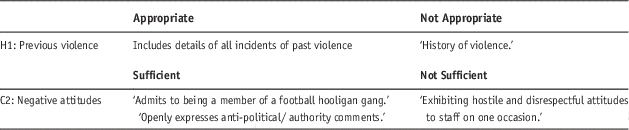
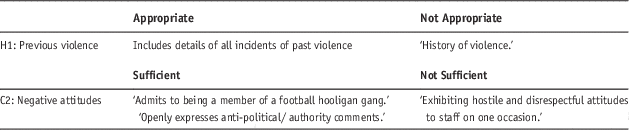
It is noted that ‘appropriate’ and ‘sufficient’ evidence is subjective. Table 1 provides examples which add some clarity to this decision process. The audit assessor (KG) has extensive knowledge of the HCR-20 and provides in-house training in the instrument. Comparisons of evidence were made by cross checking against the definitions set out in the HCR-20 manual and the standards set by examples given during HCR-20 training. These standards are:
-
∙ The HCR-20 manual should be used as a guide throughout;
-
∙ Completing a HCR-20 should be done collaboratively, multi-evidenced, and multi-disciplinary;
-
∙ As much information as appropriate should be cited to add depth to the risk assessment;
-
∙ If there is no information for one of the factors then ‘not known’ should be cited and ways of finding this information should be sought;
-
∙ The presence and relevance of a risk rating should reflect the information given for each factor, so that an accurate formulation can be created;
-
∙ Information in the HCR-20 should be communicated via RiO and placed in the patients care plan;
-
∙ If necessary, there should be liaison with other teams, such as Safeguarding.
Examples of appropriate and sufficient evidence to give clarity to the decision process.
Two of the HCR-20 assessments were cross checked by a colleague, who also provides training on using the HCR-20, for the purpose of checking rater reliability given the relative subjectivity of the ratings. Overall there was a near match between the HCR-20 assessor (KG) and the second reviewer of the results. The only discrepancies were apparent on the issue of ‘sufficient’ evidence being given. This seemed to represent a tension behind quality evidence being sought against practical constraints (e.g. the second reviewer was slightly more lenient in terms of the amount of evidence presented in recognition of time constraints on staff completing the HCR-20).
Results
Process of completing HCR-20
The files of 34 service users were reviewed in terms of the presence of a HCR-20 and, if applicable, the quality of the assessment and whether there was any service-user involvement. Completed HCR-20 risk assessments were recorded in the documents of 18 (53%) of these service users. 12 (67%) of the assessments were at least six months old, so were unlikely to represent an up-to-date risk assessment. Of those who had no HCR-20 assessment, four service users (25%) were categorised as having a significant long-term risk to others (i.e. rated two or three on the RiO Risk Screen), with two on the low secure ward and two on the psychiatric rehabilitation ward.
The percentage of HCR-20 assessments completed by an HCR-20 trained individual, including MDT involvement, using service-user interview data and records in the assessment process is displayed in Table 2. This shows that the majority of HCR-20s appear to have been completed by a trained clinician using the correct data collection process.
Data showing the process of completing the HCR-20 assessments (N=18)

MDT–Multi-disciplinary team
Quality of HCR-20 assessments
The quality of HCR-20 assessments was mixed. Of the 18 HCR-20s completed, 14 (78%) had all the risk factors completed. Only 9 (50%) of the historical risk factor items had a 100% consistency level between evidence cited and the rating given. For the clinical factors, only 9 (50%) of the HCR-20 assessments had appropriate evidence cited and 11 (61%) had sufficient evidence cited to make the rating. In terms of the risk factors, 12 (67%) of the HCR-20 assessments had appropriate evidence cited and 9 (50%) had sufficient evidence cited to make the rating. The majority of HCR-20 assessments –15 (83%) – had both the risk scenarios and case management sections fully completed. We judged that a majority of 13 (72%) also had case management information that addressed the risk factor identified.
Incorporating the HCR-20 assessments into clinical practice appeared to be poor. None of the HCR-20s reviewed were referred to in the care plan of the service user (one care plan was missing), and only 7 (39%) were referred to in the current risk information on RiO.
Service-user involvement in HCR-20 assessment
Service-user involvement was low with only 5 (28%) of service users being consulted (informed and or/given a copy) and 1 (6%) being involved (active participation) in the HCR-20 assessment process. The most common reasons why service users were not consulted or involved in the process were: risk of damaging the therapeutic relationship with the client (4 or 22%) or due to third party information (2 or 11%). Other reasons cited by the clinicians when asked why they had not informed or involved the service user in the process included, ‘it was not routine practice’, ‘the service user’s reports were considered unreliable’, ‘the service user did not want to’, ‘the service user would not have comprehended risk information’, and ‘the service user’s mental state and behaviour prevented engagement’.
Discussion
This study considered two aspects of using the HCR-20 for risk assessment of violence to others: the quality of the HCR-20 report, and service-user involvement. Previous research suggests that service users are often unaware of having risk assessments or of being a potential risk to others (Langan, Reference Langan2008; Dixon, Reference Dixon2012). This review sought to examine the quality of HCR-20 assessments completed by the MDT and nursing staff on the low secure and psychiatric rehabilitation wards and to investigate whether use of the HCR-20 as a risk assessment instrument promoted service-user involvement in the process. It was hoped that the data could be used to develop standards for quality and service-user involvement in the risk assessment process.
Process of completing HCR-20 assessments
RiO Risk Screens should be continually updated as risk increases, decreases or stays the same, and assessments such as the HCR-20 should also be updated. Having an HCR-20 and, in particular an up to date one, helps to ensure that suitable risk management and care plans are in place. However, the data shows that a fifth of service users who were rated as having a ‘significant’ or ‘high’ risk of violence to others on the RiO Risk Screen had no completed HCR-20 assessments and of those that were completed 80% were compiled at least six months previously. This suggests that when there is evidence of a need for a more thorough risk assessment of violence, which could be provided by the HCR-20, it is not consistently being undertaken. Where information was available, all assessors had completed the two-day HCR-20 training course. This is consistent with advice in the manual that assessors undertake training prior to completing the HCR-20. Table 1 suggests that, in general, HCR-20 assessors follow the appropriate data collection process for completing the instrument.
Quality of HCR-20 assessments
The results of this review suggest that quality of the HCR-20 assessments was mixed. Positive aspects included all 20 risk factors being rated, and the risk scenario and case management sections being completed. This is important as the risk scenario and case management sections are involved in formulation and risk management, leading directly on to effective care planning. With assessments such as the HCR-20, the quality of the given ratings is important. All factors being completed does not necessarily lead to a useful and sufficient risk assessment. Some of the sections were less consistently completed, for example citing appropriate and sufficient evidence for the clinical and risk factors, and referring to the HCR-20 in current care-plans and risk information on the RiO system. Matching evidence to ratings on clinical factors appeared to be especially hard for assessors, with detailed but inappropriate evidence often provided. Risk items showed the opposite pattern, with more appropriate but less detailed evidence. This may be attributed to vague item descriptions for the clinical/risk factor items on HCR-20. Interestingly, this has been addressed in version 3 (Webster et al. Reference Webster, Douglas, Eaves and Hart2013). However, most of the assessors had been trained and therefore, should have been able to correctly assess clinical aspects despite ambiguity.
Service-user involvement in HCR-20 assessments
Service-user involvement appeared to be poor, with few service users being consulted or actively involved during the assessment process. It should be noted that there is a difference between being interviewed for the collation of data for the assessment, and active service-user involvement. Service users were generally interviewed but not aware of the HCR-20 assessment being undertaken. Professionals provided a range of reasons to explain this. This was not surprising as prior to the audit there were no expectation or encouragement to involve service users. However, service-user involvement has been suggested to be empowering and encourages service users to take responsibility for their pathway through hospital admission (Henagulph et al. Reference Henagulph, McIvor and Clarke2012). There is the possibility that working collaboratively on understanding risk and underwriting safety may lead to more mutually satisfying relationships between practitioners and service users in recovery (Royal College of Psychiatrists, 2008; South London & Maudsley NHS Foundation Trust & South West London & St George’s Mental Health NHS Trust, 2010). This is consistent with the current guidance related to service users being at the centre of their care and suggests that professionals should make more effort to involve service users during the HCR-20 assessment process.
Recommendations
The results of this audit enabled standards to be proposed for HCR-20 risk assessments on the low secure and psychiatric rehabilitation wards that were reviewed:
-
∙ All inpatients on the low secure ward should have an up-to-date HCR-20 risk assessment;
-
∙ All inpatients on the psychiatric rehabilitation ward with a RiO Risk Screen score of two or more (significant or high risk) for either acute or long-term risk of violence/harm to others should have an up-to-date HCR-20 risk assessment;
-
∙ All HCR-20 risk assessments should have been completed in the last six months which is in keeping with routine clinical practice for Care Programme Approach (CPA) reviews;
-
∙ HCR-20 risk assessments should be fully completed with evidence and a rating for all 20 items, and entries should be made for the risk scenarios, case management and prioritisation sections;
-
∙ HCR-20s should be cross-referenced in the care plan and RiO risk information;
-
∙ All service users should be informed that a HCR-20 risk assessment has been undertaken and, if clinically appropriate, they should be actively involved in the process; assessors must document reasons if this is inappropriate;
-
∙ Training should be provided in HCR-20V3 and the Trust Forensic Liaison Team was available to provide supervision and support to colleagues completing HCR-20 assessments.
Strengths and Limitations
This audit was useful as it obtained data relating to the quality of assessments, which in turn has identified staff training needs and can be used to determine the standards set relating to this process. In addition, it allowed data to be accessed regarding service-user involvement. Most of the assessors were trained in HCR-20 assessments to the standard expected of the auditor. Therefore, any shortcomings would be either due to a lack of effort or understanding on the assessor’s part. Knowing that most of the assessors were trained to standard made it easier to highlight faults that needed to be rectified. One limitation of this audit is that it is based solely on data from two wards within Somerset Partnership NHS Foundation Trust. Other trusts may have different guidelines for assessors using the HCR-20. It should be noted that the audit was largely conducted by KG. Rater bias is a possibility in that KG is a trainer of the HCR-20 within the Trust. However, KG is not based on either of the two wards audited.
This audit addressed the issue of service-user involvement in completing HCR-20 assessments, and determined this by directly asking staff. Given the noted discrepancies in research comparing clinician and service-user perspectives, a limitation may be the restrictive method of determining service-user involvement in the process. Although this audit looked at an area which has not been investigated much before, and highlights some key points relating to use of the HCR-20, future research should focus on amalgamating this data with data from other trusts to enable more widespread generalisation of the recommendations.
This audit had a small sample and therefore generalisability would be difficult. The sample reflects the number of patients admitted to the low secure unit and psychiatric rehabilitation ward in a year. Potentially the audit could have extended to the low risk psychiatric intensive care unit (PICU) to increase sample size. This audit shows that even when trained to a high standard, the quality of the HCR-20 assessments can slip, hence the usefulness of this type of audit. A further limitation is that the HCR-20V3 has recently been released which has improved the vague item descriptions for the clinical and risk factor items. This may aid assessors in matching evidence with ratings given for these items. It would be interesting to replicate this audit with this new version to determine whether all of the recommendations are still appropriate and this will be conducted as a follow-up.
Conclusions
This audit has provided standards for the completion of HCR-20 risk assessments which could be applied to locked psychiatric rehabilitation or low secure wards. These standards include service-user involvement in risk assessment of violence to others using the HCR-20, ensuring that risk assessments are fully completed and up to date, and facilitating the harmonious use of the HCR-20 risk assessment instrument and RiO electronic patient records.
Acknowledgements
The authors acknowledge the support from Sian Parker in the preparation of the paper for submission for publication.
Financial support
This research received no specific grant from any funding agency, commercial or not-for-profit sectors