1. Introduction
Several years ago I published an essay in this journal about my work with interactive multimedia using ecoacoustic technologies (Burtner Reference Burtner2005). The article described an approach to music composition that uses environmentalist principles learned from native Alaskan culture, and applied in a technological Western-classical experimental tradition. Ecoacoustics embeds environmental systems into musical and performance structures using technology. It derives musical procedures from abstracted environmental processes, remapping data from the physical into the musical domain. It draws on techniques of sonification, acoustic ecology and soundscape composition, and combines it with interactive technologies. Going beyond sonification, the composer may develop syntactical structures on the basis of the recorded natural processes, and create new patterns conforming to this logic. The methodology allows for a productive collaboration between the artist and the environment, one that can also allow transformation between observed and invented systems of order, foregrounding art's ability to re-imagine the world.
The research described in that writing created the foundation for what has become a significantly broader project called EcoSono. Started in 2008, EcoSono (www.ecosono.com) is an activism network advocating environmental preservation through experimental sound art. The project starts with the ecoacoustic and experimental principles of my Alaskan-nurtured aesthetic, and applies this approach more generally in the world. While Alaska remains a core inspiration for me personally, the practice now recognises the broader vision of environmentalism as work engaged across a single interconnected planet. A holistic view of the planet is a key aspect of contemporary climate change science (Flannery Reference Flannery2005). This is further supported by research in perceptual psychology that describes a broad frame of environmental understanding (Gibson Reference Gibson1966; Classen Reference Classen1993; Gaver Reference Gaver1993a, Reference Gaver1993b). Because humans inhabit a range of comparable ecologies on Earth, and because we perceive the world with relatively equal perceptual faculties, we tend to interpret these information-rich ecological systems similarly. Therefore, even as we participate in varied cultures, we conform to certain understandings of the environment.
EcoSono is a practice first, but it is also an institution promoting and supporting engagements between humans and environments. The recent projects discussed here include the 2009 MICE (Mobile Interactive Computer Ensemble) World Tour, a 30,000-mile global circumnavigation concert tour by water; the first annual EcoSono Institute, in which a team of scientists and experimental sound artists studied environmentalism, interactive technology and sound propagation in the sea and in nine countries of the Caribbean; and the Agents Against Agency project, for which a group of nine teams from Asia, Australia, Russia and the USA created performative engagements with the natural world.
Before discussing these three projects in detail, the writing first addresses several key values of interactive ecoacoustics. First, it is important to understand the role ‘impracticality’ plays in creating a productive environmentalist art project. The projects described here seem positively impractical, and it turns out that impracticality and inconvenience may be valuable positive shaping factors of environmentalist art. In order to change an unsustainable relationship with the planet, we may need to do something against our normal tendency.
Another formative concept of EcoSono is that the purpose of outdoor recording is not the acquisition of material samples, but to hear the world and learn from it. The aesthetic described here de-emphasises sampling and soundscape composition in environmental sound artworks. A desire for human–environment collaborative work drives this tendency. Interactive ecoacoustics is about a real-time sound-based engagement with the natural world more than an attempt to record it. Human–environment–computer interactive art positions the human as an agent of change rather than a passive observer. The implication of a switch in concentration from acquisition and extraction to collaboration and engagement turns out to be profound for an interactive and performance-oriented model of art-making.
2. The importance of Impracticality for Ecoacoustic Art and Environmentalism
A paradox inherent in technology-based environmental sound art arises from the difficulty of creating highly technology-dependent work in connection with the outdoors, particularly in a remote wilderness. The subject and the methodology of this practice are profoundly at odds, and this shapes the way such work is made. Electroacoustic tools and computers are not rugged enough to withstand even moderate climate fluctuation or environmental conditions. Heat and cold alike may cause electronics to malfunction, as can sand, dust, dirt, mud, rain, rocks, plant matter, snow, water, lava and virtually every material constituting the outdoors. In addition, all this equipment requires an ample power source, limiting its mobility. Even equipment that can run on stored battery power must be recharged frequently. This is true of the tools needed to both compose and perform this music. It is far more convenient for practitioners working with music technology to stay indoors. And it is greatly inconvenient to pack up the studio and attempt to surmount these limitations of elements and distance.
At the same time, artists understand the importance of making environmentalist works. The preservation of Earth's livable habitats is among the most important challenges facing humanity, and artists can contribute valuable perceptual models for comprehending the problems and implementing solutions. In particular, artists can define new forms of human–environment interaction. Recognising the importance of engagement, sound artists and composers do compose and perform environment-attuned works using contemporary technologies. And therein lies the paradox. How can an artist create music about the environment without spending significant time creating the artwork outdoors? The difficulty of making the work produces a pressure that leads to an aesthetic tendency driven by practicality. So it is that most electroacoustic environmental work is made within the safety of studios, insulated from the natural world inside cities, perhaps with short excursions outdoors to gather source material (or not even that).
Composers have typically employed two approaches when creating technology-based environmental sound art: 1) recording natural sounds for studio-based production (or using recorded sounds of others), and 2) gathering environmental data sets for studio-based sonifications (or using data gathered by others). In either case, the work of composing itself generally takes place out of the field, in front of a computer. Most of this sound artwork is created indoors for indoor concerts or gallery settings. Even the conceptual and theoretical development of a work typically happens with little interaction with the outside world.
In spite of ample critical discourse about the complexities of using environmental samples in electroacoustic music (Truax Reference Truax1996), the acquisition model of environmental sound sampling has come to dominate environmental-based artwork with little regard for the artistic or ethical value of such a methodology. The methodology of sampling/composing, separated as it is by time and context, extracts environmental sounds from a native context and dissects them in a remote human-controlled artificial environment at some later time. In such sample-based composition, the human artistic mediation takes primacy over the environmental engagement. The methodology pits the composition practice against the environmentalist practice, eschewing a collaborative dialogue with the environment. Redefining forms of collaborative engagement is a primary focus of EcoSono.
Recent ecocriticism has addressed the primacy of human mediation in ecology-centred writing by analysing textual biases in the words used to describe the environment. Both literary and scientific writing uses anthropomorphised and romantic language to describe ecology. Ecocritic William Howarth, for example, points out how scientific geological terminology reflects human sources by describing geography in terms used to identify human bodies, buildings, tools, utensils and clothes (Howarth Reference Howarth1995). And others have described the contemporary bias towards romanticised stereotypes of ecological writing (Morton Reference Morton2010). Similarly, contemporary music has perpetuated a preference for mediation over human-environment collaboration.
Pursuing an impractical methodology by venturing out of the studio and spending significant time and energy outside is one way to break from this pattern. Real-time listening as opposed to sample acquisition is another.
3. The purpose of outdoor recording is not the acquisition of samples, but to hear the world and learn from it
A productive environmentalist perspective of sound art starts by redressing the emphasis on acquisition. It is misleading to place too much emphasis on the preservationist aspect of sampling. The existence of a well-recorded sample library obscures the compositional value of hearing these sounds in context, and the experience of learning about the subject in context. An environmental audio sample won't make a work of art music; the experience of a place may. In addition, libraries of samples can be bought and sold in a marketplace becoming another natural resource harvested for human consumption. The experience of listening in a place is much more important than recording the sounds themselves. For environmentalist art, it is not sufficient merely to place the recorded sounds of the environment into a musical context.
In Wild Soundscapes, bio-acoustician Bernie Krause writes:
The first time I heard a spring dawn chorus listening through headphones attached to microphones, I immediately realized that with my ears alone, I had been missing an exquisite part of the nature sound experience. Amplified sound gave me a way to translate the language of the natural world in ways my ‘civilized’ ears could not. The experience retrained my hearing so that I now perceive through a sharpened aural acuity something approaching what our forest-dwelling ancestors might have known. The song of life reached me with a force so great that my world was forever transformed: heightened listening was the key. (Krause Reference Krause2002: 00)
Krause elegantly describes the power of the sound recorder as sound amplifier. He does not mention the ‘record’ button which transforms that device into something else altogether. The recorded sample separates the sound from the experience. It creates the false impression that the most important sonic aspect of the adventure is contained in the audio sample. But the recording is only ever an acoustic residue of the experience. The important composition lessons will be learned by the process of individual engagement.
4. Origins: Chasing the Sounds of Snow and Raven, and Studying at the World Soundscape Project Archives
Most of what I learned about recording environmental sound, I learned from recording the sounds of snow and ravens in my 20s in Alaska, and from my work at the World Soundscape Project in 1996 at the invitation of Barry Truax.
What started as a straightforward attempt to record sounds and still images of snow around my house in Alaska branched into a complex archaeological geography project of the Alaskan terrain. In the end I discovered a sonic syntax embedded in the varied states of snow, an audio descriptor of places and times containing a logic defined by the environment. The resulting library of samples encompassed thousands of different snow sounds and each one told about the place, the time and the activity. When I finished, I could close my eyes and, using only the sound of the snow, reconstruct the place, time, season and states of the environment around my house. This project is discussed in detail in a different piece of writing (Burtner Reference Burtner2011).
By recording ravens I learned that animal audio samples reflect the personality of the sound recordist as much as the animal or place. Ravens were difficult for me. I spent five years trying to record them for my composition Ukiuq Tulugaq (Winter Raven) and never captured what I considered to be a representative sample.
Ultimately, it turned out that the sound of the raven was not of primary importance in this endeavour. Surrounding enviromental sounds at times better revealed attributes of the subject. Raven's unsounded patterns of movement and interplay with the environment at times seemed more descriptive than its vocalisations. I learned about the sound of raven from on-site listening in a way I could never have through an archive (and I did plenty of archive listening to raven sounds as well). In the pre-composition phase I had imagined a raven character appearing on stage and speaking with a voice of sampled ravens. In actuality, Ukiuq Tulugaq is far richer than that and it addresses multiple facets of its subject. When raven finally appears in Ukiuq Tulugaq, he comes in three forms simultaneously: 1) the embodied voice expressed by a violinist who plays transcriptions of raven vocalisations while simultaneously controlling the playback of samples of real recorded ravens; 2) the cultural mythological dimension of raven represented by a soprano voice gradually moving across the stage as she sings every permutation of a three-note pitch set; and 3) raven's memory, portrayed by a masked character carrying a radio transmitter which plays a recording from the beginning of this composition (over 90 minutes ago). These layers are accompanied by a high, ringing, electronic sound, two bowed glockenspiel, and a video projection of high-contrast falling snow at night. The resulting composition was deeply informed by the recording experience, and in ways I could not foresee. The music was changed by my experiences in the real world because my understanding of the environment was altered through exposure to the subject. This transformation of the individual perception of the world we can describe as an activism. It is the kind of deeply personal activism that art can actuate.
These multi-faceted multi-year adventures taught me to be sceptical of samples, and to emphasise listening over recording. Working in Alaska also taught me about the intensity of environmental sound and about how difficult it is to record in harsh environments. I froze and thawed, wetted and dried expensive microphones and recorders numerous times. I spent weeks in the wilderness without power and learned how to manage power using daisy-chained batteries and alternative electrical sources. Most importantly, these formative adventures started close to my home, arising from a personal experience with an acoustic environment. Working from a base of knowledge will help develop skills for interacting with the environment.
Barry Truax and the World Soundscape Project (WSP) Archives and researchers taught me about technique and patience, and also about the human mediation of nature through recording, something I was already experiencing with the raven project (Truax Reference Truax1978; Westerkamp Reference Westerkamp2002). Coming from a background in computer sound generation (from my time at Xenakis’ studios in Paris), I found the use of samples unnatural at first. My entrance into acoustic ecology came through computer sound generation, not sampling. I encountered Truax's acoustic ecology work with computer sound synthesis first, for example, before I knew of his soundscape compositions. Xenakis, Truax and Curtis Roads showed me a way into environmental computer music without the use of real-world samples. When I went to work at Simon Fraser, WSP provided a crash course in this unfamiliar terrain, and in the politics of sound.
In spite of its prevalence in the electroacoustic community, soundscape composition is only one branch of the environmentalist movement coming out of the 1960s and 1970s. Truax, one of the early creators of the WSP archive (formed by R. Murray Schafer) pointed to alternative models for environmental sound art in his work of the 1970s. Truax built on principles similar to the Greek-French composer, mathematician and architect Iannis Xenakis (Xenakis Reference Xenakis1992) to create sound-synthesis systems modelling the behaviour of natural systems. His work Riverrun (1986), for example, uses granular synthesis to model a vast river system from individual droplets of synthesised sound. In composing this music, he defined a field of acoustic ecology. Argentinian composer Damian Keller, a former student of Truax, has created some of the most fascinating systems of acoustic ecology beyond soundscape (Keller Reference Keller1999, Reference Keller2000).
My own music does not make use of soundscape, even as it uses environmental sound. Rather, it uses feature extraction from environmental complexes, a technique in which select parameters of the data contained in the soundscape are isolated and analysed. Through complex feature extraction, an ecosystem can be rebuilt with its own defined logic. Such a system allows the composer to interact with the environment through many systems of change, not only through audio features. I describe this approach as ecoacoustics.
5. Ecoacoustics and Interactivity
Through ecoacoustics my aim is to impress environments into musical artworks. I attempt to create a symbiosis between music and environment, an approach I value from my experience growing up in a subsistence culture of Alaska.
Ecoacoustics is a way of analysing the environment and processing it into forms that can then be scored in sound. It is a way of hearing the world as music. The approach accesses the complex but shared meanings contained in ecologies and collapses them into auditory information. The ecoacoustic procedure may at times pre-interpret higher-level cognitive processes by mapping a type of information into auditory signals (a technique described as sonification) (Kramer et al. Reference Kramer, Walker, Bonebright, Cook, Flowers, Miner, Newhoff, Bargar, Barrass, Berger, Evreinov, Fitch, Gröhn, Handel, Kaper, Levkowitz, Lodha, Shinn-Cunningham, Simoni and Tipei2004).
My ecoacoustic music embraces several distinct compositional approaches, often working together in consort. These include syntactically organised environmental sound such as the approach used in Snowprints (2001) or The Syntax of Snow (2010) (Burtner Reference Burtner2011), ecological data mapping such as that used in Ukiuq Tulugaq (Winter Raven) (Burtner Reference Burtner2002), and interaction with environmental computer-generated models such as those used in Kuik/Windcombs/Imaq (described in Burtner Reference Burtner2005).
Interaction plays a role in defining relationships between people and environments. Interactive technologies in the field allow the musician to explore the performance side of human–environment interaction. If we imagine the audio recorder not as a tool to capture sound but as a listening aid, then what other real-time perceptual aids might be useful for environmental artwork? Coupling microphones with computers allows interactive software systems to analyse, process and resynthesise sound in real time. Integrating sensors into the adventure allows real-time data feeds to stream into and merge with other environmental data, and to combine with the perceptual experiences. Some of these projects are discussed in detail below.
This work is part of a growing technology-based interactive environmental art form. Using wearable computers, GPS systems, integrated sensors and a suite of new types of transducers, environmental artists have more possibilities than ever to engage technologically with the environment in real time. With the tools of a scientist the artist's imagination can quickly discover new forms of engagement. When such projects become more common, we will see a lessening emphasis on sampling and soundscape recording, and we can move from an acquisition model towards an engagement one. The new methodology will still include recording/acquisition to be sure. Scientists and musicians will still need to study sound outside of the field, applying laboratory techniques to the sounds in order to understand them better. But the primacy of recording or sampling will yield to a suite of possible ways of understanding the environment, and the approach will foreground personal engagement, or adventure, in collaboration with the environment.
6. MICE World Tour
MICE (Mobile Interactive Computer Ensemble), which I formed in 2001 at the University of Virginia, was designed to enfold paradigms of human–computer interaction and multi-performer systems, particularly those pioneered by Stockhausen (1960s), the HUB (1980s) and Sensorband (1990s). MICE explores the varied possibilities of an ensemble in which humans and computers collaborate towards musical ends. By combining human expressivity with computer algorithms MICE forged a rich and varied model for human–computer interaction over the last decade.
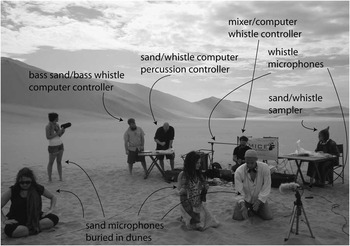
In a grand test of ‘mobile’ interactive computer ensemble work, MICE embarked in January of 2009 on a four-month adventure, travelling 30,000 miles by water in a global circumnavigation. During the tour, MICE performed in concert halls and other traditional venues, but also in extreme environmental conditions such as outdoors in the middle of the Atlantic Ocean, in the sand dunes of the Namibian desert (Figure 1), underwater in the middle of the Indian Ocean, and in other varied outdoor environments.
MICE Performing in the Namibian desert.

The tour was sponsored by the Institute for Shipboard Education, and numerous entities and organisations produced the individual concerts. Each of the 14 concerts had its own supporters and producers. Because MICE often performed on a ship, the M/V Explorer, the group had a built-in audience of approximately 700 people to attend on-ship concerts. When the ship landed at port, the group would travel to the concert site, transporting equipment, to perform concerts for local audiences. MICE performed in the following contexts:
• outdoors in the middle of the Atlantic Ocean using the energy of the wind to drive a bank of computers in a concert called Anemoi
• in equatorial Gabon in a concert called Sxueak
• in the Namibian desert using microphones buried in the dunes and performing the desert as a noise instrument and drum in a concert called Sandprints
• in Cape Town, South Africa at the Alfred Waterfront Arena
• in the middle of the Indian Ocean, underwater, using hydrophones and performers singing and playing percussion instruments underwater
• in Chennai, India at the SRM University
• in Singapore live on Pulse Radio over telematics with the National University of Singapore
• in Bangkok, Thailand at BUIC University
• in Hong Kong, China at the Tsim Sha Tsiu Harbour City
• in Yokohama, Japan at Yokohama City University
• during rough weather in the middle of the Pacific Ocean, using motion sensors attached to the ship's hull for a concert called Pacific Tilt
• in Honolulu, Hawaii for a Luau on the beach at Kapiolani Park
• in the Panama Canal, Panama during transit for a concert called El Mundo Unido broadcast live over 91.1 Radio in Charlottesville, Virginia
• back on the Atlantic Ocean at Virginia Beach, Virginia for a CD release party of MICE World Tour (MICE 2009).
Each engagement was an adventure with its own moments of drama, elation and anxiety. We were students of performance, but in the engagements with nature we learned what it means to work in performative environments. Something is performative if it causes a change in behaviour through its actuation. Performative speech, for example, is a statement that ‘does’ something rather than merely ‘representing’ something. ‘You are fired’ is a performative statement if spoken by one's boss. Such performativity in language is described by philosopher John Searle as ‘illocutionary speech acts’ (Searle Reference Searle1969). Performativity is not limited to speech but can extend to anything constituting the agency of an identity (Butler Reference Butler1990). Listening to the wind is performative if it creates the music. Touching the sand is performative if it creates the music.
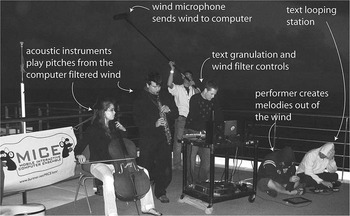
In order to fully embrace this performative aspect, the MICE compositions were written loosely and quickly, like sketches, sometimes composed right in the environment or just as we approached the location. The idea was to let the composition be effected by the environment. In the middle of the Atlantic Ocean, for example, for a concert called Anemoi, the group used a wind microphone to input real-time energy from the wind into a bank of computers to control resonant filters that created the harmony. The wind energy also fed a text synthesis engine containing texts of animist philosophy recorded in real time by spoken voices outside. The wind energy would blow fragments of the texts as if speaking through the philosophers of the past. A cellist and saxophonist listened to the filtered wind and played notes corresponding to what they heard, in counterpoint with the wind and computer synthesis.
The work explores a situation in which humans perform in counterpoint with the real-time forces of the environment. Anemoi teaches participants how to move in dialogue with the wind, how to listen to it as a musical partner. The computers enable the performers to focus the energy of the wind as an instrument. The audience, hearing this music created from the wind, also feels the real wind simultaneously in their own ears. This perceptual shift is the result of the engagement activism and it is enabled with real-time interactive technology, not with recording. Further, the music is not a musical descriptor of the system (such as we find in impressionism). The music contains aspects of the occurring physical system filtered through human technology and imagination in real time (Figure 2).
Description of the performance setup of MICE performing Anemoi in the middle of the Atlantic Ocean.

The trip required a level of flexibility that was at times harrowing but always unique. For example, the working method leading up to the Namibian Sandprints performance reveals how a typical engagement would come together. The concert was scheduled for 14 February in the Namib Desert in ‘the dunes’ (no further location would ever be revealed to MICE nor the audience because the dunes are constantly shifting and without address). On 4 February in Essaouira, Morocco, I started working on the concert. The plan was to use specially prepared hemispherical microphones and bury them in the sand dunes. Performers would play the sand as an instrument, and the sound radiating through the dunes would be transduced into a bank of computers also being performed by human performers. MICE included acoustic instrumentalists (cello, saxophone, percussion and mandolin), but I wanted any instrumental part to be performed by the people playing the sand. I decided that simple whistling would accompany the sand sounds and the two sound sources would blend together. Because the microphones would pick up dancing as low thumps, we chose to create a piece that would inspire the audience to participate by dancing on the dunes.
In Morocco, I gathered a large bag of sand and brought it onto the ship for rehearsals as we travelled down the west coast of Africa. Borrowing a large container from the kitchen, we created a mock desert to develop the sound system. In the following days I programmed Sandprints and we readied it for installation in the desert. By the time MICE arrived in Namibia the individual performer software programs were written. These included a percussive sampler for the whistle and sand sounds controlled by a multi-touch percussion controller, a bass whistle and sand sampler controlled by a Wacom tablet controller with a three-dimensional pen interface, and a multi-slider processing the sand sounds (Figure 3). Two players were designated as sand performers, and their job was also to teach the audience (who were also being transported to the location) how to play the piece so that they could join in. In Sandprints, the transduced sounds of human interaction with the sand dunes feed a bank of computer samplers controlled by human gestural interfaces. The sand and the whistling merge into a single expression of human–nature interaction. The practical details of installing and performing the concert also turn out to be a mediating factor. MICE quickly became experts at previously unimagined electroacoustic skills such as power management, cabling conservation and environmental insulation.
Description of the performance setup for MICE performing Sandprints in the Namibian desert.

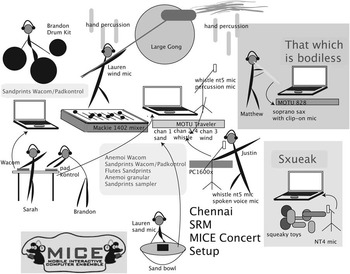
Cabling for every MICE show required audio, power and various types of data cables. These were carefully counted and measured in advance for the individual performance needs. Because equipment was often carried by hand, the amount of cabling was carefully controlled. Detailed diagrams of the performance setup helped economise the cabling (see Figure 4).
Sample MICE concert diagram showing the stage layout and system organisation.

For power, MICE adopted a system of ‘good’ power and ‘bad’ power. So-called good power came from the portable power source, a powerful battery that could run all the equipment including the audio system for a full rehearsal and concert. ‘Bad’ power (so-called) came from any other source provided by the venue no matter how it was described. Power strips marked ‘good’ and ‘bad’ insured that devices went to the correct source. Because it would have been very difficult to replace any blown piece of gear, power management was a critical issue of each concert setup. Certain devices could only take regulated power and these were run through the battery. Laptops and other less delicate devices could use varied power sources.
Power conservation was also an important factor for the remote concerts. In Namibia, MICE had absolutely no way to recharge anything out in the desert and so the entire setup, rehearsal and performance needed to be conducted with the utmost care to conservation. The battery would be shut off between system checks and even between pieces in the programme. With careful management MICE was able to perform a full rehearsal and a full concert, about three hours total time running the audio system and complete MICE setup.
Environmental insulation was essential in almost every case. The desert was a particularly difficult environment for a MICE performance because the blowing fine sand infiltrated everything instantly. A laptop left open in the sand, for example, would have been buried by blowing sand in five minutes. The night before the Sandprints concert in Namibia, every device was wrapped in clear plastic bags and taped air tight. Computers and devices were operated through the clear plastic. Cable connections required tearing a small hole in the plastic and taping around it. Every small opening in the plastic would immediately start collecting a small sand dune. In addition, the temperature was around 100 degrees Fahrenheit, and the sun beating down caused the electronics to overheat. Encased as they were in transparent plastic, they began to overheat extremely. The audio amplifiers started shutting down and required ventilation to run. But any ventilation allowed the sand dune to rush in. Using suitcases, MICE was able to erect sand barriers to help cut down on the direct sand blowing into the electronics while opening small slits to let the worst of the heat escape from the plastic casings.
A tank-like type of Namibian all-terrain truck transported MICE out into the desert and left the group there to set up. The truck and another identical one returned at the prescribed time with the audience, who joined the concert. In all, MICE spent about six hours out in the desert without shelter, studying the movement and texture and sound of the sand. The experience, for those who attended, both the performers and the audience, was transformative and powerful. The feeling of close concentration on the sand, and of carefully performing music in this harsh and stark environment, gave us pause. Pulling the soft sand through the hands and listening to it, for hours, transformed those who participated.
When we left the desert, we left no trace of our presence. The wind quickly erased our footprints. But the audience and performers left Namibia changed by the environment in ways we did not anticipate. Environmental artist Andy Reference GoldsworthyGoldsworthy became a source of philosophical strength for us during the tour. Goldsworthy has described his engagements with the environment in this way:
Looking, touching, material, place, making, the form and resulting works are integral; difficult to say where one stops and another begins. When I work with a leaf, rock, stick, it is not just material in itself, it is an opening into the processes of life within and around it. When I leave it, these processes continue. (1993: 160)
We were inspired by this quote throughout the tour, and, adding to Goldsworthy's observation, we considered the performative nature of the environment, that which we carried away inside.
The MICE tour was an exceptional adventure that took immense planning and preparation. But adventure does not need to involve remote lands or oceans. It is sufficient (and in many ways advantageous) to explore sites close to home. The opportunities that led to this trip are uncommon (although by no means unrepeatable). The M/V Explorer and the Institute for Shipboard Education create a unique programme, but they are only one of many available means for engaging with the world. The grand aspect of that adventure – circumnavigating the globe by water – was also a rare chance to suspend our typical life and experience new places and cultures.
Such trips allow us to reflect on the local and global impact of our movement and activities on the planet. Acutely aware of our status as guests in these unfamiliar cultures and environments, we became critical of our means of passage. We learned about the M/V Explorer itself: how it desalinates water to create fresh water at sea; how it recycles waste through a laborious process of sorting trash and compacting or incinerating it and then donating the valuable raw materials to host countries; how it manages feeding people fresh food without extensive waste by sorting waste foodstuffs and composting or grinding them into seafood. These are issues not just for discussion on a boat. How we manage fresh water, trash and food are important issues for all humans.
7. EcoSono Institute Caribbean Adventure
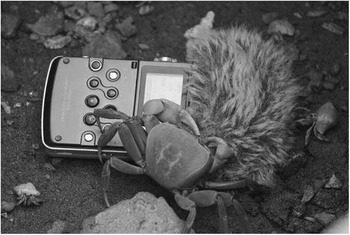
In 2010 a team of scientists and sound artists led by myself and biologist Reginald Garrett, a Professor at the University of Virginia, travelled throughout the Caribbean Sea and to Bahamas, St Kitts, Trinidad, Grenada, Dominica, Bonaire, Aruba, Curaçao and Puerto Rico (Figure 5). The team engaged in intensive study of the ecology, animals and sounds of this region, while also travelling. The team studied coral reefs, mangroves, whales and other sea life, and rainforests. Formal lectures included subjects such as ‘Electroacoustics in the Aerial Ocean’, ‘Coral Reefs’, ‘On Soundwalking’, ‘Computational and Mapping Approaches to Environmental Sound’, ‘Mangroves and Sea Grasses’, ‘Hydrophone Construction and Use’ and ‘Population, Hearing, and the Evolution of Language and Music’. In parallel to academic-style seminar work, the group pursued adventures in listening such as a study of coral reef sounds, resonant recordings of the Natural Pitch Lakes of Trinidad, wave-depth studies inside the coastal sand of Aruba, and sperm whale communications in Dominica.
Recording crabs in Bonaire on the EcoSono Institute Caribbean Adventure.

Each participant proposed a specific project and pursued that research project throughout the voyage as he or she also participated in collaborative projects and worked towards a final ecoacoustic concert. The participants are some of the most interesting among a new generation of environmental sound artists. Daniel Blinkhorn is integrating ecoacoustics into acousmatic electroacoustic music in surprising and original ways. Alex Wallace is pioneering sensor-based wearable computing and data mapping. And Stephanie Smith has heartedly embraced the combination of adventure travel and sound art.
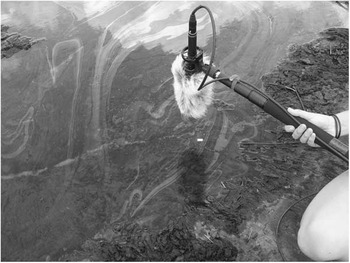
While it is difficult to isolate a single highlight that encapsulates the EcoSono Institute, the Trinidad Natural Pitch Lake expedition stands out because it was spectacularly unsuccessful and impactful in the unique way such adventure art can be. The pitch lakes of Trinidad at La Brea are the largest concentration of natural asphalt in the world, a pool of varying viscosity asphalt 70 metres deep in places. EcoSono Institute travelled here and ventured out into the molten asphalt in order to sink a hydrophone deep into the tar and listen for resonances inside the asphalt lake. A specially designed hydrophone was used, one optimised for heat and vibration sensitivity, and one inexpensive enough to be disposable should it become ruined. The toxic smell of the asphalt complements its smoldering heat and glasslike sharpness when hardened. The stuff burns and cuts at once. Most of the lake is knee-deep in rainwater with the asphalt bubbling up underneath in places and hardened in others. The trip requires a knowledgeable guide because pits of molten asphalt lie hidden beneath the water's surface. The team traversed in single file behind our guide for the slow twenty-minute hike out into the pitch lake. At the edge of a molten fissure we dropped the hydrophone down and listened for the sound. We were rewarded by nothing more than a powerful and muted silence in the headphones, and the intense stench of noxious hydrocarbon gas. The project seemed to be a failure until we discovered a vent of bubbling surface gas (Figure 6). The eerie popping of small bubbles in the highly viscous sludge reminded us that microbial life teems in this sludge without need for oxygen, interacting with the gasses and minerals, changing it and altering the environment. The realisation that the asphalt is full of life made it almost stranger, as if we were on another planet, a place not made for humans.
EcoSono Institute Team Recording the Pitch Lakes of Trinidad.

Most of the listening sessions were thrilling and productive. Tracking sperm whales from a catamaran off the coast of Dominica, hearing coral reefs in Bonaire and the Sea Turtle recordings stand out as success stories. But there is also something thrilling about the failed adventure. Perhaps nobody had ever listened to the Pitch Lakes of Trinidad before. Perhaps we were the first. And after all the effort and pain to reach that spot in the world, there is no silence more profound than that one we heard.
8. Agents Against Agency
In 2010, nine artists were asked to explore and document emergent forms and group improvisation in dialogue with nature. The resulting compilation, Agents Against Agency, is a collection of work that decentres human individualist expression – that is, ‘agency’. The collection was released as a DVD publication (EcoSono 2011)
The artists who took on this challenge each created their own project without any pre-knowledge about what the other groups were doing. The Australian/Taiwanese group 12 Dog Cycle explored the unique interplay of light and time in a resonant and abandoned brickworks factory in Melbourne, Australia, improvising as a trio of voice, accordion and saxophone (with guest saxophonist Rosalind Hall). Russian sound artist Yuri Spitsyn explored an environment of the audible circuitry of a laptop by using vibration sensors to amplify the acoustic sounds of the spinning hard drive, and creating a virtuosic performance of software and system manipulation. The Emergence Collective and IMRG presented the world's first piece for symphonic-scale human–computer orchestra, performed by the 250-person MICE Orchestra. Korea/California-based Pinko Communoids performed trio improvisations outdoors in a field in Maine, creating delicate electroacoustic interactions with the summer environment. The MICE Ensemble presented a video recording of the Sandprints performance discussed above, filmed in the Namib Desert. Ted Coffey set an ensemble of his home-made parabolic speakers in a river in Virginia, sculpting sound with an interplay of environment and these directional sound sources. The EMMI robotic collective installed a robot ensemble in the woods in early spring to perform algorithmic interactive percussion among the trees and leaves. For my video/computer/saxophone composition (dis)Locations, performed by saxophonist Michael Straus and myself, a saxophone was dissembled and scattered throughout the forest among the autumn leaves. The saxophone pieces are rediscovered and reconstructed in the course of the film. Finally, Wisconsin artists Christopher Burns and David Dinnell created Before the Seiche, a work that drifts like a computer fog of emergent digital feedback accompanied by film of natural systems presented in stark grey and black.
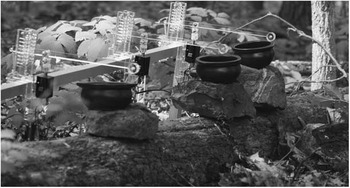
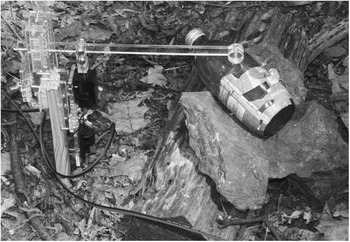
Agents Against Agency, like the MICE tour and EcoSono Institute, shifts the focus of environmental art-making towards the activism of engagement. In each piece, the process of environmental interaction overshadows the resulting media. The art is not in the mediation but in the experience. The DVD is as much a document of actions as a recording of works. None of the products arise from an acquisition model of art-making, but rather from an interactive model. The Expressive Machines Musical Instrument (EMMI) composition is an excellent example from the recording. EMMI are Troy Rogers, Scott Barton and Steven Kemper, and for the project they set up an ensemble of robots in the Virginia spring forest. They chose a relatively open and gently sloped site in the woods and then used whatever materials they found there in the music. The robots play tree branches (Figure 7), rustle leaves, tap on pieces of rubbish left in the forest (Figure 8), and play their own percussive bodies (drums and bells).
EMMI ‘Agents Against Agency’ performance image 1.
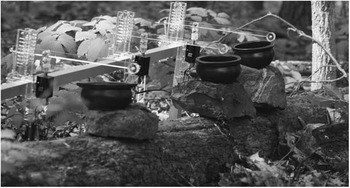
EMMI ‘Agents Against Agency’ performance image 2.

The composition begins with one robot shaking small stones in a box above a metal pan. As the stones fall through holes cut in the box they strike the pan. A microphone captures the sound of the stones falling and uses the resulting timed impulses as a rhythmic motive for the other robots. Through a complex series of permutations, the motive is expanded and reflected through the robot ensemble. Meanwhile the stones continue to fall, creating new patterns. The music emerges from this shaking, and the macrotimbre of the work is something both site specific and infused into the environment by the personality of the robots. The EMMI robots take on the principles of EcoSono interactive ecoacoustics and bypass human involvement for robotic–environment symbiotic engagement.
The EMMI piece beautifully sets technology in dialogue with nature without the direct mediation of humans. It reminds us that, in spite of many advances, our technology – the prosthesis of our minds and bodies – can pull us further from the natural world. The EcoSono approach attempts to refigure technology as a prosthesis that allows a performer, composer or listener to make music in collaboration with nature, not in the form of a virtual reality acquisition or mediation but through real human–environment interactions. We describe the experience of composing in collaboration with nature as sonic environmentalism.
EcoSono seeks to give the natural environment a participatory footing in the affairs of human music-making. By creating responsible interactions between the natural world and audiences, those involved may come to think in new ways about the environment. They may convince others of the need for sustainable practices, or they may join preservationist societies and activism networks.
This article begins with a journal entry from John Muir: ‘I only went out for a walk, and finally concluded to stay out till sundown, for going out, I found, was really going in.’ Writers and visual artists have long sought outdoor working environments, as a means of opening the mind's eye. Thoreau called it ‘reawakening’. Earth artists and musicians of the 1960s and 1970s took sculpture and instruments into the outdoors. In an age in which the computer studio is giving way to the personal mobile devices, computer musicians can push the boundaries of practical methodology. The imagination calls for it, and the world will listen back.