





Introduction
Self-care is the ability of individuals, families, and communities to promote health, prevent disease, maintain well-being, and cope with illness and disability, with or without the support of healthcare personnel (World Health Organisation, 2019). Postpartum sepsis is a life-threatening condition characterized by organ dysfunction caused by infection occurring during pregnancy, childbirth, or the postpartum period, as defined by the World Health Organization (WHO) (Pundir and Coomarasamy, Reference Pundir and Coomarasamy2016; World Health Organisation, 2017). Puerperal sepsis presents with foul-smelling vaginal discharge, abdominal tenderness, fever, and delayed uterine involution and is associated with factors such as prolonged rupture of membranes, pelvic infection, multiple vaginal examinations, and mode of delivery (World Health Organisation, 2017; Kumar and Yadav, Reference Kumar and Yadav2020; Seboka et al., Reference Seboka, Gurara, Bekele, Belachwe, Getahun and Negussie2024).
Globally, puerperal sepsis is among the preventable leading causes of maternal morbidity and mortality in both developing and developed countries (Atlaw et al., Reference Atlaw, Woldeyohannes and Berta2019; Plante et al., Reference Plante, Pacheco and Louis2019; Kumar and Yadav, Reference Kumar and Yadav2020). The evidence indicates that puerperal sepsis further causes pelvic infection and infertility if not treated early (World Health Organisation, 2017; Christiana et al., Reference Christiana, Eunice, Laraba, Lishikah, Tongdima, Nanko, Mary and Nanmi2023). Moreover, when mothers suffer from puerperal sepsis, they are unable to care for their children, which increases the chance of early neonatal loss (Bellizzi et al., Reference Bellizzi, Bassat, Ali, Sobel, Temmerman and Simeoni2017; Fenny et al., Reference Fenny, Otieku, Akufo, Obeng-Nkrumah, Asante and Enemark2021).
Worldwide, approximately 260,000 maternal deaths occur annually, with the majority occurring in low-and middle-income countries, particularly in Africa. Maternal infections, including puerperal sepsis, account for about 10–15% of these deaths (World Health Organisation, UNICEF, UNFPA, 2023). In developing countries, puerperal sepsis continues to be a major contributor to maternal morbidity and mortality, responsible for about 15% of maternal deaths (Berhan and Berhan, Reference Berhan and Berhan2014; Lindtjørn et al., Reference Lindtjørn, Mitiku, Zidda and Yaya2017; Souza et al., Reference Souza, Day, Rezende-Gomes, Zhang, Mori, Baguiya, Jayaratne, Osoti, Vogel, Campbell, Mugerwa, Lumbiganon, Özge, Cresswell, Say, Moran and Oladapo2024).
In African countries, the prevalence of puerperal sepsis ranges from 2% to 24% (Bishaw et al., Reference Bishaw, Sharew, Beka, Aynalem, Zeleke, Desta, Kassie, Amha, Eshete, Tamir, Bantigen, Mulugeta, Ferede and Bitewa2023; Bolanle et al., Reference Bolanle, Ojo, Olawade, Aluko and Esan2024; Halil et al., Reference Halil, Abdo, Hassen and Ebro2025), often leading to surgical complications, multi-organ damage, and death (Kumar and Yadav, Reference Kumar and Yadav2020). Evidence shows that sepsis requires urgent medical attention, early treatment, and resuscitation. Healthcare personnel should promptly diagnose and treat sepsis within an hour to prevent organ damage and improve survival, even in the absence of fever (Plante et al., Reference Plante, Pacheco and Louis2019).
Previous findings indicate that, beyond healthcare provider interventions, mothers’ self-care plays a significant role in promoting well-being during the postpartum period. Self-care refers to a mother’s ability to care for herself through good hygiene, nutrition, exercise, rest, and attention to physical appearance (World Health Organisation, 2019; Barkin et al., Reference Barkin, Wisner and Drive2020). However, evidence revealed that mothers generally have fewer self-care practices for the prevention of puerperal sepsis. Approximately 54.4% to 75% of postpartum women demonstrated poor self-care practices (Sultana et al., Reference Sultana, Methe and Faisal Muhammad2018; Hassan et al., Reference Mohammed Hassan, Mohamed and Solimen2021; Abdel-fattah et al., Reference Abdel-fattah, Abdel-Moniem and Farrag2022; Nchimbi and Joho, Reference Nchimbi and Joho2022; Teferi et al., Reference Teferi, Terefe, Temesgen, Seyoum, Ejigu Debebe, Kene, Geta and Wedajo2024).
A study in Egypt showed that more than half of the participants reported poor self-care practices (Abdel-fattah et al., Reference Abdel-fattah, Abdel-Moniem and Farrag2022). Similarly, in Bangladesh, puerperal sepsis self-care practices were poor (Sultana et al., Reference Sultana, Methe and Faisal Muhammad2018). In Tanzania, more than four-fifths of mothers had poor self-care practices (Nchimbi and Joho, Reference Nchimbi and Joho2022). Likewise, a study in Ethiopia indicated more than half of postpartum mothers had poor puerperal sepsis prevention practices (Teferi et al., Reference Teferi, Terefe, Temesgen, Seyoum, Ejigu Debebe, Kene, Geta and Wedajo2024). Self-care practices for puerperal sepsis prevention in the postpartum period include a range of behaviors aimed at reducing infection risk and promoting recovery. These include maintaining perineal hygiene and proper handwashing, regular changing of sanitary pads, wound care and monitoring of vaginal discharge, adequate nutrition and fluid intake, postpartum physical activity, adherence to postpartum care visits, and recognition of danger signs such as fever and abnormal vaginal discharge (World Health Organisation, 2019; Nchimbi and Joho, Reference Nchimbi and Joho2022; Teferi et al., Reference Teferi, Terefe, Temesgen, Seyoum, Ejigu Debebe, Kene, Geta and Wedajo2024; Abera et al., Reference Abera, Tetema, Zeleke, Metebo, Derribow, Gelmesa, Benti Terefe, Gudeta, Dabala, Weldeyohans, Gabure Shukulo and Senbeta2025a).
In Ethiopia, the maternal mortality ratio decreased from 401 in 2017 to 267 in 2020; however, further improvements are needed to achieve the target of 70 per 100,000 live births by 2030, as approximately 12,000 mothers die each year. Moreover, thirteen percent of these deaths are attributed to puerperal sepsis (Berhan and Berhan, Reference Berhan and Berhan2014; Ministry of Health, 2017; Lindtjørn et al., Reference Lindtjørn, Mitiku, Zidda and Yaya2017; Souza et al., Reference Souza, Day, Rezende-Gomes, Zhang, Mori, Baguiya, Jayaratne, Osoti, Vogel, Campbell, Mugerwa, Lumbiganon, Özge, Cresswell, Say, Moran and Oladapo2024). By 2026, Ethiopia aims to reduce maternal mortality to 199 per 100,000 live births to achieve Sustainable Development Goal 3.1 by 2030 through the reduction of direct causes, including puerperal sepsis (Ministry of Health, 2022). Hence, to achieve this plan, addressing contributors to maternal morbidity and mortality is essential.
In Ethiopia, primary healthcare is delivered through the Health Extension Program, where Health Extension Workers provide community-based maternal health services, including health education, home visits, and antenatal and postpartum follow-up. These services are important for promoting hygienic postpartum practices and preventing maternal complications such as puerperal sepsis.
Even though a high burden of puerperal sepsis exists in most developing settings, existing literature suggests that self-care practices for the prevention of puerperal sepsis in Central Ethiopia remain underexplored, with limited empirical evidence documenting their nature and influence on maternal health outcomes. This study aimed to assess self-care practices for puerperal sepsis prevention and their determinants among postpartum women in Halaba Town, Central Ethiopia.
Methods and materials
Study setting and period
The Halaba Zone is located in the Central Ethiopia region. Based on the 2017 census conducted by the Central Statistical Agency of Ethiopia, Halaba Zone has a total population of 232,325, of whom 117,291 are men, and 115,034 are women. Halaba Kulito Town is located in Central Ethiopia and serves as the administrative centre of Halaba Zone. It is approximately 220 km south of Addis Ababa and is situated at 7°18′44″ N, 38°05′21″ E. The town consists of five kebeles and has one general hospital, one health centre, and five health posts (Figure 1). A community-based cross-sectional study was conducted in Halaba Town from February 1 to March 30, 2025.
Map showing the location of Halaba Town in Halaba Zone, Central Ethiopia, 2025.

Study population and their eligiblity criteria
Source population:
All postpartum women residing in Halaba Town.
Study population:
All postpartum women residing in Halaba Town who had given birth within the first six weeks during the study period.
Inclusion criteria:
All postpartum women within the first six weeks after delivery who had lived in the town for at least six months during the study period and who were willing to participate in the study were included.
Exclusion criteria:
Postpartum women who were critically ill during data collection were excluded from the study.
Sample size determination
The sample size was calculated using a single population proportion formula by considering 45.6% (prevalence of self-care practices for puerperal sepsis prevention) (Teferi et al., Reference Teferi, Terefe, Temesgen, Seyoum, Ejigu Debebe, Kene, Geta and Wedajo2024), with a 95% confidence interval and a 0.05 margin of error.
 $$\begin{align}\boldsymbol{n}&={{{(\boldsymbol{Z}}{\boldsymbol{\alpha}}/{\bf 2}){{\bf 2{\boldsymbol{p}}}({\bf 1}-{\boldsymbol{p}})} \over {\boldsymbol{d}}{\bf 2}}}{=}\boldsymbol{n}={\left({\bf 1.96}\right){\bf 2}{\bf{*}}({\bf 0.456}){\bf{*}}({\bf 0.544}) \over ({\bf 0.05}){\bf 2}} \\&={ {381.19 \approx\; }\bf 381}\end{align}$$
The sample size was rounded up to 382 to ensure adequacy and correct arithmetic calculation of the sample size. After adding a 10% non-response rate, the final sample size was 420.
In Halaba town, there are five kebeles, and all were enrolled in this study. In the town, the estimated number of deliveries within the first 6 weeks in each Kebele was 793, from the logbooks of health extension workers. The sample was allocated proportionally to each kebele (Denbefam 85, Murasa ber 68, Lenda ber 119, Mehal Arad 93, and Wanja ber 55). A systematic random sampling technique was employed to select study participants. The sampling interval (K) was calculated using K = N/n, which yielded approximately two. A simple random sampling method was used to select the first participant (starting point) at the household level from the first two eligible postpartum women in each kebele. Thereafter, every second postpartum woman was selected until the required sample size was reached. If more than one eligible postpartum woman was found in a selected household, one was selected randomly.
Study variables
The dependent variable was self-care practices for the prevention of puerperal sepsis. The independent variables included sociodemographic factors (age, ethnicity, residence, religion, marital status, educational level, occupation, and family wealth index), obstetric related factors (parity, number of antenatal care (ANC) contacts, place of ANC contact, gestational age at first ANC visit, and place of birth), and postpartum behavioural and health-related factors (postpartum danger signs, nutrition, exclusive breastfeeding, immunization schedule, hygiene practices, physical exercise, family planning use, knowledge of puerperal sepsis, and counselling received on its symptoms).
Additionally, exclusive breastfeeding and immunization schedule were included as they are key components of routine postpartum counselling and may reflect a woman’s engagement with recommended postpartum care services. These practices may also serve as proxies for overall health-seeking behaviour, which could influence adherence to self-care practices for the prevention of puerperal sepsis.
Operational definitions
Self-care is the capability of women to promote health, prevent disease, and maintain well-being with or without the support of the healthcare personnel (World Health Organisation, 2019).
According to the WHO, puerperal sepsis is a genital tract infection occurring from membrane rupture or labour up to 42 days postpartum, marked by pelvic pain, fever, abnormal vaginal discharge, foul odour, or delayed uterine involution (World Health Organisation, 2017).
In this study, postpartum mothers scoring at or above the mean on self-care practice questions were considered to have good self-care practices, whereas those scoring below the mean were considered to have poor self-care practices for preventing puerperal sepsis (Sultana et al., Reference Sultana, Methe and Faisal Muhammad2018; Nchimbi and Joho, Reference Nchimbi and Joho2022; Teferi et al., Reference Teferi, Terefe, Temesgen, Seyoum, Ejigu Debebe, Kene, Geta and Wedajo2024).
Family income was scored based on assets and housing characteristics, analysed using Principal Component Analysis (PCA), and divided into three categories: poor (1st–2nd quintiles), medium (3rd quintile), and rich (4th–5th quintiles) (Chakraborty et al., Reference Chakraborty, Fry, Behl and Longfield2016; Abera et al., Reference Abera, Belay, Derribow, Bacha and Belina2025b; Tengo et al., Reference Tengo, Aliyu, Endalew and Adafirie2025a).
Data collection tool and procedures
The tool was adapted from previous literature for collecting data (Sultana et al., Reference Sultana, Methe and Faisal Muhammad2018; Nchimbi and Joho, Reference Nchimbi and Joho2022; Teferi et al., Reference Teferi, Terefe, Temesgen, Seyoum, Ejigu Debebe, Kene, Geta and Wedajo2024). The questionnaire was prepared in English, translated into the local language, and back-translated to English to ensure consistency. The tools contained socio-demographic, obstetrics-related factors, women’s knowledge of puerperal sepsis, and self-care practices to prevent puerperal sepsis.
Self-care practices were assessed using sixteen practice-related questions, with the overall mean computed and dichotomized: mothers scoring the mean and above were coded ‘1’ for good self-care practices, and those scoring below the mean were coded ‘0’ for poor self-care practices. This research used a validated tool, pre-tested for clarity and reliability, with content validity checked by field experts. The self-care practice scale consisted of sixteen items and demonstrated excellent internal consistency, with a Cronbach’s alpha of 0.97. The high alpha value reflects strong reliability of the scale rather than item redundancy, as the items assessed different aspects of postpartum self-care practices for the prevention of puerperal sepsis. Data were collected through face-to-face household interviews by five BSc nurses and one MSc midwife supervisor who spoke the local languages.
Data quality management
The questionnaire was pre-tested on 5% of the sample size at Sinbita kebele prior to the actual data collection to ensure clarity, consistency, and appropriateness of the data collection tool. Following the pretest, necessary modifications were made, and the pretest data were excluded from the final analysis. Two days of training were provided for data collectors and supervisors on the objectives of the study, interviewing techniques, ethical considerations, and proper completion of the questionnaire to ensure data quality and consistency throughout the data collection process.
The supervisors closely monitored data collection, checked questionnaires daily for completeness and consistency, and provided immediate feedback to data collectors on time. After data collection, all questionnaires were rechecked before data entry. Double data entry was then performed using the EpiData software system. In addition, data cleaning was performed using simple frequencies and graphical methods, including box plots, to identify missing values and outliers.
Statistical analysis
After the data were coded and entered into EpiData version 4.60, they were exported to SPSS version 27 for analysis. The household wealth index was computed using principal component analysis (PCA) based on 15 household asset items. The adequacy of the data for PCA was assessed using the Kaiser–Meyer–Olkin (KMO) measure and Bartlett’s test of sphericity. Components with eigenvalues greater than 1 were retained, and the first principal component was used to generate the wealth index, which was categorized into quintiles. These quintiles were further recategorized into three categories: poor (1st–2nd quintiles), medium (3rd quintile), and rich (4th–5th quintiles). Descriptive statistics, including frequencies, percentages, means, and standard deviations, were computed to summarize the data. Binary logistic regression was first performed to identify candidate variables, and variables with p ≤ 0.25 were entered into the multivariable logistic regression model.
The adequacy of the multivariable model was assessed using events per variable, with a minimum threshold of ≥10 considered acceptable. Model fitness was confirmed by the Hosmer and Lemeshow test (p = 0.527), omnibus tests (p < 0.001), and multicollinearity checked via variance inflation factor (maximum = 2.91) and tolerance (minimum = 36.9%) for predictors of self-care practice for puerperal sepsis prevention, indicating no multicollinearity issues. Additional model diagnostics, including assessment of influential observations using Cook’s distance and leverage values, confirmed that no single observation unduly influenced the model estimates. Statistical significance was declared at a p-value less than 0.05, and adjusted odds ratios (AORs) with 95% confidence intervals were used to report associations. Finally, the findings were reported in narration and tables.
Results
Socio-demographic characteristics of the respondents
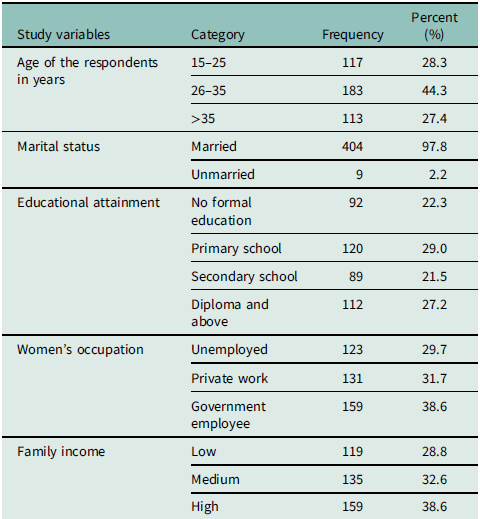
A total of 413 participants were interviewed, resulting in a response rate of 98.3%. Of the respondents, 183 (44.3%) were aged 26–35 years (30.1 ± 7.5 SD). Approximately 120 participants (29.0%) had attained primary education, and 159 (38.6%) reported a high family income (Table 1).
Socio-demographic characteristics of postpartum women in Halaba Town, Central Ethiopia, 2025 (n = 413)

Table 1. Long description
A table with four columns and five rows, detailing socio-demographic characteristics of postpartum women in Halaba Town, Central Ethiopia, 2025. The columns are labeled Study variables, Category, Frequency, and Percent (%). The rows are grouped by different study variables: Age of the respondents in years, Marital status, Educational attainment, Women’s occupation, and Family income. Each row provides categories, frequencies, and percentages for each variable. For example, the Age of the respondents in years is divided into three categories: 15-25, 26-35, and over 35, with frequencies of 117, 183, and 113, and percentages of 28.3%, 44.3%, and 27.4%, respectively. The table provides a detailed breakdown of the socio-demographic characteristics of the respondents.
Note: Unemployed means women who were not engaged in formal government or private employment, including housewives and those engaged in informal or unpaid activities.
Obstetrics-related factors of the study respondents
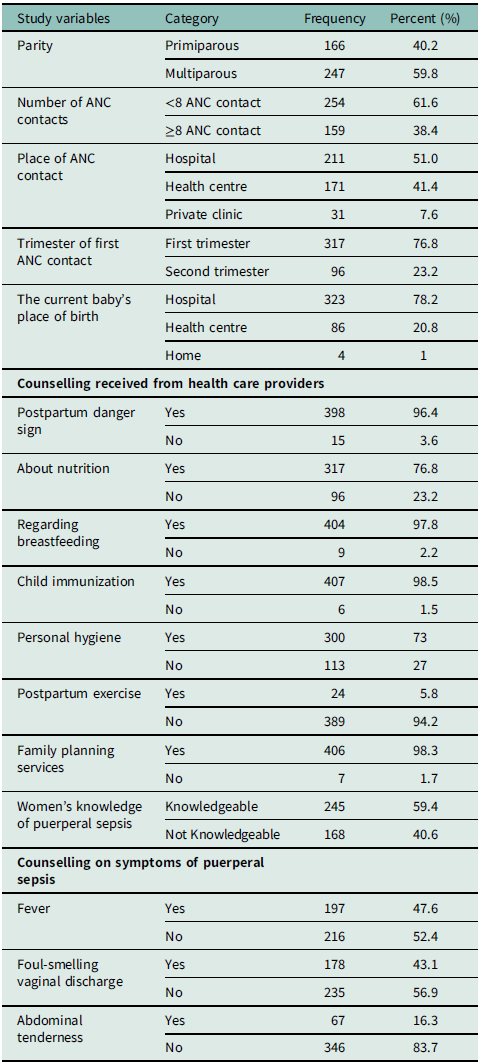
More than half of the study participants (59.8%) were multiparous. A total of 159 (38.4%) respondents had ≥8 ANC contacts, with a mean ANC contact of 5.4 ± 3.0 SD, and 76.8% of respondents started their follow-up in early pregnancy (first trimester).
All respondents reported receiving at least one form of postpartum counselling from health care providers after delivery. However, counselling was delivered on different components rather than as a uniform package, and coverage varied across specific topics. The most commonly reported counselling components were child immunization (98.5%) and family planning (98.3%), followed by breastfeeding (97.8%) and postpartum danger signs (96.4%). In contrast, counselling on postpartum exercise was very low (5.8%).
Regarding specific symptoms of puerperal sepsis, less than half of the women reported receiving counselling on fever (47.6%), foul-smelling vaginal discharge (43.1%), and abdominal tenderness (16.3%). Furthermore, 245 (59.4%) of postpartum women were knowledgeable regarding puerperal sepsis (Table 2).
Obstetrics-related factors of postpartum women in Halaba Town, Central Ethiopia, 2025 (n = 413)

Table 2. Long description
A table summarizing obstetrics-related factors of postpartum women in Halaba Town, Central Ethiopia, 2025. The table has 14 rows and 3 columns. The columns are labeled Study variables, Category, Frequency, and Percent. The rows are grouped into sections: Parity, Number of ANC contacts, Place of ANC contact, Trimester of first ANC contact, The current baby’s place of birth, Counselling received from health care providers, Women’s knowledge of puerperal sepsis, and Counselling on symptoms of puerperal sepsis. Each row lists specific categories and their corresponding frequency and percent values. Notable categories include Parity with Primiparous and Multiparous, Number of ANC contacts with less than 8 and 8 or more, Place of ANC contact with Hospital, Health center, and Private clinic, Trimester of first ANC contact with First trimester and Second trimester, The current baby’s place of birth with Hospital, Health center, and Home, Counselling received from health care providers on various topics, Women’s knowledge of puerperal sepsis with Knowledgeable and Not Knowledgeable, and Counselling on symptoms of puerperal sepsis including Fever, Foul-smelling vaginal discharge, and Abdominal tenderness.
ANC: Antenatal care.
Self-care practices to prevent puerperal sepsis
The overall prevalence of good self-care practices for the prevention of puerperal sepsis was 43.8% (95% CI: 39.1%–48.5%). In addition to the overall self-care classification, individual self-care practices were assessed. The most commonly reported practices included perineal hygiene and handwashing practices, health-seeking and follow-up practices, and wound care and vaginal discharge monitoring practices, which were practiced by most respondents. In contrast, practices such as sanitary pad management, postpartum physical activity, nutritional and fluid intake, and recognition and response to danger signs were less frequently reported.
Determinants of self-care practices to prevent puerperal sepsis
In binary logistic regression analysis, candidate variables were selected for multivariable logistic regression at a p-value of ≤0.25. Variables such as educational attainment, occupation, family income, parity, ANC contacts, and women’s knowledge regarding puerperal sepsis were identified as candidate variables for multivariable logistic analysis.
These candidate variables were entered into a multivariable logistic regression using the backward method to determine the final determinants of women’s self-care practices to prevent puerperal sepsis while controlling for potential confounders.
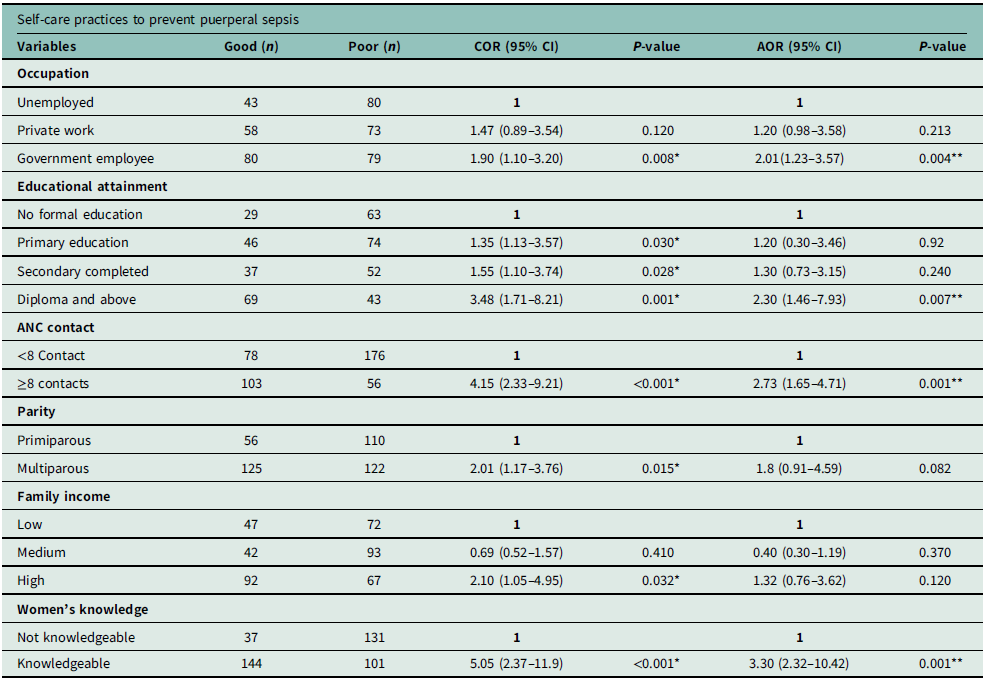
In multivariable analysis, four variables, such as educational attainment, occupation, ≥8 ANC contacts, and women’s knowledge, were identified as determinants of self-care practices to prevent puerperal sepsis after adjusting for confounders in the final model.
Postpartum women who were government employees were two times more likely (AOR = 2.01; 95% CI: 1.23–3.57) to have good self-care practices to prevent puerperal sepsis than those who were unemployed.
Postpartum women who had completed a diploma or higher education were 2.30 times more likely (AOR = 2.30; 95% CI: 1.46–7.93) to have good self-care practices to prevent puerperal sepsis than those who did not attend formal education.
Postpartum women who attended ≥8 ANC contacts were 2.73 times more likely (AOR = 2.73; 95% CI: 1.65–4.71) to have good self-care practices compared to their counterparts.
Postpartum mothers who were knowledgeable were 3.30 times more likely to have good self-care practices for puerperal sepsis prevention compared to those who were not knowledgeable about puerperal sepsis (AOR = 3.30; 95%CI:2.32–10.42), indicating a statistically significant association. However, the relatively wide confidence interval suggests limited precision, likely due to sparse data in some cells; therefore, the result should be interpreted with caution. Variables such as private work, primary education, completion of secondary education, parity, and family income were not statistically significant after adjustment in the final model (Table 3).
Bivariable and multivariable analysis of self-care practices to prevent puerperal sepsis in Halaba Town, Central Ethiopia, 2025 (n = 413)

Table 3. Long description
A table with 10 rows and 7 columns comparing self-care practices to prevent puerperal sepsis by various variables. The columns are labeled as Variables, Good (n), Poor (n), COR (95% CI), P-value, AOR (95% CI), and P-value. The variables include Occupation, Educational attainment, ANC contact, Parity, Family income, and Women’s knowledge. Each row provides data for these variables, showing the number of good and poor practices, the crude odds ratio (COR) with 95% confidence interval (CI), the P-value for COR, the adjusted odds ratio (AOR) with 95% CI, and the P-value for AOR. Notable trends include higher odds of good self-care practices among government employees, those with a diploma and above, those with more ANC contacts, and those who are knowledgeable about puerperal sepsis.
Note: ANC: Antenatal Care, AOR: Adjusted Odds Ratio, COR: Crude Odds Ratio, CI: Confidence Interval, 1: Reference,*: significant candidate variables for multivariable analysis at p ≤ 0.25,**: statistically significant at p < 0.05.
Discussion
This community-based cross-sectional study assessed self-care practices for the prevention of puerperal sepsis and identified their determinants. Poor self-care practices during the postpartum period remain a major contributor to maternal morbidity and mortality, increasing the risk of postpartum complications among mothers. The overall prevalence of good self-care practices for the prevention of puerperal sepsis was 43.8% (95% CI: 39.1%–48.5%). This indicates that more than half of the respondents had poor self-care practices for the prevention of puerperal sepsis. This finding is consistent with a study conducted in Arba Minch, Town (45.6%) (Teferi et al., Reference Teferi, Terefe, Temesgen, Seyoum, Ejigu Debebe, Kene, Geta and Wedajo2024). The result is higher compared to studies conducted in Egypt (25.3%) and Tanzania (11.4%) (Hassan et al., Reference Mohammed Hassan, Mohamed and Solimen2021; Nchimbi and Joho, Reference Nchimbi and Joho2022). The differences in prevalence between the current study and those conducted in Egypt and Tanzania may be attributed to methodological and contextual variations. The present study was community-based, whereas the studies from Egypt and Tanzania were facility-based, which may introduce selection bias and differences in exposure to maternal health services and counselling. In addition, although the included studies assessed self-care practices for puerperal sepsis prevention using broadly comparable operational definitions, minor differences in scoring methods and cut-off points may have influenced prevalence estimates. Variations in study period may also reflect changes in maternal health service coverage and awareness over time. Other contributing factors may include differences in counselling on postpartum danger signs, women’s knowledge of puerperal sepsis, and variations in educational status and awareness of preventive practices.
In this study, government employees, diploma and above educational attainment, ≥8 antenatal contacts, and women’s knowledge regarding puerperal sepsis were determinants of self-care practices to prevent puerperal sepsis. Postpartum women who were government employees were 2.01 times more likely to have good self-care practices to prevent puerperal sepsis. Beyond the relative association, absolute differences further highlighted disparities in self-care practices across occupational groups, with government-employed women reporting a higher proportion of good self-care practices (44.2%) compared with unemployed women (23.8%) and those engaged in private work (32%). This finding suggests that occupation-related differences in access to information and health services may influence postpartum self-care behaviors. The possible justification is that women who are government employees have information regarding puerperal sepsis prevention as well as access to reproductive health care services compared to unemployed women (Akhter et al., Reference Akhter, Khatun, Afrin, Akter, Halder, Biswas and Dey2025). This finding is similar to a study conducted in Tanzania (Nchimbi and Joho, Reference Nchimbi and Joho2022). Women with a diploma or higher were 2.30 times more likely to have good self-care practices to prevent puerperal sepsis than their counterparts. These findings are consistent with studies conducted in Bangladesh, Tanzania, Arba Minch Town, and Egypt (Sultana et al., Reference Sultana, Methe and Faisal Muhammad2018; Hassan et al., Reference Mohammed Hassan, Mohamed and Solimen2021; Nchimbi and Joho, Reference Nchimbi and Joho2022; Teferi et al., Reference Teferi, Terefe, Temesgen, Seyoum, Ejigu Debebe, Kene, Geta and Wedajo2024). The evidence revealed that mothers’ knowledge increased as their education status increased (Sultana et al., Reference Sultana, Methe and Faisal Muhammad2018; Nchimbi and Joho, Reference Nchimbi and Joho2022).
The mothers who attended ≥8 ANC contacts were 2.73 times more likely to have good self-care practices to prevent puerperal sepsis compared to their counterparts. During antenatal follow-up, the chance to receive information on puerperal sepsis and its prevention from healthcare providers increases, which enhances their self-care practices. The current findings revealed that, as antenatal contacts increase, the self-care practice to prevent puerperal sepsis also increases (Nchimbi and Joho, Reference Nchimbi and Joho2022; Lee et al., Reference Lee, Adam, Kanyike, Wani, Kasibante, Mukunya and Nantale2024). Furthermore, mothers who attend antenatal care during pregnancy could be more aware of postpartum danger signs and self-care during the postpartum period (Abera et al., Reference Abera, Tetema, Zeleke, Metebo, Derribow, Gelmesa, Benti Terefe, Gudeta, Dabala, Weldeyohans, Gabure Shukulo and Senbeta2025a; Tengo et al., Reference Tengo, Aliyu, Endalew and Adafirie2025b).
Postpartum women who were knowledgeable were 3.3 times more likely to have good self-care practices to prevent puerperal sepsis as compared to those who were not knowledgeable. This finding aligns with studies conducted in Tanzania, Arba Minch, and Egypt (Hassan et al., Reference Mohammed Hassan, Mohamed and Solimen2021; Nchimbi and Joho, Reference Nchimbi and Joho2022; Teferi et al., Reference Teferi, Terefe, Temesgen, Seyoum, Ejigu Debebe, Kene, Geta and Wedajo2024). The possible explanation may be that knowledgeable women are more likely to engage in health-protective behaviors and adopt recommended self-care practices during the puerperal period (Bishaw et al., Reference Bishaw, Worku and Tilahun2022; Abera et al., Reference Abera, Tetema, Zeleke, Metebo, Derribow, Gelmesa, Benti Terefe, Gudeta, Dabala, Weldeyohans, Gabure Shukulo and Senbeta2025a). Further, higher levels of knowledge may be associated with improved self-care practices among mothers (Mostafa et al., Reference Mostafa, Gamel, Genedy and Hassan2020).
Furthermore, this study highlighted important gaps in the content of postpartum counselling provided to mothers. Although counselling on general personal hygiene was relatively common (73%), essential components related to puerperal sepsis prevention, such as counselling on abdominal tenderness as a danger sign (16.3%), were considerably less emphasized. In addition, counselling on postpartum exercise was notably low (5.8%), suggesting that important aspects of physical recovery received limited attention. These findings indicate that postpartum counselling may lack comprehensiveness and appear to place greater emphasis on general hygiene practices than on critical danger signs and recovery-related information. Such variations in counselling content may have important implications for maternal knowledge and self-care practices, as inconsistent counselling may limit women’s ability to effectively engage in optimal postpartum self-care within the self-care framework (Yeneabat et al., Reference Yeneabat, Hayen, Getachew and Dawson2022; Abera et al., Reference Abera, Tetema, Zeleke, Metebo, Derribow, Gelmesa, Benti Terefe, Gudeta, Dabala, Weldeyohans, Gabure Shukulo and Senbeta2025a). Hence, these results indicated gaps in self-care practices to prevent puerperal sepsis among mothers in Halaba Town, Central Ethiopia. The findings suggest that enhancing health education during postpartum visits is crucial. Improving ANC quality, women’s education, and counselling on postpartum danger signs can enhance self-care practices and reduce maternal complications, morbidity, and mortality.
Strengths and limitations of the study
The study employed a community-based cross-sectional design with an adequate sample size and a response rate of 98.3%, enhancing the reliability and representativeness of the findings. Potential biases were minimized through clear objectives, pretested questionnaires, training of data collectors and supervisors, random sampling, and statistical adjustment for confounding variables. Ethical guidelines were followed to ensure unbiased participation.
However, this study has several limitations that should be considered when interpreting the findings. First, the classification of self-care practices was based on mean-based dichotomization of the outcome, which may limit comparability with other studies and influence the estimated prevalence of good and poor practices. Second, recall bias may have affected participants’ responses regarding postpartum self-care practices, potentially leading to either overestimation or underestimation of actual behaviors. Third, social desirability bias may have been introduced due to the use of face-to-face interviews, which could have resulted in over-reporting of recommended practices. In addition, the cross-sectional design of the study limits the ability to establish causal relationships, and the observed associations, such as those involving knowledge, antenatal care, and counselling, may be subject to confounding or reverse causality. The exclusion of critically ill postpartum women may have led to an underestimation of poor self-care practices. Furthermore, because the study was conducted in Halaba Town, the findings may not be generalizable to rural populations or other regions of Ethiopia. Finally, the use of health extension worker logbooks as the sampling frame may have introduced selection bias if some eligible women were not fully registered.
Conclusion
The present findings indicated that more than half of the respondents had poor self-care practices for preventing puerperal sepsis. Maternal educational attainment, occupational status, ANC contacts, and knowledge of puerperal sepsis were associated with self-care practices. Modifiable factors may therefore be associated with improved self-care practices among postpartum mothers. Hence, strengthening ANC follow-up, focusing on women with low educational attainment and unemployed women, and improving women’s knowledge may help enhance awareness and prevention of puerperal sepsis.
Recommendations
The following recommendations were given based on the findings: It is encouraged to provide targeted health education on puerperal sepsis and its prevention during ANC contact, using simple and culturally appropriate materials to improve women’s self-care practices. Further, at the community level, community-based campaigns focusing on mothers with lower educational levels should be designed, and health extension workers should be encouraged to disseminate information at the household level to enhance self-care practices for preventing puerperal sepsis.
Moreover, targeted strengthening of postpartum counselling is recommended, particularly focusing on improving the delivery of key puerperal sepsis danger signs, such as abdominal tenderness, which was reported by only a small proportion of women. In addition, health extension workers and maternal health providers should be trained to ensure standardized and comprehensive postpartum counselling that includes essential self-care components beyond general hygiene practices, such as postpartum exercise and recognition of danger signs. Strengthening these areas may improve women’s knowledge and subsequent self-care practices. In addition, further qualitative studies are recommended to explore barriers and facilitators of postpartum self-care practices in depth.
Data availability statement
Data that support the findings are available from the corresponding author upon a reasonable request (Email: aberashbey217@gmail.com).
Acknowledgements
The authors would like to thank Wolkite University for granting ethical approval. Authors also extend their gratitude to study participants, data collectors, and the supervisor for their unreserved efforts and willingness to participate in this research study.
Author contributions
ABD and MA wrote the proposal, participated in data collection supervision, analysed the data, and drafted the paper. MDS, BSM, AB, MGS and KNM approved the proposal with some revisions, participated in data analysis, and revised subsequent paper drafts. MA and ABD critically reviewed and revised the manuscript for important intellectual content and participated in the revision. All authors made substantial contributions to the work, critically reviewed the manuscript, approved the final version for publication, and agree to be accountable for all aspects of the work.
Funding statement
The author(s) received no financial support for this article’s research, authorship, and/or publication.
Competing interests
There is no potential conflict of interest concerning the research, authorship, and/or publication of this article.
Ethical standards
Ethical clearance was obtained from the Wolkite University, College of Medicine and Health Sciences Ethics Committee (Ref no. WKU-REC/009/2025). A formal letter of permission was obtained from Wolkite University to the Halaba Zonal Health Office and the kebeles to allow the execution of the research. The study was conducted in accordance with the ethical standards of the Declaration of Helsinki. An ethical letter was written to the Halaba town health office to obtain permission for data collection. The purpose of the study and participants’ right to refuse were explained to the study participants, and informed written consent was obtained. Moreover, consent from participants with no formal education was obtained after the information sheet was read aloud in the local language and documented by thumb impression with a witness. Additionally, written informed consent was obtained from the legally authorized representatives of all participants under 18 years old before enrollment. Coding was implemented to remove respondents’ names and other personal identifiers throughout the study to ensure participant confidentiality.
Consent for publication
Not applicable.


 Open access

