1. The Dispositional Reflexive construction in Russian
Russian has a Dispositional Reflexive (DR) construction whose meaning can be paraphrased as ‘feel like V-ing’, where V is an activity denoted by the reflexive verb. For example, the sentence in (1), with the negated reflexive predicate ne rabotaetsja, which consists of the stem rabotaet- ‘work’ and the reflexive suffix -sja, means that the experiencer, referenced with the dative pronoun mne ‘I’, does not feel like working.
(1) Mne ne rabotaet-sja.
I.dat neg work.imprf.3sg.pres-refl
‘I don't feel like working.’
(adapted from Franks Reference Franks1995: 364 ex. (58))
Similarly, the sentence with the reflexive verb spitsja in (2) translates as ‘I feel like sleeping’. The urge to sleep is so strong that the implicit experiencer can barely keep her eyes open, as the following context indicates.
(2) Spit-sja. Glaza slipajut-sja.
sleep.imprf.3sg.pres-refl eye.nom.pl stick.together.imprf.3pl.pres-refl
‘I feel like sleeping. My eyes are closing.’
The puzzle is to explain how the dispositional meaning in (1) and (2) arises.
It is often assumed that sentences such as (1) and (2) have a null modal (Schoorlemmer Reference Schoorlemmer and Toman1994, Benedicto Reference Benedicto1995, Franks Reference Franks1995, Rivero & Arregui Reference Rivero, Arregui, Demonte and McNally2012) or a null verb ‘feel like’ (see Marušič & Žaucer Reference Marušič and Žaucer2006 on Slovenian), and are derived by a regular syntactic rule (see Benedicto Reference Benedicto1995, Franks Reference Franks1995 on Russian; Marušič & Žaucer Reference Marušič and Žaucer2006 on Slovenian; Kallulli Reference Kallulli, Hole, Meinunger and Abraham2006 on Albanian). Yet, the DR construction has a number of syntactic and semantic properties that cannot be easily explained by these derivational analyses.
First, the verb in the DR construction shows default 3rd person singular neuter agreement (3a), while in the corresponding non-reflexive sentence (3b) the verb obligatorily agrees with the subject in person and number. (The gender agreement shows up in the past tense singular form only.)
- (3)
(a) Nam ne rabotal-o-s'/*rabotal-i-s'.
we.dat neg work.imprf.past-3sg.neut-refl/work.imprf.past-1pl-refl
‘We didn't feel like working.’
(b) My ne *rabotal-o/rabotal-i.
we.nom neg work.imprf.past-3sg.neut/work.imprf.past-1pl
‘We didn't work.’
If, however, the object is expressed, the verb agrees with it in person, number, and gender, as in (4). Note also the unusual case marking: the logical object argument is in the nominative, while the experiencer argument is in the dative.
- (4)
(a) Mne ne pel-o-s'.
I.dat neg sing.imprf.past-3sg.neut-refl
‘I didn't feel like singing.’
(b) Mne ne pel-i-s' eti pesni.
I.dat neg sing.imprf.past-3pl-refl these song.nom.pl
‘I didn't feel like singing these songs.’
Second, while in the previous literature the DR construction is assumed to be derived by a process akin to passivization (see Skorniakova Reference Skorniakova2008 on Russian; Marušič & Žaucer Reference Marušič and Žaucer2006, Rivero & Milojević Sheppard Reference Rivero and Sheppard2003 on South Slavic), there are semantic and syntactic differences between non-active constructions and the DR construction: (i) unlike the passive, the logical subject in the DR construction is an experiencer; (ii) syntactically, passives and impersonals can be derived by the reflexivization process that applies only to transitive verbs in Russian (Fehrmann, Junghanns & Lenertová Reference Fehrmann, Junghanns and Lenertová2010: 214), while in the DR construction the reflexive applies to intransitive roots, as in (1) and (2) above. These facts challenge the idea that the DR construction is derived by the same reflexivization process that derives non-active constructions.
Third, imperfective verbs in the DR construction take over the function performed by perfective verbs: they denote temporally bounded events that require the perfective viewpoint, as shown by umiraetsja ‘die’ in (5). Any derivational analysis needs to explain the mismatch between the form – the imperfective – and meaning – perfective.
(5) Mne ne umiraet-sja.
I.dat neg die.imprf.3sg.pres-refl
‘I don't feel like dying.’
In the subsequent sections I develop an analysis that accounts for these idiosyncratic properties of the DR construction.
The second goal of this paper is to clarify the status of the Russian DR construction with respect to the Quality Reflexive construction in (6) and the Ability Reflexive construction in (7).
(6) Mne *(horošo) spit-sja zdes'.(Quality Reflexive)
I.dat well sleep.imprf.3sg.pres-refl here
‘I sleep well here.’
(7) Mne *(ne) spit-sja.(Ability Reflexive)
I.dat neg sleep.imprf.3sg.pres-refl
‘I cannot sleep.’
The Quality Reflexive (QR) construction assesses the individual's experience of the activity denoted by the reflexive verb and carried out by the experiencer. The adverb of quality is obligatory. The Ability Reflexive (AR) construction in (7) expresses the experiencer's psychological inability to perform the activity denoted by the reflexive verb. The obligatory negation is a hallmark of this construction. While it is often assumed in the literature on Russian that there is one reflexive construction that is ambiguous, and that the disposition, ability, and quality interpretations are derived from a covert modal in the structure (Schoorlemmer Reference Schoorlemmer and Toman1994, Benedicto Reference Benedicto1995, but see Rivero & Arregui Reference Rivero, Arregui, Demonte and McNally2012 for a different view), I show that the constructions in question have incompatible semantic properties and should be recognized as distinct construction types.
By clarifying the range of meanings that Russian reflexive constructions can express, I am also able to assess the scope of cross-linguistic variation of reflexives in the Slavic family. While it has been previously observed that non-canonical reflexive constructions in Slavic languages have different interpretations, the extent of these differences has not been fully understood (see Norman Reference Norman1972, Georgiev Reference Georgiev1972, Dimitrova-Vulchanova Reference Dimitrova-Vulchanova1999 on Bulgarian and Russian; Wierzbicka Reference Wierzbicka1979 on Polish and Russian; Shibatani (Reference Shibatani1999: 72) on Croatian; Rivero & Milojević Sheppard Reference Rivero and Sheppard2003 on South and West Slavic; Marušič & Žaucer Reference Marušič and Žaucer2006 on Slovenian and other Slavic languages; Rivero & Arregui Reference Rivero, Arregui, Demonte and McNally2012 on Slavic languages). Thus, Rivero & Arregui (Reference Rivero, Arregui, Demonte and McNally2012) assume that Russian lacks the DR construction and group it together with West Slavic languages that have the QR construction only. I show that Russian differs from West and South Slavic languages in the range of meanings that its reflexive constructions exhibit.
The paper is structured as follows. In Section 2, I show that the core semantic properties of the DR construction can be accounted for with the assumption that there is a ‘feel like’ predicate in the semantic structure. In Section 3, I present data problematic for the derivational analyses. Section 4 is the analysis of the DR construction in the construction grammar framework (Goldberg Reference Goldberg1995, Reference Goldberg2006; Jackendoff Reference Jackendoff1997, Reference Jackendoff2008). Section 5 compares the DR construction to the QR and the AR constructions and argues that they should be analyzed as distinct albeit related construction types. Section 6 discusses the distribution of DRs, QRs, and ARs in Slavic languages and formulates new cross-linguistic generalizations. The paper concludes with a literature overview in Section 7 and the discussion of wider implications of the proposed analysis in Section 8.
2. Semantics of the DR construction
The core semantic function of the DR construction is to express dispositions that cannot be controlled. Its closest semantic paraphrase is the construction with the reflexive verb hotet'sja ‘feel like’, as shown in (8).
(8) Context: It's late night but for some reason you don't want to sleep.
(a) Mne ne spit-sja. (DR construction)
I.dat neg sleep.imprf.3sg.pres-refl
‘I do not feel like sleeping.’
(b) Mne ne hočet-sja spat’.(overt ‘feel like’)
I.dat neg want.imprf.3sg.pres-refl sleep.inf
‘I do not feel like sleeping.’
A number of facts indicate that the DR construction behaves as if it had a ‘feel like’ predicate in semantics (see Marušič & Žaucer Reference Marušič and Žaucer2006 on Slovenian). First, similarly to constructions with hotet'sja ‘feel like’, the DR construction lacks an actuality entailment: predisposition in itself is not sufficient to trigger event realization. Therefore, the DR construction can refer to eventualities that cannot take place under normal circumstances, as in (9), but also to eventualities that are actualized, as in (10). In the latter example, the context makes it clear that the author habitually walks in Paris and writes about the city.
(9) Mne guljaet-sja po lune.
I.dat walk.imprf.3sg.pres-refl on moon.dat
‘I feel like walking on the moon.’
(10) V Pariže mne hodit-sja,
in Paris.prep I.dat walk.imprf.3sg.pres-refl
a pro Pariž – pišet-sja.
and about Paris write.imprf.3sg.pres-refl
‘I feel like walking in Paris, and I feel like writing about Paris.’
Second, the negation in the DR construction conveys the absence of the disposition on the part of the experiencer (see Gerritsen Reference Gerritsen1990: 183). The absence of the disposition does not preclude the activity from being carried out:
(11) Emu ne rabotal-o-s', a on vsje že
he.dat neg work.imprf.past-3sg.neut-refl but he.nom yet
rabotal ne tak už i ploho.
work.imprf.3sg.past.masc neg so part and badly
‘He didn't feel like working. Yet, he worked not badly (after all).’
(Veyrenc Reference Veyrenc1980: 305, cited in Gerritsen Reference Gerritsen1990: 175 ex. (266))
These data can be explained if semantically negation scopes over a disposition predicate rather than over the verb expressing an activity.
Third, frequency adverbs, such as často ‘often’ in (12), modify the disposition rather than the event denoted by the reflexive verb.
(12) Mne často plačet-sja,
I.dat often cry.imprf.3sg.pres-refl
no ja nikogda ne plaču.
but I.nom never neg cry.imprf.1sg.pres
‘I often feel like crying but I never cry.’
Other modifiers that occur in the DR construction are sil'no ‘strongly’ and katastrofičeski ‘catastrophically’. They function as intensifiers of the disposition, yielding the meaning ‘strongly feel like V-ing’.
(13) Emu sil'no dermal-o-s' …
he.dat strongly doze.imprf.past-3sg.neut-refl
‘Už uvažim popa,’ dumal on, zevaja.
part please.prf.3pl.pres priest, think.imprf.3sg.past he yawning
‘He strongly felt like dozing. … “Well, we will please the priest,” he
thought while yawning.’
(Mamin Sibirjak, From Ural's olden time, 1885; http://federacia.ru/library/novel/734.html?part=10&lan=&pages)
Fourth, aspectual prefixes, such as the inchoative za-, appear on the reflexive verb but semantically they modify the disposition:
(14) Na polu tebe soloma.
on floor you.dat straw.nom
Za-dremal-o-s', tak ložis'.
inch.prf-doze.past-3sg.neut-refl so lay.down.2sg.inf
‘There is some straw on the floor. If you start feeling like dozing, lay down.’
(A. T. Tvardovskij, Vasilij Terkin, 1945; http://lib.ru/POEZIQ/TWARDOWSKIJ/terkin.txt)
When za- is prefixed to the reflexive verb hotet'sja ‘feel like’, as in (15a), it has the same semantic effect – it modifies the disposition. On the other hand, za- in a non-DR construction, such as (16), has as its scope the event denoted by the verb, yielding an inchoative interpretation (see Zaliznjak Reference Zaliznjak1995, Braginsky Reference Braginsky2008).
(15) Mne za-hotel-o-s' drem-at’.
I.dat inch.prf-want.past-3sg.neut-refl doze.imprf-inf
‘I started feeling like dozing.’
(16) Ivan za-pel.
Ivan.nom inch.prf-sing.3sg.past.masc
‘Ivan started to sing.’
Finally, tense in the DR construction specifies the temporal location of the disposition. Consider first the semantics of tense in non-DR constructions. Assuming that tense locates Reference Time (RT), a contextually salient time in a given discourse, with respect to Speech Time (ST) (Reichenbach Reference Reichenbach1947, Klein Reference Klein1994), the past tense on ne rabotala ‘not work’ in (17) locates the RT of not-working in the past of ST and at the temporal interval specified by ‘first week’, as shown in Figure 1.
(17) Context: Three weeks ago Ivan started a new job. Unfortunately, he got sick after the first day at work and spent the first week on a medical leave.
Ivan ne rabotal pervuju nedelju.
Ivan. nom neg work.imprf.past.3sg.masc first.acc week.acc
‘Ivan didn't work during the first week.’
Tense in the DR construction in (18), on the other hand, locates the RT of the disposition with respect to ST. Thus, (18) means that the experiencer did not feel like working during the first week at work, not that he did not work (see Figure 2).
(18) Context: Three weeks ago Ivan started a new job. He didn't feel like working during the first week on the new job.
Ivanu ne rabotal-o-s' pervuju nedelju.
Ivan.dat neg work.imprf.past-3sg.neut-refl first.acc week.acc
‘Ivan didn't feel like working during the first week.’
(Colour online) The meaning of tense in example (17).

(Colour online) The meaning of tense in example (18).
To summarize, the data presented in this section suggest that while the DR construction has only one verb in the syntactic structure, it behaves as if additionally it had a ‘feel like’ predicate in the semantic structure. This observation is similar to the proposal by Marušič & Žaucer (Reference Marušič and Žaucer2006), who derive the properties of the Slovenian DR construction from a phonologically null verb ‘feel like’. The crucial difference is that while the current analysis assumes the presence of the ‘feel like’ predicate in the semantic structure, it does not postulate a null verb in syntax. In what follows, I first show how the derivational analysis of Marušič & Žaucer (Reference Marušič and Žaucer2006) can be extended to Russian, and then discuss the data that cannot be explained by such an analysis.
3. Challenges for derivational analyses
3.1 Derivational analysis of Marušič & Žaucer (Reference Marušič and Žaucer2006)
According to Marušič & Žaucer (Reference Marušič and Žaucer2006), the DR construction in Slovenian is bi-clausal. It has a phonologically null ‘feel like’ verb in the upper clause, and an activity verb in the lower clause. If applied to Russian, such an analysis would yield the following structure for the DR construction:
(19) [CP [TP T [AspP [vQP NPDAT [NON-ACT [VP feel like
[R-ModP [AspP [vP (non-active) PRO [v [VPV NPNOM]]]]]]]]]]]
(adapted with modifications from Marušič & Žaucer Reference Marušič and Žaucer2006: 1114 ex. (32))
This analysis can explain the following properties of the DR construction. First, the null ‘feel like’ verb in the upper clause accounts for dative case on the subject and for default 3rd person singular morphology on the verb. It also explains the lack of actuality entailment. These are essentially the properties of the overt ‘feel like’ verb. Second, if we assume with Marušič & Žaucer that the lower clause has a passive structure – the reflexive morpheme -sja in this case would be a morpho-syntactic reflex of the passive – then this would explain why the object argument receives nominative rather than accusative case. (In Marušič & Žaucer's analysis the internal NP gets nominative by checking its features against the finite T in the upper clause.) Third, the assumption that the lower clause lacks TP implies that tense morphology belongs to the upper clause, which explains why tense on the activity verb in fact modifies the disposition. These are strong aspects of the derivational analysis. I now turn to the discussion of the properties of the DR construction that derivational analyses cannot explain.
3.2 Agreement dependency on argument realization
One challenge for derivational analyses is to explain why, in the absence of the logical object, the verb shows 3rd person singular neuter agreement, as in (20a), but agrees with the logical object when the latter is present, as in (20b).
- (20)
(a) Nam ne tantseval-o-s'.
we.dat neg dance.imprf.past-3sg.neut-refl
‘We didn't feel like dancing.’
(b) Nam ne tantseval-a-s' samba.
we.dat neg dance.imprf.past-3sg.fem-refl samba.nom.fem
‘We didn't feel like dancing samba.’
The contrast between (20a) and (20b) escaped the attention of linguists working on Russian because it has been assumed that the Russian DR construction does not express the direct object argument (Galkina-Fedoruk Reference Galkina-Fedoruk1958, Pariser Reference Pariser1982, Růžička Reference Růžička1988, Schoorlemmer Reference Schoorlemmer and Toman1994, Franks Reference Franks1995). Yet, DRs with overt objects are possible, as (21) shows (see also Skorniakova Reference Skorniakova2008).
- (21)
(a) Mne ne pišut-sja stihi o tebe.
I.dat neg write.imprf.3pl.pres-refl poem.nom.pl about you.prep
‘I don't feel like writing poems about you.’
(b) Pesni mne ne pojut-sja
song.nom.pl I.dat neg sing.imprf.3pl.pres-refl
vo vremja takih probežek.
at time such.gen runs.gen
‘I don't feel like singing songs during such runs.’
(c) Bez tebja mne ne smotrjat-sja fil'my.
without you.gen I.dat neg watch.imprf.3pl.pres-refl movie.nom.pl
‘Without you I don't feel like watching movies.’
When considered separately, the agreement patterns in (20a) and in (20b)/(21) are easy to explain. For example, (20a) can be analyzed on a par with Russian impersonal constructions, which are assumed to have a null 3rd person singular neuter expletive pronoun ono as a subject (see Perlmutter & Moore Reference Perlmutter and Moore2002, Fleisher Reference Fleisher2006, Skorniakova Reference Skorniakova2008). Such an analysis would explain the neuter morphology on the verb.
In order to explain agreement in (20b) and (21), one might assume that the DR construction with the nominative logical object has a passive structure (see Skorniakova Reference Skorniakova2008 on Russian; Marušič & Žaucer Reference Marušič and Žaucer2006, Rivero & Milojević Sheppard Reference Rivero and Sheppard2003 on South Slavic; Kallulli Reference Kallulli, Hole, Meinunger and Abraham2006 on Albanian). This proposal is consistent with the fact that -sja surfaces in a variety of non-active constructions: it functions as a passive marker for imperfective verbs (see Babby & Brecht Reference Babby and Brecht1975; Fehrmann et al. Reference Fehrmann, Junghanns and Lenertová2010) and as a middle marker (see Spencer & Zaretskaya Reference Spencer, Zaretskaya, Zybatow, Junghanns, Mehlhorn and Szucsich2001). However, this analysis cannot explain why the verb bears 3rd person singular neuter morphology when the logical object argument is unexpressed, as in (20a) or when the verb is intransitive. Nor can the analysis of the intransitive DR construction account for the agreement pattern of the transitive variant.
3.3 Interpretation of aspect
In Marušič & Žaucer's (Reference Marušič and Žaucer2006) analysis, sketched in Section 3.1 above, aspect on the overt activity predicate modifies the event denoted by this predicate. The authors show for the Slovenian DRs that when the disposition is directed toward a telic event, the perfective verb is used, and when the disposition is toward an atelic event, the construction has an imperfective verb. In what follows, I show that Russian shows a different pattern.
I assume, following Smith (Reference Smith1991), that the imperfective aspect ‘focuses on part of a situation, excluding its initial and final endpoints’ (Smith Reference Smith1991: 302), while the perfective aspect ‘presents events with both initial and final end-points’ (Smith Reference Smith1991: 301). Examples (22) and (23) show contexts in which the disposition is toward a temporally bounded event. Such contexts require the perfective aspect (see Dahl Reference Dahl1985: 78); the imperfective is ungrammatical.
(22) Context: Yesterday you had an impulse to do a recreational parachute jump.
Mne hotel-o-s' prygn-ut’/*pryg-at’
I.dat want.imprf.past-3sg.neut-refl jump.prf-inf/ jump.imprf-inf
s parašuta.
with parachute
‘I wanted to jump with a parachute.’
(23) Context: A patient on a suicide watch complains to the doctor.
Mne hočet-sja umer-et’/*umir-at’.
I.dat want.imprf.3sg.pres-refl die.prf-inf/die.imprf-inf
‘I want to die.’
Yet, in the DR construction, the pattern is reversed: despite the fact that the events of jumping and dying in (24) and (25) require the perfective viewpoint, only the imperfective aspect is possible (see also Pariser Reference Pariser1982: 47; Gerritsen Reference Gerritsen1990: 180).Footnote 2
(24) Context: Yesterday you had an impulse to do a recreational parachute jump.
Mne prygal-o-s'/*prygnul-o-s'
I.dat jump.imprf.past-3sg.neut-refl /jump.prf.past-3sg.neut-refl
s parašuta.
with parachute
‘I felt like jumping with a parachute.’
(25) Mne umiraet-sja/*umrjot-sja segodnja.
I.dat die.imprf.3sg.pres-refl/die.prf.3sg.pres-refl today
‘I feel like dying today.’
(adapted from http://www.stihi.ru/2008/10/13/2339)
Marušič & Žaucer (Reference Marušič and Žaucer2006: 1138) suggest that the ungrammaticality of perfective forms might be due to the fact that in the Russian DR construction ‘the disposition can presumably only be directed towards an atelic event’. Yet, this position cannot be maintained in light of the data in (24) and (25) above, where the disposition is directed toward a bounded (telic) event. These examples show that the aspectual meaning of the imperfective in the DR construction is truly idiosyncratic: it refers to temporally bounded events and expresses the perfective viewpoint.
3.4 Semi-productivity of the DR construction
If the DR construction in Russian is derived by a regular syntactic rule, we expect it to be fully productive. In this section, I empirically test this prediction.
The productivity of reflexive constructions with dative experiencers is a matter of a debate. According to Peškovskij (Reference Peškovskij1956), any Russian verb can occur in the reflexive construction with non-canonical meaning. However, his position has been subsequently challenged in the literature (Galkina-Fedoruk Reference Galkina-Fedoruk1958, Pariser Reference Pariser1982). Statements about the productivity of the DR construction specifically are hard to assess mainly because the authors usually do not single out this construction as an independent class. Those who do, often make conflicting assessments. Thus, Rivero & Arregui (Reference Rivero, Arregui, Demonte and McNally2012: 302) argue that Russian does not have the DR construction, while Marušič & Žaucer (Reference Marušič and Žaucer2006) assume that it does, but are uncertain about the scope of its distribution.
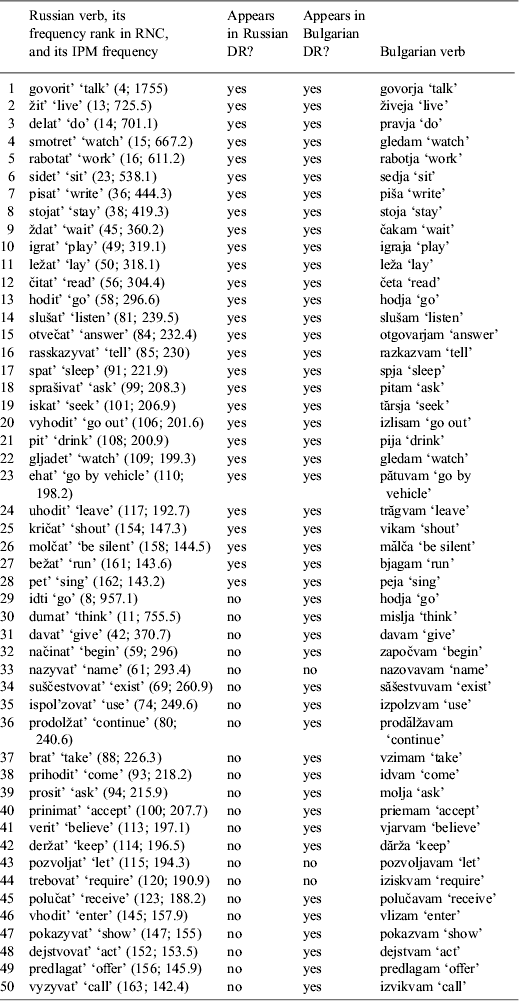
My conclusion is that the DR construction is not fully productive in Russian. Out of 50 most frequent verbs in the Russian National Corpus (http://ruscorpora.ru/en/), semantically compatible with a ‘feel like V-ing’ interpretation, only 56% occur in the DR construction, based on my own judgments and on the corpus data. For comparison, 94% of these verbs occur in the DR construction in Bulgarian (see Appendix). Moreover, the frequency of the DR construction in Russian is low compared to other reflexive constructions, such as the QR and the AR constructions. For example, only 12.4% of tokens of the reflexive rabotat'sja ‘work’ have a ‘feel like V-ing’ interpretation, and 78% of these tokens are negated.Footnote 3
The comparison with the reflexive hotet'sja ‘feel like’ highlights the limited scope of the DR construction. For example, verbs that denote uncontrollable physiological processes, including rasti ‘grow’, vyzdoravlivat’ ‘get better’, staret’ ‘get older’, molodet’ ‘get younger’, sedet’ ‘turn grey’, istekat’ krov'ju ‘bleed’, and potet’ ‘sweat’, are ungrammatical in the DR construction but freely appear as complements of the reflexive hotet'sja ‘feel like’:Footnote 4
- (26)
(a) *Mne rastet-sja/molodeet-sja.
I.dat grow.imprf.3sg.pres-refl/get.younger.imprf.3sg.pres-refl
Intended: ‘I feel like growing/getting younger.’
(b) Mne hočet-sja rasti/molodet’.
I.dat want.imprf.3sg.pres-refl grow.imprf.inf/get.younger.imprf.inf
‘I feel like growing/getting younger.’
Besides lexical restrictions that cannot be explained on semantic grounds, the DR construction also shows what on first sight appears to be a morphological restriction. Specifically, verbs that exist in the reflexive form only, such as nravit'sja ‘like’ (*nravit’), snit'sja ‘dream’ (*snit’), smejat'sja ‘laugh’ (*smejat’), and bojat'sja ‘be afraid’ (*bojat’), as well as derived reflexive verbs with self-directed meaning, such as myt'sja ‘wash oneself’, do not occur in the DR construction in Russian (see also Pariser Reference Pariser1982: 52):Footnote 5
- (27)
(a) *Ivanu smejet-sja.
Ivan.dat laugh.imprf.3sg.pres-refl
Intended: ‘Ivan feels like laughing.’
(b) *Ivanu moet-sja.
Ivan.dat wash.imprf.3sg.pres-refl
Intended: ‘Ivan feels like washing himself.’
Peškovskij (Reference Peškovskij1956) argues that this restriction is morphological: in order to occur in the DR construction, a reflexive form would have to be reflexivized for the second time. He proposes that there is a rule that blocks multiplication of identical morphemes. However, this explanation can hardly be maintained in light of data from Bulgarian. In the Bulgarian DR construction, inherently reflexive verbs, such as smeja se ‘laugh’ (*smeja), as well as derived reflexives, such as mija se ‘wash oneself’, are grammatical:
- (28)
(a) Na Ivan mu se smee. (Bulgarian)
to Ivan he.cl.dat refl laugh.imprf.3sg.pres
‘Ivan feels like laughing.’
(b) Na Ivan mu se mie. (Bulgarian)
to Ivan he.cl.dat refl wash.imprf.3sg.pres
‘Ivan feels like washing himself.’
I conclude that the DR construction in Russian does not enjoy full productivity.Footnote 6 The next section proposes the analysis that captures this fact.
4. The analysis: DR construction as a constructional idiom
4.1 The syntax and semantics of the DR construction
The discussion in the previous sections has shown that the analysis of the DR construction needs to take into consideration the following facts. First, the construction expresses dispositions, even though there is no volitional verb in the syntactic structure. Second, it has idiosyncratic structural properties, which present a challenge for derivational analyses. Third, the DR construction is semi-productive. These properties naturally lend themselves to an analysis within the construction grammar framework (see Goldberg Reference Goldberg1995, Reference Goldberg2006; Jackendoff Reference Jackendoff1997, Reference Jackendoff2002; Goldberg & Jackendoff Reference Goldberg and Jackendoff2004). Specifically, I propose that the DR construction should be analyzed as a construction, i.e. the pairing of structure and meaning stored as a unit in the lexicon, as shown in (29).
(29) Structure and meaning of the DR construction
Syntax: [NP1-DAT [VP V-IMPRF-TENSE-REFL (NP2-NOM)]]
Semantics: ‘NP1 feel like V-ing (NP2)’
This analysis derives the meaning of the DR construction from the ‘feel like’ predicate in the semantic structure. Importantly, since the construction grammar framework allows for mismatches between syntax and semantics (see also the Parallel Architecture framework developed in Jackendoff Reference Jackendoff1983, Reference Jackendoff1990, Reference Jackendoff2002; Culicover & Jackendoff Reference Culicover and Jackendoff2005), there is no null predicate in syntax. In what follows, I show how this analysis captures the properties of the DR construction. While at this point I do not present a formal semantic analysis, such an analysis is not incompatible with a constructionist account (see Sag Reference Sag2010 on the application of Montague semantics within Sign-Based Construction Grammar), and can be developed on the basis of the proposal presented here.
The core semantic properties of the DR construction – volitionality and the lack of actuality entailment – follow straightforwardly from (29) above. As a volitional predicate, ‘feel like’ does not entail event realization. Consequently, negation, when it scopes over ‘feel like’, has no effect on the actuality entailment.
If an adverb is present, it scopes over the ‘feel like’ predicate in semantics and modifies the frequency or intensity of the disposition. Mismatches between syntax and semantics, like the one observed in the DR construction – the adverb appears to modify the activity but in fact it modifies the disposition – are commonly found in constructional idioms. For example, in his analysis of the day after day construction, Jackendoff (Reference Jackendoff2008) observes that the adjective miserable in (30) structurally appears to be a modifier of the second noun. Semantically, however, it modifies the entire NP: the construction means not ‘a succession of days followed by miserable days, but rather a succession of miserable days’ (Jackendoff Reference Jackendoff2008: 21).
(30) Day after miserable day(Jackendoff Reference Jackendoff2008: 21 ex. (38a))
Jackendoff (Reference Jackendoff2008) explains the syntax–semantics mismatch by proposing that the construction means ‘many Ns in succession’. Under this analysis, there is only one counterpart of the noun in the semantic structure, and it is the semantics of the construction that is responsible for the modification pattern in (30). An argument along these lines also explains adverbial modification in the DR construction.
The unusual aspectual pattern – the ability of the imperfective to refer to temporally bounded events – is explained by the idiosyncratic properties of the DR construction. Note that Russian is not unusual in this respect. In English, too, progressive forms do not refer to telic events, but the ‘feel like’ construction overrides this semantic property: jumping in (31) has a bounded (telic) reference.
(31) I felt like jumping into the water when we were flying above the lake.
From this perspective, the semantics of the construction determines the type of the aspectual reference of the imperfective verb form. If the context is right, the imperfective form would be coerced into a telic interpretation.
The fact that tense on the reflexive verb modifies the disposition and not the eventuality denoted by the verb is a consequence of the syntax–semantics mismatch. In the proposed analysis, there is no verb corresponding to the ‘feel like’ predicate in syntax, and, by default, the temporal information is realized on the only available predicate – the reflexive verb. The temporal location of the eventuality denoted by the reflexive verb – future with respect to the disposition time – is determined by the semantics of the construction.
Last but not least, the proposed analysis allows us to explain semi-productivity of the DR construction. The structure in (29) contains open variables that can be filled in by the members of the respective phrasal and lexical categories. However, what verbs occur in the construction must be learned on a case-by-case basis. Mechanisms along these lines have been previously applied to explain semi-productivity of a wide range of constructions, including the N to N construction, such as hand to hand (compare ?finger to finger) (Jackendoff Reference Jackendoff2008), sluice-stranding, such as what about? (compare *who about?) (Culicover & Jackendoff Reference Culicover and Jackendoff2005, Culicover Reference Culicover2013), and adjectival reflexives, such as yell oneself hoarse (Goldberg & Jackendoff Reference Goldberg and Jackendoff2004).
4.2 The inheritance hierarchy of dative reflexive constructions in Russian
The advantage of a construction grammar approach is that it also allows us to explain why the specific set of structural properties, i.e. a reflexive verb plus a dative experiencer, are used to convey the dispositional meaning. When the DR construction is evaluated within a broader context, it becomes apparent that Russian routinely utilizes reflexive morphology and dative case to convey the lack of control on the part of the experiencer.Footnote 7 For example, the reflexive hotet'sja ‘feel like’ in (32a), when compared to its non-reflexive counterpart hotet’ ‘want’ in (32b), is characterized by the lack of control over the disposition. Wierzbicka (Reference Wierzbicka, Brecht and Levine1986: 410) observes that the corresponding construction in Polish (not illustrated here) expresses ‘unintentional wantings’.
- (32)
(a) Mne hočet-sja spat’.
I.dat want.imprf.3sg.pres-refl sleep.inf
‘I feel like sleeping.’
(b) Ja hoč-u spat’.
I.nom want.imprf.3sg.pres-refl sleep.inf
‘I want to sleep.’
Another class of predicates that utilize reflexive morphology to convey the lack of intentionality are cognitive verbs such as vspomnit’ ‘remember’.Footnote 8 Thus, the reflexive verb in (33a) below refers to a non-volitional process (see Wierzbicka Reference Wierzbicka, Brecht and Levine1986; Gerritsen Reference Gerritsen1990: 27–28, 140–151): this construction is not compatible with adverbs that presuppose control over recollection, such as soznatel'no ‘consciously’.Footnote 9 No such effect is observed with the non-reflexive vspomnit’ ‘remember’ in (33b).
- (33)
(a) Ivanu (#soznatel'no) vspomnil-a-s'
Ivan.dat consciously remember.prf.past-3sg.fem-refl
molodost'.
youth.nom.fem
‘Ivan experienced the memory of his youth.’
(b) Ivan (soznatel'no) vspomnil molodost’.
Ivan.nom consciously remember.prf.past.3sg.masc youth.acc.fem
‘Ivan (consciously) remembered his youth.’
Perception verbs, such as videt’ ‘see’ and slyšat’ ‘hear’, when reflexivized, also undergo a semantic shift in the predicted direction. The difference between the reflexive and the non-reflexive form is ‘a difference in control’ (Gerritsen Reference Gerritsen1990: 144; see Galkina-Fedoruk Reference Galkina-Fedoruk1958; Pariser Reference Pariser1982: 44–45; Paducheva Reference Paducheva2011: 7).
- (34)
(a) Ja videl-a dom.
I.nom see.imprf.past-1sg.fem house.nom.masc
‘I saw a house’.
(b) Mne videl-sja dom.
I.dat see.imprf.past.3sg.masc-refl house.nom.masc
‘I visually experienced a house.’
Gerritsen (Reference Gerritsen1990: 144) comments that the reflexive construction ‘turns the person into an experiencer, rather than a (more active) perceiver’. This observation is consistent with the fact that dative case is a standard means to express experiencers in Russian, and as such commonly appears in constructions with psych predicates:
(35) Detjam byl-o interesno/skučno/strašno/veselo.
children.dat be.past-3sg.neut interesting/bored/afraid/merry
‘Children were interested/bored/afraid/merry.’
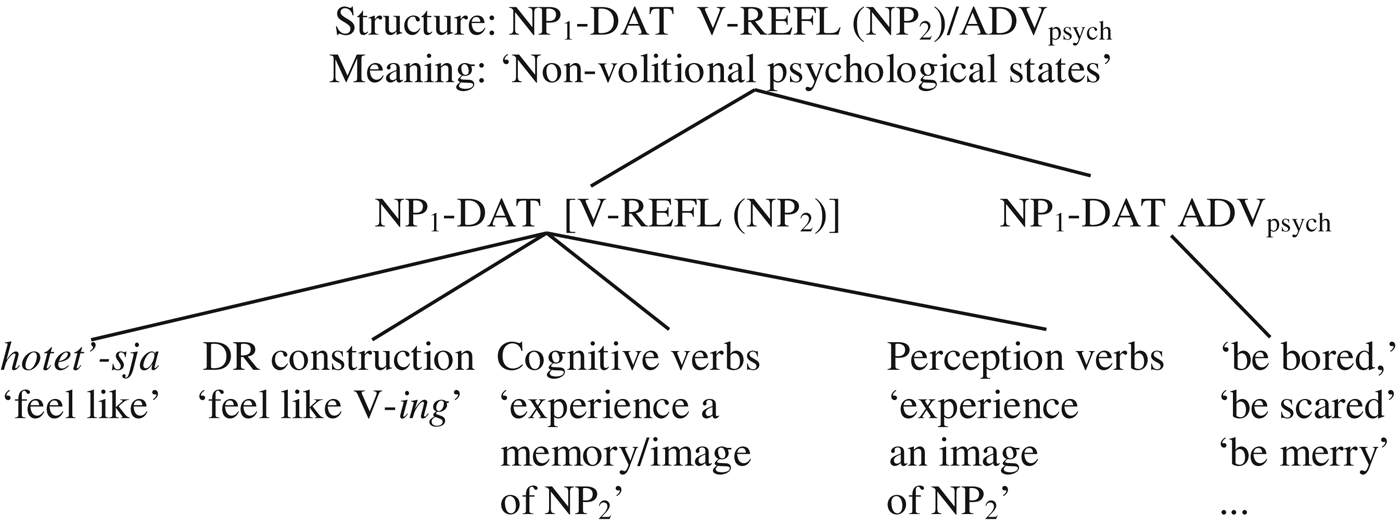
This discussion shows that psych predicates and reflexive cognitive and perception verbs have the same structural features as the DR construction and similar semantics: they denote a psychological state over which the experiencer has limited volitional control. I propose that the sharing of idiosyncratic structural and semantic features among these constructions is enabled by inheritance hierarchies, i.e. organizational principles that link structurally and semantically similar constructions in the lexicon (see Goldberg Reference Goldberg1995; Michaelis & Lambrecht Reference Michaelis and Lambrecht1996; Jackendoff Reference Jackendoff1997, Reference Jackendoff2008; Sag, Wasow & Bender Reference Sag, Wasow and Bender2003 on inheritance hierarchies within the constructionist and the head-driven Phrase Structure Grammar (HPSG) frameworks, respectively). As an example, consider how an inheritance hierarchy explains semantic similarities between the way-construction, such as Emma elbowed her way into the room (Jackendoff Reference Jackendoff1997: 547), and the resultative construction Emma cooked the pot dry. In both constructions, shown in (36) and (37), the verb is interpreted as being ‘a means or manner modifier’ (Jackendoff Reference Jackendoff1997: 555).
- (36)
(a) [VP V [bound pronoun]'s way PP] (way-construction)
(b) ‘go PP (by) V-ing’(Jackendoff Reference Jackendoff1997: 554 ex. (98))
- (37)
(a) [VP V NP AP/PP] (resultative construction)
(b) ‘cause NP to become AP/go PP by V-ing (it)’(Jackendoff Reference Jackendoff1997: 554 ex. (100))
Jackendoff proposes that this property is inherited by the resultative and the way-construction from a verb subordination archi-construction in (38):
- (38)
(a) [VP V]
(b) ‘act by V-ing’ (Jackendoff Reference Jackendoff1997: 555 ex. (101))
The structure in Figure 3 shows how inheritance hierarchies can capture family resemblance among Russian constructions with non-volitional meaning. The top node specifies the core structural and semantic properties shared by all constructions in the hierarchy, while the leaves capture variation. Thus, while some members of the hierarchy, such as the DR construction, have open variable slots, individual predicates, such as hotetsja ‘feel like’, are fully productive.
Dative reflexive constructions in Russian: The inheritance hierarchy.
In the next section, I compare the DR construction to the structurally similar QR and AR constructions. This discussion prepares the ground for assessing the scope of cross-linguistic variation in reflexive constructions (Section 6) and the overview of the previous analyses (Section 7).
5. Typology of reflexive constructions in Russian
A common view in the literature is that the Russian reflexive construction with dative subjects is ambiguous (Pariser Reference Pariser1982, Benedicto Reference Benedicto1995, Franks Reference Franks1995). For example, according to Pariser (Reference Pariser1982: 83) the reflexive construction ‘encompasses … an entire range of simultaneously expressive meanings [desire, capability, possibility, propensity], none of which are separable from the whole’. More recent literature (Rivero & Arregui Reference Rivero, Arregui, Demonte and McNally2012) distinguishes between different types of reflexive constructions, but there is a confusion about what meanings reflexive constructions in Russian can express. The goal of the subsequent discussion is to clarify this question.
5.1 The Quality Reflexive construction
Besides dispositions, reflexive sentences with dative subjects express how the activity denoted by the reflexive verb feels to the experiencer. The sentence in (39), for example, assesses the experience of living together, and the one in (40) – the quality of singing. I refer to such constructions as Quality Reflexives (QRs).
(39) Horošo nam s toboj živet-sja.
well we.dat with you live.imprf.3sg.pres-refl
‘We live happily together.’(A. P. Chekhov, Summer residents, 1885)
(40) Borisu horošo pel-i-s' narodny-je pesn-i.
Boris.dat well sing.imprf.past-3pl-refl folk-nom.pl song-nom.pl
‘Boris sang folk songs well.’(adapted from Skorniakova Reference Skorniakova2008: 6 ex. (7b))
The perceived quality is not under the experiencer's direct control (see Švedova Reference Švedova1970: 354; Vinogradov Reference Vinogradov1972: 371; Skorniakova Reference Skorniakova2008). This is evident from the fact that the QR construction is incompatible with purpose clauses, as shown in (41) (see also Bulygina Reference Bulygina and Seliverstova1982: 80; Benedicto Reference Benedicto1995).
(41) *Mne horošo rabotal-o-s', čtoby
I.dat well work.imprf.past-3sg.neut-refl so.that
ugodit’ svoemu načal'niku.
please.inf self.dat boss.dat
Intended: ‘I worked well so that to please my boss.’(adapted from Benedicto Reference Benedicto1995: 7 ex. (22b))
Despite structural and semantic similarities with the DR construction, including case assignment and agreement as well as non-volitional semantics, the QR construction has a set of properties that distinguish it from the DR construction. First, the hallmark of the QR construction is the obligatory presence of an adverbial modifier expressing quality. In the absence of the modifier, the construction gives rise to the ‘feel like V-ing’ interpretation, as in (42a), or is simply infelicitous if the predicate in question does not occur in the DR construction, like dumat'sja ‘think’ in (42b). A quality adverb makes the construction in (42b) felicitous under the QR interpretation, as shown in (42c).
- (42)
(a) Mne spal-o-s'.
I.dat sleep.imprf.past-3sg.neut-refl
=‘I felt like sleeping.’
≠‘I slept well.’
(b) #Mne dumaet-sja.
I.dat think.imprf.3sg.pres-refl
(c) Mne prekrasno dumaet-sja po nočam.
I.dat wonderfully think.imprf.3sg.pres-refl at night.dat
‘I think easily at night.’
Benedicto (Reference Benedicto1995: 14) argues that the adverb in the QR construction must refer to a psychological state. However, the data from the Russian National Corpus show that virtually any adverbial modifier can appear in the DR construction as long as it can be coerced to denote positive or negative experience (see also Wierzbicka Reference Wierzbicka, Brecht and Levine1986: 418 on Polish).Footnote 10
Second, the DR and the QR constructions have different entailment patterns. The QR construction entails event realization and thus cannot be felicitously continued by the negation of the action, as in (43) (see also Rivero & Arregui Reference Rivero, Arregui, Demonte and McNally2012, who refer to the QR constructions as ‘factual’). No such restrictions apply to the DR construction in (44).
(43) Mne legko plačet-sja,
I.dat easily cry.imprf.3sg.pres-refl
#no ja ne plaču.
but I.nom neg cry.imprf.1sg.pres
Intended: ‘I cry easily but I don't cry.’(adapted from http://olga-nebel.livejournal.com/1198337.html)
(44) Plačet-sja, no ne plaču.
cry.imprf.3sg.pres-refl but neg cry.imprf.1sg.pres
‘I feel like crying but I don't cry.’
Third, the QR and the DR constructions behave differently under negation. The negated DR construction signals the lack of disposition. Negation in the QR construction, on the other hand, scopes over the quality adverb and changes the polarity of the expression. Thus, in (45), negation scopes over horošo ‘well’ and triggers the interpretation that the quality of living is poor. Crucially, the actuality entailment is preserved in this case.
(45) U nas liberalam ne živet-sja horošo.
at we.gen liberals.dat neg live.imprf.3sg.pres-refl well
‘In our country the liberals do not live well.’
(adapted from http://vk.com/wall-33732208_40950)
Finally, the two constructions differ in terms of their productivity. According to Gerritsen (Reference Gerritsen1990: 193), the QR construction is more productive compared to the DR construction. A pilot corpus study confirms this observation. Out of 303 examples of the reflexive verb rabotat'sja ‘work’ from the Russian National Corpus, 86% are tokens of the QR construction; the rest are examples of the DR construction and the Ability Reflexive construction discussed in the next section.Footnote 11
5.2 The Ability Reflexive construction
The example in (46) shows that negated reflexive sentences are ambiguous between a dispositional interpretation, i.e. ‘NOT feel like V-ing’ and an inability to perform an action interpretation, i.e. ‘cannot V’ (see Borras & Christian Reference Borras and Christian1971; Pariser Reference Pariser1982; Janda Reference Janda1993; Benedicto Reference Benedicto1995: 2; Franks Reference Franks1995: 364; Rivero & Arregui Reference Rivero, Arregui, Demonte and McNally2012: 309). I refer to the latter as the Ability Reflexive (AR).
(46) Ej ne sidit-sja doma segodnja.
she.dat neg sit.imprf.3sg.pres-refl home today
‘She doesn't feel like staying at home today.’(Dispositional Reflexive)
‘She can't stay at home today.’(Ability Reflexive)
(adapted from Pariser Reference Pariser1982: 83 ex. (101))
The ability interpretation is only possible under negation (47); non-negated sentences can only give rise to a dispositional interpretation (48):
(47) Da i ne spit-sja kak-to.
part and neg sleep.imprf.3sg.pres-refl somehow.
Navernoje u menja bessonnitsa.
Possibly at I.gen insomnia.nom
‘I can't sleep for some reason. Possibly, I suffer from insomnia.’
(Т. Tronina, Mermaid for intimate encounters, 2004)
(48) Mne spit-sja.
I.dat sleep.imprf.3sg.pres-refl
=‘I feel like sleeping.’
≠‘I am able to sleep.’
The inability to perform an action conveyed by the AR construction is psychological rather than physical. The AR construction is infelicitous in the context that requires a physical ability interpretation, like that in (49a). In order to express the intended meaning, a root possibility modal should be used instead, as in (49b).
(49) Context: Anna, a professional dancer, sprained her leg. You say:
(a) #Anne ne tantsuet-sja.
Anna.dat neg dance.imprf.3sg.pres-refl
Intended: ‘Anna can't dance.’
(b) Anna ne možet tantsevat’.
Anna.nom neg can.pres dance.imprf.inf
‘Anna can't dance.’
These observations echo Wierzbicka's (Reference Wierzbicka1979: 375) comment that ‘the peculiar impotence of the subject is presented as purely internal’ (see also Benedicto Reference Benedicto1995) and suggest that a common semantic feature shared by the AR and the DR constructions is that they both denote uncontrollable psychological states.
While the ability interpretation has been previously subsumed under the meaning of DRs and QRs, or a generic reflexive construction (see Pariser Reference Pariser1982; Benedicto Reference Benedicto1995; Rivero & Arregui Reference Rivero, Arregui, Demonte and McNally2012: 308), the AR construction has a unique entailment pattern incompatible with the entailment patterns shown by other reflexive constructions. Specifically, the negated AR construction entails that the activity denoted by the reflexive verb was not realized: I couldn't do X entails I didn't do X. Thus, it is infelicitous to continue the AR construction in (50), which translates as ‘I couldn't sleep’, with the assertion that the experiencer managed to sleep.
(50) U menja bessonnitsa. Mne ne spit-sja,
at I.gen insomnia.nom I.dat neg sleep.imprf.3sg.pres-refl
#no mne udal-o-s' pospat’.
but I.dat manage.prf.past-3sg.neut-refl sleep.perf.inf
Intended: ‘I suffer from insomnia. I cannot sleep but I managed to sleep.’
The negated DR construction, on the other hand, is compatible with the situations in which the eventuality denoted by the reflexive verb was realized, as in (51).
(51) Emu ne rabotal-o-s', a on vsje že
he.dat neg work.imprf.past-3sg.neut-refl but he.nom yet
rabotal ne tak už i ploho.
work.imprf.3sg.past.masc neg so part and badly
‘He didn't feel like working. Yet, he worked not badly (after all).’
(Veyrenc Reference Veyrenc1980: 305, cited in Gerritsen Reference Gerritsen1990: 175 ex. (266))
These data suggest that the ability interpretation cannot be derived from the DR construction.
The AR construction also differs from the QR construction: the latter always entails event realization, even when negated. These facts challenge the analysis in Gerritsen (Reference Gerritsen1990), in which the quality and the ability readings are derived from the same construction. In her analysis, negation, the obligatorily element of the AR construction, is viewed as a type of adverbial modification: ‘ne is a qualifier, ne spitsja [“not sleep”] being the extreme variant of ploho spitsja [“sleep badly”]’ (Gerritsen Reference Gerritsen1990: 185). Such an analysis cannot explain the conflicting entailment patterns of the QR and the AR constructions. The same criticism applies to Rivero & Arrevui (Reference Rivero, Arregui, Demonte and McNally2012: 309), who assume that Russian has the QR construction only and subsume the ability reading under the latter.
I conclude that the AR construction has a set of distinctive properties, which are incompatible with that of the DR and the QR constructions. It should be recognized as yet another member of the family of reflexive constructions with dative experiencers (see also Korolev Reference Korolev1969a, Reference Korolev and Vinogradovb; Wierzbicka Reference Wierzbicka1979: 376–377).
5.3 Typology of reflexive constructions in Russian
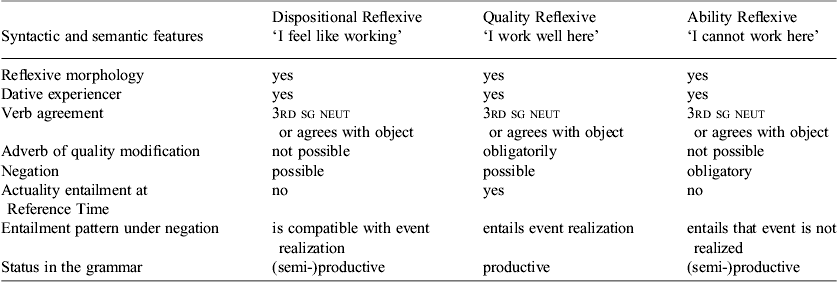
Table 1 summarizes the discussion in this section. It shows that despite certain similarities, reflexive sentences with dative subjects have different properties.
Typology of Russian reflexive constructions with dative experiencers.
The next section discusses the distribution of DRs, QRs, and ARs in Slavic languages with the goal to clarify the scope of cross-linguistic variation.Footnote 12
6. Cross-linguistic comparison: reflexive constructions in Slavic
Early work on reflexive constructions with dative subjects in Slavic languages focused on their syntactic properties rather than on their fine-grained semantics. As a consequence, different types of reflexive constructions were treated as one, which often obscured cross-linguistic generalizations. For example, Rudolf Růžička observes that ‘the impersonal sentence type [(52)] is found in all Slavic languages' and that ‘Czech and Russian (and other Slavic languages) share the “dispositional” construction [(53)]’ (Růžička Reference Růžička1988: 175).
- (52)
(a) Sestře se tam pracuje výborně. (Czech)
sister.dat refl there work.3sg excellently
‘My sister is working excellently there.’
(b) Sestre tam rabotaet-sja prekrasno. (Russian)
sister.dat there work.imprf.3sg.pres-refl excellently
‘My sister is working excellently there.’
(Růžička Reference Růžička1988: 175 exx. (83) and (84), with Franks’ (Reference Franks1995: 364) glosses)
(53) Ne-hraje se mi dobře. (Czech)
neg-play.3sg refl me.dat well
‘Not play(s) (to) me well.’
(Růžička Reference Růžička1988: 175 ex. (80), with Franks’ (Reference Franks1995: 364) glosses)
Růžička (Reference Růžička1988) uses ‘dispositional’ as an umbrella term, subsuming different types of reflexive constructions, including the QR construction in (52) and (53), under one label. However, such an approach fails to recognize that Slavic languages exhibit variation in the type of meanings that reflexive constructions can express. In what follows I present data that clarify the status of DRs, QRs, and ARs in Slavic languages.
6.1 The QR construction in East and West Slavic only
The data in (54) show how the QR construction is distributed in languages of the Slavic family. The examples in (54) are presented in the context of the question ‘How do children work here?’, which explicitly targets an assessment of quality interpretation. Note that this question also presupposes that the working activity is realized, which is consistent with the actuality entailment of the QR construction. If the constructions in (54) are indeed QRs, then they should be incompatible with the sentence continuation ‘but they do not work’, which cancels the actuality entailment.
(54) Context: How do children work here?
(a) Detjam horošo rabotaet-sja zdes',
children.dat well work.imprf.3sg.pres-refl here
(#no oni ne rabotajut). (Russian)
but they.nom neg work.imprf.3pl.pres
‘Children work here well (#but they do not work).’
(b) *Na decata dobre im se raboti
to children well they.dat refl work.imprf.3sg.pres
tuk.(Bulgarian)
here
Intended: ‘Children work well here.’
(c) Naszym dzieciom się tu dobrze/źle pracuje
our.dat kids.dat refl here good/bad work.imprf.3sg.pres
(#ale nigdy tutaj nie pracują).(Polish)
but never here neg work.imprf.3pl.pres
‘Our kids work here well (#but they never work here).’
These data suggest that unlike East (Russian) and West (Polish) Slavic languages, South Slavic languages (Bulgarian) do not have equivalents of the QR construction (see also Rivero & Arregui Reference Rivero, Arregui, Demonte and McNally2012).
6.2 The DR construction in East and South Slavic only
The status of the DR construction in Slavic languages is surrounded by controversy. For example, Franks (Reference Franks1995: 364) applies Růžička's generalization to the DR construction: ‘as discussed by Růžička (Reference Růžička1988: 175–176), the impersonal sentence type illustrated in [(55)] is found in all the Slavic languages'.
(55) Mne ne rabotaet-sja. (Russian)
me.dat neg work-refl
‘I don't feel like working.’(Franks Reference Franks1995: 364 ex. (58))
Yet, Kortland (Reference Kortland1983), Rivero & Milojević Sheppard (Reference Rivero and Sheppard2003), Rivero & Arregui (Reference Rivero, Arregui, Demonte and McNally2012) observe that West Slavic languages do not have the DR construction. Rivero & Arregui (Reference Rivero, Arregui, Demonte and McNally2012) even claim that Russian is like Polish and other West Slavic languages in that it too lacks the DR construction.
The data in (56) help to clarify this debate. The reflexive sentences in (56) are presented in the context of the question that targets dispositional meaning. The sentence continuation ‘children do not work’ is used as a control: a DR construction should be compatible with this assertion.
(56) Context: Do children feel like working here?
(a) Detjam rabotaet-sja, (no oni ne
children.dat work.imprf.3sg.pres-refl but they.nom neg
rabotajut). (Russian)
work.imprf.3pl.pres
‘Children feel like working (but they do not work).’
(b) Na decata im se raboti, (no te
to children they.cl.dat refl work.imprf.3sg.pres but they
ne rabotjat). (Bulgarian)
neg work.imprf.3pl.pres
‘Children feel like working (but they do not work.)’
(c) *Dzieciom się tu pracuje.(Polish)
children.dat refl here work.imprf.3sg.pres
Intended: ‘Children feel like working.’
I conclude that Russian and Bulgarian have the DR construction, while Polish does not.
6.3 The AR construction in East Slavic only
Marušič & Žaucer (Reference Marušič and Žaucer2006) correctly observe that the AR construction does not exist in South Slavic languages. With respect to Polish, the authors suggest that reflexive constructions do have a ‘root possibility reading’, citing (57) as an example (Marušič & Žaucer Reference Marušič and Žaucer2006: 1148; see also Dziwirek Reference Dziwirek1994: 61; Rivero & Milojević Sheppard Reference Rivero and Sheppard2003: 137).
(57) Jankowi czytało się tę książkę
Janek.dat read.3sg.neut refl this book.acc
z przyjemnością.(Polish)
with pleasure
‘Somehow, Janek was able to read this book with pleasure.’
(adapted from Marušič & Žaucer Reference Marušič and Žaucer2006: 1149 ex. (85b))
Note, however, that the construction in (57) contains a quality modifier, and thus can be an example of the QR construction. Moreover, Marušič & Žaucer's observation contradicts Wierzbicka (Reference Wierzbicka1979: 377), who compares Polish to Russian and observes that Polish reflexives do not have an ability interpretation. The data in (58) help to clarify the status of the AR construction in Slavic. The examples are presented in the context that targets the ability interpretation. Since the negated AR construction entails that the activity in question was not realized, it should be incompatible with the assertion to the contrary.
(58) Context: Are the children able to work here?
(a) Detjam ne rabotaet-sja zdes',
children.dat neg work.imprf.3sg.pres-refl here
(#no oni rabotajut). (Russian)
but they.nom work.imprf.3pl.pres
‘Children can't work here (#but they work).’
(b) #Na decata ne im
to children neg they.cl.dat
se raboti tuk.Footnote 13 (Bulgarian)
refl work.imprf.3sg.pres here
Intended: ‘Children can't work here.’
(c) *Dzieciom się tutaj nie pracuje. (Polish)
children.dat refl here neg work.imprf.3sg.pres
Intended: ‘Children can't work here.’
The data in (58) show that the AR construction is attested in Russian only.
6.4 Summary
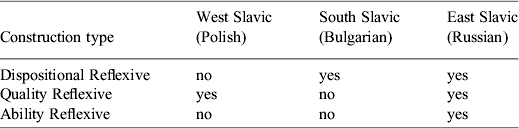
The discussion in this section, summarized in Table 2, reveals a previously unobserved fact: Russian differs from both West and South Slavic languages in that it has the AR construction, as well as the QR construction and the DR construction, even though the latter is less productive compared to, for example, Bulgarian.
Distribution of DR, QR, and AR constructions in Slavic languages.
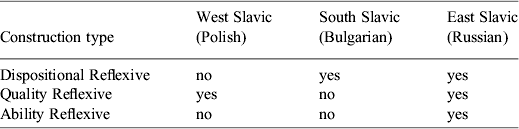
While the previous studies highlighted some of the differences among Slavic languages (see Georgiev Reference Georgiev1972: 99; Norman Reference Norman1972: 71; Marušič & Žaucer Reference Marušič and Žaucer2006; Rivero & Milojević Sheppard Reference Rivero and Sheppard2003; Rivero & Arregui Reference Rivero, Arregui, Demonte and McNally2012), the comparison was obstructed by the fact that the dispositional, the ability, and the quality of experience interpretations were often treated as different readings of a single construction. With this observation in mind, I now turn to a discussion of the previous analyses.
7. Previous analyses of the semantics of DRs, QRs, and ARs
The analyses I review in this section fall into two groups: (i) those that derive the dispositional, the ability, and the quality of experience meaning from a single semantic element – modal, as in Benedicto (Reference Benedicto1995), or a null verb, as in Marušič & Žaucer (Reference Marušič and Žaucer2006), and (ii) the analyses that postulate different semantic ingredients for different construction types (Rivero & Arregui Reference Rivero, Arregui, Demonte and McNally2012). The problem with the former is that different constructions have different entailment patterns and thus cannot be derived from the same modal/null verb. The latter derives the dispositional meaning from the same component that supplies the semantics for plans, but plans and dispositions are different, and the two constructions do not have the same entailment pattern.
7.1 Benedicto (Reference Benedicto1995)
Benedicto (Reference Benedicto1995) assumes that the dispositional, ability, and quality of experience readings are different interpretations of one construction that is ambiguous. She proposes that these different interpretations are derived from the presence of a null possibility modal in the structure. In her analysis, couched within the framework of modal semantics (Kratzer Reference Kratzer, Eikmeyer and Rieser1981, Reference Kratzer, von Stechow and Wunderlich1991), the null operator has the same quantificational force as the English modal can (existential) but differs from the latter in that its modal base, i.e. the set of propositions with respect to which the proposition denoted by the reflexive sentence is evaluated, is restricted to psychological circumstances. Under this analysis the sentence in (59) has the meaning in (60).
(59) Mne ne čitaet-sja.
I.dat neg read.imprf.3sg.pres-refl
‘I can't read.’(adapted from Benedicto Reference Benedicto1995: 1 ex. (1))
(60) ‘Given my psychological circumstances, I can't read (there is no possibility for me to read).’(Benedicto Reference Benedicto1995: 9 ex. (25))
While Benedicto's analysis explains the meaning of the AR construction, it does not provide the right semantics for the QR construction. In the QR construction, the proposition in the scope of the null possibility modal is interpreted with respect to the set of propositions (modal base) that refer to the experiencer's psychological circumstances. The quality adverb provides a scale on the basis of which the propositions in the modal base are ranked. Under these assumptions, the QR sentence in (61) has the meaning in (62).
(61) Mne udobno čital-o-s',
I.dat comfortably read.imprf.past-3sg.neut-refl
(sidja pod lampoj).
sitting under lamp
My translation: ‘I read comfortably, sitting under the lamp.’
(adapted from Benedicto Reference Benedicto1995: 15 ex. (40))
(62) ‘Given my psychological state, the possibility exists for me, given what feels comfortable for me, of reading.’(Benedicto Reference Benedicto1995: 15 ex. (41b))
According to the analysis in (62), the QR construction asserts a possibility of an action without entailing its realization. This is due to the fact that the null modal in Benedicto's analysis has an existential modal force. However, this interpretation is too weak, and it cannot capture the core semantic property of the QR construction – its actuality entailment. The examples in (63) show that the QR construction crucially differs from the possibility modal moč ‘can’ in that the actuality entailment of the QR construction cannot be canceled. Benedicto predicts that the two constructions should behave in the same way.Footnote 14
- (63)
(a) #Mne udobno čital-o-s',
I.dat comfortably read.imprf.past-3sg.neut-refl
no ja ne čital-a.
but I.nom neg read.imprf.past-fem
Intended: ‘I read comfortably, but I didn't read.’
(b) Ja mogu čitat’,
I.nom can.1sg.pres read.imprf.inf
no ja ne čita-ju.
but I.nom neg read.imprf.1sg-pres
‘I can read, but I don't read.’
Finally, while Benedicto acknowledges that reflexive constructions can express dispositions, she does not explain how her null modal can derive the ‘feel like’ interpretation. I conclude that Benedicto's (Reference Benedicto1995) uniform analysis is untenable due to the fact that reflexive constructions in question have incompatible semantic properties.
7.2 Marušič & Žaucer (Reference Marušič and Žaucer2006)
While Marušič & Žaucer (Reference Marušič and Žaucer2006) are primarily concerned with the meaning of the DR construction in Slovenian, the authors tentatively propose how their analysis can be extended to Russian. They focus on the dispositional and the ability interpretations and suggest that these meanings are derived from the null reflexive verb ‘give’. The analysis is based on the fact that in Serbian the reflexive verb ‘give’ acquires an ability reading when it appears with dative subjects, as shown in (64a), while in Slovenian, the reflexive ‘give’, when negated, can give rise to a ‘feel like’ interpretation, as in (64b).
- (64)
(a) Ne da mi se da odem kući. (Serbian)
neg give.3sg I.dat refl that go home
‘I cannot go home/something prevents me from going home.’
(adapted from Marušič & Žaucer Reference Marušič and Žaucer2006: 1148 ex. (85a))
(b) Danes se mi *(ne) da delat. (Slovenian)
today refl I.dat neg give.3sg work
‘I don't feel like working.’(adapted from Marušič & Žaucer Reference Marušič and Žaucer2006: 1148 ex. (84a))
With reference to these data and working under the assumption that the dispositional meaning in Russian arises only when the reflexive verb is negated – the assumption that cannot be maintained in light of the data in Section 2 – Marušič & Žaucer (Reference Marušič and Žaucer2006: 1149) tentatively propose that ‘the Russian null GIVE thus receives two interpretations, the “feel like” interpretation of the Slovenian/Croatian … and the root possibility interpretation of the Serbian … “give” ’.
One objection to this analysis comes from the fact that the DR construction and the AR construction have conflicting entailments, which cannot be derived from a single predicate. Another objection pertains to the choice of ‘give’ as a null predicate. One fact overlooked by the authors is that Russian does have a construction with the reflexive verb davat'sja ‘give’. However, such a construction does not trigger the dispositional meaning, as shown in (65).
(65) Mne ne dajet-sja matematika.
I.dat neg give.imprf.3sg.pres-refl math.nom
‘I can't do/master math for some reason.’
≠ ‘I don't feel like doing math for some reason.’
Moreover, the reflexive verb davat'sja ‘give’ expresses a different nuance of inability than the one observed in the AR construction: it presupposes that the activity in question presents some difficulty for the agent, such as, for example, doing math in (65), and is best translated as ‘I cannot master X’. The construction is degraded for some speakers with verbs that denote trivial activities such as relaxation in (66a). No such effect is observed in the corresponding AR construction in (66b).
(66) Context: For some reason, you are unable to relax. You say:
(a) ?Mne ne dajet-sja otdyh.
I.dat neg give.imprf.3sg.pres-refl relaxation.nom
Intended: ‘I cannot master relaxation.’
(b) Mne ne otdyhaet-sja.
I.dat neg relax.imprf.3sg.pres-refl
‘I cannot relax.’
More importantly, while both the AR construction and the construction with davat'sja ‘give’ are restricted to negated contexts, they have different entailment patterns. The reflexive ‘give’ entails that the activity in question was realized but that the experiencer is not satisfied with the outcome, while the negated AR construction entails that the activity in question did not occur. Consequently, the reflexive ‘give’ construction but not the AR construction is felicitous in contexts that assert event realization, such as (67).
(67) Context: You spent all morning practicing Un bel di but you are not happy with the result.
(a) Mne ne dajet-sja eta aria.
I.dat neg give.imprf.3sg.pres-refl this.nom aria.nom
‘I cannot master this aria.’
(b) #Mne ne poet-sja eta aria.
I.dat neg sing.imprf.3sg.pres-refl this.nom aria.nom
Intended: ‘I cannot sing this aria.’
I conclude that the reflexive ‘give’ cannot capture the meaning of the Russian DR construction or the meaning of the Russian AR construction for that matter. The construction with the reflexive ‘give’ is just another member of the family of reflexive constructions in Russian that should be granted an independent status in the grammar.
7.3 Rivero & Arregui (Reference Rivero, Arregui, Demonte and McNally2012)
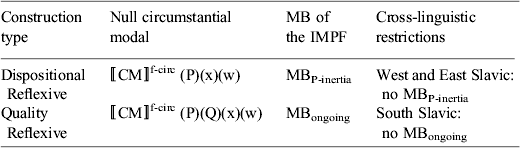
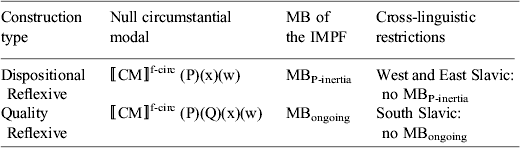
Rivero & Arregui (Reference Rivero, Arregui, Demonte and McNally2012) focus on the DR and the QR constructions in Slavic (their desideratives and factuals, respectively). They propose that these two meanings arise from the interaction of a null circumstantial modal (CM), a backbone of impersonal reflexive constructions, and the imperfective operator (IMPF) with modal flavor, shown in (68).
(68) 〚IMPF〛 = λP<l, <s, t>>λs. ∀s′: MBα (s)(s′) = 1, ∃e: P(e)(s′) = 1.(Rivero & Arregui Reference Rivero, Arregui, Demonte and McNally2012: 323 ex. (12.62))
The different interpretations arise because the IMPF operator combines with different modal bases (MBs): with MBP-inertia in the DR construction and with MBongoing in the QR construction. The intuition is that these modal bases capture the core aspects of the meaning of these respective constructions: MBongoing supplies a set of situations in progress (this is consistent with the actuality entailment of the QR constructions), while MBP-inertia supplies a set of situations in which the targeted event is in its preparatory stage (this is consistent with the fact that dispositions are future-oriented). Cross-linguistic variation is explained in terms of the availability of these modal bases in particular languages. It is assumed that West and East Slavic languages lack the DR construction because they lack MBP-inertia, while South Slavic languages lack the QR construction because MBongoing is unavailable in these languages. These assumptions are summarized in Table 3.Footnote 15
Summary of Rivero & Arregui (Reference Rivero, Arregui, Demonte and McNally2012).
While Rivero & Arregui's analysis is the most comprehensive formal semantic analysis to date, it is not problem-free. First, according to the authors, the activity denoted by the DR construction is in its preparatory stage: ‘P-inertia modal bases target events that have been set in motion’ (Rivero & Arregui Reference Rivero, Arregui, Demonte and McNally2012: 331). This analysis, while appropriate for constructions that refer to future plans, such as John was going to the movies tomorrow but he changed his mind (Rivero & Arregui Reference Rivero, Arregui, Demonte and McNally2012: 324; see also Copley Reference Copley2002 on futurates), makes incorrect predictions for desideratives. Specifically, desideratives that denote unrealistic inclinations (such as I feel like walking on the moon), as well as desideratives that refer to realistic events but for which the experiencer chooses not to take any action (e.g. I feel like lighting a cigarette but it's bad for my health) do not have preparatory stages, and cannot be accounted for by Rivero & Arregui's (Reference Rivero, Arregui, Demonte and McNally2012) analysis.
Second, in Rivero & Arregui's analysis, different modal bases in the DR and the QR constructions are partially motivated by the fact that these constructions show different aspectual properties: ‘Aspect must be imperfective in desideratives [=DRs], while factuals [=QRs] need not be imperfective’ (Rivero & Arregui Reference Rivero, Arregui, Demonte and McNally2012: 320). Yet, the DR construction permits perfective verbs with aspectual prefixes, as shown in (69).Footnote 16
- (69)
(a) Pri-jadoha mi se jabălki. (Bulgarian)
inch.prf-eat.3pl.past me.cl.dat refl apple.pl
‘I came to feel like eating apples.’(Dimitrova-Vulchanova Reference Dimitrova-Vulchanova1999: 204 ex. (6a))
(b) Za-dremal-o-s', tak ložis'. (Russian)
inch.prf-doze.past-3sg.neut-refl so lay.down.2sg.inf
‘If you start feeling like dozing, lay down.’
(A. T. Tvardovskij, Vasilij Terkin, 1945)
If the semantics of the DR constructions is tied to the imperfective morphology, it is unclear how the dispositional meaning in (69) is derived.
Third, in order to explain cross-linguistic variation, the authors propose that imperfectives in Slavic languages differ in terms of what modal base they can combine with. Specifically, ‘in West Slavic and Russian, IMPF does not have access to the preparatory MB we call P-inertia, so cannot receive an intentional reading’ (Rivero & Arregui Reference Rivero, Arregui, Demonte and McNally2012: 328). This proposal is based on the observation that past imperfective sentences in Russian and West Slavic languages cannot refer to future plans (consider Spanish Juan llegaba mañana ‘John was arriving tomorrow’; Rivero & Arregui Reference Rivero, Arregui, Demonte and McNally2012: 321). Since future plans require P-inertia modal base, the authors conclude that Russian and West Slavic languages lack what they call Intentional imperfectives. However, there is a problem in that Russian and West Slavic languages can use imperfectives to refer to future plans, as long as the verb is in the present tense, as the following examples show:
- (70)
(a) Ja vyhožu v otpusk čerez nedelju. (Russian)
I.nom go.out.imprf.1sg.pres to vacation after week.acc
‘I take a vacation in a week.’
(b) Biorę za tydzień urlop. (Polish)
take.1sg for week vacation.acc
‘I take vacation in a week.’(Łazorczyk Reference Łazorczyk2010: 88 ex. (64b))
Rivero & Arregui (Reference Rivero, Arregui, Demonte and McNally2012: 321 fn. 12) explicitly exclude constructions with impefective present tense from their analysis, but these constructions are directly relevant for their proposal. Specifically, the authors assume that the futurate meaning is possible if MBP-inertia is available in a language. The examples in (70) show that futurate meaning is possible when the imperfecitve combines with the present tense. Therefore, MBP-inertia should be available in Russian and Polish. But then it is a puzzle why reflexive constructions in West Slavic cannot express dispositions.
A similar concern challenges the authors' explanation of the absence of the QR construction in South Slavic languages. Recall that the quality of experience meaning is derived because the imperfective is associated with MBongoing. Another important function of this modal base is to derive an ongoing interpretation in non-modalized imperfective constructions (e.g. John is singing). Since imperfective verbs in South Slavic are routinely used to refer to ongoing events, these languages should have MBongoing. But then the unavailability of the quality of experience interpretation cannot be due to the absence of MBongoing in these languages.
In conclusion, Rivero & Arregui (Reference Rivero, Arregui, Demonte and McNally2012) work under the assumption that the distribution of reflexive constructions is a categorical phenomenon. The discussion in Section 5 showed that reflexive constructions differ in terms of their productivity and thus require a more nuanced approach.
8. conclusions
This paper discussed a family of reflexive constructions in Russian that have non-canonical syntactic properties and express a variety of meanings, including disposition (‘I feel like sleeping’), ability (‘I cannot sleep’), and quality of experience (‘I sleep well here’). I have argued that these constructions show fine-grained semantic differences and should be treated as distinct construction types (contra Pariser Reference Pariser1982, Benedicto Reference Benedicto1995). In order to account for idiosyncratic syntactic and semantic properties of these constructions and their semi-productivity, I proposed that they are stored in the lexicon as constructional idioms. On theoretical grounds, this analysis supports the view that lexicon contains not only words but also complex expressions with rich syntactic structure (see Jackendoff Reference Jackendoff1997, Reference Jackendoff2002, Reference Jackendoff2008). On the empirical side, the recognition of distinct construction types, DRs, ARs, and QRs, helped to better understand the scope of cross-linguistic variation. The emerging cross-linguistic generalization is that reflexive constructions with dative subjects in East, West, and South Slavic languages express a different range of meanings. This variability presents further evidence against a uniform approach that derives these constructions by run of the mill syntactic and semantic rules.
APPENDIX
Productivity of the DR construction in Russian compared to Bulgarian
In order to assess the productivity of the Russian DR construction, I compared its distribution to the corresponding construction in Bulgarian. Using the frequency data from Lyashevskaya & Sharoff (Reference Lyashevskaya and Sharoff2009), I constructed the list of the most frequent verbs in the Russian National Corpus and checked whether they occur in the DR construction, using Russian National Corpus and online data as the source. The following classes of verbs were excluded:
(i) verbs that are semantically incompatible with the ‘feel like V-ing’ interpretation, including: (a) predicates that refer to activities towards which the experiencer cannot have a disposition, e.g. as znat’ ‘know’, ponimat’ ‘understand’, ljubit’ ‘love’, bojat'sja ‘be afraid’, zametit’ ‘notice’, umet’ ‘can/be capable of’, and (b) verbs that require inanimate subjects, e.g. proishodit’ ‘happen’ and byvat’ ‘occur’
(ii) verbs that cannot occur in the Russian DR construction for morphological reasons, including inherently reflexive verbs, e.g. as pytat'sja ‘try’ and sobirat'sja ‘get together’, and perfective verbs (perfective and imperfective stems have different frequencies and sometimes different roots, compare govorit’ ‘tell (imperf.)’ and skazat’ ‘tell (perf.)’)
(iii) ambiguous verbs, e.g. sčitat’ ‘count’/‘consider’, provodit’ ‘conduct’/‘walk somebody’, predstavljat’ ‘imagine’/‘introduce’
The first 50 verbs from Lyashevskaya & Sharoff (Reference Lyashevskaya and Sharoff2009) that met the relevant semantic and morphological criteria made the list. (I considered a total of 163 verbs.) In Table A1 below, the construction is marked as possible if it occurs either in positive or negative context, i.e. ‘I feel like V-ing’/‘I don't feel like V-ing’. For Bulgarian, grammaticality judgments are based on online data and native speakers' judgments.
Productivity of the Russian vs. Bulgarian DR construction.