INTRODUCTION
The field of organizational studies has long been torn between perspectives on work, play and practice (Tokkari, Reference Tokkari2015; Jarzabkowski, Kaplan, Seidl, & Whittington, Reference Jarzabkowski, Kaplan, Seidl and Whittington2016). Serious play emerged as the dominant stream of play as practice research emphasizing managerial efforts to achieve work objectives through a controlled emergence of play (Statler, Heracleous, & Jacobs, Reference Statler, Heracleous and Jacobs2011; Schulz, Geithner, Woelfel, & Krzywinski, Reference Schulz, Geithner, Woelfel and Krzywinski2015). Despite recent advancements made in the literature (Vermeulen, Koster, Loos, & van Slobbe, Reference Vermeulen, Koster, Loos and van Slobbe2016; Dodgson, Reference Dodgson2017; Webb, Reference Webb2017), the current depiction of playful practices in organizations remains incomplete. Portraying play as a functionalized activity that occurs in artificial settings under managerial supervision, serious play scholars overlook other forms of play, which are spontaneous, self-organized, employee-driven and situated in the natural work habitat. By overemphasizing human agency and people’s doings, the serious play has disregarded the wider social structures practitioners are embedded in and draw upon to contribute, through their ongoing praxis, to the reinforcement or variation of those structures (Vaara & Whittington, Reference Vaara and Whittington2012). Due to its philosophical underpinnings, serious play neglects the primacy of the field of practices failing to explain social externalities that transcend individualities.
To date, several questions on the play as practice phenomena in organizations and beyond continue to be unanswered. How the practice of play that is not formally inscribed in mainstream activities at work emerges and develops within and across corporate settings? What is the relationship between playful praxis of organizational actors and the practice of play? How play is actually practiced and what attributes of practitioners affect the enactments of play in the workplace? Can play be practiced in counterproductive ways to challenge work and cynically resist authority? What is the role of objects of work in play as practice activities and how practitioners’ playing is influenced by the properties of these objects? To what extent the features of organizational context and actors’ interpretations of this context result in specific enactments of play at work?
There is a dearth of research on how and why the spontaneous manifestations of playful practice may be conducive toward the generation of productive corporate outcomes or subversive resistance of managerial oppressive initiatives (Karlsen & Villadsen, Reference Karlsen and Villadsen2015; Hoedemaekers, Reference Hoedemaekers2016). From a practice-based standpoint, when seeking to tap into the inner world of human agency, it is critical to comprehend how practitioners’ enactments of play are informed by objects of work, contextual conditions and wider social structures in which players are embedded and operate (Whittington, Reference Whittle, Mueller, Gilchrist and Lenney2006; Jarzabkowski & Kaplan, Reference Jarzabkowski and Kaplan2015). Drawing upon a practice lens offers a rich opportunity for putting forward a theoretical model that accounts for the dynamic, dialectical and mutually constitutive relationships between practice and praxis, and incorporates the practitioner, objects and context elements (Jarzabkowski et al., Reference Jarzabkowski, Kaplan, Seidl and Whittington2016) into the analysis of play as practice in the world of work.
We believe organizational play studies could benefit from addressing the above questions by engaging in a more focused conversation about: (1) the genesis and development of emergent and unstructured forms of play; (2) the dynamics between the enactments of play and wider social structures; (3) the role of actors’ characteristics in the conduct of playful activities at work; (4) the agentive of power of objects of play; (5) the particularities of the context in which players are embedded and operate; and (6) the idiosyncratic ways in which play is carried out in corporate settings.
In this paper, we adopt the notion of informal play as an alternative to prevailing views, which is conceived as a playful practice where employees’ spontaneous playing at work is enacted to artfully cope with challenging events that occur in their organizational life. We seek to contribute to a better understanding of informal play as practice phenomena in the following ways. First, to overcome the limitations identified in the current organizational play literature, we bring in the practice perspective to integrate the constructs of practice, practitioners, praxis, objects and context into the analysis of the informal play. Second, we advance an integrative framework that allows examining the recursive relationships between the specific ways in which informal play is practiced, perpetuated and transformed, the social actors of informal play, the particular context in which practitioners activate, and their objects of work as medium and outcome of the collective action. Third, our conceptual framework permits to deal with claims that the practice of informal play can be enacted to bring about valuable job-related outcomes or generate counter-productive consequences for organizations. Fourth, we develop a multi-domain research agenda that incorporates informal play into broader areas of organization studies to guide the future informal play as practice inquiry.
REVISITING THE LITERATURE ON ORGANIZATIONAL PLAY
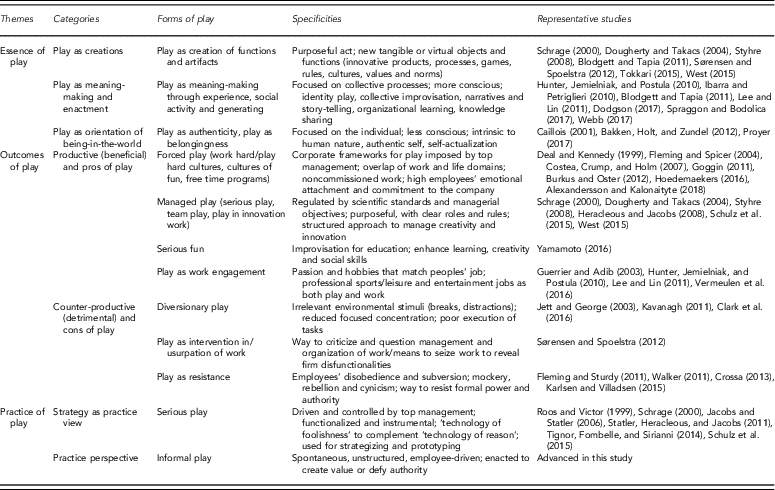
Since work and play have long been considered as incompatible domains, the phenomenon of organizational play has remained largely underexplored. In the early 1980s, scholarly interest in playful activities at work started to grow due to constantly evolving interpretations of work and increased recognition of the significance of play for shaping human development and interactions in contemporary organizations. Despite being typically associated with humor, leisure, fun and amusement (Proyer, Reference Proyer2017), play started to be viewed as a vital part of adult life and a complex subject matter that leads to unlimited affordances and multiple interpretations in corporate settings. In an in-depth analysis of the expanding organizational play literature, we identified three major themes (see Table 1), which do not rule each other out since a single study can cut across different themes and their respective categories.
Literature on the organizational play: Dominant themes, categories and forms of play

The essence of the play
The theme that focuses on the ‘essence of play’ is effectively captured through three broad categories of play that emerged in Tokkari’s (Reference Tokkari2015) metasynthesis of qualitative studies on workplace play. Being more phenomenological and existentialist, the first refers to play as the orientation of being-in-the-world, where play conveys to human beings a sense of authenticity and belongingness to a given social group (Bakken, Holt, & Zundel, Reference Bakken, Holt and Zundel2012). The play is conceived as an inherent element of human nature, an unconstrained occurrence and an end in its own, which is conducive to the embodiment of transcendental experiences and the realization of the real and unique potential of one’s own self (Caillois, Reference Caillois2001). The second category includes play as meaning making and enactment through more conscious and purposeful people’s experiences and social activities in the workplace. When faced with uncertainty, tensions and disfunctionalities, employees engage in playful collective undertakings, such as narratives and storytelling, identity play, and improvisation, with the purpose of sharing knowledge and solving complex problems to enable organizational learning (Spraggon & Bodolica, Reference Spraggon and Bodolica2017; Webb, Reference Webb2017). The last category conceptualizes play as creation of tangible or virtual artifacts, such as online games and paintings, and functions that ensue from continuous social interactions among firm members. Since play at work mobilizes abstract thinking, creativity and innovative behavior, it often culminates with the creation of new products, novel ways of doing things, and alternative cognitive frames for understanding existing realities (Schrage, Reference Schrage2000; West, Reference West2015).
Studies on the ‘essence of play’ have significantly contributed to the integration of the seemingly incompatible work and play domains by uncovering a variety of rationales, conceptualizations and manifestations of play in the workplace (Dodgson, Reference Dodgson2017). Yet, it is worth noting that play as meaning making and play as creations have attracted considerably more scholarly attention than play as being-in-the-world (Tokkari, Reference Tokkari2015). This literature has overemphasized the importance of play as a conscious and purposeful undertaking that occurs through social interactions among employees in order to achieve organizational expectations in terms of creation of material or virtual artifacts. Most research in this theme appears to be affected by preconceived ideas of play in the workplace, where the play is seen as a product of mindful collaborative activity rather than as a complex process that taps into the silent and implicit world of the individual actor. To date, there is a lack of understanding of the dynamics of organizational play from an existentialist standpoint, that conceives play as a primary necessity of human beings, a way of self-expression to cope with real-life events, and a scaffold for cognitive growth and personal learning and development. Forms of play that account for the natural predisposition of workers to play, allowing them to be true to themselves and realize their own potential, remain overlooked.
The outcomes of play
Another theme that emerged in the literature relates to the specific ‘outcomes of play,’ which permit to assess the pros and cons of playful endeavors in organizational settings. Acknowledging that play can be deployed for reasons that might trigger either beneficial or detrimental consequences at work, extant studies indicate that these more or less productive outcomes of play can be associated with seven different forms of play (Spraggon & Bodolica, Reference Spraggon and Bodolica2014). Four of these forms, namely forced play, managed play, serious fun and play as work engagement, are directed toward the achievement of productive job-related outcomes.
Inscribed within the contemporary trend of an increasing overlap between work and life domains, the forced play is depicted as a calculated top management effort to provide opportunities for leisure, amusement and well-being at work to maximize employees’ engagement and productivity (Deal & Kennedy, Reference Deal and Kennedy1999; Costea, Crump, & Holm, Reference Costea, Crump and Holm2007). Initiatives, such as cultures of fun, free time programs and ‘work hard/play hard’ cultures, are implemented in organizations to enhance workers’ emotional attachment to the firm so that they can work longer hours or engage in noncommissioned work (Goggin, Reference Goggin2011; Burkus & Oster, Reference Burkus and Oster2012). Managed play, which typically takes the form of serious play, team play or play in innovation work, represents a structured approach to manage team-based creativity and innovation in organizations (Dougherty & Takacs, Reference Dougherty and Takacs2004). Playful activities are governed by scientific standards or managerial objectives, where roles, rules and goals are clearly defined in advance to guide the interactions among players and the overall dynamics of play (Styhre, Reference Styhre2008; Schulz et al., Reference Schulz, Geithner, Woelfel and Krzywinski2015). Drawing upon the principles of play, Yamamoto (Reference Yamamoto2016) coined the concept of serious fun, which refers to the infusion of theatrical improvisation in educational contexts in order to enhance students’ learning, creativity and social skills. Finally, play as work engagement commonly emerges in specific industrial settings, such as leisure and entertainment, video game, and professional sports, where people’s passions and life interests naturally fit their jobs (Vermeulen et al., Reference Vermeulen, Koster, Loos and van Slobbe2016). It is argued that individuals can achieve higher levels of engagement and satisfaction with their work when they succeed to monetize their hobbies or when having fun is their daily work (Hunter, Jemielniak, & Postula, Reference Hunter, Jemielniak and Postula2010; Lee & Lin, Reference Lee and Lin2011).
The three remaining forms of play, including diversionary play, play as an intervention in/usurpation of work and play as resistance, are associated with different enactments of play that hold counterproductive connotations. Typically conceived as a disfunctional occurrence in organizations, diversionary play is prompted by irrelevant environmental stimuli, such as breaks, distractions and interruptions, which result in reduced employees’ concentration, misdirected efforts and delayed execution of the task at hand (Jett & George, Reference Jett and George2003; Clark, Michel, Zhdanova, Pui, & Baltes, Reference Clark, Michel, Zhdanova, Pui and Baltes2016). According to Sørensen and Spoelstra (Reference Sørensen and Spoelstra2012), play as an intervention in/usurpation of work materializes as a way to criticize management and challenge current practices in the workplace and as an uninvited means to seize work to reveal organizational misfits and inefficiencies. Play as resistance refers to exacerbated forms of defiance and insubordination of employees that allow them to deliberately deploy and skillfully make use of playful techniques to delegitimize formal power, cynically disobey authority, and block the coercive initiatives of managers (Fleming & Sturdy, Reference Fleming and Sturdy2011; Karlsen & Villadsen, Reference Karlsen and Villadsen2015).
Although extant research on the ‘outcomes of play’ enhances our understanding of a number of different forms of play in organizations, it exhibits several limitations. A certain bias can be noticed within the literature on workplace play toward its presumed positive and value-creating nature, unveiling an important need to explore more closely the politics of play and its more subversive manifestations. Studies on productive outcomes of play are largely dominated by accounts of forced and managed play, where the play is instrumentalized by top management through enabling adjustments in corporate practices and design (Alexandersson & Kalonaityte, Reference Alexandersson and Kalonaityte2018). Despite their institutionalization in the name of creativity and innovation, these forms of play are often perceived as modern practices of workplace control, which implicitly seek the subordination of workers’ bodies and mind to employers’ agendas (Hoedemaekers, Reference Hoedemaekers2016). The play remains widely portrayed as a managed rather than spontaneous undertaking, which is initiated by managers rather than employees and where workers are prompted to participate rather than let to play of their own free will. More scholarly attention is required to tap into informal and unstructured forms of play where employees become protagonists of their own playful activities that emerge in the pursuit of their daily doings at work.
The practice of play
Our analysis suggests that the ‘practice of play’ represents the third theme of organizational play research that was largely dominated by studies on the serious play (Tignor, Fombelle, & Sirianni, Reference Tignor, Fombelle and Sirianni2014; Schulz et al., Reference Schulz, Geithner, Woelfel and Krzywinski2015). Scholars who explored this phenomenon draw upon the principles of strategy as practice perspective to advance a conceptual model that views serious play as a strategy (Heracleous & Jacobs, Reference Heracleous and Jacobs2008) or practice of paradox (Statler, Heracleous, & Jacobs, Reference Statler, Heracleous and Jacobs2011). Serious play is conceived as a meaningful way of intervening in conventional business processes and an effective technique of disrupting corporate routines, where managers purposefully incorporate playful activities into traditional workshops or retreats to induce participants to achieve successful strategy formulation (Geurts, Duke, & Vermeulen, Reference Geurts, Duke and Vermeulen2007). This technique allows the infusion of the logic of reason into the logic of instinct to functionalize play and approach it as a serious business in corporations. Serious play requires formal guidance to prompt people to experience and interpret critical organizational issues relying on rational cognition, interpersonal interactions and bodily engagement with tri-dimensional objects (i.e., Legos) to materialize ideas.
Prior studies associated serious play with strategic processes such as strategy making (Roos & Victor, Reference Roos and Victor1999; Heracleous & Jacobs, Reference Heracleous and Jacobs2008), scenario planning (Jacobs & Statler, Reference Jacobs and Statler2006), product innovation (Schrage, Reference Schrage2000; Dougherty & Takacs, Reference Dougherty and Takacs2004), and decision making and corporate change (Beech, Burns, de Caestecker, MacIntosh, & MacLean, Reference Beech, Burns, de Caestecker, MacIntosh and MacLean2004; Geurts, Duke, & Vermeulen, Reference Geurts, Duke and Vermeulen2007). Relying on the construct of strategic imagination in its descriptive, creative and challenging forms, Roos and Victor (Reference Roos and Victor1999) explored the social dynamics of play to develop a model of strategy making as serious play, allowing individuals to create new knowledge, share meanings and transform their work identity. Heracleous and Jacobs (Reference Heracleous and Jacobs2008) offered an alternative view on strategizing as a crafting practice carried out via the construction and interpretation of embodied metaphors to fuel sense making. As this inductive and iterative process cannot be totally spontaneous, it ought to be framed within coordinated workshops where participants are enabled to flesh their idea associations into physical artifacts that are manipulated and analyzed from different perspectives. For Jacobs and Statler (Reference Jacobs and Statler2006), the ‘technology of foolishness’ associated with serious play represents a meaningful complement to the ‘technology of reason’ typically used in the development of strategic scenarios.
The combination of teamwork seriousness with having fun while working in teams was shown to enable successful product innovation in large firms (Dougherty & Takacs, Reference Dougherty and Takacs2004). Schrage (Reference Schrage2000) described the way engineers engage in prototyping and simulation processes by seriously playing with various material representations of ideas (e.g., tools, technologies, or toys) to improvise potential alternatives, solutions and trade-offs for achieving innovation. Researchers have also suggested that organizations can rely on different playful arrangements to cope with environmental complexity and paradoxical situations for pursuing decision making and strategic change. They may choose to employ policy gaming that integrates the rigor of systems’ analysis with the creativity of role-playing and structured group techniques (Geurts, Duke, & Vermeulen, Reference Geurts, Duke and Vermeulen2007) or ‘work with or through’ paradoxes in order to ‘keep them open’ by means of serious play (Beech et al., Reference Beech, Burns, de Caestecker, MacIntosh and MacLean2004).
Statler, Heracleous, and Jacobs (Reference Statler, Heracleous and Jacobs2011) labeled the juxtaposition of the triviality of play with the seriousness of work inherent in the practice of serious play as the ‘paradox of intentionality’ that may assist managers in tackling a variety of problems and achieving individual- and group-level goals. Since any individual actor is rarely capable of generating change in today’s world, managers organize group seminars to enable participants to ratify jointly created meanings and carefully observe the contextual, local activities of strategizing. Entailing formal managerial interventions, serious play as strategy reframes conventional work boundaries via playful design, focusing on people’s intentionality, consciousness and local purposeful actions to play with Legos for strategy formulation. Despite its contributions, the serious play offers only a limited account of the practice of workplace play, neglecting other forms of play that are not formalized and normative in nature, fall outside management agendas, are intrinsically motivated and could be detrimental for organizations.
In this article, we aim to contribute to the literature by focusing our attention on the informal play as an alternative to prevailing views on a play in organizational settings. By conceiving informal play as a specific form of play as a practice that is spontaneous, self-organized and employee-driven, we are able to acknowledge its possible enactment for not only producing valuable job-related outcomes but also cynically resisting top management authority. In our conceptualization, we draw upon a practice perspective to generate a more complete and realistic portrayal of playful practices in the world of work that extends beyond the dominant views on the serious play.
BRINGING IN A PRACTICE PERSPECTIVE
According to practice scholars, the notion of practice has been influenced by five major streams of thought, namely Marxism, phenomenological tradition, symbolic interactionism, Wittgenstein’s legacy and posthumanism (Schatzki, Knorr-Cetina, & von Savigny, Reference Schatzki, Knorr-Cetina and von Savigny2001; Miettinen, Samra-Fredericks, & Yanow, Reference Miettinen, Samra-Fredericks and Yanow2009; Nicolini, Reference Nicolini2013; Frost & Lechner, Reference Frost and Lechner2016). The Marxist theory states that current practice is an outcome of idiosyncratic historical conditions resulting from prior practices and that knowing and doing are dialectically intertwined in practice. Drawing upon Heidegger’s idea of ‘being-in-the-world,’ phenomenology scholars posit that there are no subject–object, macro–micro, inside–outside dualities as they are all constituents of a given social and historical context. Symbolic interactionism enriched the concept of practice by recognizing that knowledge can be accessed via interactions among individuals, and between individuals and artifacts. The legacy of Wittgenstein highlights the importance of language as a vehicle for creating meaning and building practice through language games. Finally, the posthumanistic school underlines the agency power of objects and artifacts and the significant role they play in social construction.
Notwithstanding the variety of practice-based traditions in the literature, they contribute different relevant elements to the definition of practice. In the field of organization studies, adopting a practice lens implies taking as the unit of analysis the activities of management rather than the organizational members themselves (Nicolini, Reference Nicolini2013). For Vaara and Whittington (Reference Vaara and Whittington2012: 287), practices are ‘accepted ways of doing things, embodied and materially mediated, that are shared between actors and routinized over time.’ Going beyond the mere description of what people actually do, selected practice scholars elaborate on the creation of meaning that occurs in daily corporate doings not only via humans’ discourse (Paroutis & Heracleous, Reference Paroutis and Heracleous2013), body, habits and concerns (Mirabeau & Maguire, Reference Mirabeau and Maguire2014; Seidl & Whittington, Reference Seidl and Whittington2014) but also through nonhumans or strategy tools (Jarzabkowski & Kaplan, Reference Jarzabkowski and Kaplan2015). To recognize the materiality of practice, the nonhuman dimension is added to the definition of practice in which humans, their activities, and objects of work are organized into a meaningful and coherent set (Gherardi, Reference Gherardi2010).
According to Carlile (Reference Carlile2002: 446), objects represent ‘the collection of artifacts that individuals work with,’ such as tools, documents, blueprints and machines that firm actors produce, reify, assess or manipulate. From a practice-based standpoint, objects of work are carriers of motives of practices as they mediate a socio-historical aspect in the accomplishment of a practice (Engeström & Blackler, Reference Engeström and Blackler2005). Drawing upon Marx’s philosophy, the cultural–historical activity theory conceives objects through a dialectical materialist epistemology and a historical materialist ontology (Miettinen & Virkkunen, Reference Miettinen and Virkkunen2005). Epistemologically, objects embrace simultaneously objective and subjective dimensions, being neither given inert entities nor subjective mental constructions. Ontologically, the theory emphasizes the social-structural constitution of the object as it presents itself in practical activity, acknowledging the inherently contradictory structuring of objects of work.
Extant practice literature goes beyond the mere ‘what’ of practices by focusing on practitioners ‘who’ are engaged in a practice and analyzing the praxis of ‘how’ practices are actually carried out and adapted in the field (Jarzabkowski et al., Reference Jarzabkowski, Kaplan, Seidl and Whittington2016). Being associated with specific daily doings, praxis is materialized through practitioners’ actions and behaviors that occur over extended periods of time or sequences of events (Vaara & Whittington, Reference Vaara and Whittington2012). Gherardi (Reference Gherardi2010) maintains that practices offer social order, provide some type of structure, and are practiced by actors who are part of those practices. Participating in practice represents a means to acquire specific practical understanding and either perpetuate or contest, via situated praxis, current habitus (Bourdieu, Reference Bourdieu1990) that is alive in and sustained by a practice community (Llewellyn & Spence, Reference Li, Chiaburu and Kirkman2009). Ritualistic activities may be actually challenged by actors in their praxis of practice as they experience surprises, bodily action misfits or knowledge gaps when coping with their objects of work. Since practitioners are seen ‘not as simple automata, but as artful interpreters of practices’ (Whittington, Reference Whittle, Mueller, Gilchrist and Lenney2006: 615), they may adjust and duplicate the existing stock of practices on which they draw when deploying a practice.
Practice scholars also draw their attention to the specificities of the general context in which actors are located and operate (Lozeau, Langley, & Denis, Reference Lozeau, Langley and Denis2002; Mirabeau & Maguire, Reference Mirabeau and Maguire2014; Chalmers & Shaw, Reference Chalmers and Shaw2017). The enactment of practices occurs in idiosyncratic ways depending not only on practitioners’ skills, agendas and their relationship with other local practices but also on specific circumstances of their organizational life (Jarzabkowski et al., Reference Jarzabkowski, Kaplan, Seidl and Whittington2016). By involving in a practice, actors follow, reinforce, shape and learn the practice and gradually internalize the particular mode of disposing themselves to enact and reproduce it in different workspaces and temporalities. Spraggon and Bodolica (Reference Spraggon and Bodolica2014) suggest that the way practitioners interpret various aspects of their work climate, such as management style, job design and task complexity, corporate culture and intrafirm interactions, influences how playful activities are actually practiced in organizations.
In this article, we define practice as a way of connecting and ordering human beings, objects, and doings into an intelligible and articulated set of activities, which are socially created, reconstructed and legitimized by actors in their situated enactments over time. In our conceptualization, practices: are not confined to top management or selected elite players but rather to all members affecting organizational life (i.e., practitioners) (Nicolini, Reference Nicolini2013); involve particular activities that are spontaneous and emergent in nature rather than solely governed by formal procedures or top-down indications (i.e., practice) (Carter, Clegg, & Kornberger, Reference Carter, Clegg and Kornberger2008); embrace nonhuman dimensions of work, such as tools and artifacts, that have a mode of existence and possess agentive power (i.e., objects) (Engeström & Blackler, Reference Engeström and Blackler2005); and are enacted in a variety of ways through actors’ situated doings (i.e., praxis) (Vaara & Whittington, Reference Vaara and Whittington2012) that are influenced by the peculiarities of the broader environment in which they are embedded (i.e., context) (Spraggon & Bodolica, Reference Spraggon and Bodolica2014). In our below analysis of informal play as a specific form of play as practice, we rely on five key practice-based constructs that emerged from our review of the practice literature, namely practice, practitioners, praxis, objects and context.
PLAY AS PRACTICE: INFORMAL PLAY VERSUS SERIOUS PLAY
The informal play is defined as a practice through which ludic individuals informally and spontaneously enact play at work to artfully and esthetically cope with organization-induced factors (e.g., surprises, breakdowns, interventions or disturbances) that are experienced by them as challenging instances intruding in their corporate life. Informal play can be thought of as a provisional world at work that provides a particular material, a mental and spiritual stage for practitioners’ improvisations, adaptations and accommodations to deal with daily happenings in the workplace (Spraggon & Bodolica, Reference Spraggon and Bodolica2014). By involving in informal play, actors are prompted to uncover and expand their inner potential, learn from every experience and achieve higher levels of personal growth. Informal, playful activities are social in nature as they embrace idiosyncratic ways of acting, moving, thinking, feeling and understanding that is rooted in and revealed via players’ bodily performances. The informal play is grounded in a specific social and material site in which the ways of doing, knowing and organizing are implicitly established by the actors who form and transform this practice. Representing coherent clustered gestalts of embodied playful behaviors, informal play can be enacted in idiosyncratic ways, such as enhancing value or resisting authority, which can be observed in practitioners’ ongoing copings with their everyday tasks.
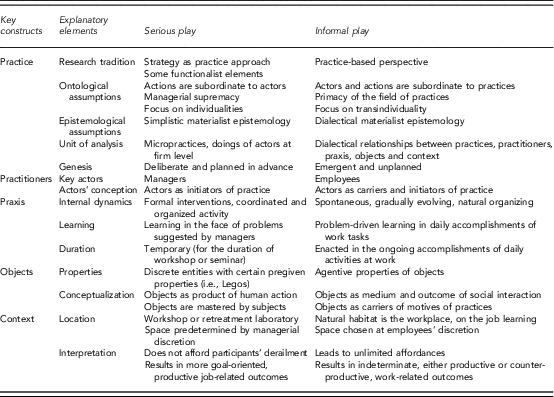
This conceptualization of informal play positions it as a distinct form of playful practice that differs from serious play along with the five practice-based constructs we retained in this article to reflect on the play as practice manifestations in organizational settings (see Table 2).
Play as practice: Comparison of serious play and informal play along five key practice-based constructs

Practice
Serious play studies equalize the notion of practice to microprocesses or to what people actually do, putting the emphasis on individualities rather than practices themselves, which represent the ontological foundation for explaining the emergence of strategizing (Sandberg & Tsoukas, Reference Sandberg and Tsoukas2011). Strategy as practice tradition falls into the ontological supremacy problem between the macro and micro levels, instead of focusing on the emerging patterned actions that arise from the primacy of the field of practices (Chia & MacKay, Reference Chia and MacKay2007; Gherardi, Reference Gherardi2010). The philosophical underpinnings of the practice-based approach that considers practices as the starting point for social analysis allow overcoming the dichotomous views on macro–micro, mind–body and agency–structure. Practice scholars focus their attention on ‘supraindividual’ or ‘transindividual’ phenomena (e.g., habitus or practice) rather than on individualities or conventional notions such as norms, interpretations, intentionality or mind (Whittington, Reference Whittle, Mueller, Gilchrist and Lenney2006; Nicolini, Reference Nicolini2013). Instead of studying the role of cognition, individuals, groups, or organizations, they seek to uncover the recursive and dialectical interdependencies between the human and the material or the subject and the object.
Given the intuitive, prereflexive and unintentional nature of the informal play, the intensity of, absorption in, the mirth of and devotion to this activity can be understood by the logic of practice rather than by the logic of modern scientific rationality (Sandberg & Tsoukas, Reference Sandberg and Tsoukas2011). A critical premise in the enactment of informal play is that shared understandings, beliefs and rules are built and dependent on playful practices. The predominance of practices over agency implies that meaningful and purposive actions derive from engaging in spontaneous and self-organized playful practices rather than from the deployment of procedures and routines that are detached from wider social structures (Jarzabkowski et al., Reference Jarzabkowski, Kaplan, Seidl and Whittington2016). From a practice standpoint, most informal playful activities carried out by organizational members follow a ‘mindless practical coping’ (Chia & MacKay, Reference Chia and MacKay2007: 233). Yet, a conscious reflective intervention becomes necessary when an interruption, failure or breakdown of coping takes place, as actors tend to acknowledge and register the cognitive boundaries between them and the object of the action (Miettinen & Virkkunen, Reference Miettinen and Virkkunen2005).
Practitioners
While serious play takes place as a result of top management endeavors to explore strategic alternatives through playful design (Statler, Heracleous, & Jacobs, Reference Statler, Heracleous and Jacobs2011), the informal play is neither planned in advance nor driven by managerial intervention. According to practice scholars, practices are seen as noticeable action patterns derived from disciplined, habituated tendencies and internalized dispositions and not from managers’ deliberate efforts deployed to strategize, as assumed by strategy as practice view (Seidl & Whittington, Reference Seidl and Whittington2014). Extant studies on serious play portray managers as independent agents, who carry out activities purposefully to deploy strategy and act on the external environment, rather than as practitioners who are instructed and structured by the rules, norms and understandings of their practices.
Adopting a different philosophical conjecture regarding agency and action, the practice lens posits that intentionality is not necessarily a precondition for strategizing (Mirabeau & Maguire, Reference Mirabeau and Maguire2014) and it is the habitus (Bourdieu, Reference Bourdieu1990) that informs players’ actions. By positioning the transmission of practices at the center of analysis, the engagement in informal playful undertakings is seen as a consequence of the intrinsic predisposition of people to unselfconsciously cope with organization-induced events (Spraggon & Bodolica, Reference Spraggon and Bodolica2014). The practice-framed notion of informal play allows conceiving practitioners not merely as the conscious initiators of practices but as both carriers and originators of practices (Vaara & Whittington, Reference Vaara and Whittington2012).
Praxis
Contrary to serious play that promotes managerial supremacy through top-down indications, the informal play is seen from an employee and improvisational perspective being more emergent, continuous and populated of surprises. While the serious play is confined to a set of supervised activities that are played by coerced practitioners in a given place and at a stipulated time (Schulz et al., Reference Schulz, Geithner, Woelfel and Krzywinski2015), employees engage in informal playful practices of their own free will and enact them in their ongoing pursuit of work-related tasks. The internal dynamics of informal play differ from serious play in that the praxis of informal play practice is typically manifested as a spontaneous endeavor initiated by organizational members in their coping with external alterations, without requiring hierarchical coordination (Spraggon & Bodolica, Reference Spraggon and Bodolica2014).
In a retrospective examination of the way a navigation team adapted to a navigational crisis while a ship was entering a harbor, Hutchins (Reference Hutchins1991: 14) showed that ‘several important aspects of a new organization are achieved not by conscious [and managerial] reflection but by local adaptations’ of employees when confronted with unexpected events. The practice of informal play conveys general principles and dispositions for playful action on which participants draw to enact their personal interpretation of the practice in their ordinary work environment (Jarzabkowski et al., Reference Jarzabkowski, Kaplan, Seidl and Whittington2016). It is through a series of continuous and situated adjustments and accommodations in the pursuit of their daily tasks that, over time, informal play actors may manage to deploy enough recursive variations that may result in substantial changes.
Objects
In an analysis of the role played by material objects in everyday aspects of social life, Miller (Reference Miller1998) concluded that an inseparable relationship exists between the material and social worlds. Latour (Reference Latour1999) unveiled the social agency power of ‘quasi-objects’ (e.g., laboratory assays or automatic door closers), arguing that they exhibit human capacities such as speaking, clustering, judging and resisting. Exploring the way artifacts are used by occupational communities in a manufacturing firm, Bechky (Reference Bechky2003) demonstrated that objects of work not only mediate the relationship between occupational boundaries (i.e., engineers, technicians and assemblers) but also enable to solve problems across these communities. This conceptualization of agentive objects underlines the significance of the material nature of practices, triggering a paradigm shift that favors the understanding of objects (nonhumans) and subjects (humans) as modes of existence (Latour, Reference Latour1999).
Indoctrinated and socialized by the practice, informal play practitioners organize their actions around their objects of work, including boundary and epistemic objects. Boundary objects are seen as multifunctional, plastic, loosely defined and general, constituting ‘trading zones’ that enable translation across social worlds (Carlile, Reference Carlile2002). As far as epistemic objects are concerned, they are conceived as things that have an unfolding ontology, are question generating, and allow producing and reproducing imminent ideas and materializing thoughts and metaphors (Bechky, Reference Bechky2003). In the case of the serious play, employees are prompted by intervening managers to play with and manipulate certain objects, such as Lego bricks and toys, which represent tri-dimensional discrete artifacts with pregiven meanings. Yet, objects of work in the practice of informal play are considered not merely as products of human action, but rather as both the medium and outcome of social interaction (Jarzabkowski & Kaplan, Reference Jarzabkowski and Kaplan2015).
Context
The predominant intrafirm arrangements are regarded as relevant factors that affect the enactment of practice in different organizational settings (Spraggon & Bodolica, Reference Spraggon and Bodolica2014). Corporate climates serve as a basis for employees to perceive and interpret current procedures in the workplace, representing a critical source for guiding behavior and funneling activity into a certain direction (Fritz & Sonnentag, Reference Fritz and Sonnentag2009). Serious play occurs in an artificial setting (e.g., workshop or experiential laboratory) that is deliberately designed to facilitate playful interactions and shape actors’ behavior. The supervised nature of the environment in which serious play is enacted, being prompted by managers concerned with instrumental ends, does not allow participants’ derailment from the achievement of value-enhancing objectives.
Because informal play takes place in the implicit, silent and ordinary aspects of everyday corporate life, studying this form of playful practice allows understanding the way practitioners interpret challenging situations, create problems and cope with them in their natural work habitat (Bourdieu, Reference Bourdieu1990). Due to the dynamic, indeterminate and open-ended nature of the informal play, its occurrence leads to unlimited affordances in organizations that may or may not result in productive job-related outcomes. In favorably perceived work climates where employees willingly engage in learning, innovation and knowledge generation (Spraggon & Bodolica, Reference Spraggon and Bodolica2012), informal play can be deployed as means to bring about valuable corporate results. Yet, in response to some unsatisfactory work contexts, practitioners may enact informal play as a practice to defy formal authority and contest oppressive initiatives of managers.
INFORMAL PLAY AS PRACTICE FRAMEWORK
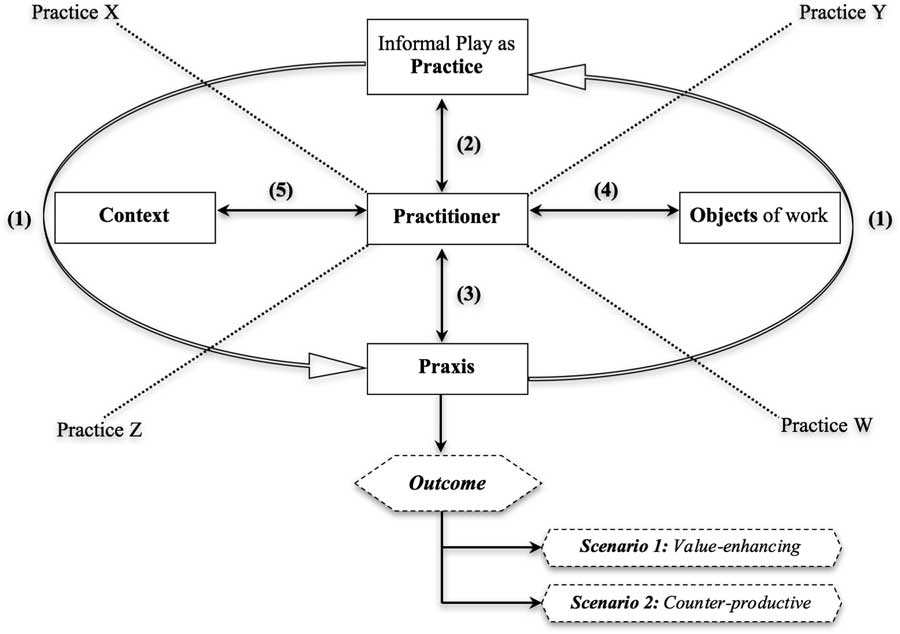
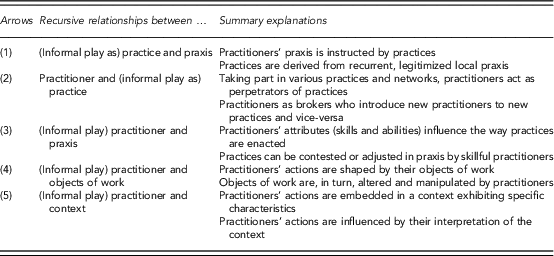
So far, mobilizing the concepts of practice, practitioners, praxis, objects and context, we introduced and developed the idea of informal play as an alternative to prevailing views on play as a practice that was dominated by studies on the serious play. In this section, we seek to achieve a higher level of abstraction by advancing an integrative practice-based framework for better understanding and conducting research on informal playful practices in organizational settings (see Figure 1). Because the practice perspective entails recursiveness and mutual dependency (Whittington, Reference Whittle, Mueller, Gilchrist and Lenney2006; Jarzabkowski et al., Reference Jarzabkowski, Kaplan, Seidl and Whittington2016), the purpose of our framework is to highlight the interconnectedness among its different constitutive elements that form an integrated gestalt. The dialectical relationships between the five practice-based constructs illustrated in the proposed theoretical framework of informal play as a practice are summarized in Table 3.
A theoretical framework for understanding informal play as practice in organizations

Explanation of the five recursive relationships in the theoretical framework of informal play as practice

Consistent with the practice tradition (Chia & MacKay, Reference Chia and MacKay2007), our framework attributes priority to the field of practices as the starting point for analyzing informal playful practices in the world of work. As illustrated in Figure 1, two possible outcome-related scenarios are acknowledged where the informal play is practiced to achieve value-enhancing objectives (scenario 1) or to engender counter-productive consequences in the workplace (scenario 2). Below we offer a detailed discussion of five iterative relationships between the retained practice-based constructs as they relate to the practice of informal play. In doing so, we seek to contribute to the literature by showcasing positive and negative externalities that spontaneous and unstructured forms of play can generate in corporations and beyond their boundaries.
(Informal play as) practice and praxis
The recursive relationship (1) between practice and praxis in our framework aims to uncover how informal play emerges as a practice and how it evolves and transforms through actors’ praxis. Practice theorists maintain that apparently insignificant situated actions of firm members are closely interconnected with wider social structures that transcend individual transactions and organizational spheres (Jarzabkowski et al., Reference Jarzabkowski, Kaplan, Seidl and Whittington2016). Focusing on the intricacy and practical logics of ordinary activities of actors at work can assist in understanding the genesis and latent dynamics of practices. According to Vaara and Whittington (Reference Vaara and Whittington2012), practices are derived from repeated, established and legitimized local praxis, which, in turn, is instructed by wider practices. Since human action is ingrained and embedded in practices, the recurrent manifestations of individuals’ doings in the workplace can be considered as instantiations of practices.
The practice of informal play occurs within and represents a component of the field of practices, which is defined as ‘the total nexus of interconnected human practices’ (Schatzki, Knorr-Cetina, & von Savigny, Reference Schatzki, Knorr-Cetina and von Savigny2001: 2). The social life of organizational members is continuously constructed and reconstructed via actions and interactions that take place within the wider net of interrelated practices (Seidl & Whittington, Reference Seidl and Whittington2014). Originating from internalized dispositions and routinized codes of behavior, informal play emerges as a practice that encompasses shared skills, embodied know how and practical understanding, and is enacted and disseminated by actors in their daily copings with firm-induced events. The recurrent in situ instances of alterations and adaptations of work processes that happen through employees’ playful praxis contribute, over time, to the reinforcement and perpetuation or the questioning and modification of the practice of informal play.
Our analysis of the genesis of wider practices and social structures and their relationships with distributed, situated praxis permits accounting for different affordances of informal play at work, which could be positive or negative in nature. When employees are confronted with task-related problems, they may draw upon the practice of informal play by internalizing, replicating and legitimizing it in their everyday praxis to explore possibilities, improvise solutions and generate valuable organizational outcomes (scenario 1). Practitioners could be induced to engage in playful pastimes with the purpose of gaining immediate mental relief from work, while gradually and unselfconsciously reengaging with ongoing job-related concerns in the midst of the joyful experience itself. Although actors may apparently stop working to pursue informal playful undertakings, their creative mind would not completely cease wandering but would continue processing information to produce analogic associations that may be useful in the conduct of their work (Hoedemaekers, Reference Hoedemaekers2016).
Yet, in their ongoing praxis of a given practice organizational members may also be driven to enact informal play in order to resist managerial domination and delegitimize the imposed principles in the workplace (scenario 2). The coercive attempts of top management to indoctrinate certain work procedures and routines may be faced with employees’ mockery, witticism, and sarcastic questioning that could result in the amplification of organizational inefficiencies, disfunctionalities and misfits (Fleming & Sturdy, Reference Fleming and Sturdy2011; Crossa, Reference Crossa2013). The newly delegitimizing informal play enactments, built on various affordances of play and its gradual modifications in praxis, may start not only crystallizing in the firm but also diffusing among the firm’s partners, competitors and industry networks.
Practitioner and (informal play as) practice
Our framework suggests that for analyzing the iterative relationship (2) between practitioner and practice it is critical to understand how informal play practitioners’ participation in and mobility across different networks influence the interconnectedness and perpetuation of practices in the field. According to Giddens (Reference Giddens1984), the contemporary world can be seen as an open social system that encompasses a plurality of practices in which actors participate and through which they transit. Practitioners play a vital role in mobilizing and diffusing practices, as they are located at the interface between practices that are enacted within the organization and practices that exist beyond the organizational boundaries. By capitalizing on the openness of social systems, practitioners may be able to act as brokers to connect new practitioners to new practices and vice-versa (Whittington, Reference Whittle, Mueller, Gilchrist and Lenney2006).
Because practitioners are seen as conduits and perpetrators of practices (Gherardi, Reference Gherardi2010), the proliferation of informal play as practice across organizational and industrial contexts may be essentially driven by actors who deploy this playful practice and have accessibility to wider social structures. Acknowledging that actors’ mobility is a key vehicle through which the practice of informal play can be transferred across settings, it is important to understand who the practitioners are, their professional background and the extent of their connectivity in the network (Carter, Clegg, & Kornberger, Reference Carter, Clegg and Kornberger2008; Seidl & Whittington, Reference Seidl and Whittington2014). This information confers valuable insights regarding the practitioner’s social memberships, profession, ideologies and religion, which may have far-reaching implications that transcend individualities (Nicolini, Reference Nicolini2013). Aiming to reproduce, deploy and institute external practices into their firm, well-connected practitioners act as carriers of informal playful practices by internalizing them from their professional networks and transferring them into their jobs.
It is worth recognizing that practitioners’ replication of certain practices established in the field may be conducive toward the generation of not only productive outcomes but also value-destroying consequences for organizations. For example, in highly innovative industries, change-embracing practitioners who are connected to several professional networks may be drawn to import dominant practices from the sector that are consistent with the logic of endless experimentation, risk taking, and trial-and-error. By designing flexible work arrangements to support these practices, employees are enabled to engage in informal playful activities at work to creatively explore possibilities and uncover novel solutions to unresolved issues related to their jobs (scenario 1). Over time, practitioners may contribute to the wide dissemination of the practice of informal play as a means for fostering creativity and innovation, resulting in the gradual establishment of dominant paradigms in the field.
Nevertheless, by participating in different industry networks, practitioners could also get exposed to a variety of legitimized and widely spread practices, which are disfunctional and ineffective but still commonly used across organizations. Although timeout practices and noncommissioned work initiatives are stereotypically revered in creative corporate settings, they are often playfully unwelcomed, purposefully disregarded and met with sarcastic resistance, leading to the reinforcement of inefficiencies in the workplace (Goggin, Reference Goggin2011; Walker, Reference Walker2011). Consequently, informal play may start diffusing across multiple network participants as an accepted practice to boycott unfitting and disfunctional practices that are imported from outside (scenario 2).
(Informal play) practitioner and praxis
The recursive relationship (3) between practitioner and praxis in the advanced framework seeks to shed light on the individual attributes of informal play actors and their influence on the praxis of practices on which they draw. Conceiving praxis as an esthetic and artful performance rather than a mere replication of a practice implies recognizing that effective praxis is dependent upon specific competences and experiences of practitioners to access and enact prevalent practices (Carter, Clegg, & Kornberger, Reference Carter, Clegg and Kornberger2008; Vaara & Whittington, Reference Vaara and Whittington2012). While practices instruct actors’ praxis, they may also be questioned, contested or adapted in praxis by skillful and knowledgeable practitioners in their daily copings with issues in organizational life. Because actors are reflexive in nature, they are able to exploit the plurality that exists in the field of practices and, on some occasions, synthesize new practices by borrowing and amalgamating guiding principles from different more or less related domains (Frost & Lechner, Reference Frost and Lechner2016).
In our conceptualization of informal play as practice, the notion of the practitioner is not reduced to just top managers who are responsible for strategy formulation but rather refers to any member in the organization who participates in and draws upon this playful practice. Being not merely passive followers of a practice (Jarzabkowski et al., Reference Jarzabkowski, Kaplan, Seidl and Whittington2016), employees possess sophisticated competences and abilities, such as improvisation, creativity and bricolage, to deftly alter the praxis of informal play. When misfits and disruptions are encountered in the workplace, skillful actors may suspend their mindless doings by changing and adapting their enactment of the practice of informal play. Through repeated adjustments and accommodations in the face of firm-induced events, practitioners become innovators and initiators and not merely perpetrators of informal playful practices.
We suggest that, in an effort to deal with organizational variations, employees may enact the practice of informal play in idiosyncratic ways to either embrace and modify or question and resist those variations. When employees are confronted with knowledge deficiencies that prevent them from effectively accomplishing their job-related tasks, they may free their creative mind by engaging in unstructured playful pastimes to facilitate the emergence and association of new ideas and insights (Spraggon & Bodolica, Reference Spraggon and Bodolica2017). Being challenged to improvise, through a sequence of recurrent and situated alterations and adaptations, actors deploy informal play practices to learn something new and find valuable avenues for action (scenario 1).
Conversely, faced with the managerial indoctrination of highly formalized work processes, knowledgeable and experienced workers may enact informal play as practice to defy top management authority and ignore their procedural expectations (scenario 2). When formal protocols, templates and documents are seen as irrelevant and inappropriate for their organization, employees may not accept nor legitimize them in their work. Practitioners’ resistance toward the compulsory usage of formalized work procedures may exacerbate when their problem-solving skills are mainly contextual and rely on collective and experimental learning on the job. To cope with knowledge misfits originating from unfitting managerial attempts, employees can make sense of the nonsense by involving in playful mockery, irony and cynic behavior in the workplace (Karlsen & Villadsen, Reference Karlsen and Villadsen2015).
(Informal play) practitioner and objects of work
In our framework, the iterative relationship (4) between practitioner and objects of work aims to explore the constraining and enabling the power of objects that are deployed and manipulated by practitioners in their enactment of informal play. Understanding social practices always involves acknowledging the nonhuman dimension and material configurations of human activity that is embodied, facilitated and mediated by physical and intangible artifacts (Carlile, Reference Carlile2002). Because practices emerge, are structured and pivot around objects of work that act as medium and end of social interactions, objects should be seen as indispensable and inseparable components of practitioners’ behaviors in the workplace (Engeström & Blackler, Reference Engeström and Blackler2005).
The actions of employees engaged in informal play as a practice are affected and shaped by their objects of work, which, in turn, are altered and manipulated by them. Based on their discursive coding and interpretation, informal play practitioners infuse their objects of practice with particular social significance. Seen as complex ‘envelopes of meaning’ that need to be deciphered and understood (Pels, Hetherington, & Vandenberghe, Reference Pels, Hetherington and Vandenberghe2002), objects carry specific motives and agendas of actors in their deployment of the practice of informal play. At the same time, the objects mobilized in informal playful practices assume human characteristics, such as thinking, judging, making decisions and speaking, revealing their agentive power to organize people’s praxis. Players are thus disciplined and instructed not only by the internalized dispositions of practice but also by their objects of work, which shape, mediate and coerce them and their actions (Jarzabkowski & Kaplan, Reference Jarzabkowski and Kaplan2015).
We argue that the mutually constitutive dynamics of practitioners’ interaction with their objects of work can result in affordances for either value creation or value destruction in the workplace. For example, leisure facilities in organizations, such as social games, sport centers and relaxation areas, may be used as a space for informal playful encounters where employees can esthetically share stories, design sketches and improvise drawings that may lead to evolving and insightful versions of solutions to address task-related concerns (scenario 1). Conversely, the constraining nature of objects of work, such as extensive written reports, protocols, templates and assessment documents, may induce a reaction of cynical compliance among employees through the enactment of informal play for mocking and resisting the impositions of these objects (scenario 2).
(Informal play) practitioner and context
The purpose of the recursive relationship (5) between practitioner and context illustrated in our framework is to unveil how practitioners’ interpretation of the general work context and its idiosyncrasies influence the enactment of the practice of informal play. Different levels of support provided by an organizational climate emit specific social signals throughout the firm, which are perceived, interpreted and shared in a reinforcing cycle of meaning and sense making, inducing certain responses from employees (Fritz & Sonnentag, Reference Fritz and Sonnentag2009). Through frequent interactions with each other, actors develop a consolidated impression of whether their work surroundings are favorable or unfavorable to them, which translates into a set of behaviors and attitudes that are commensurate with their overall impression. According to Li, Chiaburu, and Kirkman (Reference Liu, Gong, Zhou and Huang2017), corporate members are likely to react positively to environments perceived as satisfactory, while they may be enticed to engage in equilibrium-defying behaviors when faced with a hostile and unsupportive climate.
As a social practice that is tightly interconnected to other practices in the field, informal play cannot be studied in isolation from the context in which it is embedded and manifests. By overlooking practitioners’ adaptations of practice in context, scholars risk overestimating the power of practice and misconceiving it as an automatic ordering structure that is followed in praxis without complications (Jarzabkowski et al., Reference Jarzabkowski, Kaplan, Seidl and Whittington2016). When examining informal playful manifestations at work, it is critical to account for the specific characteristics of the environment in which they are practiced and the particular context-related assessments of practitioners as a driving force behind their actions. The effective enactment of the practice of informal play implies artfully interpreting the specificities of the context to craft adequate responses to changing circumstances in the workplace.
Our analysis suggests that situated enactments of informal play as practice exhibit high levels of variability in terms of potential outcomes, which may be either value enhancing or counter-productive for organizations. On the one hand, a corporate context that is perceived favorably by actors may allow them to temporally deviate from the prevalent practice by playfully improvising and experimenting with plausible solutions to successfully tackle emerging work concerns (Spraggon & Bodolica, Reference Spraggon and Bodolica2014). In an environment characterized by psychological safety, structural flexibility, openness to risk and nimble work arrangements, informal play as the practice may be deployed as a way to expedite employees’ imagination, risk taking, creative problem solving and innovation (scenario 1). On the other hand, a sarcastic and value-destroying response may be triggered when newly implemented work procedures interfere with the natural flow of practitioners’ work, disturbing their proven ways of doing and challenging their expert skills and abilities (Moore, Detert, Klebe Trevino, Baker, & Mayer, Reference Moore, Detert, Klebe Trevino, Baker and Mayer2012; Hoedemaekers, Reference Hoedemaekers2016). A shared perception of an unsupportive and psychologically threatening climate may contribute to employees’ enactment of informal play to subversively resist authority and deliberately boycott top-down indications (scenario 2).
FUTURE INFORMAL PLAY AS PRACTICE RESEARCH
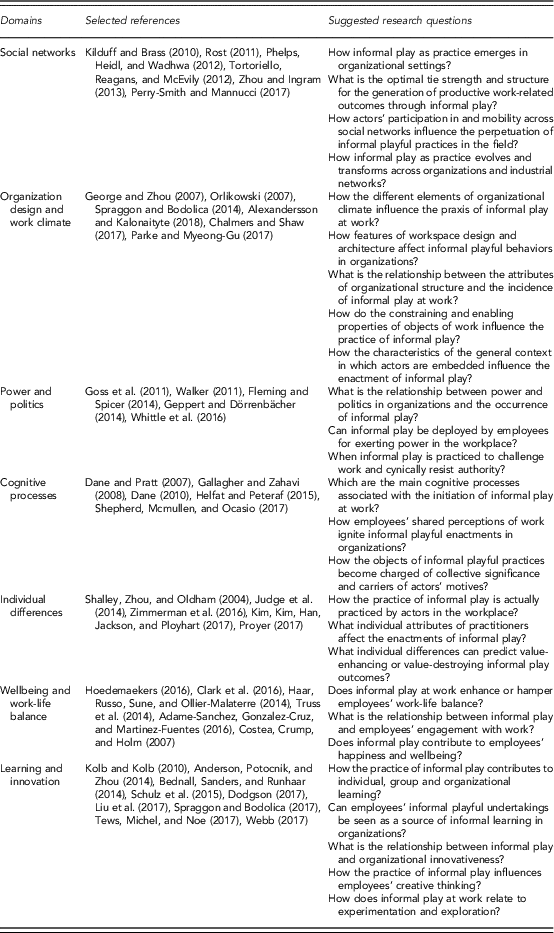
Our theoretical framework offers new insights into and a practice perspective on the analysis of play in organizational settings, opening multiple avenues for further exploration in the field. Drawing upon our review of the play and practice literatures and our conceptualization of informal play as an alternative to prevailing views on workplace play, we suggest a multidomain agenda for the next generation of informal play as practice research. In particular, we propose clustered sets of future research questions on the practice of informal play that relate to different domains, including social networks, organization design and work climate, power and politics, cognitive processes, individual differences, well-being and work–life balance, and learning and innovation (see Table 4). It is our belief that the advanced agenda for a further inquiry could contribute to the cross-fertilization of knowledge in the field of organization studies. The identified domains could benefit from a practice perspective on the informal play, while the phenomenon of informal play as the practice could be enriched through valuable insights ensuing from these domains.
A multidomain research agenda for informal play as practice

Studying informal play requires exploring its emergence, development and gradual transformation as actors constantly configure and reconfigure their work habits and simultaneously modify the enactment of this practice. The incorporation of social networks’ literature into the analysis of informal playful practices permits a better understanding of the social dynamics involved in the perpetuation of these practices across organizational and industrial fields (Kilduff & Brass, Reference Kilduff and Brass2010; Perry-Smith & Mannucci, Reference Perry-Smith and Mannucci2017). Concepts, such as strong and weak ties, structural holes, and network cohesion and range, could be useful for the identification of optimal network characteristics for the generation of valuable work-related outcomes through informal play (Rost, Reference Rost2011; Tortoriello, Reagans, & McEvily, Reference Tortoriello, Reagans and McEvily2012).
Because the physical office layout, workplace architecture and artifacts have the power to influence, facilitate and constrain practitioners’ actions and interactions (Jarzabkowski & Kaplan, Reference Jarzabkowski and Kaplan2015; Alexandersson & Kalonaityte, Reference Alexandersson and Kalonaityte2018), organization design scholars can help shed light on the importance of materiality in the study of informal play. There are rich opportunities in delving further into the relationship between contextual factors (e.g., work climate, industry features) and the ways informal play is practiced in the workplace (Chalmers & Shaw, Reference Chalmers and Shaw2017). For example, since industries exhibit significant variance in terms of their levels of uncertainty, complexity and dynamism, employees in software firms may reveal different patterns of behavior and modes of enactment of informal play compared to those working in manufacturing or healthcare organizations (Spraggon & Bodolica, Reference Spraggon and Bodolica2008; Fuglsang & Mattsson, Reference Fuglsang and Mattsson2011).
Considering the dearth of attention being given to the counterproductive manifestations of organizational play, researchers can borrow insights and learn from the literature on power and politics in the workplace (Goss, Jones, Betta, & Latham, Reference Goss, Jones, Betta and Latham2011; Fleming & Spicer, Reference Fleming and Spicer2014). Questions related to the use and misuse of power, political game playing (Geppert & Dörrenbächer, Reference Geppert and Dörrenbächer2014), intimidation and domination strategies, workplace rebellion and misbehavior (Fleming & Sturdy, Reference Fleming and Sturdy2011; Walker, Reference Walker2011), and sense-censoring and strategic inaction (Whittle, Mueller, Gilchrist, & Lenney, Reference Whittington2016) can be thoroughly addressed to uncover the complexity and hidden dynamics of subversive enactments of informal play. By espousing a more bottom-up employee-centered approach, scholars can effectively tap into the microfoundations of power relations to understand the genesis and development of informal play as resistance in corporate settings (Fleming & Sturdy, Reference Fleming and Sturdy2011; Crossa, Reference Crossa2013).
Another fruitful avenue for further inquiry constitutes the deeper examination of cognitive processes (Gallagher & Zahavi, Reference Gallagher and Zahavi2008; Dane, Reference Dane2010) associated with the initiation and conduct of informal play in the world of work. Encompassing mental activities such as judgment, comprehension, information processing, evaluation, intuition, reasoning and perception, human cognition plays a critical role in the development of group dynamics and workers’ attitudes (Helfat & Peteraf, Reference Helfat and Peteraf2015; Shepherd, Mcmullen, & Ocasio, Reference Shepherd, Mcmullen and Ocasio2017) that may transpire through the enactments of informal play. Furthermore, it important to draw attention to individual differences, in terms of personality, affectivity, skillfulness and general mental ability, as powerful predictors of behavioral variability among organizational members (Judge, Simon, Hurst, & Kelley, Reference Judge, Simon, Hurst and Kelley2014; Zimmerman, Swider, Woo, & Allen, Reference Zimmerman, Swider, Woo and Allen2016). A closer look into between-individual heterogeneity can explain differences in employees’ responsiveness to work experiences that materialize in more or less productive performances of the informal play.
Due to persistent managerial concerns for identifying the key drivers of superior performance outcomes, practices that enhance work–life balance have increasingly gained popularity in the corporate world (Truss, Alfes, Delbridge, Shantz, & Soane, Reference Truss, Alfes, Delbridge, Shantz and Soane2014; Adame-Sanchez, Gonzalez-Cruz, & Martinez-Fuentes, Reference Adame-Sanchez, Gonzalez-Cruz and Martinez-Fuentes2016). According to Costea, Crump, and Holm (Reference Costea, Crump and Holm2007), play at work can favor the expression of the psyche, representing a space for self-emancipation that may help employees achieve higher levels of individual wellness and happiness. More theoretical and empirical research is needed to examine the relationship between informal play and workers’ engagement, workaholism, and well-being (Clark et al., Reference Clark, Michel, Zhdanova, Pui and Baltes2016; Hoedemaekers, Reference Hoedemaekers2016). Finally, novel discoveries can emerge from the analysis of potential benefits of informal play, such as improvisation (Yamamoto, Reference Yamamoto2016), creativity and innovation (Liu, Gong, Zhou, & Huang, Reference Llewellyn and Spence2017), and collective tacit knowledge generation (Spraggon & Bodolica, Reference Spraggon and Bodolica2017). In light of the liminal and open-ended nature of the informal play, it would be promising to explore how this form of play relates to informal learning in organizations (Bednall, Sanders, & Runhaar, Reference Bednall, Sanders and Runhaar2014; Tews, Michel, & Noe, Reference Tews, Michel and Noe2017).
CONCLUSION
In an effort to enrich current play as practice reflections, we refocus scholars’ conversation by positioning informal play as a viable alternative to prevailing views in the literature. We advance an integrative theoretical framework that draws upon five tightly intertwined practice-based constructs to show how it can deepen our understanding of informal playful practices in the world of work. By highlighting the recursive relationships between practice, practitioners, praxis, objects and contexts, and acknowledging that informal play can be enacted in idiosyncratic ways for creating value or resisting authority, our framework aims to provide a more realistic representation of playful performances in today’s organizations. Our discussion of informal play can help rethink play phenomena at work through additional conceptual development and empirical validation. We believe that the proposed research agenda offers a platform for incorporating informal play as practice into broader domains of organization studies to generate new theoretical and practical implications.