Introduction
Over the past years, significant advancements in the clinical management of congenital heart disease (CHD) have notably improved patient survival rates, primarily due to developments in surgical techniques and perioperative care. Reference Tweddell1,Reference Jacobs, He and Mayer2 Nevertheless, despite these improvements, the complexity of surgical procedures and the requirement for highly specialised expertise continue to pose substantial risks of morbidity and mortality, particularly in severe cases of CHD. Reference Jacobs, Mayer and Mavroudis3
Mortality rates following congenital heart surgery and admissions to the ICU are reported to be less than 4%. Reference Russell, Ghanayem, Kuhn, Jeffries, Scanlon and Rice4,Reference Berger, Holubkov and Reeder5 As a result, using mortality as the sole primary outcome measure is increasingly recognised as inadequate, prompting a shift in outcome evaluation in congenital heart surgery (CHS) towards morbidity. Reference Russell, Ghanayem, Kuhn, Jeffries, Scanlon and Rice4–Reference Zeng, An and Lin6 Paediatric cardiac surgical morbidity refers to the illnesses or complications that occur shortly after a cardiac procedure and are considered adverse events related to surgery. Reference Brown, Ridout and Pagel7 A major adverse event is defined as “a complication that results in increased resource consumption or permanent morbidity”. Reference Jacobs, Benavidez, Bacha, Walters and Jacobs8 Identifying patients at risk for major adverse events remains challenging; however, doing so could help healthcare providers monitor high-risk patients more closely and allocate additional resources to prevent or manage major adverse events more effectively. Reference Oztürk, Oztürk, Ozcanoglu, Tanıdır, Çetinkaya and Hatemi9
Various scoring systems, such as the Paediatric Risk of Mortality III, Paediatric Index of Mortality II, and Paediatric Logistic Organ Dysfunction, are commonly used to predict mortality and morbidity in general paediatric ICU. Reference Slater, Shann and Pearson10–Reference Pollack, Patel and Ruttimann12 However, the accuracy of these scoring systems in patients who have undergone congenital heart surgery remains uncertain. Reference Wasniewski, Ricachinevsky and Rezende13,Reference Rezende, Ricachinevsky, Botta, Angeli and DaSilva Nogueira14 The aim of this study was to evaluate the ability of Paediatric Risk of Mortality-III, Paediatric Index of Mortality-II, and Pediatric Logistic Organ Dysfunction scores to predict major adverse events in paediatric patients following congenital heart surgery.
Materials and method
This prospective, observational study was conducted in the paediatric cardiac ICU of a tertiary single centre at Siyami Ersek Training and Research Hospital, Istanbul, Turkey, which performs an average of 12 to 20 congenital heart surgery per week. Data were collected between February 2019 and May 2019. Ethical approval was obtained from the institutional review board prior to study initiation (IRB Number: 2019/6-722, Date: 01/28/2019). The study adhered to the Strengthening the Reporting of Observational Studies in Epidemiology guidelines and included a flowchart illustrating patient enrollment and allocation (Supplementary Figure 1). Written informed consent was obtained from the parents or legal guardians of all patients scheduled for elective congenital heart surgery.
The study included patients under 18 years of age who underwent congenital heart surgery and remained in the ICU for at least 24 hours postoperatively. Patients undergoing emergency procedures or with ICU stays shorter than 24 hours were excluded.
Demographic data, patient characteristics, types of surgical procedures, and physiological parameters required for scoring system calculations were collected for each patient. Case complexity was determined using the Society of Thoracic Surgeons-European Association for Cardio-Thoracic Surgery Congenital Heart Surgery (STAT-II) Updated Mortality Categories. Reference Jacobs, Jacobs and Thibault15,Reference Allen, Zafar and Mi16
The primary outcome was to assess the predictive accuracy of the Paediatric Risk of Mortality-III, Pediatric Index of Mortality-II, and Paediatric Logistic Organ Dysfunction scoring systems for major adverse events. Major adverse events was defined as the composite of 30-day mortality, ICU readmission, reintubation, acute neurologic event, requirement for extracorporeal membrane oxygenation, cardiac arrest requiring cardiopulmonary resuscitation, need for a permanent pacemaker, acute kidney injury, and unplanned reoperation. Reference Jacobs, Benavidez, Bacha, Walters and Jacobs8,Reference Nathan, Karamichalis and Liu17 Thirty-day mortality was defined as any death occurring within 30 days of surgery, regardless of the patient’s location (ICU, hospital, or post-discharge). Secondary outcomes included hospital length of stay, duration of mechanical ventilation, and ICU length of stay.
Paediatric Risk of Mortality-III score
The Paediatric Risk of Mortality-III score is derived from the most abnormal values of 17 physiological variables recorded within the first 24 hours of ICU admission. These variables include cardiovascular, respiratory, neurologic, haematologic, and metabolic parameters such as systolic blood pressure, heart rate, body temperature, Glasgow Coma Scale, pupillary responses, pH, partial pressure of carbon dioxide, partial pressure of oxygen, total CO2, prothrombin time, activated partial thromboplastin time, white blood cell count, platelet count, blood urea nitrogen, serum creatinine, glucose, and potassium. Reference Pollack, Patel and Ruttimann12
Pediatric Index of Mortality-II score
The Pediatric Index of Mortality-II score is based on 10 physiological and clinical parameters obtained within the first hour of ICU admission. These parameters include systolic blood pressure, pupillary response, oxygenation index (PaO2/FiO2), arterial base excess, use of mechanical ventilation or cardiopulmonary bypass, elective admission status, recovery from a procedure, and the presence of either high- or low-risk diagnoses. Reference Slater, Shann and Pearson10
Paediatric Logistic Organ Dysfunction score
The Paediatric Logistic Organ Dysfunction score incorporates the most abnormal physiological values recorded during the first 24 hours following ICU admission. It includes markers of neurologic, cardiovascular, respiratory, renal, haematologic, and hepatic function, such as Glasgow Coma Scale, pupillary response, heart rate, systolic blood pressure, serum creatinine, PaO2/FiO2, PaCO2, use of mechanical ventilation, white blood cell count, platelet count, prothrombin time, aspartate transaminase. Reference Russell, Ghanayem, Kuhn, Jeffries, Scanlon and Rice4,Reference Leteurtre, Martinot and Duhamel11
Statistical analysis
Categorical variables were presented as percentages and compared using Pearson’s chi-square test or Fisher’s exact test, as appropriate. Continuous variables were presented as mean ± standard deviation or median (interquartile range) and compared using the independent-samples t-test for normally distributed variables and the Mann–Whitney U test for non-parametric variables, as appropriate. The normality of distribution was assessed using the Shapiro–Wilk test and visual assessment. The Paediatric Risk of Mortality-III, Pediatric Index of Mortality-II, and Paediatric Logistic Organ Dysfunction scores were calculated for each patient. Reference Russell, Ghanayem, Kuhn, Jeffries, Scanlon and Rice4,Reference Slater, Shann and Pearson10–Reference Pollack, Patel and Ruttimann12 Logistic regression analysis was utilised to assess major adverse events risk of the risk scores and the discriminative capacities were assessed with the area under the receiver operating characteristic curve. Youden’s test was utilised to optimise the threshold, sensitivity and specificity of the scores. Model comparisons were performed using the Akaike information criterion, the Bayesian information criterion, and the root-mean-square deviation. The goodness-of-fit was assessed using the Hosmer–Lemeshow test. Time-to-event analysis was performed using Kaplan–Meier method. Spearman correlation test was used to assess the association with scores and clinical outcomes. All statistical analyses were performed using R Statistical Software, version 4.4.1 (R Foundation for Statistical Computing, Vienna, Austria) with “ggplot”, “survival”, “survminer”, “pROC”, “rms” packages. All tests were two-tailed with p-value of <0.05 indicated statistical significance. To assess the sufficiency of the final sample, we performed a post hoc sensitivity analysis, the details of which are provided in supplementary material.
Results
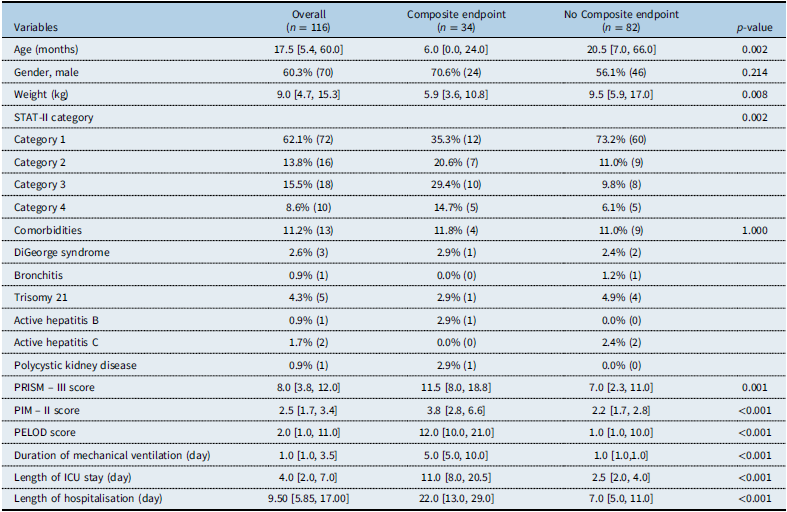
A total of 116 patients were enrolled in the study. The median age was 17.5 months (interquartile range: 5.4–60.0), and 60.3% were male. The baseline clinical characteristics are presented in Table 1. The median weight was 9.0 kg (interquartile range: 4.7–15.3). Comorbidities were present in 11.2% of patients, including trisomy 21 (4.3%), DiGeorge syndrome (2.6%), active hepatitis C (1.7%), hepatitis B (0.9%), bronchitis (0.9%), and polycystic kidney disease (0.9%). Regarding procedural complexity, the most common STAT-II category was category 1 (62.1%), followed by category 3 (15.5%), category 2 (13.8%), and category 4 (8.6%).
Baseline clinical characteristics

PELOD = Paediatric Logistic Organ Dysfunction; PIM-II = Paediatric Index of Mortality 2; PRISM-III = Paediatric Risk of Mortality III; STAT = The Society of Thoracic Surgeons-European Association for Cardio-Thoracic Surgery Congenital Heart Surgery.
Major adverse events within 30 days occurred in 34 patients (29.3%), primarily due to unplanned reoperation (10.3%) and requirement for extracorporeal membrane oxygenation (8.6%). Mortality was observed in 6 patients (5.2%) (Supplementary Table 1). Patients who experienced major adverse events were younger (6.0 [interquartile range: 0.0–24.0] vs. 20.5 [interquartile range: 7.0–66.0] months; p = 0.002) and had lower weight (5.9 [interquartile range: 3.6–10.8] vs. 9.5 [interquartile range: 5.9–17.0] kilograms; p = 0.008) compared to those without major adverse events. Procedural complexity, as defined by the STAT-II category, was higher among patients with major adverse events (Category 1: 35.3% vs. 73.2%, Category 2–4: 64.7% vs. 26.9%, p = 0.002). Paediatric Risk of Mortality-III (11.5 [IQR: 8.0–18.8] vs. 7.0 [IQR: 2.3–11.0]; p = 0.001), Pediatric Index of Mortality-II (3.8 [IQR: 2.8–6.6] vs. 2.2 [IQR: 1.7–2.8]; p < 0.001) and Paediatric Logistic Organ Dysfunction (12.0 [interquartile range: 10.0–21.0] vs. 1.0 [interquartile range: 1.0–10.0]; p < 0.001) scores were significantly higher in patients with major adverse events than in those without (Table 1).
The median length of ICU stay was 4 days (interquartile range: 2–7), and it was significantly longer in patients with major adverse events compared to those without (11 [interquartile range: 8–20] vs. 2 [interquartile range: 2–4] days, p < 0.001). Similarly, the median duration of mechanical ventilation and length of hospitalisation were longer in patients with major adverse events (Table 1, Supplementary Figure 2). The Paediatric Logistic Organ Dysfunction score showed a strong positive correlation with both the duration of mechanical ventilation and ICU stay (ρ = 0.670 and ρ = 0.631, respectively; p < 0.001) and a moderate correlation with the length of hospitalisation (ρ = 0.480, p < 0.001). In contrast, Pediatric Index of Mortality-II and Paediatric Risk of Mortality-III scores demonstrated weak to moderate correlations with these outcomes (Supplementary Table 2).
Logistic regression analysis demonstrated that Paediatric Risk of Mortality-III (odds ratio: 1.14; 95% confidence interval: 1.06–1.22; p < 0.001), Pediatric Index of Mortality-II (odds ratio: 1.03; 95% confidence interval: 1.02–1.05; p < 0.001), and Paediatric Logistic Organ Dysfunction (odds ratio: 1.13, 95% confidence interval: 1.09–1.17; p < 0.001) scores were significantly associated with a higher likelihood of major adverse events. All models demonstrated good calibration, with Hosmer–Lemeshow p-values of 0.783, 0.671, and 0.772, respectively (Table 2). The C-statistics for predicting major adverse events were as follows: Paediatric Risk of Mortality-III, 0.70 (95% confidence inerval: 0.60–0.81); Pediatric Index of Mortality-II, 0.77 (95% confidence interval: 0.66–0.88); and Pediatric Logistic Organ Dysfunction, 0.83 (95% confidence interval: 0.74–0.92), with the Paediatric Logistic Organ Dysfunction score demonstrating the highest discriminatory power (Figure 1). Based on additional model evaluation metrics, including Akaike information criterion, Bayesian information criterion, and root-mean-square deviation, the Pediatric Logistic Organ Dysfunction score showed superior performance compared to Paediatric Risk of Mortality-III and Pediatric Index of Mortality-II in predicting major adverse events at a threshold of 2.5, with sensitivity of 82.3% and specificity of 73.2% (Table 2). Patients with a Paediatric Logistic Organ Dysfunction score greater than 2.5 had significantly higher rates of major adverse events compared to those with a Paediatric Logistic Organ Dysfunction score of 2.5 or lower (log-rank p-values < 0.001) (Figure 2).
Area under the receiver operating characteristics curve for the scores.

Kaplan–Meier curve for major adverse events stratified by the PELOD cut-off level.

Diagnostic performance of paediatric scoring systems

AUC = Area Under Curve; AIC = Akaike Information Criterion; BIC = Bayesian Information Criterion; PELOD = Paediatric Logistic Organ Dysfunction; PIM-II = Paediatric Index of Mortality 2; PRISM-III = Paediatric Risk of Mortality III; RMSD = Root-Mean-Square Deviation.
Discussion
In this study, we evaluated the performance of the Paediatric Risk of Mortality-III, Pediatric Index of Mortality-II, and Paediatric Logistic Organ Dysfunction scoring systems in predicting major adverse events among patients who underwent congenital heart surgery. Patients who experienced major adverse events had significantly higher Paediatric Risk of Mortality-III, Pediatric Index of Mortality-II, and Paediatric Logistic Organ Dysfunction scores compared to those without major adverse events. Although all three scoring models demonstrated good calibration, the Paediatric Logistic Organ Dysfunction score exhibited superior discriminatory ability for predicting major adverse events than other scores. Furthermore, Paediatric Logistic Organ Dysfunction system demonstrated strong positive correlations with the duration of mechanical ventilation, ICU stay, and total hospitalisation length, whereas Paediatric Risk of Mortality-III and Pediatric Index of Mortality-II scores showed only weak to moderate correlations with these outcomes.
Previous studies have reported that 32–43% of children undergoing cardiac surgery experience at least one major adverse events. Reference Wasniewski, Ricachinevsky and Rezende13,Reference Agarwal, Wolfram, Saville, Donahue and Bichell18,Reference Benavidez, Gauvreau, Del Nido, Bacha and Jenkins19 The incidence of major adverse events in our cohort was 29.3%, which is consistent with findings from previous studies that emphasise the burden of postoperative morbidity in CHS. Agarwal et al. retrospectively reported that approximately 23–25% of complications in their paediatric CHS cohort would align with the major adverse events definition used in our study, although some components, such as ICU readmission, reintubation, and pacemaker implantation, were not reported in their dataset. Reference Agarwal, Wolfram, Saville, Donahue and Bichell18 Similarly, Benavidez et al. demonstrated a strong association between the number of postoperative complications and mortality, with odds ratios increasing progressively from 1.8 for a single complication to 9.7 for five or more. Reference Benavidez, Gauvreau, Del Nido, Bacha and Jenkins19 These findings highlight the additive impact of cumulative morbidity on outcomes and the value of early identification and prevention strategies.
Furthermore, in a large prospective multicentre study, Brown et al. reported a 21.8% rate of early postoperative morbidities, including reoperation, extracorporeal membrane oxygenation, and neurologic injury, many of which overlap with our major adverse events definition. Although their reported incidence of specific complications, such as extracorporeal membrane oxygenation use and reoperation, was lower than in our cohort, this may reflect differences in case complexity or institutional practices. Notably, they observed a significant reduction in six-month survival among patients with any morbidity, reinforcing the clinical importance of monitoring postoperative complications beyond mortality alone. Reference Brown, Ridout and Pagel7
However, the considerable heterogeneity of CHD presents a challenge to standardisation due to the wide range of anatomical variations, comorbidities, and surgical procedures involved. Reference Allen, Zafar and Mi16 The use of cardiopulmonary bypass further complicates outcome prediction because of its effects on systemic perfusion — particularly of the cerebral, renal, and hepatic systems — as well as cellular and molecular alterations, which are especially pronounced in paediatric patients. Reference Wasniewski, Ricachinevsky and Rezende13 As a result of these complexities, a specific and reliable tool for predicting outcomes in paediatric cardiac surgery patients remains lacking. Reference Zeng, An and Lin6,Reference Wasniewski, Ricachinevsky and Rezende13
In our study, we assessed the predictive performance of three general paediatric ICU scoring systems in paediatric patients undergoing congenital heart surgery. Previous studies have reported inconsistent findings regarding the effectiveness of these scoring systems in this patient population. Reference Russell, Rettiganti, Brundage, Jeffries and Gupta20,Reference Czaja, Scanlon, Kuhn and Jeffries21 Although most prior research has focused on mortality prediction, this endpoint alone is increasingly regarded as insufficient due to improved survival rates in congenital heart surgery patients. Therefore, attention has shifted toward patient centred outcomes, such as major adverse events. Reference Russell, Ghanayem, Kuhn, Jeffries, Scanlon and Rice4–Reference Zeng, An and Lin6 However, few studies to date have evaluated the utility of these scoring systems in predicting morbidity, and most of the available literature consists of retrospective analyses. Reference Berger, Holubkov and Reeder5,Reference Wasniewski, Ricachinevsky and Rezende13,Reference Agarwal, Wolfram, Saville, Donahue and Bichell18,Reference Benavidez, Gauvreau, Del Nido, Bacha and Jenkins19 In contrast, our study employed a prospective design, which enabled standardised data collection and reduced risk of bias—factors that strengthen the validity of our findings.
Paediatric Risk of Mortality-III score
The Paediatric Risk of Mortality-III score was developed using 17 physiological variables to predict mortality in paediatric ICU populations. It has been externally validated and is widely used for this purpose. Visser et al. evaluated its performance in a general paediatric ICU cohort of 12,040 patients and reported good discrimination (area under the curve: 0.90; 95% confidence interval: 0.89–0.90) with good calibration for mortality prediction. However, only 23.5% of the cohort consisted of cardiac patients, and among these, 80% had undergone surgery, which potentially limits its generalizability to congenital heart surgery population. Reference Visser, Hazelzet and Albers22 In a more targeted cohort, Russell et al. assessed the performance of Paediatric Risk of Mortality-III in 87,993 critically ill children with heart disease, 51% of whom had undergone cardiac surgery. They found that the score tended to overpredict mortality in patients with complex CHD while underpredicting mortality in those with lower severity of illness. Reference Russell, Rettiganti, Brundage, Jeffries and Gupta20
While both Visser and Russell focused primarily on mortality prediction, Berger et al. extended the evaluation of Paediatric Risk of Mortality-III to include morbidity as well, demonstrating that the score could predict both mortality and new functional morbidity in paediatric cardiac surgery patients. A key methodological difference from our study is that morbidity in their analysis was assessed using the Functional Status Scale, rather than major adverse events. Consistent with our findings, they observed that both morbidity and mortality increased with surgical complexity, as categorised by the STAT mortality categories. Yet, they found that incorporating surgical complexity classifications into the PRISM score did not improve its predictive accuracy. Reference Berger, Holubkov and Reeder5 In contrast, our study utilised the updated STAT mortality categories (STAT-II) for surgical complexity classification. Importantly, in our cohort, the Paediatric Risk of Mortality-III score demonstrated strong predictive ability for major adverse events, although it showed only weak to moderate correlations with the duration of mechanical ventilation, ICU stay, and overall hospitalisation.
Pediatric Index of Mortality-II score
Czaja et al. evaluated the performance of the Pediatric Index of Mortality-II score in paediatric patients with congenital heart surgery by retrospectively analysing a multicentre paediatric ICU database. They reported that Pediatric Index of Mortality-II exhibited limited predictive ability for mortality in this population. A potential explanation for this finding is that relying on physiological data from only the first hour of ICU admission may fail to capture the dynamic and often unstable physiological status of CHD patients following cardiac surgery. Additionally, the authors emphasised that the patients included in the study were treated by different multidisciplinary teams and under distinct institutional protocols, which may contribute to variability in outcomes. Therefore, they highlighted the need for further validation of Pediatric Index of Mortality-II in patients managed in dedicated cardiac ICUs and recommended comparisons with other ICU-based scoring systems, such as Paediatric Risk of Mortality-III. Reference Czaja, Scanlon, Kuhn and Jeffries21
Our ICU exclusively admits paediatric patients with CHD, which may result in more standardised and optimised postoperative care. Accordingly, Pediatric Index of Mortality-II demonstrated strong predictive ability for major adverse events in our study, despite showing only weak to moderate correlations with the duration of mechanical ventilation, ICU stay, and overall hospitalisation. Although Rezende et al. evaluated only mortality in their study, they reported results comparable to ours, demonstrating that Pediatric Index of Mortality-II had good discriminatory capacity for mortality prediction (area under the curve: 0.81; 95% confidence interval: 0.75–0.87) among postoperative CHD patients. Reference Rezende, Ricachinevsky, Botta, Angeli and DaSilva Nogueira14
Wasniewski et al. evaluated the incidence and predictors of adverse events following congenital heart surgery, including events of mild, moderate, and severe intensity. While the reported mortality rate (5.2%) was similar to that observed in our study, the incidence of severe adverse events was notably higher, with 37.3% classified as major. In their analysis, a Pediatric Index of Mortality-II score ≥ 5 was significantly associated with an increased risk of adverse events in univariate analysis (odds ratio: 2.54; 95% confidence interval: 1.39–4.65; p = 0.002). However, this association did not remain significant in the multivariate model (odds ratio: 0.98; 95% confidence interval: 0.47–2.04; p = 0.957), suggesting that while a higher Pediatric Index of Mortality-II score may indicate greater baseline risk, it does not independently predict adverse outcomes when adjusted for other clinical variables. Reference Wasniewski, Ricachinevsky and Rezende13
Paediatric Logistic Organ Dysfunction score
In line with our findings, Leteurtre et al. prospectively validated the Paediatric Logistic Organ Dysfunction score in a large multicentre cohort, demonstrating its strong association with mortality and the severity of multiple organ dysfunction in critically ill children. Although their study included a heterogeneous paediatric ICU population and did not specify the proportion of cardiac surgical patients, Paediatric Logistic Organ Dysfunction showed excellent discrimination for mortality prediction (paediatric logistic organ dysfunction: 0.91; 95% confidence interval: 0.89–0.93) and effectively quantified dysfunction across six organ systems. These results highlight its potential value, particularly in settings where mortality alone may not adequately capture clinical outcomes. Reference Leteurtre, Martinot and Duhamel23
In our cohort, the Paediatric Logistic Organ Dysfunction score demonstrated strong discriminatory power and good calibration in identifying patients at increased risk for major adverse events. Logistic regression analysis revealed that each one-point increase in the paediatric logistic organ dysfunction score was associated with a 13% higher likelihood of experiencing an major adverse events. Among the three models, Paediatric Logistic Organ Dysfunction exhibited the best overall performance compared to Paediatric Risk of Mortality-III and Paediatric Index of Mortality-II, achieving a sensitivity of 82.3% and a specificity of 73.2% at a cut-off value of 2.5. Additionally, it showed strong positive correlations with both the duration of mechanical ventilation and ICU stay and a moderate correlation with the length of hospitalisation. Supporting these findings, Odek et al. also reported that both Paediatric Risk of Mortality-III and Paediatric Logistic Organ Dysfunction scores were positively correlated with the duration of mechanical ventilation; however, their study did not include a direct comparative analysis of the predictive accuracy between the two scoring systems. Reference Ödek, Kendirli and Uçar24
This study has several limitations. First, it was conducted at a single, high-volume tertiary care centre with substantial expertise in paediatric cardiac surgery and intensive care. While this enhances the consistency and quality of care, it may also limit the generalizability of the findings to lower-volume institutions or centres with less specialised experience. Second, the relatively small sample size may limit the statistical robustness of the results and reduce their broader applicability across diverse clinical settings.
In conclusion, the Paediatric Risk of Mortality-III, Paediatric Index of Mortality-II, and Pediatric Logistic Organ Dysfunction scoring systems demonstrated utility in predicting major adverse events in paediatric patients admitted to the ICU following congenital heart surgery. Among these, the Pediatric Logistic Organ Dysfunction score showed superior discriminatory performance. Our findings support the feasibility of using the Pediatric Logistic Organ Dysfunction score to identify high-risk patients and to estimate the duration of mechanical ventilation, ICU stay, and overall hospitalisation. This approach may enable clinicians to better identify high-risk patients using routinely monitored parameters, allowing for closer surveillance, the development of more effective strategies to prevent major adverse events, and improved patient management.
Nevertheless, further multicentre studies with larger sample sizes are needed to confirm these results. Additionally, the development of cardiac-specific risk models remains essential to more accurately reflect the unique physiological and procedural complexity of this patient population.
Supplementary material
The supplementary material for this article can be found at https://doi.org/10.1017/S1047951125109517.
Acknowledgements
None.
Financial support
None.
Competing interests
The authors declare that there is no conflict of interest regarding the publication of this paper.
Ethical standards
Ethical approval was obtained from the institutional review board prior to study initiation (IRB Number: 2019/6-722, Date: 01/28/2019).
Funding Statement
This research received no external funding.