Introduction
Posttraumatic stress disorder (PTSD) is a pervasive and debilitating disorder characterized by a prolonged psychological stress reaction occurring in response to a traumatic event (Kessler, Reference Kessler2000). PTSD is particularly prevalent among women; at least one in nine American women will meet lifetime criteria for PTSD diagnosis and women's risk of PTSD is twice that of men (Kessler et al., Reference Kessler, Sonnega, Bromet, Hughes and Nelson1995). Thus, PTSD may have particularly important implications for women's health. Previous research has found women with PTSD have increased risk of cardiometabolic disease (e.g. Edmondson and Cohen, Reference Edmondson and Cohen2013), autoimmune disease (Lee et al. Reference Lee, Agnew-Blais, Malspeis, Keyes, Costenbader, Kubzansky, Roberts, Koenen and Karlson2016), and ovarian cancer (Gradus et al., Reference Gradus, Farkas, Svensson, Ehrenstein, Lash, Milstein, Adler and Sorensen2015). Understanding pathways linking PTSD and chronic disease comorbidities is important as this could inform effective strategies for disease prevention and management. Diet quality and physical activity are well-known modifiable behavioral risk factors for cardiovascular and cancer-related risks. Previous research has documented that PTSD is prospectively associated with physical inactivity (Winning et al., Reference Winning, Gilsanz, Koenen, Roberts, Chen, Sumner, Rimm, Maria Glymour and Kubzansky2017), over-eating, and binge eating (Mason et al., Reference Mason, Frazier, Austin, Harlow, Jackson, Raymond and Rich-Edwards2017). However, few studies have examined the potential connection between PTSD and changes in dietary quality over time.
Individuals with PTSD suffer from the persistent psychological reaction in response to trauma exposure, and these reactions can affect decision-making processes relevant to a range of behaviors. With regard to dietary behaviors, these processes include elevated impulsivity and poorer emotional regulation, which can lead to worse food choice and less regulated food intake (Mason et al., Reference Mason, Frazier, Austin, Harlow, Jackson, Raymond and Rich-Edwards2017; van den Berk-Clark et al., Reference van den Berk-Clark, Secrest, Walls, Hallberg, Lustman, Schneider and Scherrer2018). A recent review (van den Berk-Clark et al., Reference van den Berk-Clark, Secrest, Walls, Hallberg, Lustman, Schneider and Scherrer2018) summarized the evidence documenting that higher (v. lower) PTSD symptoms were associated with more frequent intake of unhealthy foods including sugar-sweetened beverages (SSB) and fast food among adolescents and young adults (Hirth et al., Reference Hirth, Rahman and Berenson2011; Vilija and Romualdas, Reference Vilija and Romualdas2014). However, these findings were from cross-sectional studies, limiting causal inference. In a small study examining both prospective (n = 49) and cross-sectional (n = 151) associations of PTSD symptoms with poorer diet quality [measured by Alternative Healthy Eating Index-2010 (AHEI) and the Dietary Approach to Stop Hypertension] among adults, findings were suggestive of potentially harmful influence of PTSD symptoms on diet quality (Gavrieli et al., Reference Gavrieli, Farr, Davis, Crowell and Mantzoros2015). However, whether the onset of PTSD symptoms leads to altered dietary behavior and deteriorations in diet quality over time has not been evaluated.
The present study investigated whether PTSD was prospectively associated with diet quality changes. We hypothesized that relative to women who experienced no trauma, those who had prevalent PTSD or developed PTSD symptoms over the study follow-up would demonstrate diet quality deteriorations. Thus, we expected high PTSD symptom levels would be associated with more unfavorable diet quality trajectories, as assessed with AHEI scores in both the short- and long-term after PTSD symptoms onset. We further evaluated the effects of PTSD on one specific dietary component, flavonoid intake. Flavonoids refer to a group of diverse classes of polyphenolic compounds naturally produced through plant metabolism, rich in widely consumed vegetables, fruits, wine, and tea (Cassidy et al., Reference Cassidy, Huang, Rice, Rimm and Tworoger2014). Previous research has demonstrated that lower flavonoid intake is associated with increased risk of many chronic diseases linked to PTSD, including obesity, stroke, and ovarian cancer (e.g. Ivey et al., Reference Ivey, Jensen, Hodgson, Eliassen, Cassidy and Rimm2017). We expected the levels of flavonoid intake would decrease after PTSD onset.
To test our hypotheses, we used data from an ongoing cohort of US women with information on trauma and PTSD: the Nurses' Health Study II (NHS II). In our previous research with NHS II, we reported that PTSD was associated with increased risks of chronic disorders, including diabetes (Roberts et al., Reference Roberts, Agnew-Blais, Spiegelman, Kubzansky, Mason, Galea, Hu, Rich-Edwards and Koenen2015), cardiovascular disease (Sumner et al., Reference Sumner, Kubzansky, Elkind, Roberts, Agnew-Blais, Chen, Cerda, Rexrode, Rich-Edwards, Spiegelman, Suglia, Rimm and Koenen2015), ovarian cancer (Roberts et al., Reference Roberts, Huang, Koenen, Kim, Kubzansky and Tworoger2019), and obesity (Kubzansky et al., Reference Kubzansky, Bordelois, Jun, Roberts, Cerda, Bluestone and Koenen2014), and unhealthy behaviors, including physical inactivity (Winning et al., Reference Winning, Gilsanz, Koenen, Roberts, Chen, Sumner, Rimm, Maria Glymour and Kubzansky2017) and TV viewing (Jung et al., Reference Jung, Winning, Roberts, Nishimi, Chen, Gilsanz, Sumner, Fernandez, Rimm, Kubzansky and Koenen2019). However, in these studies, diet was only considered as a covariate and none of them explicitly tested a potential causal relationship between PTSD and diet quality changes over time. In this study, we evaluated whether the trajectories of dietary intake differed by trauma/PTSD status during follow-up. Particularly, we distinguished prevalent trauma/PTSD symptoms (trauma/PTSD onset prior to study baseline in 1989) from new-onset trauma/PTSD symptoms (trauma/PTSD onset during follow-up). With this approach, we were able to evaluate diet quality changes among individuals experiencing high PTSD symptoms relative to those who did not experience trauma, decomposing the diet quality changes shortly after new-onset PTSD symptoms v. those from longstanding PTSD. We accounted for a range of relevant covariates [e.g. sociodemographic factors and body mass index (BMI)] identified in prior research (Gavrieli et al., Reference Gavrieli, Farr, Davis, Crowell and Mantzoros2015) and several key potential confounders including depression and chronic disease status, which have been linked with both PTSD and diet quality (e.g. O'Donnell et al., Reference O'Donnell, Creamer and Pattison2004; Jacka et al., Reference Jacka, Cherbuin, Anstey and Butterworth2015). Similar analyses were conducted evaluating the associations of PTSD with flavonoid intake specifically.
Method
Study population
We used data from the NHS II, an ongoing cohort of female registered nurses in the USA, which collects sociodemographic, medical, and behavior information by questionnaire biennially. In 1989, a total of 116 429 women, aged 24–42 years, enrolled. In 2008, an NHS II PTSD sub-study was conducted inviting women who had completed a prior questionnaire on interpersonal violence and a recent biennial questionnaire (n = 60 804) (Koenen et al., Reference Koenen, De Vivo, Rich-Edwards, Smoller, Wright and Purcell2009). Of these, 54 710 returned a questionnaire (response rate to a single mailing 90.0%). Women missing information on trauma/PTSD status (n = 1297) or with <2 measures of dietary intake during 1991–2011 (n = 1483) were excluded, resulting in 51 965 women in our analytic sample.
Compared to women in the entire NHS II (n = 116 429), those included (n = 51 965) were slightly older (34.8 v. 34.4 years) and had slightly higher diet quality scores (48.9 v. 48.6) at baseline. They were more likely to be non-Hispanic white (93.9% v. 91.0%) and fewer had cancer/diabetes/cardiovascular disease (4.5% v. 5.1%) at baseline.
Exposure assessment
To assess trauma exposure (present/absent), we used a 16-item modified version of the Brief Trauma Questionnaire (Morgan et al., Reference Morgan, Hazlett, Wang, Richardson, Schnurr and Southwick2001), in which participants reported history of lifetime traumatic exposure to each of 15 specified events (e.g. serious accident, natural disaster) and a serious event not otherwise specified. Participants also identified which event was their first and which was their worst event, as well as their age at occurrence of first and worst events. PTSD symptoms were measured with respect to the worst trauma, with the seven-item Short Screening Scale for DSM-IV PTSD (Breslau et al., Reference Breslau, Peterson, Kessler and Schultz1999). Possible scores range from 0 to 7.
Following work in pharmacoepidemiology (e.g. comparing prevalent and new users of a drug with never users) to address the mixture of time-invariant and time-varying exposure status in a sample (Shah et al., Reference Shah, Janos, Kline, Yu, Leurgans, Wilson, Wei, Bennett, Heilman and Tsao2013), and to take advantage of the rich level of information we had on women's trauma/PTSD status, we classified trauma/PTSD status based on two criteria: (a) the presence/absence of trauma exposure and PTSD symptoms severity and (b) the time of trauma/PTSD onset relative to the study entry. First, trauma/PTSD status was grouped as (i) no trauma exposure, (ii) trauma exposure with no PTSD symptoms, (iii) trauma exposure with 1–3 PTSD symptoms (e.g. low PTSD symptoms), and (iv) trauma exposure with 4–7 PTSD symptoms (e.g. high PTSD symptoms). This is based on previous literature showing that ⩾4 symptoms had 80.3% sensitivity and 97.3% specificity compared with PTSD diagnosis based on a gold-standard structured interview (Breslau et al., Reference Breslau, Peterson, Kessler and Schultz1999). Since PTSD symptoms were nested within trauma exposure, there was no category indicating the presence of PTSD symptoms in the absence of trauma exposure. We also evaluated whether these experiences of trauma occurred prior to or after the study baseline in 1989. This produced three groups that had trauma/PTSD at the time the study began (i.e. trauma occurred earlier in the women's lives) which we refer to as prevalent trauma/PTSD, three groups for whom trauma/PTSD onset during follow-up which we refer to as new-onset trauma/PTSD, and one group that did not experience any trauma prior to or during follow-up. Thus, these seven trauma/PTSD status categories are: (i) no trauma exposure in their lifetime (n = 9880), (ii) prevalent trauma with no PTSD symptoms (worst trauma exposure prior to or at study entry; n = 9857), (iii) prevalent trauma with low PTSD symptoms (n = 9687), (iv) prevalent trauma with high PTSD symptoms (n = 6329), (v) new-onset trauma with no PTSD symptoms (worst trauma exposure during follow-up; n = 4760), (vi) new-onset trauma with low PTSD symptoms (n = 6562), and (vii) new-onset trauma with high PTSD symptoms (n = 4890) (see online Supplementary Fig. S1).
Outcome assessment
Dietary information was obtained using a validated semi-quantitative food frequency questionnaire (FFQ), administered every 4 years beginning in 1991 (Yuan et al., Reference Yuan, Spiegelman, Rimm, Rosner, Stampfer, Barnett, Chavarro, Rood, Harnack, Sampson and Willett2018). Participants reported the average frequency of consumption of 131 food items over the last year (Chiuve et al., Reference Chiuve, Fung, Rimm, Hu, McCullough, Wang, Stampfer and Willett2012). Diet quality was measured using the AHEI, a validated comprehensive measure of overall diet quality (Chiuve et al., Reference Chiuve, Fung, Rimm, Hu, McCullough, Wang, Stampfer and Willett2012). In prior work in the NHS, higher v. lower AHEI scores predicted a decreased risk of obesity, diabetes, cardiovascular disease, and cancer (e.g. Wang et al., Reference Wang, Heianza, Sun, Huang, Ma, Rimm, Manson, Hu, Willett and Qi2018). AHEI quantifies the consumption of 11 dietary components and has a total score ranging from 0 to 110, whereby a higher score indicates better diet quality. Each dietary component is scored from 0 (worst quality) to 10 (optimal quality), with higher scores reflecting more frequent consumption of health-promoting foods and their nutrients (e.g. polyunsaturated fats, whole grains, and omega-3 fats) and less frequent consumption of unhealthy foods and nutrients (e.g. red meat, trans-fats). For alcohol consumption, moderate-level consumption (0.5–1.5 drinks/week) is scored as optimal, based on the J-shaped association between alcohol consumption and health risks (Rimm et al., Reference Rimm, Williams, Fosher, Criqui and Stampfer1999).
Intake of total flavonoids (mg/day, energy-adjusted), and its subclasses (anthocyanins, flavonoid polymers, proanthocyanidins alone, flavones, flavanones, flavonols, and flavan-3-ols), was calculated (Cassidy et al., Reference Cassidy, O'Reilly, Kay, Sampson, Franz, Forman, Curhan and Rimm2011). Briefly, a reference for individual flavonoid content for each serving of foods/beverages was established based on the flavonoid and proanthocyanidin content of foods database by the US Department of Agriculture (Bhagwat et al., Reference Bhagwat, Haytowitz and Holden2014). Then, intake of individual flavonoid compounds was assessed by summing the frequency of consumption of each flavonoid containing food/beverage weighted by the flavonoid content for the given portion size (Cassidy et al., Reference Cassidy, Huang, Rice, Rimm and Tworoger2014).
Covariates
We considered a range of self-reported covariates. Time-invariant covariates included race/ethnicity (defined as White, not White; 1989 questionnaire); region of birth (Northeast, West, Midwest, South, and Puerto Rico/non-US; 1993); childhood socioeconomic status based on the highest educational attainment of parents at birth (⩽3 years of college or ⩾4 years of college; 2005). Time-varying covariates were updated at each questionnaire where the question was asked, including age; living arrangements (living with a spouse/partner, living with someone other than a spouse/partner, and living alone; 1993, 2001, 2005, and 2009 questionnaire); and lifetime history of depression, considered present if women reported use of antidepressants (ascertained biennially beginning in 1993, except 1995 and 2001), physician-diagnosed depression (reported biennially beginning in 2003), or scored <60 on the five-item Mental Health Inventory, administered in 1993, 1997, and 2001 (Yamazaki et al., Reference Yamazaki, Fukuhara and Green2005). Information on living arrangements and depression in 1993 was carried backward to 1989 since these variables were not assessed at the earlier time point. Other time-varying covariates were updated biennially since 1989, including history of any cancer (excluding squamous/basal cell skin cancer), cardiovascular disease, or diabetes (including gestational/non-gestational); menopausal status (pre-menopausal, post-menopausal, unsure); smoking status (current, former, and never smokers); and BMI class (underweight <18.5, normal 18.5 to <25.0, overweight 25.0 to <30.0, and obese ⩾30.0 kg/m2). Self-reported leisure-time physical activity was assessed in 1989, 1991, 1997, 2001, 2005, and 2009, and categorized as 0–8.9 or ⩾9.0 metabolic equivalent task hours (MET-hr) per week. For all covariates, any missing information was coded as a missing category (Groenwold et al., Reference Groenwold, White, Donders, Carpenter, Altman and Moons2012).
Statistical analyses
We examined the distribution of the covariates by trauma/PTSD status at cohort baseline (1989). To assess whether trajectories of diet quality differed for women with prevalent or new-onset trauma/PTSD, compared to no trauma group, we fit linear mixed-effects spline models (Shah et al., Reference Shah, Janos, Kline, Yu, Leurgans, Wilson, Wei, Bennett, Heilman and Tsao2013; Kubzansky et al., Reference Kubzansky, Bordelois, Jun, Roberts, Cerda, Bluestone and Koenen2014). We included time and trauma/PTSD status as main effects and also included interaction terms between trauma/PTSD status and time-since-baseline as fixed effects, to estimate the association of trauma/PTSD status with diet quality changes over follow-up. Because preliminary analyses revealed major secular trends in AHEI scores (increase accelerating over time) and total flavonoids intake (J-shaped) over follow-up, in all models we included quadratic terms for time-since-baseline, centered at the median follow-up (10-year since baseline). We also included an interaction term between trauma/PTSD status and time-to-trauma/PTSD onset (linear term) to account for differences in after v. before-onset changes in diet quality for new-onset trauma/PTSD groups; for the prevalent PTSD groups, the interaction term would be defined as zero. Random slopes for time-since-baseline and time-to-trauma/PTSD onset, as well as a random intercept, were included to account for correlations induced by repeated diet quality measures within individuals over follow-up. For all models, we used a 2-year lagged approach, linking trauma/PTSD status and covariates at 1989, 1993, 1997, 2001, 2005, 2009 with subsequent diet scores in 1991, 1995, 1999, 2003, 2007, 2011, respectively, to ensure temporality between exposure/covariates and outcome considering that FFQ reflects dietary behaviors 1-year prior to the survey return. See online Supplementary Table S4 for a more detailed explanation on model specification.
We sequentially adjusted for covariates as follows: (a) Model 1 adjusted for time-updated age; (b) Model 2 further adjusted for other demographic characteristics that could confound the associations of interest including race/ethnicity, parental education, region of residence at birth, and time-updated living arrangement; (c) Model 3 added other health-related covariates that could confound trauma/PTSD status and diet quality including time-updated menopausal status, history of depression and cancers/diabetes/cardiovascular disease; (d) Model 4 added further health behaviors that could be confounders for the association between trauma/PTSD status and diet quality including time-updated physical activity, smoking, and BMI class. Because levels of absolute change are small, to make the change more interpretable, we used effect estimates that represent the 10-year difference in changes in diet quality and flavonoids intake comparing prevalent or new-onset trauma/PTSD groups to the no trauma group, centered at the median of follow-up.
To increase interpretability of findings from the quadratic regression models, we also examined the difference in percentage change in diet quality, comparing each trauma/PTSD group to the no trauma group, during follow-up using the predicted value of AHEI score and flavonoids intake, respectively, from the age-adjusted model. To do this, we used median age at baseline (35 years) and median onset-year for new-onset trauma/PTSD groups (10 years after baseline) to estimate predicted AHEI or flavonoid intake, and compared the difference in percentage change by trauma/PTSD status (reference: no trauma group) over the first and second 10-year interval, respectively, as well as the entire 20-year interval.
We also performed ancillary analyses with components of AHEI and subclasses of flavonoids as separate outcomes to evaluate if specific food components or flavonoids subclasses might drive findings with trauma/PTSD status. To understand whether the results are robust regardless of differences in baseline diet score, we also performed sensitivity analyses adjusting for baseline diet score as a covariate and examining diet change over 16 years.
Results
Sample description
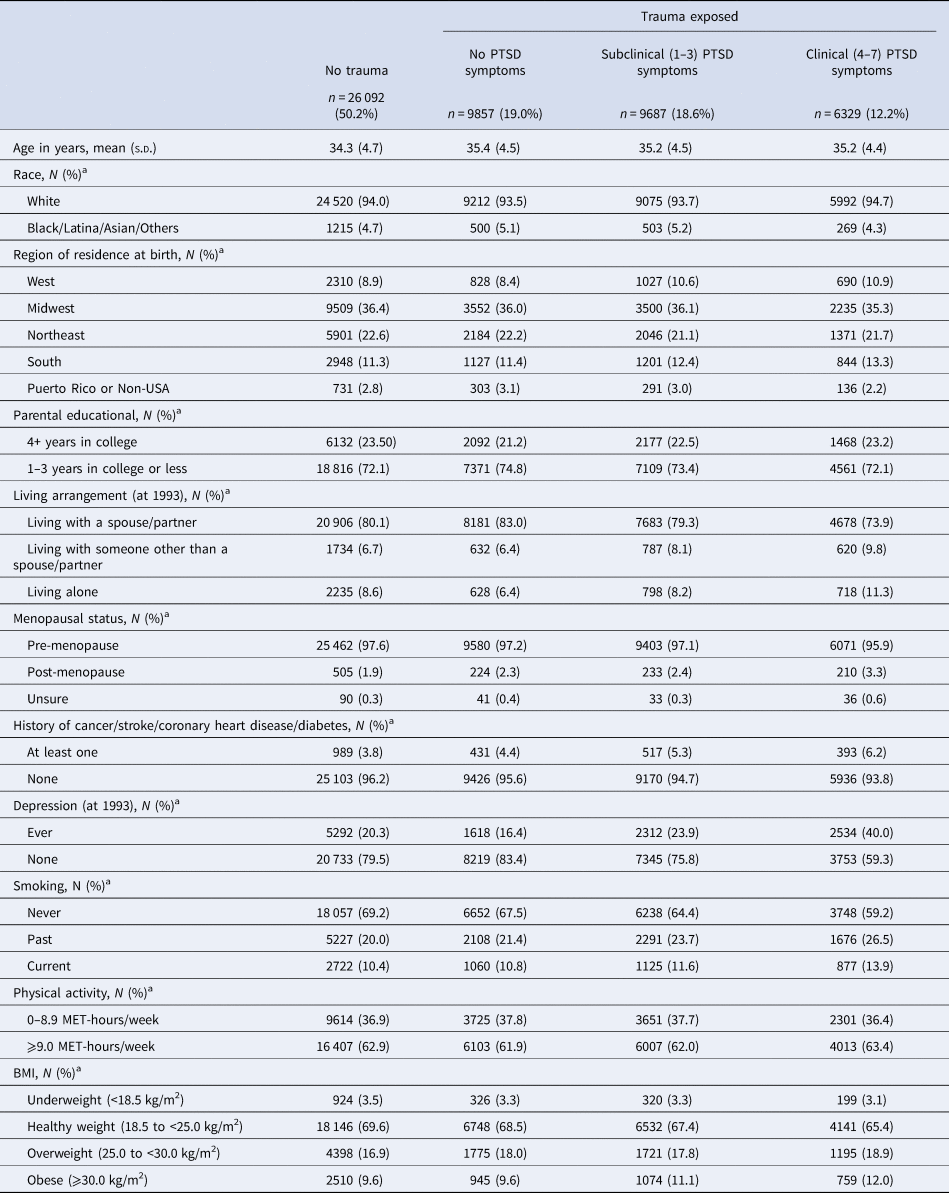
Table 1 presents the distribution of sociodemographic, health, and behavioral characteristics by trauma/PTSD status at cohort baseline (1989). Mean age of participants was 34.8 years (s.d. = 4.6) and most were non-Hispanic white. Compared with women with no trauma exposure, women who endorsed 4–7 PTSD symptoms in 1989 were slightly more likely to be postmenopausal, live alone, have a history of depression or cancers/diabetes/cardiovascular disease, and be a current smoker or overweight/obese. Of the 26 092 women with no (worst) trauma prior to 1989, 62.1% developed new-onset trauma with or without PTSD symptoms during follow-up.
Sociodemographic characteristics, health status, and behavioral factors by trauma/PTSD status among 51 965 women at baseline (1989)

PTSD, posttraumatic stress disorder; MET, metabolic equivalent tasks; BMI, body mass index (kg/m2).
a Frequency and percentage for missing value per each variable were not presented in this table.
Trauma/PTSD status with diet quality or flavonoid intake
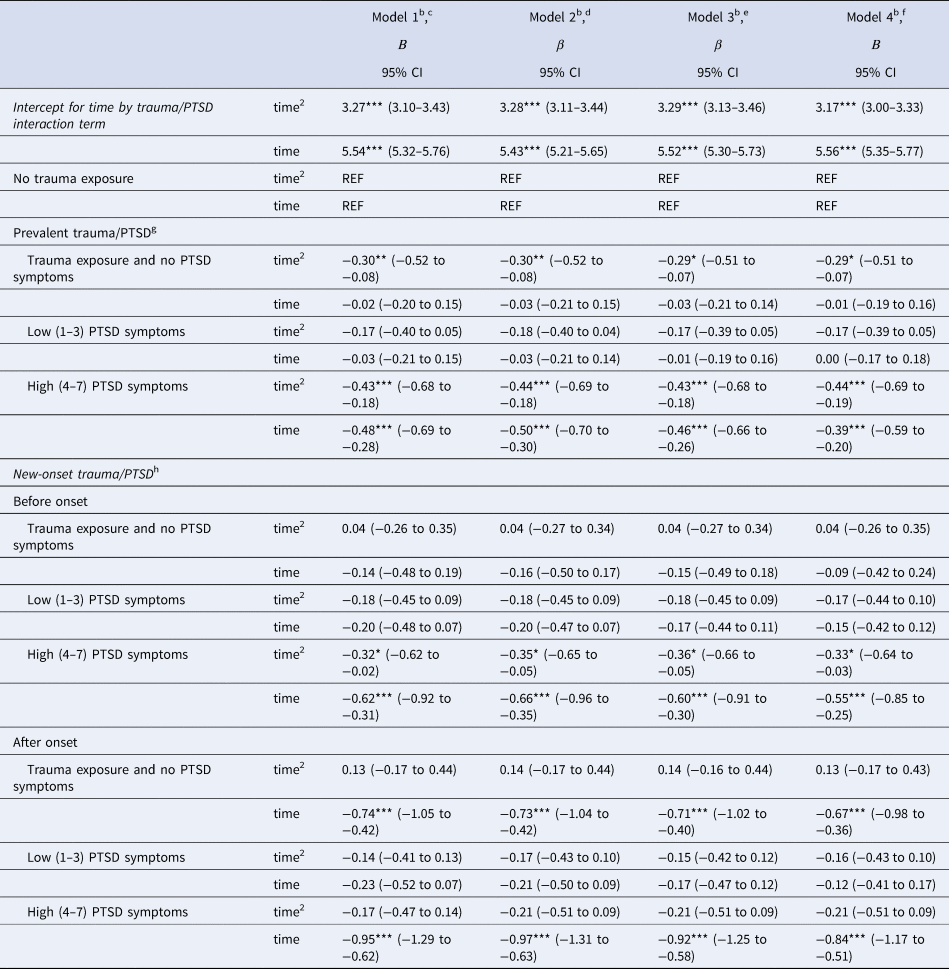
Overall, diet quality improved across 20 years of follow-up, in which AHEI scores increased accelerating over time whereas a J-shaped trend in total flavonoids intake was evident. Table 2 shows the effect estimates derived from interaction terms between trauma/PTSD status and time-since-baseline; these represent the difference in change rate in AHEI scores comparing prevalent or new-onset trauma/PTSD status with no trauma group. Compared to the no trauma group, women with prevalent trauma/PTSD symptoms tended to have less improvement in AHEI scores. For instance, women with prevalent 4–7 PTSD symptoms had a significantly less improved AHEI score during the follow-up ( $\beta _{{\rm tim}{\rm e}^2}$ −0.44, 95% CI −0.69 to −0.19 and β time −0.39, 95% CI −0.59 to −0.20, for each 10-year period since the median follow-up). A similar but less pronounced pattern was observed among women with prevalent trauma and no PTSD symptoms (
 $\beta _{{\rm tim}{\rm e}^2}$ −0.29, 95% CI −0.51 to −0.07 and β time −0.01, 95% CI −0.19 to 0.16), after adjusting for sociodemographic, medical, and behavioral characteristics. This relationship was consistent across all models.
Parameter estimates from multivariable linear mixed-effects models for differences in AHEI scorea change by trauma/PTSD status in 51 965 women followed over 20 years

PTSD, posttraumatic stress disorder; AHEI, Alternative Healthy Eating Index-2010; REF, reference group; β, beta coefficient; CI, confidence interval.
a The total AHEI score ranges from 0 to 110, whereby a higher score indicates better diet quality.
b Ten-year was used as a unit time for all analysis; thus, all effects estimates represent the level of AHEI score change according to trauma/PTSD status for each 10-year interval. All effects estimates are based on the interaction terms of time-since-baseline (quadratic and linear terms, median centered) × trauma/PTSD from the linear mixed effects model, which additionally included trauma/PTSD, time-since-baseline (quadratic and linear terms, median centered), time-to/from-onset (linear), interaction terms of trauma/PTSD × time-to/from-onset (linear) at fixed part, as well as random intercept and random slopes for time-since-baseline (quadratic and linear terms, median centered) and time-to/from-onset (linear term) by default. To address potential reverse causality, we used a 2-year lagged approach, in which exposure and covariate status at one time point were linked with dietary outcome after 2 years.
c Model 1 – adjusted for age (time updated, quadratic, and linear terms).
d Model 2 – Model 1 further adjusted race/ethnicity, parental education, region of residence at birth, and living arrangement (time-updated).
e Model 3 – Model 2 further adjusted for time-updated menopausal status, history of depression and cancers/diabetes/cardiovascular disease.
f Model 4 – Model 3 further adjusted for time-updated smoking, physical activity, and body mass index class (underweight, normal weight, overweight, and obesity).
g Prevalent trauma/PTSD groups refer to women with trauma/PTSD onset before study entry.
h New-onset groups refer to women with trauma/PTSD onset during the follow-up period.
*p < 0.05, **p < 0.01, ***p < 0.001.
The overall pattern was similar among women with new-onset trauma/PTSD. Compared with the no trauma group, women with new-onset trauma/PTSD symptoms had less improvement in AHEI scores following trauma/PTSD onset. For instance, in fully adjusted models, women with new-onset 4–7 PTSD symptoms had less improved AHEI scores during follow-up, and the deceleration in improvement was somewhat more pronounced after ( $\beta _{{\rm tim}{\rm e}^2}\; $−0.21, 95% CI −0.51 to 0.09 and β time−0.84, 95% CI −1.17 to −0.51, for each 10-year period since PTSD onset) v. before (
 $\beta _{{\rm tim}{\rm e}^2}\; $−0.33, 95% CI −0.64 to −0.03 and β time−0.55, 95% CI −0.85 to −0.25) PTSD onset. A women with new-onset 1–3 PTSD symptoms also demonstrated decelerated improvement (albeit less substantial than women with 4–7 PTSD symptoms) although rates were similar both prior to and after trauma/PTSD onset (e.g. after onset
 $\beta _{{\rm tim}{\rm e}^2}\; $−0.16, 95% CI −0.43 to 0.10, and β time−0.12, 95% CI −0.41 to 0.17).
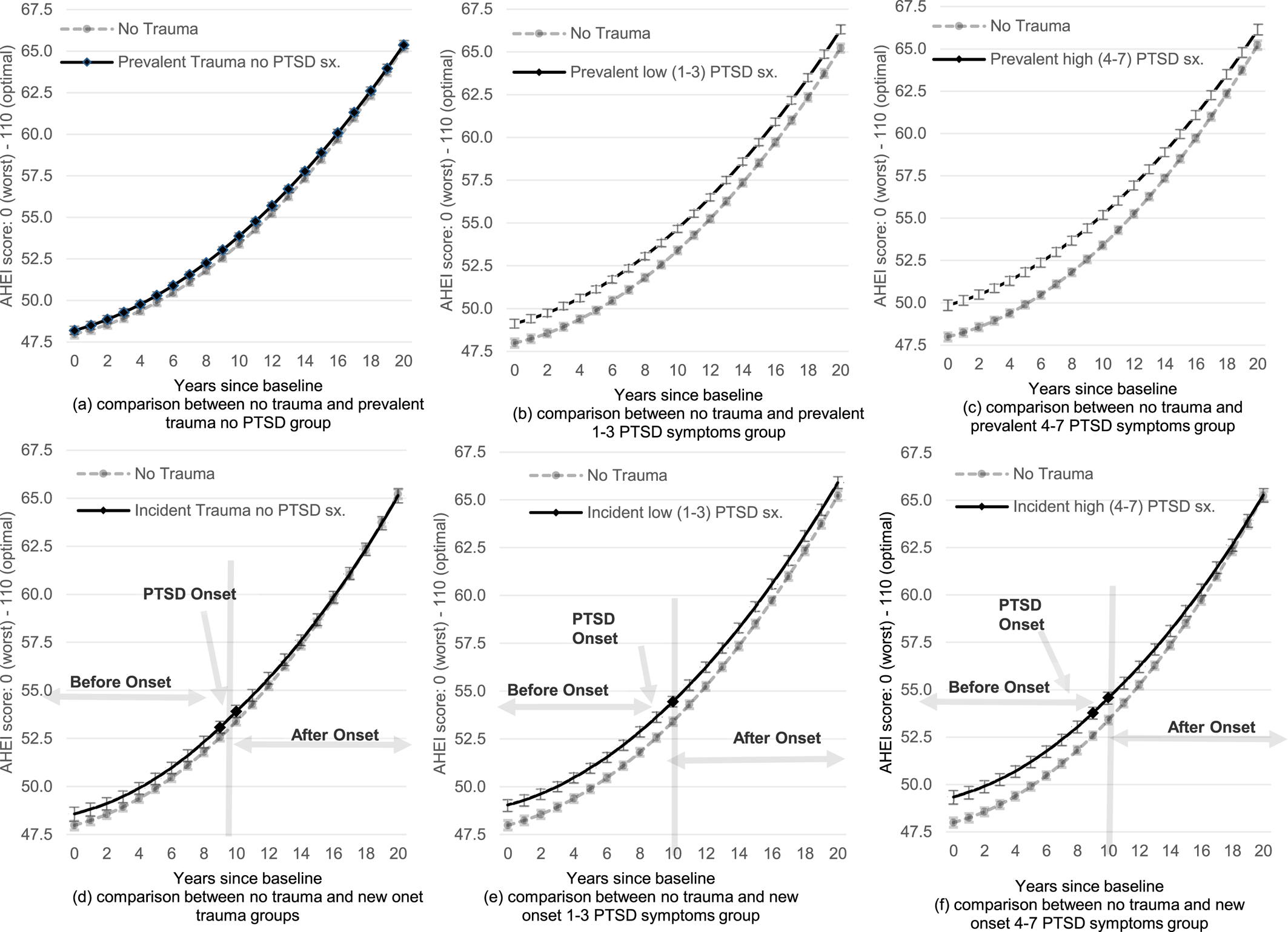
Figure 1 shows predicted trajectories of AHEI scores by trauma/PTSD status over 20 years. Generally, diet quality did not improve as much among women with high PTSD symptom levels relative to those with no trauma. For instance, the no trauma group had a 35.9% increase in AHEI scores during the follow-up (11.3% and 22.1% increase during the first and second 10-year intervals, respectively). Relative to the no trauma group, women with prevalent 4–7 PTSD symptoms had a lower improvement in AHEI scores by 3.3% during follow-up (0.5% and 2.4% for the first and second 10-year intervals, respectively). Similarly, compared to the no trauma group, among women with new-onset 4–7 PTSD symptoms, the improvement rate in AHEI score was slightly less prior to PTSD onset (0.7% less improvement) with improvement rate becoming even slower following PTSD onset (2.5% less improvement). Sensitivity analyses adjusting for baseline diet score (online Supplementary Tables S5 and S6) showed nearly consistent results.
Comparison of predicted AHEI scores (ranging from 0: worst – 110: optimal diet quality) by trauma/PTSD status (reference: no trauma, no PTSD symptoms) in 51 965 women followed over 20 years. Note. The total AHEI score ranges from 0 to 110, whereby a higher score indicates better diet quality. To predict the AHEI scores and 95% CI by trauma/PTSD status over time, we used the median age at a median of the follow-up period (i.e. 45 years old at 10 years since baseline) for all women. For women with incident trauma/PTSD, we used the median of the year of PTSD onset (i.e. 10 years after baseline, represented as the gray vertical line). Predicted scores were derived from linear mixed-effects spline model, including the following covariates: time-updated age (quadratic and linear terms, centered at median age across the follow-up), time-since-baseline (quadratic and linear terms, centered at median follow-up year), trauma/PTSD × time-since-baseline (quadratic and linear terms) interaction terms, time-to-onset (linear term), and interaction between trauma/PTSD × time-to-onset (linear term), as well as random intercept and random slopes for time-since-baseline (quadratic and linear terms) and time-to-onset (linear term). The effect estimates of interest are represented by the differences in slope of trajectory curves between each trauma/PTSD status v. reference group (no trauma), rather than single predicted AHEI score and 95% CI at each time point. To address potential reverse causality, we used a 2-year lagged approach, in which exposure and covariate status at one time point were linked with dietary outcome after 2 years.

Ancillary analyses for specific diet components
Considering associations of trauma/PTSD status with each AHEI component, the general pattern described above for overall AHEI score is evident across multiple dietary components although the specific components differed depending on whether we compared women with no trauma to women with prevalent v. new-onset PTSD (see online Supplementary Tables S1a and S1b). Specifically, women with 4–7 PTSD symptoms tended to have a smaller increase in the consumption of healthful nutrients (i.e. prevalent: whole grain and polyunsaturated fat; new-onset: omega-3 fats and whole grain) and both prevalent and new-onset groups had a larger increase in the consumption of unhealthy nutrients (i.e. trans-fat) and unhealthy use of alcohol during follow-up. A similar, albeit weaker, the pattern was observed for women with new-onset trauma with either no or low PTSD symptoms; they demonstrated a smaller increase in the consumption of omega-3 fat, whole grain, and polyunsaturated fat.
Findings with flavonoids showed less clear patterns (online Supplementary Table S2). For example, compared to no trauma group, women with new-onset 4–7 PTSD symptoms had 0.9% lower improvement in total flavonoids intake after adjusting for age, during follow-up. This broke out to 1.0% more improvement before PTSD onset, but 2.5% lower improvement after onset. Associations of trauma/PTSD status with flavonoid subclasses are presented in online Supplementary Table S3. Overall, compared to the no trauma group, women with new-onset 4–7 PTSD symptoms had a smaller increase in the consumption of most subclasses of flavonoids after PTSD onset; findings were similar for women with prevalent 4–7 PTSD symptoms but evident for fewer subclasses of flavonoids.
Discussion
In this large prospective study of US women, PTSD was associated with changes in diet quality over up to two decades of follow-up. Across the sample, women's diet quality and flavonoid intake improved over time. However, compared to women with no trauma, women with the most PTSD symptoms, whether present at baseline or occurring during follow-up, showed less improvement in diet quality. This pattern was more pronounced for women with more v. fewer PTSD symptoms. Associations were independent of a history of depression and cancers/diabetes/cardiovascular disease, as well as sociodemographic and behavioral characteristics and consistent across different measures of diet quality. Overall, these findings suggest PTSD may have modestly harmful influences on dietary habits, which is consistent with the observed greater risk of increased adiposity and obesity-related metabolic disorders among individuals with PTSD (Rosenbaum et al., Reference Rosenbaum, Stubbs, Ward, Steel, Lederman and Vancampfort2015; Suliman et al., Reference Suliman, Anthonissen, Carr, du Plessis, Emsley, Hemmings, Lochner, McGregor, van den Heuvel and Seedat2016).
Somewhat surprisingly, we also observed slightly less improvement in diet quality, prior to PTSD onset among women who went on to experience PTSD during follow-up. Following PTSD onset, improvement in diet slowed even further. One possible explanation is that more than half of women reporting PTSD symptoms in relation to their worst trauma also reported experiencing a prior trauma exposure. Such prior trauma exposure might have contributed to the smaller improvement in diet quality observable even before PTSD symptoms onset. However, these results should be interpreted with caution as the absolute level of changes in diet quality was small. To our knowledge, this is the first study documenting prospective associations of trauma/PTSD status with diet quality, further separating effects of trauma alone from those of PTSD. Our findings are generally consistent with prior evidence from cross-sectional studies (Vilija and Romualdas, Reference Vilija and Romualdas2014). For example, one study reported young women of low socioeconomic status (n = 3181) who had more v. fewer PTSD symptoms were 3–5% more likely to eat fast food and consume SSB (Hirth et al., Reference Hirth, Rahman and Berenson2011). One prior prospective study found individuals with higher v. lower PTSD symptom scores had more unfavorable diet quality 2.5 years later although the associations were somewhat unstable (Gavrieli et al., Reference Gavrieli, Farr, Davis, Crowell and Mantzoros2015).
Proposed mechanisms
One hypothesized mechanism linking PTSD to poorer diet quality includes stress-induced eating, whereby psychologically distressed individuals tend to seek highly palatable comfort foods such as high-sugar/fat foods, to relieve or soothe adverse psychological reactions (Ulrich-Lai et al., Reference Ulrich-Lai, Christiansen, Ostrander, Jones, Jones, Choi, Krause, Evanson, Furay, Davis, Solomon, de Kloet, Tamashiro, Sakai, Seeley, Woods and Herman2010; Mitchell and Wolf, Reference Mitchell and Wolf2016; Mason et al., Reference Mason, Frazier, Austin, Harlow, Jackson, Raymond and Rich-Edwards2017). Consistent with this hypothesis, in our sample, compared with the no trauma group, women with new-onset PTSD were more likely to increase the consumption of trans-fat subsequently. Foods contributing substantially to greater trans-fat intake over this time period included crackers, processed foods, and French fries. Increased impulsivity and poorer emotional regulation associated with PTSD could affect behavioral decision-making processes, resulting in decreased engagement in beneficial behaviors including healthy eating (van den Berk-Clark et al., Reference van den Berk-Clark, Secrest, Walls, Hallberg, Lustman, Schneider and Scherrer2018). In our study, women with PTSD also had decreased intake of omega-3 fats, whole grains, polyunsaturated fat, and flavonoid subclasses (e.g. anthocyanins and proanthocyanidins) over follow-up, with more pronounced associations among women with more severe PTSD symptoms. However, studies have also reported that PTSD may increase or decrease healthy behaviors such as walking and regular eating, depending on an individual's coping strategies (van den Berk-Clark et al., Reference van den Berk-Clark, Secrest, Walls, Hallberg, Lustman, Schneider and Scherrer2018). This might explain the moderate-to-mild magnitude of impacts of PTSD on diet change since we may have captured varied coping strategies, some healthful and some unhealthy.
Strengths and limitations
Our findings should be interpreted in light of several limitations. First, as we employed a retrospective measure of trauma exposure and PTSD symptoms at one point (e.g. 2008–2009) during the follow-up (e.g. 1989–2011), misclassification of trauma/PTSD status is possible. However, prior research suggests that retrospective assessment can result in underestimation of the true lifetime prevalence of psychiatric disorders, which if true, would suggest our findings are conservative (Moffitt et al., Reference Moffitt, Caspi, Taylor, Kokaua, Milne, Polanczyk and Poulton2010). Given our retrospective assessment of trauma/PTSD, as well as previous evidence linking diet quality and depression (Chang et al., Reference Chang, Cassidy, Willett, Rimm, O'Reilly and Okereke2016; Lassale et al., Reference Lassale, Batty, Baghdadli, Jacka, Sanchez-Villegas, Kivimaki and Akbaraly2019), it is also possible that diet quality precedes and influences trauma exposure and PTSD or their reporting. However, we took several steps to ensure appropriate temporality in the relationship, for example, using a 2-year lag between trauma/PTSD status with diet assessment and sensitivity analyses with adjustment of baseline diet score. Because we do not have data on a broad spectrum of psychiatric disorders and/or the timing of their onset, we were unable to assess the specificity of the effects of PTSD per se. This is an important area of exploration for future research. However, we do have valid measures of depression (history), the disorder most commonly identified as a potential confounder with regard to health-related effects of PTSD, and found associations of PTSD and diet were independent of depression. Our sample consists of highly educated and predominantly white women trained as nurses and thus may not be representative of the general population of women in terms of health knowledge/resources/behaviors, or of men. However, the estimated prevalence of PTSD in our sample was similar to that among US women (Roberts et al., Reference Roberts, Austin, Corliss, Vandermorris and Koenen2010). Also, women included in this analysis were those who remained in the cohort through 2008. Therefore, we may have captured women with less severe PTSD or who were more resilient. These selection biases may have led to underestimating the true association of PTSD with diet quality changes over time.
Our study also has numerous strengths. Data are from a large, richly characterized cohort of women, in which an extensive range of variables including dietary intake and covariates were measured repeatedly over follow-up. We identified trauma/PTSD status and diet quality using well-validated measures. We examined diet trajectories not only among women with chronic PTSD but also among women with new-onset of PTSD during follow-up, directly evaluating if diet quality differed after new-onset trauma/PTSD symptoms. Additionally, we could compare the effects of PTSD on changes in dietary intake over time, above and beyond the potential influences of trauma exposure alone, adjusting for a broad range of potential confounders, including depression and health status. Taken together, we believe our rigorous methods and comprehensive diet quality measures along with the ability to examine associations with both prevalent and new-onset PTSD make this study a novel test of the hypothesis that PTSD can lead to deterioration in diet quality, and goes well beyond a descriptive or confirmatory study.
Conclusions
This study provides novel evidence of prospective associations between high PTSD symptoms and changes in both overall diet quality and specific diet components. Our findings suggest that PTSD rather than trauma exposure alone can lead to less healthy dietary behavior. While effects are moderate in size, over time and at a population-level, they may accumulate thereby representing a meaningful target for intervention. Together with other work in this sample demonstrating that higher PTSD symptoms can lead to reduced physical activity (Winning et al., Reference Winning, Gilsanz, Koenen, Roberts, Chen, Sumner, Rimm, Maria Glymour and Kubzansky2017), these findings provide insight into behavioral mechanisms that may explain how PTSD might increase the risk of obesity (Kubzansky et al., Reference Kubzansky, Bordelois, Jun, Roberts, Cerda, Bluestone and Koenen2014) and other obesity-related comorbidities including type 2 diabetes (Roberts et al., Reference Roberts, Agnew-Blais, Spiegelman, Kubzansky, Mason, Galea, Hu, Rich-Edwards and Koenen2015), cardiovascular disease (Sumner et al., Reference Sumner, Kubzansky, Elkind, Roberts, Agnew-Blais, Chen, Cerda, Rexrode, Rich-Edwards, Spiegelman, Suglia, Rimm and Koenen2015), and even some cancers (Gradus et al., Reference Gradus, Farkas, Svensson, Ehrenstein, Lash, Milstein, Adler and Sorensen2015). Findings from the current study are consistent with a growing body of studies suggesting that the harmful effects of PTSD extend to behaviors and processes that are key risk factors for multiple adverse physical health outcomes. These findings add urgency to recent recommendations (Arenson and Cohen, Reference Arenson and Cohen2017; Koenen et al., Reference Koenen, Sumner, Gilsanz, Glymour, Ratanatharathorn, Rimm, Roberts, Winning and Kubzansky2017) to implement an integrated approach to monitoring and treating individuals with PTSD by incorporating behavioral modifications in conventional strategies for treatment and prevention of PTSD-related comorbidities.
Supplementary material
The supplementary material for this article can be found at https://doi.org/10.1017/S0033291719003246.
Acknowledgements
The authors would like to acknowledge the Channing Division of Network Medicine, Department of Medicine, Brigham and Women's Hospital, and Harvard Medical School for managing the NHS II.
Financial support
This study was supported by the Department of Defense grant W81XWH-17-1-0153 (to LDK) and the National Institute of Health grant UM1CA176726 (for NHS II infrastructure).
Conflict of interest
None.