Introduction
Noise, as a health and safety issue, is present in many industrial sectors. Up to 250 million workers worldwide are critically exposed to excessive noise (Concha-Barrientos, Campbell-Lendrum, & Steenland, Reference Concha-Barrientos, Campbell-Lendrum and Steenland2004). The most well-documented effects of exposure to excessive levels of noise are permanent hearing loss and tinnitus. There are other significant consequences, however, that may have been studied less extensively, including cardiac disease (Davies et al., Reference Davies, Teschke, Kennedy, Hodgson, Hertzman and Demers2005; van Kempen et al., Reference van Kempen, Kruize, Boshuizen, Ameling, Staatsen and de Hollander2002), length of pregnancy and birth weight of the baby (Croteau, Reference Croteau2009), and work-related and traffic accidents (Girard et al., Reference Girard, Picard, Davis, Simard, Larocque and Leroux2009; Hickson, Wood, Chaparro, Lacherez, & Marzaleck, Reference Hickson, Wood, Chaparro, Lacherez and Marzaleck2010; Picard et al., Reference Picard, Girard, Simard, Larocque, Leroux and Turcotte2008a, Reference Picard, Girard, Courteau, Leroux, Larocque and Turcotte2008b; Zwerling et al., Reference Zwerling, Sprince, Davis, Whitten, Wallace and Heeringa1998). Furthermore, it is estimated that in noisy workplaces about 14 per cent of falls occurring while moving from one location to another are attributable to either high noise levels (≥ 90 dBA), permanent noise-induced hearing loss (NIHL ≥ 16 dB HL at frequencies of 3, 4, and 6 kHz), or the combined effect of both factors (Picard et al., Reference Picard, Girard, Simard, Larocque, Leroux and Turcotte2008a).
Sensory deficits (visual and auditory) are recognized as risk factors for falls among older adults (Keller, Morton, Thomas, & Potter, Reference Keller, Morton, Thomas and Potter1999; Kulmala et al., Reference Kulmala, Viljanen, Sipilä, Pajala, Pärssinen and Kauppinen2009; Viljanen et al., Reference Viljanen, Kaprio, Pyykkö, Sorri, Pajala and Kauppinen2009a). Permanent vestibular dysfunction interfering with the maintenance of balance (control and body sway; Juntunen et al., Reference Juntunen, Matikainen, Ylikoski, Ylikoski, Ojala and Vaheri1987) would be the most likely causative factor (Golz et al., Reference Golz, Westerman, Westerman, Goldenberg, Netzer and Wiedmyer2001; Guest, Boggess, D’Este, Attia, & Brown, Reference Guest, Boggess, D’Este, Attia and Brown2011; Kumar, Vivarthini, & Bhat, Reference Kumar, Vivarthini and Bhat2010; Manabe, Kurokawa, Saito, & Saito, Reference Manabe, Kurokawa, Saito and Saito1995; Oosterveld, Polman, & Schoonheyt, Reference Oosterveld, Polman and Schoonheyt1982; Pyykkö, Aalto, & Ylikoski, Reference Pyykkö, Aalto and Ylikoski1989; Sazgar, Dortaj, Akrami, Akrami, & Karimi Yazdi, 2006; Shupak et al., Reference Shupak, Bar-El, Podoshin, Spitzer, Gordon and Ben-David1994). According to Sazgar et al. (Reference Sazgar, Dortaj, Akrami, Akrami and Karimi Yazdi2006), damage to the vestibular system, especially to the saccule, is a potential problem with cochlear-damaging factors because saccule receptors are coupled physically with the auditory receptors; that is, they share the membranous labyrinth. In theory, the membranous partition that separates the utricle and the semicircular canals from the rest of the vestibule should protect the majority of vestibular sensory cells against the adverse effects of intensive stapes vibration or other ototoxic factors, but, in the long term, occupational noise exposure may be a noteworthy exception. Vestibular dysfunction would then result from the degeneration of the inner ear structures leading to poor balance and falls (McElhinney, Koval, & Zuckerman, Reference McElhinney, Koval and Zuckerman1998; Van der Laan, Reference Van der Laan2001). According to de Noronha Ribeiro Daniel et al. (2011), falls represent a particular case of vestibule-mediated difficulty to maintain balance.
Specifically, age-related (Zuniga et al., Reference Zuniga, Dinkes, Davalos-Bichara, Carey, Schubert and King2012) and noise-induced hearing loss (Kumar et al., Reference Kumar, Vivarthini and Bhat2010) are significantly associated with measures of both cochlear and vestibular dysfunction, but their respective contribution to falls risk remains to be determined. Furthermore, with progression of presbyacusis or NIHL, from the higher to the more central and lower frequency spectrum, falls may also occur because people do not hear audible warning signals such as car horns, or pedestrians approaching them on the sidewalk (Lundalv, Reference Lundalv2004). Although an important public health issue in terms of both the prevalence and the associated costs (Fuller, Reference Fuller2000; Zecevic et al., Reference Zecevic, Chesworth, Zaric, Huang, Salmon and McAuslan2012; Peel, Reference Peel2011), the problem of falls at retirement age as a long-term effect of excessive occupational noise exposure in one’s career or in association with NIHL remains to be documented.
Within this context, the objective of this study was to verify whether the severity of NIHL, as a result of long exposure to occupational noise (≥ 80 dBA), increases the risk of falls leading to admission to hospitals among newly retired workers.
Method
Sources of Data
The administrative data used for this study came from three distinct sources. The data describing exposure to noise and hearing status of exposed workers came from the Institut national de santé publique du Québec (Quebec National Institute of Public Health [INSPQ]). This organization conducts hearing tests within the context of institution-specific health programs and archives the results of these tests. The tests are carried out according to a protocol that complies with the International Organization for Standardization (ISO) 6189 acoustics standards, including provisions addressing the reproducibility of audiometric measurements (Hétu et al., Reference Hétu, Boudreault, Balthazard, Fontaine, Fortier and Lemoine1981). These data enabled the identification of individuals to recruit into the study population, the characterization of their exposure to noise, and the hearing status of these workers at the time of their last hearing test. The second source of data was the Banque de données sur la Maintenance et Exploitation des Données pour l’Étude de la Clientèle Hospitalière (MED_ECHO) register based on patient hospitalization records, which allowed the tracing of all individuals of the study population who were admitted to hospital after a fall. The third data source was the Quebec death registry which provided information about mortality occurring in the study group.
Population
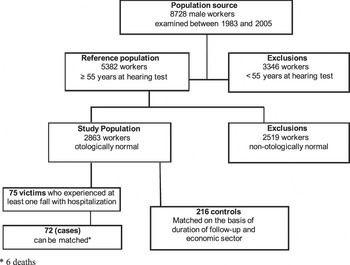
As indicated in Figure 1, the sample population consisted of 8,728 male workers presenting the following characteristics: (1) they were exposed to occupational noise (≥ 80 dBA) during the greater part, if not all, of their working life as determined at the time of the hearing test; (2) they had their hearing tested in the INSPQ’s mobile audiometric units between 1983 and 2005; (3) they were required to be at least 55 years old at the time of examination and have reached the age of 65 during the study period. Given that the hearing status of the workers was not determined on the day of their 65th birthday, the last hearing test conducted prior to this birthday was used. In the particular case where several audiometric tests were available for the same individual, only the last one was considered. Punctual noise exposure ≥ 80 dBA (a point moment determined at the time of the hearing test as was the length of occupational noise exposure) was categorized as either < 90 dBA or ≥ 90 dBA. The reference population thus included 5,382 workers aged 55 and older at the time of their last audiometric test.
Sample selection process

As the focus of this study was specifically on the effects of occupational noise, only workers whose hearing status could be qualified as normal for age (in reference to the ISO 7029 standard) as well as those whose hearing loss was typical of exposure to occupational noise (otologically normal in terms of the ISO 1999 standard [1990] and ISO 7029 standard [1999]) were included. Hearing loss could thus be used as a reliable indicator of long-duration exposure to occupational noise. Accordingly, those affected with a “personal” condition (e.g., reduced capacity of a non-occupational origin related or not to ear disease, asymmetrical hearing loss, etc.) were excluded (Picard et al., Reference Picard, Girard, Courteau, Leroux, Larocque and Turcotte2008b). The study population (see Figure 1) thus comprised 2,863 workers whose hearing was normal or qualified as otologically normal. They came from various industrial sectors (e.g., metal products manufacturing, 15.4%; mining and quarrying, 11.7%; forestry, 9.5%; transportation equipment manufacturing, 8.4%; and food and beverage industry, 8.0%). In addition, case-control analysis was used to improve the comparability of workers; each worker hospitalized for a fall was matched with three controls on the basis of the duration of follow-up and by industrial sector. Matching was possible for 96 per cent of cases. All analyses were therefore based on 288 workers (72 cases and 216 controls). Figure 1 illustrates the process of selecting the population.
Variables
Hearing
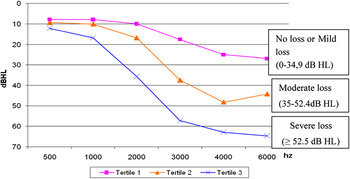
In this study, for a given frequency, a worker’s hearing loss corresponded to the hearing threshold level by air conduction (dB HL) averaged on both ears. Since the study population was exposed to occupational noise, the status of hearing at high frequencies, that is, the average loss at frequencies of 3, 4, and 6 kHz, was used. NIHL data were then separated into three categories corresponding to tertiles of this distribution (no loss or mild loss: 0–34.9 dB HL; moderate loss: 35–52.4 dB HL; and severe loss: ≥ 52.5 dB HL). Low frequencies were not considered because otologically normal workers do not experience significant hearing loss at these frequencies; high frequencies are typically affected, as illustrated in the group audiogram presented in Figure 2.
Hearing threshold of tertiles considered

Ambient Noise Exposure Level
Noise exposure level was measured by industrial hygienists from Quebec’s public health network in the weeks preceding the audiometric testing sessions. These measurements were conducted in connection with medico-environmental surveillance programs planned within the framework of institution-specific health programs. These data were specific to the work environment at the time of the hearing test and did not allow for establishing a mean or total level of exposure during the individual’s working life. Furthermore, no information was available about impulse noise exposure over the course of the individual’s career. For the study population, noise was considered according to whether it was < 90 dBA (52.6%) or ≥ 90 dBA (47.4%), the maximum noise exposure level authorized for an eight-hour exposure period by Quebec regulations. These variables were considered in the analyses for descriptive purposes only.
Participants’ Age and Duration of Noise Exposure
Age and duration of exposure to a noisy environment (corresponded to the equivalent number of years worked in noise) were reported by the worker in the hearing history questionnaire administered at the time of the hearing test and not at the time of retirement.
Hospitalization Related to a Fall
The outcome variable was first admission to hospital due to a fall. A hospital stay (≥ 1 day) associated with a fall was defined with any one of the following codes for accidental causes: E880-E888 (ICD9) (Organisation mondiale de la santé [OMS], 1977) as per the records of the Régie de l’Assurance Maladie du Québec (RAMQ), which collects and archives these data. Hospital readmissions for the same event were not considered. A total of eight (10.7%) retired workers had admission to hospital for a second fall. As for the injuries associated with a fall, there were numerous cases of multi-trauma. There were 52 cases of fractures and about 15 cases of internal traumatism to the head or trunk. Note that 6 of the 75 cases (8%) admitted to hospital died during the hospital stay related to the fall; however, it was not possible to identify whether the fall was the main cause of death.
Duration of the Follow-up
The follow-up began on the 65th birthday of the retired workers and ended upon their death by or on December 31, 2005.
Analysis
A case-control analysis was conducted on the audiometric data, hospitalization and death matched.
Each case of hospitalization for a fall was matched with three controls on the basis of duration of follow-up and industrial sector. Matching was possible for all but three cases, and analyses were therefore based on 288 workers (72 cases and 216 controls; see Figure 1). Industrial sector was used as a surrogate matching variable in an effort to take into account socioeconomic variables, general health hazards, and specific occupational risks, as these co-variables were not available in the original databases. This approach was based on the assumption that co-workers in the same occupational category shared many characteristics related to these risk factors. The strategy used for the matching of cases and controls allowed a better control of these variables and increased comparability of workers. Workers included in case control analysis came mainly from industrial sectors such as forestry (23.6%), mining and quarrying (18.1%), metal products manufacturing (11.1%), wood manufacturing industry (11.1%), primary metal manufacturing (5.6%), and the paper industry (5.6%).
We used conditional logistic regression models to estimate the odds ratio of hospitalization for a fall by categories of NIHL. Next, a test for trend was conducted by assigning to each tertile its median hearing loss using it as a continuous variable in the conditional logistic regression model. A sensitivity analysis was also performed by adding age at examination to the matching variables to have better control of presbyacusis and to check whether this variable influenced the results. This approach matched 64 cases out of 75. We used SAS software version 9.1.3 of the SAS system for Windows to perform statistical analyses SAS (2004).
Results
Descriptive Analyses
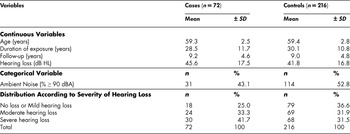
In the case-control analysis, the mean bilateral NIHL of the 72 cases retained was 45.6 dB HL, with 28.5 years of exposure to a noisy environment and 9.2 years of follow-up, whereas for the controls these variables were 41.8 dB HL, 30.1 years of noise exposure, and 9 years of follow-up (see Table 1). No statistically significant difference between the cases and the controls was found for these variables.
Comparison of cases and controls according to age, duration of occupational noise exposure and follow-up, hearing loss and ambient noise at hearing test, and distribution according to severity of hearing loss

SD = standard deviation
Nested Case-Control Analysis
The conditional logistic regression analyses show a progressive increase in the risk of hospitalization due to a fall with increasing degrees of NIHL. The OR is equal to 1.97 (CI95%; 1.001–3.876) for the most severe tertile, and the association is statistically significant (p = .0495). The association shows a significant dose/response relationship with a p-value for the trend of .0497 (see Table 2).
Conditional logistic regression on the association between hearing status and the risk of fall

* Trend test p = .0497
Sensitivity analyses considering age at examination in the matching variables gave similar results, as the severe tertile of hearing loss had a significantly higher risk than the first (p = .0247). The trend test had a p-value of .0244. Note that sensitivity analysis that added age at examination to the matching variables for better control of presbyacusis showed no influences on the results.
Discussion
Our current study indicates that male workers occupationally exposed to noise and newly retired with severe bilateral NIHL (≥ 52.5 dB HL at frequencies of 3, 4, and 6 kHz in an audiometric test administered after the age of 55), have an increased risk of falls requiring hospitalization after the age of 65. To our knowledge, this is the first time such a relationship between occupational hearing loss and the risk of falls at retirement age has been established in a formal manner. Although the association between sensory deficits, including hearing status, and the risk of falls among older adults has been reported, the specific contribution of the consequences of occupational noise has rarely been a primary concern in published studies. The incidence of falls in noisy workplaces, however, has been associated with noise exposure and NIHL (Picard et al., Reference Picard, Girard, Simard, Larocque, Leroux and Turcotte2008a). Overall, this suggests that the prevention of NIHL by reorganizing the workplace could contribute substantially to the improvement of living conditions and the prevention of falls and in lower burdens associated with aging.
From a more theoretical standpoint, the current findings also support the mounting evidence of vestibular damage and balance disorder potentiated by NIHL (Juntunen et al., Reference Juntunen, Matikainen, Ylikoski, Ylikoski, Ojala and Vaheri1987; Guest et al., Reference Guest, Boggess, D’Este, Attia and Brown2011; Kumar et al., Reference Kumar, Vivarthini and Bhat2010; Sazgar et al., Reference Sazgar, Dortaj, Akrami, Akrami and Karimi Yazdi2006; Golz et al., Reference Golz, Westerman, Westerman, Goldenberg, Netzer and Wiedmyer2001; Shupak et al., Reference Shupak, Bar-El, Podoshin, Spitzer, Gordon and Ben-David1994; Manabe et al., Reference Manabe, Kurokawa, Saito and Saito1995; Pyykkö et al., Reference Pyykkö, Aalto and Ylikoski1989; Oosterveld et al., Reference Oosterveld, Polman and Schoonheyt1982; McElhinney et al., Reference McElhinney, Koval and Zuckerman1998; Van der Laan Reference Van der Laan2001; Termoz & Prince, Reference Termoz and Prince2005; Gerson, Jarjoura, & McCord, Reference Gerson, Jarjoura and McCord1989). This is not to minimize the potential contribution of hearing loss in treating information that may hinder mobility (Viljanen et al., Reference Viljanen, Kaprio, Pyykkö, Sorri, Pajala and Kauppinen2009a, Reference Viljanen, Kaprio, Pyykkö, Sorri, Koskenvuo and Rantanen2009b). Regarding walking difficulty in particular, Viljanen et al. (Reference Viljanen, Kaprio, Pyykkö, Sorri, Pajala and Kauppinen2009a) suggested that hearing impairment leads to increased cognitive demands in situations where a person’s attention is divided, possibly causing reduced mobility and potentially interfering with his safety. Furthermore, from a psychosocial perspective, it has been suggested that reduced hearing acuity can be associated with reduced participation in various activities (Viljanen et al., Reference Viljanen, Kaprio, Pyykkö, Sorri, Pajala and Kauppinen2009a, Reference Viljanen, Kaprio, Pyykkö, Sorri, Koskenvuo and Rantanen2009b) and also with lower feelings of mastery and self-efficacy (Kramer, Kapteyn, Kuik, & Deeg, Reference Kramer, Kapteyn, Kuik and Deeg2002; Pronk et al., 2011). This, in turn, can accelerate the disablement process and increase the risk of falls. These various perspectives stress the complex nature of the relationship between hearing impairment and the risk of falls. Within this particular context, NIHL can offer a means to look for a better understanding of the mechanisms involved, given that the effect is verified during working life and retirement.
The number of falls leading to hospital admission as identified in this study (n = 75, 2.6% of study population) may seem low. Nonetheless, one should not overlook the fact that this study elicited this association between NIHL and falls among retired men, relatively young when they experienced falls, and of whom a large proportion were likely exposed to noise over a period of many years until they reached retirement age. The mean duration of the monitoring period was short (6.8 years). In fact, at the end of the study, 40 per cent of the participants were aged 65 to 70, and only 4.2 per cent were aged 80 and older. A longer follow-up period would probably have led to a marked increase in the number of hospital admissions due to falls, advancing age being strongly associated with the risk of falls (Fuller, Reference Fuller2000). We verified whether the same trend was present among other workers in the reference population that included workers who were non-otologically normal (results not shown); however, the relationship was confirmed only for workers whose hearing loss was related to their occupation.
The study subjects were in all likelihood individuals whose physical condition and health status enabled them to spend their entire working life in noisy conditions that some authors have described as painful (e.g., Cassou, Derriennic, Iwatsubo, & Amphoux, Reference Cassou, Derriennic, Iwatsubo and Amphoux1992). It can also be assumed that the population studied was, on the whole, in better health than the general population (Li, & Sung, Reference Li and Sung1999). For the most part, the injuries associated with falls involving hospitalization (fractures and internal traumatisms) were serious and probably related to the deaths of 6 of the 75 cases in this study. Furthermore, the degree of hearing loss at which an association between NIHL and falls was observed is high by comparison with hearing loss severity mentioned in published studies. For example, the hearing loss–falls association was verified in a female population based on a hearing loss ≥ 18 dB HL (0.5, 1, 2, 4 kHz) in the Viljanen et al. study (2009a), ≥ 21 dB HL in the Kulmala et al. study (2009), and the equivalent of 30 dB HL in the Keller et al. study (1999).
Limitations
This study has several noteworthy limitations. The first is related to the time that elapsed between the period when hearing was measured – when the workers were between 55 and 64 years of age – and the study’s actual observation period, which began the day of their 65th birthday. It is not unreasonable to think that the hearing loss of these individuals continued to deteriorate due either to aging (presbyacusis) or the persistence of exposure to noise over the course of a certain number of years. The hearing status at the time the individual’s fall occurred and status at the end of the monitoring period are not known. From this perspective, it is reasonable to assume that the risk of falls began to increase at a hearing threshold slightly higher than that reported here.
Another limitation relates to the lack of information on actual age at the time of retirement, compelling us to postulate that all workers began retirement the day of their 65th birthday. These limitations in accuracy enhance measurement error, which may have reduced the sensitivity of the statistical analyses, thus weakening the weight of the evidence in the study. In addition, our study included only falls severe enough to require hospitalization (≥ 1 day). It is likely that the population studied represented only a very small proportion of those who fell during the observation period. However, this situation could constitute a source of bias only if the hearing loss were associated not only with the risk of falls but also with its severity. A further limitation was that the datasets used for this study included very little information about the known risk factors for falls; thus, the results could not be adjusted for most of these factors. Also unknown were the circumstances surrounding the falls and the locations where they occurred. Notwithstanding, because of the selection and matching of the subjects, we believe that the risks of confounding related to certain risk factors and hearing loss are weak. Finally, we have no information about the use of hearing aids by the retired workers in the study population, which would have enabled us to better interpret results.
Conclusion
The results of this exploratory study showed that the average hearing loss in both ears, measured during hearing tests subsequent to exposure to occupational noise, influenced the risk of falls among workers after retirement. These results also indicated that the study of effects specific to hearing loss on the risk of falls must be extended by controlling various factors known to affect the risk of falls and the physical condition of workers (e.g., musculo-skeletal disorders). Better understanding of this problem from physiological, cognitive, and psychosocial perspectives could lead to a reduction in falls among seniors. As several authors have emphasized, it is important to encourage the implementation of preventive measures to limit sensory deficit, which also implies reducing occupational noise exposure (e.g., Cassou et al., Reference Cassou, Derriennic, Iwatsubo and Amphoux1992; Picard et al., Reference Picard, Girard, Simard, Larocque, Leroux and Turcotte2008a; Zwerling et al., Reference Zwerling, Sprince, Davis, Whitten, Wallace and Heeringa1998).