In recent years, growing attention has been paid to the potential role of the Mediterranean diet in women’s reproductive health(Reference Yang, Song and Gaskins1,Reference Szmidt, Granda and Madej2) . A meta-analysis reported that higher adherence to the Mediterranean diet was associated with a reduced risk of adverse pregnancy outcomes such as preterm birth or gestational diabetes mellitus(Reference Yang, Song and Gaskins1). However, research on other reproductive health outcomes, including dysmenorrhoea, endometriosis and premenstrual syndrome (PMS), remains limited(Reference Szmidt, Granda and Madej2). This knowledge gap is particularly important given the high prevalence of PMS (30 %)(Reference Appleton3) and the fact that its underlying mechanisms are not yet fully understood. Current hypotheses suggest that PMS may result from individual differences in sensitivity to physiological hormonal fluctuations across the menstrual cycle(Reference O’Brien, Rapkin and Dennerstein4), as well as from inappropriate inflammatory response to various stimuli and increased oxidative stress(Reference Bertone-Johnson5,Reference Granda, Szmidt and Kaluza6) . These mechanisms overlap with biological pathways known to be influenced by the Mediterranean diet, which has been shown to modulate inflammatory and oxidative processes(Reference Itsiopoulos, Mayr and Thomas7). Moreover, existing evidence indicates that lifestyle factors, such as diet(Reference Granda, Szmidt and Jarmuzek-Orska8,Reference Siminiuc and Ţurcanu9) and physical activity level(Reference El-Lithy, El-Mazny and Sabbour10–Reference Maged, Abbassy and Sakr12), can influence the severity of PMS symptoms. These findings highlight the importance of investigating the relationship between adherence to the Mediterranean diet and PMS.
To date, four cross-sectional studies have evaluated the association between adherence to the Mediterranean diet and the severity of PMS symptoms with inconclusive results(Reference Ahmed and Mohamed Lotfy13–Reference Yesildemir, Arslan and Dubus16). Less severe PMS symptoms with a higher adherence to the Mediterranean-style diet were demonstrated in a study of 262 Korean women aged 20–49 years(Reference Kwon, Sung and Lee15). In contrast, lower adherence to the Mediterranean diet was associated with lower odds of PMS in 743 Spanish students(Reference Franco-Antonio, Santano-Mogena and Cordovilla-Guardia14). In the other two studies, from Egypt(Reference Ahmed and Mohamed Lotfy13) and Turkey(Reference Yesildemir, Arslan and Dubus16), no association was found between PMS and adherence to the diet.
Considering the inconsistent findings of the limited number of studies conducted to date, and the fact that only one investigation has been carried out in a European population(Reference Franco-Antonio, Santano-Mogena and Cordovilla-Guardia14), further research is warranted to better elucidate the potential relationship between adherence to the Mediterranean diet and PMS severity. This is particularly relevant given the substantial yet underrecognised burden of PMS among European women(Reference Liu, Li and Wang17,Reference Roos, Wimmelbacher and Klein18) . Therefore, the present study aimed to examine the association between adherence to a Mediterranean-style diet and overall PMS severity, as well as the severity of specific psychological and physical symptoms, and the impact of PMS on daily functioning. We hypothesised that higher adherence to the Mediterranean diet would be associated with lower overall PMS severity and less severe individual PMS symptoms.
Methods
Study design
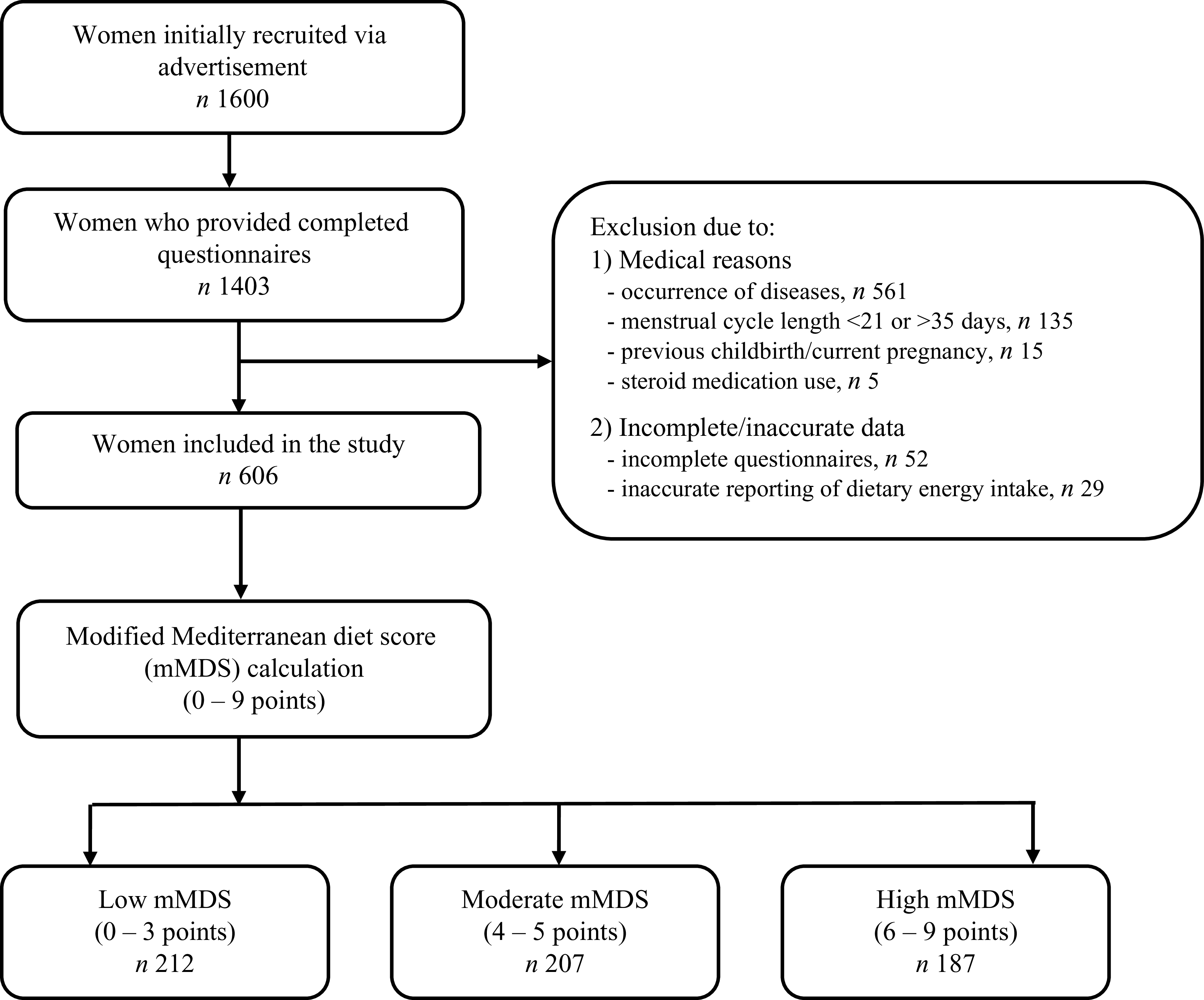
The study population consisted of generally healthy women without a prior diagnosis of or treatment for PMS. Women were recruited from students and graduates of six universities in Warsaw, Poland, between February 2019 and December 2020. In addition to in-person recruitment at universities, information about the study was shared with student groups via social media. The response rate was 87·7 %, with a total of 1600 surveys distributed. The flow of participant recruitment and retention is depicted in Figure 1. Most participants were excluded due to pre-existing health conditions (n 561), including thyroid disease (n 129), depression (n 55) and other conditions such as polycystic ovary syndrome, eating disorders, epilepsy and type 1 and type 2 diabetes. Detailed information regarding participant exclusions has been reported previously(Reference Granda, Szmidt and Jarmuzek-Orska8). After applying all exclusion criteria, data from 606 women were included in the final analysis. The minimum required sample size was calculated using Cochran’s formula(Reference Barlett, Kotrlik and Higgins19), assuming a 95 % confidence level and a maximum error margin of 5 %, which resulted in a required sample size of 384 women.
Flow chart of participants’ recruitment and enrolment in the study. mMDS, modified Mediterranean diet score.

Figure 1. Long description
The flowchart begins with 1600 women initially recruited via advertisement. Of these, 1403 women provided completed questionnaires. Exclusions were made due to medical reasons, including the occurrence of diseases (561 women), menstrual cycle length less than 21 or more than 35 days (135 women), previous childbirth or current pregnancy (15 women), and steroid medication use (5 women). Additionally, exclusions were made due to incomplete or inaccurate data, including incomplete questionnaires (52 women) and inaccurate reporting of dietary energy intake (29 women). This left 606 women included in the study. The modified Mediterranean diet score (mMDS) was calculated for these women, ranging from 0 to 9 points. The women were then categorized into three groups based on their mMDS: low mMDS (0-3 points, 212 women), moderate mMDS (4-5 points, 207 women), and high mMDS (6-9 points, 187 women).
General information and food intake
Data such as weight, height, menstrual health (age at menarche, average menstrual cycle length and average menstrual bleeding duration), place of residence, self-reported physical activity level, smoking status, use of hormonal contraception and use of dietary supplements were collected using a general questionnaire.
Food intake was assessed with a validated FFQ-NutriForHer(Reference Szmidt, Sicinska and Januszko20), a tool consisting of 138 food items grouped into thirteen food groups. Women reported their average portion size consumed on one occasion and how often, on average, they had consumed specific foods during the previous year by selecting one of eight predefined frequency categories, ranging from ‘less than once a month’ to ‘3 or more times per day’. Daily intake of each food item was subsequently estimated by multiplying the reported consumption frequency (using predefined frequency conversion factors) by the stated portion size. Energy and nutritional value of the diet were calculated using the Tables of Composition and Nutritional Value of Food developed by the Institute of Food and Nutrition in Poland(Reference Kunachowicz, Przygoda and Nadolna21). The FFQ-NutriForHer was validated in a group of 121 women (aged 18–30 years), and a 3-d dietary record was used as a reference method(Reference Szmidt, Sicinska and Januszko20). The average Pearson’s correlation coefficients were 0·51 for macronutrients and 0·62 for micronutrients.
Assessment of adherence to the Mediterranean-style diet
To assess adherence to the Mediterranean-style diet, we used a modified Mediterranean diet score (mMDS), originally developed by Trichopoulou et al. (Reference Trichopoulou, Bamia and Trichopoulos22). Consumption of each of the food group with beneficial health potential (vegetables; legumes, seeds and nuts; fruits; wholegrain cereals; fish and seafood; fermented milk products; and the ratio of MUFA to SFA) at or above the median was scored as 1 point, and consumption below the median was scored as 0 points (online Supplementary Materials – Table S1). For the food group including red, processed and organ meat, reverse scoring was applied. For alcohol consumption, 1 point was assigned to women who consumed, on average, between 5 and 25 g of ethanol per day; otherwise, 0 points were assigned. All food groups (except ethanol) were energy-adjusted to the mean energy intake of 2090 kcal/d using the residual method(Reference Willett and Stampfer23). The total mMDS score ranged from 0 (no adherence) to 9 points (highest adherence). Detailed information on the specific food items included in the mMDS is provided in online Supplementary Table S2. Based on tertiles of the mMDS distribution, participants were classified into three groups: low (0–3 points), moderate (4–5 points) and high adherence (6–9 points) to the Mediterranean-style diet.
Assessment of premenstrual symptoms
To assess the severity of premenstrual symptoms, two instruments were used: (1) Premenstrual Symptoms Screening Tool (PSST) and (2) Calendar of Premenstrual Experiences (COPE).
The validated PSST(Reference Henz, Ferreira and Oderich24,Reference Mirghafourvand, Asghari Jafarabadi and Ghanbari-Homayi25) , developed by Steiner et al. (Reference Steiner, Macdougall and Brown26), was used to classify women according to PMS severity. This scale assesses mainly the occurrence and severity of psychological symptoms (e.g. irritability, anxiety, feeling overwhelmed, reduced interest in work or social activities and difficulty concentrating) and evaluates the extent to which these symptoms interfere with some aspects of daily functioning (including work productivity, relationships with co-workers and family members, social activities and home responsibilities). Based on PSST results and consultation with a gynaecologist, women were classified into three groups according to overall PMS severity: (1) No-PMS group, (2) Mild-PMS group and (3) Moderate/Severe-PMS group. Detailed information on the classification criteria for overall PMS severity is presented elsewhere(Reference Granda, Szmidt and Jarmuzek-Orska8).
The COPE scale, originally developed by Mortola et al. (Reference Mortola, Girton and Beck27) and later modified by Kroll-Desrosiers et al. (Reference Kroll-Desrosiers, Ronnenberg and Zagarins28), was used to assess eighteen physical premenstrual symptoms (e.g. bloating, dizziness, fatigue, diarrhoea/constipation, skin changes and back pain).
In both scales, participants were asked to indicate whether they experienced each symptom and if yes, women were asked to rate the severity of symptoms using one of four predefined categories: no symptom, mild, moderate or severe. In the PSST scale, women were also asked to assess whether, and to what extent, symptoms affected their daily life functioning in the days preceding menstruation. Both the PSST and COPE questionnaires were completed retrospectively, based on symptoms experienced during the most recent menstrual cycle.
Symptom severity for each item of the PSST and COPE scales was quantified by assigning the following point values: no symptom or impact = 0, mild = 1, moderate = 2 and severe = 3. Each symptom’s severity was expressed as mean and standard deviation, with higher scores indicating greater severity.
Statistical analysis
Qualitative data were presented as frequencies and percentages, whereas quantitative data were reported as means and standard deviations. Differences in the distribution of nominal variables between groups were determined using the χ 2 test. For quantitative variables, the normality of distribution was assessed using the Shapiro–Wilk test. Due to the non-normal distributions of these variables, the means between two groups were compared using the Mann–Whitney U test.
A logistic regression model was used to estimate OR with 95 % CI to examine the association between adherence to the Mediterranean diet and overall PMS severity, as well as the severity of individual PMS symptoms. The Low mMDS group was used as the reference category, and the Moderate and High mMDS groups were compared with it. Multivariable OR with 95 % CI were adjusted for age (years, continuous variable), BMI (kg/m2, continuous variable), cigarette smoking status (no, yes), self-reported physical activity level (very low/low, moderate, high/very high), oral contraceptive use (no, yes), supplement use (no, yes) and total energy intake (kcal/d, continuous variable).
Statistical analyses were performed using the STATISTICA 13.0 software, and the statistical significance level was set at a P-value ≤ 0·05.
Results
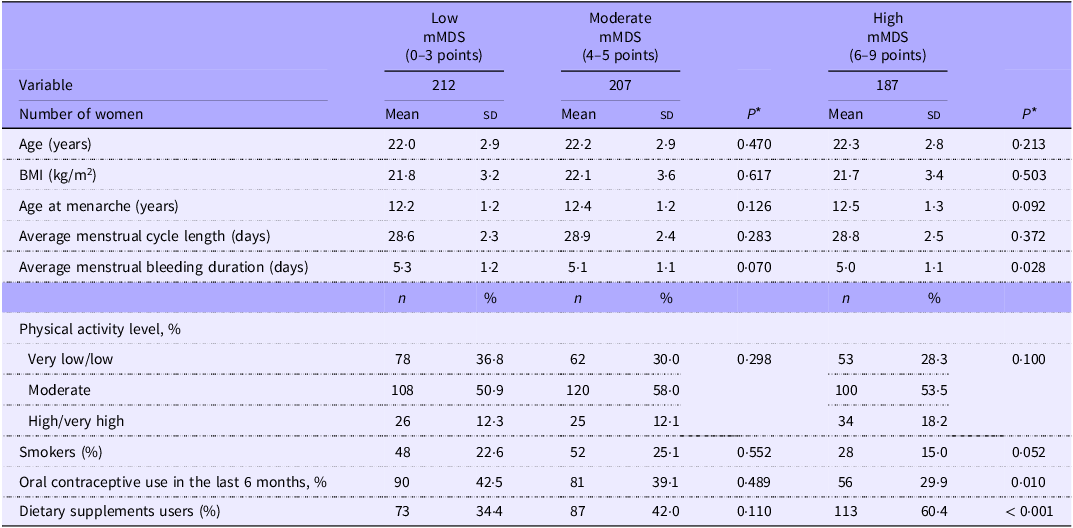
In total, 606 women with a mean age of 22·2 (sd 2·8) years were included in the study. The average mMDS was 4·3 (sd 2·1) points (range: 0–9 points). The mean mMDS score was 2·1 (sd 0·9) in the Low mMDS group, 4·5 (sd 0·5) in the Moderate mMDS group and 6·8 (sd 0·8) in the High mMDS group (Table 1). Women with low adherence to the Mediterranean-style diet (mMDS ≤ 3 points) had a significantly longer menstrual bleeding duration than those with high adherence (mMDS ≥ 6 points). Moreover, compared with the Low mMDS group, women in the High mMDS group were less likely to use oral hormonal contraception (29·9 %) and more likely to use dietary supplements (60·4 %). The most commonly used supplements were vitamin D (25·1 %), Mg (15·5 %), vitamin C (13·7 %) and vitamin B6 (10·7 %). Women in the High mMDS group were also significantly more likely to use vitamin B12, vitamin D and n-3 supplements compared with those in the Low mMDS group (online Supplementary Table S3).
Sociodemographic and lifestyle parameters stratified by the modified Mediterranean diet score (mMDS; n 606)

Table 1. Long description
The table presents sociodemographic and lifestyle parameters stratified by the modified Mediterranean diet score (mMDS) in 606 women. It includes three groups: Low mMDS (0-3 points), Moderate mMDS (4-5 points), and High mMDS (6-9 points). The table has 12 rows and 10 columns, with headers for variables such as age, body mass index (BMI), age at menarche, average menstrual cycle length, average menstrual bleeding duration, physical activity level, smokers percentage, oral contraceptive use, and dietary supplements users percentage. Each group’s mean, standard deviation, and percentage values are provided. Notable trends include longer menstrual bleeding duration in the Low mMDS group compared to the High mMDS group, and higher dietary supplement use in the High mMDS group.
* P-values for comparisons with the Low mMDS group (Mann–Whitney U test was used to compare means, and χ 2 test to compare percentage distribution).
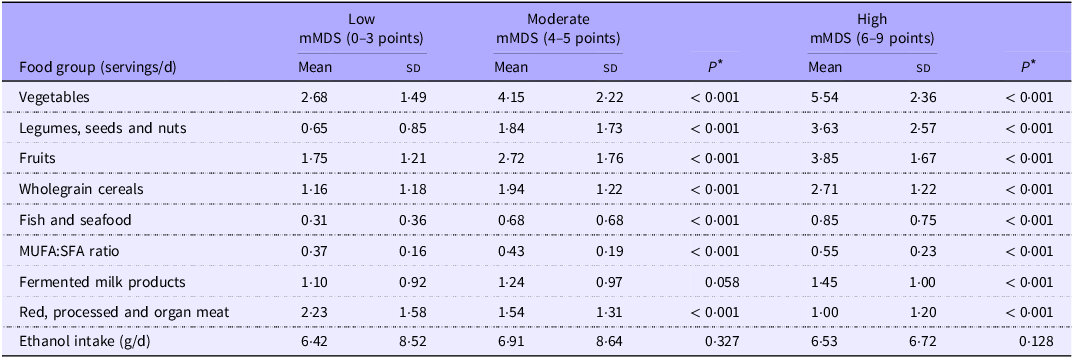
As expected, women in the High mMDS group, compared with those in Low and Moderate mMDS groups, had the highest intakes of vegetables, legumes, seeds and nuts, fruits, wholegrain cereals, fish and seafood and fermented milk products (Table 2). They also had the highest MUFA:SFA ratio and the lowest consumption of red, processed and organ meat.
Food group consumption stratified by the modified Mediterranean diet score (mMDS) (n 606)

Table 2. Long description
The table presents data on food group consumption stratified by the modified Mediterranean diet score (mMDS) among 606 women. It includes three groups: Low (0-3 points), Moderate (4-5 points), and High (6-9 points) mMDS. The table has 10 rows and 7 columns, with columns for mean and standard deviation (SD) of servings per day for each food group, and P-values indicating statistical significance. Row 1: Vegetables, Low Mean 2.68, Low SD 1.49, Moderate Mean 4.15, Moderate SD 2.22, P < 0.001, High Mean 5.54, High SD 2.36, P < 0.001. Row 2: Legumes, seeds and nuts, Low Mean 0.65, Low SD 0.85, Moderate Mean 1.84, Moderate SD 1.73, P < 0.001, High Mean 3.63, High SD 2.57, P < 0.001. Row 3: Fruits, Low Mean 1.75, Low SD 1.21, Moderate Mean 2.72, Moderate SD 1.76, P < 0.001, High Mean 3.85, High SD 1.67, P < 0.001. Row 4: Wholegrain cereals, Low Mean 1.16, Low SD 1.18, Moderate Mean 1.94, Moderate SD 1.22, P < 0.001, High Mean 2.71, High SD 1.22, P < 0.001. Row 5: Fish and seafood, Low Mean 0.31, Low SD 0.36, Moderate Mean 0.68, Moderate SD 0.68, P < 0.001, High Mean 0.85, High SD 0.75, P < 0.001. Row 6: MUFA:SFA ratio, Low Mean 0.37, Low SD 0.16, Moderate Mean 0.43, Moderate SD 0.19, P < 0.001, High Mean 0.55, High SD 0.23, P < 0.001. Row 7: Fermented milk products, Low Mean 1.10, Low SD 0.92, Moderate Mean 1.24, Moderate SD 0.97, P 0.058, High Mean 1.45, High SD 1.00, P < 0.001. Row 8: Red, processed and organ meat, Low Mean 2.23, Low SD 1.58, Moderate Mean 1.54, Moderate SD 1.31, P < 0.001, High Mean 1.00, High SD 1.20, P < 0.001. Row 9: Ethanol intake grams per day, Low Mean 6.42, Low SD 8.52, Moderate Mean 6.91, Moderate SD 8.64, P 0.327, High Mean 6.53, High SD 6.72, P 0.128.
* P-values for comparisons with the Low mMDS group (Mann–Whitney U test). All food groups (except ethanol) were energy-adjusted to the mean energy intake (2090 kcal/d) using the residual method(Reference Willett and Stampfer23).
Energy intake and energy-adjusted nutrient intakes by different Mediterranean diet adherence groups are presented in online Supplementary Table S4. Women in the High mMDS group had significantly higher intakes of protein, dietary fibre, vitamins (A, E, B1, B2, folates and C), as well as Ca and Fe, and significantly lower intake of sucrose compared with women in the Low mMDS group.
Mediterranean-Style diet adherence and premenstrual syndrome severity
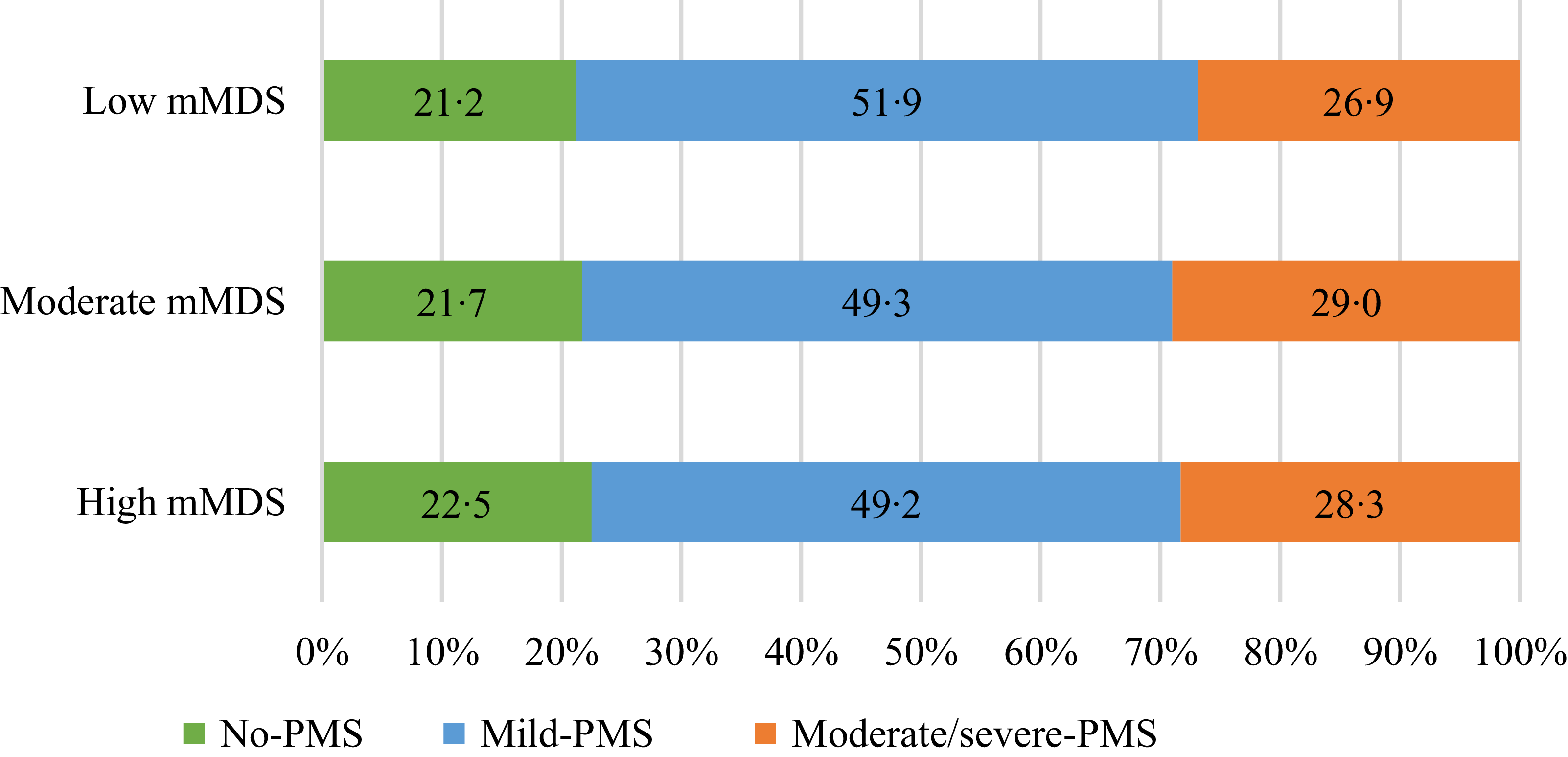
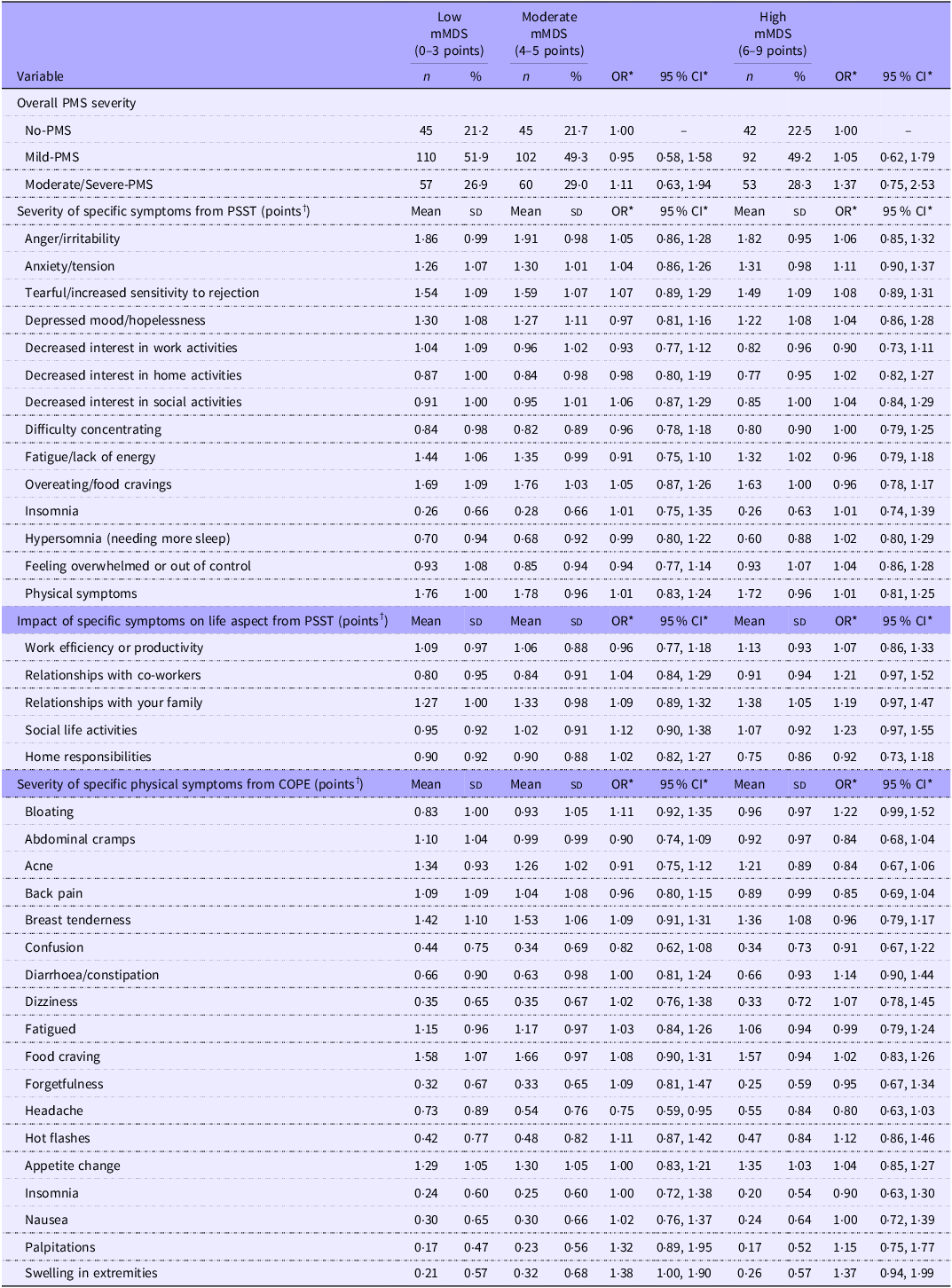
Three overall PMS severity groups were identified: No-PMS (21·8 % of women), Mild-PMS (50·2 %) and Moderate/Severe-PMS (28·0 %). The distribution of overall PMS severity groups did not differ significantly across Mediterranean-style diet adherence groups (Figure 2, Table 3). Compared with women with Low mMDS (0–3 points), those with Moderate mMDS (4–5 points) had an OR of 1·11 (95 % CI 0·63, 1·94) for Moderate/Severe-PMS. Among women with High mMDS (6–9 points), the corresponding OR was 1·37 (95 % CI 0·75, 2·53).
Distribution of premenstrual syndrome (PMS) severity groups across tertiles of Mediterranean diet adherence. No statistically significant differences were found between groups based on the χ 2 test (P = 0·980). mMDS, modified Mediterranean diet score.

Long description
The horizontal bar graph compares the distribution of premenstrual syndrome (PMS) severity groups across tertiles of Mediterranean diet adherence. The x-axis represents the percentage distribution from 0% to 100%, while the y-axis categorizes the data into three groups based on modified Mediterranean diet score (mMDS): Low mMDS, Moderate mMDS, and High mMDS. Each bar is divided into three segments representing different PMS severity levels: No-PMS in green, Mild-PMS in blue, and Moderate/severe-PMS in orange. For Low mMDS, the distribution is approximately 21.2% No-PMS, 51.9% Mild-PMS, and 26.9% Moderate/severe-PMS. For Moderate mMDS, it is approximately 21.7% No-PMS, 49.3% Mild-PMS, and 29.0% Moderate/severe-PMS. For High mMDS, it is approximately 22.5% No-PMS, 49.2% Mild-PMS, and 28.3% Moderate/severe-PMS. No statistically significant differences were found between groups based on the chi-squared test (P equals 0.980). All values are approximated.
Overall premenstrual syndrome (PMS) severity and severity of specific PMS symptoms and their impact on various aspects of life stratified by the modified Mediterranean diet score (mMDS)

Table 3. Long description
The table presents data on the distribution of overall PMS severity groups across different levels of Mediterranean-style diet adherence, measured by the modified Mediterranean diet score (mMDS). The table is divided into three columns representing Low mMDS (0-3 points), Moderate mMDS (4-5 points), and High mMDS (6-9 points). Each column includes the number of participants (n), percentage (%), odds ratio (OR), and 95% confidence interval (CI) for different PMS severity groups: No-PMS, Mild-PMS, and Moderate/Severe-PMS. The table also includes rows for the severity of specific symptoms from PSST (points), their impact on life aspects from PSST (points), and the severity of specific physical symptoms from COPE (points). Notable trends include the distribution of PMS severity groups and the corresponding OR and CI values across different diet adherence levels.
PSST, Premenstrual Symptoms Screening Tool; COPE, Calendar of Premenstrual Experiences.
*OR with 95 % CI were adjusted for: age, BMI, cigarette smoking status, self-reported physical activity level, oral contraceptive use, supplement use and total energy intake.
†The mean points for each symptom and for each life aspect ranged from 0 to 3, where 0 = no symptom, 1 = mild, 2 = moderate and 3 = severe symptom.
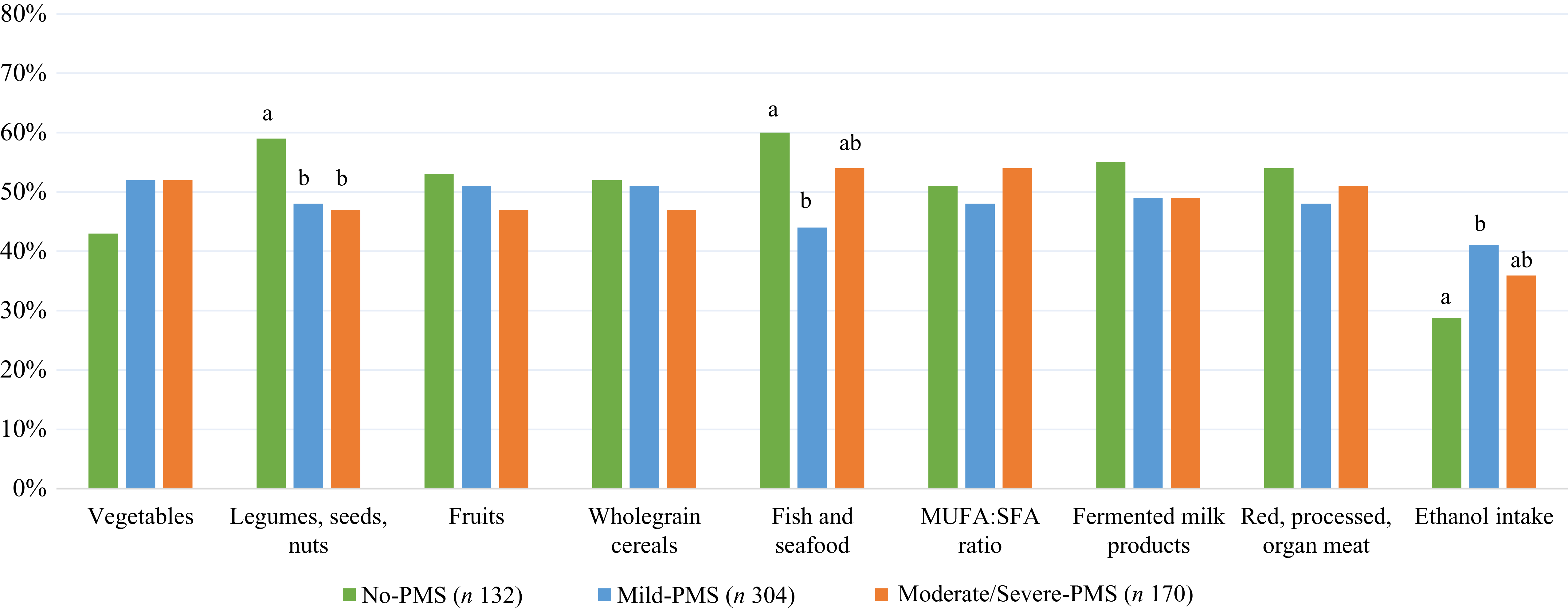
Of the nine mMDS components, only three showed statistically significant differences across PMS severity groups (Figure 3). Compared with the Mild-PMS group, a significantly higher percentage of women in the No-PMS group met the mMDS scoring thresholds for legumes, seeds and nuts (59·1 v. 48·0 %, P = 0·003) and for fish and seafood (59·9 v. 44·4 %, P = 0·003), whereas a lower proportion met the mMDS criterion for ethanol intake (28·8 v. 41·1 %, P = 0·014). Moreover, a significantly higher percentage of women in the No-PMS group than in the Moderate/Severe-PMS group met the mMDS scoring threshold for legumes, seeds and nuts (59·1 v. 46·5 %, P = 0·029).
Percentage of women meeting the modified Mediterranean diet score (mMDS) thresholds for individual food groups included in the mMDS across premenstrual syndrome (PMS) severity groups. a, b – different letters indicate statistically significant differences between PMS severity groups according to the χ 2 test (P-value ≤ 0·05).

Figure 3. Long description
The bar graph compares the percentage of women meeting modified Mediterranean diet score thresholds across different PMS severity groups. The x-axis lists food groups: Vegetables, Legumes, seeds, nuts, Fruits, Wholegrain cereals, Fish and seafood, MUFA:SFA ratio, Fermented milk products, Red, processed, organ meat, and Ethanol intake. The y-axis shows percentage values ranging from 0 to 80 percent. The graph features three data series represented by different colors: green for No-PMS, blue for Mild-PMS, and orange for Moderate/Severe-PMS. Each food group has three bars indicating the percentage of women in each PMS severity group meeting the diet score thresholds. Notable trends include higher percentages of women with No-PMS meeting the thresholds for Legumes, seeds, nuts, and Fish and seafood compared to other groups. The graph also highlights statistically significant differences between groups using letters ‘a’ and ‘b’. All values are approximated.
Of the thirty-two specific premenstrual symptoms assessed (fourteen from the PSST scale and eighteen physical symptoms from the COPE scale), only headache showed a statistically significant association, limited to the Moderate mMDS group (Table 3). An inverse association with headache was observed in the Moderate v. Low mMDS group (OR = 0·75, 95 % CI 0·59, 0·95), but not in the High v. Low mMDS group (OR = 0·80, 95 % CI 0·63, 1·03). Moreover, no statistically significant association was found between adherence to the Mediterranean-style diet and the impact of PMS symptoms on daily functioning.
Discussion
No association was observed between adherence to the Mediterranean-style diet and overall PMS severity, and no significant associations were identified for individual symptoms. Thus, the hypothesis that higher adherence to the Mediterranean diet would be associated with lower overall PMS severity and reduced individual symptom’s severity was not confirmed.
The lack of an association between adherence to the Mediterranean-style diet and overall PMS severity observed in our study is consistent with findings reported in 469 Turkish (aged 18–49 years) and(Reference Yesildemir, Arslan and Dubus16) 352 Egyptian (aged 18–26 years) women(Reference Ahmed and Mohamed Lotfy13). In contrast, a study involving 262 Korean women aged 20–49 years found that the proportion of women with PMS was significantly lower in the group with the highest adherence to the Mediterranean diet compared with the group with the lowest adherence (55·4 % v. 74·4 %, respectively, P = 0·045)(Reference Kwon, Sung and Lee15). However, it is worth noting that this study used a Korean version of the Mediterranean Diet Adherence Screener (MEDAS), which despite being validated, includes food items typical of the Korean diet (such as perilla oil) and does not apply median-based scoring, thereby differing from the traditional Mediterranean diet score(Reference Kwon, Sung and Lee15).
The relationship between individual PMS symptoms and adherence to the Mediterranean diet has yielded inconsistent findings across studies. In a recently published study of 743 university students from Spain, lower adherence to the Mediterranean diet was associated with a 50 % lower risk of physical premenstrual symptoms (OR = 0·50, 95 % CI 0·22, 0·94)(Reference Franco-Antonio, Santano-Mogena and Cordovilla-Guardia14). In contrast, our findings did not support such associations, as no significant relationships were observed for individual symptoms, except for an inverse association with headache severity in the moderate v. low adherence group (OR = 0·75, 95 % CI 0·59, 0·95); no statistically significant association was observed in the high v. low adherence group (OR = 0·80, 95 % CI 0·63, 1·03). However, direct comparison of our findings with those of previous studies is challenging because of the substantial methodological variety of the tools used to assess adherence to the Mediterranean diet. In particular, the cited studies(Reference Ahmed and Mohamed Lotfy13–Reference Yesildemir, Arslan and Dubus16) used tools that did not follow the traditional median-based scoring approach but instead relied on simplified self-reported measures (e.g. dichotomous yes/no responses or declared preferences for specific food items), which may be more susceptible to recall bias and misclassification. Therefore, these methodological differences should be considered when interpreting and comparing the results.
Our results may be partly explained by the construction of the mMDS, which primarily includes health-promoting food groups and places less emphasis on foods with potentially adverse effects, such as fast-food products, sugar-sweetened beverages and highly processed foods. Meanwhile, recently published studies indicate that ultra-processed foods may increase the severity of symptoms(Reference Bekar, Matar and Selçuk29,Reference Bodur, Ersoy-Söke and Karademir30) . This hypothesis is further supported by the findings of Kwon et al. (Reference Kwon, Sung and Lee15), who used a different Mediterranean diet adherence index that included a wider range of undesirable food items. In their study, women without PMS showed significantly higher adherence than women with PMS for three components: intake of butter, margarine and cream; sugar-sweetened beverages; and sweets and breads, suggesting that limiting potentially harmful foods may be particularly relevant for PMS.
Our hypothesis, although not confirmed by the results of this study (among the thirty-two premenstrual symptoms examined only weak suggestions for headache were observed), remains grounded in a plausible biological mechanism. Premenstrual symptoms are largely driven by the drop in oestrogen during the late luteal phase, which lowers serotonin levels and triggers the release of pro-inflammatory mediators, such as PG, thereby increasing pain sensitivity(Reference Frederiksen, Bekker-Nielsen Dunbar and Snoer31). The Mediterranean diet, rich in n-3 fatty acids derived from fish and seafood, may counteract this pathway by shifting the balance from pro-inflammatory PG and leukotrienes towards anti-inflammatory mediators such as resolvins and protectins(Reference Behrouz, Hakimi and Mir32). This is consistent with results of a randomised controlled trial demonstrating that a high n-3 diet significantly reduced headache frequency and pain in patients with migraine(Reference Ramsden, Zamora and Faurot33).
In our study, we also observed that women in the No-PMS group, compared with those in the Mild-PMS group, more frequently met the mMDS scoring thresholds for legumes, seeds and nuts, and fish and seafood, and less frequently for ethanol intake. In contrast to our findings, in Turkish women (58·6 % with PMS), wine consumption was higher in women with PMS than in those without it(Reference Yesildemir, Arslan and Dubus16). In that study, compliance was defined as consumption of at least seven glasses of wine per week, which raises the possibility that the adherence group included individuals with substantial alcohol intake. By contrast, in our study, we applied a narrower intake range of 5–25 g of ethanol, thereby reducing the likelihood of including participants with excessive alcohol consumption in the adherent group. This concern is consistent with the evidence from a meta-analysis which showed that heavy drinking was associated with a higher risk of PMS compared with any alcohol consumption (OR = 1·79, 95 % CI 1·39, 2·32)(Reference Fernández, Saulyte and Inskip34). Protective effects of nuts, seeds and legumes on the severity of PMS were demonstrated previously in other studies(Reference Granda, Szmidt and Jarmuzek-Orska8,Reference Isgin-Atici, Kanbur and Akgül35) , likely attributable to their content of phytochemicals with anti-inflammatory properties(Reference Alasalvar and Bolling36) and compounds with oestrogen receptor-binding potential, such as isoflavones(Reference Kim, Kwon and Kim37). Studies by other authors have also confirmed the beneficial effect of fish consumption in alleviating premenstrual symptoms(Reference Granda, Szmidt and Jarmuzek-Orska8,Reference Takeda, Imoto and Nagasawa38,Reference Helmy, Kamel and Gabr39) , with the probable mechanism being the anti-inflammatory effect of n-3 fatty acids(Reference Tokuyama and Nakamoto40). The lack of differences between the No-PMS and Moderate/Severe-PMS groups may be due to the fact that dietary factors play a greater role in reducing the severity of less severe PMS symptoms, whereas in more severe forms pharmacological treatment may be necessary.
Strengths and limitations
This study has several important strengths: the sample was relatively large (n 606), clearly exceeding the previously calculated minimum size (n 384). Before launching the main survey, a pilot study (n 34) was carried out to test the procedures and ensure that the questionnaires were understandable. Data were collected using validated instruments: dietary intake was assessed with the semi-quantitative FFQ-NutriForHer(Reference Szmidt, Sicinska and Januszko20), and premenstrual symptoms were measured with the PSST(Reference Steiner, Macdougall and Brown26), a widely used tool for PMS assessment that was also used to classify women into different PMS severity groups. A licensed, validated Polish translation of the PSST was employed, and PMS diagnoses were confirmed in consultation with a gynaecologist. Strict exclusion criteria were applied, as reflected in the number of women who did not qualify, which likely enhanced internal validity and reduced potential bias, and distinguishes our study from many others on this topic that used more permissive inclusion criteria. To our knowledge, this is the first study to examine the association between adherence to the Mediterranean-style diet and the impact of premenstrual symptoms on daily functioning.
Several limitations should also be acknowledged. The study sample was not representative, as recruitment was mainly conducted in academic settings, probably yielding a relatively homogeneous group of young women with higher nutrition-related awareness and health interest. Additionally, most women had a BMI within the normal range, which further limits the generalisability of the findings. The study group was also relatively homogeneous in terms of age, which may restrict generalisability, particularly given that PMS symptoms have been shown to vary across the reproductive lifespan(Reference Dennerstein, Lehert and Heinemann41). Moreover, the cross-sectional design precludes any inference of causality. Self-selection bias is also possible, since women experiencing PMS symptoms may have been more inclined to participate due to personal interest in the topic. Our study also did not capture recent diet modifications potentially adopted in response to PMS symptoms, especially among women with higher symptom severity. Additionally, adherence to the Mediterranean-style diet was assessed in a Central European population, where this dietary pattern is not predominant. Although the mMDS was modified to better reflect local dietary habits (e.g. by replacing dairy products intake with fermented milk products), some degree of misclassification of adherence cannot be excluded. Moreover, although the vast majority of women (> 95 %) were recruited before the onset of the COVID-19 pandemic in Poland (March 2020), the pandemic may still have influenced the dietary behaviours and lifestyle habits of a small proportion of participants. Finally, although the PSST is a validated instrument, it relies on retrospective reporting, whereas prospective daily symptom recording is considered the diagnostic gold standard for PMS.
Conclusions
In conclusion, no association was observed between adherence to the Mediterranean-style diet and overall PMS severity, nor with the severity of specific psychological and physical symptoms. Prospective and intervention studies are needed to clarify whether dietary patterns, including adherence to the Mediterranean diet, may play a role in PMS management in European women.
Supplementary material
For supplementary material/s referred to in this article, please visit https://doi.org/10.1017/S000711452610765X
Acknowledgements
The authors would like to offer their gratitude to all the women who kindly participated in this study.
This research was funded by the Polish Ministry of Science and Higher Education with funds from the Institute of Human Nutrition Sciences, Warsaw University of Life Sciences (WULS), for scientific research.
The authors’ contributions are as follows: D.G.: Conceptualisation, Methodology, Data curation, Formal analysis, Investigation, Project administration, Visualisation and Writing – original draft. M.K.S.: Methodology, Investigation, Visualisation and Review and editing. J.K.: Conceptualisation, Methodology, Supervision, Visualisation and Writing – review and editing. All authors listed approved the content of the submitted manuscript.
The authors declare that there are no conflicts of interest.
This study was conducted according to the guidelines laid down in the Declaration of Helsinki, and all procedures involving human patients were approved by the Ethics Committee for Research Involving Humans at the Faculty of Human Nutrition and Consumer Sciences, Warsaw University of Life Sciences (approval no. 9_2019, issued on 22.01.2019). Written informed consent was obtained from all patients.
The datasets generated for this study are available on request to the corresponding author.