


Over the past decade, women have made considerable progress in reaching national-level political office. Female presidents, prime ministers, and cabinet members now set policy in some of the world's most influential countries (e.g., Germany) and fastest growing economies (e.g., Brazil). In Latin America in particular, where women have long been subjected to gender-based marginalization from political and economic power, there have been dramatic increases in the number of women contesting and winning the presidency. In addition, the share of female cabinet ministers in the region has increased from 7% in 1990 to 18% by the mid-2000s (Escobar-Lemmon and Taylor-Robinson Reference Escobar-Lemmon and Taylor-Robinson2005). Growing literatures on women in leadership, women's movements, and women's rights have explored these trends, often demonstrating how gender attitudes in the mass public shape important outcomes such as women's mobilization and representation (Erickson and O'Neill Reference Erickson and O'Neill2002; Klein Reference Klein1984; Paxton Reference Paxton1997).
Yet fewer attempts have been made to understand the factors that facilitate or undermine public support for women in politics, particularly outside the developed world. Thus, we cannot be certain if the observed shift toward greater descriptive representation for women is rooted in widespread, deeply held support for female political leadership or if it is based on temporary contextual features or frustrations with the historically male-dominated status quo, which have facilitated significant but perhaps only ephemeral advances for female politicians. Different lines of theorizing suggest competing predictions regarding the extent to which gender egalitarian progress is likely to continue or succumb to reversals. Socialization arguments contend that, as women gain opportunities and influence, social structures are transformed in ways that foster support for equality, making women's gains self-reinforcing (Inglehart and Norris Reference Inglehart and Norris2003; Phillips Reference Phillips1995). In contrast, approaches emphasizing status discontent suggest that female advancement may provoke a backlash from those who see women's progress as a threat, thus undermining the steady movement toward egalitarianism (Banaszak and Plutzer Reference Banaszak and Plutzer1993b). Alternatively, elite cue theory suggests that progress for women may be contingent, because it depends on the transmission of pro- or anti-egalitarian messages by opinion leaders (Beaman et al. Reference Beaman, Chattopadhyay, Duflo, Pande and Topalova2009; Hansen Reference Hansen1997). In this article we test the explanatory power of these arguments regarding the way in which context influences the formation and persistence of gender egalitarian attitudes, while also exploring a series of individual-level effects. In considering contextual and individual influences together, we develop a thorough account of the factors shaping attitudes about women in politics.
Most of what we know about the foundations of public support for female leadership is based on studies of developed democracies, where women's economic and political advances are more consolidated and thus less susceptible to reversions back to traditional gendered hierarchies (Klein Reference Klein1984; Norris Reference Norris1987). However, understanding the sources of mass attitudes about women's involvement in politics is especially important in contexts where the gains made by women are likely to be more tenuous and public support for female leadership could play a pivotal role in shoring up or undermining gender equity in the public realm. In this article, we analyze mass support for female political leadership in Latin America and the Caribbean in order to explore how gender values form and to assess the extent to which recent advances in descriptive representation for women across the region have a foundation in firm or contingent attitudes regarding female leadership.
Analyzing Latin American support for women in politics not only permits important empirical insights but also offers significant theoretical leverage in understanding gender attitude formation more generally. Until now, our limited knowledge of gender attitudes outside advanced democracies has been largely based on single-country studies, which necessarily privilege individual-level explanations and hamper the empirical assessment of arguments about contextual effects (Arana and Santacruz Giralt Reference Arana and Santacruz Giralt2005; Morgan, Espinal, and Hartlyn Reference Morgan, Espinal and Hartlyn2008). In fact, most research on gender norms, whether in new or established democracies, does not theorize about or test how the economic, social, or political environment shapes gender attitudes (but see Banaszak and Plutzer Reference Banaszak and Plutzer1993b; Inglehart and Norris Reference Inglehart and Norris2003). If we are to understand public support for women in politics—particularly if we wish to assess whether recent trends toward increased descriptive representation have a stable or fleeting basis in mass attitudes—we must consider not only the influence of individual-level experiences but also the potential impact of contextual variables. Moreover, previous research analyzing developed countries has suggested that, even within that relatively homogeneous set, gender attitudes across countries cannot be explained by individual-level factors alone—context matters (Banaszak and Plutzer Reference Banaszak and Plutzer1993a; Fuwa Reference Fuwa2004; Iversen and Rosenbluth Reference Iversen and Rosenbluth2010).
Analysis of Latin America offers a unique opportunity to assess contextual theories of gender attitude formation. Advanced democracies manifest relatively little variation on key country-level factors that are expected to shape gender attitudes, such as female empowerment and development. In contrast, these variables span wide ranges in Latin America and the Caribbean, providing significant analytical leverage over contextual theories of gender attitude formation, which would be hard to parse out elsewhere. Analyzing gender norms in Latin America also creates openings for theoretical insights at the individual level. Existing scholarship on advanced democracies has emphasized the significance of socialization experiences and ideology in understanding gender attitudes; by testing these individual-level explanations outside the realm where they were originally developed, we assess their portability.
Exploring gender attitudes in Latin America also provides an opportunity to illuminate an often obscured and undervalued facet of democratization. Although extensive research has examined public attitudes about a variety of democratic norms and institutions in developing democracies (Booth and Seligson Reference Booth and Seligson2009; Finkel and Smith Reference Finkel and Smith2011; Morgan Reference Morgan2007), gender egalitarianism has received little attention, despite being a value pivotal to substantively meaningful democracy. Although women constitute half the world's population, and excluding women from full citizenship rights and denying them influence in the halls of power raise serious concerns about the nature or even the existence of democracy (Baldez Reference Baldez2010; McDonagh Reference McDonagh2002), analyses of democracy often neglect gender egalitarianism. Here we take steps to better understand this important democratic value.
In doing so, we make three major contributions. First, by examining the factors that shape attitudes toward female political leadership, we increase our understanding of recent trends toward greater descriptive representation for women across Latin America and offer some insight into the durability of these processes. Second, because Latin American and Caribbean countries exhibit considerable variation on the contextual factors that we expect to influence gender attitudes, we gain significant leverage in assessing how the political and economic environment promotes or impedes gender egalitarianism. This aspect of the analysis enables the development of important new theoretical insights about the role of context in gender norm development and produces policy-relevant suggestions concerning egalitarian attitude formation. Finally, we assess how individual socialization experiences, which have been the main focus of previous research, shape gender norms in a region where these arguments have been scarcely tested.
In the next two sections of the article, we outline our theoretical expectations concerning the contextual and individual factors that may shape support for women in politics. Next, we describe the variation in gender values observed across countries and sexes in Latin America and detail our strategy for explaining this variation. The subsequent section presents results from hierarchical ordered logit models analyzing support for women as political leaders. We conclude by discussing the theoretical implications and policy lessons suggested by our findings.
CONTEXTUALIZING ATTITUDES ABOUT WOMEN IN POLITICS
This article develops a theory of attitudes regarding women in politics, integrating explanations at both the contextual and individual levels. A growing literature has demonstrated the significance of context for explaining gender gaps in political engagement and efficacy (Atkeson Reference Atkeson2003; Desposato and Norrander Reference Desposato and Norrander2009; Hansen Reference Hansen1997; Schwindt-Bayer and Mishler Reference Schwindt-Bayer and Mishler2005), and previous research hints at the idea that the political, economic, and cultural environment has important effects on gender attitudes by establishing that cross-national differences in these attitudes cannot be explained by individual-level factors alone (Banaszak and Plutzer Reference Banaszak and Plutzer1993a). But apart from a few notable exceptions (e.g., Banaszak and Plutzer Reference Banaszak and Plutzer1993b; Inglehart and Norris Reference Inglehart and Norris2003; Moore and Vanneman Reference Moore and Vanneman2003), little research has explored how context shapes gender values, and virtually no studies have theorized about contextual effects on feminist attitudes in developing democracies. Here we take on the important task of theorizing and testing how context influences support for women in politics.
We are particularly interested in understanding the extent to which recent progress for female politicians is self-reinforcing—fostering increased support for gender equality—as opposed to being fleeting, idiosyncratic, or even counterproductive. As women move out of traditional roles and become more visible and influential in the public sphere, gender norms are likely to shift in response. When women occupy prominent economic or political positions, people are confronted more frequently and more overtly with a reality in which women have access to power, and mass attitudes about female participation in public life are likely to be shaped by this reality. But what is the nature of people's reaction to female empowerment? Different theoretical frameworks offer divergent predictions.
Status discontent theory would expect women's empowerment to undermine support for gender equity (Gusfield Reference Gusfield1963; Hofstadter Reference Hofstadter and Bell1963). As women make gains, those who face the loss of status as a result, namely men, may react against this changing context and retrench to embrace more traditional gender norms (Banaszak and Plutzer Reference Banaszak and Plutzer1993b; Franceschet, Krook, and Piscopo Reference Franceschet, Krook and Piscopo2012). From this perspective, female advancement poses a threat, particularly for men who see empowered women as competitors for jobs, status, and influence. As women begin to thrive, men become jealous and increasingly defend traditional gender norms in order to limit the challenges they face from prosperous or powerful women. If the status discontent rationale is correct, female empowerment will be associated with less male support for gender equality. Moreover, status discontent may be particularly pronounced among those men being left behind as women move ahead (Banaszak and Plutzer Reference Banaszak and Plutzer1993b). If frustration with female advancement has this sort of disproportionate effect, we would expect men who do not have high-status positions to hold particularly reactionary gender attitudes as women make gains, arguably at their expense.
In contrast, socialization theory suggests that female advancement is not perceived as a threat by men, but instead women's progress transforms traditional values into more egalitarian ones. This approach sees female empowerment as dispelling “myths about women's inabilities to participate” (Banaszak and Plutzer Reference Banaszak and Plutzer1993b, 149), giving women new economic and political resources, and leading to the recognition and rejection of discrimination and inequality in society. Female role models who are thriving in their professions expose people to the idea of women as leaders and provide positive evidence concerning the impact of female involvement (Beaman et al. Reference Beaman, Chattopadhyay, Duflo, Pande and Topalova2009). This verification of women's success replaces the unsubstantiated hearsay that often undermines women's credibility. Advances for women, particularly in visible positions, have the potential to reshape economic, political, and family structures in ways that promote egalitarianism (Alexander Reference Alexander2012; Klein Reference Klein1984; Mansbridge Reference Mansbridge1999; Norris Reference Norris1987; Phillips Reference Phillips1995). If, as socialization theory might predict, women's progress fosters societal acceptance of female equality, we should observe positive relationships between our country-level measures of women's empowerment and support for female politicians among women and men. Socialization theory also suggests individual-level effects in which egalitarian attitudes are more likely to be found among people who personally experience life events that have feminist consciousness-raising potential, such as educational or employment opportunities. Thus, whereas society-wide socialization processes, such as the level of female participation in paid work, might be expected to shape the overall degree of egalitarianism in a country, personal socialization experiences may explain individual variation in gender values. We discuss and test the individual-level manifestations of socialization theory in more detail later.
A complementary theoretical perspective to the socialization approach concerns the role of elite cues in shaping gender attitudes. While socialization theory emphasizes how gender norms are influenced by general societal trends, such as the presence and influence of women in the workplace (Banaszak and Plutzer Reference Banaszak and Plutzer1993b; Phillips Reference Phillips1995), research on elite behavior suggests that opinion leaders such as politicians may act as socializing agents who promote or undermine mass support for gender equality through their conduct while in the public eye (Escobar-Lemmon and Taylor-Robinson Reference Escobar-Lemmon and Taylor-Robinson2009, 696; Kittilson Reference Kittilson2010; Morgan, Espinal, and Hartlyn Reference Morgan, Espinal and Hartlyn2008). Politicians are constantly sending messages through their actions, such as nominating people to fill key positions, proposing and passing legislation, and implementing policy (Zaller Reference Zaller1992), and a large and expanding body of scholarship on an array of issues strongly supports the claim that elite cues influence mass attitudes, particularly when people have less information or investment in issues (e.g., Arceneaux Reference Arceneaux2008; Kam Reference Kam2005; Merolla, Stephenson, and Zechmeister Reference Merolla, Stephenson and Zechmeister2007). Following this line of theorizing, studies of gender and politics have also found evidence that the messages elite behaviors communicate about women and their role in the political realm are likely to shape mass opinion, with (in)egalitarianism fostering (anti)feminist attitudes (Atkeson Reference Atkeson2003; Hansen Reference Hansen1997; Morgan, Espinal, and Hartlyn Reference Morgan, Espinal and Hartlyn2008; Sapiro and Conover Reference Sapiro and Conover1997).
Moreover, women and men may respond differently to elite cues about gender egalitarianism. Scholarship on the relative impact of elite cues has demonstrated that those who already hold firm beliefs on an issue are less likely to be influenced by such cues, whereas those with weak prior views are much more susceptible to the messages communicated via elite behavior (Bullock Reference Bullock2011, 510; Levendusky Reference Levendusky2010). On gender issues, women's opinions are likely to be deeply internalized and firmly held because these issues affect them more directly than men and the views women form have a basis in their own experiences (Klein Reference Klein1984). In contrast, men's positions on gender issues are less personal and as a result are likely to be weakly held and malleable. Thus, male attitudes about the suitability of female leaders are more prone to fluctuation based on pro- or anti-egalitarian cues from elites, whereas women's views are likely to persist regardless of elite behavior. This logic aligns with a small body of existing evidence, which has found male views of gender equality to be more susceptible to elite cues than female attitudes (Beaman et al. Reference Beaman, Chattopadhyay, Duflo, Pande and Topalova2009; Morgan, Espinal, and Hartlyn Reference Morgan, Espinal and Hartlyn2008). Gender egalitarian (anti-egalitarian) actions by opinion leaders may strengthen (weaken) men's commitment to female equality, but would not be expected to have the same effect among women, who are likely to have stronger prior attitudes. Thus if elite cues matter, we expect to observe the influence primarily among males.
Each of these theories concerning the effect of context on gender attitude formation suggests different conclusions about the durability of recent advances for women in Latin America. If status discontent is the primary response to women's advancement, current gains for female politicians may be only temporary as men react negatively to women's success. In contrast, socialization theory suggests that progress for women promises to spur a virtuous cycle in which female empowerment fosters more gender egalitarian attitudes among both sexes, which in turn yield greater opportunities for women's advancement, and so forth. Alternatively, if elite cues are a significant factor in shaping (male) attitudes toward female leadership, the ability of women to hold on to recent gains will be contingent on political leaders’ actions that enhance or undermine egalitarianism.
To assess the explanatory power of these three theoretical perspectives, we included five contextual variablesFootnote 1 in our analysis of Latin American support for women as political leaders: female labor force participation, the proportion of professional workers who are women, the share of national legislative seats held by women, the share of cabinet ministries led by women, and the left-right ideological position of the country's president or prime minister.Footnote 2 Female labor force participation and the proportion of professional jobs filled by women reflect social conditions relating to women's economic empowerment, with the latter measure directly capturing female status. Contextual expressions of socialization theory would expect both these indicators of female opportunity to be positively associated with gender egalitarian attitudes across the entire population. Alternatively, the status discontent approach predicts these variables will have an inverse relationship with the gender egalitarianism of male respondents. Under this view, when women threaten male opportunities for advancement, men are especially likely to react negatively. The women professionals variable, which provides a clear indicator of high female status in the economic realm, is particularly important in testing the status discontent hypothesis. Additionally, to assess whether status discontent disproportionately affects men who are being left behind as women advance, the analysis incorporates an interaction between the share of female professionals and the professional status of male respondents. If this nuance of status discontent theory is correct, then men without professional status themselves are especially likely to respond to women's professional progress with anti-egalitarian sentiment. Elite cues theory generates no predictions for the two female employment variables because those variables capture only general societal conditions, not elite behavior. Thus, the effects found for these measures serve to adjudicate between the status discontent and socialization hypotheses.
The share of legislative seats held by women is another prominent measure of female empowerment in the existing literature. The variable incorporates both social conditions reflecting opportunities for women and elements of elite behavior pertaining to the recruitment and nomination of female candidates. Because the measure reflects female political opportunities, the status discontent hypothesis anticipates a negative relationship between this variable and support for women in politics, particularly among male respondents. Alternatively, because the measure captures elements of general social conditions as well as elite cues about female leadership, both socialization and elite cues arguments predict a positive effect on egalitarianism for this measure. Thus, a positive coefficient for this item would contradict status discontent theory, but would not necessarily allow us to distinguish between socialization and elite cues as the precise causal mechanism producing the observed effect (unless the effect is seen only among men, which would align more with the elite cues perspective).
Our variables measuring women in the cabinet and left leadership allowed us to assess more directly the explanatory power of the elite cues argument. Selecting women as cabinet ministers sends a clear signal that power brokers and opinion leaders consider women to be suitable for national-level leadership. Cabinet ministers frequently attract notice from the media and the mass public, and appointment of women to these positions is likely to draw attention, providing an opportunity for elites to foster acceptance of female leadership. Thus, “as women become more visible in presidential cabinets. . . it is possible that presidents’ appointments will change gender roles in Latin America” (Escobar-Lemmon and Taylor-Robinson Reference Escobar-Lemmon and Taylor-Robinson2009, 696). Moreover, cabinet nominations occur outside the election process, thereby removing direct public influence from the decision and making the selection of women an identifiable elite behavior. Additionally, because the left has traditionally had ties to the feminist movement in Latin America, we expect presidents or prime ministers with left-leaning ideological orientations to transmit more gender egalitarian messages on average than those at the center or on the right (Ewig Reference Ewig1999; Jelin Reference Jelin1990). For both women in cabinet and left leadership, elite cues theory anticipates a positive effect on support for women in politics, particularly among men.Footnote 3
The analysis also incorporated a measure of economic development as an indicator of the general socialization context, beyond the socialization that could be produced by female advancement specifically. Previous research suggests that more developed countries feature environments more supportive of feminist values (Inglehart and Norris Reference Inglehart and Norris2003; Iversen and Rosenbluth Reference Iversen and Rosenbluth2006). Based on the logic that modernization has the potential to generate tangible opportunities for women and to restructure society in more egalitarian ways, we hypothesize that more economically developed countries manifest higher levels of support for female politicians. In essence, this measure captures socialization patterns outside the specific effects potentially produced by women's advancement, as hypothesized earlier. We use the UNDP's GDP per capita index adjusted for purchasing power parity to test for this effect.Footnote 4
INDIVIDUAL-LEVEL FACTORS AND SUPPORT FOR WOMEN IN POLITICS
We also theorize about how individual-level factors influence Latin American gender attitudes. Some factors, such as those pertaining to personal socialization experiences, are derived from a rich body of supportive evidence. Others have been directly or indirectly suggested by gender scholars, but have been subject to only scant empirical testing. We begin by specifying our expectations about the effects of dissatisfaction with the status quo and the role of democratic values, which are comparatively novel theoretical contributions and which may be particularly relevant in developing democracies such as those in Latin America. We then discuss hypotheses based on the more common explanations of ideology and individual socialization.
Women in Latin America (and elsewhere) have long been denied access to established spheres of political influence. As a result, they are likely to be perceived as disconnected from male-dominated power struggles. Even those women who have entered politics have largely done so as outsiders through activities such as social movement leadership or affiliation with new parties (del Campo Reference del Campo2005; Fernandes Reference Fernandes2007; Jaquette Reference Jaquette1994; Rodriguez Reference Rodriguez2003). Although female politicians typically possess the necessary credentials for public service, even surpassing men in this regard, they often lack insider ties to political parties and the established political class (Escobar-Lemmon and Taylor-Robinson Reference Escobar-Lemmon and Taylor-Robinson2009, 693–95). Given women's historical exclusion, people frustrated with traditional elites and institutions may view female politicians positively, just as they might opt for indigenous candidates or charismatic leaders operating outside established parties (Barr Reference Barr2009; Morgan Reference Morgan2011). Also, women are often perceived as more trustworthy and immune to the machinations of traditional old-boys networks (Bouvier Reference Bouvier and Goetz2009; Buvinic and Rosa Reference Buvinic and Rosa2004; Swamy et al. Reference Swamy, Knack, Lee and Azfar2001). Outsiders, such as women, offer the hope that new leadership might reform unresponsive, ineffective, or corrupt political institutions and processes. Thus, dissatisfaction with the system may foster support for female politicians as an alternative to the status quo. Specifically, we hypothesize that lack of trust in existing government institutions may prompt people to look for ways to reform or transform these structures, putting them in search of alternatives to entrenched (male) elites who are viewed as culpable for the current state of affairs.
To test this argument, we included trust in government as an individual-level independent variable.Footnote 5 In general, we expect less trusting respondents to be more supportive of female leadership. But in contexts where women already have sizable political influence and are thus viewed as part of the status quo, female politicians may not have particular appeal among those looking for an opportunity to overturn entrenched power structures. In such contexts, distrustful respondents may be no more inclined to support women than their trusting neighbors. To test this argument, we interacted trust with a fundamental measure of women's political influence—presence in the cabinet. If we are correct that people who are dissatisfied with the system support female politicians because they represent an alternative to the status quo, then the negative relationship between trust and gender egalitarianism may diminish as women gain more political power. So although we expect the main effect of trust to be negative, we hypothesize that the interaction between trust and women in the cabinet will be positive, potentially offsetting the main effect in countries where women have attained significant political influence. The Latin American context provides particularly strong leverage in testing this claim because of regional variation in women's executive-level representation.
We also considered the extent to which gender egalitarianism is tied to democratic values. Even in democracies where everyone should be treated equally, women continue to be excluded from politics and are often regarded as inferior to men. Ideally, those who espouse general democratic values, such as treating outsiders with tolerance or affirming the rules of the game, will also apply these values to more specific rights, such as equality for traditionally marginalized groups like women (Inglehart and Norris Reference Inglehart and Norris2003). Previous research on democratic values and attitudes toward immigrants suggests this is a plausible expectation (Orcés Reference Orcés2009). We hypothesize that people who support democracy and its norms will likewise favor equal political participation for women. Newer democracies, such as those in Latin America, pose an especially strenuous test for this argument because where democracy is emerging, webs of values may have not yet emerged, and general positive sentiment concerning democracy may not be reflected in specific values. To assess whether gender egalitarianism is shaped by democratic norms, we included two measures of democratic attitudes. The first taps diffuse support for democracy by asking respondents if they agree that democracy is better than any other form of government. The second measure assesses tolerance for homosexuals, a frequent target of discrimination in Latin America. We expect these values to be positively associated with gender egalitarianism.
Moving now to more common explanations of gender norms, we expect ideology and partisan affiliation to shape attitudes about women in politics. Left-leaning parties typically maintain ties to women's movements and advocate egalitarianism, and left ideology tends to align with feminist claims (Banaszak and Plutzer Reference Banaszak and Plutzer1993a). Although the left has not facilitated as much concrete progress on women's issues as feminists might wish, it is likely that people affiliated with the left will be more supportive of gender egalitarianism. A large body of research has found evidence for this connection in Europe and the United States (Burns, Schlozman, and Verba Reference Burns, Schlozman and Verba2001; Sanbonmatsu Reference Sanbonmatsu2003). We expect a similar pattern to hold in Latin America where left parties have been “the most forceful advocates of gender equality” (Htun Reference Htun, Domínguez and Shifter2003, 128). The Latin American left has aligned with women's movements, led the way in adopting gender quotas, facilitated women's advancement to political office, and advocated for feminist policies (Escobar-Lemmon and Taylor-Robinson Reference Escobar-Lemmon and Taylor-Robinson2005; Rodriguez Reference Rodriguez2003; Sacchet Reference Sacchet and Goetz2009). Thus, people with left ideologies and partisan sympathies are more likely to view women as competent leaders.
We included two independent variables to examine these hypotheses: left ideology and left party support. Left ideology captures diffuse attitudes associated with feminism, whereas left partisanship reflects direct experience in political activism, which may generate gender egalitarian attitudes.Footnote 6 Previous research suggests that feminism among men is especially likely to stem from abstract ideological commitments (Klein Reference Klein1984; Reingold and Foust Reference Reingold and Foust1998), whereas women's participation in left parties often serves as a consciousness-raising experience that heightens their gender egalitarian attitudes (Beckwith Reference Beckwith2000; Sternbach et al. Reference Sternbach, Navarro-Aranguren, Chuchryk and Alvarez1992). Thus, the ideology variable may be particularly important among men, while partisanship may matter more for women.
Finally, we considered a series of individual socialization effects related to life experiences and personal backgrounds, which have been the main focus of much of the previous theorizing about gender attitudes. Based on this scholarship, we expect education, wealth, and employment to have liberalizing effects, increasing support for women in politics (Arana and Santacruz Giralt Reference Arana and Santacruz Giralt2005; Klein Reference Klein1984). In contrast, we theorize that marriage and parenthood will reduce gender egalitarianism (Hayes, McAllister, and Studlar Reference Hayes, McAllister and Studlar2000; Liao and Cai 1995; Plutzer Reference Plutzer1991). Older and more religious respondents are less likely to support women in politics (Burns, Schlozman, and Verba Reference Burns, Schlozman and Verba2001; Inglehart and Norris Reference Inglehart and Norris2003; Plutzer Reference Plutzer1991). We also accounted for the potential influence of racial/ethnic identity. Although existing literature is somewhat ambiguous as to the expected effect of this variable (Sanbonmatsu Reference Sanbonmatsu2003), several studies seem to suggest that nonwhite women may be more supportive of egalitarian views as a result of being subjected to discrimination on two dimensions (race/ethnicity and gender), whereas whites may be less open to outsiders’ claims for power (Kane Reference Kane2000; Richards Reference Richards2005). To assess the effects of these socialization experiences, we included a series of variables: education, wealth, employment, marital status, parenthood, religiosity, race, and age. Moreover, we expect high occupational status to increase egalitarianism among women who have experienced this consciousness-raising opportunity together with other women (Banaszak and Plutzer Reference Banaszak and Plutzer1993b; Klein Reference Klein1984). To test for this relationship, we interacted women's professional status with the country's overall level of female professionals.
Ideally, the analysis would also include socialization measures that captured the kinds of male experiences most likely to promote gender egalitarian attitudes, such as the education or employment of their mothers or female partners (Bolzendahl and Myers Reference Bolzendahl and Myers2004; Plutzer Reference Plutzer1991). Unfortunately, these kinds of questions are not available in the survey instrument used here. The socialization measures at our disposal more effectively gauge women's exposure to potential consciousness-raising opportunities through their own education, employment, and so forth. Thus, the socialization variables in the analysis here may carry greater weight among women than men.
DATA AND METHODS
To assess how these contextual and individual factors influence attitudes toward women in politics, we used multilevel modeling techniques to analyze data from the 2008 AmericasBarometer for 19 Latin American and Caribbean countries.Footnote 7 We compiled data for the contextual variables from various sources.Footnote 8 In this section we trace the contours of support for women in politics and detail our approach to analyzing this indicator of gender attitudes.
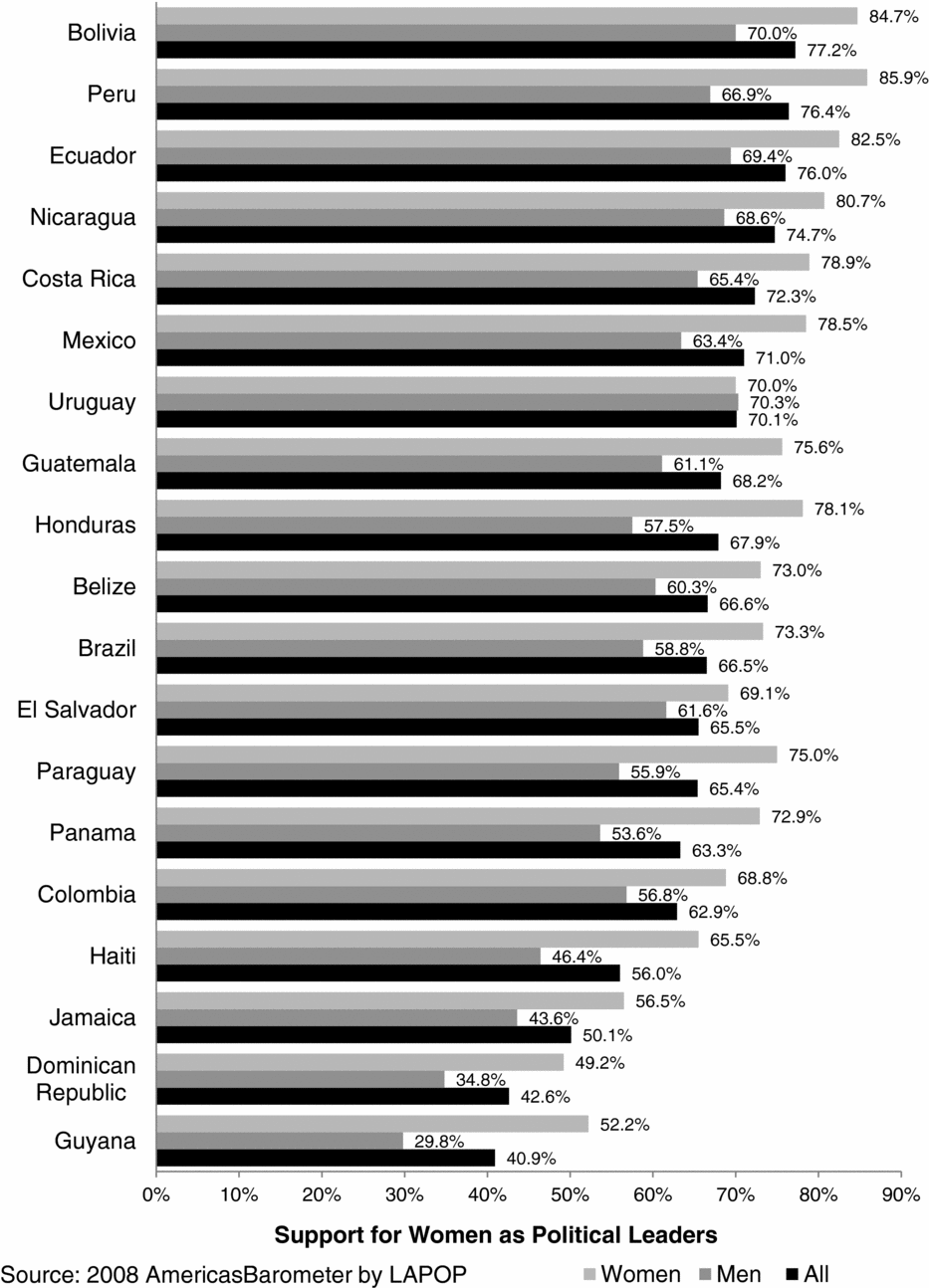
To measure views about women in politics, we used a survey item that asked respondents if men make better political leaders than women.Footnote 9Figure 1 depicts for each country the percentage of all respondents, as well as the shares of women and men, who disagreed or strongly disagreed that male political leaders are superior to female leaders. There is considerable regional variation in this measure. The Andean countries of Bolivia, Peru, and Ecuador have the highest levels of support for female politicians, with more than three-quarters of their populations holding egalitarian views. At the other end of the spectrum, the Caribbean basin countries of Jamaica, the Dominican Republic, and Guyana have much lower levels of gender egalitarianism, with 50% or fewer respondents viewing women as having political leadership capacities commensurate with those of men. This cross-national variation suggests that support for women in politics is not just an individual-level phenomenon, but that country-level factors may also be important.
Support for Women in Politics, by Country and Sex
Note: Figure depicts percentage who disagreed or strongly disagreed that men make better political leaders than women.

Moreover, analysis of the variance in this item demonstrates that there are significant differences across countries and individuals. The intra-class correlation coefficient (ICC) allowed us to assess how the overall variance in support for female politicians is divided between individual and national levels.Footnote 10 The ICC indicates that among females 5.74% of the variance in attitudes toward women in politics occurs across countries, compared to 5.71% among males. This country-level variation may not seem particularly large, but is nevertheless substantively significant and comparable to that in other analyses in which individual attitudes were the dependent variables (Fuwa Reference Fuwa2004; Kelleher and Lowery Reference Kelleher and Lowery2009; Steenbergen and Jones Reference Steenbergen and Jones2002). For both men and women, the individual- and country-level variance components are statistically significant, suggesting that both contextual and individual explanations have the potential to contribute to our understanding of support for female leadership in Latin America.
The ICC values demonstrate the statistical and substantive importance of explicitly modeling the variance at both the individual and country levels (Steenbergen and Jones Reference Steenbergen and Jones2002). To assess how factors at each level shape support for women as political leaders, we used multilevel analysis. This approach is the most suitable method for two reasons: It accounts for clustering in the error term, which is common when individuals from different countries are lumped together in one analysis, and it addresses heteroskedasticity, thereby removing the threat of biased standard errors, which are produced by modeling strategies that do not deal with the problem of nonconstant variance across countries (Kelleher and Lowery Reference Kelleher and Lowery2009; Raudenbush and Bryk Reference Raudenbush and Bryk2002; Steenbergen and Jones Reference Steenbergen and Jones2002). Multilevel modeling also has the substantive advantage of allowing us to explore individual and contextual effects as well as cross-level interactions. To our knowledge, this article represents the first effort to use this modeling strategy to properly test theories concerning the formation of gender attitudes in the developing world.
Returning our attention to Figure 1, we also observe significant differences in the patterns of gender attitudes among female and male respondents. In fact, variance decomposition analysis indicated that about 6% of the variance in the dependent variable can be attributed to the sex of the respondent. Women hold more feminist views than men in every country except Uruguay where there is no significant gender difference. In some places, such as Guyana, Honduras, and Panama, the gap is extremely wide, with females averaging about 20 points higher than males in support for women in politics. Elsewhere, as in El Salvador, Colombia, and Nicaragua, the differences are smaller. Thus, the countries’ rank orderings change substantially if we consider female versus male respondents. Uruguay has the highest percentage of men who support female political leadership, but in terms of support among women, Uruguay ranks 13th of 19 countries. Peru places first in support among women, but only fifth among men. These patterns raise the possibility, also suggested in the earlier theoretical discussion, that country-level explanations of male egalitarianism may be distinct from those that elucidate female attitudes.
For theoretical and empirical reasons, then, we conducted our analysis separately for women and men. We have theorized about possible ways in which feminist attitude formation may vary based on a respondent's sex. Men are likely to be more vulnerable to elite cues than women, whose prior beliefs on gender issues are probably held more strongly than those of men. Likewise, female advancement may produce status discontent and undermine egalitarianism among men, but is less likely to have this negative impact on women. Alternatively, given the sorts of individual-level socialization variables available in the data, women's attitudes may be shaped more by their direct personal experiences with education or employment than those of men, who are more likely to be influenced indirectly via their wives and mothers. We have also suggested that abstract ideological commitments may have a more powerful effect among men, whereas direct involvement with party politics may serve as a stronger consciousness-raising experience for women. Together these expectations offer a theoretical rationale for considering different causal patterns among women and men. Conducting separate analyses, rather than including a series of interaction terms by sex, also facilitates analysis and interpretation.Footnote 11
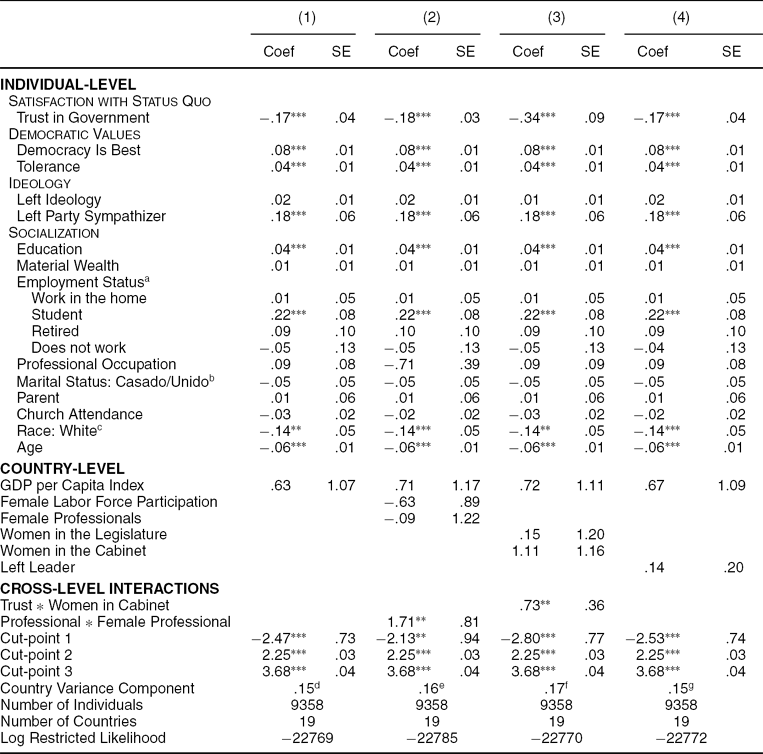
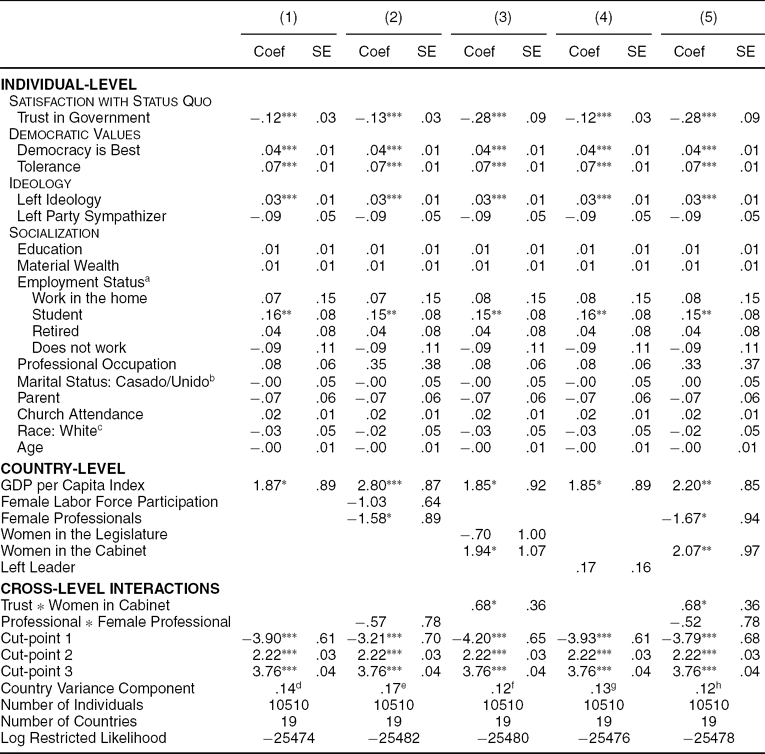
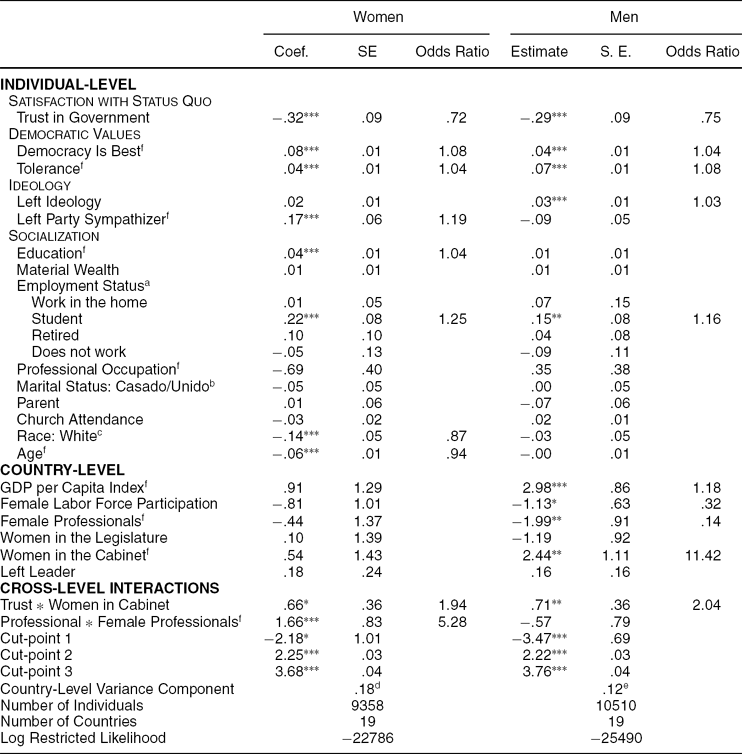
In analyzing female and male attitudes toward women in political leadership, we used multilevel ordered logit models because the dependent variable has four ordered categories. Additionally, the analysis included a random intercept and random slopes for the two individual variables that are elements of cross-level interactions: trust in government and professional occupation.Footnote 12 The analysis begins with preliminary models for female and male respondents in Tables 1 and 2, respectively, and then Table 3 presents the final models.
Female Support for Women as Political Leaders: Preliminary Models
*p < 0.10; **p < 0.05; ***p < 0.01. Given the large number of respondents, 0.05 is the cut-point for significance on individual-level indicators. The 0.10 level of significance is only used for contextual variables where the N is much smaller. All tests are two-tailed.
a Reference Category: In the workforce.
b Married or common law; Reference Category: Not married.
c Reference Category: Nonwhite.
d χ2 17 df = 323.4, p < .01; e χ2 15 df = 311.9, p < .01; f χ2 15 df = 321.8, p < .01; g χ2 16 df = 299.4, p < .01.
Note: Models also include random slopes for the individual-level variables that are components of cross-level interactions: Trust and Professional Occupation. Random slopes are not shown.
Analysis conducted in HLM 6.06. HLM's ordered logit procedure estimates the likelihood of being in the lower category, which reverses the typical coefficient signs. To make interpretation more straightforward, we reversed the coding of the dependent variable so that positive coefficients indicate more support for women as political leaders. Individual-level data are from the 2008 AmericasBarometer conducted by LAPOP; the authors compiled the country-level data. See Supplemental Appendix for more details.
Male Support for Women as Political Leaders: Preliminary Models
*p < 0.10; **p < 0.05; ***p < 0.01. Given the large number of respondents, 0.05 is the cut-point for significance on individual-level indicators. The 0.10 level of significance is only used for contextual variables where the N is much smaller. All tests are two-tailed.
a Reference Category: In the workforce.
b Married or common law; Reference Category: Not married.
c Reference Category: Nonwhite.
d χ2 17 df = 389.3, p < .01; e χ2 15 df = 413.3, p < .01; f χ2 15 df = 317.4, p < .01; g χ2 16 df = 328.3, p < .01; h χ2 15 df = 288.8, p <. 01
Note: Models also include random slopes for the individual-level variables that are components of cross-level interactions: Trust and Professional Occupation. Random slopes are not shown.
Analysis conducted in HLM 6.06. HLM's ordered logit procedure estimates the likelihood of being in the lower category, which reverses the typical coefficient signs. To make interpretation more straightforward, we reversed the coding of the dependent variable so that positive coefficients indicate more support for women as political leaders. Individual-level data are from the 2008 AmericasBarometer conducted by LAPOP; the authors compiled the country-level data. See Supplemental Appendix for more details.
Latin American Support for Women as Political Leaders: Full Models
*p < 0.10; **p < 0.05; ***p < 0.01. Given the large number of respondents, 0.05 is the cut-point for significance on individual-level indicators. The 0.10 level of significance is only used for contextual variables where the N is much smaller. All tests are two-tailed.
a Reference Category: In the workforce.
b Married or common law; Reference Category: Not married.
c Reference Category: Nonwhite.
d χ2 12 df = 268.2, p < .01; e χ2 12 df = 242.0, p < .01
f Indicates that we observed a significant difference in the coefficient for men versus women, as calculated in a single unified model using interaction terms between all independent variables and sex of the respondent. See footnote 11 in the text for details.
Note: Models also include random slopes for the individual-level variables that are components of cross-level interactions: Trust and Professional Occupation. Random slopes are not shown.
Analysis conducted in HLM 6.06. HLM's ordered logit procedure estimates the likelihood of being in the lower category, which reverses the typical coefficient signs. To make interpretation more straightforward, we reversed the coding of the dependent variable so that positive coefficients indicate more support for women as political leaders. Individual-level data are from the 2008 AmericasBarometer conducted by LAPOP; the authors compiled the country-level data. See Supplemental Appendix for more details.
All specifications include the same set of individual-level variables, but in the first two tables each model incorporates a separate set of conceptually similar contextual variables.Footnote 13 This preliminary analysis allows us to assess whether the results from the full analysis are robust to more parsimonious specifications.Footnote 14 The models in column 1 of Tables 1 and 2 each include GDP as the only contextual variable. In column 2, we add our indicators of women's economic empowerment: female labor force participation and female professionals. The third models drop the measures of economic empowerment and instead incorporate the two indicators of women's presence in politics: share of women in the legislature and in the cabinet. The models in column 4 remove these measures of female political power and add the left-leaning executive measure, an indicator of general elite support for gender egalitarianism. Table 2 also presents a fifth model for male respondents that incorporates only those contextual variables found to be significant in the previous models: GDP, female professionals, and women in the cabinet. There is no similar model in Table 1 because we observed no significant effects for any of the contextual variables among women. The results from these preliminary models are highly consistent with the final models presented in Table 3, indicating that the findings are robust to a variety of specifications. For the sake of simplicity, we focus the following discussion on the final models found in Table 3.Footnote 15
CONTEXTUAL EFFECTS ON SUPPORT FOR WOMEN IN POLITICS
The analysis finds empirical support for some of our contextual hypotheses concerning attitudes toward women as political leaders. Status discontent theory postulates that men will react negatively to women's empowerment. We observe this pattern in our variables measuring female economic advancement—the share of professional jobs filled by women as well as female labor force participation which only achieves significance in the full model. In countries where women have more success in the workplace, status discontent is activated and men react by rejecting gender egalitarianism. Women in the workforce compete with men for a limited number of jobs, and female success provokes frustration among men, who may feel their own opportunities are being stifled. Women's economic advancement threatens men and incites discontent, which produces a backlash. As a result, where women constitute a larger share of the professional workforce, men tend to oppose gender egalitarian values. As the theory would predict, we do not observe a similar pattern among women, who are presumably the beneficiaries of greater employment opportunities, particularly for female professionals.Footnote 16 Additionally, we do not find a significant interactive effect between male respondents’ professional status and the share of female professionals, suggesting that the anti-egalitarian effect of status discontent influences all men, regardless of whether they are personally being left behind as women advance or not.
Alternatively, the findings concerning women's economic and political advancement do not provide evidence of positive socialization effects in which trends favoring women's achievement would be expected to produce society-wide value transformation toward egalitarianism. The results indicate that neither women in the workplace nor female professionals nor the presence of women in the legislature resocialize people to be more accepting of women in politics. Although we find some evidence (discussed later) that educational and employment opportunities for individual women shape their gender attitudes, these effects are based on respondents’ own experiences and are not evident at the country level. Thus it seems that the socializing effects of female advancement matter not via general societal transformation but by changing individual women's attitudes through personal experience.Footnote 17
But although female progress does not seem to have the overall effect of promoting gender egalitarian socialization, political elites have the capacity to activate positive attitudes toward female leadership by choosing to appoint women to key positions in national politics. When elites signal support for gender equality by nominating women to influential political offices such as cabinet positions, men respond to these cues by increasing their acceptance of female leadership. As elite cue theory expects, male attitudes are particularly susceptible to issue leadership relating to gender norms. The coefficient for men in the analysis is both statistically significant and distinct from the coefficient for women, indicating clearly different effects for elite cues among female and male respondents. As previous theorizing on elite cues anticipates, men's views concerning female equality are likely to be less firm than those of women, and as a result men are more open to behavioral cues that favor gender egalitarianism. But men are also more susceptible to the negative signals transmitted when elites exclude women. Thus, elite cues transmitted via cabinet appointments have the capacity to promote or impede support for female political leadership among men.
Our findings concerning the importance of elite cues align with observational and experimental evidence from previous studies, which support the idea that the messages communicated by elite behavior have the capacity to shape gender norms. For instance, over-time analysis of gender attitudes in the Dominican Republic found that elite discourse and actions promoting gender egalitarianism spurred greater support for women's political equality, whereas subsequent reversals toward anti-egalitarian behaviors and rhetoric from elites effectively undermined male support for gender equity (Morgan, Espinal, and Hartlyn Reference Morgan, Espinal and Hartlyn2008). Similarly, an experiment conducted in Norway identified elite behavior as influential in shaping views regarding the competence of female politicians, arguing that “women serving in prominent public roles can and do. . .change perceptions” (Matland Reference Matland1994, 283). Perhaps the strongest corroborating evidence that elite cues influence attitudes about women in politics, particularly among men, comes from a study on India that drew data from a natural experiment as well as public opinion surveys and laboratory experiments (Beaman et al. Reference Beaman, Chattopadhyay, Duflo, Pande and Topalova2009). In their analysis, Beaman and her colleagues take advantage of the random assignment of gender quotas for Indian village council elections to demonstrate that prior exposure to female leadership is associated with more positive perceptions of women as leaders. A laboratory experiment also found that men who had lived in villages with female councilors evaluated male and female leaders as equally competent, whereas men who had not experienced a woman's leadership viewed female politicians as significantly less effective than men. As in our analysis, women's attitudes were not influenced by their experiences with female leaders. Congruent with our findings here, these studies indicate that male views about gender equality in politics are malleable and are shaped by elite cues about female leadership.
Our analysis finds no evidence that left leaders, who may provide general elite support for gender equality, shape overall attitudes toward women in politics, independent of the choices they make concerning the selection of female cabinet ministers. Moreover, the share of women in the legislature has no significant effects on egalitarianism, and the effect of female labor force participation is inconsistent. That the proportion of female professionals and the share of women in the cabinet are stronger predictors of gender attitudes than these measures should not be surprising. Many working women in Latin America are still relegated to gendered work such as domestic service. Women's labor force participation therefore tells us less about meaningful economic opportunities and influence than the proportion of professional jobs occupied by women (Rodriguez Reference Rodriguez2003). The weak finding for female labor force participation, compared to the uniformly negative effect for female professionals, suggests that progress for women in gaining access to the upper strata of the workforce, not just mere employment, creates the status discontent effect. In the political arena, cabinet ministers are more likely than ordinary legislators to attract notice from the media or the mass public. Because cabinet ministers have national platforms and broader influence, appointing a female minister is a stronger elite cue than nominating women to run for legislative office, and a female minister's national stage enhances her ability to set a visible example, providing an opportunity to promote acceptance of women in leadership. It follows that appointing female ministers shapes the national (male) psyche more than nominating and electing female legislators.Footnote 18
The analysis also included GDP as an indicator of broad societal conditions related to economic development. We find support for the hypothesis that general socialization processes associated with different levels of development shape gender egalitarianism, but only among men. Men living in more prosperous and presumably more modernized countries are significantly more supportive of female leadership than men in poorer countries.
INDIVIDUAL-LEVEL EFFECTS ON SUPPORT FOR WOMEN IN POLITICS
We begin our discussion of individual-level effects by examining the hypothesis that distrust of government and a desire to disrupt entrenched power structures encourage support for women in politics, particularly in contexts where female leadership constitutes a notable break with the status quo. Among both women and men, lack of trust in government is associated with more support for female political leadership. Furthermore, the interaction between trust and the share of cabinet seats held by women indicates that, where women have attained influential political positions, their outsider status wanes and frustration with government institutions no longer fosters support for women in politics. Where female presence in the cabinet is significant, distrustful citizens are no more likely to favor female leadership than trusting ones.
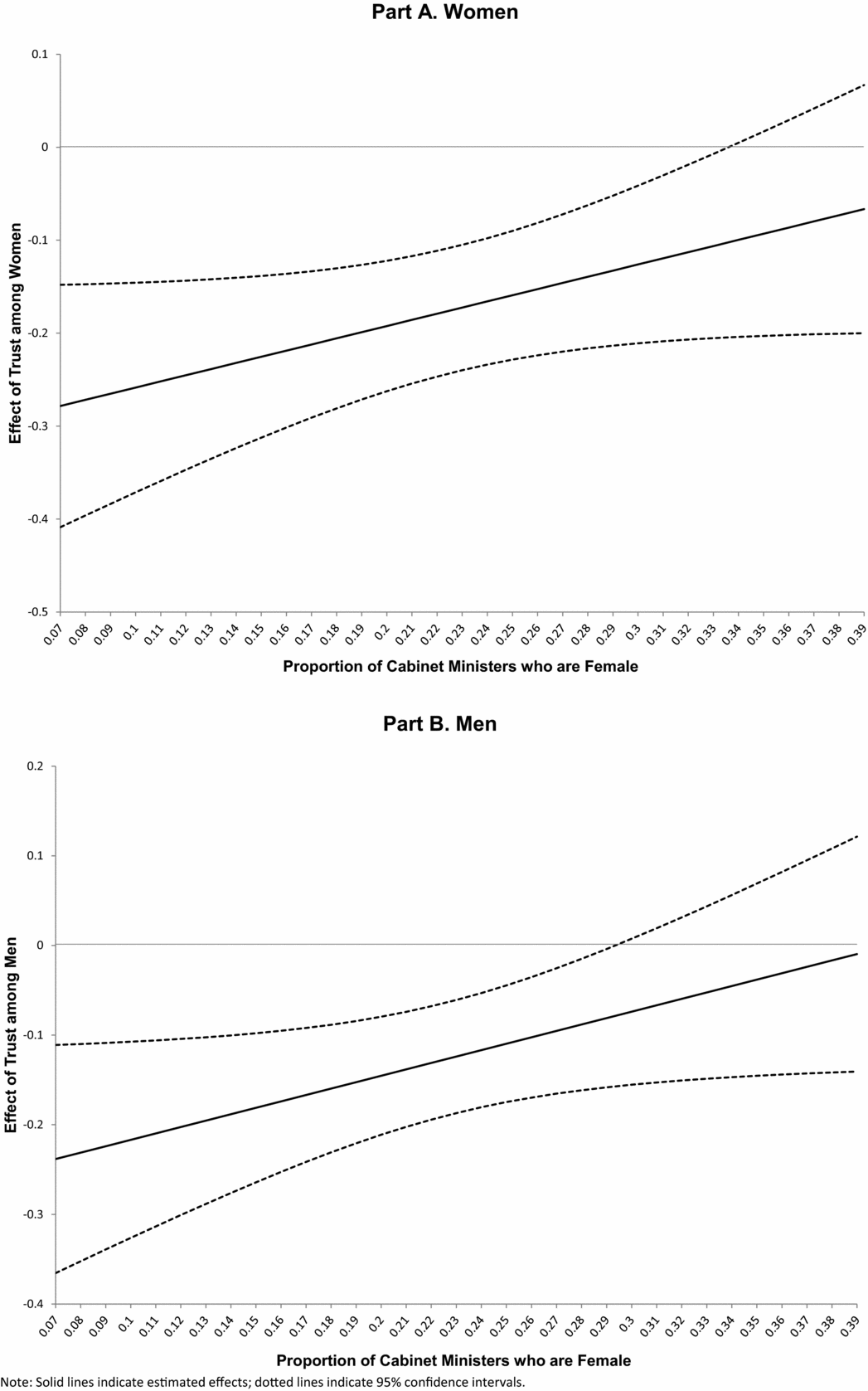
The marginal effects of trust, taking into account the share of cabinet seats occupied by women, are depicted in Figure 2. As women capture more executive-level representation, the magnitude of trust's effect on support for female leadership dissipates. In Part A of the figure, we see that where women have obtained at least 34% of the cabinet seats trust no longer has a significant negative effect on the gender attitudes of female respondents. The same basic pattern is reflected in Part B among male respondents. Once women surpass 29% of the cabinet, men who are distrustful stop translating that distrust into support for female politicians. The threshold at which women cease to be viewed as an anti-establishment option is slightly lower among male respondents than among females, suggesting that women look for more descriptive representation before they stop considering themselves outsiders.
Marginal Effects of Trust, Conditional on Share of Cabinet Seats held by Women
These results substantiate our theory and align with previous research about the role of distrust in facilitating advances for those typically excluded from political power (Barr Reference Barr2009). As long as women are viewed as outsiders, the discontented may support female leadership, hoping women will disrupt the entrenched male elite and prompt change. But where women have achieved representation in the political establishment, female politicians lose their allure as outsiders, and distrust no longer has a pro-woman effect. In El Salvador where women held 39% of cabinet seats at the time of the survey and in Ecuador where 35% of cabinet ministers were women, distrusting citizens of both sexes did not support female leaders more than their trusting neighbors. The same was true among men in Nicaragua, where female ministers constituted 33% of the cabinet. Interestingly, these levels at which female cabinet ministers cease to be viewed as outsiders and instead seem to be taken as normal participants in the political power structure align quite closely with the one-third threshold often seen as pivotal in discussions of critical mass in the literature on women's representation. The basic premise of critical mass arguments is that once women achieve a reasonable threshold of representation, female participation in political leadership is widely considered normal among voters and political elites. In this context, women are no longer treated like outsiders, and they are more able to have a policy impact (Dahlerup Reference Dahlerup1988; Davis Reference Davis1997; Stevenson Reference Stevenson, Dominguez and Poiré1999). In our analysis, there is some suggestion that this is happening in Latin America—in countries where women surpass the one-third threshold in cabinet representation, distrusting citizens no longer view female politicians as alternatives to the discredited status quo.
We also found evidence that support for democracy and its ideals is associated with the specific democratic value of gender egalitarianism. Among both sexes, viewing democracy as the best form of government and respecting gay rights are associated with more feminist attitudes. In a context where women's rights and representation have long been denied, it is encouraging to observe that diffuse support for democracy and adherence to specific democratic norms are linked to egalitarian views of women. These connections between support for the idea of democracy and respect for associated rights and freedoms, such as equal access to representation, suggest that a general commitment to democratic norms may translate into support for protecting the specific rights and liberties associated with these ideals, such as gender equality.Footnote 19
Moving to more conventional theories of gender attitudes, we found consistent support across both sexes for our hypothesis that those who affiliate with the left support egalitarian positions. Commitment to left ideology increases gender egalitarianism among male respondents. Alternatively, only for women does the tangible act of affiliating with a left party promote feminism. Here, then, we see some support for the idea that the nature of one's affiliation with the left may affect women and men differently. Men are more influenced by abstract ideological commitments, whereas female attitudes respond to direct experiences with left organizations.Footnote 20
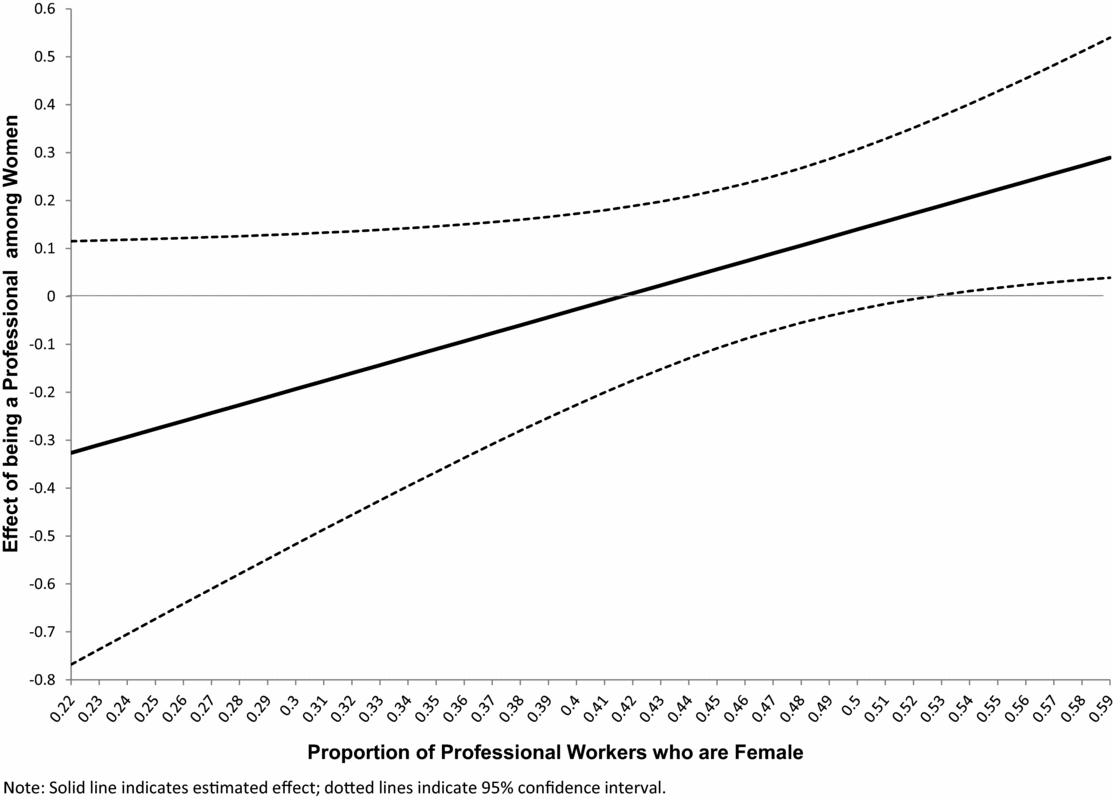
Finally, we considered the impact of individual socialization on feminist values. As we anticipated, given that the available measures are largely personal and not familial, the socialization experiences analyzed here have more impact on female views of women in politics than on male attitudes. In line with previous research, we find that educated, younger women are more likely to hold feminist attitudes than their less educated, older counterparts; we find no similar effects among men. The analysis also provides some evidence to suggest that women who encounter potentially consciousness-raising discrimination on multiple fronts due to their race/ethnicity as well as their sex are more likely to hold egalitarian attitudes about women in politics.Footnote 21 In addition, we found that women in professional occupations hold more gender egalitarian views, provided they live in a country where at least 53% of professional jobs are filled by females (Figure 3). In our sample, the countries of Paraguay, Uruguay, Brazil, and Guyana met this threshold. Where female professionals do not reach this threshold, being employed in a professional job has no effect.Footnote 22 This finding supports the view that pro-feminist socialization is more likely to occur where women can process their experiences collectively. Moreover, the effects for professional occupation as well as education and age are significantly different between women and men, indicating clear gender divergence in these variables’ effects. The only measure of personal experience that has a significant effect among men and women is that of being a student. Students of both sexes are significantly more egalitarian than those who are working—a logical finding given that being an adult student in Latin America says something very specific about one's age, class, and exposure to progressive socialization. We found no effects for wealth, marital status, parenthood, or religiosity.Footnote 23
Marginal Effect of being a Female Professional, Conditional on Share of Female Professionals
DISCUSSION AND CONCLUSIONS
This article offers important theoretical and empirical insights into the factors that shape gender attitudes. At the individual level, we find that, even in relatively young Latin American and Caribbean democracies, gender egalitarianism is connected to support for democracy and its ideals. These findings suggest that efforts to promote pro-democracy attitudes and to advance norms such as tolerance and equality may also generate progress for women. Additionally, we find that theories with well-established explanatory power in more advanced democracies offer insight into gender attitudes in the developing world. Affiliation with the left promotes gender egalitarian attitudes, and consciousness-raising socialization experiences generate greater support for female political leadership, at least among women. Because our data do not include measures of the socialization factors most likely to shape male attitudes, such as the employment and educational status of their wives or mothers, a more direct evaluation of the influence of socialization experiences among Latin American men awaits better data and future research.
Yet this article moves beyond individual-level hypotheses to explore the influence of contextual factors, which have been commonly neglected in previous scholarship examining gender attitudes in both Latin America and the developed world. We elaborated and assessed three arguments—status discontent, socialization, and elite cue theories—that offer somewhat contrasting predictions about contextual effects on gender attitude formation. Given the regional variation on the country-level variables used to assess these theories, the analysis here offers considerable analytical leverage in adjudicating among the competing hypotheses they suggest. The findings offer support for status discontent and substantiate the significance of elite cues. Although socialization experiences matter for individual women, we found no evidence that women's progress generates positive socialization effects beyond the general socializing influence of economic development.
These results suggest that recent trends toward greater descriptive representation for women are not necessarily rooted in deeply held egalitarian norms within the mass public. Gender egalitarian attitudes are contingent and potentially susceptible to reversals. In contrast to other research suggesting the possibility of a virtuous socialization cycle (Alexander Reference Alexander2012), the evidence here indicates that Latin American support for gender equality in politics is not an inherently self-perpetuating process in which societal progress for women helps cement widespread public enthusiasm for women's equality. Evidence of positive socialization effects via female economic and political advancement is not present at the societal level. Trends toward greater opportunities for women shape the attitudes of those women who directly benefit from this progress (and may also influence the views of their male relatives), but the positive socializing effects of factors such as female professional employment do not have society-wide dividends. Instead, economic advancement for women seems to provoke a backlash effect among men. In countries where women are more likely to hold professional positions, male support for female equality is low. This finding suggests that progress toward gender equality is not a naturally self-reinforcing process in which female advancement helps perpetuate additional gains. On the contrary, men may perceive opportunities for women as a threat to their own well-being or advancement so that the dynamic of support for equality among men may be cyclical, rather than exhibiting steady progress.
Furthermore, our evidence indicates that male attitudes about gender equality are susceptible to the influence of elite cues. Whereas women hold their gender attitudes more strongly and thus remain unaffected by elite behaviors, male support for women in politics is highly contingent on elite actions. In contexts where women are regularly nominated and serve as cabinet ministers, men are significantly more supportive of female leadership than in countries where political power brokers leave women outside the top echelon of national politics. Because male attitudes concerning women in politics are highly contingent on the decisions taken by political elites, actions that delegitimize equal participation for women could easily undermine gender egalitarian norms and weaken public support for female leadership.
We found attitudes toward female political equality to be contingent in another respect as well. Namely, support for women in leadership is higher among those who are frustrated with the status quo and see female candidates as outsiders with the potential for overturning entrenched hierarchies and reforming failed institutions. However, as women make gains in executive-level representation, female politicians lose their outsider status and cease offering an attractive alternative to the unsatisfactory state of affairs. Therefore for some respondents support for women in politics is not the result of firm feminist commitments, but is conditional on distrust of existing political institutions as well as the decidedly nonfeminist outcome of women's political exclusion.
Together these findings suggest that progress toward greater public support for women in politics is not an ineluctable process that will simply proceed apace, reinforcing itself as a result of female economic and political empowerment. Although we did find some congruence between economic development at the national level and support for women in politics—suggesting that economic growth has the potential to shore up egalitarian ideals—beyond this factor, support for political equality of the sexes is contingent and may be susceptible to reversal. Economic progress for women is associated with less support for female political representation. Elites who for various reasons exclude women from influential and visible posts in government weaken public enthusiasm for female candidates. And somewhat disturbingly from a normative perspective, strengthening citizen trust in government may undermine opportunities for women and other traditionally marginalized groups whose public support and opportunities to reach power are enhanced when voters are frustrated with the current state of democratic institutions.
Thus, policymakers and activists who wish to promote gender egalitarian norms face a complex set of challenges, but the analysis does suggest several potential paths forward. For one, female representation in the top echelons of national government could serve as a catalyst engendering male support for feminist political goals. With this in mind, the recent ascension of women to national leadership in several countries, including Brazil, Costa Rica, and Jamaica, is a potentially promising development. At the time of the survey in 2008, only Chile and Argentina had female executives, and lacking data for these two countries our analysis was unable to offer specific insights into the impact of currently having a female leader. However, the positive relationship we observed for female cabinet ministers suggests that having women in national leadership has the potential to generate positive cuing effects, provided their electoral success and performance in office do not create the perception that female politicians are just part of the failed status quo. In general, politicians should take care that their actions do not undermine but instead uphold women's equality, because elite behavior has significant cuing effects.
Gender equality may also be enhanced via economic development, which facilitates the acceptance of postmaterial values such as egalitarianism (Inglehart and Norris Reference Inglehart and Norris2003). Among individual women, feminist consciousness may be fostered by expanding access to professional occupations and education. Overall, consciousness-raising experiences among women together with economic prosperity and a pro-female political environment could promote broader acceptance of female leadership.
These findings also suggest paths for future research. Extending the analysis to democracies at different stages of development would illuminate whether the contextual theories examined here find similar support in a broader set of countries or whether the patterns of status discontent and elite cuing we identified are confined to countries similar to those we studied. Future research could also explore the effects of additional contextual factors that may shape women's support for female political leadership or could provide further evidence that female gender attitudes are more firmly held than those of men and are thus largely immune to societal effects. It would also be useful to assess relevant socialization experiences among men, specifically pertaining to their positions as sons, husbands, and fathers. Finally, the theoretical insights here might be extended to illuminate attitudes toward other traditionally marginalized groups, such as racial, ethnic, or religious minorities and immigrants.
Supplementary materials
To view supplementary material for this article, please visit http://dx.doi.org/10.1017/S0003055413000385




Comments
No Comments have been published for this article.