

1. Introduction
There is much debate between economists and economic historians working on the relative importance of various contributors to growth as to whether technological or institutional innovation is of prime importance. Whilst the usual interpretation of the A term in a standard neoclassical growth model is as technology, others have recently emphasized a more important role for institutions (see, for example, Acemoglu et al. Reference Acemoglu, Johnson, Robinson, Aghion and Durlauf2005). We look into this debate from a firm-level microeconomic perspective through the investigation of a natural experiment: the almost simultaneous introduction of the automatic cream separator and the cooperative ownership form in the Danish dairy industry from around 1880.
The story of the emergence and success of Danish creameries at the end of the nineteenth century is well known and is considered to be one of the primary causes of the success of the Danish economy during this period. Two innovations are normally considered to have been the main contributors to this success: one technological, and one institutional. First, the invention of the automatic cream separator in 1878 allowed for butter production on a larger scale than had been possible under previous technologies. In particular, it allowed for the extraction of more cream from the (whole) milk; and for the immediate separation of cream from milk which had been transported over longer distances, without first needing a period of time for the cream to separate by itself. The technology quickly replaced pre-existing technologies in almost all dairies. Second, the cooperative movement emerged as an efficient way to utilize this technology. By solving some of the incentive problems involved in the management of a creamery dependent on many small suppliers, cooperatives allowed for the efficient use of the technology. In doing so they successfully outcompeted rival institutional forms, such as the old estate dairies and private creameries (see Hviid Reference Hviid2006, table 1, based on Bjørn Reference Bjørn1982). The technological and institutional determinants of the success are thus clearly interdependent: the invention of the automatic cream separator led to the success of the cooperative movement which in turn allowed for the successful use of the technology. This makes it difficult to determine whether the productivity increases were due to better technology (a shift in the production possibility frontier) or better institutions (higher productive efficiency bringing the firm closer to this frontier) or both, although most research has focused on the institutional explanation (see, for example, Henriksen Reference Henriksen and Persson1993 and O'Rourke Reference O'Rourke2007).
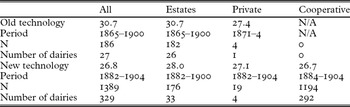
Summary statistics on milk-to-butter ratios

We shed light on this story by quantifying the impact of the institutional and technological innovations using appropriate econometric modelling. We collect data from a large sample of creameries using different technologies and different institutions and quantify the gains from moving to cooperative ownership and from using the automatic cream separators by applying the tool of stochastic frontier analysis.
Given the extent and importance of the discussion about sources of productivity growth, it is surprising that there are not many more studies comparing the relative impact of technological and organizational innovations. Nevertheless, economic historians have had something to say on this subject. In particular, much has been written on a famous example from the English Industrial Revolution of the great inventions in cotton spinning in late eighteenth-century England: Hargreaves’ spinning jenny, Arkwright's water frame and Crompton's combination of both, the mule; and the accompanying change in labour organization, which is commonly known as ‘the rise of the factory’. However, it turns out that systematically disentangling the effects of the institution, the factory system (Clark Reference Clark1994; Landes Reference Landes1986; Williamson Reference Williamson1980; Marglin Reference Marglin1974), from those of the new technologies (spinning devices) is not so easy in practice, since the data on this period are relatively scarce and the only possible way seems to be to reconstruct ‘typical accounts’ relying on a series of critical assumptions (Allen Reference Allen, Robert2009, pp. 185–206) instead of a thorough econometric analysis. Besides, an (almost) simultaneous technological and institutional shock is seldom observed in economic history.Footnote 1 Hence, we are not aware of a comparable example which is as well suited for this purpose as the Danish creameries of the late nineteenth century, where technological progress (the steam-driven cream separator) and institutional change (private enterprise vs cooperatives) were probably as important for Denmark as the introduction of jennies and factories for Britain.
2. Innovation in the Danish dairy industry
Producing butter is essentially a two-stage process: the first concerns producing the milk and the second extracting the cream from the milk in order to make butter. We concentrate here on the second stage, at which the main innovations in technology and institutional forms happened. Nevertheless, we can be sure that increased technical efficiency in the second stage of production (more butter out of the same amount of milk) saved all kinds of resources (cows, milkmaids, land for pasture and fodder, and labour for cultivating it) in the first stage.
In analyses of firm-level efficiency, a division is usually made between technical and allocative/cost efficiency, and in the following we concentrate exclusively on the former. This is not because cost efficiency is uninteresting – there are certainly reasons to believe that many of the advantages enjoyed by cooperatives were gained through being able to keep costs down, for example through a more efficient transportation network – but we simply do not have the data on prices of multiple inputs necessary for such an analysis.
Nevertheless, we can learn much from a simple look at the amount of butter produced per unit of milk. Contemporaries were well aware that the milk to butter ratio was one of the key indicators of a creamery's productivity, and it was standard accounting practice to report this statistic. There are a number of factors that could explain differences in this ratio, however, which is the motivation for our formal econometric analysis below.
Differences in the milk/butter ratio can be attributed to two main things: differing returns to scale due to different technologies, thus implying different ratios of output to input at different scales of production, and other ‘efficiency’ differences, which cause production to fall below the possibility frontier of best practice. Another important factor was time, during which the existing technologies were improved.
2.1. Returns to scale
Considering returns to scale we observe in our period the movement from one technology to another, so it is sensible to consider what implications this might have. The traditional system for separating cream from the milk was known in Denmark as the bøtter-system, in which the milk was poured into a flat container with a large surface area, the bøtte, after which the cream would gradually rise to the surface. Experimentation improved the system gradually. Especially important was the acceleration of the cream separation process by placing the container in a basin with (cold) water, which could be cooled further by the use of preserved crushed ice. From the 1860s this became the most common technology, and in the descriptions of their own technology used by the estates in our data set we find different combinations of the words bøtter, vand (water) and is (ice), together with additional terms indicating improvements in the form of the container, such as Destinonske fade, a rather more sophisticated version of the standard technology. Clearly, however, we should expect to find decreasing returns to scale with such a technology, since the production process was not easily replicable within the confines of an existing dairy.
With the invention of the automatic cream separator (a centrifuge) in 1878, however, the water and ice dairies were very quickly replaced by those using the new technology.Footnote 2 Here it was the centrifuge that was the bottleneck in the day-to-day running of the dairy. Time was essential for the skimmed milk to be returned to the dairy farmers in a usable state for the feeding of calves and pigs. However, a study of the most important Danish producer of centrifuges, the Burmeister & Wain machine factory, demonstrates that this bottleneck was becoming wider over time. The technical capacity of the largest centrifuges, here measured in kilograms skimmed per hour, was growing quickly over time from 240 in 1880 to 800 in 1885. At the same time, the price of a machine of a given size was declining measured in fixed prices.Footnote 3 Moreover, it is clear that early creameries made allowance for easy future expansion when they were built. A contemporary account giving a sample of designs of some early centrifuge dairies of various capacitiesFootnote 4 demonstrates that the creameries were flexible with respect to the number of centrifuges installed (Bøggild Reference Bøggild1896, pp. 469–72). The earliest example, from 1887, illustrates that ‘room was left for an additional centrifuge’. The newest ones, from 1889 and 1890, had two and four centrifuges installed respectively.
There was, of course, an upper limit to the possibility of adding more centrifuges to the original steam engine. This did not necessarily have to be reached very early in the life of a modern creamery, however. Micro-evidence from the diary of an influential farmer, involved in the first cooperative creamery on Zealand in 1884, tells us that this creamery was successful in attracting suppliers from the neighbouring villages, and that it had to add new machines on several occasions. It was not, however, until 1907 that it had to be ‘rebuilt and modernized’ (Jensen Reference Jensen1985, p. 86). All in all, it might seem reasonable to expect, if not constant returns, then less diminishing returns to the new technology compared to the old.
2.2. Efficiency differences
Turning to differences in efficiency, it is first important to note the fact that in some ways the institutional development of the cooperatives was inseparable from the technological development of the separator. In fact, the centrifuge at first presented a challenge to Danish agriculture, which the new organizational form helped to solve. The first steam-driven cream separators were made for the daily milk of 300 to 400 cows, thus exceeding by far the average Danish herd size of 6 to 14 cows. Only a small fraction of Danish farmers, mostly traditional estates, could aspire to run these cream separators on their own. However, even many of these estates had herd sizes far below 300.Footnote 5 The new technology thus presented difficulties for the organization of the second step of production, since increasing the average herd size to optimum sizes for all farms would have required reallocation of land and farms to a degree exceeding that which was possible (since it would have involved many small tenants becoming dependent farm workers; see Persson Reference Persson2010, p. 86).
By bringing together large numbers of small producers, the cooperative movement was able to take advantage of the many benefits the centrifuge offered, perhaps most importantly that cream could be instantly separated from the milk without requiring time for separation. This was even the case for milk which had been transported over long distances, which would have been completely homogenized by the process of transportation, and thus would have required much longer time for separation under the old system, with higher risks of the milk spoiling. The Danish cooperative dairies, relying as they did on the transportation of milk from outlying small producers to a central creamery, depended exclusively on the centrifuge technology. Also, Hviid (Reference Hviid2006) describes how the ability to produce large quantities of a homogeneous product helped small producers to realize a better price for their product. Moreover, Henriksen (Reference Henriksen1999, p. 61) quotes historical evidence about the new technology that suggests that it was able to produce about 25 to 30 per cent more butter out of the same amount of milk, when compared to the simplest version of the bøtter technology as used by small-herd owners. The change from the best traditional practice, the ice dairy, to the steam driven separator would still improve efficiency by more than 10 per cent.Footnote 6
An alternative organizational form which enjoyed some brief success in the 1870s and 1880s was the fællesmejeri (private creamery). These have often been overlooked in the literature, although see Bjørn (Reference Bjørn1977). They bought milk from surrounding farms and thus differed from cooperative creameries, which were collectively owned by their suppliers. Importantly for us, however, both used essentially the same technology (Henriksen Reference Henriksen1999, p. 63), but Henriksen (1997) and Henriksen and Hviid (Reference Henriksen and Hviid2005) have argued that cooperative creameries were the superior institutional form for several reasons. First, they were attractive to farmers because they offered them a larger slice of the cake, since farmers as owners not only received payments for their milk as suppliers, but also dividends as residual claimants. This should have reduced deadweight losses and adverse redistribution effects due to the market power of the owner of the cream separator. Second, they seem to have been the best option to avoid the problem posed by the large initial investment involved in acquiring the cream separator and the associated capital (particularly the creamery building and steam engine), which involved the risk of ex-post extortion by milk suppliers (‘lock-in’ and ‘hold up’). They achieved this by forcing their members to sign collective agreements for the regular provision of all their milk (except that for own consumption in the household) to their creamery for a fixed minimum period, thus ensuring that the initial investment could be recovered. Third, the cooperative institutional form was also helpful for dealing with asymmetric information on the quality (cream content) of the milk provided and could furthermore ensure a year-round supply of milk by forcing their members to provide winter-feeding for milk cows (see Henriksen 1997; Henriksen and Hviid Reference Henriksen and Hviid2005; Henriksen and O'Rourke Reference Henriksen and O'Rourke2005).
To obtain a good result the milk had to be fresh, that is newly milked, given the technology for transport and refrigeration in the late nineteenth century. In our readings of the minutes of 210 cooperatives (see Henriksen et al. Reference Henriksen, Hviid and Sharp2010) we find that this was an issue particularly in the (few) creameries that were closed on Sundays for religious reasons. The members were supposed to find use for the Sunday milk in their own household and were, consequently, rebuked for delivering a conspicuously large amount of milk on Mondays. The milk also had to be clean, that is free from microbes that could make the butter-making process fail. Before the introduction of better measurement methods, the creameries had to rely on being able to see or smell dirt. The manager of the creamery was authorized to reject such supplies and the board of the cooperatives was, in most cases, empowered to inspect the stables of a member suspected of neglecting cleanliness. Both old and dirty milk would lead to more waste in the production process. Equally important was the avoidance of deliberate fraud that lowered the fat percentage of the milk, making it less suitable for butter production per kilo of milk. In Henriksen and Hviid (Reference Henriksen and Hviid2005) we showed how new technology for everyday testing of the fat percentage was, albeit somewhat slowly, adopted by the cooperatives. The resistance to paying for the milk according to the fat content came from suppliers who suspected they were going to lose out in the process because the milk from their cows was naturally meagre. Henriksen et al. (Reference Henriksen, Hviid and Sharp2010) demonstrate how the cooperatives, before complete testing was implemented, monitored and enforced the statutes on milk adulteration, mostly resulting in harsh material punishment for the perpetrators. The claim is that private contractual arrangements regarding hygiene and adulteration could not have accomplished the same result.
Private dairies seem therefore to have faced a problem of less regular milk supply and potentially lower quality of the supplied milk due to hold-up problems. Additional problems for the quantity of supplied milk (although not for the quality) might come from their weaker position as regards the enforcement of winter-feeding among their suppliers. A lower fat content might lead to lower quality of the butter, higher milk-to-butter ratios and temporary or permanent underutilization of the capital embodied in the cream separators and the creamery (see Henriksen Reference Henriksen1999, p. 68; Bjørn Reference Bjørn1977, p. 78; Pedersen Reference Pedersen1885, p. 44).
For the third institutional form, vertically integrated private estate dairies, for which we happen to have more data than for private creameries, the predictions are less clear. Henriksen (Reference Henriksen1999, p. 71) refers to the islands of Lolland and Falster, where relatively few cooperatives were active, and explains this by the presence of large estates that did not have to rely on external suppliers to run a cream separator. However, Henriksen and Hviid (Reference Henriksen and Hviid2005, pp. 367, 390) mention in general the problem of surveying the efforts of employees responsible for milking, where the last drops of milk have the highest fat content, and therefore would provide the highest butter-to-milk ratio. This problem was likely to increase with herd size, and hence might be less of an issue for the average cooperative member's herd than for estates having a herd large enough to supply a cream separator on their own. Contemporary accounts also expressed much concern that larger herds, such as those associated with the estates, were less efficient than the smaller herds associated with the cooperatives, since owners of small herds were better able to focus on giving feed to the most productive animals, thus taking advantage of each animal's productive potential (see, for example, Bøggild Reference Bøggild1895, pp. 120–2).
In general, therefore, we can establish two kinds of hypotheses for our empirical work: first, the steam-driven cream separator was technically able to extract a higher share of the cream from milk of any fat content in a shorter period of time than the traditional system of containers and cooling, which should translate into lower milk-to-butter ratios for the new system compared to the traditional one. We might also expect the old technology to be subject to more sharply diminishing returns to scale. Moreover, as the centrifuge technology was improving over time, we would expect a trend in milk-to-butter ratios. Second, for several reasons we would expect – given the same technology – that cooperative creameries were able to use this technology more efficiently than private creameries. Since these reasons are mostly related to the hold-up power of suppliers, private creameries might also have been less efficient than estate dairies, which were integrated owner-suppliers. However, the latter might face principle–agent problems in milking and additionally might be running cream separators below their best capacity utilization because not all of them actually had sufficiently large herd sizes. We should therefore also test whether there is an efficiency gain from being a cooperative creamery that was independent of the size of production: as is made clear below, cooperatives were generally more productive than other creameries, but they were also generally larger.
A final point that is worth bearing in mind is that it seems from contemporary evidence (see Bøggild Reference Bøggild1896, p. 469–72) that larger creameries were often newer than smaller creameries and thus might be expected to have a more advanced capital stock. We are unable to control for capital in our analysis, since we only have inputs of milk. Except for the initial fixed costs associated with building a creamery and buying the power generator, capital was certainly a relatively minor part of the variable costs of production, usually less than 10 per cent of turnover (Bøggild Reference Bøggild1899, p. 159). Nevertheless, if creameries were established at different times, then higher individual productive efficiency might also be due to newer capital stock.
3. The data
Our data were collected from a number of sources. We have used archival sources,Footnote 7 as well as data published in the Danish journals Tidsskrift for Landøkonomi Footnote 8 and Mælkeritidende, and in the survey of Danish creameries compiled by Ellbrecht (Reference Ellbrecht1915-18). Our sample comprises 27 time series for creameries using old technologies (primarily ice dairies). All of these are estates or private creameries. In addition, we have time series for 334 centrifuge creameries (a mixture of private, estate and cooperative creameries). We focus on the period 1865–1900, but we have included in some cases at most one observation from after this date in order to have time series of at least three observations for each dairy. Our panel is unbalanced, and most time series contain some gaps, i.e. they do not have observations for every year for the period they cover. Table 1 gives descriptive statistics of average input-to-output ratios for the different organizational forms using the two different technologies. Note that there were no cooperatives using the old technology.
Clearly, the old technology gave on average worse ratios than the new technology, and cooperatives were on average more efficient than private dairies, which were on average more efficient than the estates. We have, however, very few observations from private creameries.
4. Method
Assessing productive inefficiency requires the estimation of a production function. For this we need data on inputs and outputs. We argue that the relevant input variable for our analysis is the amount of milk used, and the output is of course the amount of butter produced. This gives us a simple production function of the form

where butter is output of butter in pund (500 grams) and milk is the input of milk in pund. Our data set is a panel, so inputs vary across both creameries (i) and time (t).
We are aware that this is a somewhat unconventional production function, since the usual factors of production (capital, labour, etc.) are not present. Nevertheless, it is a production function, in the sense that it gives the production of an output based on an input. Also, the literature on productive efficiency usually terms these production functions, so this choice of terminology is also intended to avoid confusion. Moreover, this should be seen in the light of the fact that the production of butter is in reality a two-stage process, the first being the production of milk (which requires labour and capital, in the form of land, cows, a dairy, etc.), and the second being the production of butter from the milk.
We concentrate on the second stage, where the role of capital and labour in the production process is of secondary importance,Footnote 9 if we consider this to be largely a story about extracting cream from (whole) milk. By this, we effectively assess the technological efficiency of the creameries in our sample, not cost efficiency, which would imply also using data on prices.Footnote 10
Our motivation for focusing on the second stage is that data for the first stage (numbers of cows, labourers etc.) is lacking in almost all cases, since the vast majority of the milk suppliers were small farms for which no records have been preserved, if kept at all. This also implies that the two stages were conducted for all producers except the estate dairies in two different firms. Moreover, the main technological innovation concerns the second stage, i.e. the movement from ice creameries to those using centrifuges. We can capture the form of the production function under the alternative technologies using this simple one-input specification, although, as discussed above, the inefficiency term might be capturing inefficiencies in the first stage rather than in the second stage.
To estimate the production function, we use the stochastic frontier model with a time-varying technical efficiency term formulated by Battese and Coelli (Reference Battese and Coelli1995) and described by Kumbhakar and Lovell (Reference Kumbhakar and Lovell2000, p. 271).Footnote 11 These models have the general form


Equation (2) is the general formula for a stochastic frontier model in a panel setting, where the production of y is given by a vector of inputs, x. The important contribution of these models is the separation of the error term into a standard stochastic error, vit, and an inefficiency term, uit. The Battese and Coelli (Reference Battese and Coelli1995) formulation of the model allows us to explain this inefficiency term with a vector of variables zit.
For our purposes, yit obviously corresponds to the (log) output of butter, and xit to the (log) input of milk. We also introduce a trend, t, to capture for example technological progress over time. Since we have two technologies, we estimate two production functions, one for the old technology (primarily ice creameries) and one for the new (using centrifuges). For the centrifuge creameries we wish to explain the inefficiency term with reference to their institutional status: estates, private creameries or cooperative creameries (since no cooperatives used the old technology). These are coded through the use of the dummies ESTATE (= 1 if an estate) and PRIVATE (= 1 if private). Due to data scarcity for private creameries, however, we initially introduce only one dummy, ESTPRIV (= 1 if estate or private). In addition, we control for ‘size’ in the efficiency term, which we measure by the (log) input of milk.
5. Results
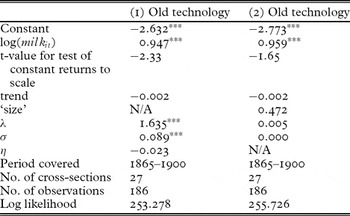
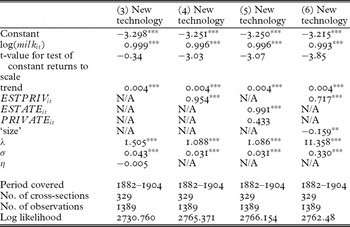
Table 2 gives the results of our estimations. Models 1 and 3 are from a standard stochastic frontier analysis for the creameries using the old and new technologies respectively. Models 4 and 5 attempt to explain the inefficiency term by institutional type, and models 2 and 6 introduce the ‘size’ explanation of inefficiency.
Estimation results, old technology

The results seem intuitive and in line with our a priori expectations as discussed in Section 2. For the old technology (models 1 and 2), there is no significant trend, which implies that productivity was not increasing over time using this technology, and there were diminishing returns to scale. For the new technology (models 3, 4, 5 and 6), however, we see productivity growth of 0.4 per cent per year and we now have (approximately) constant returns to scale. This growth in productivity might be due to technological progress, the breeding of cows which could produce a higher fat content in their milk, or might be due to the sort of institutional innovations such as performance-related pay discussed by Hviid (Reference Hviid2006). The finding of constant returns to scale for the new technology might seem surprising at first. In reality, the production function probably demonstrated increasing returns at low volumes of milk as the centrifuge required a certain minimum level of input to function effectively. Then, after a certain level of input there would be diminishing returns as the machine's operating capacity was exceeded. However, our finding simply reflects the fact that no machines in our sample were operating at ‘unreasonable’ levels of input. For normal usage, the new technology demonstrated constant returns, which was not the case for the old.
The significance of λ indicates the presence of inefficiency in the production process (and thus justifies the use of a stochastic frontier model).Footnote 12 The average inefficiency of creameries under the old system was 6.6 per cent, as calculated by taking the simple average of the inefficiency terms, uit. For the new system we estimate four models. Model 3 uses the same methodology as model 1, and the fact that η is insignificant in both implies that there is no time-varying inefficiency. Thus, for models 4 and 5 we attempt to explain the inefficiency by factors other than time, and compare the relative efficiency of the various systems. Since we have relatively few observations for private creameries, we group them with the estate dairies in the first estimation attempt, giving the results for model 3. The mean inefficiency for the whole sample is 3.1 per cent, so significantly lower than for the old technology above. However, and as expected, model 4 reveals that estates and private dairies were significantly less productive than cooperatives: the coefficient should be interpreted as implying that they had 95.4 per cent higher inefficiency. This implies that the average efficiency of estates/private creameries was 3.1*1.954 = 6.1 per cent, giving an average inefficiency of 6.1 per cent – rather similar to their inefficiency under the old system of 6.6 per cent.
Estimation results, new technology

Notes: **/*** = significant difference from 0 at 5%/1% level;  ; stochastic frontier, e=v−u; time varying uit=exp [−η(t−T)]|Ui.| (for models 1 and 3) or uit=exp(ηzit)|Ui.| (models 2, 4, 5 and 6).
Although we have very few observations of private dairies, we attempt to differentiate between them by coding them differently in model 5. As might be expected, since we have so few observations, the coefficient for private creameries is insignificant. However, it nevertheless implies that they were in fact less inefficient than estate dairies.
Finally, in models 2 and 6 we control for ‘size’ in the efficiency term. In this context it is important to distinguish between returns to scale and efficiency differences owing to size. The first relates to maximum production possibilities, whilst the second relates to inefficiencies at different sizes which cause production to fall short of this possible maximum. There is an insignificant positive effect for the old technology, implying that larger creameries were less efficient than smaller ones. A tentative interpretation might be that this reflects the gains from better monitoring and greater milking effort, since most of this sample consists of estates, so a larger amount of milk processed corresponds to larger herd sizes, which is not the case when we look at cooperatives, who source their milk from a large number of small herds. For the new technology we thus find a significant negative coefficient, so larger creameries were more efficient.Footnote 13 Thus, despite constant returns to scale, larger producers were able to achieve higher levels of output relative to input (and thus approach the production possibility frontier) by minimizing inefficiencies. The reasons for this are unclear, but might have to do with more efficient organizational structures and/or a better-educated workforce in larger creameries. Interestingly the ESTPRIV coefficient falls, but remains significant, implying that, as expected, the efficiency gains from cooperatives are less when we control for the size of the creameries.
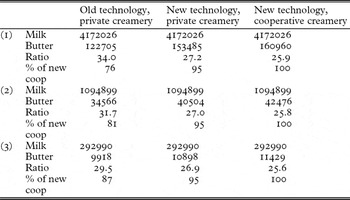
To assess the economic implications of our results, in Table 3 we report the results of putting the sample mean of milk inputs into the production functions obtained from the stochastic frontier models as reported in Table 2 (and our preferred models 1 and 4), in terms of milk-to-butter ratios for the average enterprise. We calculate these for 1900 and use three kinds of assumptions about the average enterprise, given in Table 3 together with the results.Footnote 14
Comparisons of the efficiency of different types of creameries at different scales of production

Notes: The trend is set to 1900; (1) Using average milk input for whole sample; (2) Using average milk input for private creameries; (3) Using average milk input under old system; ‘% of new coop’ is the % butter extracted from the given amount of milk as a proportion of cooperatives with the new technology.
We observe that, depending on the scale of production with the old technology, the new technology used between 9 and 20 per cent less milk for the production of the same amount of butter for the same institutional form with – as reported above – almost identical average inefficiency. Additionally, since for the creameries in our sample the old technology showed decreasing returns to scale, creameries using the old technology would have been much less productive at the sort of scales the cooperatives operated at in 1900, which is in line with the fact that cooperatives did not use the old technology.
With the new technology, however, the amount of milk used does not have such an impact, since it has constant returns to scale. If we compare the two governance forms, we find a 5 per cent differential in the milk-to-butter ratios. This would suggest that of the total gain of technological progress and institutional innovation of 13 to 24 per cent, between 63 and 79 per cent would be due to the technological innovation of the cream separator and the rest due to the greater efficiency of the cooperatives in using it. However, note that we might well be underestimating the efficiency gains of the cooperatives and the centrifuge, since we are comparing them to the best practice of old-style butter-making, as represented by the estates who sent accounts to the Tidsskrift for Landøkonomi.
Looking at some implications of our results for all of Denmark we should first note that it would have been impossible to match the levels of production seen in the late nineteenth century if the centrifuge had not been introduced – to run efficiently there would have to have been very many small creameries. Clearly, the technological innovation was vital for the success of the Danish dairy industry. This should not, however, distract from the economic significance of the institutional innovation of the cooperatives. In 1900-4 Denmark produced approximately 83.8 million kilograms of butter (Johansen Reference Johansen1985, p. 150) of which around 90 per cent was exported. Given the volume of Danish foreign exports of butter over this period, this corresponds to rather large volumes of missing trade, if the cooperative movement had failed to take off as it failed to, for example, in Ireland (O'Rourke Reference O'Rourke2007). Moreover, since exports of butter accounted for approximately 9 per cent of Danish GDP, the 5 per cent drop in production suggested by our estimates might have implied almost 0.5 per cent lower GDP.
6. Conclusions
This has been the first attempt to quantify some of the well-known hypotheses for explaining the success of the Danish dairy system at the end of the nineteenth century, using a new database of dairy statistics. We find that the old technology exhibited diminishing returns to scale, whilst the new technology exhibited constant returns to scale. The inefficiency of the estates and the private creameries at 6 to 7 per cent was approximately the same under the new and the old technologies and twice that of the cooperative dairies, thus demonstrating that the institutional innovation had an impact separate from that of the technological innovation. For the story of the take-off and growth of the Danish economy, both technology and institutions clearly mattered.
Acknowledgements
This article was begun while Markus Lampe was post-doctoral researcher funded by the Department of Economics at the University of Copenhagen and was also worked on while Paul Sharp was visiting Universidad Carlos III de Madrid. Ingrid Henriksen and Paul Sharp would like to acknowledge generous support from the Carlsberg Foundation, while Markus Lampe appreciates funding by Spain's Ministerio de Ciencia e Innovación (project ECO2008-02089). We also would like to thank Carsten Burhop, Juan Carmona, Jan Pedersen, Martin Uebele and seminar participants at the University of Copenhagen for valuable comments and suggestions.