INTRODUCTION
Two of the most important effects of trawl fishing are the reduction in habitat complexity and the alteration of benthic community structure (Turner et al., Reference Turner, Thrush, Hewitt, Cummings and Funnell1999; Kaiser et al., Reference Kaiser, Spence and Hart2000a; Callaway et al., Reference Callaway, Alsvåg, de Boois, Cotter, Ford, Hinz, Jennings, Kröncke, Lancaster, Piet, Prince and Ehrich2002; Kaiser et al., Reference Kaiser, Collie, Hall, Jennings and Poiner2002). Trawling directly disturbs benthic organisms, by physical removal and/or resuspension of superficial sediment (Palanques et al., Reference Palanques, Guillén and Puig2001; Smith et al., Reference Smith, Rumohr, Karakassis and Papadopoulou2003). Indirectly trawling increases the vulnerability to predation of many benthic species by physically removing shelters provided by holes, ripples and emergent seabed organisms (Kaiser et al., Reference Kaiser, Ramsay, Richardson, Spence and Brand2002b; Colloca et al., Reference Colloca, Carpentieri, Balestri and Ardizzone2004). There is a consensus that vulnerable species, such as large-size bottom-dwelling species directly impacted by the gear, are replaced by less vulnerable organisms, such as small-size burrowers (Collie et al., Reference Collie, Escanero and Valentine1997; Thrush et al., Reference Thrush, Hewitt, Cummings, Dayton, Cryer and Turner1998; Bergman & Van Santbrink, Reference Bergman and Van Santbrink2000) and/or scavengers (Kaiser et al., Reference Kaiser, Edwards, Armstrong, Radford, Lough, Flatt and Jones1998, Reference Kaiser, Spence and Hart2000a). Thus the most intensively fished areas are likely to be in a permanently altered state, dominated by a resilient fauna adapted to frequent trawling disturbance (Kaiser et al., Reference Kaiser, Ramsay, Richardson, Spence and Brand2000b; Thrush & Dayton, Reference Thrush and Dayton2002).
As benthos is an important food source for demersal fish, a high level of trawling disturbance could affect the diet of the latter, with implications for whole food web dynamics (Pinnegar et al., Reference Pinnegar, Polunin, Francour, Badalamenti, Chemello, Harmelin-Vivien, Hereu, Milazzo, Zabala, D'Anna and Pipitone2000, Reference Pinnegar, Jennings, O'Brien and Polunin2002; Jennings et al., Reference Jennings, Greenstreet, Hill, Piet, Pinnegar and Warr2002; Sanchez & Olaso, Reference Sanchez and Olaso2004). However, detecting the effects of trawling on benthic habitats and communities is not easy due to natural variability, thus an effort should be made to select homogeneous areas with different fishing pressures. Also, while direct effects of trawling on target stocks are generally evident (Hiddink et al., Reference Hiddink, Jennings, Kaiser, Queirós, Duplisea and Piet2006), indirect changes on the feeding habits of demersal fish are more difficult to detect. Contrasting the diet of fish from trawled and untrawled areas may lead to a better understanding of the trophodynamic response of demersal fish to trawling. The trawl fishing ban imposed in the Gulf of Castellammare, north-western Sicily in 1990 (Pipitone et al., Reference Pipitone, Badalamenti, D'Anna and Patti2000a) gave us the opportunity to explore changes in the diet and trophic level of fish, by comparing them with those from intensively trawled control areas.
The scaldfish Arnoglossus laterna is a highly motile predatory fish with medium vulnerability to trawling (de Juan et al., Reference de Juan, Thrush and Demestre2007), ten-times more abundant in the Gulf of Castellammare than in the two control areas (personal unpublished data). Adult scaldfish prey on benthic prey such as polychaetes, bivalves, peracarids and decapods (Avsar, Reference Avsar1994; Darnaude et al., Reference Darnaude, Harmelin-Vivien and Salen-Picard2001, Reference Darnaude, Salen-Picard and Harmelin-Vivien2004; Cabral et al., Reference Cabral, Lopes and Loeper2002). Conversely, juveniles prey mainly on copepods, amphipods and mysids (Avsar, Reference Avsar1994) which are part of the suprabenthos that is a group of small-sized animals with low swimming capacity occupying the benthic boundary layer (Brunel et al., Reference Brunel, Besner, Messier, Poirier, Granger and Weinstein1978; Mees & Jones, Reference Mees and Jones1997). The suprabenthos in general does not seem to be affected by trawling (Ligas, Reference Ligas2005).
The main objective of this paper was to assess if and how trawling affects the feeding ecology of a benthic feeder such as scaldfish, and to evaluate whether its diet can be used as an indirect indicator of trawling disturbance. Three hypotheses were tested: (1) the diet of scaldfish is more specialized in the untrawled area because of the expected higher availability of benthic food; (2) there is a difference between the diet of larger scaldfish (feeding on benthos) and the diet of juveniles (feeding on suprabenthos, which is not or less affected by trawling); and (3) the mean trophic level of scaldfish in the untrawled area is higher than in trawled areas, as a consequence of a diet switch to small fish prey which are particularly abundant in the untrawled area (Sweeting et al., in press). This paper uses stomach content analysis along with nitrogen and carbon stable isotope analysis (δ15N and δ13C) contrasting trawled versus untrawled areas to assess the impact of trawling on the trophic ecology of juveniles and adults of scaldfish.
MATERIALS AND METHODS
Study area
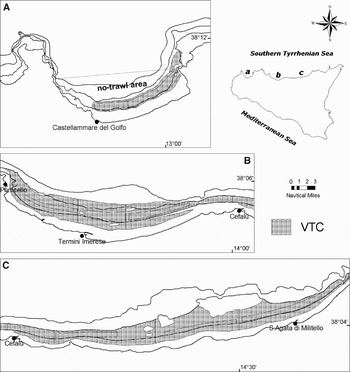
The study was carried out in three areas along the coast of northern Sicily (Figure 1): the Gulf of Castellammare (GCAST, 38°04′N 12°56′E) where trawling has been banned since 1990 (Pipitone et al., Reference Pipitone, Badalamenti, D'Anna and Patti2000a) and the Gulfs of Termini Imerese (GTERM, 38°02′N 13°46′E) and Sant'Agata (GSANT, 38°04′N 14°20′E), where trawling is permitted at >50 m depth according to the Italian legislation.
Map of (A) the Gulf of Castellammare; (B) the Gulf of Termini Imerese; and (C) the Gulf of Sant'Agata in northern Sicily. The dashed line in the Gulf of Castellammare represents the northern boundary of the no-trawl area. Shaded areas (VTC) indicate the terrigenous mud-shelf assemblage.

Sampling
A total of 239 scaldfish were collected by bottom otter trawl in the three areas in May–June 2005: 102 in GCAST, 91 in GTERM and 46 in GSANT. Samples were taken between 40 and 80 m depth over muddy bottoms (VTC sensu Pérès & Picard, Reference Pérès and Picard1964; terrigenous mud-shelf assemblage sensu Pérès, Reference Pérès and Kinne1982) with the aid of maps drawn in previous studies (Arena & Bombace, Reference Arena and Bombace1970; Andaloro, Reference Andaloro1994; Pipitone et al., Reference Pipitone, Badalamenti, D'Anna, Whitmarsh, James and Pickering2000b) (Figure 1). Benthic samples were collected and analysed with a Van Veen grab during the present study (D'Anna & Pipitone, Reference D'Anna and Pipitone2007); although a sedimentary study was not carried out, the presence of species such as the polychaete Sternaspis scutata, the crab Goneplax rhomboides and the sea cucumber Labidoplax digitata allowed us to confirm the type of benthic assemblage.
Scaldfish were frozen on board, then dissected for stomach content analysis in the laboratory after taking total length (TL) to the nearest mm and total weight to the nearest 0.1 g. All the specimens examined were subdivided in to two size-classes: juveniles with TL < 100 mm and adults with TL > 105 mm (Avsar, Reference Avsar1994).
A portion of white muscle close to the dorsal fin was taken from two juvenile and three adult fish of similar total length from each area (juveniles TL = 87.5 ± 6.9 mm, F2.3 = 2.48, P > 0.05 and adults TL = 112.8 ± 8.7 mm, F2.6 = 5.18, P > 0.05) and prepared for δ15N and δ13C analysis. Unfortunately, due to problems with the instruments it was possible to analyse only nine samples (one juvenile and two adults from each area) for δ13C instead of fifteen. Thus, differences for carbon were tested separately for juveniles and adults and for areas on pooled adult and juvenile data.
Using continuous flow, the muscle samples were introduced into a Finnigan Delta XP Plus isotope ratio mass spectrometer for isotopic analysis. Three capsules of an internal reference (international certified leucine) were analysed at the beginning of each sequence and one every six samples to compensate for machine drift and as a quality control measure. Experimental precision (based on the standard deviation of replicates of the internal standard) was <0.2‰ for δ15N and <0.1‰ for δ13C. δ15N and δ13C values were obtained in parts per thousand (‰) relative to Vienna Pee Dee Belemnite (vPDB) and atmospheric N2 standards, respectively, according to the following formula: δ13C or δ15N = [(Rsample/Rstandard) – 1] × 103, where R = 13C/12C or 15N/14N.
Stomach content analysis
All prey items found in the stomach contents were identified under a stereomicroscope to the lowest possible taxonomic level, then counted and weighed (precision: 0.0001 g) after blotting on tissue paper to remove excess moisture. All undamaged prey items were measured using a micrometer. Vacuity coefficient (%V = per cent number of empty stomachs), stomach fullness (=weight of stomach contents/weight of fish*100, used as a proxy of feeding intensity) and the following indices of prey importance were calculated (see Hyslop, Reference Hyslop1980 for a review): per cent frequency of occurrence (%F), per cent numerical composition (%N), per cent gravimetric composition (%W) and index of relative importance (IRI) = (%N + %W)*%F (Pinkas et al., Reference Pinkas, Oliphant and Iverson1971), expressed as %IRI = (IRI/ΣIRI)*100. Prey items were sorted in decreasing order according to their %IRI contribution, and then cumulative %IRI was calculated. The Shannon diversity index (H′) calculated using natural logarithm was used as a measure of diet diversity. In order to measure sample size sufficiency (i.e. the number of stomachs to be examined), the cumulative trophic diversity (H′) was plotted against the cumulative number of analysed stomachs (Ferry & Cailliet, Reference Ferry, Caillet, MacKinlay and Shearer1996) for each area and size-class. The logistic curve and the linear regression were calculated and the respective goodness of fit coefficients (R2) estimated. The sample size was considered sufficient when R2 from the logistic curve was higher than R2 from the linear regression (Castriota et al., Reference Castriota, Scarabello, Finoia, Sinopoli and Andaloro2005).
Diet breadth was calculated separately for each area and size-class, using Levin's standardized index (Hulbert, Reference Hulbert1978; Krebs, Reference Krebs1989),  , where pij = proportion of prey j in the diet of predator i, and n = number of prey categories. This index ranges between 0 and 1, with lower values indicating a specialist diet dominated by few prey items and higher values indicating a generalist diet with a broad food spectrum (Gibson & Ezzi, Reference Gibson and Ezzi1987; Krebs, Reference Krebs1989).
Trophic level estimates
The trophic level (TrL) was calculated from δ15N data of scaldfish using the shrimp Alpheus glaber as reference (mean δ15N = 5.66‰±0.27; one-way ANOVA of δ15N values between areas: F2.6 = 0.99, P > 0.05). Alpheus glaber is one of the dominant deposit feeders in the benthic assemblages of the study areas (D'Anna & Pipitone, Reference D'Anna and Pipitone2007; Fanelli, Reference Fanelli2007). The rationale behind this choice was that benthic food webs of shelf muddy bottoms are generally detritus-based, hence a deposit feeder is better suited as reference material than copepods, which are the standard reference material for plankton-based food webs. δ15N values of scaldfish were converted to trophic level based on the assumption that there is a fractionation of 3.4‰ at each trophic level (Minagawa & Wada, Reference Minagawa and Wada1984; Post, Reference Post2002) and that the reference material (A. glaber) has a trophic level of 2:  , where δ15N is the mean δ15N value of predator, and δ15Nref is the mean δ15N of the reference material.
Data analysis
Differences between the %IRI of the main prey items in the three areas were tested by a Chi-square test (Yates' correction). A two-way permutational univariate ANOVA (Anderson, Reference Anderson2001) based on Euclidean distances, with area (three levels: GCAST, GSANT and GTERM) and size (two levels: adults and juveniles) as fixed factors, was adopted to analyse stable isotope data, fullness, diversity and Levin's niche breadth. While permutational ANOVA was designed for multivariate analysis on distance matrices, it can be used for univariate ANOVA. When we have only one variable in the analysis and we choose to use Euclidean distances, the resulting sums of squares and F-ratios are exactly the same as Fisher's univariate F-statistic in traditional ANOVA. Variance was partitioned for factor area by contrasting untrawled versus trawled (UtrvsTr) areas and the two trawled areas (GSANT versus GTERM). Significance was set at P = 0.05; P values were obtained using 9999 permutations of residuals under a reduced model (Anderson, Reference Anderson2001). The same design was used to analyse stomach content weight data. In this case, the PERMANOVA was based on modified Gower distance after a fourth root transformation of the multivariate set of data. This measure of resemblance was used because it takes into account the joint absence of food items in the stomachs of fish in the three areas. It was deemed the most suitable for stomach content data, which are often highly skewed and whose matrices contain many zeros (Anderson, Reference Anderson2001; Cannicci et al., Reference Cannicci, Gomei, Dahdouh-Guebas, Rorandelli and Terllizzi2007; Fanelli & Cartes, Reference Fanelli and Cartes2008).
The fullness index data were arc-sin transformed before performing the analysis, because arc-sin transformation is appropriate for data expressed as decimal fractions or percentages (Underwood, Reference Underwood1997). The distribution of percentages is binomial and this transformation makes the distribution normal. Since we could not analyse δ13C data from an equal number of specimens of different sizes from each area, a one-way ANOVA was used to test first for differences in δ13C between areas and then between sizes.
A distance-based test for homogeneity of multivariate dispersions (PERMDISP) was then performed on factors that resulted significant in the PERMANOVA (Anderson, Reference Anderson2006). A SIMPER analysis (Clarke, Reference Clarke1993) was also applied to stomach content data in order to determine the most typical prey species in each area and size-class.
All the statistical analyses were performed with PRIMER 6 and PERMANOVA plus (Clarke & Warwick, Reference Clarke and Warwick1995; Anderson, Reference Anderson2006) and with STATISTICA 6.0.
RESULTS
Stomach content analysis
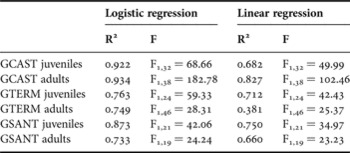
The cumulative prey types curve fitted better a logistic curve than a linear relation for A. laterna when 100% of the guts examined were taken into consideration; then sample size was considered sufficient to describe the diet of this species for each area and size (Table 1).
Results of the sample size sufficiency analysis for the total number of Arnoglossus laterna examined stomachs in each area. All values are significant at P < 0.001.

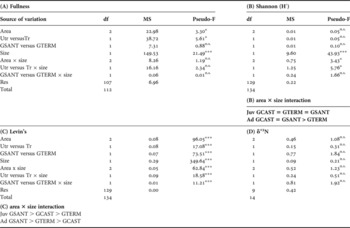
The fullness index of the analysed stomachs varied significantly between the three areas, with a lower value in the untrawled area (GCAST = 0.55±0.4, GTERM = 1.07±1.4, GSANT = 0.87±1.2) (Table 2A). Adults had significantly fuller stomachs than juveniles (adults: GCAST = 0.60±0.5, GTERM = 1.74±1.3, GSANT = 1.47±1.2; juveniles: GCAST = 0.33±0.2, GTERM = 0.81±1.2, GSANT = 0.31±0.2) and, although the interaction area x size was not significant, there were significant differences in fullness between adults from GCAST and GSANT–GTERM (pairwise test within level adult of factor size: GCAST versus GTERM t = 2.43, P < 0.05; GCAST versus GSANT t = 3.31, P < 0.05; GTERM versus GSANT t = 0.46; P > 0.05).
Two-way permutational univariate ANOVA on: (A) fullness; (B) Shannon trophic diversity index; (C) Levin's niche breadth index; and (D) δ15N values of scaldfish based on the experimental design described in the text (9999 permutations). Utr, untrawled area (GCAST); Tr, trawled areas (GTERM, GSANT). Pairwise tests on the significant interaction term area × size are reported. GCAST, Gulf of Castellammare; GSANT, Gulf of Sant'Agata; GTERM, Gulf of Termini Imerese; Juv, juvenile scaldfish; Ad, adult scaldfish; *P < 0.05; ***P < 0.001; n.s., not significant.

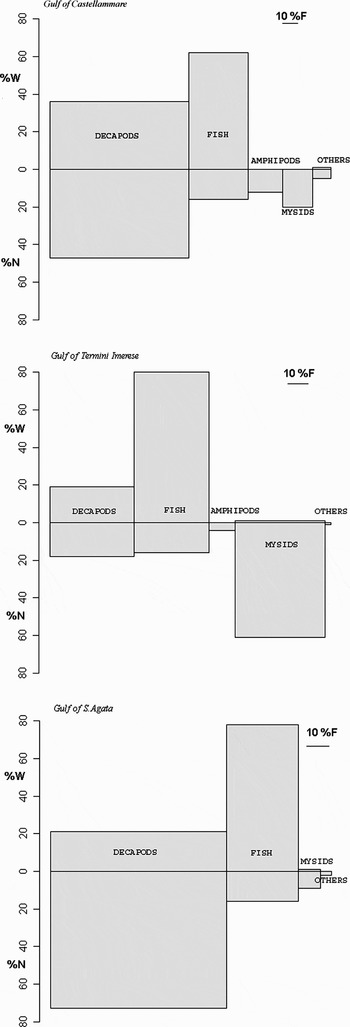
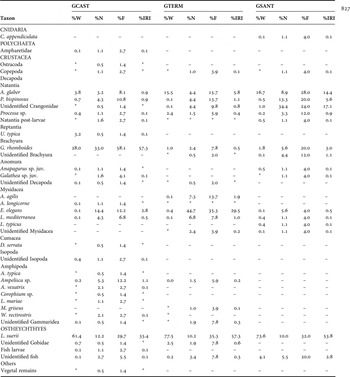
Thirty-six different prey items were identified in the 192 stomachs (GCAST juveniles: 34, GCAST adults: 40; GTERM juveniles: 26; GTERM adults: 48; GSANT juveniles: 23; GSANT adults: 21) of scaldfish analysed for diet composition (Annex 1). The diet consisted mainly of fish (mean %IRI in the three Gulfs = 65) and decapods (mean %IRI = 28). At the species level, the decapods Goneplax rhomboides and Alpheus glaber and the fish Lesueurigobius suerii dominated the diet.
The proportion (%IRI) of decapods and fish ingested was higher in GCAST and GSANT (χ2 test, P < 0.05), while mysids were an important prey in GTERM (Annex 1; Figure 2).
Indices of prey importance in the diet of scaldfish. Only prey items with %IRI >1 are shown. The area of each rectangle is equivalent to the value of %IRI. For the meaning of %IRI, %N, %W and %F see text.

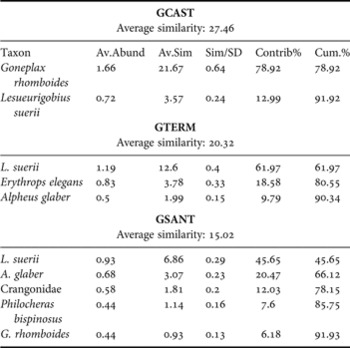
On the basis of the SIMPER analysis the preferred prey in the trawled areas was L. suerii, which contributed with 45.6% and 62% to the diet in GSANT and GTERM, respectively. In GCAST G. rhomboides was the most typical species, adding 78.9% to similarity among samples (Table 3).
SIMPER analysis of scaldfish stomach contents from the three areas off northern Sicily (cut-off for low contribution: 90%). GCAST, Gulf of Castellammare; GSANT, Gulf of Sant'Agata; GTERM, Gulf of Termini Imerese.

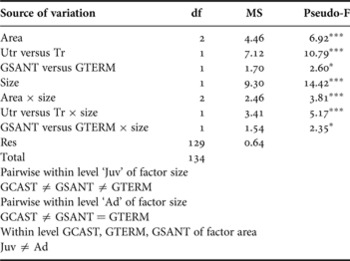
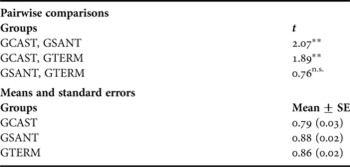
Asymmetrical PERMANOVA provided evidence for separation of stomach contents between untrawled and trawled areas (Utr versus Tr), between the two trawled areas, between size-classes (juveniles versus adults) and for the interactions (Table 4). The pairwise comparison based on the area × size interaction showed that the diet of juvenile scaldfish differed significantly among all areas; however the diet of adults varied significantly between untrawled and trawled areas, but not between trawled areas. Moreover, the diet of juveniles and adults was different among the three areas. Although the PERMDISP test based on factor area was not significant (F3.135 = 3.43, P = 0.068), the pairwise test (Table 5) evidenced a significant difference in the homogeneity of multivariate dispersions between GCAST and GTERM–GSANT, while GTERM and GSANT did not differ from each other. Data from GCAST were less dispersed than those from GTERM and GSANT.
PERMANOVA based on the modified Gower dissimilarity of standardized and fourth root transformed stomach contents weight data (36 taxa; 9999 permutations). Utr, untrawled area (GCAST); Tr, trawled areas (GTERM, GSANT). Pairwise tests on the significant interaction term ‘area x size’ are reported. Juv, juvenile scaldfish; Ad, adult scaldfish; *P < 0.05; **P < 0.01; ***p < 0.001; n.s., not significant.

Pairwise comparison of PERMDISP test of factor area based on the modified Gower dissimilarities of standardized and fourth root transformed stomach content weight data (36 taxa). **P < 0.01; n.s., not significant.

The mean Shannon diversity index (GCAST = 1.03±0.31, GTERM = 0.73±0.17, GSANT = 0.97±0.38) was significant only for the area × size interaction, but not for the differences arising from the pairwise comparison (Table 2B). As far as the Levin's index is concerned, juveniles had a significantly wider niche breadth than adults (Table 2C). The lowest value, indicating the narrowest niche breadth, was found for adults in GCAST (Table 6).
Levin's index for each size-class and area. Standard deviations are also given.

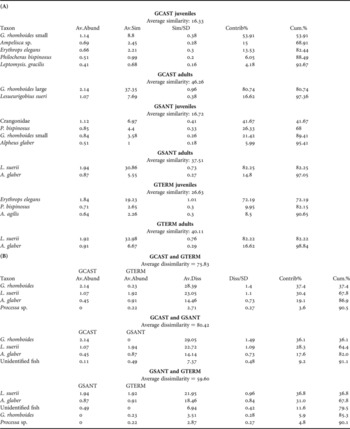
The diets of juvenile and adult scaldfish were different, as shown by the SIMPER analysis (Table 7). Juveniles fed mostly on suprabenthic species such as amphipods (mainly Ampelisca sp.), small decapods (mainly Philocheras bispinosus and small G. rhomboides with 4–6 mm carapace width, CW) and mysids (Leptomysis gracilis and Erythrops elegans), which contributed largely to the diet in the three Gulfs (Table 7a). Adults preyed mainly on large G. rhomboides (CW: 6.1–8.4 mm) and L. suerii in GCAST and on L. suerii and A. glaber in GTERM and GSANT (Table 7a). SIMPER performed on adults evidenced higher dissimilarity between untrawled and trawled areas (Table 7b) than between the two trawled areas, where the average abundance of the main prey items (L. suerii and A. glaber) was very similar.
SIMPER analysis of stomach contents in two size-classes of scaldfish in each area (cut-off for low contribution: 90%). Juveniles, TL < 100 mm; adults, TL > 105 mm. (A) Similarity within each size-class per area; (B) dissimilarity within adults between areas. Goneplax rhomboides small ranged between 4 and 6 mm CW. G rhomboides large ranged between 6.1 and 8.4 mm CW. GCAST, Gulf of Castellammare; GSANT, Gulf of Sant'Agata; GTERM, Gulf of Termini Imerese.

Stable isotope data
δ15N values of scaldfish did not differ between areas (δ15N GCAST: 9.61‰±0.87; δ15N GTERM: 9.26‰±0.32; δ15N GSANT: 9.80‰±0.39) and size-classes (δ15N adults: 9.3‰±0.4; δ15N juveniles: 9.2‰±0.9) (Table 2D). Individuals from GSANT had δ13C values significantly more enriched (δ13C GSANT: −17.43‰±0.01) than those from GCAST and GTERM (δ13C GCAST: −18.06‰±0.80; δ13C GTERM: −19.27‰±0.54) (one-way ANOVA F2.6 = 8.4; P < 0.05). δ15N values did not differ between size-classes (Table 2d), while the δ13C value of juveniles was significantly more depleted than in adults (δ13C juveniles: −18.92‰±0.15; δ13C adults: −17.66‰±0.37) (one-way ANOVA F1.7 = 38.4; P < 0.05). Since no significant differences existed in the scaldfish δ15N values by area and by size (Table 2D) and the same reference value was used for the trophic level calculations, we assumed the same mean trophic level value of 3.06 (±0.19) for scaldfish in the overall study area.
DISCUSSION
Differences in diet composition: fishing impact and predator size
Scaldfish living on the muddy bottom off the northern coast of Sicily preyed mainly upon fish and decapod crustaceans. This species, like other bothid fish, is an active predator, responding primarily to moving prey and thus feeding mainly on active rather than on sedentary prey (De Groot, Reference De Groot1971; Braber & De Groot, Reference Braber and De Groot1973; Darnaude et al., Reference Darnaude, Harmelin-Vivien and Salen-Picard2001). Small gobiid fish, like Lesueurigobius suerii in this study, which are the most important prey in the trawled areas and the second most important in the untrawled area in terms of %IRI, constitute a significant component in the diet of scaldfish (Gibson & Ezzi, Reference Gibson and Ezzi1980). Avsar (1994) found that scaldfish from Turkey fed mainly on crustaceans (amphipods, euphausiids, decapods, mysids and copepods), with fish and polychaetes as secondary prey items; similar feeding habits were described by Gibson & Ezzi (Reference Gibson and Ezzi1980) off the Scottish coast and by Cabral et al. (Reference Cabral, Lopes and Loeper2002) off Portugal, although in these two areas scaldfish preyed almost exclusively upon crustaceans. Shrimps were the main food item of scaldfish in the Irish Sea (Amezcua et al., Reference Amezcua, Nash and Veale2003), while amphipods, mysids, hermit crabs, shrimps and occasionally polychaetes were the preferential prey of juvenile scaldfish in the Gulf of Fos (north-western Mediterranean) (Darnaude et al., Reference Darnaude, Harmelin-Vivien and Salen-Picard2001). Our results partially agree with the above findings, with differences attributable to geographical and bathymetric variability in resource availability. According to existing data on the abundance and biomass of benthos (D'Anna & Pipitone, Reference D'Anna and Pipitone2007; Fanelli, Reference Fanelli2007), the dominant preys in the diet of adult scaldfish are not the most abundant in the benthos of the study areas. This suggests selective feeding behaviour in adult scaldfish, as supported by the values of the Shannon diversity index calculated on prey items.
Stomach fullness, used as an expression of feeding intensity, was higher in adult than in juvenile scaldfish. The fullness index of juveniles did not vary between trawled and untrawled areas, while adults had fuller stomachs in the trawled areas. This result suggests that trawling does not affect the feeding intensity of juveniles feeding on suprabenthos—which is not affected by trawl gear (Ligas, Reference Ligas2005; Fanelli, Reference Fanelli2007)—while it does affect that of the benthic feeding adults. It seems that adult scaldfish benefit indirectly from trawling, since at least two of their main prey (L. suerii and Alpheus glaber) are more abundant in the trawled areas. It has been shown that, depending on the degree of disturbance, resource availability may be higher in disturbed areas, due to the occurrence of opportunistic species (Connell, 1978). The postulated increase in scavengers in areas with higher trawling impact (Kaiser et al., Reference Kaiser, Collie, Hall, Jennings and Poiner2002a) was not found for the suprabenthos, as shown by Fanelli (Reference Fanelli2007).
The diet of juveniles varied among the three areas, thus the detected differences cannot be attributed to fishing pressure. In fact, as also found by Darnaude et al. (Reference Darnaude, Harmelin-Vivien and Salen-Picard2001, Reference Darnaude, Salen-Picard and Harmelin-Vivien2004), juveniles fed on suprabenthic resources such as mysids, amphipods and small decapods like Philocheras bispinosus. These last differ among the three areas in terms of biomass, abundance and assemblage structure, as a response to different environmental characteristics such as primary production and advective fluxes (Fanelli, Reference Fanelli2007). That the suprabenthic assemblage is not affected by trawling has been suggested in other studies comparing trawled and untrawled areas (Ligas, Reference Ligas2005; Cartes et al., Reference Cartes, Papiol, Palanques, Guillén and Demestre2007). In contrast the effect of the trawl ban in the Gulf of Castellammare, and hence of the presence of an undisturbed benthic assemblage, was evident in the diet of adult scaldfish, which differed significantly in trawled versus untrawled areas. Several studies have highlighted that trawling activities heavily affect the structure and diversity of benthic communities (see Jennings & Kaiser, Reference Jennings and Kaiser1998 and references cited therein). In addition, the increase in the abundance of motile burrowing predators and scavengers caused by trawling was correlated to the reduction of highly motile surface predators and of less motile burrowing filter feeders (de Juan et al., Reference de Juan, Thrush and Demestre2007). In an undisturbed bottom community, such as in the untrawled Gulf of Castellammare, benthic resources are expected to be more abundant and diversified than in intensively fished areas (Auster & Langton, Reference Auster and Langton1999; Norse & Watling, Reference Norse, Watling and Benaka1999; Collie et al., Reference Collie, Hall, Kaiser and Poiner2000; Kaiser et al., 2002a, Reference Kaiser, Clarke, Hinz, Austen, Somerfield and Karakassis2006 and references cited therein). A recent study that included an analysis of the benthic communities in the three Gulfs surveyed in this study showed a general trend of increased benthic abundance in the untrawled area compared to trawled areas, but no difference in the benthic biomass (D'Anna & Pipitone, Reference D'Anna and Pipitone2007). Moreover, a higher abundance of highly vulnerable organisms, represented by sedentary surface filter feeders (e.g. bivalves and burrowing species with low motility such as ophiuroids and amphipods like Ampelisca spp.) was also found in the Gulf of Castellammare, indicating a well structured and less disturbed community.
In the untrawled Gulf the scaldfish exhibited more selective feeding behaviour, as evidenced by lower data dispersion (PERMDISP) and Levin's index for adults. Goneplax rhomboides, a species with medium vulnerability to trawling disturbance (de Juan et al., Reference de Juan, Thrush and Demestre2007), was twice as abundant in the Gulf of Castellammare as in the trawled areas (D'Anna & Pipitone, Reference D'Anna and Pipitone2007; Fanelli, Reference Fanelli2007). This is in agreement with de Juan et al. (Reference de Juan, Thrush and Demestre2007), who observed a higher abundance of this crab in an unfished site than in an intensively trawled area off the Catalan coast. Indeed, G. rhomboides seemed to be the preferred prey of adult scaldfish in GCAST. In the trawled areas, the proportion of other prey increased and the most typical species in the diet of scaldfish were L. suerii and A. glaber. Lesueurigobius suerii is a motile burrowing predator, more abundant in trawled than in untrawled sites off the Catalan coast (de Juan et al., Reference de Juan, Thrush and Demestre2007) and off northern Sicily (Fanelli, Reference Fanelli2007). The shrimp A. glaber was the species that contributed most to the dissimilarity between GCAST and GSANT–GTERM. This species is a sedentary burrowing deposit feeder with low vulnerability to trawling (de Juan et al., Reference de Juan, Thrush and Demestre2007) and while equally abundant in trawled and untrawled areas (D'Anna & Pipitone, Reference D'Anna and Pipitone2007), it was more frequently ingested in the trawled areas. De Juan et al. (Reference de Juan, Thrush and Demestre2007) noted that sedentary burrowing deposit feeders dominated the infaunal community in the Catalan trawling grounds, but also that it is difficult to ascertain whether this assemblage configuration is solely a result of trawling disturbance history or whether it represents a characteristic community of muddy bottoms.
Stable isotopes
The present study showed a difference in the information provided by the stomach content analysis and the δ15N analysis of scaldfish, as far as trawl impact and ontogenetic changes in the diet are concerned. While the diet of adult scaldfish varied significantly between trawled and untrawled areas, the δ15N value and the mean trophic level did not. Although trawling disturbance normally leads to a reduction in infauna and epifauna biomass, and to dramatic changes in the composition of the infauna (see Jennings et al., Reference Jennings, Dimore, Duplisea, Warr and Lancaster2001 among others), these changes are not considered to affect the mean trophic level of the community (Jennings et al., Reference Jennings, Dimore, Duplisea, Warr and Lancaster2001). Jennings et al. (Reference Jennings, Dimore, Duplisea, Warr and Lancaster2001) after studying the impacts of demersal fishing at large spatial scales suggested that ‘the trophic structure of intensively fished communities has not change, despite changes in species composition, to ensure the continued processing of production by those remaining invertebrates that can withstand the levels of mortality imposed by trawling’. However, Badalamenti et al. (Reference Badalamenti, Sweeting, Polunin, Pinnegar, D'Anna and Pipitone2008) reported a small increase of the trophic level of benthic fish in the GCAST untrawled area. In the case of scaldfish we cannot exclude that, given the small sample size used for the stable isotopes analysis in this study, the absence of a difference is due to the low power of the analysis. Indeed, recent data on the benthic food web revealed greater δ15N values for omnivorous and carnivorous invertebrates at GCAST when compared to GTERM and GSANT and no differences for selective benthic deposit feeders (D'Anna & Pipitone, Reference D'Anna and Pipitone2007) and for suprabenthic deposit feeders (Fanelli, Reference Fanelli2007).
Finally, the ontogenetic shift observed in the diet of scaldfish larger than 105 mm was not paralleled by an increase in the δ15N value with size, once again as a possible consequence of the low power of our analysis. Peracarids such as amphipods, cumaceans and mysids, which were preyed by juvenile scaldfish, have approximately the same δ15N value of A. glaber and G. rhomboides consumed by adults (mean δ15N of peracarids: 5.4‰, mean δ15N of A. glaber and G. rhomboides: 5.2‰; Fanelli, Reference Fanelli2007). Similarly, the carnivores P. bispinosus and L. suerii (Costa, Reference Costa1988; Cartes et al., Reference Cartes, Grémare, Maynou, Villora-Moreno and Dinet2002), consumed by juveniles and adults respectively, exhibited mean δ15N values of 7.13‰ and 8.21‰ (Fanelli, Reference Fanelli2007), hence δ15N values of scaldfish did not rise with size.
The value of δ13C in scaldfish increased with size and appeared more enriched in adults. δ13C is a good indicator of the source of organic matter consumed in the food chain because plants and invertebrates associated with benthic food chains are relatively enriched with δ13C and easily distinguished from plankton, which is depleted (Pinnegar & Polunin, Reference Pinnegar and Polunin1999). Suprabenthic resources exploited by juvenile scaldfish were mainly composed of mysids like Leptomysis gracilis, Erythrops elegans and Acanthomysis longicorne which consume primarily phytoplankton and zooplankton (Mauchline, Reference Mauchline1980; Cartes & Sorbe, Reference Cartes and Sorbe1998), thus juveniles exhibited more depleted δ13C values. On the contrary the preferred prey of adult scaldfish were the deposit feeder A. glaber (Cartes et al., Reference Cartes, Grémare, Maynou, Villora-Moreno and Dinet2002), the infaunal feeder G. rhomboides (Cartes et al., Reference Cartes, Grémare, Maynou, Villora-Moreno and Dinet2002) and the benthic carnivore L. suerii (Costa, Reference Costa1988), linked to a detritus-based food web enriched in δ13C. The above recognized low power of our analysis is particularly important for carbon, where overall only nine fish were analysed. In this case a type II error is likely to occur in the comparison among areas.
Our results have shown that the diet of a benthic fish such as the scaldfish, at least the adults, can be used as an indicator of trawling disturbance, as observed for other species with similar benthic feeding behaviour (e.g. Pagellus erythrinus; Fanelli Reference Fanelli2007). In contrast, it remains to be established whether trophic levels are good indicators of fishing disturbance, since no change was observed in the trophic structure of benthic communities that have undergone a re-arrangement process as a response to the impact of trawling gear.
ACKNOWLEDGEMENTS
The authors wish to thank all the participants in the field work and all the staff at CNR–IAMC in the Gulf of Castellammare. Special thanks to Drs P. Rumolo and C. Sweeting for helping with isotope analysis. The first author was funded by a CNR–IAMC pre-doctoral fellowship. We thank H. Main for revising the English.
List of prey items identified in the stomach contents of scaldfish. GCAST, Gulf of Castellammare; GTERM, Gulf of Termini Imerese; GSANT, Gulf of Sant'Agata. For the meaning of %W, %N, %F and %IRI see text. Values less than 0.1 are indicated with asterisks.