1. Introduction
In the last decade, the concept of ‘translanguaging’ has been widely used across a variety of multilingual contexts. Scholars have engaged in its conceptualisation (e.g. García, Reference García2009; García & Wei, Reference García and Wei2014a; Wei, Reference Wei2018) as well as conducting a vast and ever-increasing number of empirical studies, in educational contexts in particular. Interestingly, a close look at this successful uptake of the concept reveals that it is often understood in different ways in the literature. This apparent lack of consistency is mainly due to the fact that ‘translanguaging’ has evolved by drawing on two very different types of research and epistemologies across the years, namely what we will call in this article ‘the fixed language approach’ and ‘the fluid languaging approach’. In this regard, the term ‘translanguaging’ keeps evolving. It is a dynamic, ‘transmutable’ (Leung & Valdés, Reference Leung and Valdés2019) concept that aims to capture a dynamic phenomenon, namely the complex practices of multilingual speakers. As a result, ‘translanguaging’ has been operationalised in empirical studies in many different ways. What is certain, however, is that before travelling beyond the classroom walls, the notion of ‘translanguaging’ emerged in educational contexts. Education (in the sense of institutionalised spaces for teaching and learning) continues to be the site par excellence where ‘translanguaging’ is explored and further refined (e.g. Wei & Lin, Reference Wei and Lin2019). It is with a view to taking stock of what is meant by ‘translanguaging’ in education that we have engaged in the present review. To do so, we built on previous reviews of the term (e.g. Creese & Blackledge, Reference Creese and Blackledge2015; Poza, Reference Poza2017; Turner & Lin, Reference Turner and Lin2017; Leung & Valdés, Reference Leung and Valdés2019), on papers that have contributed to the conceptualisation of ‘translanguaging’ (e.g. García, Reference García2009; Hornberger & Link, Reference Hornberger and Link2012a, Reference Hornberger and Link2012b; Lewis, Jones, & Baker, Reference Lewis, Jones and Baker2012a, Reference Lewis, Jones and Baker2012b; Wei, Reference Wei2018) and on empirical studies of translanguaging in education. We offer here a review of the genealogy of the concept of ‘translanguaging’, as well as a review of the ways in which ‘translanguaging’ has been operationalised in empirical studies across different educational contexts. Our aim is thus twofold: (1) to offer a critical account of the conceptualisations of ‘translanguaging’ and (2) to offer a review of how this concept has been interpreted and applied in the study of multilingualism in diverse educational contexts across the globe.
This review focuses exclusively on ‘translanguaging’ as a field of enquiry in its own right. We have purposefully decided not to engage in a discussion on the differences – or lack of differences – between ‘translanguaging’ and other related concepts such as ‘sociolinguistic repertoire’ (e.g. Fishman, Reference Fishman1970; Rymes, Reference Rymes2014), ‘code-switching’ (e.g. Gafaranga, Reference Gafaranga2007, Reference Gafaranga2016), ‘metrolingualism’ (Otsuji & Pennycook, Reference Otsuji and Pennycook2010), ‘polylingualism’ (e.g. Jørgensen, Reference Jørgensen2003, Reference Jørgensen2008), ‘codemeshing’ and ‘translingual practice’ (e.g. Canagarajah, Reference Canagarajah2011b), ‘heteroglossia’ (e.g. Blackledge & Creese, Reference Blackledge, Creese, Blackledge and Creese2014; Jaffe, Reference Jaffe2015), and ‘multilanguaging’ (Nguyen, Reference Nguyen2012) (for a helpful discussion on this matter see, for instance, Jaspers & Madsen, Reference Jaspers and Madsen2016, Reference Jaspers and Madsen2019). However, in practice, some scholars can identify both code-switching and translanguaging in the same study (e.g. Jones, Reference Jones2017; Probyn, Reference Probyn2019), and others use the term ‘translanguaging’ to refer to practices that could arguably also be understood as code-switching practices (e.g. Gort & Pontier, Reference Gort and Pontier2013; Afaf al-Bataineh & Gallagher, Reference Afaf al-Bataineh and Gallagher2018). There is therefore still much to tease out with regards to the ways these two terms relate to each other. However, we feel this should be the focus of a separate article.
It will be obvious to the reader that most of the studies reviewed here have been written in English, although we have been able to include some publications in French (e.g. Pedley, Reference Pedley2018), Mandarin (e.g. Zhang, Reference Zhang2016) and Portuguese (e.g. Leroy & Santos, Reference Leroy and Santos2017) thanks to the broad communicative repertoire of the three authors. We hope that this will encourage scholars to publish – and explore further studies published – in languages other than English in the field of translanguaging in education.
We first present our methodological approach to this State-of-the-Art article. We then review the genealogy of the conceptualisation of ‘translanguaging’ and offer a way to understand its evolution by suggesting the existence of two approaches to scholarship that work with the notion of ‘translanguaging’. After this, we review the many ways in which ‘translanguaging’ has been interpreted and implemented in the study of multilingualism in different types of educational contexts. We then go on to outline a possible agenda for future research, calling especially for methodologies adapted to a linguistics of fluidity. Finally, we take stock of the arguments regarding the ideological impact and transformative power of ‘translanguaging’ practices in education.
2. The review method
Literature reviews are increasingly considered to be distinctive contributions to research in their own right, with their own methods (e.g. Jesson et al., Reference Jesson, Matheson and Lacey2011; Gough, Oliver, & Thomas, Reference Gough, Oliver and Thomas2017). We explain here our choice of review and show how we conducted it.
2.1. A State-of-the-Art review
State-of-the-Art reviews are a type of ‘traditional review’ that takes stock of a particular notion or research on a subject. They are often described as being on the opposite side of the spectrum to ‘systematic reviews’ or ‘meta analysis’. This is because State-of-the-Art reviews are often narratives, with no defined method nor specified research questions (Jesson et al., Reference Jesson, Matheson and Lacey2011, p. 103), whereas systematic reviews adopt a structured approach and rigorous methods, claiming to evaluate previous studies in a ‘neutral’ way (see Macaro, Handley, & Walter, Reference Macaro, Handley and Walter2012; Macaro, Curle, Pun, An, & Dearden, et al., Reference Macaro, Curle, Pun, An and Dearden2018 for examples of systematic reviews). The present State-of-the-Art review sits within a qualitative and interpretive paradigm and presents a narrative that is our own. However, it is more structured than a traditional State-of-the-Art review and has some level of systematicity insofar as it is guided by a set of review aims, review questions and a search strategy. In this sense, it is close to a ‘meta synthesis’, known for developing ‘an explanatory theory or model, which could explain the findings of a group of similar qualitative studies” (Walsh & Downe, Reference Walsh and Downe2005, p. 204). We make our methodology transparent in the sections below.
2.2. Aims
The aims of this State-of-the-Art review on translanguaging in education are as follows:
(1) To account for the ways in which the concept of ‘translanguaging’ has been conceptualised in the field of education.
(2) To account for the ways in which the concept of ‘translanguaging’ has been operationalised in studies of translanguaging in different educational contexts, highlighting its impact as well as any potential methodological issues.
(3) To understand the potential impact of translanguaging in education.
(4) To consider the significance of the recent scholarly turn to linguistic fluidity.
This review is therefore both a conceptual review and a review of empirical studies in classroom contexts. It will offer a synthesis through the form of a conceptual map, as well as specific examples of particular studies. Throughout, it adopts a critical approach by evaluating studies against a set of research questions. It further evaluates the coherence (or lack of) between how ‘translanguaging’ is being conceptualised and how it is researched in particular educational settings.
2.3. Review questions
This review was guided by the following four research questions:
(1) How is ‘translanguaging’ conceptualised?
(2) How is the concept of ‘translanguaging’ operationalised in empirical studies of translanguaging in education across different contexts?
(3) What is the potential impact of translanguaging in education?
(4) What is the significance of the recent scholarly turn to linguistic fluidity?
Research question (1) will be addressed in section 3 of this paper; research question (2) will be addressed in section 4 of this paper; research questions (3) and (4) will be discussed in sections 5 and 6 of this paper.
2.4. The review process
Our search strategy consisted of entering key words in the search engine ‘Google Scholar’, the databases Education Research Information Centre (ERIC) and Linguistics and Language Behavior Abstracts (LLBA), and to search manually what we regard as key journals in the field of translanguaging in education, e.g. Language and Education; Linguistics and Education; Classroom Discourse; The International Journal of Bilingual Education and Bilingualism; Applied Linguistics; The Applied Linguistics Review; Modern Language Journal. The review exercise was conducted in 2019. At the time of the review, we found a vast number of empirical studies of translanguaging in education. To give an example, a search on Google Scholar for ‘translanguaging in education’ gave about 11,900 results.
We selected studies for our review that we considered to be either representative or original. We decided to include journal articles, book chapters, monographs, conference proceedings, research reports and PhD theses. We focused on outputs written in the languages that the three of us understand, namely English, French, Portuguese and Mandarin. A majority of the studies had been written in English. We decided to exclude conference presentations, Master's theses and media reports (blogs, Youtube videos etc.). The conceptual review consisted of careful reading and analysis of both theoretical and empirical publications to identify the way(s) in which ‘translanguaging’ has been conceptualised. The critical review of empirical studies focused on how ‘translanguaging’ has been conceptualised in particular educational contexts, how it has been researched, and whether there were any inconsistencies between the way in which it was conceptualised and the way it was researched. We reviewed a sample of studies that are representative of broader trends in the field, and that focus on different parts of the world. We selected studies that gave a sense of the variety of data sources used in the study of translanguaging in education, such as data relating to literacy practices, interactional discourse, interviews and surveys.
This review was conducted by the three authors of this paper. We are based in UK universities, and are interested in issues of language policy, critical literacy and multilingualism in education. Bonacina-Pugh has conducted research in a French complementary school in Scotland (Bonacina & Gafaranga, Reference Bonacina and Gafaranga2011), in an induction classroom for newly-arrived migrants in France (e.g. Bonacina-Pugh, Reference Bonacina-Pugh2013), and in a multilingual university in the UK (e.g. Bonacina-Pugh, Barakos, & Chen, Reference Bonacina-Pugh, Barakos and Chen2020) to investigate multilingual interaction as well as ‘practiced’ language policies (Bonacina-Pugh, Reference Bonacina-Pugh2012, Reference Bonacina-Pugh2020). Da Costa Cabral (Reference da Costa Cabral2018) has also conducted her research in a multilingual educational setting. She conducted a multi-scalar study of language processes in the global south, in the nation of Timor-Leste. She analysed multilingual classroom interaction and talk around texts and the values relating to language and nation underpinning the discourses and practices of policymakers and educational practitioners. Huang's research was in the area of multilingual education and complementary schools, with a particular focus on British Chinese communities. She looked at how Chinese migrants use multilingual resources to negotiate language ideology and ethnical identity in different contexts including families, schools, community centres and social media communication (Huang, Reference Huang and Mazzaferro2018, Reference Huang2020). Our socio-cultural backgrounds and intellectual trajectories will have inevitably shaped the narrative of this review, which remains, undoubtedly, our own.
3. Conceptualising translanguaging
The term ‘translanguaging’ has been used since the early 1980s, in research that was very different from the research in which it is often used today. In this section, we retrace the genealogy of the conceptualisation of ‘translanguaging’ and argue that ‘translanguaging’ has been approached in two different ways, what we propose to call ‘the fixed language approach’ and ‘the fluid languaging approach’, respectively. Each of these approaches entails a different understanding of translanguaging and is grounded in a different epistemology. Other scholars have also engaged in disentangling the ways in which ‘translanguaging’ has been conceptualised. García and Lin (Reference García, Lin, García and Lin2017), for instance, observed ‘weak’ and ‘strong’ forms of translanguaging and Anderson (Reference Anderson2017) wrote about a translingual continuum with ‘monolanguaging’ and ‘strong translanguaging’ featuring on opposite sides of a continuum (see, for instance, Turnbull, Reference Turnbull2019 for an example of the operationalisation of these concepts in the study of translanguaging in an English as a Foreign Language (EFL) classroom in Japan). To put it briefly, translanguaging is said to be ‘weak’ when speakers are inclined to soften the barriers between languages whilst still acknowledging the existence of these languages as separate entities. Translanguaging is said to be ‘strong’ when speakers acknowledge that they use one single repertoire made up of a variety of semiotic resources. Likewise, Leung and Valdés (Reference Leung and Valdés2019, p. 359) consider translanguaging as ‘a multifaceted and multilayer polysemic term’ and aim to unravel its different conceptualisations. They argue (2019, p. 359) that translanguaging is usually approached from two analytic perspectives: ‘(a) languages are distinct and separate entities and (b) languages are configurations of temporal lexical and syntactic features expressing human meaning’ (see also Poza, 2017, p. 113 for another three ways of understanding translanguaging). In the present review, we chose to build on the recent work of Jaspers and Madsen (e.g. Reference Jaspers and Madsen2019) on linguistic fixity and fluidity, where both fixity and fluidity are valued and seen as opening up or closing spaces for social transformation. The debate over fixity and fluidity has very much shaped translanguaging research over the years (and research on bilingualism in general; see, for instance, Creese & Blackledge, Reference Creese and Blackledge2011), and our critical review of the literature showed that ‘translanguaging’ can be approached indeed from either a ‘fixed language approach’ or a ‘fluid languaging approach’. In the following sections, we review these two approaches and end with a conceptual map of the notion of ‘translanguaging’.
3.1. ‘The ‘fixed language approach’ – ‘translanguaging’ in bilingual education
We propose to call this body of work ‘the fixed language approach’. This approach to translanguaging as a focus of study first emerged in Bangor, Wales, in the 1980s (Lewis et al., Reference Lewis, Jones and Baker2012a). Translanguaging as a concept was originally coined by Cen Williams (Reference Williams1994) when researching strategies of using both Welsh and English in a single classroom setting. The Welsh term ‘trawsieithu’ was later translated into English by Colin Baker as ‘translanguaging’ (Baker, Reference Baker2001). Williams’ (Reference Williams1994, Reference Williams2002) original conceptualisation of translanguaging refers to a pedagogical practice that alternates the use of Welsh and English for input (reading and/or listening) and output (speaking and/or writing) in the same lesson, and this can be systematically varied. For example, pupils gather information from English and Welsh sources, discuss the content in Welsh and English and complete written work in Welsh, which could include some English vocabulary and terminology (Jones, Reference Jones2017).
In this first and original meaning, ‘translanguaging’ refers to the careful planning of the use of English and Welsh in the classroom. This was innovative at the time, as it went against a monolingual ethos prevalent in the Welsh educational system, according to which bilingual talk in the classroom was seen as a problem and not as a resource (Williams, Reference Williams1994; Baker, Reference Baker2001; Lewis, Jones, & Baker, Reference Lewis, Jones and Baker2012b). Thus, ‘translanguaging’ first appeared in the literature as a pedagogical practice, which consists of the strategic use of one language to support the learning of another, varying the language of the input and the output. As Williams (Reference Williams, Williams, Lewis and Baker1996, p. 64) put it: ‘translanguaging means that you receive information through the medium of one language (e.g., English) and use it through the medium of the other language (e.g., Welsh)’. The aim of this pedagogic strategy is to reinforce both languages and to increase understanding. According to Lewis et al. (Reference Lewis, Jones and Baker2012b), translanguaging provides scaffolding and support that can be removed when children are more advanced in their language competence.
In developing a translanguaging approach, Baker (e.g. Reference Baker2001, Reference Baker and Hornberger2003, Reference Baker2011) argued for the relevance of ‘translanguaging’ to all bilingual educational contexts and to extending it beyond the Welsh bilingual educational context. He defined translanguaging as being about making meaning in two languages (Reference Baker2011, p. 288) and stated that: ‘the teacher can allow a student to use both languages, but in a planned, developmental and strategic manner, to maximise a students’ linguistic and cognitive capability, and to reflect the fact that language is sociocultural both in content and process’ (Reference Baker2011, p. 290). Based on a large survey of bilingual education in Wales, Lewis (Reference Lewis2008) and Jones (Reference Jones2010) further proposed two types of translanguaging practice, namely ‘teacher-directed translanguaging’ (when translanguaging is planned by the teacher) and ‘pupil-directed translanguaging’ (when translanguaging is planned by pupils). Later on, Jones (Reference Jones2017) further proposed two types of classroom translanguaging practices that can be either teacher- or pupil-directed. The first type is translanguaging without a specific learning goal and is referred to as basic interpersonal translanguaging (BIT), used for personal interaction, social cohesion and classroom management. The second type is translanguaging for teaching and learning, referred to as cognitive academic translanguaging (CAT), which is used to emphasise academic language and subject-specific terminology. Jones admits, however, that there are no clear-cut boundaries between BIT and CAT, as they tend to overlap and co-exist in the same educational space. Epistemologically, this conceptualisation of translanguaging was originally grounded in second language acquisition pedagogy, where learners’ bilingual resources were no longer viewed as a disadvantage in the learning of a second language (L2), but rather as an asset (Jones & Lewis, Reference Jones, Lewis, Mennen and Thomas2014).
To summarise, this first conceptualisation of ‘translanguaging’ emerged in local bilingual educational contexts in Wales and was then further extended to all bilingual educational contexts by Baker (e.g. Reference Baker2001). It refers to the planned, systematic and functional use of two languages in the bilingual classroom. As we will see in section 4 below, this first conceptualisation is still widely applied today. It legitimises the use of two languages in the classroom and its key tenet is the planned use of different languages. We note that ‘languages’ are viewed here as separate and bounded entities with specific functions allocated to each one of them. This is why we call this first approach to the study of translanguaging the ‘fixed language approach’. The view of translanguaging as the fluid and dynamic use of a complex set of semiotic signs – a view that transcends the idea of ‘language’ – emerged only later in the literature in what we call ‘the fluid languaging approach’, following an epistemological turn in Sociolinguistics.
3.2. The ‘fluid languaging approach’– from a pedagogical practice to a theoretical concept
In the ‘fluid languaging approach’, the conceptualisation of ‘translanguaging’ has been influenced by the post-modern and post-structuralist turn in Sociolinguistics and has therefore very little epistemological resemblance with the way ‘translanguaging’ was originally conceptualised in the fixed language approach. The ‘fluid languaging approach’ is grounded in the work of García (e.g. Reference García2009) in the United States, as well as in work by García and Wei (Reference García and Wei2014) and Hornberger (e.g. Hornberger & Link, Reference Hornberger and Link2012a, Reference Hornberger and Link2012b). Many scholars in other parts of the world have also offered key contributions to the development of this tradition, such as Creese and Blackledge (e.g. Reference Creese and Blackledge2015), Wei (e.g. Reference Wei2018), Wei and Lin (Reference Wei and Lin2019) and Lin (e.g. Reference Lin2019).
Although we present here a clear distinction between the two approaches to translanguaging, it should be said that, in practice, scholars progressively moved from one approach to the other as the field of Sociolinguistics evolved. García's work is a good example of this transition. In her early work (e.g. Reference García2009), she explicitly built on Williams’ (Reference Williams, Williams, Lewis and Baker1996) and Baker's (Reference Baker2001) scholarship to expand their initial conceptualisation of translanguaging in bilingual education. She proposed the term ‘translanguaging’ to refer to the practices of bilingual speakers in their daily life and not just to the planned use of two languages in a bilingual educational context. Lewis et al. (Reference Lewis, Jones and Baker2012a) then endeavoured to bridge their work with what looked like a new approach emerging in the United States, in García's work especially. For instance, in 2012, they wrote:
What began in Wales in the early 1980s, and has developed in Welsh education circles from the 1980s to the present, has very recently caught the imagination of expert North American and English educationalists. In particular, the term has been generalised from school to street, from pedagogical practices to everyday cognitive processing, from classroom lessons to all contexts of a bilingual's life. (Lewis et al., 2012a, p. 647)
However, García moved away from the fixed language approach in which the use of particular languages can be planned for particular pedagogical functions. A key example of this move is when García wrote that she views translanguaging as ‘an approach to bilingualism that is centred, not on languages as has often been the case, but on the practices of bilinguals that are readily observable’ (Reference García2009, p. 44, our emphasis). This focus on practices and not on languages is symbolic of an epistemological shift that was taking place at the time across the field of Sociolinguistics, and especially critical Sociolinguistics, according to which the notion of ‘language’ was losing its purchase. In this regard, Pennycook's (Reference Pennycook2010) work made a key contribution to understanding language as a local practice that is part of social and local activity (p. 128). From this new standpoint:
. . . the notion of discrete, bounded languages becomes very dubious, since languages are always mixed, hybrid and drawing on multiple resources. We might therefore suggest that languages, like subjects, are always a work in progress (indeed subjects and languages are mutually constitutive), and that we cannot therefore understand language without taking particular language practices in particular locations into account’ (Pennycook, Reference Pennycook2010, p. 129).
Viewing language as a local practice brought about a clear divide between the ‘fixed language approach’ and the emerging ‘fluid languaging approach’. The idea that speakers speak a ‘language’ was challenged by a number of other critical sociolinguists (e.g. Heller, Reference Heller2007; Makoni & Pennycook, Reference Makoni and Pennycook2007). For instance, Makoni and Pennycook (Reference Makoni and Pennycook2007) argued that ‘languages’ as we know them are ‘social constructs’, that have been ‘invented’ (2007, p. 1) by states, with the help of language academies, in order to unify nations and reinforce national identities and boundaries. More recently, in our global age where people migrate across borders and communicate in multiple ways using digital technologies, communication has become even more complex, dynamic and mobile. As a result, the notion of ‘language’ is often no longer seen as useful to refer to the communicative practices of the twenty-first century. It refers to the idea of a fixed and bounded system that no longer reflects speakers’ fluid practices. As Creese and Blackledge (Reference Creese and Blackledge2015, p. 25) helpfully put it, ‘languages cannot be viewed as discrete, bounded, impermeable, autonomous systems’. To move beyond the fixed understanding of ‘languages’, Makoni and Pennycook (Reference Makoni and Pennycook2007) among others (see also Shohamy, Reference Shohamy2006), argue that there are no languages but only languaging. The term ‘languaging’ was coined by Walter Mignolo (Reference Mignolo1996) but has acquired currency among many sociolinguists (e.g. Jørgensen, Karrebæk, Madsen, & Møller, Reference Jørgensen, Karrebæk, Madsen and Møller2011; Creese & Blackledge, Reference Creese and Blackledge2015; Wei, Reference Wei2018, to name but a few) who are studying how people use ‘signs’, ‘linguistic features’ or ‘communicative repertoires’, to make meaning in complex and dynamic contexts. As García writes, ‘what we have learned to call dialects, pidgins, creoles, and academic language are instances of languaging: social practices that we perform’ (Reference García2009, pp. 32–33).
The development of the notion of ‘languaging’ is also closely linked with a new Sociolinguistics of ‘mobility’. Blommaert and Rampton (Reference Blommaert and Rampton2011) posit that, in today's global era, sociolinguists need to look at how mobility shapes the study of communication, language and identity. Blommaert (Reference Blommaert2014) further argues for ‘complexity’ to be a new paradigmatic principle in sociolinguistics. For him (Blommaert, Reference Blommaert2012, p. 2), terms that use prefixes such as ‘pluri’, ‘multi’, ‘inter’ and ‘trans’ suggest separable units that no longer reflect the fluidity of today's practices. In this line, the terms ‘multi-’ or ‘pluri-’ lingualism are no longer helpful insofar as they are embedded in a view of ‘languages’ as fixed and bounded entities (see also Otheguy, García, & Reid, Reference Otheguy, García and Reid2019 on the difference between translanguaging and plurilingualism). As a result, scholars contributing to the fluid languaging approach often refer to ‘complex semiotic practices’ as opposed to ‘multilingual language practices’. Interestingly, Makoni and Pennycook (Reference Makoni and Pennycook2007) argue that the term ‘languaging’ is sufficient to refer to complex semiotic practices. However, García and Wei differ and argue that ‘a term other than just “languaging” is needed to refer to complex multilingual situations’ (Reference García and Wei2014, p. 17). This is the reason why they adopted and developed the term ‘translanguaging’.
We have shown so far that, in the fluid languaging approach, ‘translanguaging’ is based on conceptual premises that are different from the ones that pertain to the fixed language approach. In the former, ‘translanguaging’ is grounded in: (1) a move away from the idea that ‘languages’ represent fixed communities and identities; (2) a Sociolinguistics of mobility and complexity; and (3) the questioning of the relevance of the notion of ‘languages’ as bounded entities. We now turn to how ‘translanguaging’ is defined in this tradition.
In the fluid languaging approach, ‘translanguaging’ has been defined in various ways. A core consensus seems to emerge in the literature, however, whereby ‘translanguaging’ can be defined as: the practice of making meaning using different semiotic signs as one integrated system. We have emphasised three key terms in our definition, which we develop in what follows:
(1) The idea of making meaning is important because it indicates that, in translanguaging research, the focus is on language as practice and not on language as an object of enquiry.
(2) The use of the term semiotic signs is also important because it clearly situates ‘translanguaging’ within the intellectual heritage of Systemic Functional Linguistics (e.g. Halliday, Reference Halliday1985). As Wei and Lin (Reference Wei and Lin2019) remind us, Halliday (Reference Halliday1985) was already using the notion of ‘languaging’ in a similar way and considered linguistics as ‘the study of how people exchange meanings by languaging’ (1985, p. 193; in Wei & Lin, Reference Wei and Lin2019, p. 210). It should be noted that the notion of ‘semiotic signs’ was not present in some earlier definitions of ‘translanguaging’ in the fluid languaging approach. For instance, when defining ‘translanguaging’, García referred to ‘multiple discursive practices’ (García, Reference García2009, p. 45), or to the way multilingual speakers ‘employ, create and interpret different kinds of linguistic signs to communicate across contexts’ (García & Wei, Reference García and Wei2014a, p. 28, our emphasis), or again to the fact that ‘bilinguals have one linguistic repertoire from which they select features strategically to communicate effectively’ (García & Wei, Reference García and Wei2014a, p. 22, our emphasis). Progressively a consensus arose: the term ‘semiotic sign’ became more frequently used rather than the terms ‘features’, ‘linguistic signs’ or ‘discursive practices’. This is because the term ‘semiotic sign’ enables the analyst to understand how sign makers convey meanings not just by drawing on multiple linguistic systems but also by drawing on other non-verbal and visual systems. In other words, it encompasses the multimodality of communication, gestures, pictures, as well as different so-called ‘languages’. As García and Wei (Reference García and Wei2014, p. 29) write, ‘translanguaging for us includes all meaning-making modes’.
(3) The last aspect of the definition we proposed above concerns the idea that sign makers employ signs as one integrated system. This refers to a key point in the theorisation of ‘translanguaging’, namely to the fact that all semiotic signs form one repertoire that sign makers in the twenty-first century draw on to communicate meaning and perform particular social identities. García and Wei (Reference García and Wei2014, p. 32) talk about the ‘interconnectedness of all signs’ and about a ‘trans-semiotic system’ (Reference García and Wei2014, p. 42). They further explain how ‘translanguaging’ refers, therefore, to ‘the act of languaging between systems that have been described as separate, and beyond them’ (Reference García and Wei2014, p. 43). In their repertoire, sign makers do not separate gestures, gaze, emoticons, languages to communicate and interpret meaning; all semiotic signs form one trans-semiotic system.
Whilst in the fixed language approach, the prefix ‘trans’ in translanguaging referred to moving between languages, in the fluid languaging approach, all signs form one system so the prefix ‘trans’ no longer means moving between systems. Wei and Hua (Reference Wei and Hua2013) state that the prefix ‘trans’ carries three meanings (see also Wei & Lin, Reference Wei and Lin2019, p. 210):
(1) The first meaning is that of ‘transcending’. Translanguaging means transcending systems, structures, communicative contexts and spaces (2013, p. 520).
(2) The second meaning is that of ‘transformative’. Translanguaging is an act that transforms the multilingual speaker's identity and that transforms communicative spaces and social structures. In this sense, it can be used as a verb. This is what Wei and Lin (Reference Wei and Lin2019) did in giving to their recent special issue the title of ‘translanguaging classroom discourse’. As they put it (2019, p. 210): ‘translanguaging classroom discourse is not only about encouraging fluid multilingual practices within the limits and boundaries set up by these role sets, objectives and tasks, but to aim at challenging and transforming them.’
(3) The third dimension of the prefix ‘trans’ is that of ‘transdisciplinary’. Translanguaging is believed to open doors not only onto the ways multilingual speakers make meaning fluidly across systems, but also onto ‘human sociality, human cognition and learning, social relations and social structures’ (Wei & Lin, Reference Wei and Lin2019, p. 211).
We can see here how we are now far from the fixed language approach to ‘translanguaging’, which referred to the planned alternation of separate languages in bilingual education. This differentiation is reiterated in the most recent scholarship, in statements like these: ‘translanguaging pedagogy therefore cannot and should not be reduced to allowing the pupils to use their non-language-of-instruction L1s in class, not to mixing and switching between linguistic codes only’ (Wei & Lin, Reference Wei and Lin2019, p. 211). García and Wei had already clarified that ‘translanguaging does not refer to two separate languages nor to a synthesis of different language practices or to a hybrid mixture’ (Reference García and Wei2014, p. 21). It refers to ‘new language practices’ (Reference García and Wei2014, p. 21, original emphasis). Most importantly, in the fluid languaging approach, translanguaging has come to refer to a practical theory of language.
In what follows, we now elaborate on two further conceptualisations of translanguaging: (1) translanguaging as pedagogy and (2) translanguaging as a practical theory of language. We will clarify how these two common conceptualisations sit within the two approaches we introduced above.
3.3. Translanguaging as pedagogy
‘Translanguaging as pedagogy’ is a term well discussed in the literature on translanguaging in education. It is being used in both epistemological approaches described above. Translanguaging as pedagogy can refer to either:
(1) the use of two or more separate languages for specific teaching and learning functions (in line with the fixed language approach)
or
(2) the flexible use of semiotic signs to make meaning in a complex multilingual classroom (in line with the fluid languaging approach).
In the fixed language approach, it is argued that ‘plurilingual heteroglossic pedagogies are done with intent and are carefully planned’ (García & Flores, Reference García, Flores, Martin-Jones, Blackledge and Creese2012, pp. 238–239, our emphasis). In the fluid languaging approach, García and Wei (Reference García and Wei2014, p. 233, our emphasis) argue that translanguaging as a pedagogy refers to ‘building on bilingual students’ language practices flexibly in order to develop new understandings and new language practices, including language practices for academic purposes’. Similarly, Blackledge and Creese (Reference Blackledge and Creese2010, p. 201) explain that translanguaging as pedagogy is ‘a release from monolingual, instructional approaches and advocate teaching bilingual children by means of bilingual pedagogy, with two or more languages used alongside each other’. Therefore, across diverse research contexts, translanguaging as pedagogy may refer to both the planned bi/multilingual classroom practices and the flexible bi/multilingual classroom practices. This said, they are not incompatible. When reviewing the literature, we found that there are different context-based implications and interpretations of translanguaging. Some examples follow here.
Cenoz and Gorter (Reference Cenoz and Gorter2017) differentiate translanguaging occurring inside and outside schools. They distinguish ‘pedagogical’ translanguaging from ‘spontaneous’ translanguaging, defining pedagogical translanguaging as ‘instructional strategies that integrate two or more languages. In its origin, it was a planned alternation of the languages for input and output, but it has expanded to include other pedagogical strategies that go across languages’ (2017, p. 3–4). Their discussion indicates that in some school pedagogical translanguaging practices, the explicit aim is for learners to adopt more than one language in response to wider language-in-education policy discourses, such as those in minoritised language contexts.
Canagarajah (Reference Canagarajah2011a, Reference Canagarajah2011b) discusses the possibility of teachers learning from students’ translanguaging strategies while developing their teaching through a dialogical pedagogy. Drawing on an ethnographic project, he describes the translanguaging strategies of a Saudi Arabian undergraduate student in her essay writing. Her strategies were analysed through thematic coding of multiple forms of data: drafts of essay, journals, classroom assignments, peer review, stimulated recall, and member checks. The strategies were of four types: recontextualisation strategies, voice strategies, interactional strategies and textualisation strategies. Canagarajah (Reference Canagarajah2011a) shows how the feedback of the instructor and peers can help students question their choices, think critically about diverse options, assess the effectiveness of their choices, and develop metacognitive awareness. In this study, Canagarajah (Reference Canagarajah2011a) argues for adopting translanguaging as a useful pedagogy that works in both planned and flexible ways in supporting a bilingual's essay writing. Canagarajah (Reference Canagarajah2011b) concluded that translanguaging practices should derive from the students’ own practices and knowledge. Simultaneously, teachers should create translanguaging spaces and provide models of translanguaging in the classroom.
Hurst and Mona (Reference Hurst and Mona2017) propose translanguaging as a ‘socially just’ pedagogy in post-colonial African contexts. They explain how South African higher education relies primarily on English as the medium of education and consequently reproduces a monolingual norm and anglo-normativity. According to Hurst and Mona, this is a social justice issue, because named languages such as English have become a means of discrimination in this multilingual nation. The article presents translanguaging pedagogy as a way to address this problem, with an account of the implementation of translanguaging pedagogies in an introductory course at the University of Cape Town in 2015 and 2016. Through an analysis of lecturer reflections, classroom practice and assessments, the authors highlight how translanguaging pedagogies can support students who are disempowered by English monolingualism and they show how students respond positively to these pedagogies. The article makes the argument that multilingual pedagogies are a necessary response to the current crisis in South African higher education.
In these empirical studies, translanguaging as pedagogy is discussed and conceptualised as strategies for the teaching of writing, multilingual awareness, the communicative capacity of teachers, and creating socially just pedagogy. A word of caution is, however, needed to conclude this section. As Martin-Jones (Reference Martin-Jones and Heller2007, p. 90) put it: ‘we need to question whether bilingual interaction strategies “work” in the classroom context’. Similarly, Blackledge and Creese (Reference Blackledge and Creese2010, p. 213) urge caution and warn against making the generalisation that mixed language practices are beneficial everywhere.
3.4. Translanguaging as a practical theory of language
Building on García and Wei's (Reference García and Wei2014) book on translanguaging and answering Kramsch's (Reference Kramsch2015) call for an ‘applied linguistic theory of language practice’, Wei (Reference Wei2018) proposed that we should further develop translanguaging as a practical theory of language. In his view, the concept of translanguaging ‘has been applied to pedagogy, everyday social interaction, cross-modal and multi-modal communication, linguistic landscape, visual arts, music, and transgender discourse’ (Reference Wei2018, p. 9). In his discussion, Li Wei uses examples of Chinglish and multilingual use of language resources associated with different groups in Singapore to explain languaging as a practice and a process. Languaging is a practice that involves dynamic and functionally integrated use of different languages and language varieties. More importantly, he calls for understanding translanguaging as a process of knowledge construction that goes beyond language(s). He draws on psycholinguistic studies to discuss two fundamental theoretical questions in contemporary linguistics: (1) The relationship between language and thought; and (2) modularity of mind. He then puts forward two points:
(1) Multilinguals do not think unilingually in a politically named linguistic entity, even when they are in a ‘monolingual mode’, producing one nameable language only for a specific stretch of speech or text.
(2) Human beings think beyond language, and thinking requires the use of a variety of cognitive, semiotic, and modal resources. Language, in its conventional sense of speech and writing, is only one of these. (Wei, Reference Wei2018, p. 18)
Wei's (Reference Wei2018) work is clearly grounded in the ‘fluid languaging approach’ to translanguaging introduced in section 3.2. above. He contextualises translanguaging in the linguistic realities of the twenty-first century, especially the fluid and dynamic practices that transcend the boundaries between named languages, language varieties and other semiotic systems. He discusses the interconnections between language and the human mind and asks why and how we need to address issues raised by multimodality.
From Li Wei's point of view, human communication has always been multimodal; people use textual, oral, spatial and visual resources, or modes, to construct and interpret messages. He argues that translanguaging embraces the multimodal social semiotic view that linguistic signs are part of a wider repertoire of modal resources that sign makers have at their disposal and that carry particular socio-historical and political associations. It foregrounds the different ways language users employ, create, and interpret different kinds of signs to communicate across contexts and participants, and to perform their different subjectivities. He claims that translanguaging can break the ideological divide that continues to sort students into different educational programs. With translanguaging as a practical theory in educational contexts, instead of educating students to acquire and have a special language code, the emphasis should be on educating all students, regardless of their language practices, to maximise the meaning making, creativity and criticality of their educational experience.
A recent case study conducted by Leung (Reference Leung2019) in Hong Kong can be seen as an example of applying translanguaging as a theoretical lens in education. Leung discusses translanguaging in interpreting visual arts in early childhood education. She examines how translanguaging emerged in children's artworks in four K3 level (aged 5–6) classes in a Hong Kong kindergarten. Altogether, 88 children participated in the study (N = 32 girls and 56 boys): 57 were Cantonese-speaking Hong Kong citizens and the rest were non-Cantonese speaking children (26 Mainland Chinese; two Nepalese; three Pakistanis). Her findings indicate that translanguaging does not exist only in verbal languages; the participating children also tried to make good use of visual language, along with Chinese and English words they had learnt, to share their ideas, thoughts and feelings. This study provides a good illustration of translanguaging as a practical theory of language. It draws on psycholinguistic research to emphasise how human beings think beyond language, and how thinking requires the use of a variety of cognitive, semiotic and modal resources. This, in our understanding, is the key to developing translanguaging as a practical theory of language, with the emphasis on the on-going languaging.
García and her colleagues have also gone beyond seeing translanguaging merely as a pedagogy, to see it as opening a door to social justice in multilingual educational contexts (see Otheguy, García & Reid, Reference Otheguy, García and Reid2015; García & Kleyn, Reference García and Kleyn2016; Vogel & García, Reference Vogel, García, Noblit and Moll2017). They claim that translanguaging has always contained the seeds of transformation. The transformation in translanguaging can only come about by disrupting the naturalisations concerning language and language education that have kept minoritised communities disengaged and miseducated. In their view, translanguaging is not solely a scaffold to learn the dominant ways of using language; and it is not solely a pedagogy for those who are least able to succeed. Translanguaging is a way to enable language-minoritised communities who have been marginalised in schools and society to finally see (and hear) themselves as they are, as bilinguals who have a right to their own language practices, free of judgement from the white monolingual listening subject; and free to use their own practices to expand understandings. In this claim, translanguaging is seen as a bottom-up practical way to raise further awareness of social justice in multilingual educational contexts, where marginalised communities and languages are impacted by relationships of power.
3.5. A conceptual map of ‘translanguaging’
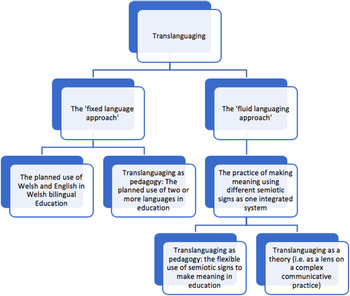
In section 3, we have traced the genealogy of the term ‘translanguaging’ and identified two research approaches in which the term has been used and developed, namely ‘the fixed language approach’ and ‘the fluid languaging approach’. We have shown that even though the same term ‘translanguaging’ is used in both approaches, it refers to very different phenomena. We have then shown how translanguaging is usually conceptualised as either a pedagogy or a practical theory of language, and how these two conceptualisations can be articulated, bearing in mind the distinct epistemologies underpinning the two approaches. It is therefore crucial, when engaging in reading about translanguaging scholarship or in undertaking translanguaging research, to clearly identify the relevant approach. With this in mind, we propose the following diagram in Figure 1 to give a visual representation of the different conceptualisations of ‘translanguaging’.
A conceptual map of ‘translanguaging’

4. A review of empirical work on translanguaging in education
In this section, we turn to a review of empirical studies of translanguaging in education with a view to accounting for the ways in which the concept of ‘translanguaging’ has been operationalised across different educational contexts. We have focused on the following key settings: mainstream classrooms (section 4.1.); higher education (section 4.2); foreign language education (section 4.3.); immersion education (section 4.4.); heritage and minority education (4.5); and content and language integrated learning (CLIL) (section 4.6). We also describe the impact of translanguaging practices in these different educational settings, which can look like: learners developing a better metalinguistic awareness; existing language hierarchies being challenged; marginalised languages or languages with a lower status being included in the classroom; students being empowered through the creation of spaces that enable the display of their linguistic resources, knowledge and views of the world; new identities being constructed and enacted; or cultural values and power relationships being renegotiated in the classroom.
4.1. Translanguaging in mainstream classrooms
Translanguaging is a concept that has been used to describe the complex meaning-making practices that take place in mainstream education settings that are multilingual in nature. We make reference here to classroom settings in the Global South, where communication between teachers and learners has involved the use of different linguistic resources ever since the colonial era. We also make reference to mainstream classrooms in the Global North, which have become more multilingual due to the increasing transnational population flows of the twenty-first century. The use of the term ‘Global South’ refers to nations situated in the south of the globe that have also been often designated as developing, or even more negatively, undeveloped (Shoba & Chimbutane, Reference Shoba and Chimbutane2013). Mignolo (Reference Mignolo2014), a decolonial theorist, has observed that the geographical division of the world as ‘West’/’East’ or ‘North’/‘South’ is determined essentially by economic and political criteria. He says that the division as ‘West’/‘East’, which was previously determined by colonialism, Christianity and its civilising mission shifted after World War II to ‘North’/‘South’ divide in order to legitimise a mission of development and modernisation led by Europe and the USA. The studies reviewed below are only examples of the many complex issues found in mainstream classrooms.
In her research in the Global South, Probyn (Reference Probyn2019) argues that heteroglossic practices have been long documented in studies of mainstream education in this part of the world, and she refers, in particular, to scholarship on code-switching (e.g. Lin & Martin, Reference Lin and Martin2005). In her 2019 paper, she presents language practices in Grade 8 science classes in eight township and rural schools in South Africa, where the teachers and learners shared a common African language (isiXhosa) and where the medium of instruction was English. She video-recorded a series of five consecutive science lessons for each of the eight science teachers and interviewed all eight teachers too. She then conducted a socio-cultural analysis of the data (Mercer, Reference Mercer2004) with a view to accounting for both the science content of the lessons and the language resources used to construct that knowledge. Her findings reveal that one particular teacher had adopted translanguaging as a pedagogy and was building on learners’ understanding in their home language before transferring that understanding into English. A detailed analysis of seven excerpts of classroom talk showed that this teacher's ‘translanguaging practices appeared flexible and responsive to learners’ needs’ (2019, p. 226) while, at the same time, posing a challenge to ‘the post-colonial monolingual ideologies’ prevalent in these classrooms (2019, p. 16). It is clear that Probyn understands translanguaging both as a pedagogy and as a theory, and that she draws on both the fixed and fluid approach to translanguaging. She ends her paper with a call for ‘planned, systematic and sustainable translanguaging pedagogies that can be incorporated into mainstream teacher education’ (2019, p. 233) whilst also praising the way in which access to the science curriculum was improved when the teacher drew on students’ full repertoires in ‘a flexible and responsive manner’ (2019, p. 226).
In a study carried out in the Global North, Duarte (e.g. Reference Duarte2018, Reference Duarte2019) notes that most of the translanguaging studies in education have been conducted in bilingual educational programmes or in complementary schools and that little is known about the potential of translanguaging practices in mainstream education (2019, p. 151). In her 2019 paper, she examined the use of translanguaging as a tool for acquiring new knowledge by drawing on video recordings of 59 10th Grade (15-year-olds) subject-matter classes in four secondary schools in Germany. Like Probyn (Reference Probyn2019), Duarte adopted a sociocultural approach to discourse analysis (Mercer, Reference Mercer2004) to focus this time on peer-peer interactions. Building on the theoretical assumption that participation in social interaction is key to cognitive development, she showed how pupils’ translanguaging practices, between German and other language resources, supported pupils’ participation and therefore their co-construction of knowledge. Duarte's understanding of translanguaging is clearly situated in the fluid languaging approach since she defines translanguaging as ‘the dynamic and flexible ways in which multilingual speakers access their language repertoires to expand their communicative potential’ (2019, p. 151). For that reason, her quantitative analysis of the number of occurrences of each language available in the classes under study was slightly surprising as it indexed the use of an analytical lens that still conceives languages as bounded and numerable entities. Her qualitative analysis of classroom talk remains, nevertheless, very rich and sheds light on how translanguaging was used to scaffold meaning through interaction and to ‘reinforce the creative process of knowledge building, by mediating the emergence of high-order thinking’ (2019, p. 62).
Another scholar who puts to the fore the creative power of translanguaging in mainstream education is Pedley (Reference Pedley2018a, Reference Pedley2018b). In her work, published so far in French, Pedley focused on the case of Scotland, UK, where a language education policy has been adopted according to which pupils need to learn two languages in the first and fifth year of their primary school education. Pedley focused on a multilingual poetry competition in Scotland called ‘Mother Tongue Other Tongue’, run by the Scotland's National Centre for Languages (SCILT), where pupils were invited to write a poem in a language(s) of their choice, accompanied by a commentary in English. In 2015–2016, the year of her study, poems were submitted in 36 different languages. Pedley showed how pupils discovered their creative abilities during the writing of their poems, and how they playfully used all the linguistic resources in their repertoires. She argued that, in doing this, pupils found their own voice as ‘multilingual’ speakers and developed a sense of belonging to an emerging multilingual community of practice. They were then able to confidently share with their monolingual peers their newly acquired multilingual identity and demonstrate the value of speaking and learning more than one language. Furthermore, Pedley showed how this competition was an opportunity for pupils to explore translanguaging as a literacy practice and she noted that this activity was for them the equivalent of a ‘rite of passage’, where their languages became their own. She called this a case of ‘language appropriation’ (Castellotti, Reference Castellotti2017). Pedley's (Reference Pedley2018a, Reference Pedley2018b) view of translanguaging is in line with the fluid languaging approach. She used translanguaging as a conceptual lens and in so doing, offered a glimpse into the creative forging of new literacy practices in mainstream education.
Translanguaging in literacy practices in mainstream education has also been studied by Torpsten (Reference Torpsten2018) who focused on a multilingual school in Sweden where, originally, only Swedish was allowed, and mother tongues were taught separately in after-school classes. Torpsten showed how a teacher decided to adopt translanguaging as pedagogy ‘in order to break away from the previous monolinguistic approach in school and to promote learning in all subjects’ (Reference Torpsten2018, p. 109). Torpsten did research in that teacher's classroom and collected a sample of texts and pictures produced by eleven-year-old pupils. As part of this research, she focused on the case of three pupils who spoke Swedish as an additional language and provided an account of their attitudes towards translanguaging practices in class. The three pupils spoke Chechen, Thai and Somali, as well as Swedish. Using an ecological approach (Kramsch, Reference Kramsch2008) and a linguistic life-story approach (Bengtsson, Reference Bengtsson2007), Torpsten elicited these pupils’ life stories and linguistic memories. She showed how they became more at ease in translanguaging in literacy activities. They also demonstrated positive attitudes towards translanguaging and showed signs of the emergence of a multilingual identity. In this study, translanguaging sometimes seemed to be conceptualised in ways that were mostly compatible with the fixed language approach. For instance, Torpsten wrote that ‘reading can be done in one language and writing in another’ (Reference Torpsten2018, p. 105). However, the data analysis in her paper shows evidence of the use of multiple language resources in literacy activities. Torpsten's account also reveals that she adopted a fluid languaging approach, since she showed how speakers used multiple semiotic signs (such as drawings, colours, languages, etc.) to convey meaning in complex ways.
To summarise, some of the studies in mainstream education focused on: (a) building an understanding of how translanguaging supports the co-construction of knowledge and (b) on attitudes towards translanguaging practices. All the studies in the contexts reviewed here indicated that translanguaging did indeed contribute to knowledge construction as well as to the construction of multilingual identities. Researchers encouraged translanguaging as a pedagogy, but rarely endorsed translanguaging as a theoretical lens, where translanguaging could be seen as serving more than knowledge construction.
4.2. Higher education
The papers on research in higher education settings reviewed here dealt with participants in undergraduate and postgraduate courses. Key participants were either lecturers and students, just lecturers or just students. The studies by Mazak and Herbas-Donoso (Reference Mazak and Herbas-Donoso2015), Caruso (Reference Caruso2018) and Wang and Curdt-Christiansen (Reference Wang and Curdt-Christiansen2019) were concerned with translanguaging practices related to subject-content in undergraduate courses. Afaf al-Bataineh and Gallagher (Reference Afaf al-Bataineh and Gallagher2018) focused their study on students’ views about translanguaging practices in the classroom.
Mazak and Herbas-Donoso (Reference Mazak and Herbas-Donoso2015) examined interactions in an undergraduate Plant Science course in Puerto Rico. In this study, the authors described the translanguaging practices of a Puerto Rican lecturer in relation to written materials used in the classrooms. The university was officially bilingual in Spanish and English, the co-official languages of the country. However, there was no policy defining the language(s) of instruction, of materials, texts or forms of assessment. The translanguaging practices of the lecturer consisted of using Spanish to talk about English academic articles and PowerPoint slides in English. According to the two authors, these translanguaging practices transformed the science classroom into a space where Spanish was legitimised as a language of science. The connections to scientific discourse in English was also valued and developed for specific purposes since English has been constructed as a global language for scientific research and it is highly valued in academia. The authors argue that translanguaging practices supported the development of Puerto Rican Science students’ linguistic repertoires and contributed to the breaking of the monopoly of English as the only language of knowledge-building in the field of science.
Caruso (Reference Caruso2018) carried out a study of an undergraduate course called ‘Language and Communication Policies’ at a university in Portugal. A case study approach was taken in this research and the data sources were field notes based on participant-observation in the classroom, audio-recordings and questionnaires. The participants in this case study were a Portuguese lecturer who could speak Portuguese, English and French, local students from Portugal, and Erasmus students from Spain and Italy. All students had different linguistic backgrounds but they were all proficient in English. Caruso reviewed two approaches to translanguaging in her paper, but her main framework seems to have been rooted in the fixed language approach. This framework was relevant to the discussion of her main finding, namely, that the translanguaging in the interactions in the course involved careful planning to ensure equal use of all participants’ linguistic resources. At the beginning of the course, the Portuguese lecturer established the nature of the translanguaging practices in his course – the students could draw on any linguistic resources they wanted, but one condition was that they had to read the relevant academic text in English. The lecturer also established that there would be one language for the PowerPoint slides, one language for oral presentations and another language for interacting with him and peers. Caruso (Reference Caruso2018) reported that the majority of the students assigned high value to the use of several languages in the classroom because it facilitated communication and understanding. It included all the students’ linguistic resources and enriched each individual's repertoire. The author argues that translanguaging practices also enabled the participants to engage in metalinguistic discussions and facilitated the co-construction of knowledge. In addition, translanguaging helped to ensure equity and facilitated inclusion.
Wang and Curdt-Christiansen (Reference Wang and Curdt-Christiansen2019) analysed classroom practices and Chinese students’ views on the translanguaging practices of teachers in a Business Management Bilingual Education programme in China. The authors found that the Chinese teachers’ bilingual practices were very flexible. English and Chinese were used in a flexible way to introduce the content of the lesson, to explain certain concepts and terminologies, to summarise the content and to manage the class. Translanguaging practices were grouped into four different categories by Wang and Curdt-Christiansen as bilingual label quests, simultaneous code-mixing, cross-language recapping, and dual-language substantiation. Students evaluated their bilingual programme positively, although they were not totally satisfied with some language practices. The majority of the students stated that the course did not offer them adequate opportunities to practise spoken English. Wang and Curdt-Christiansen (Reference Wang and Curdt-Christiansen2019) argue that if English had been the only medium of instruction in the programme, the outcomes may not have been positive and the students may not have had a flexible attitude towards translanguaging practices.
In the three studies described above, English was part of the participants’ linguistic repertoire and practices. The concern of the lecturers was to mediate the content of the subject that they were teaching by drawing on any linguistic resources available to their students. Texts were in one language only, but the talk around the texts was multilingual. Regarding the views of students on translanguaging, the studies by Caruso (Reference Caruso2018) and Wang and Curdt-Christiansen (Reference Wang and Curdt-Christiansen2019) offered distinct perspectives. The students in Portugal appreciated the use of their linguistic resources, whilst the students in China indicated that they would have preferred to have more opportunities to practise English in their classroom.
Afaf al-Bataineh and Gallagher (Reference Afaf al-Bataineh and Gallagher2018) examined local teacher trainees’ attitudes in the United Arab Emirates towards written stories involving translanguaging. The teacher trainees expressed both positive and negative views about multilingual practices in their interviews. Some stated that the use of more than one language in the classroom develops pupils’ vocabulary and capacity to interact in two languages or that it encourages cultural and linguistic diversity. However, most of the trainee teachers were against the use of two languages in the classroom. The majority strongly rejected the idea of using two languages to teach writing to children. They argued that it would hinder the development of pupils’ creativity in using each language. In addition, they also stated that the use of English and Emirates Arabic was perceived as being a threat to the status of Modern Standard Arabic. Their views were shaped by their beliefs about language pedagogy and about Modern Standard Arabic, Emirati Arabic and English in their society and in the classroom. The interviews with the teacher trainees provided detailed insights into their language ideologies and beliefs about bilingual pedagogy that seem to be rooted in the conceptualisation of translanguaging associated with the fixed language approach. In fact, the participants did not talk about bilingualism as shuttling in fluid and dynamic ways from one set of linguistic resources to another. Bilingualism was seen as involving the use of linguistic systems that are fixed and bounded entities.
In these examples of research in higher education settings, scholars were drawing on both conceptualisations of translanguaging; namely, the fixed language and fluid languaging approaches. The pedagogical benefits of translanguaging were alluded to in all papers. Translanguaging practices can help teachers and students to create spaces for languages other than English to be developed as languages of knowledge in the field of science; they can facilitate communication and understanding, inclusion, and ensure equity among students who share Romance linguistic resources and English; they can improve students’ attitudes towards flexible multilingualism; they can help teachers to enhance young learners’ vocabulary and ability to interact in more than one language. However, in some studies students expressed reservations about translanguaging practices in the classroom, and preferred more space to practise English.
4.3. Foreign language education
The papers selected for this section were all about translanguaging in classroom interactions, although a few of them also provided an analysis of students’ views. Interactional data were used by all the authors and a few of them included interview data as well. Martina-Meltrán (Reference Martina-Meltrán2014) and Rasman (2018) examined peer-peer interactions, Yuvayapan (Reference Yuvayapan2019) and Ollerhead (Reference Ollerhead2019) focused mostly on the teachers’ linguistic practices, while Leroy and Santos (Reference Leroy and Santos2017) considered students’ written work. Most papers drew on the fluid languaging approach to translanguaging. The only exception was that by Yuvayapan (Reference Yuvayapan2019).
Martina-Meltrán (Reference Martina-Meltrán2014) investigated students’ translanguaging practices in a programme called Language Ambassadors (LA) that included high school students in the USA. The students who had English as their home language were learning Spanish as a foreign language, while students who spoke Spanish at home were learning L2 English. They participated in joint literacy activities across English and Spanish that involved reciprocal teaching/learning opportunities. Conversations and the written language had to be done in their target language, in the language that the students were aiming to learn. Participating in this LA programme were also Spanish and ESOL teachers. Interactional ethnography was the approach adopted in her study. The data gathered included fieldnotes based on classroom observations, audio/video-recordings, interviews and students’ written work. Combining the theoretical concepts of Third Space (Moje et al., Reference Moje, Ciechanowski, Kramer, Ellis, Carrillo and Collazo2004), funds of knowledge (González, Moll, & Amanti, Reference González, Moll and Amanti2005) and translanguaging, the author conducted classroom discourse analysis to reveal how language and literacy learning were being developed in the classroom and to provide a detailed analysis of peer-peer and teacher-peer interactions. Martina-Meltrán found that the use of the utterance ‘what do you want to say?’ came up many times in both English and Spanish language during the LA programme sessions. It indexed the students’ engagement with the texts they had written and their support for each other in expressing ideas. As they engaged in this literacy work, they resolved linguistic problems and displayed and increased their metalinguistic awareness. Martina-Meltrán came to the conclusion that translanguaging practices such as these provide interactional opportunities for language development and for the cultivation of equitable learning environments. They also have the potential to shift students’ and teachers’ beliefs about what counts as appropriate language use in school and opens up space for more pluralistic views of students’ linguistic repertoires.
The other two scholars, Rasman (2018) and Yuvayapan (Reference Yuvayapan2019) make valuable points regarding the wider ideologies shaping translanguaging practices in the classrooms where they conducted their research. Rasman (2018) investigated the teaching of English as a Foreign Language in a secondary school on the Island of Java, in Indonesia. He took an ecological approach (van Lier, Reference van Lier, Creese, Martin and Hornberger2008) and analysed the translanguaging practices of students in a group discussion activity as they used their full repertoire. This included Javanese, Indonesian and English. In the extracts of classroom interaction presented, the author illustrates the ways in which shuttling between the different linguistic resources associated with those languages enabled students to negotiate and understand the meaning of words in English to interact and scaffold each other when performing group tasks. In addition, these translanguaging practices enhanced their multilingual abilities as they expanded their vocabulary in English. However, Rasman (2018) pointed out that despite the value of spontaneous translanguaging spaces, created by the students and allowed by the teacher, there were ideological constraints on students’ use of their full repertoire. Indonesian and English have higher status than Javanese. Indonesian is the national language associated with power and authority, and the language of educated people in the wider social, political and educational context. Drawing on his analysis of the interactional data that he had gathered, Rasman showed that, in this group activity, students hesitated to use Javanese and mocked the Javanese accent.
Yuvayapan (Reference Yuvayapan2019) investigated the perceptions and practices of Turkish teachers of English working in public and private schools in different cities in Turkey. She reviewed the work of scholars on translanguaging from both of the approaches identified in this review. However, given that her analysis focused on the use of both English and Turkish to support English learning, her work seems to belong to the fixed language approach. This study draws on a survey, classroom observation and interview data. The survey shows that the majority of teachers agreed with the use of Turkish in the English lessons (and not English only). Ten teachers were interviewed and some said that the use of Turkish could limit students’ autonomy and competence in English, but all of the teachers agreed that Turkish should be used to interact with students with lower proficiency in English. With regard to the actual classroom practices, Yuvayapan's observations provided evidence that Turkish was used to clarify English content, to manage classroom routines, to bond with the students and to motivate students to engage with the lessons. Yuvayapan argues that translanguaging practices in the foreign language classrooms that she studied meant using teachers and students’ full linguistic repertoire by using both Turkish and English to ensure that students are able to learn English, the target language. Despite these beliefs about the benefits of using Turkish in their classrooms, teachers also drew attention to the institutional constraints in the schools where they taught. The school language policies actively prohibited the use of Turkish in English lessons.
Leroy and Santos (Reference Leroy and Santos2017) carried out a study at a university located on the triple frontier between Argentina, Brazil and Paraguay. It is a public university which opened officially in 2010 with the aim of developing international cooperation among a group of South American nations through education. Brazilian students had to take Spanish as an Additional Language classes, while other students had to take Portuguese as an Additional Language (PAL). The focus of this study was on one of the PAL classes. The authors cited the work of García and Leiva (Reference García, Leiva, Blackledge and Creese2014) on translanguaging. They combined this perspective with the notion of transculturation (Ortíz, Reference Ortíz2002) and with the work of Mignolo (Reference Mignolo2000) on decoloniality in the field of Cultural Studies. The lecturer was from Brazil and he was proficient in Portuguese, Spanish, French and English. Students were originally from Chile, Colombia, El Salvador and Haiti. Leroy and Santos (Reference Leroy and Santos2017) analysed the students’ written portfolios. In these portfolios, students had evaluated their learning experiences, the teaching materials and the methodologies of the lecturer. The researchers found out that translanguaging was part of the way that the students understood and expressed themselves about Brazil, the new country they were living in. The authors argued that translanguaging practices in this PAL classroom could not be separated from the way the students understood the world. In their view, the students were creating a transgressive space in the classroom where new discourses and forms of expression were being produced. The students’ translanguaging practices contradicted the authoritarian monolingual practices of education in Brazil. The authors concluded that the value of translanguaging practices is that it can encourage students and lecturers in language classes to think of borders not as places that separate and fragment, but as spaces that unite, include and transform people through the use of diverse linguistic and semiotic resources wherever they are and contribute to the fostering of social justice.
In sum, what we take from these examples of research is that translanguaging in foreign language education is not only about its pedagogical implications, but it is also about the relationship between the practices of teaching and learning in the classroom, people's everyday life and the wider society. We see that, as teachers open up spaces for translanguaging practices, students can creatively interact with each other, engage with their own text, and together find solutions for the linguistic problems they encounter; and ultimately, students can develop the target language that they are learning. We also see that people's knowledge and views of the world shape their translanguaging practices and, at the same time, their translanguaging practices are shaped by the wider ideological context.
4.4. Immersion education
The papers selected for this section on immersion education contexts are based on research that focused on young learners: children aged 5–12 years old. The studies of translanguaging in immersion education programmes were mostly conducted in the USA and Canada but we have also included a study conducted in Europe. The fluid languaging approach served as the main framework for all the papers selected. In the first two articles, the authors investigated translanguaging in literacy practices and its pedagogical implications. The two remaining articles focused on the relationship between translanguaging, identity work and social relationships.
Zhang and Guo (Reference Zhang and Guo2017) conducted a qualitative study in a Mandarin–English bilingual program in a state school in Alberta, Canada. They investigated the translanguaging literacy practices of eight children in Year 5. The data collection phase of the study included classroom observation, semi-structured interviews with children's parents, teachers and the program coordinator, informal conversation and email communication with the children, and the gathering of students’ artifacts. They used Multiple Literacy theory (Masny & Cole, Reference Masny, Cole, Masny and Cole2009) and a fluid languaging approach to translanguaging as the two frameworks for this study. Drawing on translanguaging theory, the authors directed their attention to the ways in which participants went beyond language boundaries. They also drew on the concepts of creativity and criticality from Wei's (Reference Wei2011) work. They reported that children engaged in two kinds of literacy practices: they used only traditional Chinese characters; or they mixed traditional Chinese characters creatively with simplified ones, ignoring the boundaries between the two writing systems. Children also created poems, nicknames and homonyms. They drew on their own funds of linguistic and cultural knowledge and mixed them. Zhang and Guo argued that translanguaging is a legitimate practice and that the practices they documented did not constrain pupils’ learning. It actually encouraged them to use language and orthographic resources as they wished. It enhanced pupil's creativity as they pushed the boundaries of writing systems, producing new and different structures.
Velasco and Fialais (Reference Velasco and Fialais2018) also focused on translanguaging in literacy practices but in a French–German public Kindergarten school in the Alsace region of France. Students aged 5 and 6, from multilingual backgrounds, were the participants in this study. They were expected to develop their reading skills at this stage. In their article, Velasco and Fialais describe the ways in which the children were simultaneously developing biliteracy in French and German. The notion of translanguaging space (e.g. Wei, Reference Wei2011) was used to characterise the ways the teacher was developing the children's biliteracy practices in the classroom. The teacher selected some words from the children's lexical repertoire and asked them to analyse identical and non-identical cognates that embedded different phonological, print and semantic elements in French and German. Children showed a metalinguistic ability to analyse the visual forms and sounds of selected words in a meaningful way. Based on these findings, Velasco and Fialais argue that it is possible to create pedagogical spaces that can support the development of young children's metalinguistic awareness. They also emphasise the role of teachers in creating translanguaging spaces that can foster comparisons and metalinguistic understandings of different languages and the writing systems associated with them.
García-Mateus and Palmer (Reference García-Mateus and Palmer2017) studied the translanguaging practices of a two-way bilingual education (TWBE) classroom in a primary school in the USA. Their aim was to contribute to the discussions about the relationship between translanguaging and identity construction and about the transformative potential of translanguaging pedagogy (Garcia and Wei, Reference García and Wei2014). In their analysis of translanguaging interactions, García-Mateus and Palmer explored the ways in which the participants exchanged information, and, at the same time, co-constructed their sense of identity and positioned themselves in the interaction. Seven students in a Year 1 class were the focus of this study, but for this paper, the authors focused only on describing the interactions of two students about bilingual poems. In the first extract, García-Mateus and Palmer describe one of the students’ awareness of the contrast between the phonetics of Spanish and English. Writing about the second extract, the authors illustrated the ways in which the two students were engaging with the academic task, drawing on a range of linguistic and cultural resources. García-Mateus and Palmer (Reference García-Mateus and Palmer2017) argued that in this second extract, the students’ translanguaging practices served as a means of performing bilingual identities. According to the authors, in dual contexts such as these, translanguaging practices not only support the development of critical linguistic awareness but they also contribute to the enactment of bilingual identities as a positive social act over an extended timeframe.
Poza (Reference Poza2019) also studied a TWBE classroom (Spanish and English) in the USA. The participants in his ethnographic study were Latinx students aged 10–12 years old, in Year 5. In his paper, Poza addresses the question of how translanguaging practices shape social relations and identity work. In the extracts presented in the paper, the author illustrates the ways in which students’ translanguaging practices helped them to engage with North American cultural activities (e.g. tetherball and speaking English) and to build social bonds with each other. The students’ participation in tetherball activities and their use of English contradicted the stereotypes about Latinx who are constructed in dominant discourse as being reluctant to embrace the linguistic and cultural norms of North American society and as only participating in the cultural life of their own ethnic group. Translanguaging was also used by students to convey their dislikes, to articulate opposing views, to convey affinities and it also served as a resource for storytelling and acquisition of information. In addition, translanguaging was employed as a resource to communicate affect, to build social relationships, to reject and distance someone and to narrate real or fictitious events. Poza was not only concerned with the role of translanguaging for academic purposes, but also with the role of translanguaging in shaping social relations.
The four papers above have illustrated that some of the research on translanguaging in immersion education settings has focused on the pedagogical implications of translanguaging. In general, the authors argued that translanguaging practices in the classroom served as a resource: it enabled students to engage in discussions about the lesson content, to enhance their confidence and creativity, to participate in classroom activities, and to develop their metalinguistic awareness. In addition, this strand of research in immersion classrooms has shown how translanguaging practices contribute to the construction of a bilingual identity and to the shaping of social relations between students in the classroom.
4.5. Heritage and minority education
Studies of heritage and minority education have mostly been based in European contexts. Two papers reviewed here have been written about heritage education in the UK and two papers have focused on minority language education in other parts of Europe. Wei (Reference Wei2014) and Creese and Blackledge (Reference Creese and Blackledge2015) explored translanguaging practices in complementary schools in the UK. Moriarty (Reference Moriarty2017) and Leonet, Cenoz, and Gorter (Reference Leonet, Cenoz and Gorter2017) investigated the views of teachers and students regarding translanguaging practices in the revitalisation of minority languages such as Irish and Basque.
Wei (Reference Wei2014) conducted ethnographic research in a Chinese complementary school, promoting the teaching and learning of Cantonese and Mandarin to 10–12-year-old pupils. The pupils were mostly British-born, while many of the teachers were from mainland China and had been in the UK for a short period of time. Theoretical concepts such as funds of knowledge (Moll, Amanti, Neff, & González, Reference Moll, Amanti, Neff and González1992), symbolic competence (Kramsch, Reference Kramsch2006) and the fluid languaging approach to translanguaging were combined to shed light on the ways in which teachers and students used and negotiated the differences in their linguistic knowledge and socio-cultural experiences. In his paper, Li Wei focuses first on the conceptual framework, on the trans- features of languaging. He points to three innovative features to be considered in language pedagogy: trans-systems and trans-spaces; the transformative nature of languaging; and the transdisciplinary consequences of conceptualising language in a new way (p. 164). He argues that the mobilisation of participants’ linguistic resources contributes to the development of their socio-cultural identities and to the creation of new social spaces. The teachers in this study tried to transmit certain cultural values and practices from mainland China, whilst the pupils tried to contest these and provided resistance to the values and practices transmitted by the teachers. Both teachers and pupils asserted their own socio-cultural identities and, at the same time, learned from each other as they drew on their own linguistic resources and negotiated their funds of knowledge.
Creese and Blackledge (Reference Creese and Blackledge2015) discuss the relationship between translanguaging and identity in their account of an ethnographic study that they conducted in a Panjabi complementary school in Birmingham, UK. The authors’ conceptualisation of translanguaging is in line with the fluid languaging approach. They agree that languages are not fixed and separate entities and that people draw on their communicative repertoires as one integrated system. Creese and Blackledge also take the view that translanguaging can create transformative spaces for the construction of identities. In this paper, they represent identities as socially constructed, in interaction, in superdiverse urban contexts in Birmingham. They discuss and analyse the linguistic practices that they observed and audio-recorded in the classroom in this complementary school. They describe how the teacher drew on linguistic resources shared with the students, which included English and Panjabi, to make teaching points or to uphold classroom management. The translanguaging practices of the students indexed their awareness of their cultural heritage but at the same time served to position themselves as young, urban, sophisticated speakers with multilingual resources. The use of different linguistic resources included their choice of register and style. They moved beyond linguistic systems to adopt, impose and negotiate cultural values and the identity of urban youth. Their classroom practices served as a means of navigating the relations of power between teachers and learners.
Moriarty (Reference Moriarty2017) conducted an ethnographic study in two primary schools in the Republic of Ireland. The data presented in his paper were gathered in one classroom in an Irish primary school where English was the medium of instruction and Irish was a school subject. The author argued that there is a strong need to move away from the compartmentalisation of languages in the Irish sociolinguistic context. This is in line with the fluid languaging approach to translanguaging. Moriarty focused on the use of rap as a pedagogical tool to develop a more flexible approach to the teaching and learning of Irish. The teacher reported being passionate about the teaching of Irish, but pupils and parents had a negative attitude towards the Irish language. Children were given a set of guiding principles and were asked to create rap in Irish and perform it for the school. Although Moriarty did not provide us with extracts of the classroom interactions, he reported that pupils were translanguaging in their rap work and that this learning activity had triggered some changes in their beliefs about the Irish language. The rap songs were written mostly in Irish, but pupils were also drawing on languages that were part of their linguistic repertoire, including English, occasional use of Polish, French and an indigenous language from Nigeria. Rap provided a safe space for pupils to use their linguistic resources creatively and Irish lessons came to be perceived as lively and engaging. Reflecting on these findings, Moriarty argues that the principles of translanguaging rap can offer a ‘safe space’ for the development of a more holistic approach (Cenoz & Gorter, Reference Cenoz and Gorter2011) to language teaching and learning.
Leonet et al. (Reference Leonet, Cenoz and Gorter2017) examined the views of teachers regarding spontaneous translanguaging as a pedagogical tool in classes designed to maintain and develop Basque, a minority language in Spain. In their paper, the authors report on a pedagogical intervention, which was part of a larger project, in a state primary school, that aimed at developing students’ language awareness and metalinguistic awareness through translanguaging. The pedagogical intervention occurred in a Year 5 and 6 classroom during the Basque, English and Spanish language arts classes. Teachers were interviewed regarding the outcome of the intervention. They reported that it had helped to reinforce students’ vocabulary and discourse skills in Basque and had contributed to the development of metalinguistic awareness among the students. It also contributed to reducing their concerns about the boundaries between languages and raised the status of Basque vis-à-vis English and Spanish. Nevertheless, the teachers showed more concern about reinforcing the use of Basque than English or Spanish in their classes. The authors therefore concluded that a sustainable translanguaging pedagogy should be developed – one that takes account of the social and ideological contexts for the minority language while still attempting to create spaces for the use of the minority language. At the same time, learners with linguistic resources other than those of English or Spanish in their repertoires should also be able to draw on all their resources in their communicative repertoires.
In our review of the four articles above we noticed that the creation of spaces for translanguaging resulted in different processes in the two types of educational settings. In summary, in the two complementary schools, translanguaging created spaces for participants to engage in identity work and to negotiate cultural values and relations of power in the classroom; whereas in the two minority education settings, translanguaging contributed to the creation of spaces for the use of the minority languages and to the raising of the status of the minority languages among the students.
4.6. CLIL
We finish section 4 by reviewing translanguaging studies in the context of the CLIL classroom, also known as the European approach to bilingual education (Nikula, Reference Nikula, Deusen-Scholl N. and May2017). Despite the ongoing debate over the (lack of) differences between CLIL and immersion education (e.g. Cenoz, Reference Cenoz2015), we have decided here to review studies of translanguaging in CLIL separately, with a view to highlighting some of the issues that seem to be specific to the way translanguaging is conceptualised in CLIL contexts.
The role of multilingualism in CLIL has often been investigated by looking at the use of pupils’ first language (L1) when learning an L2 (e.g. Lasagabaster, Reference Lasagabaster2013; Gierlinger, Reference Gierlinger2015 to name but a few). Rather than keeping pupils’ languages separate, there is a growing consensus that pupils’ L1 can contribute to the learning of content in an L2 in CLIL classrooms. Marsh (Reference Marsh2002) undertook one of the first studies of translanguaging in CLIL contexts, reporting on 17 case studies of CLIL classrooms across Europe. He defines translanguaging as ‘the use of more than one language’, such as when a ‘teacher may speak in one language, and a pupil reply in another’ (2002, p. 17). It is clear that translanguaging is conceptualised here within the fixed language approach (see section 3.1) and the idea of pedagogic variation in language use for input and for output. In this sense, translanguaging is seen as a scaffolding tool to support the teaching and learning of the L2 in CLIL classrooms. Many scholars investigating multilingualism in CLIL contexts follow this conceptualisation of translanguaging, grounded in the fixed language approach. This is the case, for instance, of Lasagabaster (Reference Lasagabaster2013) for whom translanguaging is said to take place ‘if students read about a topic in the L1 and present their work in the L2’ (Lasagabaster, Reference Lasagabaster2013, p. 2). Another example is Coyle, Hood, and Marsh (Reference Coyle, Hood and Marsh2010, p. 16), who define translanguaging ‘as a systematic shift from one language to another for specific reasons’. The idea of systematicity and planning of language choice indicates clearly that these studies are grounded in the fixed language approach of translanguaging research. This enables scholars to show the value of bilingual talk in CLIL contexts, showing how teaching and learning can indeed take place in two or more languages in the same classroom.
Some scholars have started to try and move away from the L1 versus L2 dichotomy in the CLIL classroom, to focus instead on the functions of translanguaging (as opposed to the functions of the L1 in the CLIL classroom). Nikula and Moore (Reference Nikula and Moore2019) is a good example of this step forward. In their paper, they use the term ‘translanguaging’ as an umbrella term to refer to ‘bilingual behaviour’ (2019, p. 237), including language alternation, translation, calques, coinage and borrowings. They also recognise that translanguaging is a discursive practice that has ideological orientations (2019, p. 239) echoing Lewis, Jones and Baker's statement that ‘translanguaging is ideological’ (2012b, p. 666). They suggest that, in the CLIL classroom, ‘a fruitful way to proceed might be to proactively plan for language use which will involve the learners’ entire repertoire’ (2019, p. 244). This clearly situates their conceptualisation of translanguaging within the original fixed language approach to translanguaging. Nikula and Moore offer extracts from a corpus of interactions recorded in CLIL classrooms in Austria, Finland and Spain and focus on identifying different uses of translanguaging. More specifically, building on earlier work (Moore & Nikula, Reference Moore, Nikula, Nikula, Dafouz, Moore and Smit2016), they seek to establish whether instances of translanguaging are ‘orienting to language content’ (to support understanding of a particular language focus) or ‘orienting to the flow of interaction’ (to signal interactional alignment for instance) (2019, p. 242). The analysis reveals that the focus remains largely on the use of the L1 in the target language CLIL classroom. Their research reveals that ‘translanguaging’ in CLIL is ‘a tool to foster learning’ (2019, p. 241) and no mention is made about its potential transformative dimension. Furthermore, we note that the focus remains exclusively on linguistic practices, which indicates that translanguaging is not understood multimodally here, as the ability to make meaning through multiple semiotic signs.
Interestingly, other scholars note that focusing on the functions of translanguaging still denotes a focus on the use of the L1 in CLIL classrooms. Bieri (Reference Bieri2018, p. 92), for instance, calls for the need to adopt a broader understanding of translanguaging to shed light on translanguaging as pedagogy in CLIL classes. She situates her understanding of translanguaging within what we have called here the fluid languaging approach. She writes that ‘there is a multitude of integrated and interacting resources that compose each individual's repertoire where the individual can choose from in order to communicate effectively’ (2018, p. 93). This definition of translanguaging clearly echoes Wei's (Reference Wei2018) idea that a communicative repertoire is multimodal and (Canagarajah Reference Canagarajah2011a: 401) idea that all semiotic resources form one ‘integrated system’. In her study of translanguaging in CLIL and non-CLIL biology lessons in Switzerland, Bieri undertook the investigation of translanguaging practices by looking at ‘all facets’ of students’ and teachers’ multilingual repertoire (2018, p. 94). She analysed a corpus of 31 teacher lectures in CLIL (English) and non-CLIL (German) biology lessons video-recorded in an upper-secondary school in Basel-land. She also conducted a set of interviews with these teachers. However, despite having video-recorded data, there are no examples of how translanguaging is multimodal in that context. Bieri nevertheless provides a very detailed analysis of extracts of classroom talk where multiple languages are used creatively. She shows how translanguaging takes place between the students’ L1 (German), the target language (English) and the source languages of the subject specific vocabulary (Latin and Greek). She is clearly moving the focus away from understanding the functions of the L1 in the CLIL classroom. Furthermore, she shows that there is a mismatch between the CLIL teachers’ translanguaging practices and their monolingual perspectives, highlighting the need to examine both attitudes and actual practices in translanguaging research in CLIL contexts.
Going beyond translanguaging as pedagogy, Lin's work (e.g. Reference Lin2019; Lin & He, Reference Lin and He2017; Lin & Lo, Reference Lin and Lo2017) has paved the way to adopting translanguaging as a lens in CLIL contexts. Her recent review (2019) of translanguaging in CLIL classrooms recommends ways to approach extracts of classroom talk without focusing on either the use of the L1 or on functions of translanguaging. She provides two helpful examples of transcripts of classroom talk, accompanied by a photo of a particular interactional moment in a CLIL classroom in a secondary school in Hong Kong. Her detailed analysis shows convincingly, in our view, how students and teachers maintain an ‘uninterrupted flow of meaning making’ (2019, p. 11), or ‘the corriente’ (García, Johnson, & Seltzer, Reference García, Johnson and Seltzer2017), by drawing on their full communicative repertoire, including verbal and non-verbal semiotic resources such as visuals, gestures, eye-gaze etc. (what she calls ‘trans-semiotizing’). Her work is undoubtedly grounded in the fluid languaging approach of translanguaging research and contributes to the conceptualisation of translanguaging as theory. She anticipates that translanguaging and trans-semiotising can contribute to the challenging of existing hierarchical models of learning and teacher positioning. We find these words helpful in re-situating translanguaging studies in CLIL contexts:
. . . the role of language in the content-based classroom is not so much that of providing input for a human cognitive computer (the learner) to process and churn out a target language grammar as that of providing resources for classroom participants to co-construct meaning and understanding of the world in dynamic, spatially oriented meaning-making activity (i.e. a participatory, dialogic view). (Lin, 2019, p. 12)
5. Methodological considerations: The research reviewed here and directions for future research
In the empirical studies that we reviewed in section 4, researchers paid a lot of attention to the everyday classroom linguistic practices of teachers and students. Many studies favoured ethnographic approaches to the investigation of people's everyday translanguaging practices in educational settings. This choice follows the increasing shift towards ethnographic approaches to the study of multilingualism in the field of Sociolinguistics (see Martin-Jones & Martin, Reference Martin-Jones and Martin2017).
The main data sources used in most of the papers were interactional data and students’ written work and artefacts. Some researchers made references to classroom observations but extracts from fieldnotes were not drawn upon as data sources in their papers. Insights from sources such as ethnographic fieldnotes or field work diaries might have been incorporated into the analysis of the classroom interactions but this was not made explicit. Some studies included interview data and a small minority provided quantitative data from surveys conducted in classroom or school contexts. From data sources such as interviews and questionnaires, researchers were able to provide some insights into the participants’ perspectives on translanguaging practices.
Approaches to data analysis varied. In most papers, researchers drew only on the notion of translanguaging. Some researchers combined the notion of translanguaging with other theoretical frameworks to interpret the interactional and written data they had collected. For instance, Duarte (Reference Duarte2019) used socio-cultural discourse analysis (Mercer, Reference Mercer2004) to link the study of translanguaging practices and knowledge building processes; Rasman (2018) took an ecological perspective (van Lier, Reference van Lier, Creese, Martin and Hornberger2008) to explain the relationship between translanguaging practices and the wider socio-cultural context; Wei (Reference Wei2014) examined the ways in which teachers and students negotiated different funds of knowledge (Moll et al., Reference Moll, Amanti, Neff and González1992) and symbolic competence (Kramsch, Reference Kramsch2006); and Zhang and Guo (Reference Zhang and Guo2017) used Multiple Literacy theory (Masny and Cole, Reference Masny, Cole, Masny and Cole2009) to analyse children's translanguaging as they engaged in literacy practices.
As we have already noted, in most of the studies that we have reviewed here, there was thus a clear preference for ethnographically-informed research, but researchers tended not to offer methodological reflections on the specific nature of research into translanguaging in educational settings. Just two researchers offered reflections of this kind. Canagarajah (Reference Canagarajah2011a) and Wei (Reference Wei2011) proposed explicit approaches based on their research on translanguaging. The approaches proposed by these two scholars required collaboration and dialogue with participants in order to fully understand their translanguaging practices and to build an account of how they made sense of their world as multilingual writers and speakers.
In Canagarajah's (Reference Canagarajah2011a) study of the multilingual writing of one of his students, he made the case for a dialogical pedagogical approach and a commitment to building an understanding of participants’ individual translanguaging practices. He stated that ‘it is important that we develop our pedagogies ground up, from the practices we see multilingual students adopting’ (p. 415). His rationale for taking this approach is that they ‘bring with them funds of knowledge from home that are important for them’ (p. 415). In his view, extended open dialogue with multilingual students will enable us to build a deeper understanding of their practices, and of the social and historical context in which they have evolved. This will enable researchers to identify translanguaging practices in the classroom that are most appropriate.
In his paper, Wei (Reference Wei2011) describes the life trajectories, experiences and translanguaging practices of three Chinese undergraduate students of mathematics in London. Building on this study, he calls for a paradigm shift in the ways we investigate translanguaging space and analyse the creativity and criticality of multilingual practices. Wei (Reference Wei2011) argues that in the analysis of multilingual practices, linguists need to move away ‘from frequency and regularity oriented, pattern-seeking approaches to a focus on spontaneous, impromptu, and momentary actions and performances of the individual’ (p. 1224). In methodological terms, he proposed a method that he calls ‘Moment Analysis’ that is focused on the critical and creative moments of peoples’ actions. Wei (Reference Wei2011, p. 1224) states that: ‘A moment can be a point in or a period of time which has outstanding significance. It is characterised by its distinctiveness and impact on subsequent events or developments. People present at such moments would recognise their importance and may adjust their behaviour according to their interpretation of them.’
Observations, recordings of naturally occurring social interactions and participants’ metalinguistic comments are needed to do Moment Analysis. The latter can be gathered through conversations, individual or group interviews, journals and autobiographies where the participants express their views and comments on their own practices.
Looking ahead, there is a need for further methodological development and refinement in research design in the study of translanguaging. We list below some of the areas that need to be borne in mind.
• As conceptualisations of translanguaging are dynamic and keep evolving, methodologies need to be continuously adapted to keep up with these developments. For example, with regard to methods of data analysis, there needs to be closer alignment with the specific ways in which translanguaging has been conceptualised. As we have shown in this review, some scholars situate their work conceptually within the fluid languaging approach (that is, in relation to an epistemology where the notion of ‘language’ loses its relevance), but still continue to analyse the communicative functions associated with the use of particular named ‘languages’. Turnbull (Reference Turnbull2019) highlights the fact that this methodological tension is particularly salient in translanguaging research in foreign language (FL) contexts, where ‘the very goal of FL education is to teach and acquire “named languages”’ (2019, p. 234). Likewise, Pennycook (Reference Pennycook2010, p. 129) had raised a similar methodological concern in these terms: ‘how can we go about exploring language diversity without positing the existence of languages?’. Pennycook then suggested the idea of exploring ‘language ecologies’ to render language in its complex social, political and cultural environments (2010, p 129).
• Within the fixed language approach, where the aim of the analysis is often to understand the functions of the planned alternation of two or more languages, there is a need for more fine-tuned interactional analysis of translanguaging practices, drawing for instance on sequential approaches to bilingual talk such as Conversation Analysis.
• With the fluid languaging approach, where the aim is often to understand the complex ways in which speakers make meaning using a multiplicity of semiotic resources, there is a need to identify methodologies that would be suited to a sociolinguistics of mobile resources (a methodology for our times). As indicated above, we find Wei's (Reference Wei2011) suggestions regarding ‘moment analysis’ particularly promising in this regard.
• In order to overcome bias on the part of the analyst in research on translanguaging, we suggest that future research adopts methodological approaches that enables the study of translanguaging practices from an emic perspective, where the focus is on speakers’ practices, and on the fluid or fixed ways in which they draw on the resources within their linguistic repertoires in exchanging meanings with their interlocutors. We would in this view recommend an ethnomethodological perspective such as the one adopted in Conversation Analysis, where speakers’ actions are the starting point to understand complex multilingual interaction. In addition, we would also recommend ethnographic approaches, which enable us to get access to people's daily meaning-making practices, to their language values and beliefs and as Canagarajah (Reference Canagarajah2011a) has put it, to their insider interpretations of particular ways of speaking and/or writing.
• Drawing on different data sources, and triangulating information from those sources, are well-established knowledge-building practices within different ethnographic approaches. Ethnographic methods such as observations, the taking of fieldnotes, making audio- or video-recordings of classroom practices and analysing moments of classroom interaction, collection of artefacts, documenting biographies, carrying out interviews and focus group work enable us as researchers to build a detailed account of translanguaging practices as they naturally occur. This range of research activities needs to be combined with the investigation of the life trajectories, experiences, beliefs and values of the participants and the ways in which they perceive their own translanguaging practices.
• As Paulsrud, Rosén, Straszer, and Wedin (Reference Paulsrud, Rosén, Straszer and Wedin2017) argue, there is a need to conduct research beyond English-dominant educational settings such as the USA and the United Kingdom. They suggest that widening the variety of educational contexts to named languages other than English would give new insights into translanguaging as a theory and a practice.
• More work is needed to understand the conflicts and tensions between translanguaging and language policy in educational contexts. Wei and Martin (Reference Wei and Martin2009) made similar observations about the conflicts and tensions between code-switching and language policy. This is a particularly urgent line of enquiry as the field of language policy is moving towards ethnographic and interactional approaches that enable us to show how language policy as practice contributes to the legitimisation of different language resources at the local level of classrooms (e.g., Bonacina-Pugh, Reference Bonacina-Pugh2012, Reference Bonacina-Pugh2020; Gynne, Reference Gynne2019; Bonacina-Pugh et al., Reference Bonacina-Pugh, Barakos and Chen2020).
• Researcher reflexivity also needs to be a key dimension of any research activity related to translanguaging practices. The importance of reflexivity was made clear by Martin-Jones and da Costa Cabral (Reference Martin-Jones, da Costa Cabral, Tollefson and Pérez-Milans2018) in language policy research: ‘Researchers engaged in critical ethnographic research on language policy processes now have a keener awareness of the ways in which their own historically and socially situated subjectivity shapes different stages of the research process, especially when they are working closely with educational practitioners and students in local schools and classrooms’ (pp. 84–85). Likewise, researchers’ awareness of their own subjectivity should be addressed more often in qualitative research on translanguaging.
6. The turn towards translanguaging: Taking stock of its significance and current limitations
In this review, we asked four research questions:
(1) How is ‘translanguaging’ conceptualised?
(2) How is the concept of ‘translanguaging’ operationalised in empirical studies of translanguaging in education across different contexts?
(3) What is the potential impact of translanguaging in education?
(4) What is the significance of the recent scholarly turn to linguistic fluidity?
To answer the first and second questions, we have shown that two approaches are used in the study of translanguaging, namely what we have proposed to call the ‘fixed language approach’ and the ‘fluid languaging approach’. We then reviewed how translanguaging has been studied in different educational contexts. Each educational context raises particular issues that have influenced the way in which translanguaging has been investigated. With the fixed language approach, research on translanguaging mainly discusses the planned use of two languages. With the fluid languaging approach, scholars go beyond the notion of ‘language’ and explore the complex ways in which speakers use semiotic signs to co-construct meaning and transgress existing structures and relationships of power.
To answer our third research question, we have shed light throughout this paper on the impact of translanguaging in education. We have mentioned in particular:
a. The pedagogical power of translanguaging in education. Blackledge and Creese (Reference Blackledge and Creese2010, p. 201) explain that translanguaging as pedagogy is ‘a release from monolingual, instructional approaches and advocate teaching bilingual children by means of bilingual pedagogy, with two or more languages used alongside each other’. In our review of empirical research, we have shown that translanguaging can bring pedagogical benefits to learners and teachers in different educational settings. We also noted that examples of the pedagogical power of translanguaging in education were found in both the ‘fixed language’ and the ‘fluid languaging’ approaches to translanguaging.
b. The transformative power of translanguaging in education. García (Reference García2009) describes the transformative nature of translanguaging as a way of freeing language users from named languages. We discussed, for instance, how, in the particular context of community language education, Garcia and Wei, Reference García and Wei2014 indicated that the transformative potential of translanguaging enables language-minoritised communities who have been marginalised in schools and society to finally see (and hear) themselves as they are. In section 4, we have also shown how, in both the ‘fluid’ and ‘fixed’ approaches, translanguaging can have a transformative impact on learners’ identity and on their ideological ranking of languages. We noted that transformation in terms of multilingual speakers’ identity occurred mainly in classrooms where learners were speakers and writers of a non-dominant language of the society they lived in. They were learners not only from a migrant background, but also users of local marginalised languages, or learners in contexts where English is often constructed as the legitimate language. For these learners, translanguaging meant being given the opportunity to participate in the classroom by using their minority non-English language and knowledge.
To answer our fourth and final research question, we have shown throughout this review the significance of the recent scholarly turn to linguistic fluidity in shaping the ‘fluid language approach’ to translanguaging research, in particular the importance of the notion of ‘languaging’ and seeing language as a local practice. Translanguaging scholarship has also in turn contributed to the ongoing reflection on linguistic fluidity in Applied Linguistics. One of its main contributions is that it challenges the ‘multi’ approaches. It highlights the fact that ‘multi-’, as used in the term ‘multilingualism’ for instance, is problematic as it implies the coexistence of multiple and therefore separate languages. The fluid languaging approach to translanguaging therefore offers a kind of ‘post-multilingualism’ approach, which shows disturbances, interruptions and the breaking of boundaries between languages, and between languages and non-linguistic cues, with a view to capturing the complex flow of semiotic signs in meaning-making practices.
In lieu of a conclusion, we now point to the two main limitations in the current scholarship on translanguaging in education with the hope to stimulate and orient ongoing and future research. The first aspect of translanguaging research that has been questioned in the literature is its claim to be ‘transformative’. As García (Reference García2019, p. 373) points out, in many educational contexts, translanguaging spaces may still be too small to be called ‘transformative’ and it might often be the case that the authoritative code continues to hold power (see also our review of Rasman, 2018). Similarly, Block (Reference Block2018, p. 254) criticises current translanguaging studies as ‘not enough’ to be described as ‘transformative’. For him, transformation can only be achieved if the whole economy is reorganised. He argues that translanguaging research is currently not radically different from any other critical language studies in education because it does not address the redistribution of sources, nor does it address political and economic conditions. Likewise, Kubota (Reference Kubota2016, p. 490) also calls for more attention to be paid to ‘issues of asymmetrical relations of power and inequalities that privilege or stigmatise individuals and groups due to their plurilingualism, cosmopolitanism, and hybridity on the one hand, or their monolingualism and monoculturalism on the other’.
The second aspect of translanguaging research that has been criticised is the fact that it often celebrates fluidity over fixity. Jaspers and Madsen (Reference Jaspers and Madsen2016, Reference Jaspers and Madsen2019), for instance, argue that language fixity is still very much relevant in today's practices. In this sense, language fixity and fluidity might not be in a dichotomous relationship as it first appeared. On the contrary, Jaspers and Madsen (Reference Jaspers and Madsen2019, p. 16) argue that: ‘without linguistic fixity, […] there is no fluidity […] The two are part of the same linguistic culture where their mutual association with widely shared liberal values, such as communication, equality, inclusion and emancipation, invites dilemmas in everyday life and academia’. Kubota (Reference Kubota2016) also puts forward that the conceptual features of the multilingual turn overlap with neoliberal multiculturalism, which uncritically supports diversity, plurality, flexibility, individualism, and cosmopolitanism. In this vein, some scholars have shown the relevance of both language fluidity and fixity in translanguaging research in education. For instance, based on her empirical research of the British Chinese communities, Huang (Reference Huang and Mazzaferro2018, Reference Huang2020) sees translanguaging ideology and pedagogy as part and parcel of a stratified and complex school ecology. This school ecology, structured by the tension between centrifugal and centripetal forces, compounds language ideologies including those that represent bilingualism as knowing and using two fixed and separate languages; those that assert a preference for school-wide monolingualism based on a particular named language in its standardised form; and, at the same time, translanguaging practices and pedagogy. These different language ideologies and practices have meanings and values for different members within the educational institutions. In Huang's study, translanguaging is employed by some Chinese language teachers as a ‘natural’ practice to teach and learn in the classroom, while other Chinese teachers preferred adopting a ‘Chinese-only’ ideology and pedagogy. Huang argues that, in the multilingual context of community schools, criticising separate bilingualism in favour of translanguaging as the ‘advanced practice’ may therefore not serve as a panacea for all. Charalambous et al (Reference Charalambous, Charalambous and Zembylas2016) offer another good example of a study where the assumption that translanguaging pedagogies promote social justice is challenged. Their ethnographic case study of a classroom in a superdiverse Greek-Cypriot primary school shows the ways in which histories of conflict between ethnic groups and ideologies of language as a bounded system shape translanguaging practices. Classroom observations and interviews with the teacher reveal that Turkish-speaking pupils avoided displaying their Turkish abilities in the classroom. In their detailed analysis of classroom interactions, Charalambous et al. (Reference Charalambous, Charalambous and Zembylas2016) illustrate how students suppressed and showed emotional discomfort when asked to use Turkish in the classroom despite the teacher's attempts to promote the use of students’ full linguistic repertoire. According to Charalambous et al. (Reference Charalambous, Charalambous and Zembylas2016), the silence and reluctance to speak in Turkish is linked to wider nationalist ideological constructions of Turkish in the three ethnonationalist contexts where Turkish is described as being the language of the ‘enemy’ or ‘other’. Charalambous et al. (Reference Charalambous, Charalambous and Zembylas2016) argue that in the encounter between superdiversity and nationalist conflicts, it becomes more challenging to renegotiate linguistic and ethnic boundaries, because discourses of conflict make these boundaries less fluid (Charalambous and Rampton, Reference Charalambous, Rampton and Jackson2011). In this sense, discourses about language fixity can prevent more fluid languaging practices and silence students. They further argue that research on translanguaging in superdiverse contexts should not ignore the impact of wider ideologies such as nationalism, which still shapes the political order of nation-states we live in.
In sum, these two criticisms of the study of translanguaging in education suggest that, whilst translanguaging research in education has indeed opened the door to a post-multilingualism era in Applied Linguistics, its transformative power cannot be assumed and analytical attention should still be paid to the locality of meaning making practices and to the potential relevance of both language fixity and fluidity.
Questions arising
1. What would a methodology of our time look like? That is, a methodology suited to a sociolinguistics of mobile resources.
2. Are all translanguaging practices transformative? If not, what would support translanguaging practices in education to be transformative practices?
3. Is there a difference between ‘translanguaging’ as it is conceptualised in the fluid languaging approach and ‘communication’? Is all communication translanguaging?
4. Is there a difference between ‘translanguaging’ as it is conceptualised in the fixed language approach and ‘code-switching’?
5. What could studies on translanguaging in education involving semiotic resources other than ‘English’ bring to the field?
6. What could studies of translanguaging in non-educational contexts bring to the conceptualisation of translanguaging in education presented in this paper?
7. What would be the pedagogical and transformative power of translanguaging in education for learners who are not bilingual and are not part of language-minoritised groups?
8. What is the long-term impact of translanguaging practices in education on learners, teachers and the wider educational and societal structures?
9. In which ways can research on translanguaging practices in education inform language policies?
Acknowledgements
We are grateful to Professor Marilyn Martin-Jones, MOSAIC Group for Research on Multilingualism, University of Birmingham (UK) for the feedback she kindly gave us on an earlier version of this review. We are also thankful for the helpful comments we received from Professor Angela Creese, University of Stirling (UK), Professor Li Wei, UCL (UK) and two other anonymous reviewers. Last but not least, our thanks go to the editor of Language Teaching, Dr Graeme Porte, for his helpful editorial advice and patience as we finalised this paper under lockdown.
Florence Bonacina-Pugh is a Lecturer/Assistant Professor in Language Education and Programme Director of the MSc Language Education at The University of Edinburgh, UK. Her main research interests lie in the fields of language policy, multilingualism and citizenship. She has conducted studies in mainstream and complementary schools, as well as in higher-educational contexts. She is the co-founder and co-chair of the Language Policy Special Interest Group of the British Association of Applied Linguistics. Recent publications can be found in The International Journal of Bilingual Education and Bilingualism, Language Policy, Language and Education and Applied Linguistics Review.
Ildegrada da Costa Cabral has taught and supervised theses at Master's level at the University of Birmingham and the University of Nottingham (UK) since 2016. She was awarded a PhD in the School of Education at the University of Birmingham in 2015. In her doctoral research she undertook a multi-scalar investigation of language policy processes in Timor-Leste. Her current research interests include bilingual classroom discourse, linguistic ethnography, language policy processes, multilingualism and transnational migration. Her published research has appeared in The AILA Review, International Journal of Multilingualism and Current Issues in Language Planning.
Jing Huang achieved her PhD in 2016 at the University of Birmingham, UK. She recently worked as a Research Associate in the Department of Education at the University of Bath, UK. The project is an ESRC-funded multi-level investigation on language policy, which looks at how global mobility impacts UK multilingualism and language socialisation at the national, community and family levels. Prior to her doctoral study, Jing has taught English and Chinese for general and academic purposes in the UK and China for many years. Jing is interested in using ethnography to research multilingual practices of individuals, families, schools and communities, particularly in relation to social mobility, cross-boundary communication and bilingual education. Her latest work can be found in The Journal of Multilingual and Multicultural Development.