





Introduction
Habitat fragmentation and infrastructure development are major drivers of biodiversity loss globally, with disproportionate impacts on narrowly distributed endemic species (Fahrig, Reference Fahrig2003; Haddad et al., Reference Haddad, Brudvig, Clobert, Davies, Gonzalez, Holt, Lovejoy, Sexton, Austin, Collins, Cook, Damschen, Ewers, Foster, Jenkins, King, Laurance, Levey, Margules, Melbourne, Nicholls, Orrock, Song and Townshend2015). In the Lower Rio Grande Valley of southern Texas, recent large-scale construction related to border barrier infrastructure, natural gas processing and space exploration have intensified prior habitat loss, fragmentation and disturbance in Tamaulipan thornscrub and other ecosystems that currently support some of the most imperilled plant species in North America (Sternberg, Reference Sternberg2005; Fowler et al., Reference Fowler, Best, Price and Hempel2011; Middleton et al., Reference Middleton, Gonzalez, Lain, Trevino, Gabler, Garrett, Molano-Flores, Coons, de la Garza and Feria-arroyo2024). Effective mitigation and recovery of these species increasingly depend on active management interventions rather than passive protection (Guerrant et al., Reference Guerrant, Havens and Maunder2004; Maschinski and Albrecht, Reference Maschinski and Albrecht2017; Center for Plant Conservation, 2019). For many rare plants, population augmentation, reintroduction and ex situ conservation are central components of recovery strategies (Havens et al., Reference Havens, Vitt, Maunder, Guerrant and Dixon2006; Guerrant et al., Reference Guerrant, Havens and Vitt2014). These approaches depend fundamentally on the availability, viability and predictable performance of seeds. Early life-history stages, particularly seed storage and germination, often represent critical bottlenecks in recovery efforts but are frequently understudied in endangered plants (Menges, Reference Menges2008; Baskin and Baskin, Reference Baskin and Baskin2014).
Seed dormancy and germination timing are central processes in plant life histories, shaping recruitment, population persistence and responses to environmental variability (Harper, Reference Harper1977; Fenner and Thompson, Reference Fenner and Thompson2005). Across taxa, dormancy functions as a risk-spreading strategy that decouples germination from immediate environmental conditions, allowing seeds to persist through unfavourable periods and germinate when conditions are more likely to support establishment (Cohen, Reference Cohen1966; Venable, Reference Venable2007). Seed dormancy mechanisms vary widely among taxa and environments, particularly in arid and semi-arid systems where rainfall is episodic and recruitment opportunities are unpredictable (Venable, Reference Venable2007; Baskin and Baskin, Reference Baskin and Baskin2014). The expression of dormancy is influenced by both intrinsic factors, including seed developmental state and maternal environment, and extrinsic factors such as temperature, moisture and light (Roach and Wulff, Reference Roach and Wulff1987; Donohue, Reference Donohue2009; Baskin and Baskin, Reference Baskin and Baskin2014). As a result, germination responses often vary widely among species and even among seed cohorts within a species, reflecting adaptive strategies shaped by climate variability, disturbance regimes and habitat heterogeneity (Donohue et al., Reference Donohue, Casas, Burghardt, Kovach and Willis2010).
Within this broader theoretical framework, dry after-ripening and short-term post-collection conditions play particularly important roles in regulating dormancy release and germination responses (Probert, Reference Probert and Fenner2000; Baskin and Baskin, Reference Baskin and Baskin2014). Many species exhibit physiological dormancy that diminishes during dry storage as biochemical constraints on embryo growth are relaxed, leading to increased germination probability and altered germination timing (Baskin and Baskin, Reference Baskin and Baskin2004; Finch-Savage and Leubner-Metzger, Reference Finch-Savage and Leubner-Metzger2006). However, responses to post-collection conditions are highly species-specific and can be strongly modulated by storage temperature, duration and maternal effects (Probert, Reference Probert and Fenner2000; Walters et al., Reference Walters, Wheeler and Grotenhuis2005; Baskin and Baskin, Reference Baskin and Baskin2014). In some cases, short-term holding or dry after-ripening enhances germination, whereas inappropriate pre-storage or post-collection conditions can rapidly reduce seed quality or viability (Walters et al., Reference Walters, Wheeler and Grotenhuis2005; Probert et al., Reference Probert, Adams, Coneybeer, Crawford and Hay2007). These dynamics are well documented in model systems and agronomic species but remain poorly characterized for many wild plants, especially those with narrow geographic ranges or specialized habitat requirements (Merritt et al., Reference Merritt, Turner, Clarke and Dixon2007).
For narrowly distributed and endangered plant species, knowledge gaps in basic seed biology can have immediate and disproportionate consequences for conservation and recovery (Havens et al., Reference Havens, Vitt, Maunder, Guerrant and Dixon2006; Guerrant et al., Reference Guerrant, Havens and Vitt2014). Many such species are represented by small, fragmented populations, where seed collections are necessarily limited and often irreplaceable (Guerrant et al., Reference Guerrant, Havens and Maunder2004). In these systems, decisions about seed handling, propagation and planting must frequently be made in the absence of species-specific empirical data. This is particularly true for rare plants of the Lower Rio Grande Valley of southern Texas, a region that supports multiple federally listed endangered species but remains strikingly understudied with respect to seed ecology and early life-history processes (Sternberg, Reference Sternberg2005; Fowler et al., Reference Fowler, Best, Price and Hempel2011; Middleton et al., Reference Middleton, Gonzalez, Lain, Trevino, Gabler, Garrett, Molano-Flores, Coons, de la Garza and Feria-arroyo2024). In Tamaulipan thornscrub habitats of southern Texas, germination responses among native woody species are highly variable and often poorly predicted by standard dormancy classifications, complicating restoration and nursery propagation efforts (Luera et al., Reference Luera, Wahl-villarreal, Christoffersen, Treviño, Soti and Gabler2021). Recent work further demonstrates that germination outcomes often depend on interactions among scarification, hormonal cues, stratification and substrate conditions, underscoring the need for integrative approaches to seed ecology and storage research (Luera and Gabler, Reference Luera and Gabler2022). The lack of information on seed dormancy, viability and storage responses has been repeatedly identified as a constraint on recovery planning and implementation, yet this knowledge gap remains unresolved for many taxa in the region (USFWS, 2004, 2015, 2019; Luera et al., Reference Luera, Wahl-villarreal, Christoffersen, Treviño, Soti and Gabler2021).
Physaria thamnophila (Zapata bladderpod) exemplifies this challenge. This federally endangered Brassicaceae species is endemic to calcareous upland habitats near the Rio Grande River and occurs in a semi-arid, subtropical environment characterized by high temperatures and strong interannual variability in rainfall (Sternberg, Reference Sternberg2005; Fowler et al., Reference Fowler, Best, Price and Hempel2011). Field observations indicate that aboveground emergence, flowering and fruiting are strongly associated with rainfall pulses rather than fixed seasonality, with plants most commonly detected and reproductive during cooler, wetter portions of the year (Fowler et al., Reference Fowler, Best, Price and Hempel2011; USFWS, 2015). Thus, seed dormancy and dormancy release are likely important not only for propagation but also for synchronizing germination with episodic opportunities for establishment in the field. When seeds of P. thamnophila became available for research and conservation use, a fundamental question emerged: how should they be stored to maintain viability until propagation or planting can occur? Although cold storage is commonly used to preserve seeds, its applicability to this species was uncertain, given that temperatures in its native habitat rarely approach freezing (Fowler et al., Reference Fowler, Best, Price and Hempel2011). Exposure to subzero temperatures could plausibly reduce viability or alter dormancy expression in seeds adapted to persist in consistently warm environments. At the same time, prior work on congeners suggested that dry after-ripening might promote germination, further underscoring the need for a controlled evaluation of short-term storage conditions (Cruz et al., Reference Cruz, Romano and Dierig2012). Within the Brassicaceae, physiological dormancy and dormancy release via dry storage are common, but responses to storage duration and temperature vary widely among species and populations (Donohue et al., Reference Donohue, Casas, Burghardt, Kovach and Willis2010; Baskin and Baskin, Reference Baskin and Baskin2014). As a result, while congeneric studies offer a conceptual framework for expected germination responses, they provide limited predictive power for narrowly endemic species such as P. thamnophila.
Seed collections of endangered species are necessarily small and irreplaceable; thus, conservation practitioners must often make immediate decisions about storage conditions with little opportunity for trial and error (Guerrant et al., Reference Guerrant, Havens and Maunder2004). Short-term holding periods, spanning weeks to months, are especially relevant given permitting timelines, nursery capacity and seasonal planting windows, yet the effects of storage duration and temperature on seed viability and germination remain unknown for Physaria thamnophila. The objective of this study was to evaluate how short-term storage duration and storage temperature influence germination probability and germination timing in this species. Specifically, we tested the effects of dry after-ripening and storage at refrigerator versus freezer temperatures across multiple storage intervals, while accounting for variation among maternal seed sources. This study provides the first experimental assessment of dormancy release under short-term post-collection conditions in P. thamnophila and establishes foundational guidance for propagation, population supplementation and species recovery efforts.
Materials and methods
Study species and seed collection
Physaria thamnophila (Rollins & E.A. Shaw) O’Kane & Al-Shehbaz (Zapata bladderpod) is a federally endangered perennial member of the Brassicaceae endemic to calcareous upland habitats of southern Texas and northern Mexico (USFWS, 2004; Sternberg, Reference Sternberg2005; Fowler et al., Reference Fowler, Best, Price and Hempel2011). The species forms basal rosettes of silvery-green, pubescent leaves and produces yellow, four-petaled flowers typical of the family. Plants emerge and reproduce episodically in response to rainfall and occur in semi-arid to subtropical environments characterized by high temperatures and irregular precipitation, resulting in strong interannual variability in plant emergence, flowering and seed production (Fowler et al., Reference Fowler, Best, Price and Hempel2011).
We collected seeds in March 2023 from a naturally occurring population within the Arroyo Morteros tract of the Lower Rio Grande Valley National Wildlife Refuge in Starr County, Texas. This population occurs within Tamaulipan thornscrub shrubland dominated by woody species such as blackbrush (Acacia rigidula) and other shrubs associated with calcareous substrates (Sternberg, Reference Sternberg2005; Fowler et al., Reference Fowler, Best, Price and Hempel2011). Soils at the site are shallow, well-drained and calcareous, developed over limestone or caliche and support sparse to patchy canopy cover. Physaria thamnophila individuals most commonly occur in open microsites with limited shrub cover, where soil disturbance, high light availability with some shading and moisture retention may facilitate germination and establishment (Fowler et al., Reference Fowler, Best, Price and Hempel2011).
We collected seeds under a U.S. Fish and Wildlife Service (USFWS) 3-200-59 Scientific Purposes, Enhancement of Propagation, or Survival Permit (commonly known as a recovery permit) issued to Dr. Brenda Molano-Flores (#PER0034621) and a USFWS Research and Monitoring Special Use Permit issued to Dr. Christopher Gabler (#LRGV-2-2-23-SAB). To protect the species, we do not report specific collection coordinates. We harvested mature fruits (siliques) by hand from multiple maternal plants and transported them to the laboratory for subsequent storage and germination experiments. In accordance with best-practice guidelines established by the Center for Plant Conservation, we harvested no more than 10% of the total reproductive output produced by any individual plant (Maschinski and Albrecht, Reference Maschinski and Albrecht2017; Center for Plant Conservation, 2019).
Experimental design
We used a fully factorial experimental design to evaluate the effects of short-term cool storage and after-ripening treatments on germination in Physaria thamnophila. We manipulated cool-storage temperature (refrigerator at 3°C or freezer at −18°C), after-ripening (yes or no) and cool-storage duration (14, 28, 90 or 180 d). We included seeds from three maternal plants and distributed seeds evenly across all treatment combinations.
In total, we planted 288 seeds (96 seeds per maternal plant). For each maternal plant, we allocated seeds evenly across the 2 × 2 × 4 treatment combinations (temperature × after-ripening × storage duration), resulting in six seeds per combination. We further divided these six seeds into two replicate groups of three seeds to provide within-treatment replication. We randomly assigned each replicate group to one of two Petri dishes designated for that cool-storage duration × after-ripening combination, such that dishes were nested within cool-storage duration and after-ripening treatments (Supplementary Figure S1).
Each dish contained nine seeds total and was subdivided into three sections. Each section received three seeds from a single maternal plant × temperature combination, and we ensured that both maternal plant and cool-storage temperature varied within each dish. As a result, each dish contained seeds from three distinct maternal plant × temperature combinations. This arrangement allowed each dish to function as a shared microenvironment, effectively serving as a block while maintaining independence of individual seed observations across treatments. We randomized seed assignments to storage treatments, dishes and dish sections (Supplementary Figure S1).
We germinated seeds in Petri dishes on paper towels to maintain an even distribution of moisture within each dish and to create an obstruction-free view to identify germination, which we placed within a modified drying oven set at 28°C under light-emitting diode lamps providing a photosynthetic photon flux density of 415 µmol/m2/s and monitored for 30 d. We added 2–5 ml of reverse osmosis water to each dish three times per week as needed to fully saturate the paper towels and maintain consistent dish moisture content.
We tracked germination outcomes for each seed individually and treated each seed as an independent observational unit for statistical analyses. For germination probability, we modelled germination as a binary response using a binomial generalized linear modelling framework (see Statistical analyses). For germination timing, we modelled days to germination as a continuous response using a linear modelling approach.
Cool-storage and after-ripening treatments
Following collection, we placed seeds in paper coin envelopes and kept them at ambient temperature during transport to the laboratory, where we processed them within 18–48 h of collection. For cool-storage treatments, we stored seeds in paper coin envelopes placed inside sealed plastic storage bags and held them either in a refrigerator at 3°C or a freezer at −18°C. We did not add desiccant or otherwise actively control humidity during cool storage. All seeds remained under these conditions for their assigned cool-storage durations (14, 28, 90 or 180 d) prior to initiation of after-ripening treatments. Seeds assigned to the after-ripening treatment remained in paper envelopes and were stored dry at room temperature (22–24°C) for 30 d prior to sowing. Seeds not assigned to after-ripening were transferred directly from cool-storage to Petri dishes for germination.
Statistical analyses
We conducted all statistical analyses in R version 4.4.3 (R Foundation for Statistical Computing, Vienna, Austria) and analysed germination probability and germination timing separately.
For germination probability, we modelled germination as a binary response (yes or no) using a generalized linear model with a binomial error distribution and logit link function via the glm() function in R. The full model included cool-storage duration, cool-storage temperature, after-ripening treatment, maternal plant and dish as fixed categorical variables, along with all possible two-way interaction terms. The dish term was nested within the cool-storage duration × after-ripening treatment combination (as described above) and served as a blocking factor to account for variable microenvironmental conditions between Petri dishes. We evaluated the significance of individual model terms using likelihood ratio tests based on comparisons of nested models, providing marginal (Type III–equivalent) tests of fixed effects.
For germination timing, we analysed days to germination as a continuous response using a permutation-based linear modelling approach implemented with the lmp() function in R. We did so because equivalent models fitted using ordinary least squares via the lm() function violated assumptions of residual normality and homoscedasticity, and because exclusion of seeds that failed to germinate resulted in an unbalanced design. We calculated F statistics using marginal (Type III) sums of squares. We initially specified the same full model as for germination probability, but we used stepwise model pruning to remove non-significant higher-order interaction terms, including our blocking term (dish), to limit overparameterization and improve statistical power given the reduced sample size.
In both analyses, we treated maternal plant and dish as fixed effects when included in the final model. We treated maternal plant as a fixed effect because only three maternal plants were included, which is too few levels to estimate a reliable random-effect variance component, and because differences among the sampled maternal sources were of direct biological interest. We conducted post hoc comparisons for maternal plant and cool-storage duration using unadjusted least-squares means implemented with the lsmeans() function from the ‘emmeans’ package in R.
Results
Germination probability
Germination probability depended significantly on after-ripening treatment, cool-storage duration and maternal plant identity (Table 1; Fig. 1). After-ripening explained the most deviance (28.2%) and significantly increased mean germination from 45.1% in seeds planted directly from cool storage to 74.3% following dry after-ripening (Fig. 1C). Cool-storage duration also affected germination probability and explained the second most deviance (20.6%), with mean germination increasing from 54.2% after 14 d of cool storage to 69.4% after 180 d (Fig. 1A). Post hoc comparisons indicated higher germination after 180 d relative to 28 d, and, although other cool-storage durations were not distinct, there was a general trend for greater germination as cool-storage time increased.
Results of a binomial generalized linear model evaluating the effects of cool-storage duration (time), cool-storage temperature, after-ripening treatment, maternal plant identity (parent) and dish (nested within storage duration × after-ripening) on germination probability of Physaria thamnophila; asterisks denote P-value thresholds: ***, P < 0.001; **, 0.01 < P ≤ 0.001; *, 0.05 < P ≤ 0.01; ., 0.1 < P ≤ 0.05

Table 1 Long description
The table reports likelihood ratio test results from a binomial generalized linear model of germination probability, listing degrees of freedom, test statistic, partial pseudo R squared, and p values for each factor and interaction. After-ripening is the strongest effect, with a very small p value and the largest partial pseudo R squared at 28.18 percent. Cool-storage time is significant with p 0.0403 and explains 20.62 percent of deviance, while maternal parent identity is also significant with p 0.0010 and explains 7.80 percent. Cool-storage temperature alone is not statistically significant, with p 0.0931 and a small partial pseudo R squared of 1.96 percent. All tested two-way interactions and the three-way term involving dish are not significant, with p values well above 0.05 and near-zero to modest partial pseudo R squared values. The overall model is significant with p 0.0024 and explains 39.84 percent of deviance, so results indicate meaningful effects but also substantial unexplained variation.
Notes: Significance was assessed using likelihood ratio tests based on comparisons of nested models. Partial pseudo-R 2 values indicate the proportion of model deviance explained by each term.
Maternal plant identity explained less variation (7.8%), but mean germination differed significantly among maternal sources, ranging from 46.9% to 69.8% (Fig. 1D). Cool-storage temperature had a marginal effect on germination probability (p = 0.0931), with refrigerated seeds exhibiting a trend for higher mean germination (64.6%) than those stored in the freezer (54.9%; Fig. 1B) and explained even less deviance (2.0%). No two-way interactions among cool-storage duration, temperature, after-ripening or maternal plant were detected (Table 1). Dish identity, modelled as a nested blocking factor, explained a substantial proportion of deviance (15.4%) but did not significantly influence germination probability (p = 0.3399).
Germination timing
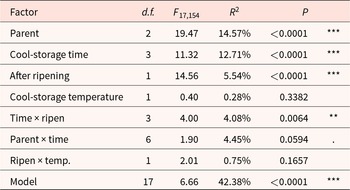
Germination timing depended significantly on cool-storage duration, after-ripening treatment, maternal plant identity and the duration × after-ripening interaction (Table 2; Fig. 2). Maternal plant identity explained the greatest proportion of variation in germination timing (14.6%) and significantly influenced germination timing, with mean germination time ranging from 5.5–5.9 d for two maternal sources to 10.9 ± 7.1 d for the third (Fig. 2D). Cool-storage duration explained a similar proportion of variation (12.7%) and strongly influenced the rate of germination, with mean time to germination declining from 11.0 ± 9.2 d after 14 d of cool storage to 4.8 ± 2.3 d after 180 d (Fig. 2A). Post hoc comparisons indicated progressively faster germination with increasing cool-storage duration, consistent with a monotonic decline in germination time across cool-storage intervals. After-ripening explained less variance (5.5%) but significantly affected germination timing, with seeds subjected to dry after-ripening germinating an average of 3.2 d earlier (6.35 ± 5.17 d) than seeds that did not receive after-ripening (9.51 ± 7.76 d; Fig. 2C).
Mean germination probability (%) of Physaria thamnophila seeds as a function of (A) cool-storage duration, (B) after-ripening treatment, (C) cool-storage temperature and (D) maternal plant identity. Points represent group means, and error bars represent bootstrapped 95% confidence intervals. Lower case letters indicate results of post hoc least-squares mean comparisons; values that share a letter are not significantly different. Statistical results are summarized in Table 1.

Figure 1 Long description
The image A showing a scatter plot with the vertical axis labeled Germination percent and the horizontal axis labeled Storage time (days). The vertical axis shows 40, 50, 60, 70, 80. The horizontal axis shows 50, 100, 150. Four points with vertical error bars are plotted at storage times near 28, 42, 90 and 180 days. Text above the points reads ab, a, ab and b. A single asterisk appears above the plot. The image B showing a scatter plot with the vertical axis labeled Germination percent and the horizontal axis labeled After ripening. The vertical axis shows 40, 50, 60, 70, 80. Two points with vertical error bars are plotted at no and yes. The point at no is near 45. The point at yes is near 75. Three asterisks appear above the plot. The image C showing a scatter plot with the vertical axis labeled Germination percent and the horizontal axis labeled Storage method. The vertical axis shows 40, 50, 60, 70, 80. Two points with vertical error bars are plotted at Freeze and Refrig. The point at Freeze is near 55. The point at Refrig is near 65. Text at the top left reads p equals 0.0931. The image D showing a scatter plot with the vertical axis labeled Germination percent and the horizontal axis labeled Parent. The vertical axis shows 40, 50, 60, 70, 80. The horizontal axis shows 1, 2, 3. Three points with vertical error bars are plotted at 1, 2 and 3. The point at 1 is near 62 with text b near it. The point at 2 is near 47 with text a near it. The point at 3 is near 70 with text b near it. Three asterisks appear above the plot.
Results of a permutation-based factorial ANOVA evaluating the effects of cool-storage duration, cool-storage temperature, after-ripening treatment, maternal plant identity and select interactions on germination timing (days to radicle emergence) of Physaria thamnophila; asterisks denote P-value thresholds: ***, P < 0.001; **, 0.01 < P ≤ 0.001; ., 0.1 < P ≤ 0.05

Table 2 Long description
The table reports a permutation-based factorial ANOVA testing which factors affect days to radicle emergence. Parent identity, cool-storage duration, and after-ripening each show strong effects with very small p-values and explain about 14.57 percent, 12.71 percent, and 5.54 percent of variance, respectively. Cool-storage temperature alone is not significant, with a small F value, p about 0.34, and only 0.28 percent variance explained. The interaction between cool-storage time and after-ripening is significant, explaining about 4.08 percent of variance, indicating the effect of time depends on whether seeds were after-ripened. The parent by time interaction is marginal, with p about 0.059 and about 4.45 percent variance explained. The after-ripening by temperature interaction is not significant, with p about 0.166 and about 0.75 percent variance explained. Overall, the full model is significant and accounts for about 42.38 percent of the variation in germination timing, but results reflect permutation testing and do not indicate the direction of effects.
Notes: Significance was assessed using permutation tests with F statistics calculated from marginal (Type III) sums of squares. Partial R 2 values indicate the proportion of variance explained by each term.
Short-term cool-storage temperature did not significantly affect germination timing (p = 0.41) and explained little variance (0.3%), with mean germination times differing by less than 0.4 d between refrigerated and frozen seeds (Fig. 2B). In contrast, a significant interaction between cool-storage duration and after-ripening treatment explained 4.1% of observed variance and indicated that the accelerating effect of after-ripening was strongest at shorter cool-storage durations and diminished as cool-storage duration increased (Fig. 2E). A marginal interaction between maternal plant identity and cool-storage duration was also detected (p = 0.087) and explained 4.5% of the variance, suggesting modest differences among maternal sources in how germination timing responded to cool-storage duration.
Discussion
Across treatments, dry after-ripening and increased cool-storage duration consistently promoted germination and shortened germination time in Physaria thamnophila, whereas cool-storage temperature had comparatively weak effects. Together, these results indicate that P. thamnophila seeds exhibit physiological dormancy, retain viability for at least 210 d under short-term cool-storage conditions and are likely tolerant of exposure to freezing temperatures. Physiological dormancy in P. thamnophila can be alleviated by 30 d of dry after-ripening at room temperature, although longer cool-storage durations appear to reduce the need for after-ripening. Collectively, these findings have important implications for both ecological understanding and conservation practice for this species.
Life history context of dormancy release
Field observations suggest that Physaria thamnophila is best understood as a rainfall-responsive, short-lived perennial or facultatively multigenerational species (USFWS, 2004, 2015, 2024; Fowler et al., Reference Fowler, Best, Price and Hempel2011; Middleton et al., Reference Middleton, Gonzalez, Lain, Trevino, Gabler, Garrett, Molano-Flores, Coons, de la Garza and Feria-arroyo2024). Plants may emerge from seed or resprout from belowground structures (caudices) following rainfall, and flowering and fruiting are most common when precipitation is sufficient and temperatures are not strongly limiting; (USFWS, 2015, 2024; Middleton et al., Reference Middleton, Gonzalez, Lain, Trevino, Gabler, Garrett, Molano-Flores, Coons, de la Garza and Feria-arroyo2024). Its seasonal germination pattern is reminiscent of a winter annual, but it is more appropriate to characterize its life history strategy as being responsive to episodic rainfall while possessing mechanisms to avoid germination during the very hot and dry summer characteristic of southern Texas (Fowler et al., Reference Fowler, Best, Price and Hempel2011; USFWS, 2015).
This life-history pattern is closely tied to seasonal rainfall and temperature regimes in the Lower Rio Grande Valley. Summers are typically hot and dry, with soil moisture often too limited to permit successful germination or seedling establishment even if dormancy has relaxed (USFWS, 2004; Fowler et al., Reference Fowler, Best, Price and Hempel2011). In contrast, rainfall is most likely to generate recruitment opportunities during cooler portions of the year, especially following peak rainfall in September and again during late spring rains (USFWS, 2015, 2024). Under favourable conditions, P. thamnophila plants can proceed from germination to initiation of reproduction in approximately 1 month and produce mature fruits roughly 1 month later (C.A.G. and J.T.G., unpublished data). Reproductive plants may also continue producing additional floral spikes and sequential flowers and fruits for several weeks if soil moisture remains sufficient (C.A.G. and J.T.G., unpublished data).
Mean germination time (days to radicle emergence) of Physaria thamnophila seeds as a function of (A) cool-storage duration, (B) after-ripening treatment, (C) cool-storage temperature, (D) maternal plant identity and (E) the cool-storage duration × after-ripening interaction. Points represent group means, and error bars represent bootstrapped 95% confidence intervals. Lower case letters indicate results of post hoc least-squares mean comparisons; values that share a letter are not significantly different. Statistical results are summarized in Table 2.

Figure 2 Long description
A) Vertical axis label: Germination time (days). Tick labels: 5, 10, 15, 20. Horizontal axis label: Storage time (days). Tick labels: 50, 100, 150. Four points with vertical error bars are plotted at storage times near 14, 30, 90 and 180 days. The point near 14 days is above 10 days and has the letter c. The point near 30 days is below 10 days and has the letter b. The point near 90 days is below 10 days and has the letter b. The point near 180 days is near 5 days and has the letter a. Three asterisks are shown. B) Vertical axis label: Germination time (days). Tick labels: 5, 10, 15, 20. Horizontal axis label: After ripening. Category labels: no, yes. Two points with vertical error bars are plotted. The point at no is near 10 days. The point at yes is between 5 and 10 days. Three asterisks are shown. C) Vertical axis label: Germination time (days). Tick labels: 5, 10, 15, 20. Horizontal axis label: Storage method. Category labels: Freeze, Refrig. Two points with vertical error bars are plotted. Both points are between 5 and 10 days. The text n.s. is shown. D) Vertical axis label: Germination time (days). Tick labels: 5, 10, 15, 20. Horizontal axis label: Parent. Category labels: 1, 2, 3. Three points with vertical error bars are plotted. Parent 1 is above 10 days and has the letter a. Parent 2 is near 5 days and has the letter b. Parent 3 is between 5 and 10 days and has the letter b. Three asterisks are shown. E) Two scatter plots labeled Control and After ripening. Each plot has the vertical axis label Germination time (days) with tick labels 5, 10, 15, 20 and the horizontal axis label Storage time (days) with tick labels 50, 100, 150. Each plot shows points with vertical error bars at storage times near 14, 30, 90 and 180 days. Control: the point near 14 days is above 10 days and has the letter b. The point near 30 days is near 10 days and has the letter c. The point near 90 days is between 5 and 10 days and has the letter b. The point near 180 days is between 5 and 10 days and has the letter ab. After ripening: the point near 14 days is between 5 and 10 days and has the letter b. The point near 30 days is between 5 and 10 days and has the letter b. The point near 90 days is between 5 and 10 days and has the letter ab. The point near 180 days is near 5 days and has the letter a. Three asterisks are shown. Across A and E, the plotted points move from higher germination time at shorter storage times toward lower germination time at the longest storage time. In B, the yes category is lower than the no category. In C, both storage methods plot in a similar range. In D, Parent 1 is higher than Parents 2 and 3. E presents the storage time series split into Control and After ripening, using the same storage time values as A.
These patterns create at least two major windows for recruitment and reproduction. Seeds present in the seed bank at the start of summer may undergo dormancy release during hot, dry post-dispersal conditions without experiencing enough moisture to germinate. When substantial rainfall occurs in early autumn, those seeds are then positioned to germinate rapidly, along with any established plants resprouting after summer drought (USFWS, 2015, 2024). Resulting plants may flower in October–November and produce mature fruits from November to December (USFWS, 2015, 2024; Middleton et al., Reference Middleton, Gonzalez, Lain, Trevino, Gabler, Garrett, Molano-Flores, Coons, de la Garza and Feria-arroyo2024). A second recruitment pulse typically occurs in spring, when episodic rainfall in February–April triggers plants to germinate, flower and produce seed in April–June before the onset of the hottest and driest portion of summer (USFWS, 2015; Middleton et al., Reference Middleton, Gonzalez, Lain, Trevino, Gabler, Garrett, Molano-Flores, Coons, de la Garza and Feria-arroyo2024).
Dry after-ripening may therefore help synchronize germination with favourable rainfall pulses while preventing immediate germination of newly matured seeds. Seeds produced in late spring or early summer are likely to encounter hot, dry conditions that promote after-ripening but usually lack sufficient soil moisture to trigger germination (Cruz et al., Reference Cruz, Romano and Dierig2012; Baskin and Baskin, Reference Baskin and Baskin2014). This delay is likely important because seedlings germinating in June or July would face intense drought stress and may be unlikely to reproduce or allocate enough resources belowground to persist until autumn (USFWS, 2004; Fowler et al., Reference Fowler, Best, Price and Hempel2011). Likewise, seeds produced in autumn may remain dormant through the relatively dry winter unless unusual winter rainfall creates a favourable establishment window. As a result, unlike most winter annuals, P. thamnophila may be able to complete two generations per year, and potentially three generations with adequate winter rainfall and without a winter freeze, which do not occur every year and are typically brief and light.
In this context, the dormancy pattern observed in our experiment appears consistent with the opportunities and constraints imposed by a semi-arid, subtropical environment with hot, dry summers; mild but often dry winters; and episodic rainfall concentrated most reliably in early autumn and late spring (Fowler et al., Reference Fowler, Best, Price and Hempel2011; USFWS, 2015, 2024). A relatively short dry after-ripening requirement may be long enough to prevent seeds from germinating immediately at the end of a reproductive rainfall pulse, but short enough to allow rapid response to later rainfall events during favourable portions of the year (Harper, Reference Harper1977; Venable, Reference Venable2007; Baskin and Baskin, Reference Baskin and Baskin2014). Thus, dormancy release in P. thamnophila is not simply a propagation issue, but a likely component of the species’ adaptation to temporally variable recruitment opportunities in its native habitat.
Dormancy release
The positive effects of dry after-ripening on germination probability and timing are consistent with physiological dormancy mechanisms described for many members of the Brassicaceae (Baskin and Baskin, Reference Baskin and Baskin2004, Reference Baskin and Baskin2014; Finch-Savage and Leubner-Metzger, Reference Finch-Savage and Leubner-Metzger2006). More broadly, dry after-ripening commonly promotes dormancy release in species from seasonal dry habitats, where delayed germination can help synchronize emergence with favourable moisture conditions (Probert, Reference Probert and Fenner2000; Cruz-Tejada et al., Reference Cruz-Tejada, Mattana, Rosbakh, Fernández-pascual and Carta2024). Seeds subjected to after-ripening exhibited substantially higher germination and emerged several days earlier than seeds planted directly from cool-storage, indicating that dormancy release continued under warm, dry conditions following initial cool-storage. These patterns suggest that dormancy in Physaria thamnophila is not static following seed maturation, but instead relaxes over relatively short timescales in response to post-dispersal conditions (Cruz et al., Reference Cruz, Romano and Dierig2012; Baskin and Baskin, Reference Baskin and Baskin2014).
Cool-storage duration exerted similarly strong effects, at least in the short term, even in the absence of after-ripening. Increased cool-storage time consistently increased germination and shortened germination time, indicating that dormancy release also occurred during cool storage. The significant interaction between cool-storage duration and after-ripening for germination timing further suggests that these processes are at least partially redundant, with extended cool storage diminishing the additional benefit of after-ripening. Together, these patterns imply that multiple dormancy-alleviating pathways may operate in P. thamnophila, potentially reflecting a flexible strategy for responding to post-dispersal environmental conditions (Baskin and Baskin, Reference Baskin and Baskin2014).
Such flexibility and dormancy itself are likely adaptive in the highly variable environments where P. thamnophila occurs, where rainfall is rare and the timing and magnitude of precipitation events are relatively unpredictable (USFWS, 2004; Sternberg, Reference Sternberg2005; Fowler et al., Reference Fowler, Best, Price and Hempel2011). Gradual dormancy release during cool storage, coupled with shortened germination time following dry after-ripening, may allow seeds to balance rapid recruitment under favourable conditions with delayed emergence when conditions are less suitable, while also avoiding germination of newly matured seeds at the tail end of a rainy period (Harper, Reference Harper1977; Venable, Reference Venable2007).
Maternal source effects and heterogeneity in germination responses
Maternal plant identity explained substantial variation in both germination likelihood and germination timing, indicating that early life-history traits in Physaria thamnophila varied among maternal seed sources. Seeds produced by one maternal plant consistently germinated less frequently and more slowly than seeds from the other two maternal sources, even when subjected to identical cool-storage and germination conditions. These source-specific differences could reflect multiple, non-mutually exclusive mechanisms, including fixed genetic differences among maternal lines, maternal environmental effects during seed development, developmentally induced plasticity, or differences in seed provisioning or dormancy state. Similar source effects in other systems have been linked to variation among mother plants, populations, collection years and local climatic conditions that influence dormancy state during seed development (Andersson and Milberg, Reference Andersson and Milberg1998; Donohue, Reference Donohue2009; Carta et al., Reference Carta, Probert, Puglia, Peruzzi and Bedini2016). We cannot distinguish among these mechanisms here because our study did not include genetic analyses or reciprocal maternal environments; therefore, we interpret maternal plant identity as a seed-source effect rather than attributing the observed variation solely to maternal effects. Nevertheless, these differences suggest that dormancy expression and germination responses in P. thamnophila are shaped, at least in part, by factors associated with maternal source rather than by storage environment alone.
Maternal-source variation in seed dormancy and germination is widely documented across plant taxa and has been reported among mother plants, populations and years of seed collection (Roach and Wulff, Reference Roach and Wulff1987; Andersson and Milberg, Reference Andersson and Milberg1998; Donohue, Reference Donohue2009). Such variation may arise from variation in maternal environment, resource provisioning or developmental conditions during seed maturation. In the present study, the persistence of maternal differences across cool-storage durations and treatments indicates that such effects may remain influential even after dormancy has begun to relax. Although the specific mechanisms underlying these differences were not evaluated here, the magnitude of maternal variation observed suggests that maternal identity is a nontrivial source of heterogeneity in germination outcomes for this species.
For endangered plants with limited population sizes, maternal effects may have particularly important implications for both experimental inference and applied propagation. When seed collections are necessarily small and drawn from relatively few maternal plants, variation among maternal sources can disproportionately influence estimates of germination success and timing (Guerrant et al., Reference Guerrant, Havens and Maunder2004, Reference Guerrant, Havens and Vitt2014). The strong effects of maternal source observed here highlight the importance of distributing collections across multiple maternal plants whenever possible and of explicitly accounting for maternal identity in germination studies and propagation efforts involving P. thamnophila.
Freezing tolerance during short-term cool storage
In contrast to after-ripening and cool-storage duration, cool-storage temperature had comparatively weak effects on germination outcomes in Physaria thamnophila. Seeds stored at freezer temperatures exhibited a marginal reduction in germination likelihood relative to refrigerated seeds, but the magnitude of this difference was small, and cool-storage temperature had no detectable effect on germination timing. These results indicate that P. thamnophila seeds tolerate short-term exposure to subzero temperatures without substantial loss of viability or delayed emergence.
This finding is notable given that P. thamnophila is endemic to a subtropical region where freezing temperatures are rare (USFWS, 2004; Fowler et al., Reference Fowler, Best, Price and Hempel2011). In the absence of empirical data, seeds from warm-climate species are often assumed to be sensitive to freezing, which can constrain storage decisions for rare plants (Walters et al., Reference Walters, Wheeler and Grotenhuis2005; Guerrant et al., Reference Guerrant, Havens and Vitt2014). Although the marginal reduction in germination likelihood observed here warrants caution, the absence of strong negative effects suggests that brief freezer storage does not pose a major risk to seed viability in this species.
From a conservation perspective, tolerance of short-term freezing has practical implications for seed handling and storage. Refrigeration and freezer storage are commonly used short-term seed-handling approaches for managing limited seed collections, yet guidance for endangered plants is often based on general recommendations rather than species-specific evidence (Maschinski and Albrecht, Reference Maschinski and Albrecht2017; Center for Plant Conservation, 2019). The results presented here support the use of freezer storage for P. thamnophila over short timescales and provide a basis for future work evaluating longer-term storage durations and lower temperatures, including those relevant to seed banking.
Implications for conservation and future research
Together, these results provide practical guidance for managing limited seed collections of Physaria thamnophila and underscore the value of species-specific seed biology data for endangered plant conservation (Guerrant et al., Reference Guerrant, Havens and Maunder2004; Center for Plant Conservation, 2019). Seed quality and germination outcomes can depend strongly on post-collection handling before seed banking, longer-term ex situ conservation or propagation (Probert et al., Reference Probert, Adams, Coneybeer, Crawford and Hay2007). In this case, short-term cool storage followed by dry after-ripening substantially improved both germination likelihood and speed, offering a straightforward approach for increasing propagation success without specialized treatments. At the same time, the strong effects of cool-storage duration indicate that dormancy release can occur during cool storage itself, highlighting the importance of considering time since collection when interpreting germination outcomes and planning propagation efforts. For recovery programmes that rely on small seed lots and rapid grow-out for population supplementation or reintroduction, these results indicate that short-term cool storage followed by dry after-ripening can improve propagation outcomes without requiring specialized equipment.
More broadly, this study illustrates how limited empirical knowledge of seed dormancy and storage responses can constrain recovery efforts for rare plants (Havens et al., Reference Havens, Vitt, Maunder, Guerrant and Dixon2006; Maschinski and Albrecht, Reference Maschinski and Albrecht2017). For P. thamnophila, even basic questions regarding short-term storage conditions, dormancy release and freezing tolerance had not been systematically evaluated prior to this work. By establishing baseline expectations for these processes, the present study provides a foundation for subsequent experiments examining longer-term storage, germination cues and the physiological mechanisms underlying dormancy release.
Finally, as recovery planning increasingly emphasizes proactive seed collection and ex situ conservation, empirical evaluations of storage and germination responses will be essential for translating collections into effective management tools (Guerrant et al., Reference Guerrant, Havens and Vitt2014; Center for Plant Conservation, 2019). The results presented here contribute to that effort by clarifying how short-term cool-storage conditions influence germination outcomes in P. thamnophila and by identifying priorities for future research needed to support propagation, restoration and long-term conservation of this species.
Supplementary material
The supplementary material for this article can be found at 10.1017/S0960258526100208.
Acknowledgements
The authors thank Drs. Brenda Molano-Flores and Janice Coons for their seed collection guidance and supervision and their general advice and expertise regarding the focal species. The authors thank the USFWS and their personnel at the Lower Rio Grande Valley National Wildlife Refuge for permitting and access to study sites, as well as the U.S. Customs and Border Protection and their personnel at the Lower Rio Grande Valley Sector for site access and security.
Author contributions
C.A.G.: conceptualization, data curation, formal analysis, funding acquisition, methodology, project administration, resources, supervision, visualization, writing – original draft, writing – review & editing. J.T.G.: conceptualization, data collection, data curation, investigation, methodology, supervision, writing – review & editing.
Funding statement
This research was supported by the United States Geological Survey (USGS) Wetland and Aquatic Research Center (C.A.G., grant number DOI-USGS G23AC00001-00).
Competing interests
The authors declare none.
Use of AI tools
The authors used ChatGPT 5.2 to review a complete draft of the manuscript and suggest changes to the text that would improve the clarity and economy of its language.
Data availability
The complete dataset used in this study has been made available through the USGS ScienceBase Catalog (https://www.sciencebase.gov/catalog/).




 Open access

